Santiago, day 1

Yesterday was my first day in Santiago, Chile, which means it was also my first day in South America. I’ve previously visited Asia, Africa, Australia, and Europe, so now all I need to do is contrive some way to get to Antarctica and I’ll be all set.

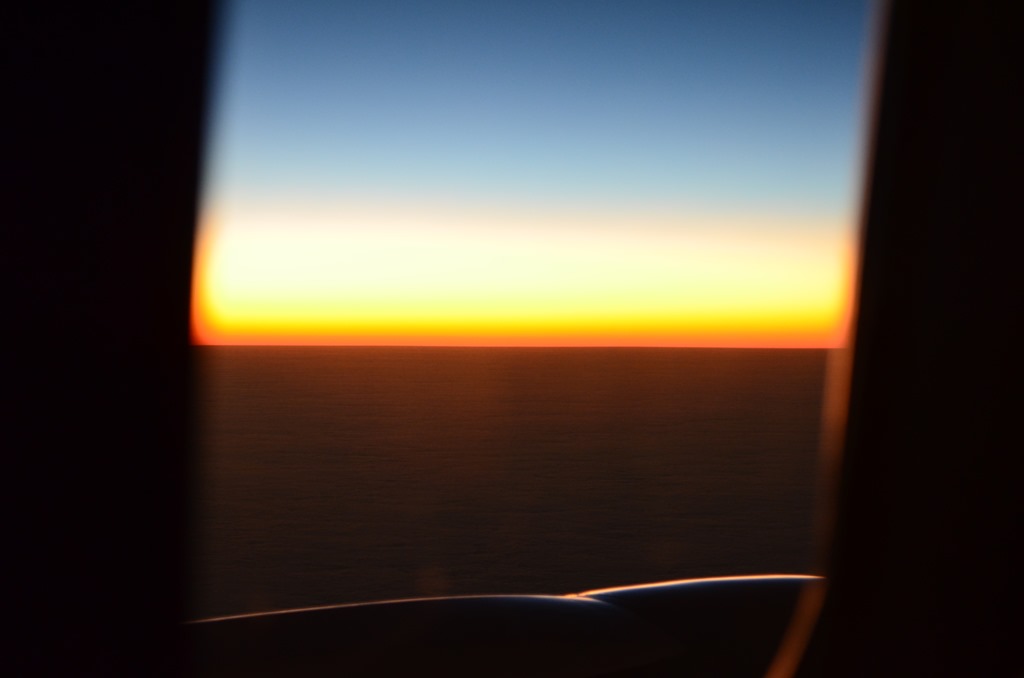
To get here, I flew on Delta’s flight from Atlanta, about which I can say that only that it was adequate. My Economy Comfort seat was decent, and I slept for a good six hours or so, waking up just in time to watch the sun rise over the Pacific.

DSC_1772

sunrise, before it got too bright to actually take pictures of

Upon arrival at Santiago’s airport, I found that Chile, like Brazil and Argentina, charge incoming visitors if those visitors are citizens of a country that charges Chileans an entry fee. For example, Chileans visiting the US must pay a $160 fee, so Americans visiting Chile have to pay the same fee. This is handled via separate set of stalls at customs: first you pay the fee and get your passport stamped, then you go through immigration, then you claim your luggage and go through a customs inspection. During this process, I learned that you are not permitted to import beef jerky (or other kinds of smoked meats) into Chile, which is too bad because I had packed a bunch of it for quick protein. Alas.

I’d already reserved a taxi through TaxiOficial.cl, as recommended by our travel department. After baggage claim, a quick stop by the payment desk netted me a receipt that I handed to the driver, who whisked me off to the Intercontinental in the business district. The hotel is well situated right near a major highway, a large mall, and, well, lots of businesses. I checked in, took a quick shower, unpacked, and set out to go exploring.

First, though, I rented a car. This was recommended by SantiagoTourist.com, a web site I found while at the hotel. (Oddly the hotel wifi seems to block Bing, but allows Google.) For about $60, I got a manual-transmission Chevy Spark, the smallest car I’ve ever driven. However, it proved to be adequate for my needs, since all I really needed was basic transportation. First I drove to the Bellavista area so I could go up Cerro de San Cristobal. (ed note: I’m typing this on a Windows machine that doesn’t make it easy to add accent marks, so I’m not adding them. Just pretend like they’re there.)  I parked in a public garage on Calle Pio Nono and walked about 8 blocks to the entrance of the park, from which you can take a funicular railway to the top, hike up a trail, or ride on a bike path. I elected for the funicular, which was a good call, as I got some excellent pictures on the way up. As you can see, it was a typically hazy/smoggy day, so the mountains were visible more as a suggestion of mountains than anything else.

DSC_1793

looking down onto the city from the railway

The funicular, which cost CLP$2600 (or around US$7)  stops halfway up so you can go to the zoo; I declined and went all the way to the top, whereupon I was able to climb up to the top of San Cristobal. There’s a chapel there, along with a large statue of the Virgin Mary, which you’ll see often in images of Santiago. However, from one angle I spotted something unusual—a ladder running all the way up the statue. I was sorely tempted to climb the scaffolding next to the statue and ascend this ladder, but since I didn’t think going to jail in Chile would be much fun, I decided not to.

After taking the funicular back down, I walked through part of the Barrio Bellavista area, more or less following the walking street-art tour that SantiagoTourist recommended. This turned out to be time well spent; some of the art was amazing, while some was just good, but there’s a lot of it. A few samples:

DSC_1776DSC_1781DSC_1785DSC_1814

A few of the many murals and street paintings in Bellavista

After Bellavista, I drove back to the hotel to plug in my gadgets for a few minutes and plan the rest of my day. (I made another stop en route, thanks to a suggestion from my friend Anne, but it’s classified until Christmas.) A quick glance at the map showed that I was close to Parque de las Esculturas, a large  open-air sculpture park and botanical garden, so I headed out to walk it and see what’s what. The park itself is right next to the Mapocho River, the level of which varies greatly according to how much snowmelt and/or rain is nearby. The park was full of people, mostly couples apparently looking for a place to smooch away from their parental units. Lots of stray dogs, too; that’s sort of a hallmark of Santiago (one night I saw three dogs in the middle of a six-lane road chasing each car as it passed; miraculously none of them got hit.) None of the sculptures especially resonated with me, but the park also has little islands of trees, most native to Chile and/or Argentina, and it was neat to see the differences in the native flora and the kinds of trees I’m used to. As an example, here’s a picture of an ombu treefrom the park.

ombu-tree

I’d never heard of an ombu tree before

After the park, I walked back towards the hotel, stopping at the enormous Costanera Center mall. It’s basically just like an American mall: it has a Dunkin Donuts, an Applebee’s, and a ton of other US-centric shops. That made me want to leave, since ordinarily I avoid malls like the plague. It was moderately crowded, so I could people-watch, and I was hungry, so I decided to stay. Luckily there were some local restaurants; the top-floor food court has a very nice assortment of sitdown restaurants, American fast food, Chilean fast food, and snack shops. I decided to sit down and have a steak… but took the waiter’s advice and ordered without looking at the menu, a mistake that ended up costing me $87 for what was, admittedly, an excellent steak, a platter of jamon and mozzarella, and a pisco sour. Still, I was surprised; Santiago is pricier than I’d anticipated. Apart from that, there was nothing remarkable about the mall except for its size; it has five huge floors with several hundred stores; if I don’t go back that will be fine with me.

By that point I was pretty tired, so I headed back to the hotel, read a bit, and went to bed. What I should have been doing was planning my trip to Valparaiso for the next day, but hey.

Leave a comment

Filed under General Stuff, Travel

Fitness update: two months in

So far I’m just over halfway through the four-month group fitness program I signed up for on Fitocracy: I’m doing the program with John Romaniello, but there are others with different focuses.

tl;dr: I am super pleased with the results. I’ve lost 8 pounds, which is no big deal; I wasn’t doing this to lose weight per se. I have also greatly improved my strength; my bench press went from around 100 to a max of 165 (so far). My deadlift max is 245, and I have squatted 235 (and am working on going higher). My goal is to break a 200 bench, 300 deadlift, and 300 squat by the end of the year. Just as importantly, I look better. I’ve lost quite a bit of body fat (more on that in a minute) and my muscles are bigger. Most importantly of all, I feel better. My balance and posture have improved, I am more mentally alert, and I am less stressed.

How’d I do it? There’s no magic, just picking up heavy things and putting them back down. Oh, and eating better. The big deal for me has been cutting down the amount of carbs that I eat. I used to eat a lot of carbs, which contributed to a high fasting glucose level. How high? Well, last year in California it was 99 mg/dl, which is 1 point away from the checkbox labeled “prediabetic.” This year, before I started exercising, it was down to 92. I am eager to see what it looks like now that my carb intake has gone down. How much has it gone down? On rest days, I get 63 grams of carbs. A single piece of Costco pizza has 66 carbs (as does a 20-ounce bottle of Dr Pepper). Since I absolutely adore bread, pasta, and desserts this has been a bit of an adjustment, but because I am eating plenty of fats and protein, I rarely feel hungry or deprived.

My goal is to hit certain targets for protein, fats, and carbohydrate intake each day. These are known colloquially as macros, or macronutrients. There are many different philosophies on what you should eat, when, and how much. For me, at least, counting my macros and eating whatever I want as long as it falls in those numbers (often called “if it fits your macros”, or IIFYM) has worked well. That basically gives me the freedom, much like Weight Watchers, to skip or combine meals in order to squeeze in an occasional treat. This excellent beginner’s guide to macros by Mike Vacanti, one of my coaches, has a lot more detail if you’re interested.

I’ve also changed my eating habits in another way: I follow the “leangains” method of intermittent fasting. It’s simple: I eat all my calories within an 8-hour window (sometimes stretched to 9 or 10 hours depending on what’s going on that day). If I eat “breakfast” at noon, that means I can eat until 8pm, but ideally nothing after that. This process helps tailor your body’s production of insulin, leptin, and other hormones to maximize fat burning and muscle gain. It sounds foolish, but you know what? It works. Basically, I skip breakfast, eat my first meal around noon, snack in the afternoon, and eat a normal dinner. This is not hugely different from my past life, except i no longer chow down on huge bowls of sugary Raisin Bran first thing in the morning. John Romaniello, my other coach, has a great summary of IF principles for beginners; purists may quibble with some of his broad definitions but the basic message is spot on.

What about cardio? I’m essentially not doing anything apart from the weightlifting, which is certainly doing a great job of elevating my heart rate. I guess I should say I’m not doing any endurance work. I’d like to, but on days when I lift I’m too tired, and on days when I don’t I’m resting from the lifting. As a data point, I ran a 5K with Julie and came in within about a minute of my last several races’ average, all without any running. For longer distances, clearly I’d need to get more running in too, and if I want to hit my goal of doing at least one sprint triathlon in 2014 I’ll need to start swimming.

Doing the right exercises (such as barbell squats, the bench press, deadlifts, and a few others) will activate a bunch of your muscles more or less at once. You can do isolation exercises to target specific muscles, but the basic large-muscle-group lifts will take you a long way. (And you won’t run out of options– take a look at a site such as ExRx.net to see what I mean.)

A few tips I’ve picked up, some of which may be more useful than others:

  • You can do an awful lot with protein powder, including making some pretty good cheesecake and really good shakes. As with most other foods, your experience will vary; some kinds of powder taste better to some people than others. For example, I really like BioTrust’s chocolate but their vanilla is only OK. I’ve had other people rave about how good it is though. I normally have a shake each day, with added fruit, milk, almond milk, or other ingredients depending on what macros I need to hit.
  • Beef jerky, nuts, and protein bars are essential for travel because there’s basically nothing in an airport or airplane that is nutritionally acceptable.
  • Greek yogurt: basically pure protein. Add a little to your shake to keep the powder from foaming in the blender (super important if you use the inexpensive and tasty, but foamy, Optimum Nutrition brand that Costco sells.)
  • When you’re doing pull-ups or chin-ups, squeeze your shoulder blades together like you’re trying to trap a tennis ball between them. Makes a huge difference.
  • Learn to distinguish between soreness and pain. (Hint: pain hurts more). It’s perfectly OK to exercise when sore; when in pain, not so much.
  • Different people prefer different exercise programs. Some will swear by high-rep sets with relatively low weight, while others insist that only high-weight, low-rep sets are worth a hoot. I am a big believer in experimenting until you find what works… but lift something, whether high or low reps.
  • If you’re deadlifting properly, the bar will scrape your shins. This will hurt and may draw blood. So buy some deadlift socks. Problem solved.
  • No, weightlifting will not make you too bulky if you’re a woman. Really. Trust me on this.

Although I’m pleased with my results, this is not to say that everything has been perfect. I still have some weak areas. The biggest is that my upper body isn’t as strong as my lower body: I have huge strong quads, fairly strong hams and flutes, and not-as-strong-as-I-would-like calves, but my chest, shoulders, and arms are proportionately weaker. The way to fix this: pick up heavy things and put them back down.

Like every other human, I also have some asymmetry between my left and right sides: my right side is quite a bit stronger. This is improving with time but it’s still a little frustrating because sometimes it limits how much weight I can move. My grip is weaker than I’d like, too, but that’s also coming along.

On the nutrition front, as my homeboy Tim says, food prep is super important to effective nutrition. It is much easier to make out a menu, so that you know what macros you’re going to be getting, and then eat the same thing every day. For example, my normal lunch is two Butterball turkey burgers on the stove. I am not good at this planning, which sometimes results in me eating either too much or not enough for the day’s planned macros. I am getting better at making out the menu in advance, but not at doing bulk-food preparation. That will come with time.

In summary: weightlifting is awesome. I wish I’d started sooner but I will definitely keep doing it. And a big shout out to Brian Hill, whose amazing transformation I’ve mentioned here before. I picked up a lot of random factoids from talking to him that are just now starting to make sense as I become more knowledgable. His discipline, example, and results have been a big motivator for me.

1 Comment

Filed under Fitness, Friends & Family, General Stuff

Thursday trivia #100

Boy, it’s taken me a long time to knock out 100 of these updates.

  • I’ve proposed 3 sessions for MEC 2014 and one for the Lync Conference. Let’s see which ones make it into the goal. Worst case is either 0 or all 4: in one case I have to pay for my own conference attendance, and in the other I’ll be so busy speaking I won’t get to really enjoy the shows.
  • I haven’t been flying much lately, but I aim to remedy that shortly. Every time I have a spell where I don’t have time to fly I am reminded of why people don’t buy their own airplanes. They cost you money whether you have time to fly them or not.
  • Fitness progress continues. I have an upcoming post on that in the queue.
  • This story (which has been mislabeled as “hacking”) is a great example of why optional mobile device management (MDM) isn’t worth a hoot: if you want to manage your organization’s mobile devices, users cannot be allowed to opt out. The LA Unified School District tried to go cheap and not spend money on a “real” MDM solution, and they paid for it.
  • Deb Fallows, wife of the estimable James Fallows and a noted author in her own right, has a great set of articles exploring aviation lingo (not surprising, given that she’s a linguist). Here’s one excellent example.
  • I’ve enjoyed using iTunes Radio, but the current version of iTunes for iOS is super buggy. I hope they fix it soon.
  • Apropos of music: the GDR2 + Amber update for my Nokia Lumia 920 has introduced Bluetooth stuttering and problems displaying song/artist data on my car stereo. GDR1 worked flawlessly. GDR3 claims to introduce a bunch of BT fixes, so I hope these problems disappear too, along with the iTunes 11.1.1 bugs.
  • PhotoReviewer sounds like exactly what I want: a tool to quickly triage large numbers of photos and decide which to keep and which to get rid of. I can’t tell from this review whether it works on existing iPhoto libraries or only on pictures you haven’t imported yet, but I’m going to try it.

Leave a comment

Filed under General Stuff, Musings

2-factor Lync authentication and missing Exchange features

Two-factor authentication (or just 2FA) is increasingly important as a means of controlling access to a variety of systems. I’m delighted that SMS-based authentication  (which I wrote about in 2008), has become a de facto standard for many banks and online services. Microsoft bought PhoneFactor and offers its SMS-based system as part of multi-factor authentication for Azure, which makes it even easier to deploy 2FA in your own applications.

Customers have been demanding 2FA for Lync, Exchange, and other on-premises applications for a while now. Exchange supports the use of smart cards for authentication with Outlook Anywhere and OWA, and various third parties such as RSA have shipped authentication solutions that support other authentication factors, such as one-time codes or tokens. Lync, however, has been a little later to the party. With the July 2013 release of Lync Server 2013 CU2, Lync supports the use of smart cards (whether physical or virtual) as an authentication mechanism. Recently I became aware that there are some Lync features that aren’t available when the client authenticates with a smart card– that’s because the client authenticates to two different endpoints. It authenticates to Lync using two-factor authentication, but the Lync client can’t currently authenticate to Exchange using the same smart card, so services based on access through Exchange Web Services (EWS) won’t work. The docs say that this is “by design,” which I hope means “we didn’t have time to get to it yet.”

The result of this limitation means that Lync 2013 clients using 2FA cannot use several features, including

  • the Unified Contact Store. You’ll need to use Invoke-CsUcsRollback to disable Lync 2FA users’ UCS access if you’ve enabled it.
  • the ability to automatically set presence based on the user’s calendar state, i.e. the Lync client will no longer set your presence to “out of office”, “in a meeting,” etc. based on what’s on your calendar. Presence that indicates call states such as “in a conference call” still works.
  • integration with the Exchange-based Conversation History folder. If you’ve configured the use of Exchange 2013 as an archive for Lync on the server side, that still works.
  • Access to high-definition user photos
  • The ability to see and access Exchange UM voicemail messages from the Lync client

These limitations weren’t fixed in CU3, but I am hopeful that a not-too-distant future version of the client will enable full 2FA use. In the meantime, if you’re planning on using 2FA, keep these limitations in mind.

1 Comment

Filed under General Tech Stuff, UC&C

Need Windows licensing help? Better call Paul

No, I’m not giving it. That would be like me giving advice on how to do a pencil drawing, or what wine goes with In-N-Out Burger.

A year or so ago, I had a very complex Windows licensing questions that Microsoft was unable to answer. More to the point, no two Microsoft people were able to give me the same answer. I did a little digging and found Paul DeGroot of Pica Communications, author of the only book on Microsoft licensing that I know of. Paul quickly and clearly answered my question, and a couple of rounds of follow-up questions after that. Armed with his information, I was able to solve the particular problem I was having in a less expensive, less painful way than just buying all the licenses. As I was cleaning out my inbox, I found our discussion and remembered, guiltily, that I meant to mention Paul’s services earlier. Under the banner “better late than never” consider this a belated, and strong, recommendation.

Leave a comment

Filed under General Tech Stuff, UC&C

First real instrument lesson

I took the boys down to Tuscaloosa last weekend to visit David. The weather was fine, and we had a lovely visit, but it ran a bit long, and then I couldn’t get the plane started. It’s finicky, but it was my fault, not the plane’s. Then I wouldn’t have been able to get back to Redstone before dark, and I’m not night current, so we ended up leaving the plane and driving home (a process made much harder by the fact that it’s impossible to rent a rental car after 6pm in Tuscaloosa on a Sunday). The next day I needed to go back down to pick up the airplane, so I called my instructor to see if he wanted to fly me down there. The flight turned into an instrument training lesson, which was exactly what I was hoping for.

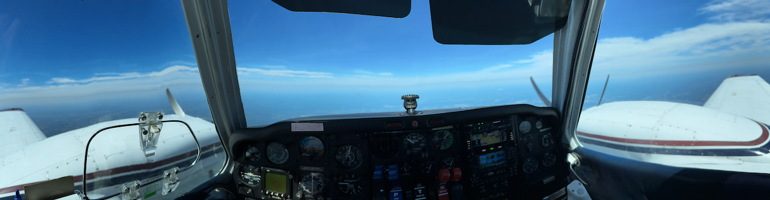
Weather at Redstone on departure was fair: ceilings were about 3500’ with visibility of 4 miles. It started raining just as I was finishing the preflight. John had filed an IFR flight plan direct to Tuscaloosa at 5000’, which turned out to be ideal for getting me some actual instrument time, including flying through rain. This turned out to be a nonissue because when you’re only using your cockpit instruments for navigation, not being able to see because of rain doesn’t pose a probem.

I say “actual” because you can log both simulated instrument time (in which you wear a view-limiting device such as this) or actual time. “Actual” in this context means you’re flying completely on instruments, without visual reference to the ground. In our case, that meant we were flying through a layer of clouds for a total of nearly 50 minutes. That meant that I had to control the airplane’s altitude, attitude, and course using only the instruments in the cockpit. All pilots are required to receive training on this, and to demonstrate proficiency in doing it, as part of the initial training process, but doing it in actual is quite a different matter. It’s very demanding work; you have to keep a consistent scan pattern on your instruments to make sure you’re holding course and altitude.

One key difference is that the best way to do this is to use predetermined engine settings: at a certain RPM and manifold pressure at a given altitude, you can predict how fast the plane will go and to make it climb or descend at a predictable rate, you know how much power to add or remove. Flying on an instrument flight plan often involves reaching very specific altitudes at specific points in space, i.e. you may be told to cross a fix at a given altitude, and you need to figure out how to make that happen.

I did reasonably well; I didn’t have any trouble maintaining my altitude, and my heading control was generally good except for a couple of minor excursions when I got over-focused on altitude or airspeed. You really have to divide your attention between all of the instruments to maintain a consistent flight path, and that’s very much a learned (and perishable) skill.

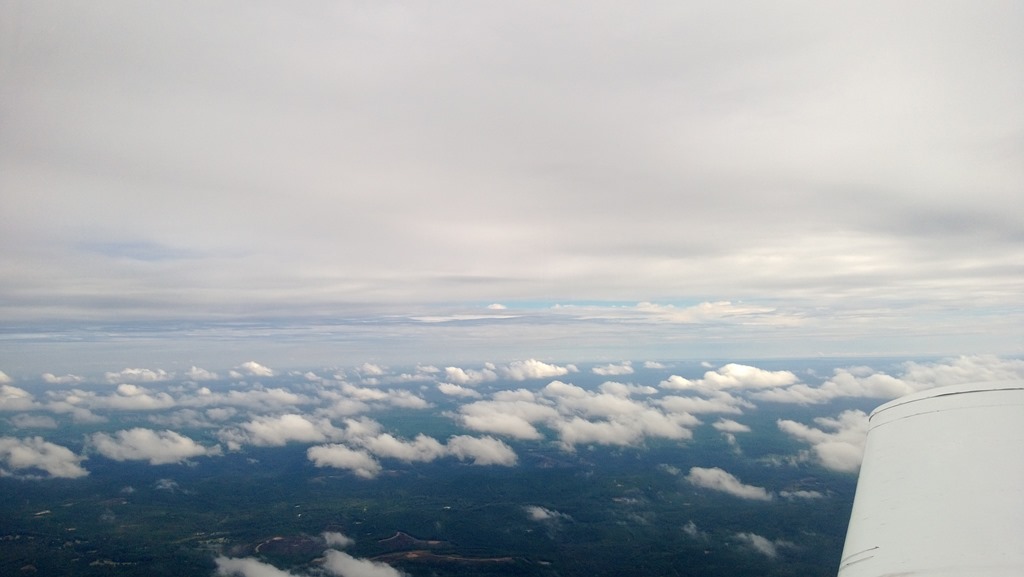
We made it safely to Tuscaloosa, landed, and I got the Arrow started. I took off first, flying VFR back to Huntsville at 3500’. In the Arrow, I was averaging about 145kts groundspeed on the return, and the flight, which took place between a high layer of solid overcast and a lower layer of broken clouds, was quite nice.

WP_20130930_004


between the layers en route TCL-HSV

After a smooth and uneventful flight, and a decent landing, I logged 0.2 simulated instrument, 0.8 actual, 0.2 VFR for the leg down, plus another 1.0 for the return VFR flight. I’m looking forward to more instrument time… make mine actual!

Leave a comment

Filed under aviation

Off to Exchange Connections 2013!

Off to Las Vegas I go! I am en route to Exchange Connections 2013, where I’ll be presenting 3 sessions: one on Exchange ActiveSync with the folks from BoxTone, one on Exchange 2013 and Lync 2013 integration, and one on Exchange 2013 unified messaging. I also plan to have breakfast, lunch, dinner, coffee, beer, snacks, or cuddles (well, OK, probably not cuddles) with as many members of the Exchange product group, MVP community, and world at large as possible. If you’re there, by all means please come by and say hello! (and if you want to go lift weights together, even better!)

Sadly, my book won’t be on sale there because it is still being printed. However, I’ll be giving away a copy or two in each of my sessions, so if you’re feeling lucky, come on by.

In related news, registration opened for the 2014 edition of the Microsoft Exchange Conference, or MEC. I am ridiculously excited about the return of the return of MEC, and not just because it’s in Austin and I might finally get to meet some of my Dell coworkers. The product group has been sharing a bit of what they’ve got planned with the MVPs and I can say, with conviction, that it will be just as good, if not better than, MEC 2012.

But back to now. Somewhat unusually, I am flying United, connecting through Houston both ways. Normally I wouldn’t, but scheduling dictated it and with luck I’ll be in Houston long enough to have some of my favorites (plus: Channel 9!)  Then it’s a ridiculously short return to Huntsville– basically, long enough to change suitcases and grab my running shoes– before I head to Vermont to run the Leaf Peepers 5K with my lovely sister (note: subscribe to her blog; you’ll be glad you did), thence to Hoboken to meet with customers.

See you at the show!

1 Comment

Filed under Travel, UC&C

Odd iOS 7.0x Exchange ActiveSync problem

from the oops-they-may-have-done-it-again department…

I just got an e-mail from a former coworker reporting a problem with synchronizing some, but not all, iOS 7.0.x devices with Exchange 2010 SP2. There are four users (Alex, Eric, James, and Peter, let’s say) with shiny new iPhone 5s devices. Two of them get the same error when syncing: the Provision verb is returning a status of 110 and throwing an exception from Microsoft.Exchange.Security.Compliance.MessageDigestForNonCryptographicPurposes.HashCore. This seems to point to a problem with crypto negotiation with the devices, but I haven’t been able to look at a trace of the conversation between the device and the server to check.

James’ device works fine. Alex’s device works fine. Peter’s device does not work, either with his own account or Alex’s. Eric’s device does not work with his account; no other accounts have been tested. This seems to indicate that the problem is not (necessarily) with the account. Peter and Eric have both wiped their devices, deleted their Exchange accounts, rebooted the devices, and done all the other stuff you might try when faced with this problem, but to no avail.

This Apple support forum thread seems to indicate that a few others who have the same problem, but none of the recommended fixes have worked for Alex or Peter. My working theory is that this is due to an unwanted interaction of some kind between Exchange 2010 SP2 and iOS 7.x, but I can’t prove that yet. As far as I can tell, Exchange 2013 CU2 doesn’t have the same problem.

I’m posting this in hope that it might come to the attention of anyone else who’s having a similar problem so I can get a sense of its scope and nature.

More news when there is news…

7 Comments

Filed under UC&C

Thursday trivia #99

  • I’ve gotten to know Tim Bauer through the group fitness program we’re both in. What an inspiring guy: sample 1 and sample 2. Check out his blog.
  • Mike Vacanti is one of my coaches. This blog post on feeling insecure about your own fitness compared to others was very thought-provoking for me. It applies much more broadly than just fitness, too.
  • Speaking of fitness: you’d be amazed at all the stuff you can make with protein powder. There are so many flavors and varieties! I like the Optimum Nutrition stuff that Costco sells because Costco, but I’m always interested in trying new kinds. BioTrust is pretty good, but it’s expensive and they spam their customers. GNC’s stuff is edible but not great (at least the vanilla and cookies & cream flavors; haven’t tried any others).
  • Amazon’s new “Mayday” customer-support feature has the potential to be a huge game changer. It will be very interesting to see whether they can scale it and provide good quality service. (If you haven’t seen it, it’s like OnStar, but for your tablet.) 
  • I’m always interested in a good invasive-species story, like the one about the testicle-eating fish spotted in New Jersey. However, of more local interest, the plague of little white bugs we’ve been having here in Huntsville is actually the result of the Asian hackberry woolly aphid, an invasive species that was first spotted in Georgia in 1996 (no one’s sure exactly how it got there, it turns out) and has made its way north– and west, having been spotted in Texas. (It’s also in California but it’s not clear if it was imported from Asia to California or somehow made it from Texas westward).
  • I’ve mentioned the use of precision robotics for filming high-speed stuff before, but this video takes the cake. Projection mapping has huge potential for theatrical applications… and just think of what Disney could do with it if they wanted.
  • Like Bo, I have not had good experience refilling printer cartridges. The first time I tried it, everything went well, but it wasn’t my printer. The second time, it was, and I never could get the printer to recognize that the refilled cartridge was usable. When a refill kit costs $6 and an off-brand cartridge costs $13, you know what? I’ll pay $7 to not have to deal with toner backsplash and fiddling with the stupid flag gear.

1 Comment

Filed under Friends & Family, General Stuff, Musings

My new favorite word: “unable”

Sometimes one word can speak volumes. This is especially true when there’s a well-defined and mutually understood vocabulary that all parties in a conversation are using– which is exactly what happens when you talk on the radio with an air traffic controller. Although it often sounds bizarre to outsiders, the back-and-forth between pilot and controller can be incredibly information-rich. The FAA has a standard glossary that pilots and controllers are supposed to use, and you can’t go far wrong by sticking with it. Many of the terms in the glossary compress a great deal of meaning into a few syllables, which is important when you’re busy– which, as either a pilot or controller, you will be!

For example, the controller at a busy training airport such as Palo Alto (which usually has between 500-700 takeoffs/landings per day, a lot for a small airport with a 2500′ runway) could say “One Tango Golf, there’s a 172 on final. If you go right now, then you can take off on runway 31”, or he can say “One Tango Golf, landing traffic, expedite, cleared for take off, 31”. Now consider the workload of a pilot flying into an airport like Atlanta or Dallas, or a controller in the tower cab at Chicago-O’Hare or Newark, and you see why brevity is so important.

My favorite of all these expressions is simple: “unable”. The glossary defines it thus:

Indicates inability to comply with a specific instruction, request, or clearance.

Depending on how you use it, it can mean “I won’t do that” or “I can’t do that.” Rather than provide a long explanation, all you have to say is “unable.” Suppose I’ve filed a route from point A to point B and the controller wants to have me deviate to point C, and I happen to be low on fuel? “Unable.” Want me to turn towards an area of built-up clouds? “Unable.” Because the pilot in command has ultimate responsibility for the safety of flight, as PIC you have unlimited authority to accept, or reject, controller requests or instructions– with the very significant caveat that you may be required to account for doing so. If the controller tells me to sidestep to a parallel runway on approach, and I don’t, and I cause an accident, having said “unable” isn’t going to get me out of trouble.

The magic word works both ways, of course: when you ask a controller for something (“Niner Eight Mike, request lower” to get a lower altitude, for example) the controller can merely say “Unable” and that’s it. Of course, whoever receives the U-word can always ask for something different, or explain why they want whatever it is.

Now I just need to brief the people I talk to most frequently so they know what the word means to. “Dad, can you take me to the mall?” “Unable.”

Leave a comment

Filed under aviation

Thursday trivia #98

  • I took part of a day this week to open a business bank account, get Alabama license plates, and get my concealed carry pistol permit. Surprisingly, the trip to the credit union took the most time by far. The DMV and sheriff’s office were both quick and the people there could not have been more pleasant. Now it’s a race to see whether my driver’s license or my license plate arrive first.
  • In possibly-related news, I am excited that Last Resort Guns is about to open their new range… at the end of my street. (Well, across a 4-lane road, but still!) I bought a membership, so a couple of days a week I’ll probably eat a sandwich as I walk to the range, get some practice in, and then walk home again. Sounds like a great lunch hour.
  • Got my complex endorsement and checkout in the Piper Arrow this past week. Sadly, of the club’s two Arrows, one is grounded and the other has a broken autopilot, so I’ll probably stick with the 182 for my long trips until that’s fixed… or until I get checked out in the 182RG, which is next on my list.
  • I also shot my first practice ILS approach under the hood. Wow. Lots to learn. I blew right through the glideslope because I was busy managing power and tracking my heading. Can’t do that.
  • Monday marked the start of my fifth week of my coached fitness program, and brought with it a completely new set of workout routines. Ouch. However, over the past month I have gotten much stronger; my bench, deadlift, and squats have all improved and I am starting to see some actual hypertrophy in my upper body, so that’s all good.
  • Heading to Perrysburg again this weekend to run the Rotary River Run 5K. Since I haven’t run a race since Memorial Day, and haven’t been running much, I am not looking for great results.
  • I just noticed that Exchange 2013 Unleashed (which I haven’t read, and which I hope is better than the 2010 version) is available from Amazon as a rental book. Ouch.

Leave a comment

Filed under Friends & Family, General Stuff, Musings

New header picture: Alpine, TX

It was time for a new header; my old one was from a 2010 trip to Alaska I took with the boys. This one is a roadside shot from Texas Highway 118 outside Alpine, Texas. I shot it with the camera on my Nokia 920, and it hasn’t been retouched or processed in any way. What you see is what I saw looking at it– an amazing picture from an amazing trip. I should’ve shot a panorama, though; maybe next time.

2 Comments

Filed under General Stuff

Keeping up: Office 365 OnRamp changes

Microsoft Exchange Server 2013 Inside Out: Clients, Connectivity, and UM (colloquially known as “the book”) is now in production! I’ve reviewed all the page proofs, corrected the few composition and layout mistakes I found, and returned the proofs to the editorial staff so they can turn PDFs into paper. It’s pretty exciting, although thanks to my tardiness the book won’t be ready in time to be sold at Exchange Connections (about which, more tomorrow.) However, I’ve been assured that Tony’s book on Mailbox and HA will be available there.

About a month ago, I wrote this in the Office 365 chapter:

One of the difficulties inherent in writing about cloud services is that they can change rapidly and often. The screen shots of Office 365 in this chapter reflect its appearance and function as of late 2013, but it’s likely that some of the underlying Office 365 code will change, so don’t be surprised if what you see on screen doesn’t exactly match what you read here.

As if to reinforce that point, today Microsoft has changed the OnRamp tool that you use to assess your organizational readiness for Office 365. The readiness review portion of the tool seems to have disappeared, leaving the checklist portion (which is similar in intent to the Exchange Deployment Assistant, another topic covered in the chapter). I haven’t found where the readiness review went, but I’m fairly sure it still exists somewhere in the maze of Office 365 tools.

The moral of this story? Although Microsoft likes to mock Google’s habit of suddenly introducing changes to end users without warning, they are starting to develop the same habit, except it mostly affects administrators. I hope this particular change was just a slip and not a harbinger of the way toolset changes will be handled in the future. (The secondary moral: man, it’s going to be a challenge to keep up with Office 365 updates in anything I write in the future!)

Leave a comment

Filed under UC&C

Speed, time, and cost

Recently I had the opportunity to fly down to Louisiana to see my mom, grandmother, and uncles. This was an easy trip: straight-line, it’s 411 miles from airport to airport. It took me 3:12 to get down there and 3:00 to get back. Why the difference? In a word, wind. In the northern hemisphere (and, more particularly, in the US, since that’s where I’m flying), prevailing winds tend to follow predictable patterns: west-to-east for much of the country, and (in general) onshore in coastal areas. The strength and direction of winds aloft vary, of course. For example, the definition of a frontal boundary (the line demarcating where a cold or warm front actually starts or ends) is an area where the wind suddenly changes direction and speed. It’s generally true that you’ll face headwinds when flying from east to west and tailwinds when flying from west to east, but the strength and direction of the winds can change quite a bit as you move across different types of terrain, through different weather systems, and so on.


PaulR  Dell 20130901 004

astute readers can figure out exactly where I was when this picture was taken

In the picture above, the “GS” number in the lower right shows that I had a groundspeed of 148 knots. Since one knot is 1.14 statute miles/hour, that’s just over 170mph. That seems pretty good, considering that it’s more than double the speed limit on any of the roads that link Huntsville and Alexandria (and triple, or more, the speed limit for the West Monroe-Alexandria leg). The 128kts average groundspeed I had going westbound still equates to 147mph. Although a 20-knot difference is nothing to sneeze at, the practical impact is that it saved me… exactly 12 minutes, mostly because the winds kept changing.

That brings up the question of fuel usage. Every powered airplane has a set of performance charts that show you, for a given altitude and power setting, how fast you can go in still air (and remember, airspeed isn’t the same as groundspeed; that’s a topic for another post) and how much fuel you’ll burn while doing so. Book fuel burn for the Cessna 182P is between 12 and 14 gallons per hour, depending on your altitude and power setting. Most rental aircraft are rented “wet”; that is, the hourly rental rate includes gas and oil. In a rental, you therefore have an incentive to configure the engine for best speed even if you burn a couple more gph. When it’s your airplane (or when it’s a “dry” rental) you’re paying for the fuel, so you get to choose: would you rather burn more gph or get there a little later?

The correct answer is “it depends.” Aviation gasoline costs anywhere from $5 to $7/gallon in the US. (Why so much? Why the variance? Those are topics for another post too.) Suppose I can cruise at 130kts for 12gph, or 150kts for 15gph. That extra speed is going to cost me, let’s say, $18/hour. For a 411nm trip, that means I can get there in about 3 hours 9 minutes for just under 38 gallons (so, call it $228). On the other hand, at 150kts I could get there in only 2 hours 44 minutes, but it would cost me 41 gallons of fuel, or $246. In my case, since I was renting a plane, I went pedal to the metal, adjusting the engine for max speed rather than best fuel efficiency.

Now, this is an oversimplification, of course. It ignores the time spent climbing and descending (you burn more fuel in the climb, and less in a descent, but not enough to equal what you burned climbing), it assumes that ATC doesn’t reroute you anyplace inconvenient, and so on; it’s a good enough estimate for our purposes.

Let’s compare, now, the cost/mile of flying versus driving. I drive a 2005 Nissan Altima that gets 30mpg on the highway. Bing Maps says the fastest road route is 514 statute miles. So, that’ll cost me about $60 in gas, as opposed to $384 for the airplane rental. I’m leaving out all the other fixed and variable costs of the car; if I wanted this to be more precise I’d compare the cost of driving a rental car from here to there, but who would do that if they didn’t have to? Anyway, flying is considerably more expensive until you figure the time savings. Bing calls this an 8-hour trip, assuming no stops for fuel, food, or bathroom breaks. I can make it in a hair over 3 in the plane, though I have to take my own food. As with the car, that price stays the same whether I fly solo or with passengers (or cargo, such as the excellent banana pudding I brought back– thanks, Mom!)

Clearly I could come up with a business rationale that values my time at what Dell bills customers for it, or what I bill for it on standalone projects, but the right way to think about it, I think, is that the time I gain is priceless: being able to get to see family and friends, or attend important events, or just get out of town for a trip, is important, and the airplane gives me the flexibility to go farther, faster, more often than I could in a car, for considerably less money (usually) than it would take to fly commercial.

For another time: does it make sense to spend more money to rent or buy a faster airplane? It depends.

Leave a comment

Filed under aviation

Thursday trivia #97

  • Bo has introduced me to several great local restaurants– yesterday we’d planned on lunching at My Old San Juan, a local Puerto Rican place, but they’re in between owners again, so we went to Saigon instead. Dee-licious and great company.
  • One of our lunchtime topics was the fact that some people perceive general aviation as super risky. I thought this article by Mac McClellan on that very topic was interesting. Pilots, by definition, accept the risk in exactly the way Mac states, but how do we reduce that risk? He makes a good point about motorcycles that I won’t repeat here; go read the article.
  • A really interesting story about Fed pressure on Microsoft to implement a backdoor in BitLocker.
  • “Not every tech problem is an IT problem. Some of them are HR problems.” So sayeth my friend (and fellow MVP) Ben Schorr, and boy, is that ever true.
  • Being more careful about what I eat has led me to discover some pretty great new recipes. For example, this fantastic flat iron steak was dinner Monday night. Next up: Alton Brown frittatas.
  • I am really encouraged as I watch the new Last Resort Guns facility take shape on County Line Road. I just applied (i.e. bought) a one-year family membership to the range; since it is literally right at the end of my street I expect to get plenty of use out of it.
  • I’m not even remotely interested in the new iPhones. Maybe that will change after I get iOS 7 on my existing iOS devices.
  • Here’s a fascinating question: is Silicon Valley a non-state actor? I agree with Tom Ricks on this: I think it is.
  • Aviate, navigate, communicate: not just for aviation any more; it’s now a business metaphor.
  • I am super glad that it’s football season! Last weekend’s Saints and LSU games were great, and this week I also get to look forward to Alabama crushing Johnny Football. Life is good.

Leave a comment

Filed under Friends & Family, General Stuff, Musings