Microsoft, encryption, and Office 365

So the gloves are starting to come off: Microsoft general counsel Brad Smith wrote a long blog post this morning discussing how Microsoft plans to protect its customers’ data from unlawful interception by “unauthorized government access”. He never specifically mentions NSA, GCHQ, et al, but clearly the Five Eyes partners are who he’s talking about. Many other news outlets have dissected Smith’s post in detail, so I wanted to focus on a couple of lesser-known aspects.

First is that Microsoft is promising to use perfect forward secrecy (PFS) when it encrypts communications links. Most link-encryption protocols, including IPsec and SSL, use a key exchange algorithm known as Diffie-Hellman to allow  the two endpoints can agree on a temporary session key by using their longer-term private/public key pairs. The session key is usually  be renegotiated for each conversation. If Eve the eavesdropper or Mallet the man-in-the-middle intercept the communications, they may be able to decrypt it if they can guess or obtain the session key. Without PFS, an attacker who can intercept and record a communication stream now and can guess or obtain the private key of either endpoint can decrypt the stream. Think of this like finding a message in a bottle written in an unknown language, then next year seeing Rosetta Stone begin to offer a course in the language. PFS protects an encrypted communication stream now from future attack by changing the way the session keys are generated and shared. Twitter, Google, and a number of other cloud companies have already deployed PFS (Google, in fact, started in 2011) so it is great to see Microsoft joining in this trend. (A topic for another day: under what conditions can on-premises Exchange and Lync use PFS? Paging Mark Smith…)

Second is that Microsoft is acknowledging that they use data-at-rest encryption, and will be using it more often. Probably more than any other vendor, Microsoft is responsible for democratizing disk encryption by including BitLocker in Windows Vista and its successors, then steadily improving it. (Yes, I know that TrueCrypt and PGP predated BitLocker, but their installed bases are tiny by comparison.) Back in 2011 I wrote about some of the tradeoffs in using BitLocker with Exchange, and I suspected that Microsoft was using BitLocker in their Office 365 data centers, a suspicion that was confirmed recently during a presentation by some of the Office 365 engineering team and, now, by Smith’s post. Having said that, data-at-rest encryption isn’t that wonderful in the context of Office 365 because the risk of an attacker (or even an insider) stealing data by stealing/copying physical disks from an Office 365 data center is already low. There are many layers of physical and procedural security that help keep this risk low, so encrypting the stored data on disk is of relatively low value compared to encrypting the links over which that data travels.

The third aspect is actually something that’s missing from Smith’s post, expressed as one word: Skype. Outlook.com, Office 365, SkyDrive, and Azure are all mentioned specifically as targets for improved encryption, but nothing about Skype? That seems like a telling omission, especially given Microsoft’s lack of prior transparency about interception of Skype communications. Given the PR benefits that the company undoubtedly expects from announcing how they’re going to strengthen security, the fact that Smith was silent on Skype indicates, at least to suspicious folks like me, that for  now they aren’t making any changes. Perhaps the newly-announced transparency centers will provide neutral third parties an opportunity to inspect the Skype source code to verify its integrity.

Finally, keep in mind that nothing discussed in Smith’s post addresses targeted operations where the attacker (or government agency, take your pick) mounts man-in-the-middle attacks (QUANTUM/FOXACID)  or infiltrates malware onto a specific target’s computer. That’s not necessarily a problem that Microsoft can solve on its own.

Leave a comment

Filed under Office 365, UC&C

Thursday trivia #104

  • Last week I had a fantastic visit to Louisiana for Thanksgiving, bracketed by perfect flying weather. It was great to see my mom, grandmother, uncles, and cousins.
  • Next week I’m headed to Dell World in Austin, where I’ll get to meet my boss for the first time, help run some nifty hands-on labs, and see a number of family members and long-time friends. I’m also looking forward to Elon Musk’s keynote.
  • It amazes me that PayPal continues to prosper with as many problems as their back-end systems have. For example, my account contains ship-to addresses going back at least four years and there’s no way to remove them except by calling support. Ooops.
  • This article about what it was really like to fly commercially in the 1950s was fascinating. I know that I am much happier with the navigation and communications technology available to modern pilots than I would have been using the 1950s equivalents. 
  • My friend Glenn posted a photo to Facebook of one of Amazon’s new drones labeled “Amazon drones: Skeet Shooting With Prizes”. Yep.

2 Comments

Filed under Friends & Family, General Stuff

Exchange 2013 Cumulative Update 3 released

I thought it might be fun to write an annotated version of the Exchange team blog post announcing the availability of CU3 for Exchange Server 2013. So here goes…

The Exchange team is announcing today the availability of our most recent quarterly servicing update to Exchange Server 2013.  Cumulative Update 3  for Exchange Server 2013 and updated UM Language Packs are now available on the Microsoft Download Center.  Cumulative Update 3 includes fixes for customer reported issues, minor product enhancements and previously released security bulletins.   A complete list of customer reported issues resolved in Exchange Server 2013 Cumulative Update 3 can be found in Knowledge Base Article KB2892464.

Translation: “We’re getting the hang of this cumulative update model. Notice that we gave you a list of bug fixes in this release, just like y’all asked for last time, although we’re not saying that this is a comprehensive list of every bug fixed in the CU.

We would like to call attention to an important fix in Exchange Server 2013 Cumulative Update 3 which impacts customers who rely upon Backup and Recovery mechanisms to protect Exchange data.  Cumulative Update 3 includes a fix for an issue which may randomly prevent a backup dataset taken from Exchange Server 2013 from restoring correctly.  Customers who rely on Backup and Recovery in their day-to-day operations are encouraged to deploy Cumulative Update 3 and initiate backups of their data to ensure that data contained in backups may be restored correctly.  More information on this fix is available in KB2888315.

Translation: “Backups are sooooo 2005. Why are you even doing them instead of using Exchange native data protection? DAGs and JBOD, baby. Just make sure you have at least 3 database copies. But if you are, well, take another backup right quick to make sure you can restore later.” [ Note that I am manfully resisting the urge to ask how this issue slipped through testing. –PR]

In addition to the customer reported fixes in Cumulative Update 3, the following new enhancements and improvements to existing functionality have also been added for Exchange Server 2013 customers:

  • Usability improvements when adding members to new and existing groups in the Exchange Administration Console
  • Online RMS available for use by non-cloud based Exchange eployments
  • Improved admin audit log experience
  • Windows 8.1/IE11 no longer require the use of OWA Light

Translation: “Who doesn’t like new features?  We promised to deliver new features on-premises, and we did, so yay us! However, notice how we avoided saying ‘on-premises’, instead using the clumsy ‘non-cloud based’ term instead.

More information on these topics can be found in our What’s New in Exchange Server 2013, Release Notes and product documentation available on TechNet. Cumulative Update 3 includes Exchange related updates to Active Directory schema and configuration.  For information on extending schema and configuring the active directory please review the appropriate TechNet documentation.   Also, to prevent installation issues you should ensure that the Windows PowerShell Script Execution Policy is set to “Unrestricted” on the server being upgraded or installed.  To verify the policy settings, run the Get-ExecutionPolicy cmdlet from PowerShell on the machine being upgraded.  If the policies are NOT set to Unrestricted you should use the resolution steps in KB981474 to adjust the settings.

Translation: “Because we love you and want you to be happy, we’ve included a schema update to keep your Active Directory looking shiny and fresh. Remember, we can push schema updates in CUs now. Sorry if this means your organizational change control process means you have to delay installing the CU for months while you wait for the change to be assessed and approved.

Our next update for Exchange Server 2013, Cumulative Update 4, will be released as Exchange Server 2013 Service Pack 1.  Customers who are accustomed to deploying Cumulative Updates should consider Service Pack 1 to be equivalent to Cumulative Update 4 and deploy as normal.

Translation: “CU4 will be so awesome that it’s really a service pack, if you like service packs, but if you don’t, then it’s not. Because every CU can include both features and fixes now, we have lots of flexibility to choose when to deploy features. Part of the reason we changed the servicing model was to get people away from the ‘wait for SP1’ attitude, so if SP1 is really just CU4, that helps show there’s no reason to wait.

Reminder:  Customers in hybrid deployments where Exchange is deployed in-house and in the cloud, or who are using Exchange Online Archiving with their in-house Exchange deployment are required to maintain currency on Cumulative Update releases.

Translation: “Surprise! Since you can’t control what release your Office 365 tenant is running, if you’re in hybrid mode (or want to be), you now must commit to remaining on the current CU. If that’s a problem because of schema changes, well, good luck with that. I suppose if enough people complain we might start pre-announcing which CUs will contain schema changes so you can plan ahead.

Overall, I’m looking forward to seeing CU3 be widely deployed. It seems to be a stable and solid release based on my experience with it. The new features will be welcome, and I am heartened to see the team continuing to hit their release cadence.

Leave a comment

Filed under UC&C

MVP Summit wrap-up

I’ve just returned from the 2013 edition of the mostly-annual Microsoft Most Valuable Professional (MVP) Summit. I say “mostly-annual” because Microsoft normally holds a Summit about every 12 months. The previous event was only 9 months ago, but for various logistical and product lifecycle-related reasons, they decided to return to the tradition of holding the event towards the end of the calendar year.

This year’s Summit was probably the best that I’ve attended in terms of both logistics and engagement from the product groups, at least for the sessions I attended. The transportation, housing, and events all ran very smoothly, with few delays and plenty of the delicious oversized cookies usually served in the afternoons. The product group mixer, which is an opportunity for each group of MVPs to mingle with various folks from their product teams, was nicely organized and well attended. I met a few Exchange MVPs I didn’t already know (such as Germany’s Norbert Klenner, Ratish Nair from India, and Damian Scoles from the US, a first-year MVP) and was able to spend time with many that I have known for a while, including Michael van Horenbeeck (whom Tony had previously christened “Michael van Hybrid”), Jeff Guillet, Michel de Rooij, Jason Sherry, my Santiago homeboy Jorge Patricio Diaz Guzman, Magnus Björk (now known as “Magnus Availability” after asking one too many questions about Managed Availability), J. Peter Bruzzese (who for some reason doesn’t yet have a snappy nickname; I am thinking that maybe “Mailbox Pete” would fit?), Siegfried Weber, Serkan Varoglu, and too many others to list.

The session content was generally excellent. Overall, the Exchange team did a solid job of both telling us about upcoming changes and improvements and asking for our feedback. There is a lot of exciting stuff coming in the recently-announced Service Pack 1, and from both the formal and informal discussions it seems clear that the product group has a clear vision of where they want to invest effort— product quality being one of the key investment areas— as they deliver new capabilities. Many of the sessions were held in a panel format that allowed full and frank discussion between MVPs— always an opinionated bunch— and the people responsible for designing and building Exchange.

Although the content was all 100% NDA, I think it will probably be OK with the NDA police if I close by saying that Navin Chand and the rest of the Exchange team have some exceptionally cool things planned for MEC that they will be talking about in the not too distant future. If you haven’t already registered I would give very serious consideration to doing so. Navin told me that there are more than 180 session slots available during MEC— compare this to fewer than 40 session slots allocated to Lync and Exchange together at a typical TechEd and you can see just how much more material will be available at MEC. What kind of material? Well, the Lync Conference team announced their session selections this week, and their conference is in February. If one were to extrapolate, one might assume that MEC will be announcing their sessions in January-ish given that the event is in April, so I think we’ll be finding out relatively soon. (Note that I don’t know the real dates, even under NDA, so this is just a SWAG).  

My thanks to all the people at “big Microsoft” and in the Exchange and Lync product groups who worked to get content together for this year’s Summit. They set a very high bar for future events.

Leave a comment

Filed under General Stuff

Thursday trivia #103

  • This was a big week! I spent the first part of the week in Redmond for the annual Microsoft MVP Summit. It was amazing— great content (all under NDA, at least for now) and a wonderful chance to catch up with my MVP peers. While there, I found out that my session proposal for the 2014 Lync Conference was accepted, so I’ll be presenting to an audience from what Jeff Guillet has started calling the “Skype Pro” community.
  • I’m also going to be working in the hands-on labs at Dell World. No word yet on whether I’ll get to take Michael and Elon Musk out for BBQ but it will be neat to catch up with family, friends, and coworkers in Austin.
  • Just bought John Ewing’s Concise Guide to IFR. I’m looking forward to reading it. I haven’t spent as much time studying for my instrument written as I need to, so I grabbed the Sporty’s Study Buddy app as well.
  • I sold my Surface Pro because I had planned to take advantage of an MVP discount on the Surface Pro 2 that Microsoft was going to offer at the Summit… then they withdrew the offer. I can’t decide if I want to buy a Surface Pro 2 or a Dell Venue 11 Pro; they seem similar in specs in most respects. The original Surface Pro was a great device for me but if I can get an employee discount on the Venue 11 Pro that might tip the balance in its favor. (I also like that the Surface line is starting to grow an ecosystem of accessories, too.)
  • Weather permitting, I’ll be flying to Louisiana for Thanksgiving, probably with a side trip to Texas. Have airplane, will travel…
  • This is very well said: weightlifting gives you the serenity of the iron. I certainly find that when I am lifting or running (not as much for cycling, meaning I’m probably not doing it with enough intensity) that it clears my mind wonderfully well.

Leave a comment

Filed under General Stuff

Exchange 2013 SP1 coming in early 2014

Microsoft today announced that Service Pack 1 for Exchange 2013 is coming in “early 2014”. The announcement has a few interesting nuances:

  • The Edge Server role is coming back. Not by popular demand, as far as I can tell; I presume this is being introduced to pacify a few large, noisy customers who are using Edge, because I haven’t seen any signs that customers are demanding it. I would not expect to see significant feature improvements or investments in this role, either in SP1 or going forward.
  • S/MIME for OWA support is coming. This has been known for some time; as yet we don’t know the specific details of which browsers will be supported.
  • SP1 will require a schema update. I will have more to say about this in the very near future.

Interestingly, SP1 is essentially CU4: it is applied in the same way as other CUs, and if you skip SP1 and install CU5 later on, you’ll get all the fixes and features included in SP1. The Lync team is doing the same thing with their CUs; the old rule that only service packs could include new features is dead and buried.

1 Comment

Filed under UC&C

iOS 7 Exchange ActiveSync problems revisited

Back in September I posted an article about a problem that occurred when synchronizing iOS 7 devices against Exchange 2010 SP2. The wheels of justice grind slowly, but Microsoft has released a KB article and accompanying hotfix that describe the symptoms precisely.

I also got an odd report from a large enterprise customer; they had several hundred iOS 7.0.2 devices, all on Verizon in one specific region, that were having synchronization problems. The issue here turned out to be a network configuration issue on Verizon’s network that required some action from them to fix.

Now you’re probably starting to see the value in solutions like those from BoxTone


3 Comments

Filed under UC&C

My introduction to night instrument flying

There’s something particularly special about flying at night. As the air cools, it tends to calm, and on a clear night the visibility is stunning.

Sadly, I hadn’t flown at night since leaving California. After moving here, I ran afoul of RAFA’s requirement for night checkouts. See, the FAA has its own set of requirements about what’s known as “night currency.” In order to legally fly with passengers at night, you must have completed at least 3 takeoffs and landings at night during the preceding 90 days. On top of that RAFA requires that you have a RAFA instructor check your night flying technique out. This is immensely complicated by the fact that the Redstone Arsenal airfield currently doesn’t have any working lights, so getting checked out requires moving your plane to Huntsville while it’s light, then putting it back the next day. I just hadn’t been able to get an instructor and an airplane together at the same time, so my FAA currency had lapsed too.

Luckily last Friday I was able to solve that problem. Caroline, one of the RAFA instructors, had posted a picture on Facebook of a night flight she did with a student, and I commented on it, so she responded and told me to let her know when I wanted to fly at night. Challenge accepted! I booked the trusty club 182 for the evening, but it was down with a transponder failure, so I ended up in a 172 with Caroline and her friend Norma, who came along just for fun. Rather than a typical night requalification— 3 circuits around the traffic pattern— we decided to get some instrument practice. After taking off from Huntsville, I put on the foggles and flew us to Cullman,where I did a not-terrible job of flying the GPS approach to runway 20. (More on the various types of approaches and what they mean in a future post). Then I flew us back to Huntsville, where I flew the instrument landing system (ILS) approach to runway 36R. That was much more challenging, I thought, in part because we were getting radar vectors from the controller (a fancy way of saying that he was assigning us headings to fly to line us up with the approach course). After my approach, Caroline flew one while I acted as safety pilot, then I flew another approach and we called it a night (well, except for an excellent dinner, but that’s not really aviation-related).

Nightflight

Norma took this picture upon landing on 36R at Huntsville

Flying instrument approaches at night is no different than flying them during the day: the airplane doesn’t know it’s night, and you’re either flying in clouds or using a view-limiting device that keeps you from seeing outside in any event, so you stay focused on the instruments and fly the approach. Despite the fact that there shouldn’t be a difference, I really enjoyed the night approaches and look forward to doing it again… and again and again, since getting really good at instrument landings is kinda the whole point of getting your instrument rating.

Leave a comment

Filed under aviation

The future of importing large quantities of Exchange data to Office 365?

It wouldn’t be accurate to say “you can’t”, but Microsoft doesn’t make it easy.

Whether you’re moving mailboxes or PST data to Office 365, your imports are throttled; that is, Microsoft imposes a limit on how fast you can move information into their data centers. The exact speed of your import process will vary according to a variety of factors, including what protocol (IMAP4, MAPI, or EWS) you’re using, what migration tool you’re using, and how many concurrent threads it can spin up, how busy the data center you’re importing into is, and the mix of item sizes in the mailboxes or PSTs you’re importing.

The problem with this throttling is that it’s largely opaque. Although Microsoft publishes “observed data,” my own observations have shown that migration throughput can vary widely based on these factors and a bunch of others besides, possibly including the phase of the moon and whether you have recently said anything disparaging about Microsoft anywhere on the Internet.

Recently I had a customer who wanted to migrate 30TB of PST data to Exchange Online Personal Archives. While this might sound ridiculous, it makes perfect sense given that Office 365 E4 plans include an unlimited-size Personal Archive for each mailbox. That’s a hard deal to beat… if you can figure out how to get the data in. At one point, in a fit of frustration we asked Microsoft whether we could just send them a bunch of disk drives containing the PSTs. “Of course not,” they said (with “silly boy” being the unspoken coda to that phrase). But it turns out that Azure is now providing bulk import of data by sending disks to them: the Windows Azure Import/Export Service is now in preview. With any luck, we’ll see a similar service from Office 365 in the not-too-distant future. And when it happens, remember, Andy Tanenbaum had the idea first.

3 Comments

Filed under Office 365, UC&C

Thursday trivia #102

Whew. Back from Chile and trying to catch up. Entropy always increases.

  • Upgraded my MacBook Pro to Mac OS X Mavericks (which I still think is a clumsy name) yesterday. So far I don’t notice any major differences in my workflow but I haven’t really had time to explore.
  • If you’re an Exchange designer or architect, I’d appreciate your response to this short survey on Exchange site designs.
  • Burn down the farm? That’s a radical approach.
  • It takes a special kind of crazy— the good kind— to build your own fully functional Boeing 767 simulator.
  • I’m starting to get more and more excited about the release of the Xbox One.
  • From the “industry on parade” department: here’s a really interesting analysis of how Apple builds the new Mac Pro. I have no need for one, but they sure are purty. 
  • Because ROCKETS.

Leave a comment

Filed under General Stuff

Sunday surprise in Santiago

I purposefully didn’t plan much for this weekend; I had a quiet day yesterday, with a bit of shopping and a Spanish-subtitled horror movie, and I planned to spend part of the day working. My coworker was eager to get out and see a bit more of the city, so we ended up spending the day exploring– and it was quite a day!

Like many other cities, Santiago has a tourist bus service called Turistik that runs a circular route around the city. You get on the bus, get off wherever you want, and linger at each stop, or not, as you see fit. We decided to use the bus to get around, so we paid CLP$20.000 (see what I did there? about US$40) for an all-day pass, then caught the bus right in front of the hotel. It first stopped at Parque Arauco, a very large and verrrrry upscale outdoor mall where I had dinner and my movie last night. If you’ve been to Redmond Town Center, Levis Commons, or Fallen Timbers, you’ll get the idea (except that Parque Arauco has a car dealership too, so take that, yanquis!) We stayed on the bus and went to Cerro de San Cristobal, where we’d planned to hike the trail to the top. Unfortunately, as we found out after a long walk to the trailhead, the trail on the side of the hill where we were was closed, so we ended up taking the funicular to the top instead rather than hiking around the hill to the other trailhead. The weather was still fairly overcast, but there was a very refreshing breeze on the top of the hill, and the haze wasn’t as bad as it was last weekend when I was there.

After a short walk around Bellavista, we caught the bus again to Mercado Central(the Central Market), an indoor market that combines several large restaurants (we had lunch at Donde Augusto, which was excellent), a fish market, fruit and vegetable stands, etc. It’s completely touristy but was still pretty interesting.


From there we walked to Plaza de Armas, which contains the central cathedral of Santiago, the main post office, and several other major buildings. They were setting up for a concert of some kind, so the square was crowded and busy.

DSC_1871

The Metropolitan Cathedral of Santiago

WP_20131027_014

a Rapa Nui-inspired statue in Plaza de Armas

Most of the museums and other public facilities were closed, so we didn’t get to do much of the traditional tourist stuff. We walked back to the Mercado and caught the bus again; when it stopped opposite Cerro Santa Lucia, Dave said “hey, that place looks neat; let’s go check it out.”

DSC_1874

the fountain in the courtyard

The whole hill is layered with stone staircases and various structures, including several small gardens, a church built in 1872 by Benjamin Vicuna McKenna, and two forts originally built for defense of the city. The views from the top of the hill are spectacular, too.

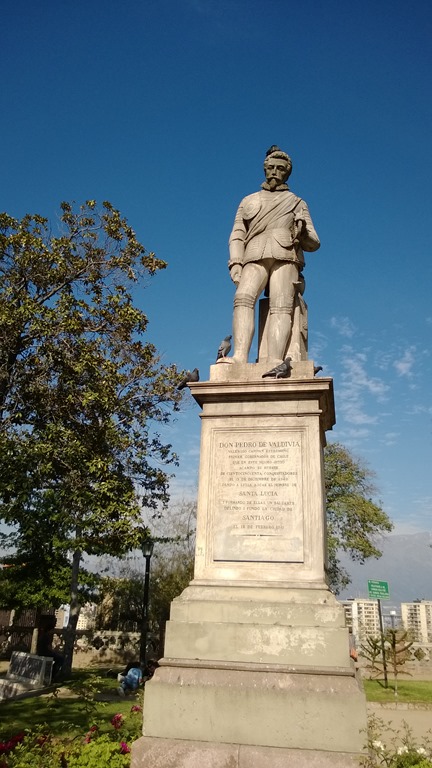
WP_20131027_027

Pedro de Valdivia, first governor of Chile

DSC_1876

city view from the top of Santa Lucia; you can actually see mountains in this one

As we were exploring, we could hear what sounded like a marching band off in the middle distance– a little unusual, given that they were playing an assortment of songs including movie themes. They didn’t seem to actually be marching, though. We made our way back down toward the street and I noticed something unusual: there was a medium-sized crowd of people thronging the street, and at a nearby underpass there were big arches of purple and white balloons. We watched for a few minutes and watched as a group of dancers in what I presume was traditional Incan dress (given that their jackets said “Atahualpas de Paramonga”, preceded by a group of drummers, danced their way up the street.

DSC_1885

A dancer; not shown: non-traditional tennis shoes

As the dancers moved down the street a larger group came into view, carrying a large, flower-bedecked bier and preceded by a group of women in what looked like purple habits. The women were walking backwards and swinging censers, producing a cloud of smoke such as I haven’t seen since the last concert I went to at Shoreline.

DSC_1888 DSC_1892

a mysterious object borne through the streets

As they passed, I was able to read the sign on the nearest corner of the bier and learned that the bier was carried by members of Hermandad del Señor de Los Milagros, or the Brotherhood of the Lord of Miracles. We had lucked into part of the annual procession honoring the Lord of Miracles, which takes place on the last Sunday in October. The tradition started in Peru but has spread worldwide. As the procession neared the underpass, the waiting spectators dumped glitter and balloons on the celebrants below, who gleefully stomped on the balloons to pop them.

WP_20131027_034

fire in the hole

WP_20131027_036

I was able to capture a balloon intact.. before stomping on it

After the procession left, we walked back to the bus stop, but the bus was long gone. We walked for about a mile and a half until we found a cab, then headed back to the hotel, where I passed a quiet night working on slides for the webcast I did yesterday.  All in all, it was a day very well spent, and it was fun for a change to go prowling around the city with someone instead of kicking it solo. Thanks, Dave!

Leave a comment

Filed under Travel

Santiago, day 2

It’s a measure of how much I’ve been working that I am just now getting around to posting a travelogue from last Sunday. This week has passed by in a blitz of activity, which is good. My team has gotten a lot accomplished, which, after all, is what we came here for. But before all the work started, I had the pleasure of having a day to explore.

I’d planned to meet my coworkers Todd and Dave at the hotel after their flight arrived, then drive to Valparaiso with fellow MVP and well-known Chilean Jorge Patricio Diaz Guzman. Unfortunately, Jorge had a work emergency to tend to, so I kept the rental car I’d gotten on Saturday. I rented through the hotel by asking the concierge to find me a rental car, because this seemed to be the fastest way to get a car. Sure enough, within 20 minutes or so Maxima had delivered a car to the hotel: a tiny Chevy Spark with a manual transmission and almost enough room for 3 adults. (It has 4 seats but it is wishful thinking to imagine that four normal-sized American men could fit into it; luckily we only had 3 people.)

WP_20131019_004

they see me rollin’, they be laughin’

After Dave and Todd arrived and had a few minutes to unpack and freshen up, we set out for Valparaiso. The route to get there is very straightforward: get on highway 68 going west and keep going for 120 km or so until you hit the ocean. It’s a lovely drive, with two large tunnels and some long up- and downhill grades that our car could barely handle. The speed limit ranges from 70 km/h to 120 km/h, but no one except American tourists and people in underpowered cars like hours follow it, especially not big trucks. We made it to Valparaiso but decided, since none of us had any firm plans to do anything there, to go back to a restaurant Todd knew of in Concon, another 20 or so km down the coast. The weather was pleasant and there were great views along the coast, so off we went, braving significant traffic along the way. Both sides of the narrow coastal road are packed with restaurants, shops, and rental property but there is little parking, so we spent lots of time waiting while other drivers maneuvered in or out of parking spaces. We also made frequent stops for photos, both on the route out and back.

WP_20131020_005

a view of the coast while standing on a rock in a tidal pool (Nokia 920)

DSC_1826

ocean view (Nikon D5100)

DSC_1841

action shot! rock climbing + sailboat

Eventually we made it to the restaurant Todd had recommended, Punta del Este. It was well worth the trip– think Dave’s Cajun Kitchen, or your favorite hometown restaurant for those of you who aren’t from Houma, and you’ll get the idea. We had an appetizer platter of razor clams, conger eel, and several kinds of fish. I had tilapia with shrimp sauce, which was also excellent. Then we drove back, stopping at a few different places to take pictures; there was one gorgeous house that Dave was particularly smitten with.

DSC_1843

We haven’t picked out a name for this other than la casa de Dave

On the way back we needed gas, so we stopped at a highway rest stop that would be familiar to anyone who’s ever traveled the New York or Ohio Turnpikes. Fuel here is expensive, but at least you get full service at the station in exchange for your hard-earned CLP$. After returning the car (a simple matter of giving the keys back to the concierge), we walked over to Costanera Center, the nearby mall, to find dinner. We had an excellent meal at Le Due Torri, an Italian-and-seafood place that delivered very well on both fronts, then back to the hotel. e were all pretty worn out by that point but it was an interesting way to spend the day. I’d love to come back to the Vina del Mar/Concon area during the Chilean summer; the views are gorgeous.

Leave a comment

Filed under General Stuff, Travel

Office 365 PhotoSync and the third-party market for Office 365

Office 365 has its own thriving MVP community, and fellow MVP Loryan Strant sent me an announcement of a new product he’s developed for Office 365: PhotoSync. The purpose behind the tool is to ease the process of managing user photos in enterprises by providing a better tool for managing user photos. There are tools that provide similiar functionality for on-premises deployments, of course, but this tool’s unique approach (or perhaps unique marketing, as I haven’t tried it myself) is to focus on the fact that many Office 365 deployments will use directory synchronization to get directory information from the on-premises deployment to Office 365.

Using a shared hosted service means accepting some compromises; for example, Microsoft greatly limits subscribers’ ability to customize SharePoint or to configure various aspects of Exchange such as database and DAG settings. This might seem to limit the possibilities for developing software products to supplement Office 365. I think it’s a healthy sign that third parties such as Loryan are developing add-ons and utilities for use with Office 365, although I suspect that only the most agile organizations will be able to identify opportunities and exploit them fast enough to keep up with the cadence of feature and service updates that Microsoft seems to be aiming for.

More on PhotoSync in the future…

1 Comment

Filed under Office 365

Thursday trivia #101

I wrote a long post, then WordPress ate it, so here’s what you get instead: I am still in Santiago and have already worked 40 hours this week, with more on the way. A typical day starts about 8am with a team breakfast at the hotel, then about a 2km walk to get there, then boom! the fun begins. I have not left the office before 9pm yet, but I haven’t been there after 10pm either, so that’s good. When I get time (hopefully this weekend) I’ll write up my trip to Vina del Mar this past Sunday, then another post with some random observations about Santiago based on what little I’ve seen.

One Exchange-related note: I am fortunate to be working with two extremely sharp graduates of the Microsoft Certified Master program. I am more convinced than ever that Microsoft is doing themselves a great deal of damage by ending the program that takes smart, experienced consultants and gives them a means to sharpen their skills to such a high degree.

Leave a comment

Filed under General Stuff

Exchange 2013 Inside Out: Clients, Connectivity, and UM now available

At long last!

Today is officially the release date for Microsoft Exchange Server 2013 Inside Out: Clients, Connectivity, and UM. Because I missed my original deadline, the book was not available at the same time as Tony’s Exchange Server 2013 Inside Out: Mailbox and High Availability, which is a shame since the two books complement each other well. Between the two of them, they cover virtually every important or interesting aspect of Exchange 2013. My book focuses on client access, transport, unified messaging, Lync, and Office 365 integration, which is plenty!

I feel like it’s fair to reprint a section of the acknowledgements from the book here; I owe a great debt to the many people who volunteered their time to read drafts of the manuscript, point out errors, and make suggestions for improvement. As always, they share in the credit for the high quality of the book, and I am solely responsible for errors and shortcomings in it. Many thanks to my posse:

I was incredibly fortunate to receive a great deal of help with this book from a variety of sources. A large group of Exchange experts from the Microsoft Most Valuable Professional (MVP) and Microsoft Certified Systems Master (MCSM) communities volunteered their time to read early drafts of the chapters as they were produced; their mission was to identify shortcomings or errors and to suggest, based on their own experience, ways in which the book could be improved. This book is much better thanks to their efforts, which I very much appreciate. My thanks to Kamal Abburi, Thierry Demorre, Devin Ganger, Steve Goodman, Todd Hawkins, Georg Hinterhofer, Miha Pihler, Maarten Piederiet, Simon Poirier, Brian Reid, Brian R. Ricks, Jeffrey Rosen, Mitch Roberson, Kay Sellenrode, Bhargav Shukla, Thomas Stensitzki, Richard Timmering, Steven van Houttum, Elias VarVarezis, Johan Veldhuis, and Jerrid Williams. My thanks also go to the broader MCSM and MVP communities, particularly Paul Cunningham, Brian Desmond, and Pat Richard, for discussing topics or sharing scripts that informed the material I wrote.

In addition to these volunteers, I benefited greatly from the efforts of many people from the Exchange, Lync, and Office 365 product teams at Microsoft, including Diego Carlomagno, Bulent Egilmez, David Espinoza, Kern Hardman, Pavani Haridasyam, Tom Kaupe, Roy Kuntz, Lou Mandich, Jon Orton, Tony Smith, Greg Taylor, and Mini Varkey. Extra thanks to Rajesh Jha for taking the time to write the foreword for both books—no easy task considering how often Tony and I have hassled him about various matters.

One thing I can’t explain is the pricing of the two books. For some reason, the Kindle edition of my book is selling at list price, $39.99. The Kindle edition of Tony’s book is discounted, and both the Kindle and print editions of his book are less expensive than the print edition of my book! This is solely due to Amazon’s complex and inscrutable pricing algorithms; it seems unfair since Tony’s book is longer (and probably better written) but there you have it.

4 Comments

Filed under General Stuff