[editorial note: I wrote this last week and forgot to publish it on Friday, so now you’re getting it on Monday.]
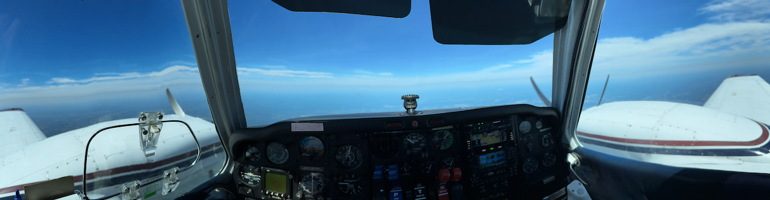
Frankly, it’s a little sad that I have spent more time writing about flying than actually flying over the last few months. The weather here has not been great lately and it has been challenging to try to line up availability of an airplane and an instructor or friend with a period of good weather when I am not already committed to doing something else. I was able to get my biennial flight review (BFR) completed in a single-engine 182RG, and I’m only one approach short for my IFR currency, whether I do it in a single or twin-engine aircraft, but none of that is the same as flying my own plane.
It’s a whole process
I have skipped over a lot of the details of the rebuild and reassembly process for two reasons. One is that I don’t know what all of them are because I am not a powerplant mechanic. The other is that some of them are sort of implied in the idea that you’re going to take an engine apart, fix whatever needs fixing, and then put it all back together. Poplar Grove refers to this whole process as “rework and reassembly,” so that’s what I’ll call it too. That process is now underway. For example, the oil coolers are being partially disassembled, cleaned, and reconditioned prior to being put back on the engines– that’s rework. Some components may be polished, remachined, re-coated, etc as part of this process; others will be replaced with either new or overhauled versions. Once all the parts are in the correct condition, they’re assembled back into a functioning engine. That’s also not as simple as it sounds, since many of the parts have very specific assembly requirements for torque, positioning, etc that must be met.
Once the engine is back together, there’s still quite a bit of work to be done to make sure that it works correctly, doesn’t leak, and so on. With a brand-new cylinder (or, in this case, 12 of them), there’s a break-in period while the piston rings, pistons, and cylinder walls are rubbing together. You want to end up with a nice smooth cross-hatch pattern, which helps distribute oil on the cylinder walls but also helps seat the piston rings; to get that pattern, you need to operate the engine in a very specific set of conditions of of high power and relatively low altitude. Some shops do the majority of the break-in themselves, others leave it for the owner.
Once the engine has been test run, Poplar Grove will box it up and ship it back to Baker Aviation, where they will install it. This is probably the most error-prone part of the whole process because it requires mating the engine to all the sensors and controls it had before, along with mechanically attaching it to fuel and oil supplies, the airframe, and so on. This requires a lot more leak checking, torque certifications, and so on. Then when that’s done, the plane can be test flown and the break-in process can be completed.
Where things stand now
Poplar Grove is nearly ready to start the assembly– they expect to finish the rework and reassembly preparation work the week of 10 August. Once done, that means the needed parts are all lined up and ready to go. With luck, they’ll have the engines done by the end of August. Then Curtis and his crew will install the engines (and spiffy new baffling) on the airframe, and I’ll go pick it up and do the test and acceptance flights.
“While you’re in there…”
These are said to be the most dangerous words uttered in aviation maintenance. Scope creep is a real problem. It’s super tempting to stack work on during a long-running process like this overhaul; after all, since the plane is already down for maintenance, it seems like the ideal time to fix stuff so that you don’t have to fix it later. Along those lines, I’ve had the shop send the fuel boost pumps, propeller governors, and autopilot roll servo out for overhaul. I didn’t plan or budget for the fuel pump and prop governor overhauls but had mentally made note of the fact that they’d need to be done at some point:
- in my model of Baron, you can’t start either engine if the electric boost pump on that side has failed. At the high-boost setting, my pumps show two different pressures– one is wrong but we can’t tell which because the correct pressure output is not documented anywhere. Since one is bad-ish and the other is good-ish, I decided to just do them both.
- the propeller governor is critical for two reasons: it controls the propeller blade angle to regulate the engine speed, but it’s super important for allowing the prop to feather when needed. The governor is plumbed into the engine oil system and uses oil pressure to hydraulically control the prop. Recently a friend had a scary emergency landing as the result of an engine failure. The cause: failure of a seal in his prop governor blew all the oil out of his engine. Thankfully he was OK and the airplane is repairable, but it was a bit of a wakeup call that my governors were due for some TLC.
- the autopilot roll servo is basically an electric motor– the old-school kind that uses carbon brushes. Carbon had built up in the armature, since carbon brushes wear over time, adding friction. The added friction meant that the autopilot controller had to put more voltage into the motor to get it to start moving. When it did move, that extra voltage would make the airplane overbank in one direction, at which point the controller would bank the opposite direction to fix it. That led to a gentle, but annoying, left-to-right rocking motion in level flight. “While you’re in there…” meant that there wasn’t going to be a better time to fix this.
There are a few other things that I’d like to get done during this time, but my window is closing, which is probably good from a budgeting standpoint. These component overhauls will add another 4-5% to the total cost, but I am rationalizing that increase by remembering that they’d need to be done eventually anyway.
Fingers crossed…


