A few quick notes on Office 365 Groups

Today the Office 365 team announced the rollout of the first phase of the Groups feature. I hadn’t been playing close attention to the roadmap for this particular feature, so I decided to play around with it and report my findings. Rather than the kind of carefully reasoned analysis you might expect from Tony or Van Hybrid, this is sort of a stream-of-consciousness record of my initial exploration. However, it probably reflects how most customers will discover and use the feature. Remember that this is written within a few hours after the feature launched, so things that I call out as not working or missing may not be lit up in my tenant yet.

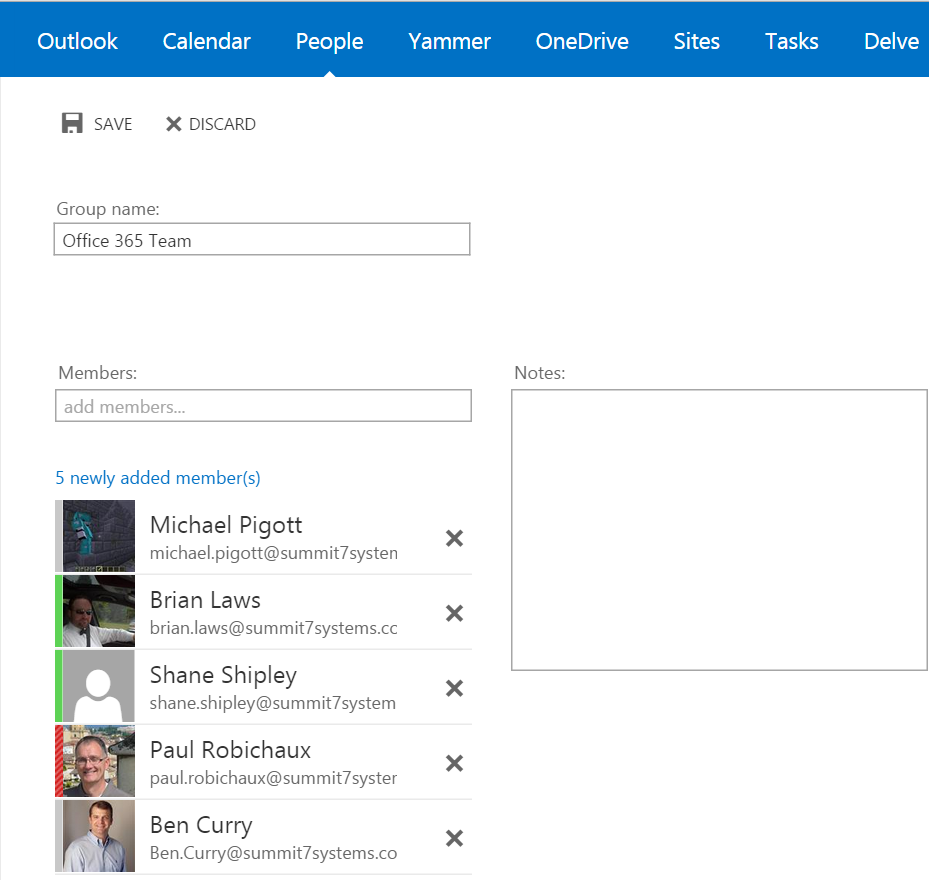
  • First, I looked around to figure out how to create a new group. The screenshot in the online help shows Groups appearing in the left-side folder nav bar. I didn’t see that in my tenant. When I switched to the People view, I noticed that the People search selector had a “Groups” item available, but since there were no groups that wasn’t super helpful. Clicking the “New” icon at the upper right of the People view gave me a modal pop-up asking me whether I wanted to create a new group or person. The interface for creating new groups is straightforward: give your group a name, add some people to it, and off you go. Here’s what it looks like:
Creating a new group is straightforward.

Creating a new group is straightforward.

Note that there’s no way to specify an email address for the group object. You can send mail to it from within OWA, or by clicking the envelope icon in the group information sheet, but there’s no visible external SMTP address to, send to. This seems like an oversight.

  • The group documentation says that newly created groups get their own OneDrive for Business folder and group mailbox, but I haven’t yet seen any signs of those objects in my tenant. However, the docs also say that group members will get a “welcome to your new group” email once those objects have been created, and because that hasn’t shown up yet, I’m guessing that there’s just a short provisioning delay.
  • I created a new group named “Managing Consultants”. I picked that name on purpose, because I already had a mail-enabled security group with the same name. The Groups interface happily let me create a duplicate. The existing USG doesn’t show up in the Groups interface in OWA, nor does the new Group show up in Outlook’s online GAL (which may just be an artifact of AD latency). The help topic for creating and navigating groups shows a number of settings that aren’t visible in my tenant. For example, you can supposedly change the URL used to access the group or set the group to either private or public– those options aren’t available to me yet.
  • I clicked on the mail icon to create a message and sent it off; it arrived immediately in the target mailboxes. Interestingly, though, the group name doesn’t show up in Outlook; instead, the individual group members’ names appear.
  • Even after creating two groups and sending a message to one of them, neither group appeared in the OWA left navigation bar. Surprisingly, they didn’t appear in the OneDrive nav bar either:
Where'd my groups go?

Where’d my groups go?

  • Bizarrely, clicking the “Browse groups” item opens a new OWA window, which opens in mail view, not the People view. The new OWA window’s left nav bar has a People section, but it’s empty– even though the original OWA window I kept open still correctly shows unread mail from people in my Inbox.
  • When I create a Group, it doesn’t appear as an available group in Yammer. I presume this is by design.
  • I didn’t test Group conversations because there are no visible Group objects in OWA where the docs say they should be.

From the bumpy state of feature display and behavior at this point, I infer that there’s a multi-step provisioning task that runs when a new Group is created, and that at least the ODB step hasn’t run yet. This might confuse users who wonder why they can use a group for one purpose (sending mail) but not another (ODB). I’ll wait a day or so for the provisioning and loop back to see which of these items are bugs and which are just caused by setup delays.

6 Comments

Filed under Office 365, UC&C

Training Tuesday: a new bike and my first long bike ride

Wow, lots has happened since my last Training Tuesday entry. Maybe I should call it “Triathlon Tuesday,” since not every post is about training? But then again, not every post is about triathlon, either, as you’ll soon see.

I’d been wanting a new bike for some time. My previous ride, a Specialized Crosstrail Sport Disc, is a big, heavy beast of a bike. Its gearing is designed for trails; it has 3 chainrings (more on which later) with 9 gears in each. In addition, the frame geometry is such that you sit up straight and tall, which is fine for riding to work (the reason why I bought it) but not so great for riding fast in races or training. After my debacle at Rocketman, and my successful experience at Nation’s Tri with a rented Cannondale road bike, I knew I wanted to try to find a road bike before my last two races: Racin’ the Station and Rocketman Florida.

To save you lots of tedium, I’ll cut my description of the shopping process short. Suffice to say I did a ton of research, hit all the local bike shops, test rode a bunch of bikes, and spent an unhealthy amount of time looking at bikes on SearchTempest and eBay. The keys to finding the perfect bike are that you should pick a bike:

  • that fits you. This is a bit of a problem since I am tall. Bike geometry is complicated, so I quit trying to predict what would fit me in favor of riding bikes to see. how they felt
  • that’s in your price range. You can spend many thousands of dollars on super-fast racing bikes with all kinds of fancy crap, but that wouldn’t do me much good. To get faster, I need more time riding, not an uber-bike. All I wanted was a basic entry-level road bike, so I set a budget limit of $1000.
  • that you like. This was tricky. I saw lots of bikes that I liked that weren’t in my price range, and some that I liked and were in my price range didn’t fit me (including a really sweet all-carbon Douglas).

I pretty much struck out at the local bike shops. The model year for bikes changes over in August or September, so there were very few 2014 bikes in my size left, and most manufacturers hadn’t shipped many 2015 bikes in my size and price range. So I narrowed things down to a couple of 2014 models at two local shops– a Trek Madone 2.1 and a Cannondale CADD9–  and was planning on going to pick one out when I got back from Exchange Connections. In the meantime, though, a mechanic who works for one of the local shops told me about a sweet-sounding bike he had: a 2013 Giant Defy 1. It was in my price range, and I liked the idea of getting a slightly used bike for less than retail. We met Wednesday, I test-rode the bike for a few laps around the parking lot, and made the deal. Thus this picture from Wednesday night:

What a sexy beast! And the bike is nice too.

What a sexy beast! And the bike is nice too.

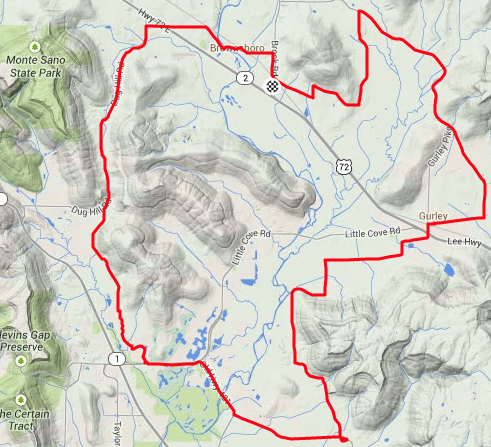
I didn’t get a chance to ride Thursday, but Friday afternoon after work I put on my SPD pedals and speed/cadence sensors and got in about a 2-mile ride. After a few tweaks to the seat position, I packed up the bike and went to bed. Saturday morning, I got up bright and early to meet Wendy (one of my Tri101 coaches), her husband, Teresa (another 101 alum), and her husband to convoy over to the All You Can Eat ride sponsored by the Spring City Cycling Club. I hadn’t really planned on riding this ride, but after I told Wendy that I bought the bike, she encouraged me to give it a shot. I decided to go for it. I only signed up the 34-mile loop, but I figured that would be plenty. The 50-, 67-, and 103-mile groups rolled out at 8am, and I joined them so I could ride with Wendy and Mike. The weather was absolutely perfect: mid-70s, with a nice breeze and plenty of sunshine. The first 6 miles or so were pretty slow, as we were riding in a big mob. However, about mile 7, there was a long downhill (with a sharp left at the bottom, yikes), and that spread the group out a good bit. I hit about 30mph downhill and could easily have gone faster if I weren’t so chicken!

Doesn't look like much from here…

Doesn’t look like much from here…

This ride was much different from what I’m used to. In triathlons, you’re not allowed to bunch up or draft, and everyone rides hell-for-leather. In this kind of ride, you can ride abreast, clump up, ride right of the centerline, and pretty much do what you want as long as you’re not unsafe. It was great to be able to ride along chatting with people, the more so because I actually knew some of the people I was talking to!

Another big difference: in this kind of ride, there are rest stops WITH FOOD. That’s right: we rode about 15 miles, stopped for a snack, rode another 8 miles, snacked again, and then rode about 9 miles to the finish. At the first stop, I had half a PB&J, a banana, a big cup of Gatorade, four or five Fig Newtons, and a brownie. Longer distances thus mean more snacks, giving you a built-in incentive to push your distance. As it was, 34 miles is about double my previous long ride distance, so that was enough pushing for me.

After rest stop 2, the ride went fine until we turned onto Salty Bottom Road (great name, huh?) The turn put us into the teeth of a stiff headwind, which slowed me down, and then I had to stop and walk up about half the hill around mile 32– I was just gassed at that point. I definitely felt the difference in chainrings on this hill; on the Crosstrail I would have just dropped to the lowest ring and blasted up the hill (well, OK, “blasted” probably isn’t the right verb). Having only 2 rings is going to take some getting used to.

The scenery was incredible: a hundred shades of green in the grass and fields, a squadron of planes overhead flying into Moontown for the EAA 190 pancake breakfast, and mountains, or at least what passes for mountains here, in the background. The course was very well marked and the support volunteers did a wonderful job of feeding us, providing a sag wagon, and handling all the pesky logistics.

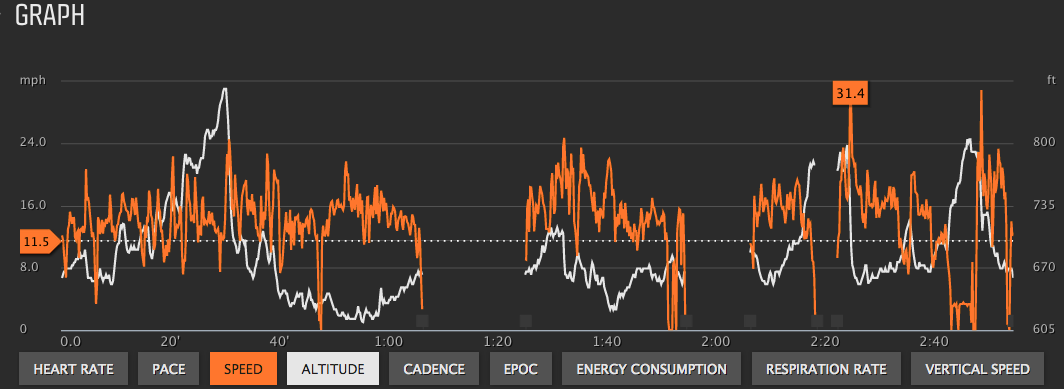
This graph nicely summarizes the overall ride for me. The white line is elevation; the orange line is speed. The gaps indicate rest stops. You can clearly see the big downhill around mile 7 (look for the steep white cliff), plus a few later hills. My average speed was 14.3mph, which was pulled down by the long stretch of chat-riding  at the start. I was routinely hitting 20+ mph on the flats, something that would have been improbable, if not impossible, on the Crosstrail, so I’m really pleased with the results.

Tale of the tape

Tale of the tape

Now I need to log some more miles before Rocketman Orlando, which features a 32-mile bike course. On Sunday, I rode the Racin’ the Station course with a group, just to get a feel for it; I wasn’t pushing hard at all and averaged around 14.5mph. I need to get a few more rides in this week (along with RtS this Saturday). I’ll definitely be on the lookout for other sub-metric-century rides– I may have accidentally caught the club-ride bug!

Leave a comment

Filed under Fitness

My first real IFR trip: Decatur-Manassas and back

My trip to DC to compete in the Nation’s Triathlon was my first “real” IFR flight. I say “real” because it combined flight in actual instrument conditions with busy airspace and a long cross-country—conditions I expect to encounter often as I fly around.

Earlier in the summer, I had signed up for the tri.The timing was such that I would come home from GATTS, have a couple of days to pack, and then fly up to DC, hopefully with my instrument rating. That turns out to be what happened.

Flight planning was straightforward. The DC metro area has a number of general aviation airports scattered around, but it also has significant restrictions on its airspace. Without going into all of the gory details, it’s enough to point out that the airports that are closest to central DC are heavily restricted. In order to fly to the so-called “Maryland 3”, you have to go to either Dulles or BWI, get fingerprinted, have security interviews with the FAA and TSA, and then get a PIN that you use when filing flight plans. I didn’t have time to do that, so I settled on Manassas, which is further out but would provide a reverse commute into and out of the city—it also helped that the route from Manassas to the hotel passed right by the bike shop where I’d made arrangements to rent a road bike.

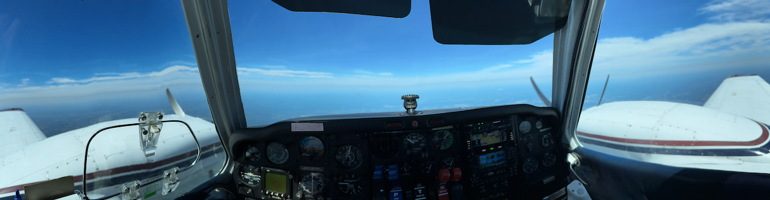
I planned an early departure Saturday morning. Because I’d been out of the office for most of the week, I couldn’t leave earlier than about 5pm, and I didn’t want to fly night IFR in unfamiliar, complex airspace after a full, and tiring, day at work—that’s how accidents happen. My original plan was to fly from Decatur to KGEV, fuel up with avgas and diet Coke, and then continue on to Manassas. The weather at Decatur at departure time was OK, with an overcast layer about 2000’, and Huntsville Approach quickly cleared me to my target altitude. The first hour or so of the flight was smooth on top, then things got a bit bouncy because there were clouds at my filed altitude—with some light rain and a fair bit of chop. Once past that, though, things were looking good until I looked at the weather at my destination airport and alternate . Both were below minimums, so instead I flew a bit further east and landed at Winston-Salem, which was nicely VFR. It turns out that the airport there has self-service or full-service fuel, with a whopping $1.69/gal price difference—but getting to the self-service pump from the FBO is an adventure that involves runway crossings and, in my case, aggravating the pilot of a Malibu who had to hold short while I taxied. Such is life.

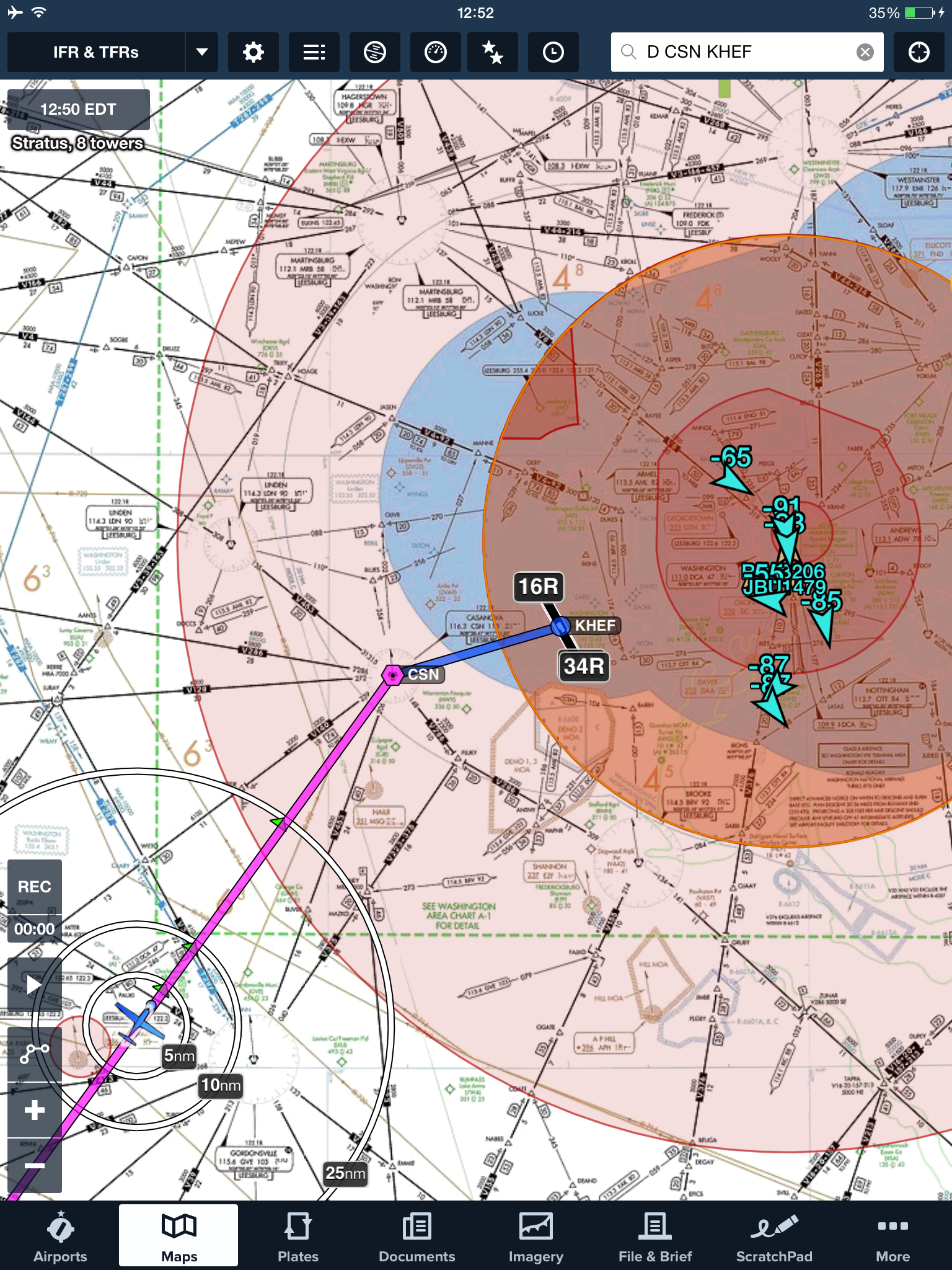
The flight into Manassas was perfectly uneventful, just the way I like. I had filed direct from Winston-Salem to Manassas, but I didn’t expect to get that routing, and sure enough, I didn’t; Potomac Approach sent me direct to the Casanova VOR, then direct Manassas. It was fun watching the Foreflight traffic display en route, since I could see a ton of traffic into Reagan.

Watch out for the big iron!

Watch out for the big iron!

Going to CSN first wasn’t much of a diversion, so it was no big deal. Manassas was VFR, but storms were expected later, so after I landed, the fine folks at Dulles Aviation hangared the plane. (I also want to point out that they provided stellar service: the rental car was ready when I got there, saving me a commute to the nearest Avis office some 12 miles away, and they treated me like I had just flown in on a Gulfstream.)

The return trip looked simple enough too. I filed direct Manassas to Greenbriar, WV. The race was on Sunday, and I needed to be at work Monday morning, so I had to leave late in the afternoon, meaning that several of the airports I would normally have considered as fuel stops were either closed, or would be. Greenbriar was reporting 900’ overcast, which was fine with me, so I filed, preflighted, and started up, then called Manassas Ground to get my clearance.

Here’s what I was naively expecting: “N32706, Manassas Ground, cleared as filed to LWB, climb and maintain 9000’, departure frequency…”

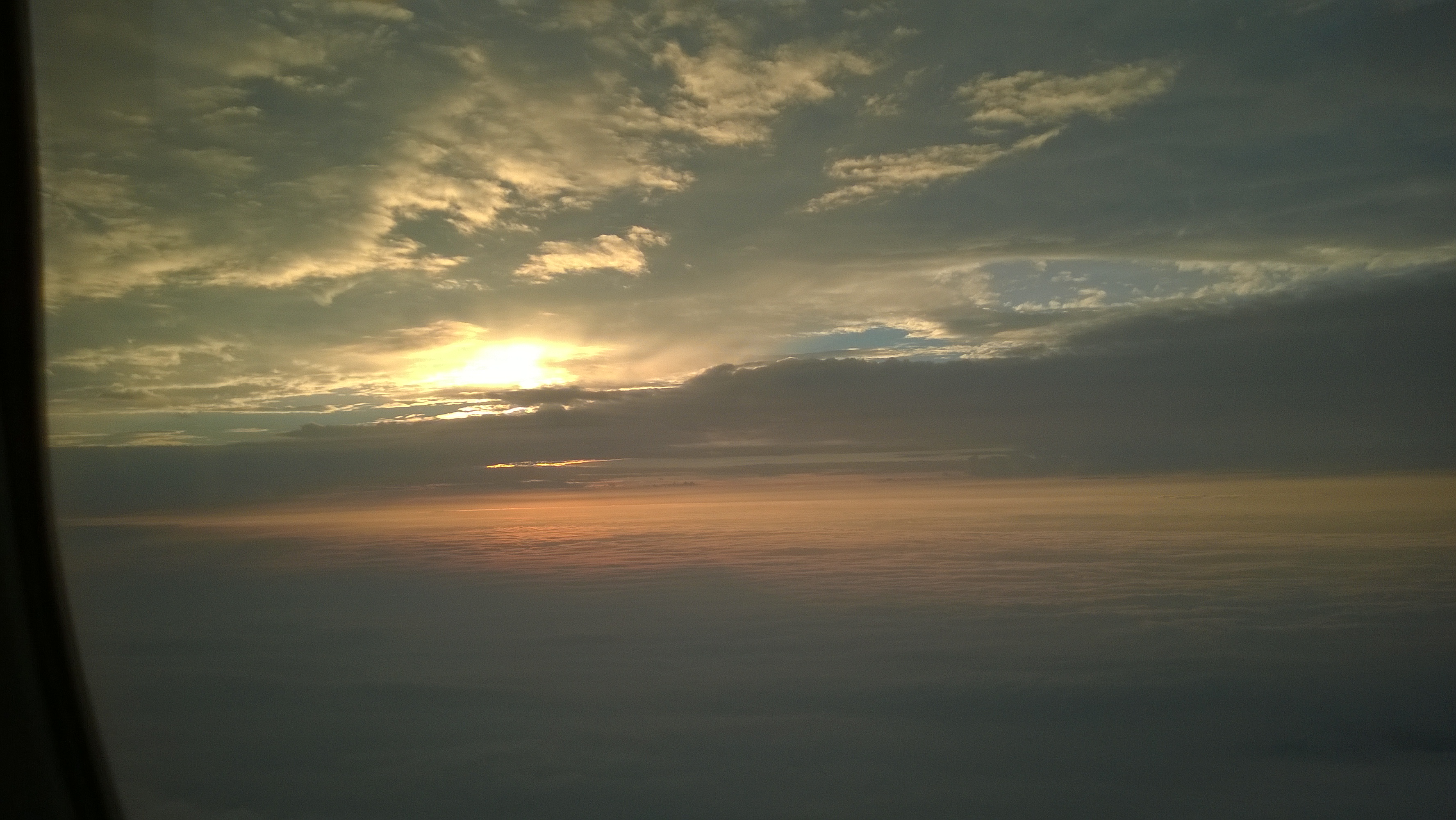
Here’s what I got instead: “N32706, Manassas Ground, cleared to LWB via the ARSENAL FOUR departure, thence the Montebello transition, then direct NATTS, then direct LWB; departure frequency…” Thus we see how ATC deals with the expectations of a novice IFR pilot. This set off a frantic burst of knob-twiddling as I tried to set up the KLN94 for that departure (which it didn’t have, since its onboard database was too old). I eventually got it set up, was cleared for takeoff, and then got a series of ridiculous vectors from Potomac Approach that sent me well north of where I wanted to be. However, the flight to Greenbriar was nice and smooth between layers, and, as advertised, the weather on arrival necessitated shooting the ILS, which I did smoothly. After taking on fuel, it was off to Decatur; the rest of the flight was unremarkably smooth except for a great sunset and some tasty snacks (yay vanilla wafers!) I considered it a very successful trip!

A great sunset to cap off a great trip

A great sunset to cap off a great trip. Not shown: vanilla wafers.

Leave a comment

Filed under aviation

GATTS days 8 & 9: judgment day(s)

The title of this post gives it away: I didn’t pass my check ride on the first try. Read on to find out why…

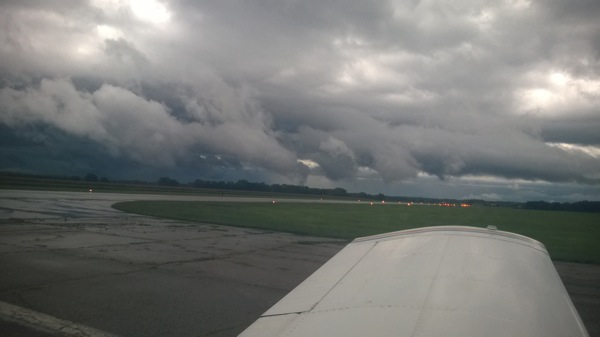
On day 8, I woke up early, loaded the car, and drove to the airport to meet Peter. We’d arranged with Ken to meet early because the weather from Manhattan to Topeka (and the surrounding area) was poor: 1200’ or less ceilings, with lots of wind and a good bit of rain. Peter and I agreed to head east and see what the weather looked like when we got there. Short answer: it was terrible. The entire flight was in clouds, with plenty of bumps, then on arrival, ATC gave us about 20 minutes of holding on the localizer, which was, um, invigorating, not to mention bouncy. We finally landed and this is what we saw:

Paul robichaux net 20140903 001

Ken was there waiting for us, so we went inside and went through the standard check ride prep; he and I both signed into IACRA to complete my check ride paperwork, he briefed me on the Pilot’s Bill of Rights, and so on. Then we spent about an hour on the oral exam, which was perfectly straightforward. I wasn’t surprised by any of his questions, largely thanks to the combination of Peter’s coaching and my own study. The weather wasn’t good enough for us to conduct the practice approaches on the check ride under VFR conditions, so we adjourned to the airport restaurant for a snack (which was interrupted by a business phone call for me, alas). After about an hour and a half, the weather had lifted enough for us to fly. We took off, and Ken had me intercept V4 to give us some distance from the airport. We flew west a bit, then he had me recover from unusual attitudes, which went well… except.

See, I was having a hell of a time keeping to my assigned altitude. I’d like to blame it on the wind, but it wasn’t just that; my scan was deteriorating faster than ever before. I’m still not sure if I was nervous, rattled from the weather, or what, but after a few gentle reminders from Ken (example: “Do you know what the PTS requirements for holding altitude are?”, just in case my poor performance was due to ignorance vice lack of skill), he had me head in to the ILS for runway 13. I flew fairly well despite the wind gusts, intercepting and tracking the localizer without a problem.. but, again, my altitude control was poor, and I let the glideslope needle hit full deflection down. I was too high, and that was that: he had me land, gave me the dreaded letter of discontinuance, and held a short debrief with Peter and me. Then I flew us home, in a funk the whole way; we did some remedial training en route, which I obviously needed but didn’t want. After landing I went back to the apartment, sulked for a while, worked a bit, and then mentally steeled myself to repeat the process the next day… and that’s exactly what happened. The next morning, we went back to the airport, flew to Topeka, met Ken, did the same IACRA stuff, and went out to the airplane.

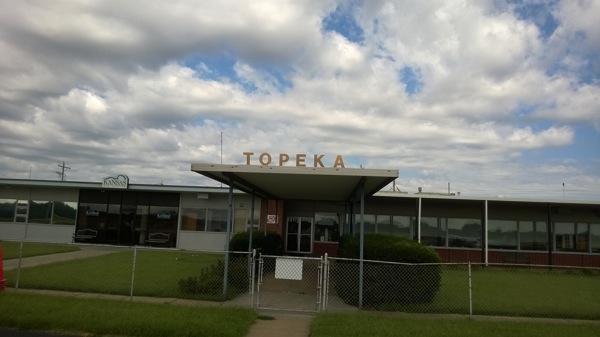
When you retake a failed (or interrupted) checkride, the examiner doesn’t have to retest you on the portions you passed, although she can. In my case, Ken just wanted me to fly the approaches and holds, which I did, starting with the ILS for 13. It was still breezy, but nowhere near as windy as the preceding day, and/or maybe I was less nervous. In any event, I flew a textbook ILS approach, did a decent job on the hold (despite a stiff and inconvenient crosswind), and followed with the VOR and localizer back course approaches. I landed, taxied in, and Ken shook my hand to congratulate me. Here’s what the airport looked like when we taxied up:

Paul robichaux net 20140901 003After another debrief, in which the often-heard and completely true phrase “license to learn” was tossed around several times, we bade Ken goodbye and headed back to the ramp. After a short and uneventful flight back to Manhattan, I shook hands with Peter for the last time, got a fresh diet Coke, and headed home. The flight home was smooth and clear, so I didn’t actually get to perform any approaches, more’s the pity. After such a long time away, I was delighted to get home, sleep in my own bed, play with the cat, and generally settle in a bit.

Once a little more time has passed, I’ll write up my overall impressions of GATTS. It is safe to say that I’m pleased with what I learned and their teaching methods, but I feel like I need a bit more experience before I form a complete opinion. Meanwhile, I’ll be flying!

8 Comments

Filed under aviation

GATTS day 7: checkride prep, plus a race

Day 7 of my GATTS experience happened to be Labor Day. That didn’t really make any difference to the flight schedule, but I did talk Peer into a later start time so that I’d have time to go run the Summer Send-Off 5K race in nearby Chapman, Kansas. The race was a lot of fun; I ran well despite getting lost on the way there and arriving literally 30 seconds before the starting gun. (Irony of the day: just as I was passing the high school demolished by a 2008 tornado, my iPod served up Flux Pavilion’s “Blow the Roof”).

Race in Kansas? Sure, why not? One more state on my list that I can cross off.

Race in Kansas? Sure, why not? One more state on my list that I can cross off.

After the race and a quick shower, I met Peter at the airport for a mock checkride. Checkrides are normally administered by people who hold the role of DPE, or designated pilot examiner. They’re not FAA employees; many of them are very high-time instructors, often retired. Every instructor knows, or should, the local DPEs: what they think is important, what they emphasize in the oral and practical exams, what their habits and idiosyncracies are. Although Peter didn’t attempt to imitate the DPE’s mannerisms or anything, he did tell me that I should expect to take off, intercept the V4 airway westbound, return to do the ILS 31 approach at Topeka, execute the published missed approach, transition to the VOR 22 approach, and then come back to do the localizer backcourse for 13. This last was necessary because of FedEx’s failure to deliver my updated GPS card on time, the dirty rats– I couldn’t legally fly a GPS approach without the updated data card, so I was stuck with the backcourse.

The first part of any FAA checkride, of course, is the oral exam, so Peter quizzed me for an hour or so on weather, procedures, approaches, lost communications procedures, and pretty much everything else we had discussed at any time during the preceding week. That went well, I thought; I felt well prepared by the combination of my study and his teaching. Then we went out to the ramp, fired up the airplane, and flew to Topeka to simulate the flight check portion. The flight went very well, although it was windy and bumpy, so I had trouble maintaining the nice oval shape we all associate with a well-flown holding pattern. Part of the goal of the simulated checkride is to put the applicant at ease with the flow of the ride, and it definitely helped; despite the blustery winds, I flew within the PTS and felt good once we got back on the ground and put the plane away. I had an easy night, packing and making one last visit to Hibachi Hut for bread pudding and a sandwich, then went to bed, eager to face the DPE on the morrow…

Leave a comment

Filed under aviation

Exchange Connections wrap-up wrap-up

Over at the Summit 7 blog, I have a post detailing some of my higher-level thoughts from this year’s Exchange Connections conference. I also had a few less-structured things to throw out there, thus this post.

First, I was really thankful to be able to see and spend time with so many of my good friends from the Exchange tribe. With the untimely demise of our friend Andrew Ehrensing fresh in my mind, I really appreciated getting to see Tony, Paul, Nathan, Wes, Michael, Jaap, Michel, Amy, Jay, Joel, Sigi, Andrew, Bhargav, Greg, the two Jeffs, Chris, Dave, Megan– and that’s just who I can remember off the top of my head (sorry if I’ve forgotten anyone). One of the biggest benefits of Exchange Connections and MEC is the close engagement it fosters within our community.

Second, sometimes session attendance offers surprising insights. I had 3 sessions: one on Managed Availability, one on Office 365 migration, and one on Lync/Exchange feature integration. I expected the migration session to draw the biggest crowd, but my Managed Availability session was jam-packed, and the Lync session was well-attended too– despite the fact that the integration items I talked about are well-documented and fairly common. I got some good attendee questions, which I’ll be using as blog fodder. It was a bit surprising to see how few attendees had deployed SharePoint, although that may have been because the real SharePoint devotees were in other sessions. Few of the attendees in my session had already deployed Office 365, although again those who had were probably in other sessions.

All three went well, though I felt a little flat in the second half of the first session. Thankfully none of my sessions were in the first time slot of the day, nor were any on the last day. My experience with Vegas conferences has been that being first up or on the last day means that attendees will be {tired, hung over, broke} and not at their most receptive.

Speaking of Vegas conferences: the Aria is a great property and I hope that future Exchange Connections conferences return there. I never did get to try their vaunted red velvet pancakes (Tony, here’s a recipe if you want to try them at home) but the conference food itself was decent and the meals I had (at Javier’s and the Aria Cafe) were quite good.

With Exchange Connections out of the way, my next planned event is the MVP Summit in Redmond in November. The Exchange MVPs have a long list of things we want to vigorously discuss with the product team, so I am looking forward to getting everyone in the same room again and having it out!

3 Comments

Filed under UC&C

GATTS day 6: building comfort

[ sorry about the gap in posting the rest of my GATTS writeup; I’ve been kinda busy. ]

Day 5 of my GATTS experience was all about refinement. We started in the classroom, where we covered the rules for filing alternate airports and spent a good bit of time on decoding IFR charts (which, luckily, was one of the areas where I worked extra hard when studying for my written). Then we got in the airplane and flew to Topeka to shoot the ILS runway 32 approach, something that Peter told me would almost certainly be featured in my checkride. The GPS in 706 is not equipped with a WAAS-capable GPS, which means that I can’t fly precision GPS approaches. That means that, if I want a precision approach (and who wouldn’t?), it’s the ILS for me, at least until we can upgrade to a newer GP

Of course, one of the most important parts of flying an approach is the missed approach procedure– the sequence of steps you take when, after flying the approach, you’re unable to land because of poor visibility, runway misalignment, and so on. When you’re practicing an approach, it’s common to tell ATC what you’re going to do after the approach– land, execute the published missed approach procedure, or do something else. In our case, we flew the published miss for the ILS 32 approach, which involves flying to the Topeka VOR and then flying a racetrack holding pattern. For a real missed approach, ATC might send you to the normal missed approach holding point, or they might vector you around for another try, depending on the reasons why you went missed.

After the missed, we flew on to Miami County. No, I’d never heard of it either. It turns out that there is a superb BBQ restaurant at the airport, We B Smokin, so after shooting a good GPS approach, we had lunch. I accidentally ordered enough food to feed two normal humans, so by the time we were done eating I was a slow-moving hazard to navigation. We fueled up and departed for Forbes, flew the VOR/DME, and then went back to Manhattan. This was fortuitous timing, because there was a line of thunderstorms poised to attack from the west, so we called it a day and I went to Manhattan’s only movie theater for November Man (pretty decent; worth the $6) and a large bucket of popcorn, followed by watching the storms roll in from the safety of my balcony.

By this point in the training, I was feeling very comfortable operating “in the system”: my radio calls were concise, I was getting better at visualizing what the approach I’d selected would require me to do, and I was much more comfortable with the workload required to brief and set up the approach, then fly it to either a landing or a missed approach. The steady diet of daily flying, in whatever weather we happened to have, was a key part in building my comfort level. Although the flying weather to this point had been pretty good, the stiff, variable winds we had all week were more than enough to challenge me– just what I was looking for.

3 Comments

Filed under aviation

New ADAL hopefully means Outlook MFA coming soon

Remember back in April when I wrote this post on multi-factor authentication (MFA) for Office 2013? (It’s OK if you don’t, because you can go read it now.) Good news: one of the things required to ship MFA in office is an updated version of the Active Directory Authentication Library, or ADAL. Well, guess what? A couple of days ago, Microsoft announced a major Azure AD update that includes a new release of ADAL. The release notes don’t specifically mention MFA support in ADAL, but they do say that ADAL 2.0 supports “new authentication flows” so I am hopeful that this is the release required to unlock Office 2013 MFA support. I guess we’ll see; it wouldn’t surprise me to see Microsoft announce its availability at TechEd Europe, since that’s the next major event on their schedule. Stay tuned…

Leave a comment

Filed under Office 365, UC&C

GATTS day 4: all sorts of approaches, plus “Lady Liberty”

I’m writing this recap a few days behind, and by now honestly lots of the flying is a blur– so I may have missed a few details here and there. Feel free to request a refund of your purchase price.

Day 4 started in the airplane, and whew. We flew arcs on the VOR-A at Emporia, then went to El Dorado, Kansas (which I never even knew existed) for fuel and an ILS approach. The airport there is named for Jack Thomas, a Marine fighter ace in World War II, and there is a nifty commemorative plaque. I hope he wasn’t watching, because I flew clumsily and nearly blew the approach. It didn’t help that on final approach I was distracted by a loud beeping; our backup radio was picking up a nearby emergency locator transmitter (ELT) that someone had accidentally triggered. Peter suggested that perhaps Captain Thomas’ ghost had affected my approach. Maybe he’s right….

Capt. Jack Edwards, USMC. Semper Fidelis.

Capt. Jack Thomas, USMC. Semper Fidelis.

When we left, our next stop was Hutchinson, where we flew the localizer backcourse (LOC BC) approach to runway 31. In a previous entry, I mentioned that an ILS provides precision lateral and vertical guidance; the lateral component is based on a radio transmitter known as the localizer. It transmits a narrow beam aligned with the runway centerline.. but it can broadcast in both directions. Hutchinson is a great example: the localizer on runway 13 is used for the ILS 13 and for the LOC BC 31. The difference: when you fly the backcourse, is that the course deviation indicator (CDI) is backwards! It’s still showing your lateral deviation from the runway centerline, but its direction is reversed than it would be on the front course. So instead of turning right when the needle is to the right of center, you turn left. This is wicked confusing until you get used to it. Having the GPS in map mode helps a lot because you get a good picture of the correct track to the localizer line.

After a pretty good landing at Hutchinson, we ate at the Airport Steakhouse. Sadly, there was no steak, but the buffet was decent. Right next to the main building, there’s a large repair shop, Midwest Malibu, that specializes in Piper Malibu, Meridian, and Mirage aircraft– very pretty, multi-million dollar birds. We walked over and had a quick tour, which was neat; I always like seeing the guts of interesting machinery. The highlight of the stop in Hutchinson for me was seeing Lady Liberty, the A-26 bomber flown by the Commemorative Air Force. She had an engine failure on final approach, so the picture below was carefully framed not to show the side with the missing engine.

WP_20140829_003

When we left Hutchinson, our next stop was Marshall Army Air Field, part of Fort Riley. We didn’t stop there, of course; instead, we flew what’s known as a precision approach radar (PAR) approach. In a PAR approach, the controller gives you continuous verbal guidance on which way to fly and how your lateral and vertical alignment is holding up. You don’t acknowledge the controller, you just apply course corrections based on what he tells you. It’s both harder and easier than it sounds, but it was neat to do it. Civilian air traffic controllers can conduct similar approaches, but PAR approaches are unique to the military. Then it was back to Manhattan and the GPS for runway 21.

In the afternoon classroom session, we switched gears and moved to a different simulator, this one based on the Garmin G1000. I was familiar with the G1000 for VFR flying, but I hadn’t used it for IFR approaches before. The combination of the G1000 and the GFC700 autopilot is capable of flying a complete approach all the way to landing. Not that we did that, of course, but I did fly a couple of practice approaches into Alexandria, something that will come in handy when I go visit. Today’s classroom topics included more on currency, the start of a few days’ worth of discussions on weather, and coverage of the conditions under which you must designate an alternate airport as part of your flight plan (basically, if the weather at your destination airport is below a certain set of minimums, you have to pick an alternate and make sure you have enough fuel to get there).

Nifty portable G1000 simulator

Nifty portable G1000 simulator

After such a long day, I was pretty tired, so I went back to the apartment, read for a bit, and then headed out to find the Kansas State University rec center, where I’d read that there was a lap pool. Long story short: nope, it’s in another building (the Natatorium), but I eventually found it, got in the water about 845pm, and swam 800m, a new distance record. Then it was home for a turkey sandwich and a good night’s sleep. Luckily I wasn’t further troubled by ghosts.

Leave a comment

Filed under aviation

GATTS day 3: DME arcs and Nebraska

First, I forgot to mention a couple of other things that Peter and I discussed in the day 2 classroom sessions. We talked about IFR currency rules (remember, kids, 6 6 HIT), as well as the procedures to be used if you lose radio contact with ATC. The most interesting topic to me was the discussion of DME arcs on approaches, like the one shown below:

See that arc? It's called a DME arc. Want to know why? Read on.

See that arc? It’s called a DME arc. Want to know why? Read on.

This is the VOR/DME-A approach to Emporia, Kansas.  Depending on where you are when you join the approach, several different things can happen. If you’re approaching from the southeast, you’ll probably get cleared straight to LUYIY, and you can just fly the approach inbound. If you’re coming from the west side of the airport, you might get sent to the triangle labeled ANUGE (those triangles mark intersections, imaginary points in space that you use for navigation); from the northeast or east, you’d probably go to KICRE. In those latter two cases, you’d fly a constant-distance arc from the intersection to the final approach course. They’re called DME arcs because originally they required you to have a special navigation receiver known as distance measuring equipment. Now you can use GPS instead, unless you happen to have a DME receiver. To fly these approaches, you basically fly to the intersection, fly a distance, turn 10 degrees towards the center of the arc, and fly another distance. Think of it like making a circle out of straight lines. (There’s a decent explanatory video here if you’re interested in more detail).

Anyway, on to day 3’s work. Since we’d finished day 2 in the classroom, day 3’s morning was spent in the airplane. We took off from Manhattan and flew to Marysville (where we shot the GPS 16  approach) and then on to Plattsmouth, Nebraska: my first time to visit the Cornhusker State. I flew the GPS 34 approach, but not until Omaha Approach vectored me all over the place to accommodate some KC-135s working the traffic pattern at Offutt AFB. After landing, we borrowed a crew car and went to– no joke– Mom’s Cafe, where I had a chicken-fried steak about the size of my laptop screen. In fact, it was so big that I couldn’t eat the whole thing and declined the offered dessert.

After fueling the plane, it was off to Beatrice (pronounced “BEE-at-riss”), where I flew an approach– can’t for the life of me remember which one though; then we flew back to Manhattan, shot another GPS approach, and spent some time in the sim practicing ILS and VOR approaches into Topeka. Why Topeka? Tune in tomorrow to find out…


2 Comments

Filed under aviation

GATTS day 2: ILS and VOR approaches

Day 2 was a busy day– by this point, I was settled into the apartment and was able to navigate around through Manhattan fairly well. We spent the morning in the classroom talking about various types of approaches, primarily ILS and VOR approaches.

There are two basic types of instrument approaches: precision and non-precision. The method of navigation for the approach determines how precise an approach you can fly. Some approaches give you guidance on whether you’re left or right of the runway centerline (lateral guidance), but you have to figure out your own vertical position. Others give you both lateral and vertical guidance. For example, an LNAV approach gives lateral guidance but no vertical guidance, while an ILS approach gives lateral and vertical guidance. A precision approach is one where vertical guidance is provided by a ground reference, e.g. the glideslope signal transmitted by an ILS. A non-precision approach can still include vertical guidance, but it’s either calculated or measured by something aboard the airplane. For example, my onboard GPS can use barometric pressure differences to calculate the current altitude, and it knows where the airplane is along the approach course. The diagram for each approach includes a profile view that shows what your vertical profile should look like on approach, such as this profile from the ILS to runway 17 at the Montpelier, Vermont airport:

The underline beneath those numbers has a simple meaning: don't go lower than that altitude or you might die.

The underline beneath those numbers has a simple meaning: don’t go lower than that altitude at that point in the approach or you might die.

Let’s say that the GPS sees I am between the REGGI and JIPDO waypoints. It knows that I can descend a maximum of 600′ between the two. By using either GPS altitude data (VNAV) or altitude data derived from the current altimeter setting (Baro-VNAV), it can give me a visual indication of how much I should climb or descend to follow a smooth path along the approach course.

After all that, it was time to go flying in the ancient simulator. This particular sim doesn’t have a GPS but that wasn’t a problem given what we were doing. I (mostly) tamed the roll axis sensitivity and flew pretty well; we flew a couple of approaches and then took a break for lunch at a nearby Mexican place, thence to the airport. Our planned route was pretty interesting: Manhattan-Salina-Newton-Emporia-Manhattan. It makes a pretty square, as you can see below:

Kansas is square. So was our route.

Kansas is square. So was our route.

We flew one approach at each airport; I forgot to note exactly which ones, but I’d guess (based on the approach plate history in my iPad)  the ILS 35 at Salina, the VOR/DME-A at Newton, and one of the GPS approaches at Emporia, plus the GPS at Manhattan. 3 in the sim and 2.6 PIC in the airplane made for another fun-filled day!

1 Comment

Filed under aviation

Database debacle: why aviation GPS systems are different

tl;dr: We’ve all been spoiled, and it’s Google’s fault.

All right, maybe it’s not entirely their fault (though I do love a good Google-bashing session), but the widespread availability of Google Maps put incredible price pressure on vendors of mapping data to drop their prices. That pressure led to today’s bounty of mapping applications: Google, Microsoft, and Apple offer high-quality map data on their mobile and desktop operating systems, and there is a huge number of applications that take advantage of this data and mash it up in interesting ways. Most of the major vendors of portable GPS devices quit charging for map data, given that their competition– smartphones– have instant map updates anytime, anywhere.

Sadly, this revolution in cheap, broadly available map data has largely bypassed the aviation world. In part that’s because the number of data sources are small; in the US, you can get approved digital chart data for aviation use from the US government or from a small number of private providers, many of whom take the government data and format it in various ways for specific applications or devices. The approach plates, sectional charts, and other maps that pilots depend on for planning and flying are generally not free (though, in fairness, some sites, such as SkyVector, make lots of data available for free).

If you have a panel-mounted or handheld GPS that’s certified for aviation use, you’ll be paying for regular database updates, one way or another.

This is true for two reasons. The first is that data quality is super important. Things change all the time: people put up new towers, airports open or close, the FAA changes routes to accommodate changes in air traffic patterns, and so on. If your car GPS doesn’t show the street you’re on, no biggie: you’re still on it, and there are probably signs. At worst, you can stop and ask for directions. On the other hand, if your airplane GPS doesn’t include a newly added TV tower along your route of flight, you may be in for a very unpleasant surprise.

The other reason is that the FAA requires you to use only certified and up-to-date data sources for navigation. You may use some data providers or devices for “reference” or “advisory” use, but you can’t depend on them as the sole source of navigation data. For example, the excellent Foreflight app for iOS has charts that display your aircraft’s position (known as “georeferenced” charts), which provides great situational awareness. For $149/year, you get full access to all the visual and instrument navigation charts for US airspace. But the FAA won’t let you use the iPad as a primary navigational instrument for instrument flight. For that, you need an IFR-certified GPS, and those have strict requirements for data quality and timeliness.

As part of my instrument flight course at GATTS, I’ve been learning to use the Bendix/King KLN94 navigator in my airplane. The KLN94 first shipped in (drum roll) 1991. Think about that for a second: I am flying with a GPS system that dates back to the First Gulf War. That said, it’s pretty capable; it can navigate me through almost all the different types of instrument approaches, and its user interface, while clunky, is not that much worse than the very popular Garmin 430/530 that followed it. (For an example of flying the KLN94, see this video.)  When Derek and I bought the plane, I knew the KLN94 database was out of date, but the owner gave us a Compact Flash card with a map update. (Note: yes, I said “Compact Flash.” Remember those? If so, then you are officially old.)

Today I got ready to install the database update on that card.. only to find that it was valid for 1-28 May of this year. That’s right; the whole card had one lousy month of map data on it.. data that was 3 months out of date. Showing up for my checkride with an outdated database in my GPS would lead to instant failure. But I found out about this about 215p on the Friday before a holiday weekend. I won’t say I peed a little, but I was getting unsettled at the prospect of hosing my checkride schedule. As soon as we landed, I called Bendix/King’s “Wingman” service number.. and got their answering machine. Uh oh.

At this point, I was trying to figure out how long it would take me to drive to Olathe, Kansas (not long) to pick up a new database card. Maybe I could lurk outside the Bendix building like a ticket scalper! Or I could hand-write a cardboard sign: “NEED KLN94 UPDATES PLEASE HELP”.

You might be wondering why I didn’t just download a new database update from Bendix/King’s web site. Fair question. See, there’s another problem with aircraft GPS systems. They often have ridiculous systems for providing data updates. KLN94 database updates can be downloaded from Bendix/King’s web site, but the only supported device for loading the databases is a single model of SanDisk CompactFlash card reader or you need a special cable to use it and the software to use that cable only works on Windows 95. Oh, that one card reader? It needs a firmware update, which requires a machine running Win95 to install. Other systems have their own failings, so I’m not picking on Bendix/King, but sheesh.

A second call to their tech support number got me a super helpful gentleman named Shane. He confirmed that only the Holy SanDisk could be used to load database updates, but he passed me over to Lorie, one of the folks in the database update department. She listened patiently to my explanation, refrained from saying how stupid I was to put off the update, and told me the solution: “Go to our web site, order the card, and I’ll make sure you get it tomorrow.” Whew, that seemed simple enough. I went to the web site, created an account, and found the KLN94 updates. For the low, low price of only $280, I could get a new CompactFlash card with data valid from 21 August to 18 September.

That’s right.

$280.

I ordered it anyway.

It will be here tomorrow. Then I can update my GPS and pass my checkride. After that, I will expedite installing a GPS system that has a lower ongoing maintenance cost. (In fairness, it’s only $120 to download a single month, and there are deep discounts for subscriptions, but I hope not to have the KLN94 long enough to make a subscription worthwhile.)

So, hats off to Shane and Lorie for their help; thanks to Bendix/King for continuing to support a 24-year-old GPS system, and shame on me for waiting until the last minute to check my database. Bet your boots that won’t happen again.

Leave a comment

Filed under aviation

GATTS day 1: holds and approaches

My first real day of GATTS started bright and early Tuesday morning. I met Peter at the GATTS classroom facility, which is in a nice office park adjacent to a sports bar and some medical offices. When you walk in, here’s what you see:

WP_20140828_003

Sadly, that wasn’t the simulator that Peter and I were scheduled to use, but more on that later. We adjourned to a small classroom and proceeded to dive into that day’s classroom curriculum. Because GATTS requires its students to pass the written exam before they show up, this was more a review of practical issues surrounding the topics we covered than a tabula rasa introduction. The GATTS class is structured in a fairly standard triad: first you discuss a topic with the instructor, then you do it in the simulator, then you do it in the airplane. These three things may take place on the same day, or they may not. I picked up a few tricks for holds, including what they teach as the “GATTS entry”. Instead of worrying about parallel vs teardrop vs direct, they preach a simpler rule: if you’re coming from the “long” side of the hold, go direct, and if you’re not, fly to the fix, fly 1nm past it, then turn 45 degrees opposite the turn direction for 2nm, then start your procedure turn. For example, let’s say you’re going to fly the published hold at DCU:

The DCU VOR 274 degree hold is that little racetrack-looking thing

The DCU VOR 274 degree hold is that little racetrack-looking thing

If you’re west of the Decatur VOR, just fly until you intercept it; that’s easy. If you’re east, fly to it, fly past it, then turn from 274 degrees to 219 degrees, fly for 2nm, and then do your standard-rate procedure turn– you’ll magically end up about 3nm from the VOR on a heading of 94 degrees. (Try it if you don’t believe me). I was always taught to fly timed legs in a hold, so doing it with DME distance was quite a revelation, and it’s much easierI flew that hold a few times in the simulator, along with a couple of other ones, then we reviewed and flew a few simulated approaches. About the simulator: Flight Simulator 2000 on an ancient Dell running Windows 95. Yep, old school. It shares the common PCATD simulator trait of being super sensitive in the roll axis, so you fly it like you do an A320: put in the amount of roll you want, then take it back out again. Neutralizing the controls in a turn does, basically, nothing; you have to apply an equal amount of opposite aileron to get where you want.

Anyway, I did a decent job in the simulator (flying a total of 4 approaches for 3.3 hours), so we headed out to the airport to go do some bidness. We flew approaches at Abilene (the VOR-DME A), Herington (the GPS 17), and Manhattan (the GPS runway 21, if I remember right) approaches, netting a total of 1.9 PIC hours for the 4 approaches. Sadly I only got 0.1 actual on this outing, but I did learn a great deal about how to coax the ancient KLN94 in the airplane into doing what I want.

The mental effort of learning all this stuff took its toll in the evening; after we put the plane to bed, I went to the grocery store, loaded up on food, then went back to the apartment and did absolutely nothing productive for the rest of the night. It took a while for all that learning to sink in, I guess!

Leave a comment

Filed under aviation

GATTS day 0: Huntsville to Manhattan

In my last flying post, I explained why I was going to GATTS to get my instrument rating. For the next few posts, I’ll be chronicling my experiences there.

One of the things that appealed to me about GATTS was that you have the option to use your own airplane. Another is that they assign a single instructor to work with each student for the entire course, and (for a modest fee) they’d send the instructor down a day early to ferry the plane back. I wanted to take advantage of that option for two reasons: in case the weather were bad my arrival in Kansas wouldn’t be delayed, and I could use the extra flight time to get a head start on my classwork. I signed up for the ferry option, and, as planned, my instructor, a cheerful fellow named Peter Schmoling, showed up Sunday afternoon. The boys and I took him to dinner to get acquainted, and then Monday morning I picked him up at his hotel and we headed to DCU to start our trip.

We had planned to fly from Decatur to Kennett Memorial in Missouri, thence to Manhattan, Kansas, where GATTS is located. This plan went off without a hitch. I don’t have much to say about the actual flight except that I hand-flew both legs and logged a bunch of simulated instrument time while doing it. It was pretty smooth.

We found that the Kennett airport had a nest of fast food places right near the arrival end of runway 18, so we walked over to McDonald’s and had lunch. After refueling, I got to practice my hot-start techniques. The POH calls for a hot start procedure that’s identical to the cold start, minus priming. After doing some Internet research, I found that the consensus seems to be that the best procedure is to leave the electric fuel pump off, set the throttle to full, mixture to idle, and then start the engine. It took a couple of tries, but this procedure worked and we were off to Manhattan. Our flight was completely uneventful except that we had a controller out of Kansas City Center who sounded just like Cleveland Brown. I took the ILS approach for runway 3, landed, and taxied to the hangar that GATTS provides– it was a tight fit, but with Peter’s help I got the plane in without bending anything.

GATTS includes housing and a car in the course fee. My car was a late-90s Taurus with great air conditioning– the only thing I was really interested in at that point. After handing over a map and the car keys, Peter took off and I drove downtown to my apartment building, which sits over a swanky restaurant named Harry’s. The apartment itself is basic, but nice: a small kitchen (two toasters but no dishwasher), a comfy double bed, a dinette, and a living room with a balcony overlooking the street below. It sort of reminds me of a timeshare beach condo: it has all the necessities but nothing fancy. GATTS maintains 3 apartments in the building for students, and previous occupants had left a small collection of airplane magazines, books, and movies around.

I unpacked, plugged in all my gadgets, and set out to explore.

My nifty apartment building

My nifty apartment building

Right up the street is Manhattan Town Center, a smallish indoor mall. I walked a lap there just to see what was on offer (answer: nothing I wanted except an iPad charging cord, since I’d forgotten mine). I’d spotted several restaurants during my short walk; the closest was Hibachi Hut, which I’d ignored because of the name. When I looked on Yelp, though, I saw that they a) served Cajun food and b) had great ratings, so I went there for dinner and had an excellent shrimp and crab bisque and a dish of andouille and chicken pasta. Friendly, quick service, great cornbread, and a nice selection of local beers made it a very pleasant meal.

Then I decided to explore a bit more; my apartment is right next to the Riley County Courthouse, and further down Poyntz Street is Manhattan City Park. I didn’t make it to the park my first day, but the courthouse has this excellent statue as part of a small courtyard dedicated to American veterans.

Because AMERICA.

Because AMERICA.

By this point I was pretty tired, so I hit the bed. Day totals: 4.8 hours PIC time, 0.5 actual instrument, 4.4 simulated instrument, and 2 approaches. All in all, a great way to start the week!

1 Comment

Filed under aviation

Rocketman 2014: my epic fail

In idle conversation with my friend and fellow TRI101 attendee Alex, we started kicking around the idea of forming a relay team to do the Rocketman Olympic-distance triathlon. The Olympic distance is the next step up from sprints; it combines a 1500m swim, a 40Km bike ride, and a 10Km run. I figured I could do either the bike or run, but not both back-to-back, and I knew I didn’t want to attempt the swim… but Alex is a strong swimmer and he jumped at the chance. We recruited Ryan, another TRI101 member who runs ultradistance races, and we were all set.

In the weeks leading up to the Huntsville Sprint, I’d been thinking about buying a new bike. Instead of splurging I decided to rent one from Madison Cycles and give it a try for this race. I picked it up on Wednesday, but didn’t get to ride it until Friday, at which point it scared me badly! At nearly 10lbs lighter than my normal ride, and with much narrower tires, different geometry, and different gearing, it felt much less stable, and after my first ride my shoulders ached from gripping the handlebars so hard. On Saturday I rode it again and felt a lot better, though. I packed my stuff, attended the race brief with Alex and Ryan, and got to bed at a reasonable time. Sunday morning found me up at 0430 to finish my last-minute prep and drive out to the Arsenal’s recreation area, which abuts the Tennessee River. I’d signed up for a volunteer shift at the packet pickup booth, where I had a grand time visiting with friends and helping triathletes get their packets and swag for the race. The morning was cool and overcast, and as dawn broke I was excited about the race.

I met Alex and Ryan at the transition area, got everything set up, and headed over to the swim area. In a relay race, the swimmer starts with the timing chip and hands it to the cyclist in T1,  then the cyclist hands off to the runner in T2. Rocketman has a separate transition area for teams, which is handy.  Once Alex started the swim, Ryan and I hung out in the transition area until he came out, then I was out the chute and on the bike. By this time it had warmed up a bit, but it wasn’t too bad, and I felt great. Fresh breeze! Beautiful scenery! I’d violated my normal “nothing new on race day” rule and was sporting a Camelbak for hydration; I figured it, along with two water bottles on the bike, would keep me well hydrated.

The first mile of the course went by smoothly and quickly. I was keeping an eye on my pace because 40Km was about a third farther than my previous longest ride, and about half again as long as my previous longest race, but I was still feeling great as I rounded the turn near mile 2… and then suddenly it seemed like the bike was slowing down. I pedaled faster. This had no effect other than to rock me back and forth in the saddle. “Maybe I need to shift some more,” I thought. So I did, fiddling with the bike’s four shift levers in a fruitless effort to stop decelerating. Finally I had to unclip and pull over, where after some experimentation I found that the freewheel gear inside the rear hub had broken or something. Pedaling turned the crank, which moved the chain, which turned the rear cassette, which did nothing to the back wheel. I fiddled with it for another 10 minutes or so, to no avail; then I reluctantly turned the bike right side up and started the Walk of Shame back to the corral.

Along the way, I am happy to say, probably 4 out of 5 cyclists who passed by me asked me if I was OK. I appreciated their support a great deal, though they were moving too fast for me to do more than shout “THANKS!” at their rapidly receding backs. At one intersection, world-famous race photographer Gregg Gelmis was set up and captured the moment:

Me after my rental bike crapped out during Rocketman 2014

Me after my rental bike crapped out during Rocketman 2014

Thanks to my distinctive jersey (which I love, so shut up, haters), Alex and Ryan could see me before I made it back into the corral and they knew something was wrong. I am very grateful to them for how gracious they were; the mechanical failure of my bike meant that I officially did not finish (DNF’d) and so our team was marked as DNF’ing. Ryan ran the 10Km leg anyway and turned in an excellent time; while he was killing it in the 90-degree sun, Alex and I got to cheer a number of our TRI101 friends and coaches as they crossed the finish line. (Results are here if you want to see how fast everyone was.)

The Madison Cycles folks were very apologetic, and I’m sure they’ll settle up with me when I get back home. Mechanical issues happen. as anyone who’s owned any device more complex than a pencil knows well, so I don’t blame them, but it was still frustrated because I was excited to compete. I still had a great time; I especially enjoy the social aspect of triathlons because, while it’s a very competitive sport, the competitors tend to be very friendly and incredibly supportive. It’s a sport where you can take genuine pleasure in the successes of your friends, which suits me just fine.

The only thing to do: come back next year and DO THE WHOLE RACE. That will show ’em.

3 Comments

Filed under FAIL, Fitness