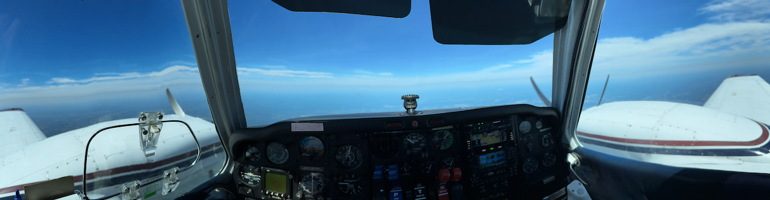
One of my goals for 2013 is to continue my aviation education and skill-building. Another is to do more writing (and photography) on aviation-related topics. To do this, I’m kicking off a new habit: Flying Fridays. While it would be great if I could guarantee that I’d get to fly every Friday, that’s not likely to happen right now. I can, however, guarantee that I’ll have a new blog post every Friday on an aviation-related topic. This might be as simple as a trip report or a tip on how to use a particular feature of an app or avionics device, or it might be more involved. With that in mind, I’d love to hear what my readers are interested in knowing about aviation. I’ve gotten several private e-mails asking questions about various aspects of my flight training, and I’m happy to write about that, or any other topic that catches your interest– leave me a comment here or send e-mail and I’ll add it to my queue.
Category Archives: aviation
Coming soon: do-it-yourself armed drones
I recently finished Daniel Suarez’s excellent thriller Kill Decision. The major plot point: parties unknown have been releasing autonomous, armed drones that are killing people in a variety of ways. The drones are capable of insect-level intelligence and swarming behavior, and of autonomously finding human targets and bombing or shooting them. Suarez asks a fairly provocative question: would America’s love affair with drones change if other countries, or criminal syndicates, or even individuals had them and used them as freely in the US as we use them elsewhere? Great plot, well-written, and solid characterizations– by far the best of his books so far. Highly recommended.
Anyway, with that in mind, I saw an article on the Lawfare blog about a guy who equipped an inexpensive commercial drone with a paintball marker. This video shows it in action, hitting targets easily while maneuvering slowly. The video’s a little fear-monger-y, but the narrator is right: “it seems inevitable” that these drones will be used in ways the manufacturer didn’t anticipate. I sent the video to a couple of coworkers, one of whom asked “I wonder how hard it is to shoot accurately with it?” That got me to thinking… so off the top of my head, I jotted down a few factors that would affect the accuracy of a firearm-equipped drone. Note that here I’m talking about an autonomous UAV, not a remotely-piloted, man-in-the-loop drone.
- What’s it for? What kind of range and endurance do you need? It would be easy to build a sort of launch rack that would launch a drone to check out a target that triggered a tripwire, motion detector, etc. It’d be a little harder to build one that could autonomously navigate, but definitely doable– as Paul proved with his Charlie-following project. See also: the Burrito Bomber, which can follow waypoints and then deliver a payload on target. Drones to sneak into somewhere and snipe a single target would have different range/payload requirements than a patrol or incident-reponse drone. This drives the weight of the drone (since more range requires more fuel).
- What’s it packing? The purpose of the drone dictates what kind of firearm you want it to carry. Some of Suarez’s drones had short-barrelled .38 pistols, which are plenty good enough to kill from close range but wouldn’t be very accurate past around 35 feet or so. A longer barrel and a heavier round would provide better accuracy, at the cost of weight and size.
- How much range do you need? A sniper drone that can shoot targets from 1500yds is definitely feasible— use a .50 Barrett, for example. It would be heavy and range-limited, though, unless you wanted to make it bigger. In general, heavier bullets are more stable and give you better accuracy, but they’re heavier to carry and shoot.
- How stable is the drone? A light drone that’s sensitive to wind, etc. will be harder-pressed to make accurate shots. Gyrostabilizing the gun platform would help, but it would add a weight and cost penalty (including for power for the gyros, plus the gyros themselves). The bigger the drone, the more sensors, power, and ammo you can carry… but the more noise, infrared, and visual signature it creates. A small sneaky drone may be a better deal than a large, more powerful one.
- What can you see? In other words, what kind of sensors do you have for aiming? How good is their resolution and range? Do they have to be automated? If so, you need to be able to either fire at the centroid of the target or track interesting parts, like wheels of a truck or a person’s head), using machine vision.
- Where are you pointing the gun, and how accurate can you be? What kind of angular resolution does the gun-pointing system have? If you’re willing to slow to a dead hover, or nearly so, you can be very accurate (as in the video above). If you want to go faster, you’ll have a more challenging set of requirements– you have to be able to point the gun while the drone’s moving, and changing its aim point means fighting inertia in a way you don’t have to worry about in a hover.
There are lots of other more subtle considerations, I’m sure; these are just what I came up with in 5 minutes. Any engineer, pilot, or armorer could come up with a couple dozen more without too much effort. Of course, you could just buy a pre made system like this one from Autocopter. Isn’t it great to know they’ll lease you as many UAVs as you need? Just for a ballpark figure, Autocopter quotes an 8Kg payload on their smallest drones– figure 3Kg for a cut-down M4 and that leaves you a reasonable 5Kg for sensors, guidance, navigation, and control.
What could you do with such drones? The mind boggles. Imagine that, say, your favorite Mexican drug cartel cooked up a bunch of these in their machine shops and used them to guard the pot farms they run in national forests. Or say the white-supremacy militia guys in Idaho built some for sovereign defense. Or suppose you built 100 or so of them, staged them inside an empty 18-wheeler with a tarp over the top, then launched them into Candlestick Park during a 49ers game. There are all sorts of movie-plot-worthy applications for these drones, to say nothing of the ones Suarez wrote about.
Meanwhile, the February 2013 NASA Aviation Safety Reporting System (ASRS) newsletter is full of safety reports filed after drones got into airspace where they weren’t supposed to be… and these were piloted, unarmed drones. How careful do you think these hypothetical armed drones would be about respecting the National Airspace System? I think I’ll be extra careful when flying around… that smudge on the windscreen might turn out to be an armed autonomous drone.
Filed under aviation, General Tech Stuff, Musings
Checkride: a drama in two parts
Executive summary: I am now a certificated private pilot, airplane, single-engine land (what the FAA refers to as the PP-ASEL rating).
I’d originally planned to take my checkride on 11 December, just a few days after my previous checkride post. The DPE, Sherry Diamond, met me at Palo Alto right at 9; I had arrived earlier to preflight the airplane and pull the maintenance records to verify that the airplane was airworthy.
Sherry did a great job of concisely explaining the process: we had a few minutes of get-acquainted time, then we reviewed the paperwork necessary for the checkride (including the IACRA application), and she explained that we’d do the oral portion of the exam then proceed to the flight test portion. At any time, she told me, I could discontinue the test without penalty– yeah, right, I thought.
Briefing done, we started the oral portion of the exam. There were no surprises here: she asked me questions about weather, night operations, aircraft systems (example: “does this airplane have any deicing equipment?” “Not really; just a heater and defroster, but it’s not approved for flight into known icing anyway.”), and other topics specified in the PTS. I reviewed the maintenance records with her, then we discussed the planned route of flight: from KPAO east across the Bay to the east side of I-880, then south to pick up US 101, then continuing on along a route I carefully plotted with checkpoints. As I briefed her on the route, I explained why I’d chosen that particular route, what the weather briefers had told me about enroute and destination weather, and so on. She asked a few additional follow-up questions and then asked me if I was ready to go to the plane. Was I ever!
We went to the plane, where I gave her a quick passenger brief ( a required element of the PTS). After that, we strapped in and I started the plane, completed my pre-taxi checklist, called Palo Alto ground to get taxi instructors, and taxied out for takeoff. After the runup, Sherry asked for a short-field takeoff and I gave her a good one, then I demonstrated power-off and soft-field landings.
On my next takeoff, I started flying the planned route… but not for long; Sherry told me that the weather at our destination was below minimums and that I should divert to Hayward. I planned the diversion without incident, then it was off to the practice area for airwork.
My airwork was a little raggedy; in fact, I muffed the power-on stall, a maneuver that’s supposed to simulate an accidental stall during takeoff. I didn’t take off enough power at stall entry, so my pitch angle was too high. I knew right then that I’d failed, which was aggravating for two reasons– the obvious one, plus the fact that I hadn’t failed on the recovery from the stall but on the entry. The whole point of that maneuver is to test whether you can safely get out of a situation that you should never get into in the first place.
We headed back toward Palo Alto and she gave me a simulated engine failure over Fremont. I was rattled from my previous failure, so I put the flaps down too early and failed to maintain the correct airspeed (a topic on which I’ll have a lot to say in my next aviation post, in fact). I wasn’t too upset about that, since I’d already failed the ride. We headed back to the airport for a debrief; Sherry and Andy were both encouraging, but I was crushed.
It’s fair to say that I went through the standard mourning process over the next couple of days, but it didn’t take me long to realize that it was no one’s fault but mine: I had failed to meet the practical test standards, so I determined to redouble my efforts and fix the deficiencies.. and that’s exactly what I did! We rescheduled the checkride for 21 December, but the weather was terrible; with the intervening holidays, 8 January was the first date that Sherry had open.
In the interim, I practiced a whole bunch. As promised, I’ll cover that in another post later.
Tuesday morning dawned bright and clear; I packed my flight gear and went to work until it was time to meet Sherry at the airport. This ride promised to be shorter since we didn’t need to repeat the oral exam or any of the other stuff I’d previously practiced. After reviewing the paperwork again, a process made more challenging by a balky computer, we headed out to the airplane. After a normal takeoff, I took us to the practice area, avoiding conflicting traffic twice, demonstrated recovery from both power-on and power-off stalls, and headed back across the Bay towards Palo Alto, whereupon Sherry promptly gave me a simulated engine failure. I handled this one much more gracefully, maintaining the right airspeed throughout. With that done, she had me fly back to Palo Alto, whereupon I stuck a very nice short-field landing– one of my best ever, in fact.
We taxied back to the parking area in silence; after I shut down the airplane, Sherry extended her hand and said, simply, “Congratulations.”
We had a short debrief that covered her impressions of my performance, then we used the computer to print out my Temporary Airman Certificate. This is exactly like a temporary driver’s license; I’ll use it until I get the nice laminated plastic one from the FAA in Oklahoma City. In the meantime, though… I’m a pilot!
Filed under aviation
“Go or No-Go: Heading North”
Air Facts Journal is one of my favorite web publications. I’ve been reading Richard Collins since I was a wee lad (thank you, FLYING Magazine) and the other authors and editors there are every bit as good– I learn something from just about every article. One of my favorite features is their “Go or No Go,” in which you’re presented with a realistic scenario involving a flight: you’re in city X, you want to get to city Y, here’s the weather, here are any other pertinent facts… do you go or not? The discussions around these articles have been really helpful in pointing out to me what my personal minimums and comfort levels are at this stage of my aviation career (which I intend to be long-lived, thus my interest in learning from the experiences of others).
This week’s “Go or No-Go” involves the world’s most famous freight pilot:
Talk about “get-home-itis.” Your trip today is the final leg of a marathon freight dog run, with over 1 billion legs in the logbook so far. The flight has gone flawlessly, but you’re dead tired and would really like to get home to the Mrs. (Claus, that is). But just because you’re the big red man doesn’t mean you can skip the weather briefing, so you take one last glance at your iPad before takeoff.
It shows a good deal of white stuff out there and some serious fog, so it looks like your last flight won’t be easy. The good news is you are very current (23 hours in the last day) and your Mark IV sleigh is in excellent condition. You also don’t have to worry about running out of fuel tonight–you started using renewable energy sources long before it was fashionable–so you can deviate if you need to.
Read the report below and then tell us if you’re going or canceling.
Even if you aren’t a pilot, it’s worth looking at the scenario to get a sense of some of the factors that can influence, positively or negatively, a decision to complete a planned flight. The other scenarios they’ve published make for interesting reading too.
Filed under aviation
Santa’s checkride
The FAA requires that pilots have what’s known as a biennal flight review, or BFR. Every two years, you have to fly with an instructor, who’s supposed to point out anything you need to work on. Of course, pilots who fly charter, passenger, or cargo flights may have additional “line checks” or other check flights.
To prepare for his checkride, Santa had the elves wash the sled and bathe all the reindeer. Santa got his logbook out and made sure all his paperwork was in order. He knew the examiner would examine all his equipment and truly put his flying skills to the test…
The morning of the checkride arrived. The examiner arrived promptly, introduced himself, and started the inquisition with a barrage of questions. Moving to the hangar, the examiner walked slowly around the sled. He checked the reindeer harnesses, the landing gear, and Rudolph’s nose. He painstakingly reviewed Santa’s weight and balance calculations for the sled’s enormous payload.
Finally, they were ready for the checkride. Santa got in and fastened his seatbelt and shoulder harness and checked the compass. Then the examiner hopped in carrying, to Santa’s surprise, a shotgun.
“What’s that for?!?” asked Santa incredulously.
The examiner winked and said, “I’m not supposed to tell you this ahead of time,” as he leaned over to whisper in Santa’s ear, “but you’re gonna lose an engine on takeoff.”
(hat tip to John at Golf Hotel Whiskey).
Filed under aviation
Endeavour fly-by
[ this is pretty old– the flyby was 21 September 2012, and I just found this post lingering in my drafts folder. I wrote it with the intention of finding an aviation outlet for it. It would have been much more interesting had I posted it sooner– sorry about that. It turns out that no one wanted a “real” article on the flyby, so I’m publishing this– better late than never.]
“Once in a lifetime” is a perhaps overused phrase. However, with the demise of the Space Shuttle program, almost everything associated with the program has entered its last phase. Endeavour was the last of the shuttles to be built; it was a replacement for Columbia. It is thus fitting that it was the last Shuttle to be retired, and when I found out that its farewell flight would take it through the Bay Area I made plans to see it. NASA announced the route of flight and a tentative schedule a couple of weeks in advance, but I didn’t start planning seriously until a couple of days ago. My first stop: an email to the press coordinator at NASA Ames, asking for press credentials on behalf of Windows IT Pro. Astute readers will know that they don’t usually publish aviation stories (and I am working on a real article for a real aviation publication) but I figured it was worth a shot. Sure enough, they put me on the press access list.
A few coworkers and I got to talking about how to best take advantage of this once-in-a-lifetime opportunity, and the game was afoot.
The first decision: where would the best viewing be? The route of flight was supposed to take the Shuttle from south to north. At first it looked like the Palo Alto airport might be the simplest place to go: limited crowds, no problem with parking. However, we weren’t sure exactly what path it would take, and I was worried that we wouldn’t get a good angle from the accessible areas. Eric suggested a spot in the wildlife refuge but we ruled that out as well. With press credentials, we reasoned, we shouldn’t have any problem getting on base or getting a good spot.
Eric picked me up at a nearby Taco Bell about 8am and we made our way to the Ellis gate, where we were quickly admitted and directed to the press area. The helpful NASA PAO staff gave us credentials, and we bumped into fellow Acuitan Tim, whom we deputized as a backup photographer. We tried to buy breakfast, but the food trucks were largely out of food since they had opened at 0600, thus illustrating something about early birds and Belgian waffles. As we walked through the line of booths that NASA Ames had set up to showcase their work, I was surprised and pleased at how many young kids were there. The crowd vibe was surprisingly upbeat given the fact that, when you think about it, this was a sad occasion: the final flight of the last of the United States’ fleet of man-rated spacecraft.
The flight operations building was where we’d planned to watch the flyby. Our press credentials got us in and we made our way through the building to the back apron. Here’s a sample of what it looked like from ground level.
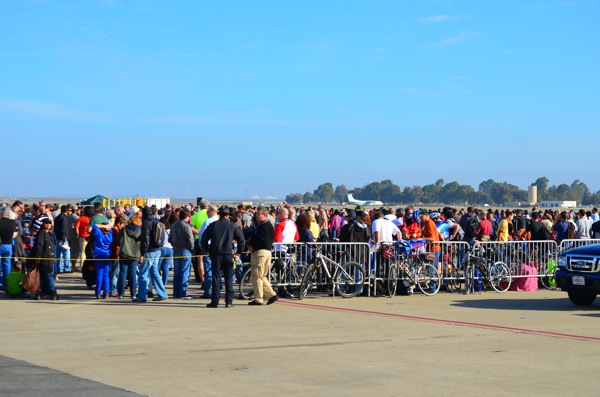
We heard estimates of the crowd size ranging from 13,000 to 20,000; I didn’t get a final count from the Ames PAO but it was a large and cheerful crowd.
I made a few exploratory forays to the parking apron to see if anyone yelled at me for being out there. No one did, so our first plan was to set up our tripods out there when the Shuttle got closer, on the theory that setting up too soon might get us ordered back to the seating area. In the meantime, though, we went inside the building to have a look around. Seeing a stairwell, Eric suggested we go see what was on the second floor; Tim volunteered to watch the camera gear and Eric and I went upstairs. The second floor is dedicated to offices for the control tower– Moffett Field, of course, has its own Class C airspace with a control tower, and that tower happens to be located on top of the building we were in. At the end of the hall, we came to another stairwell; a quick exchange of glances was all it took to convince us to go up and see what happened. There we were greeted with an imposing site: a big, black metal gate with a sign warning us not to enter. The gate, however, was open, and we could hear voices coming from above– so after a bit of consultation, during which I believe the word “bail” may have been used once or twice, up we went.
Soon enough we found ourselves on the outside of the control tower. There were some other folks on the east side of the tower, in full sun; we had a shady corner on the west side to ourselves. Amazed at our good fortune, Eric went to go get Tim and the camera gear. He then got to meet the tower chief, who was a little aggrieved that the media was invading the outside of his tower. Eric and Tim were able to convince him to let them rejoin me up top, as you can see below.

Here are Eric and Tim enjoying a moment of peace and quiet before they started slinging camera equipment around.
(I should note that this picture was taken with a Nokia Lumia 800, the camera software for which is about a million times better than the iPhone’s built-in app.) The elbow you see in the extreme right of this picture belonged to Pat, one of the tower managers; he was very friendly and was kind enough to keep us informed about where the Shuttle was during its flight. We had been expecting the Shuttle to fly down the length of the runway from the south; turns out it was going to approach from the north, meaning that it should have come from right next to Tim’s head in the picture above. We set up our cameras: Eric and Tim had theirs on tripods; I had a camcorder on a monopod and my D5100 around my neck.
We waited; the PA announcer would occasionally give the crowd updates, and at last the call came telling us the aircraft were only a couple of minutes out. We readied our cameras. Surprise! Rather than flying along the runway centerline, as the PAO (and announcer) had repeatedly told us would happen, the Shuttle stack flew along 101– to the west of Moffett– on our side of the control tower! Our seeming bad luck at getting a spot away from the runway turned out to be perfect luck indeed. The Shuttle’s chase aircraft flew down the runway centerline, but I doubt anyone was paying much attention to it.
The actual flyby… wow. I was too busy taking pictures with my camera to notice which way the camcorder was pointed, so I didn’t get any video, and some of my pictures are poorly composed because I was eagerly watching the flyby with my Mark 1, Mod 0 eyeballs instead of looking at the camera. Here are the two best of the resulting pictures:


After the flyby, the crowd slowly dissipated; it took us about half an hour to exit Moffett and get back onto 101.
Filed under aviation, California
Checkride: the last days
Part of the reason I’ve been so quiet lately is that I’ve been preparing for the check ride for my private pilot’s license. I’ve written before about the requirements for the check ride; just as with your driver’s license, to get a pilot’s licenses you must demonstrate competency by passing a practical test. Before you are allowed to take the practical test, you must pass a written exam and meet some minimum requirements for the amount and kind of training you need. I have met all the minimums– including flying at night and flying without outside visual reference, using flight instruments alone– and have a check ride scheduled for next week. Since early September, I’ve been practicing various maneuvers and studying the body of knowledge that the examiner will expect me to demonstrate competence in. About a month ago, I got the nod from my instructor: “It’s time. Call the examiner and schedule your check ride.”
Of course, I did so immediately and was crushed to find out that she couldn’t schedule me until mid-December. Undaunted, I took the first available date and kept on studying and learning. One big focus area for me was landings. The practical test standards require that the applicant demonstrate four kinds of landings:
- the “regular” kind
- power-off landings: at a point on the downwind leg of the traffic pattern, you pull the throttle to idle and glide to a landing on the selected runway
- short-field landings, in which you must pick a point on the runway and land within a specified distance after (but not before) it. This simulates approach and landing to a short runway, or over an obstacle such as a tree, crane, or tower in the approach path. The key to making great short-field landings is airspeed control: if you are going too fast when you cross the runway threshold, your airplane will float on seemingly forever, causing you to miss your touchdown point.
- soft-field landings, which you might use to land on grass, sand, a plowed field, or other non-paved surfaces. The key here is to land the airplane as softly as possible, which requires quite a bit of finesse (not to mention excellent airspeed control) and to use aerodynamic braking instead of the wheel brakes to slow down.
For extra fun, you can combine these– imagine, for example, that you need to land in a plowed field after an engine failure and you have a power-off soft-field landing. And, of course, there are short- and soft-field takeoffs, too. Being able to do these consistently is critical, because each type of takeoff and landing has characteristic speeds and distances that the examiner will evaluate. I can honestly say that my landings have improved beyond the point I thought possible– if you’d told me a year ago that I could land my airplane safely in 500′ of runway I wouldn’t have believed it.
FAA check rides are supposed to be based on realistic scenarios. Here’s the extent of the guidance I got from the examiner:
I’m planning on meeting you at 9am (traffic permitting). You can plan xctry to KPRB, calculate takeoff and landing distances over a 50ft obstacle and I’m 120lbs with no bags for weight and balance. Go ahead and preflight and assure fuel is as desired.
I have a destination and I know how much payload I need to haul (in this case, right about 300 lbs). Other than that, the route, fuel on board, altitude, intermediate stops if any, and every other aspect of the flight are up to me as the pilot-in-command (PIC). This nicely reflects the common uses for light aircraft: go to a specified destination with a passenger, with all the other factors being subject to the PIC’s judgement. To meet the requirements for this scenario, I need to be able to show the examiner a solid flight plan, taking into account weather, terrain, airport availability, and any other considerations that might impact my ability to get us safely there and back. (The only slightly unusual aspect of this plan is that my flight plan needs to include obstacle clearance; there currently aren’t any obstacles at Palo Alto or Paso Robles, but the FAA requires that applicants show that they know how to plan for obstacle clearance, so thus it shall be.) I need to show that I can file a flight plan and deal with air traffic control (ATC) as we fly, including canceling the flight plan when we divert and dealing with any instructions that ATC may give us en route.
Before we get to that point I have to prove that the airplane is airworthy, which I’ll do by showing that its maintenance records are up to date and that any required inspection or maintenance has been performed. This is really part of the oral exam, which is more or less continuous: the examiner will be evaluating my knowledge from the minute I shake her hand and say “hello” until she signs my temporary license. The examiner can ask anything she likes about any aspect of what private pilots are supposed to know, and I’d better be able to answer correctly. She is also expected to create what the FAA calls a “realistic distraction” to see how I handle it; this means she can try to distract me by talking, dropping an object and asking me to pick it up, or anything else that a passenger might reasonably do in flight.
Will we actually fly to Paso Robles? Nope. At some point along the route, the examiner will divert me to an alternate destination, simulating a change in weather at the destination or perhaps a passenger who has to go to the bathroom RIGHT NOW I MEAN IT. The examiner will also simulate an in-flight emergency that requires a simulated emergency landing. She can also fail, or simulate failure of, anything else in the airplane, including navigation and communications systems. I’ll also have to demonstrate the maneuvers called for in the PTS, which will be done somewhere along our route of flight.
There’s a surprising amount of paperwork that has to happen first. The FAA uses a system called IACRA to process applicant paperwork. I had to fill out an application in IACRA, then my flight instructor had to log in to IACRA and approve it; along with an endorsement in my logbook, this signals the examiner that I’ve met the skill and knowledge requirements to attempt the practical test. Updating my logbook and completing the IACRA paperwork took me a couple of hours, but I finished it this morning. All the paperwork is done, so all I need now is a good night’s sleep on Monday and good weather on Tuesday!
Filed under aviation
Air traffic control call signs
I am a huge fan of LiveATC.net. I often listen to the San Jose airport control tower and/or NORCAL Approach as background noise at home, in the office, or while driving; it is always interesting and often educational. One of the most interesting things I’ve heard is the variety of callsigns for different aircraft and operators. Some of these are pretty prosaic– if you hear “UPS 9336 Heavy” or “Southwest 229” that tells you everything you need to know. There are some others that are more colorful, though:
- “Traffic Watch” is a popular call during rush hour.
- Stanford (“Stanford One”) and several other medical helicopter operators are unpredictably active; you never know when they’ll pop up.
- There’s at least one Boeing Business Jet operating out of SJC with the call sign “Boeing 1 Tango Sierra”; I haven’t taken the time to figure out whose it is, but I’m betting Google.
- “Redstripe” is the call sign for JetSuite, a private fractional-ownership jet company.
- I’m not sure who owns the “Starbase” call sign but it sounds cool on the radio. The only references I could find to it were here and here, and they’re inconclusive. (Looks like the FAA thinks the second one is dispositive.)
- “Dotcom” is an umbrella call sign offered by FltPlan.com; you can sign up for their service and then use one of their calls (e.g. “Dotcom 521”) instead of your aircraft registration number. This is useful to keep your competitors (or other interested parties) from performing physical traffic analysis on your airplanes.
There’s a pretty good list of airline callsigns that covers many international airlines, and it looks like the FAA’s official list is here (for some reason it doesn’t seem to be well indexed in Google). Other fun callsigns on the FAA list: Sputter, Jigsaw, Flapjack, Raptor, and Argonaut. Maybe I should print out a copy and start checking off the ones that I hear!
Filed under aviation
Please stay home, Mr. President
Our dear leader, President Obama, is coming to the Bay Area on Monday. (Why he’s coming is unclear to me; it’s not as though Romney has any chance of winning California, so I presume it’s so Obama can raise money from his legions of wealthy fans out here.)
Anyway, the point of this post is to point out what happens when he’s here. The picture below will help illustrate my complaint.
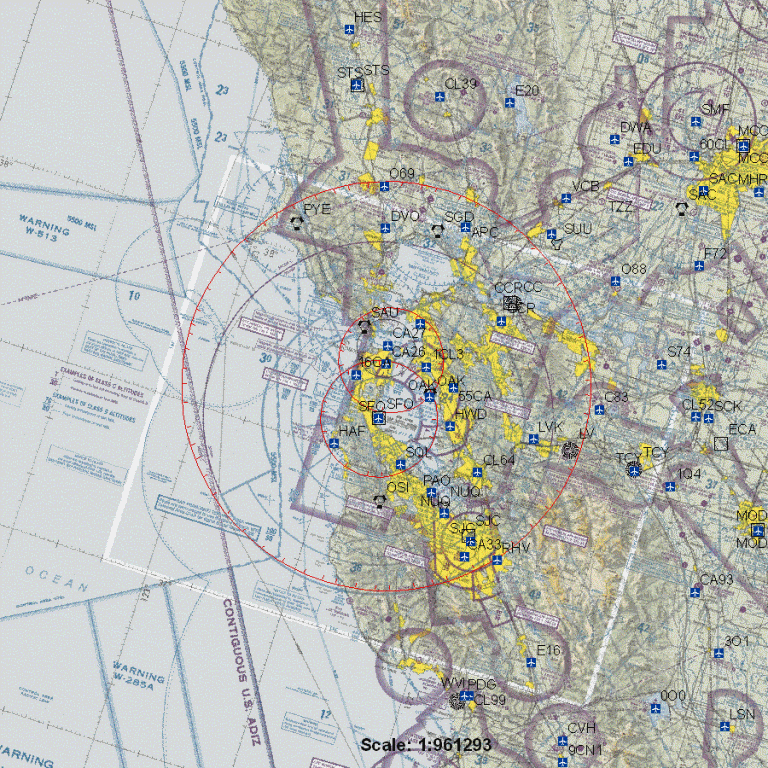
See those red rings? During his visit, most private aircraft are essentially not allowed to fly within those rings; flight training (and cropdusting, and animal control, and a long list of other operations) are specifically prohibited, and there are other restrictions. Commercial passenger and cargo flights are exempt, luckily (otherwise AA passengers departing SFO Monday would be in even more trouble, hey ho!)
The largest ring is a 35-nautical-mile radius centered around the San Francisco (SFO) VOR. That takes in the Palo Alto, San Jose, Oakland, and San Carlos airports. So from 1pm Monday until 10am Tuesday, the dozens of instructors and hundreds of students training at those airports are grounded. That means an immediate loss of several thousand dollars per instructor– and the losses are greater for flight schools themselves.
More to the point, this is just a further delay in my pursuit of my license, as I can’t fly during that time unless I am actively, y’know, going somewhere.
Oh, and the best part: the geographic and time restrictions of this temporary flight restriction can change at any time. So I could, in theory, inadvertently and innocently violate it if it changes while I am in flight. This is rare and unlikely, thank goodness.
So thank you, Mr. President. I’m glad you’re doing your part to help the economy. See also previous helpful contributions here and here. (substitute “Bush”, “Romney,” or the name of your favorite post-9/11 president above if it makes you feel better, although President Obama has been a worse offender in this respect than was President Bush.)
Thursday trivia #72
- Last week’s 311 show was as good as I expected it to be. I’m already looking forward to their tour next year.
- Rwanda has an awesome national… I’m not sure what to call it. It’s not a holiday, and it’s more than a tradition. By law, on the last Saturday of every month, everyone cleans. Known as umuganda, it’s a long-standing event that goes back to colonial times. Business close, public transport shuts down, and all able-bodied people between 18 and 65 clean from 8am until 11am. What a fantastic idea.
- I learned the preceding, and much more, from this thoroughly interesting article on Rwanda. I think I’m going to have to add it as a bucket-list destination.
- If you are easily grossed out, do not read this article. No, seriously. I really mean it.
- If you’re a Breaking Bad fan, I commend this remix video to your attention.
- “Who would buy once-radioactive beer? I mean, besides me.” /raises hand.
- Last week I wrote about the process of preparing for my checkride. This guy passed his checkride… after two of the blades on his propeller fell off. I bet everything after the emergency landing was easy.
Filed under aviation, General Stuff
Checkride prep, 1 Sept
It’s getting close!
To get a pilot’s license or rating in the US, you have to pass a practical examination with an FAA examiner.
Side note: “What’s the difference between a license and a rating?” you ask. A license gives you flying privileges for a particular category and class, such as “airplane, single-engine, land” or “Zeppelin.” A rating gives you additional privileges for whatever licenses you hold, such as an instrument rating (which you use in conjunction with a single- or multi-engine airplane license, a helicopter license, or whatever.)
The examiner may be an FAA employee, but more often is what the FAA calls a DPE: a designated pilot examiner. Think of the DPE like a sort of super-instructor: a civilian instructor who handles practical exams for the FAA and has the power to grant, or deny, your license based on your exam performance. Each FAA field office has a list of DPEs to which it has delegated this authority (here’s the San Jose list.)
How do you know what the examiner will test you on? There’s a document for each license and rating known as the Practical Test Standard, or PTS, that tells you. For example, the parachute rigger PTS spells out exactly what a parachute rigger must know; likewise the PTS for various pilot licenses. The PTS I’m working on is here; it sets out three things:
- What the examiner may and must test the applicant on during the oral exam. Most of these descriptions are very broad, and include the phrase “exhibit knowledge.” The DPE can ask you pretty much anything as a means of seeing whether you can exhibit knowledge; there’s no category of things they cannot ask you.
- What maneuvers the examiner may and must test. Most of these are self-evident: climbs, turns, descents, straight-and-level flight, steep turns, and so on. In a few cases, the examiner can choose one (or more) maneuvers from a list.
- What performance standards each maneuver requires. For example, a steep turn requires 45° of bank, ±5º, and you must maintain altitude ±100 feet.
As you might imagine, the practical examination is a big deal. Before you can take it, your CFI has to give you a logbook endorsement indicating that you’re ready. This endorsement means that your instructor thinks you’re prepared for both parts of the check ride: the oral exam and the practical flight test. Preparation is super important. I’ve been studying the PTS so I know the required precision for the maneuvers, practicing the maneuvers both with my instructor and solo, studying the ASA check ride exam prep guide, and watching the King Schools check ride prep course. Of these things, the most important is the flying practice. The two things I need to nail down are crosswind takeoffs and landings and short-field landings; more on those in the next post.
Filed under aviation
Long solo cross-country, 4 July
What better way to celebrate Independence Day than to exercise my Constitutional right of free travel? That’s right: “free” as in “not encumbered by TSA or any of their baloney.”
The FAA requires that private pilots know how to plan and safely execute what they call “cross-country” flights. I’d already flown one with Andy from Palo Alto to Columbia, but the FAA requires that private pilots plan and carry out a cross-country flight of at least 150nm total distance, with one leg being at least 50nm and landings at 3 separate airports.
Andy had originally asked me to plan a flight from Palo Alto (KPAO) to Paso Robles (KPRB) to Salinas (KSNS) and back to KPAO. The first leg to Paso Robles is 129nm, so the total trip distance would meet all the FAA’s requirements. In my earlier post I gave a quick summary of what it means to construct a VFR flight plan; here’s a slightly more detailed list:
- Puled out a bunch of paper charts: my San Francisco and Los Angeles sectional charts and my San Franciscoterminal chart. Sectional charts are large-scale charts that show terrain features, airports, roads, navigation aids, and other useful items at 1:500,000 scale. Terminal charts show a smaller area at double the scale, so they’re great for navigation planning in urban areas.
- Used the paper charts to plot a direct route of flight, using a straightedge and a Sharpie marker to lay out my course. Paper charts cost about $9 each, so you might wonder why I’d be willing to deface them with a Sharpie. The truth is, they expire after about 5 months, so you may as well mark on them.
- Used the route of flight to identify checkpoints– visual features on the ground that I can look at to tell where I am and what my progress along the course is. There are some well-known visual checkpoints already marked on the sectionals. For example, VPSUN is the golf course at Sunol, while VPMOR is the LDS temple in Oakland. You can use these as reporting points; for example, I can call the Palo Alto tower and say “Palo Alto, Cessna One Niner One Tango Golf, overhead Leslie Salt, landing Palo Alto with Juliet.” That doesn’t mean Juliet’s in the airplane; rather, it means that I’m reporting being overhead the Leslie Salt Company’s salt refinery with ATIS information— a radio broadcast telling me what the current airport weather and runway conditions are– Juliet.
- Measured the distance between checkpoints and put that into my navigation log.
- Got a weather forecast showing the projected winds aloft and used those to calculate the amount of wind correction necessary for each leg.
- Used the wind and airspeed data to figure out how long each leg would take to fly, or, in other words, the ETA to go between each pair of checkpoints
- Used the ETA data to estimate fuel consumption for each leg
- Reviewed the airport data, including which runways exist, whether they were open or closed, any restrictions on their use, what the standard traffic patterns and altitudes were, and so on.
After doing all that, I reviewed the weather forecast and saw that Salinas and Monterey were both fogged in. That didn’t bode well for my planned route, but I went to the airport anyway to meet with Andy and discuss my flight plan. Student pilots have to have an instructor’s logbook endorsement to legally do the long cross-country, you see, so meeting with him was a precondition to taking off. I reviewed the route of flight with him and pointed out some alternate options given that I couldn’t overfly the fog areas. He suggested a completely different route: over the hills to Tracy (KTCY), then down to Los Baños (KLSN), then to KPRB, and then back either direct (if the fog was gone) or by reversing that route. I replanned the route, got his endorsement, and went to check out the airplane I’d reserved… except that it was gone.
OK, OK, I exaggerate… a bit. The automated scheduling system that Advantage uses expects that you’ll sign out the airplane at the scheduled time. If you don’t do so within 30 minutes of your scheduled time, the system puts the airplane back in the available pool. I had an 0800 reservation, but at 0830 I was still meeting with Andy, so the plane became available and someone else grabbed it. Luckily there was another G1000-equipped 172 available at noon, so I took it instead.
Before I took off, I asked Palo Alto ground control for VFR flight following. This is essentially radar surveillance; air traffic control assigns you a unique transponder code that identifies your aircraft on radar. ATC will issue traffic and safety advisories, notifying you of other aircraft in your vicinity and so on. As you leave each bubble of radar surveillance, ATC hands you off to the next one. For my flight, I started out with Palo Alto and was handed off to NORCAL Approach, the TRACON (or terminal radar approach control center) that owns the airspace over most of northern California. I stayed with NORCAL until I got to an area outside their control, at which point they handed me over to Oakland Center, the air route traffic control center (ARTCC) that provides radar services outside of TRACON-controlled areas.
Anyway, one of the benefits of flight following is that you get traffic advisory calls. I got several on my route towards Tracy; that airspace is heavily traveled as people fly into and out of Palo Alto, Hayward, San Carlos, and the other airports in the area. My favorite call? That’s easy: “Cessna Two Hotel Golf, traffic your 1 o’clock, 2 miles, 5000 feet northbound, flight of two F-18. Hobo 51, traffic your 11-o’clock, 2 miles, 3000 feet eastbound, Cessna 172.” Sure enough, there went two F-18s zipping past, too fast for me to unlimber the camera and get a picture.
The flight itself was great! Good visibility on the outbound leg; I took off from Palo Alto, made a right Dunbarton, overflew Sunol, overflew the Livermore area, and headed to Tracy. AsHere’s what the Tracy airport looks like from 5500′ up; it looks small from the ground, but those two runways are 4000′ each.

My route of flight from metropolitan Tracy (!) down to Los Baños took me roughly along Interstate 5. To the west there are all kinds of interesting hills; to the east there are a string of smallish towns, plus lots and lots of cultivated land. From the air, the patchwork of different shades of green is absolutely gorgeous.

that salad you’re eating? it probably came from the Central Valley
My approach and landing at Los Baños were uneventful, with a good landing on their runway. The Los Baños airport is uncontrolled, meaning there’s no control tower or radar service. Each aircraft is required to vigorously “see and avoid,” of course, but there’s also a radio frequency on which aircraft in the vicinity announce their location and intentions. So you call to tell anyone listening that you’re approaching the airport, where you’re going, and where you are… i.e. “Los Baños traffic, Cessna Two Hotel Golf, 5 miles north of the field, two thousand five hundred, entering the pattern for landing runway 32”, or whatever. Then you call again when you get closer; meanwhile, other aircraft, if any, are making their own calls. I landed well, taxied back on the parallel taxiway, waited a minute for another aircraft to take off and clear the pattern, and took off to the south.
The route of flight that Andy and I had planned called for me to go from KLSN to New Coalingua airport, then turn southwest for Paso Robles.. so that’s what I did, being careful to stay out of the Lemoore military operating areas (MOAs). Andy warned me that I’d know when I was getting close to New Coalingua because I’d be able to smell Harris Ranch. I thought he was pulling my leg, but, sure enough, I could smell the stockyards from more than a mile up and several miles lateral distance. I made the turn before C80 and found Paso Robles right where it was supposed to be. I landed, taxied in to a parking spot, and went inside to find out if they had any food, having neglected to pack anything. They didn’t, but the kind folks at Paso Robles Jet Center loaned me a crew car so I could drive into town and eat at Margie’s Diner. As advertised, the diner had extremely large portions, which suited me just fine. I had a delicious grilled ham-and-cheese and two large diet Pepsis; meanwhile, the line crew refueled my plane so that when I got there (after a brief encounter with the airport’s resident cat) I was ready to go. I took off and headed to the northwest, towards Salinas, but there was a huge layer of haze that looked like it covered pretty much my entire route of flight.
Haze, of course, diminishes visibility rather than eliminating it. It wouldn’t have been legal for me to overfly an area of fog that obscured the ground completely, whereas I could have legally flown over the haze. However, “legal” and “prudent” don’t always mean the same thing, so I elected to go back the way that I came, mostly. Instead of going back to C80, I cut the corner by flying to the Priest VOR, then to the Panoche VOR, then telling the G1000 to take me back towards Tracy and thence to Palo Alto. On the way back, I practiced using the GFC700 autopilot in the airplane a bit. This might seem contradictory– why use the autopilot at all as a student? There are several good reasons. First, I want to know how every piece of equipment in the airplane works so that I can get the most utility from it. Second, for instrument flying the autopilot is a tremendous aid because it can keep the aircraft pointed in the right direction at the right altitude while the pilot aviates, navigates, and communicates. Third, one of the things you’re required to demonstrate on the FAA check ride is what the FAA calls “lost procedures”– in other words, what do you do if you get lost? I want the option to be able to tell the autopilot to keep the wings level and altitude steady while I’m rooting around looking for charts or whatever. Fourth, it’s cool. Anyway, I spent some time refreshing my knowledge of how to set up the autopilot to track a heading and maintain an altitude. There are many more sophisticated things it can do that I haven’t started exploring yet, like fly a profile such that you end up at a specific altitude over a specific point on the ground. That will come with time.
Coming back I had a great view of the San Luis reservoir, near Los Baños; see below.

There was a bit of haze, but off to the west I could still see heavy haze on my original planned route, and I was perfectly happy to see it over there instead of underneath me. My approach through the hills and the east side of the Bay went well, and I nailed the landing back at Palo Alto. 4.0 hours of pilot-in-command and solo cross-country time for the books!
Filed under aviation, California
Airwork, 4 June
There’s an old saw in aviation: to be a successful pilot, all you have to do is make sure that your lifetime total of takeoffs and landings match. With that in mind, student pilots spend a fair amount of time practicing various kinds of takeoffs and landings to become proficient. In this particular session, we worked on soft-field takeoffs and landings.
One thing that many non-pilots assume is that airplanes can take off or land pretty much anywhere. This is true for some values of “airplanes” and “pretty much anywhere.” It’s true that almost any reasonably level surface of sufficient length can be used as a landing strip, but some airplanes are much better suited to what we call unimproved strips– those that aren’t paved– than others. If you watch almost any TV show involving Alaska, for example, you’ll see lots of video of airplanes landing on grass strips, dirt, gravel or sandbars in rivers, snow, and ice. Some of these airplanes will have tricycle gear (meaning a nose wheel and two main gear located under the fuselage), while others will be taildraggers (which use a steerable wheel under the tail, along with two main gear). Some will have skis, while others will have big bush tires. But what about your everyday, run-of-the-mill Cessna or Piper? It turns out that they can operate just fine from many kinds of unimproved runway, including grass and dirt strips. More to the point, though, in case of a precautionary or forced landing, it’s really important to know how to take off and land safely on soft-surfaced runways, so we practice it.
For a soft-field takeoff or landing in a tricycle-gear airplane, one key is to try to keep the nose wheel off the ground as much as possible by keeping the yoke back. As airspeed increases, keeping the yoke back raises the nose, lessening the load on the nose wheel and reducing the chance that it will dig in to the surface and flip the plane over. As you land, keeping the yoke back allows you to convert forward airspeed into lift, which has the beneficial effect of slowing the airplane down quickly without using brakes and while keeping the nose wheel out of the mud, or whatever is on the surface.
To accomplish a good soft-field takeoff, there are a few other things to do. First, momentum is your friend. Once you begin to turn onto the runway, you don’t stop to line up (provided, of course, that ATC hasn’t told you to “line up and wait,” which means that they’ve cleared you to line up on the departure end of the runway and wait for clearance to actually take off while another aircraft lands), and you control your taxi speed such that you don’t have to use the brakes as you turn to align with the runway. As you’re completing your turn, you advance the power smoothly to takeoff power while keeping the yoke back. Once you gain sufficient speed to take off, you add enough up-elevator to leave the runway surface and then immediately push forward so that you don’t climb.
“Wait, what?” I can hear you asking.
Flying machines can benefit from something known as ground effect. This is what makes hovercraft work; an airfoil moving within a certain distance off the ground will generate a sort of cushion of air that provides additional lift and reduced drag, beyond what the airfoil generates on its own. You might remember from a previous discussion that every airplane has a characteristic speed at which it climbs best— it gains the most altitude for each foot of forward motion at that speed. The goal of keeping the aircraft in ground effect is to keep it off the muddy/sticky/grassy surface– which would just slow it down– and allow it to accelerate to best-climb speed as quickly as possible, while surfing the cushion of ground-effect air. This takes some getting used to because your learned reaction to leaving the ground is to put in enough pitch to climb at the desired speed. Instead of doing that, you have to force the aircraft to stay close to the ground until it’s time to climb. This is easy to do; it just requires some extra thought. Once you’ve reached best-climb speed, you can trim the aircraft to maintain that speed, retract the flaps (if you added any), and transition to a normal climb.
Soft-field landings are all about speed. If you’re landing on a soft field it’s a good bet that the field is also shorter than you might like, so you’ll want to slow down your approach. Even if the field is long, though, you’ll still carry 5-10 knots less speed into the approach. For short-field approaches in the 172, I fly 70 knots with the first 10° of flaps, then I slow to 65 knots with 20° flaps and 60 knots with full flaps. If you do it right, you’ll end up in your landing flare doing no more than about 40 knots. Think of what this means in practical terms: if you’re landing on a plowed field (let’s say) because of an engine failure, if you can cut your touchdown speed by 20 knots, you’ve reduced the kinetic energy you’re carrying by a large amount, given that kinetic energy changes as the square of velocity (remember good ol’ KE = 1/2mv^2!)
Short-field takeoffs and landings are different beasts; here the goal is to take off or land within the minimum distance possible, perhaps including clearing an obstacle on the approach or departure. For example, the airfield at Milton, Florida (2R4) is a great place to practice short-field work because there are trees several hundred feet from each end of the runway. These don’t present any real danger, but they make a great target; in a short-field approach, you fly a steeper than usual descent to clear any obstacles, then land a bit firmer than usual– your goal is to avoid any unnecessary float, because float translates to additional distance flown down the runway. You may not have any additional distance to spare. Because it’s late, and I’m sleepy, rather than go on about short-field work I’ll leave this AOPA Flight Training article for those who are interested; it’s pretty good.
Filed under aviation
Pictures from my B-17 ride
I still have to write a more detailed post about my adventure flying in Nine O Nine, the Collings Foundation‘s immaculately restored B-17. I took 3 cameras: my iPhone, a Nikon D5100, and a ContourHD helmet cam (only without the helmet). It was my first outing with the D5100 and the ContourHD both, and I’m really pleased with the results. Check out my Flickr stream for airplane pics; as soon as I get the video edited (which will probably be a while), I’ll post it too.
Filed under aviation, California, General Stuff


