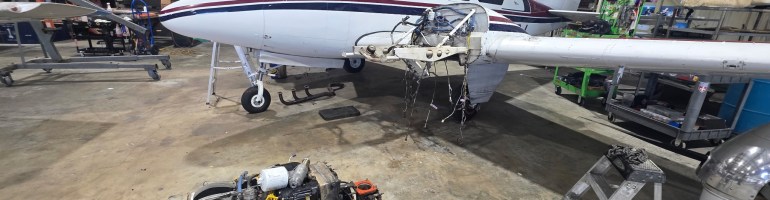
Since my last update, not as much has happened as I had hoped for.
The good news is that the engines are off the plane and in the hands of Poplar Grove Airmotive for rebuilding. This took longer than I wanted it to. I wasn’t really prepared for the feeling of seeing a bare engine mount with an engine sitting on the floor next to it– it’s sort of like seeing a beloved family member or family pet in the hospital.
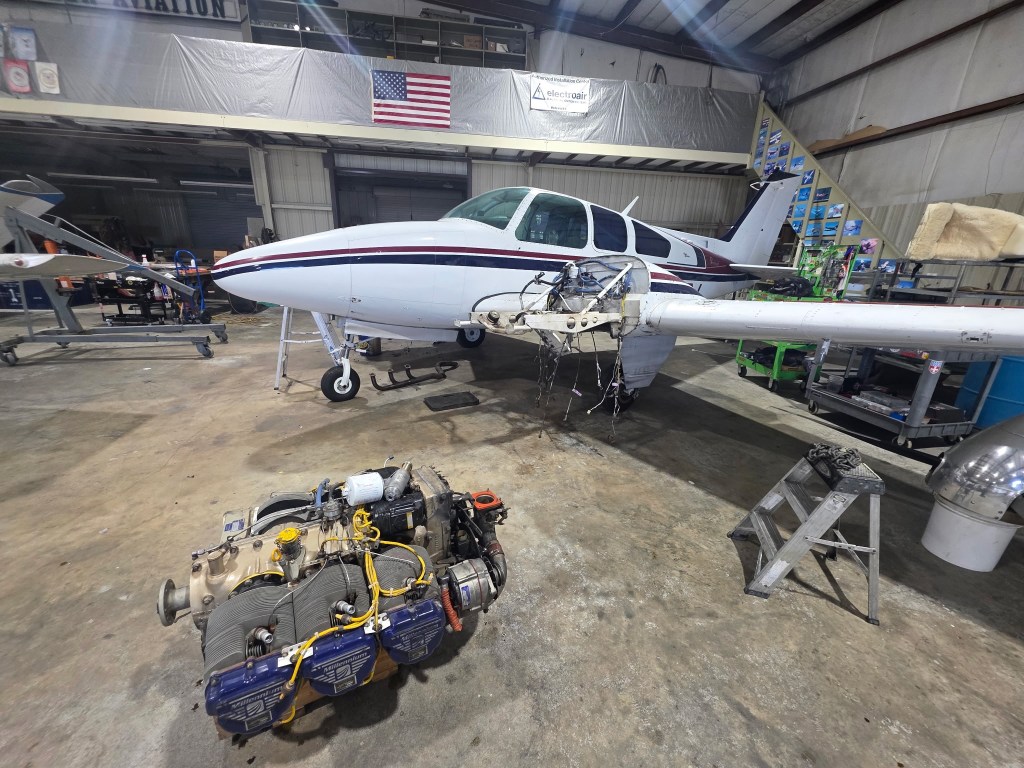
From this angle you can’t see the cracks that condemned this engine, but they are definitely there. In the picture above, the propeller flange is on the left side of the engine; you can see the top of the block and This angle gives you a little bit better view of the engine and its mechanical layout: the individual cylinders bolt onto the case, with the alternator at the bottom right, the magnetos on the top, and the oil filter in the upper right. Here’s another view:
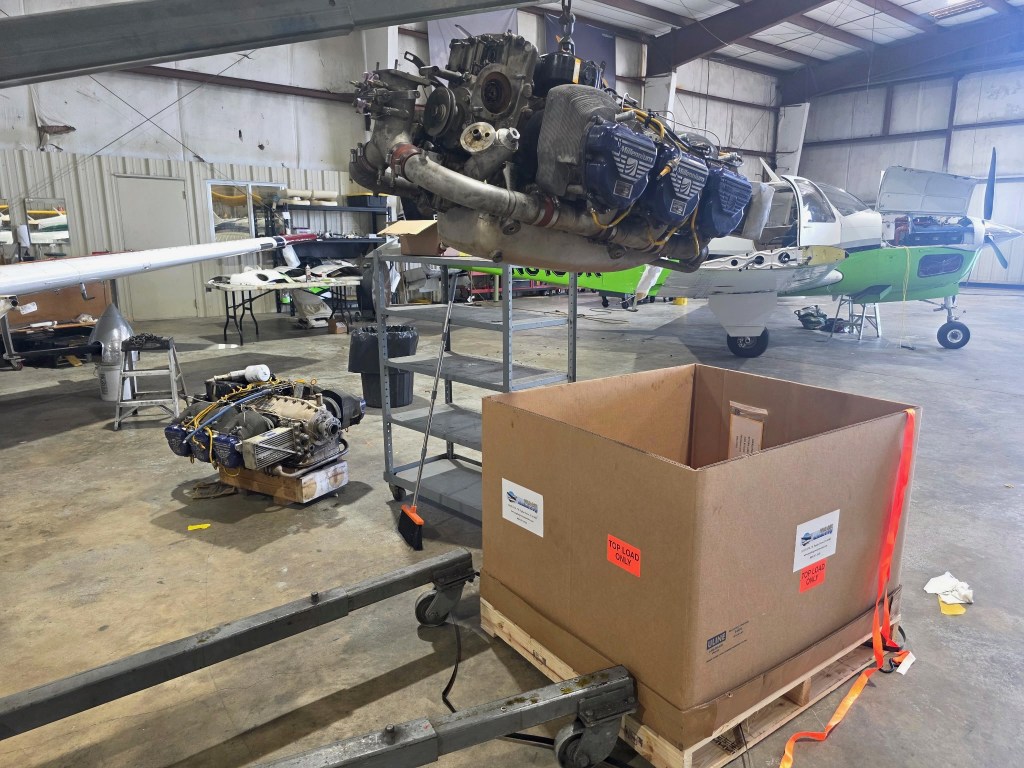
From this angle you can see the induction system; the exhaust is detached and sitting on the floor, so you can’t see it.
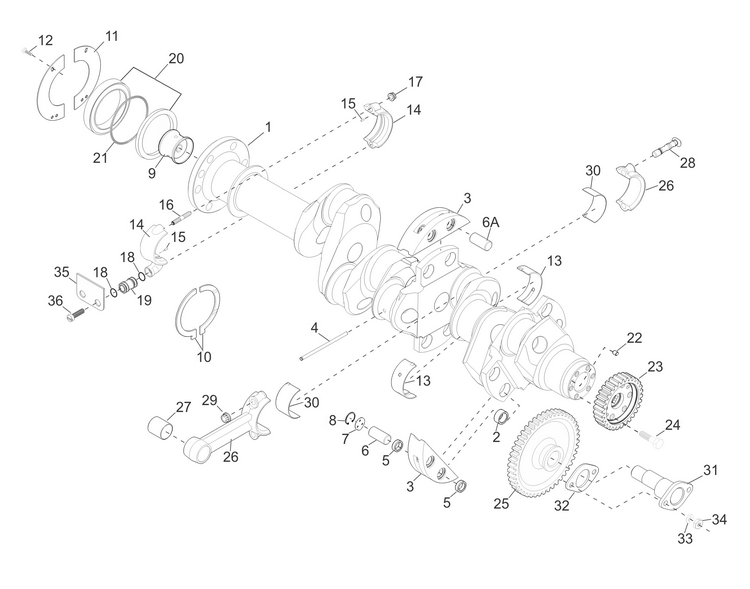
Once the engines were off, Curtis packed them in the sturdy cardboard shipping boxes you see above and off they went to Poplar Grove. Now it’s up to them to disassemble the old engines and build the new ones. This process is pretty involved. Some parts will be dimensioned and tested, then reused if they’re OK– the crankshaft being the most obvious example. Most will be replaced; there are tons of dampers, springs, counterweights, studs, bolts, and so on that aren’t recycled. The diagram below from the engine parts catalog shows the crankshaft itself (part 1) but also the other parts just in that one assembly.
Some of the engine accessories will be replaced with new or overhauled units, while others (like the oil cooler) will be IRAN’d (“inspect and repair/replace as necessary”). The alternators and magnetos are already meant to be inspected and overhauled every 500 flight hours, but the starter, oil pump, and other parts get a thorough review during this stage at Poplar Grove’s in-house shop.
(brief digression: for engine designations, the letters tell you about the induction and fuel, and the numbers tell you the displacement. So an IO-470 is a 470-cubic-inch fuel-injected gasoline engine; a TSIO-520 is a turbosupercharged fuel-injected 520ci engine, and so on. The letters after the displacement number refer to variants of that engine, so an IO-470L and an IO-470K are nearly identical but not necessarily interchangeable.)
The Cygnet STC calls for the installation of IO-520 cylinders, and as I mentioned in the last post, instead of modifying the IO-470 cases I opted for new IO-520E cases, which are dimensionally identical except for the location of the oil filler neck. The cylinders and cases are on hand, and I sent the STC paperwork to Poplar Grove so they have instructions and documentation on what to do.
Now, we wait…


