Category Archives: aviation

Writings about aviation, including chronicles of my flight lessons, product reviews, and so on.

ATOP part 2: flying the A320

I woke up at 0300. Not on purpose; sometimes that just happens. I couldn’t go back to sleep because I was so excited. I was going to fly a jet transport, I thought. Is it time to go yet? The time passed faster than I expected, and soon I was in my rental car (Dodge Avenger; underpowered and buzzy; smelled like a porta-john) headed for JetBlue University.

IMG 0406

the place looks a bit different in the early dawn: welcoming and yet a bit foreboding

Our syllabus for the morning was simple: each of us would fly four takeoffs and four landings around the pattern at MCO: two from the captain’s seat on the left and two as the first officer (FO).  The first takeoff would be with a warmed-up airplane positioned at the end of runway 36L; we would take off, fly an instrument approach to runway 36R (as shown below), do a touch-and-go, then circle back and shoot the approach to 36R again, this time landing to a full stop.

MCO approach to 36R

Do you know what all this stuff means? Yeah, me neither.

jetBlue, like most other commercial air carriers, has a distinct policy about who does what in the cockpit, but it’s actually not broken down into captain/first officer. Instead, there’s a pilot flying (PF) and a pilot monitoring (PM). The PM (often, but not always, the FO) handles radio calls and checklist items, while the PF actually flies the plane. The PM is in charge of things like calling out airspeed and altitude milestones, plus executing tasks the captain sets for him. For example, the PM’s job is to call out when the aircraft has reached its rotation speed– the speed at which it can be lifted off the runway. Once the aircraft is aloft, the captain may direct the PM to do things like adjust the wing flaps, retract the gear, and so on. We kept it simple; the captain would fly and the FO would be the PM. That meant I’d get two hops in: one paired with Dexter and the other paired with Steve. We’d also briefed having one other crew in the cab with us as observers; the other three pilots would be outside watching the training videos required for our high-altitude endorsement.

IMG 0407

Blue Simsation, here we come (FFS stands for “full flight simulator”, not the other FFS)

First we met in a briefing room; each sim has one. Real jetBlue crews meet here to go over their flight plan and brief weather, routes, and so on. We used it as a place to hang out while we exchanged crews. The actual simulator cab can accommodate at least seven people; at one point we had one crew flying, one crew observing, two instructors, and one guy who didn’t get out before the simulator’s motion controls were activated (at which point the drawbridge goes up and you can’t easily leave.)

Then it was time to board the sim. As I mentioned in yesterday’s post, it looks exactly like an A320 cockpit (with a few minor exceptions, like the console that the instructor uses to position the plane, cause failures, and so on.) I was too excited to remember to take a picture of the empty cab so you could see what it looked like with people in it.

I don’t remember in what order we flew, and I’m sure . I do remember the sensations and sights of flying the A320 sim, though, and I will remember them until I die. The visual presentation is incredibly accurate, as are the motion cues. When you line up on the departure runway and advance the throttles, what you see, hear, and feel is as close to the real thing as you can imagine. In the picture below you can clearly see that the sun is beginning to rise in the east, and that it’s a relatively clear Florida morning.

DSC 0428

Thanos and Adam flying into a dawn sky

This shot is a little blurry because I had the flash turned off, but it shows what Thanos’ approach to the runway looked like.

DSC 0429

jetBlue 426, cleared to land runway 36R

For my first leg, I flew as PM with Dexter as the PF. As you can see from the video I will post soon (as soon as I edit out all the pauses), he did a very creditable job despite me missing a few radio calls. One thing that the video doesn’t capture well is that we occasionally had to pause the simulator to figure out why the airplane was doing something we didn’t expect. This was almost always the result of either the PM or PF failing to push a button or change modes on the flight management system (FMS). As Phil explained, flying as an airline pilot is as much about managing, programming, and monitoring the FMS as it is about airmanship. In the A320 (and its bigger siblings the A330 and A340 as well), if you have the FMS correctly programmed with your flight plan, Fifi will do much of the work for you, including tuning the navigation radios, locating and capturing the instrument landing system (ILS) navigation markers, and generally helping you focus on the big picture of safely flying the plane by taking away many of the minutiae.

Flying as PM was fun, but being the actual pilot of this beast was something else altogether. This was the coolest thing I’ve ever done in my whole life: flying a 169,000lb aircraft at speeds just under 250 knots is not something most people will ever get to do, even when it’s simulated. My first landing was decent, my second was superb, my third was mediocre (stupid crosswinds!), and my fourth was decent. All were exhilarating, though. There are many, many differences in systems and control behavior between the lowly Cessna 172 I normally fly and the A320, but the same skills apply to both: precise control movements, attention to detail, and a feel for what the aircraft is doing. Of course, it didn’t hurt that I had two very experienced instructors with me!

I have to give props to Adam and John, who I would say flew the two best approaches and landings. John had to deal with an APU fire on one approach, followed by terrible weather on the next two, while Adam (if I remember correctly) did the best job of planting Fifi right on the runway centerline, crosswinds notwithstanding.

For the last landing of the day, Wayne and Phil set Steve up for a category IIIB autolanding. In this mode, the aircraft can navigate to touchdown entirely by itself, including reducing thrust and applying brakes after landing. Wayne set us up with a very low cloud ceiling, and Steve engaged the autopilot and armed it for approach mode. We then watched nervously as Fifi executed a flawless ILS approach and landing. This video shows an actual cat-IIIB approach in an A320, and you’ll notice that a) you can’t see anything outside and b) it’s very hard to spot any differences between the sim and the actual aircraft.

Overall the ATOP experience was superb. I had a great time, met some interesting people, and learned an incredible amount about the A320, with which I am now completely infatuated. I think one look at the big stupid grin on my face below says it all:

DSC 0466

1 Comment

Filed under aviation

ATOP part 1: in which Paul meets Fifi

I wanted to do something unique for my birthday this year. I have enough things already, and I didn’t really fancy buying myself anything in particular. Instead, I thought I’d rather have some kind of unique experience.

Several months ago, a friend of mine at Microsoft mentioned ATOP, the Airline Training Orientation Program. It’s run by Wayne Phillips, a pilot and FAA inspector from Michigan, and its mission is to give pilots of all experience levels exposure to airline training. The upshot: pay a fee, and you get to attend a 12-hour ground school, then fly a Boeing 737 or Airbus A320 simulator for an hour… an hour which you can log as simulator time in your pilot’s logbook.

When Rich first told me about the program, I didn’t know when I’d be in Pensacola so I couldn’t commit to a date. However, right before I left Mountain View I got an email from ATOP announcing their dates for the next six months– and one of them was right after my birthday. Problem solved.

I quickly signed up for the open date, a session training on the A320 (nicknamed “Fifi” by its pilots), booked a flight on Delta PNS-ATL-MCO (using miles, of course), and started reading up on the A320. The ATOP folks supply attendees with about 300 pages of A320 or B737 documentation, mostly garnered from line pilots at Delta, JetBlue, American, and Continental. I started reading and quickly learned more than I thought possible about the A320 systems, but certainly less than I’d actually need to fly the darn thing.

Logbook and papers in hand, I flew from PNS to ATL, had a quick snack at Popeye’s in Terminal B (where the same bald-headed manager has ruled with an iron fist in a velvet glove for at least the last 10 years), and continued on to MCO. My flight was uneventful, but sadly I wasn’t on an A320; instead I had two fairly decrepit old DC-9s.

After laying up at a nearby hotel (the Country Inn and Suites; not too bad, especially at the ATOP discount rate), I met the other attendees in the lobby bright and early Saturday morning. There were six other folks in the class: Steve’s retired and on his fourth ATOP class. Thanos is a Greek dentist and pilot from Florida. Adam is a private pilot who works for Royal Caribbean Cruise Lines. John and Johnny are aviation students from Jackson University, and Dexter’s a student as well. I wasn’t the oldest (that would be Steve, who’s just about to turn 70), but I was the second-oldest.

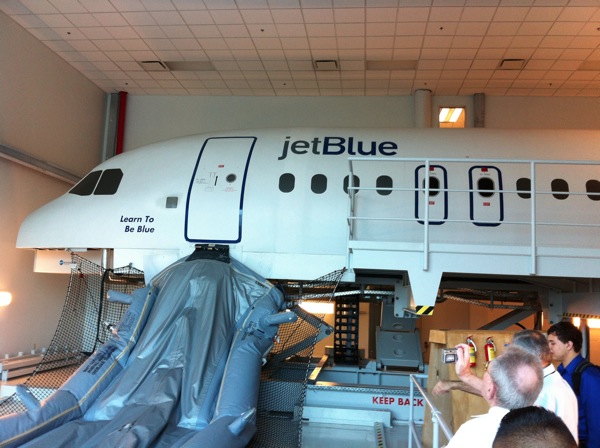
After a quick bus ride we arrived at JetBlue University, the training facility where JetBlue trains all of its pilots, flight attendants, and gate agents. The facility itself is new, large, and fancy. There’s a swimming pool for practicing with life rafts, for example, and a trainer for flight attendants to practice evacuations using the emergency slides.

IMG 0392

the emergency egress trainer, which moves side to side and back and forth– in two axes

There are two types of training devices that you can use for flight training. One is (surprise) known as a flight training device. It’s a replica of the cockpit, with instruments and controls that work like the real thing, but without the visual aids that a full simulator provides. The FTD isn’t much to look at– sort of like a disembodied airplane cockpit. There’s a control console (not visible below) that the instructor can use to set up various conditions… say, an engine fire or hydraulic failure.

IMG 0395

one of JetBlue’s A320 FTDs. Displays and controls work as they do in the real airplane, with a few minor exceptions (e.g. you can’t turn on the windshield wipers)

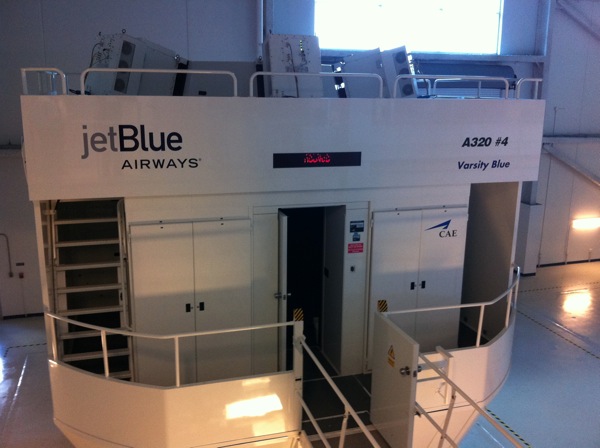
We also toured the simulator hall. Each of JetBlue’s simulators is a full flight simulator at level D according to the FAA’s definition: full-motion, wide field of view, with sound. The sims themselves are mighty beasts; I doubt you could fit one in my apartment. Each has a name (the one below is “Varsity Blue,” but there are others, like “Welcome to the School of Blue”) and an FAA registration number– when you log simulator time in one of these, you log the sim’s registration number just like you would log time in an actual aircraft.

IMG 0398

One of JetBlue’s full-motion, Level D flight simulators for the A320

You enter the sim through the bridge in the lower part of the picture, then they pull it up and lock the door. This isn’t so the pilots inside can’t escape; it’s so the simulator can move freely, but escape-proofing is a nice side benefit. Inside, the conventional cockpit layout is forward, and there are comfy chairs for an observer and the simulator controller. You can’t really tell from this picture, but the visual presentation is stunning– it’s exactly what you’d see from inside a real aircraft during all phases of flight. In this picture, the sim is parked at a gate in Orlando, so most of what you see is concrete and terminal building.

IMG 0401

a view from inside the simulator; because of the narrow field of view of my camera you can’t see the side windows but there’s stuff happening there too

Note that all the aircraft screens are blank, just like they would be if you were taking the first flight of the day in an aircraft that was parked overnight. Good thing that we learned how to start a cold aircraft! Phil mentioned that most Airbus operators leave the aircraft powered overnight; with 150+ computers in the aircraft, the chances of something getting stuck or failing to boot properly from a cold shutdown are high enough that leaving some systems powered up makes more sense.

After the tour, we made our way to the classroom, which is festooned with posters of the A320’s flight controls, overhead console, and center pedestal. Each of us got a set of these for reference, and then Wayne started in on ground school. We went over each system in some detail. For example, I can now tell you how the packs (really PACKs, or pneumatic air cycle kits) work and how to control them. The thing that surprised me the most about the training is how automated the A320 really is, and how many mundane tasks it automates away in normal operation. If you do something out of sequence, or fail to set something up properly,  the aircraft will tell you. Wayne described the A320 as a “lights-out” aircraft: during normal operation, almost none of the buttons on the center pedestal or overhead console will be lit. We covered all of the major systems: electrical, hydraulic, pneumatic, engine, and so on, learning how each works, how to control it, and what to do when things go wrong.

For lunch, we ordered in pizza, and what was supposed to be a working lunch turned into a fascinating career discussion. Wayne and Phil both believe that the job market for pilots will steadily improve over the next ten or so years because of the demographics of the current pilot base. Phil even mentioned that JetBlue had just hired a 59-year-old pilot, which certainly gave me hope that a career as a professional pilot isn’t off the table for me just yet.

After lunch we had more systems training, plus a bonus. Just because I could, I also signed up for the high-altitude endorsement. The FAA requires (in FAR 61.31.(g)) that you receive special training in high-altitude operations before operating a pressurized aircraft that can climb above FL250 (that’s 25,000 feet for those of you following along at home). This training consists of some ground school covering high-altitude physiology, including hypoxia, some time in a cockpit procedures trainer (CPT), colloquially known as a “wooden Indian”, and some time practicing emergency descents in the FTD. The CPT is basically a paper cockpit mockup– you can learn where things are and “chair-fly” your way through learning procedures. We each took a turn going through the profile we’ll fly in the simulator on Sunday: a takeoff from Orlando International, a series of maneuvers around the traffic pattern, a touch-and-go-landing, another lap around the pattern, and another landing.

IMG 0402

from left to right: John, Phil, and Johnny in the CPT. Phil took the time to explain the control flows to us until we had them all down pat.

After we finished in the CPT, it was on to the FTD for emergency descents. Wayne set us up at FL350, then simulated an explosive decompression, at which point the fun started. We used the standard JetBlue emergency descent checklist, which only has 10 steps on it. First you don your oxygen mask, then you determine a new, lower altitude, tell the airplane to go there (optionally hitting the “expedite” button), call air traffic control, and make sure not to fly into any surrounding terrain. Once you set the commanded altitude, Fifi automatically deploys speed brakes, changes engine thrust, and adjusts the aircraft pitch and trim to maintain the correct rate of descent. It’s spooky to see the trim wheels move on their own.

Interestingly (to me, anyway), the engine thrust is controlled by a system known as autothrust, not auto-throttles. The thrust levers don’t move at all, but the autothrust system will change the engine power output as needed to maintain the correct speed during climb, cruise, and descent. Set the speed you want and off you go. As with other aspects of the A320, the flight control laws will try to keep you from doing anything stupid. For example, the FAA prohibits speeds over 250 knots under 10,000 feet, so the autothrust system won’t exceed that. During an emergency descent, it will automatically throttle the engines back to idle, and so on.

By the time we finished our runs through the FTD, it was about 7:15– so we’d been on the grounds training for nearly 12 hours. The JetBlue shuttle bus took us back to the hotel, I walked over to Friday’s for dinner, and hit the bed, tired as can be.

Tomorrow (or, really, later today) is the big adventure: two hours flying Fifi. (I originally signed up for one hour but bought a second hour after one of the registrants had to cancel due to illness– after all, it’s a birthday present.) More to come.. in the meantime, read lots more about Fifi from Captain Dave or Karlene.


1 Comment

Filed under aviation

A few pictures from Fleet Week 2011

The boys and I made a pilgrimage to Fleet Week 2011 in San Francisco this past weekend. Selected photos are here. We drove to Pier 30 and parked, where we started with a tour of the USS Bonhomme Richard (LHD-6), which was well-provisioned with a nice selection of Marine vehicles and aircraft. Among other things, the boys got to check out a HiMARS truck, where thanks to Marine Cpl. Lamb from the great state of Tennessee the boys got to see a cellphone video he took of a fire mission in Afghanistan; a V-22, an AH-1Z Cobra (which I hadn’t seen before), and a variety of crew-served and individual weapons. The boys also got to hear an unusual call on the 1MC: “Man down, man down, man down on the flight deck!” A visitor tripped over a tiedown chain, so the Navy surged a bunch of corpsman to make sure he wasn’t hurt. They liked that quite a bit.

A quick taxi ride took us over to Marina Green for the airshow proper.

Having learned my lesson from last year, I’d rented a Sigma 50-500mm lens from LensRentals.com. I figured that this lens, which was every bit as big and heavy as advertised, would do a better job of capturing the action than my own 70-300. Sure enough, it did, but with a couple of caveats. It turns out that it’s a lot harder to take pictures of fast-moving aircraft with a telephoto lens than you might think. This problem was compounded by the fact that autofocus on the Sigma is fairly slow. Accordingly, I had a hard time getting pictures that were both well-framed and well-focused. However, some of them came out quite well.. I deleted the others, that being the major advantage of a digital camera. Tom and I between us took almost 600 pictures, about 150 of which were good enough to make the initial cut. I’ve posted a few of the better ones on my Flickr “airplanes” set.

Side note about LensRentals.com: I could not have been more pleased with their prices or service. I will definitely use them again, possibly for the Veterans’ Day airshow that the Blue Angels traditionally put on at NAS Pensacola. I recommend them highly.

The taxi ride on the way back might have been the highlight of the show: we had the same crazy, gravel-voiced, wrong-side-of-the-road-driving-on driver who scared the stuffing out of us last year. The odds against getting the same driver two years in a row must have been very high but… well, there it was. We survived, barely, and the four of us laughed uncontrollably for several minutes after exiting the cab. Whether the laughter was from relief at our survival or amusement at running into the same guy two years running, I couldn’t say.

Leave a comment

Filed under aviation, Friends & Family, General Stuff

Huntsville and Nazi rocket scientists

Interesting article on the front page of the WSJ today: “In Huntsville, Ala., Rocketeer’s Legacy Has Complex Echoes“. The article talks about the fact that von Braun, Stuhlinger, and other key players in NASA’s early booster development were participants (with varying degrees of culpability) in Nazi Germany’s industrial program. The primary source for the article’s claims of heavy Nazi involvement on the part of the scientists is Linda Hunt, a “media critic” who wrote a book on the topic. I haven’t read it, but it certainly didn’t get good reviews. It’s not clear to me that it would have been better to prosecute the lot of them immediately after WW II; doing so would certainly have made the not-yet-prosecuted much more reluctant to work here instead of for the fUSSR. However, it’s unpleasant to be reminded of the kinds of compromises that governments routinely engage in, One cool note, though: the article quotes my former coworker at NTI, Dave Cornutt,

1 Comment

Filed under aviation, Musings