Today’s random walk on the Internet produced some unexpected, and yet surprisingly interesting, results. I was checking the weather forecast at an airport and noticed that they had an AWOS (automated weather observation service) phone system. You can call the AWOS to listen to a computer-synthesized voice reading you the current and forecast conditions– so I did. The AWOS material was followed by a human-recorded message with additional information, including the advice “Use caution for deer on runways.”
I thought that was funny, so I texted a friend who lives near the airport. Her reply: “I wonder how many airplane-deer collisions there are each year?” That got me to wondering, so I started searching.
First, I found the FAA’s Wildlife Strike Database. Despite my recent and seemingly-exhaustive study of the FAA’s regulations and rules, I didn’t know they had one.. but they do. Pilots can voluntarily report strikes, and you can search the database by type of animal, state, or airline. The animal types include hummingbirds of various kinds, alligators, and yellow finches. The database is good for hours of fun; for example, I found no alligator strikes reported in Louisiana from 1960 to today, but 14 in Florida, 11 of which were at one airport (which I will now plan to avoid, thank you very much.) You can download the entire database for more detailed analysis, but I don’t have time to do so right now. Maybe on my next vacation…
Then I found this great paper: Deer on Airports: An Accident Waiting to Happen. First of all, it’s from the proceedings of the 18th Vertebrate Pest Conference. How cool is that? I wonder whether the definition of “vertebrate pest” includes lawyers, telemarketers, Lotus Notes administrators, and other kinds of common pests, or just those from the animal kingdom. (Note to self: this year’s conference is in Monterey in a few weeks; perhaps I should drop by. The conference program looks really interesting.) Anyway, the paper was published in 1998, so it’s a bit dated, but it describes findings from 343 deer strikes over a 14-year period. Conclusion: dusk at November is the time your aircraft is most likely to hit a deer, and the average cost of an aircraft-deer encounter is $74,583. The last sentence of the abstract sums things up nicely: “Deer removal by professional shooters, in conjunction with permanent exclusion with 3 m high fencing, is the preferred management action.”
Now, where’d I put that deer rifle?
Oh, sorry; back to the post. Anyway, I didn’t get a comprehensive answer, as I haven’t yet found more recent statistics on the number of deer strikes, but I’m going to keep looking.. and you better believe I’ll keep my eyes peeled for alligator, deer, elephants, and other vertebrates that might infest my takeoff, landing, and approach paths.
Wow. Weather is absolutely fascinating. I’ve been reading the FAA’s Aviation Weather, which is somewhat dry but nonetheless captivating. If you’ve ever wondered why a particular weather phenomenon happens (say, fog), this book will explain it.
Great investigative journalism (or whatever the correct term is): security research Per Thorsheim does an experiment to see which law-enforcement organizations appear to support TLS encryption for SMTP mail. If you’re wondering why this is relevant, recall that the recent “hack” [I hate using that term since it’s not really a hack as much as it was social engineering] of the FBI-Scotland Yard conference call happened after a member of Anonymous found a conference call invitation in stolen e-mail. That kind of data can have intrinsic value that might make it attractive to an attacker, and using STARTTLS is a conceptually simple way to protect it while in transit.
TLS support in Exchange 2010 has come a long way from the bad old day of Exchange 2003, where you may recall that enabling TLS would cause the SMTP virtual server to refuse to talk to any other SMTP server that wouldn’t accept TLS. Exchange 2007 added support for opportunistic TLS, and Exchange 2010 has it too. Microsoft’s documentation makes clear how to set it up, so I encourage you to stop reading this article and just go do it.
As some of my readers may know, California is nominally where I live; however, I’ve been in Pensacola since October. California, of course, has the distinction of having extremely restrictive gun laws. Needless to say, these laws have done little or nothing to reduce gun-related crime. They do, however, make it difficult or impossible for law-abiding citizens to exercise the same rights and freedoms that citizens of other states take for granted. (But at least it’s not as bad in California as it is in DC; check out Emily Miller’s Washington Times series on DC gun ownership to see what I mean.)
(nb. This would be a good time to mention that I’m not interested in debating any aspect of firearms law. I believe that as a law-abiding citizen I have the constituionally-protected right to keep and bear arms, and that that right properly includes the ability to carry a weapon on my person for self-defense, whether or not I face an imminent threat like a crazed ex-spouse. I don’t think that criminals or the mentally ill should have guns.. but criminals get them anyway, even in places like California and DC. Feel free to disagree with me, but do it someplace else.)
Anyway, one side effect of California’s laws is that it is difficult, or impossible, to get a permit to legally carry a concealed weapon in California. Each individual county makes its own rules, and larger counties, like Santa Clara County, just flat-out won’t issue permits. (Unless you donate thousands of dollars to the sheriff’s re-election campaign. But I digress.)
However, Florida and Utah offer permits to non-residents. If you meet the legal requirements to obtain a Florida or Utah permit, you can then use that permit to legally carry a concealed weapon in the 38 or so states that have reciprocity agreements with Florida and/or Utah. That means that a Florida non-resident permit will allow the holder to legally carry in Alabama, Louisiana, Mississippi, Tennessee, Texas, and Washington– all places I travel. Of course, in each state the permit holder still has to obey the laws of that state, which vary from place to place.
Florida and Utah both require a class that covers the legal and safety aspects of concealed carry. The interesting thing is that one can become certified as an instructor qualified to teach this class, then offer it out of state. I’d been trying (though not very hard) to find a convenient class in the Bay Area, but hadn’t managed to do so before I came out to Pensacola. After Christmas, I decided to resume my search and called around to a couple of local gun shops. I quickly got the word that I needed to talk to “Captain Ron.”
“Captain Ron” is actually Ron Beermünder, who runs the Blackwater River Tactical Range. His web site contains a wealth of information on Florida’s CCW law, as well as information about the classes he teaches. I opted for the 4-hour course; for $180, you get the legal instruction that Florida requires plus the chance to shoot 300 rounds of various-caliber pistol ammunition while being coached by an expert instructor. What’s not to like? I signed up, and this past week drove out to Ron’s range to take the class.
The class itself was excellent. Ron is an engaging and funny man, with a sharp sense of humor and a large chest of war stories. We spent about 90 minutes on the legal overview; simply put, in Florida the law is that a CCW permit holder is essentially held to the same standard as a police officer when it comes to use of force. If a police officer would be justified in using deadly force to prevent or stop a crime, so too would a CCW holder, but neither a citizen nor a cop is allowed to use unreasonable or excessive force. That strikes me as a reasonable standard, and it’s easy to keep in mind. Other details we covered include what Florida law says about where you may and may not carry, under what conditions you may use deadly force, and the fact that just because the law says you can stand your ground in the face of a threat doesn’t mean you should.
The range portion was equally good. Ron had a wide variety of pistols; I shot Smith and Wesson revolvers in .22 and .22 Magnum and Glock pistols in 9mm (including the Glock 26, which is what I’d normally be carrying.) We did timed-fire drills, and I learned a great deal about trigger manipulation and indexing. My accuracy and speed both improved quite a bit during our time on the range, and I’m looking forward to getting some more practice when my schedule allows. If nothing else, I learned that the Glock has a reset trigger and how to properly use it; that tip alone made a huge difference in my second-shot accuracy.
The actual mechanics of getting the permit are straightforward if you qualify: once you’ve completed the class, you need to provide the state proof that you completed it, a registration fee, and fingerprints. You can do this via mail, but it takes up to 3 months to get your permit back. Ron suggested driving to the nearest regional office of the Department of Agriculture and Consumer Services and applying in person. (Yes, I did say “Agriculture.”) Thus I found myself driving to Fort Walton Beach in search of the nearest office; there are only 8 throughout the entire state. I had previously made an appointment, and when the appointment time arrived I filled out an on-screen form, gave the clerk a copy of my certificate from Ron’s school, had my fingerprints scanned, wrote a check for $117, and had my application notarized. 20 minutes later, I was done; now all I have to do is wait for my permit to arrive in the mail! (I should note that I have never dealt with state government employees as pleasant, efficient, or helpful as the folks at the FWB licensing office. I wish they could export their attitude to the California DMV!) Once my permit arrives, it will be valid for seven years from the date of issuance.
This is all of course rendered moot by the fact that a) I work on a military base where no one is allowed to have personal weapons and b) all my pistols are in California, not to mention that c) I can’t legally carry in California anyway. If nothing else, I’m glad to have contributed to the numbers of law-abiding CCW permit holders. There are more of us out there than you think.
Fellow Exchange MVP Rajith Enchiparambil, proprietor of the excellent How Exchange Works blog, asked an interesting question the other day: how does Autodiscover work in Outlook 2011? Is it different from the way Autodiscover works in Outlook for Windows?It turns out that the answer is (as you might have predicted) “it depends.” To answer that question in depth, we have to dig into the guts of Autodiscover (or AutoD, as its friends call it).
The first thing to know is that there are two parts to AutoD. One is the service that runs on Exchange 2007 and later. This service is implemented as a virtual directory named “Autodiscover” on the CAS role. When you install the CAS role, the vdir is automatically created and provisioned for you. In addition to the vdir, an Active Directory service connection point (SCP) object is created. (For probably more detail on SCPs than you’d want, see this article.)
See, in Windows Outlook, there are two primary ways that AutoD can work: domain-joined Windows machine can perform an LDAP lookup to find an AD SCP, or any machine can try to hit a predefined series of URLs. Why are there two methods? Because this design allows a computer, or device, to find the correct Exchange CAS whether it’s domain-joined or not, and whether or not it’s on the internal corporate network.
(See what I did there? I said device, because mobile devices can use AutoD also. Currently, iOS and Windows Phone 7.x devices use AutoD, as do some Exchange ActiveSync clients on some Android devices. For our purposes, we’ll treat mobile devices just like Macs insomuch as they use similar web-based queries for the AutoD vdir.)
So let’s ignore the SCP lookup process. How does Mac Outlook 2011 use AutoDiscover?
First it tries to connect to the standard AutoD URL, which is made up of the primary Exchange SMTP domain plus /Autodiscover/Autodiscover.xml. For example, https://robichaux.net/Autodiscover/Autodiscover.xml would be the first URL Outlook would try for an account in the robichaux.net domain. If that works, great. If not, it will then try tacking “autodiscover” onto the FQDN and keeping the same relative path.
If neither of those standard URL requests, both of which are made using HTTPS, bear fruit, the next attempt will be to do an HTTP request for the second URL. This request will be redirected if HTTP-to-HTTPS redirection is in use, which is what we want– if a redirection occurs, Outlook will catch the HTTP 302 response and make an AutoD request against the redirected URL.
If that check fails, the next step is to perform a DNS SRV lookup to try to find the FQDN of an Exchange CAS. If the SRV query returns a target machine, Outlook will tack on /autodiscover/autodiscover/xml to it and perform an AutoD query against the result.
Once Outlook or a mobile device gets back an Autodiscover manifest, of course, what it does with the result will vary according to its capabilities. For example, Outlook 2011 and mobile Exchange ActiveSync clients don’t (currently) use the returned URL for the target mailbox’s Exchange unified messaging (UM) server.
This process is generally pretty robust unless you’ve misconfigured the Autodiscover or service URLs on the CAS. It turns out that there’s a separate Exchange Web Services (EWS) external URL property on the CAS, and if you fail to set that properly– say, if some of your users snuck some Macs or iPads or something onto your network– then AutoD will return the EWS URL that you set, which will be wrong, so Mac Outlook won’t connect properly. The Test-* cmdlets are very useful in tracking this kind of problem down; Exchange MVP Tim Harrington has written a good primer on their use.
You might be able to commit the perfect felony… in Idaho. Then again, maybe not; the world breathlessly awaits a test case, as explained by this (surprisingly interesting) constitutional law thought experiment.
I could spend hours playing with milez.biz, which helps you figure out how many frequent flyer miles it takes to go between two cities. For example, it takes 75,000 miles to fly from San Francisco (or Huntsville, for that matter) to Sydney on American, but 100,000 miles for the same route on Delta.
You may know that Symantec recently admitted that its network was compromised and that the attackers got the source code to pcAnywhere, Norton Internet Security, and a few other products. Buried in their acknowledgement, however, was the fact that the source code leaked in 2006and has thus been floating around in the community for quite a while.
Jonathan Shapiro’s response on the IP list seemed to hit the right note for me:
The pcAnywhere source code leaked in 2006, and in all that time nobody thought to do a serious security review to assess the customer exposure that this created? And now after five years in which a responsible software process would have addressed these issues as a matter of routine, they are having people turn the product off?
This is the company that ships the anti-virus and firewall software that you are probably relying on right now. A version of which, by the way, has also leaked. Do you want to be running security software – or indeed any software – from a company that fails to promptly report critical vulnerabilities when they occur and then ignores them for five years?
You can argue about whether Microsoft’s disclosure policy is perfect or not. I cannot, however, imagine a circumstance in which Microsoft became aware of a potential vulnerability and then didn’t fix it for five years.
So: if you’re running Symantec security software on your personal machine, your company’s workstations, or your servers… time to get rid of it and replace it with software from a more responsible (and, one hopes, more security-conscious) vendor.
I want to lead off this edition by giving mad props to my friend and coworker Brian Hill, who’s just chronicled the results of a two-year program to improve his health. tl;dr: vastly improved his health, lost 80 lbs, and has turned into a muscle beast. Check it out. I wonder if I can afford him as a personal trainer?
The Chinese have an aircraft carrier. The Indian Navy now has a nuclear attack submarine (plus another home-built one coming next year). Good thing we have a robust Navy.. at least for now.
Apropos of the cost of Macs vs PCs, the brilliant Horace Dediu has a really interesting analysis of Apple’s ASP (average selling prices) for various devices. Money quote: “The evidence I see is that Apple does not change pricing but rather stakes out a specific price point as resonating with consumers given their positioning. They then doggedly stick to it.”
Let’s see whether Apple’s former retail genius, Ron Johnson, can bring the rain at JC Penney. I’m rooting for him.
[ putting this in the “FAIL” category since it’s no longer Thursday, but better late than never…]
To begin with, my hearty congratulations to Tony Redmond on receiving a “Distinguished” award from the Society for Technical Communications (STC) for Exchange 2010 Inside Out. This is quite an honor, but a well-deserved one. I read and edit a great deal of material focused on Exchange, and Tony’s book is the best I’ve encountered. Well done.
And speaking of books: I have the galleys for Bruce Schneier’s latest book, Liars and Outliers. It’s been an interesting read so far, although much of what he has to say about the nature of trust and how trust granting works seems intuitively obvious.
Looks like I’ll be speaking at TEC 2012 in San Diego. That should be fun; I thoroughly enjoyed speaking at TEC 2010 in Vegas.
I think it’s telling that if you search for “Exchange Connections 2012” you get this page, which doesn’t actually mention Exchange Connections– you have to scroll the list of icons over to the right to see it at all, and the textual conference descriptions don’t mention it. That’s rather sad. The page that is ostensibly about Exchange Connections is even worse.
After next week my teaching schedule will lighten up a bit, so I’m hopeful that I’ll be spending a lot more time flying.
Some people tend to think that their negative statements and claims won’t get back to their intended target. Wrong-o.
This very cool story of the man whose life inspired the character of Omar Little on The Wireshows that there is redemption available, and that there can be a second– or even a third– act in our lives if we want it and will work towards it.
Risk identification and mitigation is really important in aviation. That was the first thing I thought of when I read this blog post at AVWeb. Personally, I wouldn’t have attempted that flight in those conditions.
I just grabbed an app that purports to take you from your couch to being ready to run a 10K race in 14 weeks. The app maker says I can just jump in at the 5K stage and be good to go. We’ll see.
Last year I decided to do a year-end retrospective. It was short and to the point. I still like the idea of summarizing the year, and I still like the idea of doing so concisely, so here’s what I want to say about 2011: it was better than some years and worse than others.
I accomplished some of the personal and professional goals I’d set for myself, but there are some others that are yet incomplete, so I have some things to strive towards in the coming year. I made progress on some fronts and had setbacks– some self-inflicted, some not– in others.
I have a lot to work on in the coming year.
America’s 1st Sergeant sums it up nicely with this post on the concept of initium. I have a number of personal, professional, and life initiatives underway that I hope will bear fruit in 2012. If they don’t, it won’t be due to lack of initiative or effort on my part.
Thanks to all my family and friends for their support and help during the past year, and here’s wishing all who read this a prosperous, safe, and happy 2012!
(See part 1 for the beginning of our Christmas cruise adventure. One note: I failed to mention how much we all loved the conch fritters at Caroline’s in Key West. I’d never had them before but look forward to having them again.)
Our at-sea day on Boxing Day was uneventful; the boys spent much of the day hanging out in their various clubs, while I parked myself with a good book on the fantail in the “Serenity” adults-only area. There were a lot of noisy young adults there, but it was quite a bit more pleasant than the high-noise, high-traffic area around the pool on the Lido deck, plus the view from the stern of the ship was stunning. For our elegant dinner that night, we had lobster and alligator fritters, both of which were very, very popular with all four of us.
I actually forgot to mention the high point of our first sea day. David and I signed up for the “Behind the Fun” tour, a $55, 3-hour tour of several “backstage” areas on the ship. The tour includes the ship’s laundry (staffed exclusively by Indonesians, as are all Carnival ships; there’s sort of an unofficial Indonesian mafia that finds jobs for family members, fellow villagers, etc.), the kitchen (which is huge, spotless, and busy), the engine control room (crewed by a chief engineer who perfectly fit the stereotype of a brusque, grease-stained technophile), and the ship’s bridge, where we got to meet the captain and a couple of other deck officers. The whole thing was fascinating; we learned a ton about the operations that take place behind the scenes and that helped us better appreciate the largely invisible efforts that the staff has to make to keep everything running smoothly.
On the 27th, we made port in Nassau, which is where we’d booked two major activities: a Segway beach tour and a visit with the Bahamian Ministry of Tourism’s “People to People” program. I’d read about both of these on CruiseCritic, and the four of us were all excited about them both. Sadly, the People-to-People meeting never materialized. I registered on 11 December and never heard anything back until the 20th or so; I immediately answered the email I got from them but never heard back. We met the van from Bahamas Segway and Beach Experience promptly at 0930 and were richly entertained by Meeks, our driver, on the 15-minute van ride to the nature preserve. This is a bit of a grandiose term; it’s really a nearly 200-acre plot that was originally supposed to be a resort before ownership and tax disputes put the land into a title dispute from which it hasn’t recovered. In any event, the property is gorgeous, with a number of nature trails and a gorgeous area where we stopped to recharge the Segways and learn how to plait palm fronds (seriously! one of the other tour attendees was from Jamaica and taught all 3 boys how to do it.)
The four of us at the Segway beach area
The experience of riding the Segway itself was fantastic! My only complaint is that I was going too fast, hit a soft spot in the trail, overcorrected, and went flying– it is, in fact, possible to wreck a Segway. Fortunately the expensive Segway was undamaged; I wound up with a sore neck, a broken camera, and wounded pride, but nothing too serious. Despite that, the whole Segway experience was superb; the tour company did a great job, the weather could not have been nicer, and riding the Segway itself is a blast. I recommend this tour very, very highly.
People-to-People? Not so much. Despite all my efforts, I couldn’t get hold of an actual human until the morning of our arrival, and they had no record of our visit. The lady I spoke to was quite apologetic and tried really hard to find someone for us, but she didn’t succeed until nearly 1pm, when we were just sitting down to order lunch. With a requirement to be back aboard ship at 5pm, there was no way to make it work, which was really disappointing. Maybe next time.
We had lunch at the Fish Fry, a strip of restaurants right outside downtown Nassau. I don’t remember the name of the place where we ate, but the food– conch, shrimp, and grouper, all fried– was superb. After lunch, we walked the 1.5 miles or so back to the cruise ship pier, going past Junkanoo Beach. It was a beautiful walk along the water, as you can see from the two pictures below.
The view from Junkanoo Beach out towards the water
Another view, this one towards the cruise ship pier
Of course, these pics (and all the others from this point on) came from my iPhone, since my D40 wouldn’t admit that there was a lens connected to it. It is now on its way back to Nikon’s body and fender shop; if they can’t fix it for a reasonable cost I’ll pick up either a D3100 or a D5100.
On the 28th, we were due into Freeport at 0800. I woke up about 0735 and went forward but didn’t see land anywhere. What I did find was wind gusting 15-25 knots. Sure enough, the winds in Freeport were too high for us to safely dock, so we had another sea day instead. This was disappointing, as we’d booked a bottom-fishing expedition that promised barracuda, shark, and other fun sea life. However, we all had a good day playing Uno, drinking too much soda, and generally taking advantage of all the services aboard the ship.
Debarkation on the 29th was quite smooth. Our cabins were both on the Verandah deck inboard; we had V12 and V20, which were nicely appointed and very convenient to the observation area. Because we were first-time Carnival cruisers on a discount fare, we were assigned a debarkation number of 2 (out of 30 or so). This was great, since we wanted to get back to Pensacola, not linger on the ship like the long-time cruisers. After a delicious breakfast, they called our group and within 20 minutes we were out and waiting for the Avis shuttle van. The debarkation and customs process was flawless and quick.
Service and staffing, overall, were on a par with Disney and Princess. I thought that Princess had the best dining room staff and cabin stewards, but Carnival’s were quite good. For the price we paid, the accommodations and service were quite good, and I would happily cruise with Carnival again– hopefully soon!
So this year I wanted to do something different with the boys. Arlene and I have been able to work together to share the boys during holidays, long weekends, and so on, and when she offered me some extra time with the boys over their Christmas break I jumped at the chance. David wanted to stay in Huntsville with his girlfriend; no one wanted to go to California, and I was not going to spend Christmas in a hotel room. After talking it over with them in some depth, we decided to take a cruise.
Thanks to the fine folks at VacationsToGo, we identified the 24 December sailing of the Carnival Ecstasy as our best bet. Alexander, our travel agent, did a superb job. This is my second booking with VacationsToGo, and it won’t be the last. We got what I considered to be a great price on the cruise, and Alexander handled all the arrangements because I was locked in The Bunker during most of the planning period.
We were set to depart Port Canaveral on Christmas Eve. After a long drive from Montgomery to Valdosta to Cocoa Beach, we stopped at the KSC Visitors’ Center for the big KSC tour. Unfortunately, we missed the last tour bus, though we did get to go ice skating (or, more precisely, the boys did; I was having no part of that.) The tickets were very expensive relative to what you get (~ $43/person), and I didn’t feel like the exhibits were worth the money. They also don’t accept a Space and Rocket Center membership as reciprocal, which is too bad.
Tom, cold-chillin’ on the ice at the KSC mini-rink
One of the fun things about our KSC visit was the holiday decorations; the rocket garden had a huge tree, and there were decorations at the ISS mural as well.
your tax dollars at work
Closest I’ll ever get to the ISS
When we were done at KSC, we settled in at the International Palms Resort in Cocoa Beach, which I found through Kayak. For $53 a night, it was quite decent, although not fancy. We didn’t use any of the “resort” features, which include a basketball court and a boardwalk leading to the beach. Instead, we went to do some last-minute Christmas shopping at Walmart, a process which we reprised the next morning at both Walmart and Merritt Square Mall. Once all the shopping was done, we dropped our rental car off at Avis in Cocoa Beach and took their shuttle to the cruise ship terminal. Note: if you’re thinking about doing the same thing, be forewarned that the Avis staff was completely overwhelmed when we were there. We waited nearly an hour for the right shuttle, and the staff was just flappin’. They were obviously in a rush to get everything done before they closed, but their customer service suffered as a result.
The boarding process went smoothly and fairly quickly. We got aboard and started exploring the ship, which has a sort of metro-art-deco feel to it. Lots of neon (and faux neon), etc. I didn’t especially care for it. I think the ship, which was built in ’91, is showing its age, and I vaguely remember that Carnival is planning on refurbishing it in the near future. Anyway, we got settled in fairly fast, although our luggage didn’t show up until much later. At dinner, we met our table companions: a couple from upstate New York and a mother (with a daughter and two sons, all older than my boys) from Shreveport. David, Tom, and I all ordered escargot as an appetizer, and Matt tried them and decided that he liked them too– score!
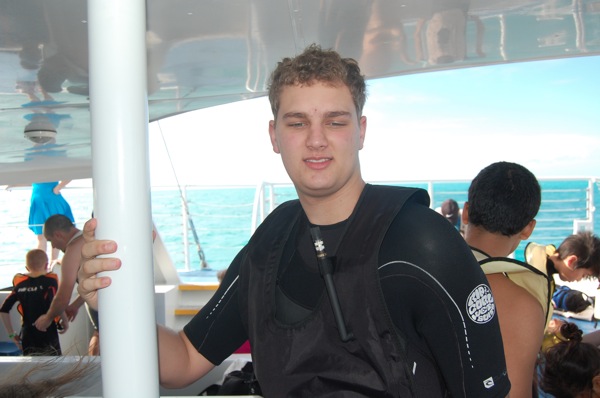
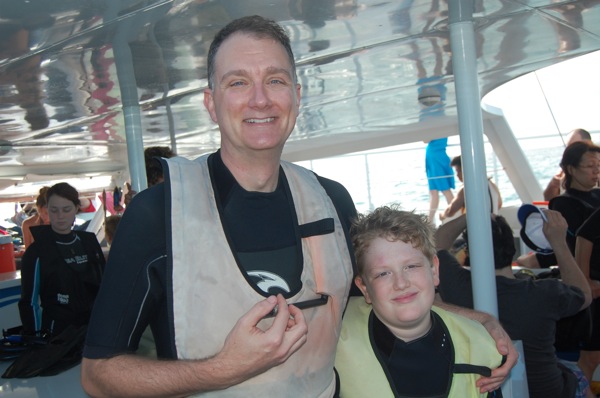
Christmas Day was a blast. We opened presents in the morning, then made port in Key West and set out for our snorkeling trip, booked through Fury Watersports. I recommend them highly: great equipment and a superbly friendly staff made them a great choice. The snorkeling itself was eventful. Tom was one of the first ones in the water, and he was the first one out after an encounter with a Portuguese man-o-war. Then David got in, then Matt and I. Matt was very reluctant after Tom’s sting, and even with gentle encouragement from Missy (one of the boat crew; she did a great job with Matt) he wasn’t having any. Shortly thereafter I got stung by a moon jellyfish, and then David poked one accidentally and got stung on the finger. The snorkeling itself was anticlimax; I didn’t see anything except a few grouper. The weather and water were gorgeous though, and I loved being out on the water.
David in full snorkeling regalia
Matt and I get ready to get in the water
Tom and Missy on the snorkel boat
After we made it back to Key West, we had a delicious lunch of conch fritters and shrimp poboys at Caroline’s, walked around Duval Street for a while, and had superb key lime pie at the Key West Key Lime Pie Company. At lunch, Matt pulled his own tooth, so that was his injury du jour— more permanent than a jellyfish sting. Back aboard ship, we had dinner, and the boys went to parties at their individual age clubs. Carnival, like Disney, has clubs for various age groups. David and Tom very quickly took to their peers; Matt thought the activities for his age group were lame, probably because he thinks he’s as old as his brothers (and partly because they were kinda lame by comparison.) Surprisingly, Christmas wasn’t an occasion for an elegant or formal night, although the food and service were excellent. (I should take this opportunity to point out that the ship was decorated quite nicely for the holidays– lots of tinsel, lights, Christmas ornaments, and so on.)
This is getting a bit long, so I’ll wrap it up in a second post once I’ve had a bit of recovery time. We just got back to Pensacola today and I need a bit of a respite from my vacation…
James Fallows frequently writes about aviation, and, when he does, it’s always worth reading. I didn’t even hear of the I-287 crash until I read his post about it.
I think I know what my next iPhone programming project will be… in my spare time, chuckle snort guffaw. (But I’m not telling. Hint: it involves Exchange.)
Saturday I’m running the Ho Ho Hustle in downtown Pensacola. This will be my last 5K of the year, so I hope it’s a good one!
I am thankful that my sons don’t have to take this 1869 entrance exam to Harvard, ’cause none of them could pass it. I wouldn’t either (although I know a couple of people who could, so… um.. does that help?)
Today my Navy students are taking a four-hour midterm, then tomorrow they have a two-hour practical exam. I’m not sure who will be more glad when they’re done: them or our instructor staff.