A busy weekend: Strikeforce, Maker Faire

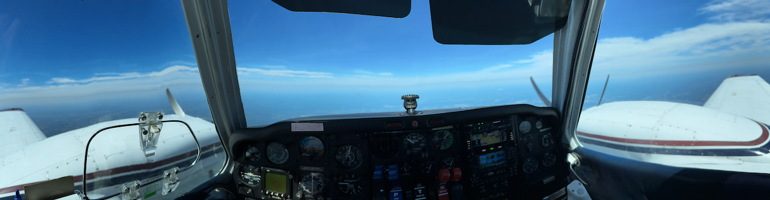
Saturday I worked a bunch, then went for my first solo flight here in the Bay Area (flight journal here). Saturday night I went to the Strikeforce Heavyweight Grand Prix. Sunday I went to the Maker Faire and then took a flight on a B-17.. now I feel like I need a nap.

So, let’s start with the fight. Strikeforce is the little brother of the MMA world, trailing UFC in both attendance and influence. Many of its successful fighters have gone on to compete in UFC; not a few UFC fighters have stepped back down to Strikeforce, sort of like a baseball player might spend some time in the minors before returning to the show. We had great seats and got there about 10 minutes before the fights started– just long enough to grab an H-P Pavilion hot dog. (Note to self: skip the hot dog next time.)

Floor seats FTWfloor seats: 13 rows back, not too shabby. Not shown: enormous overhead video screen.

There were a total of four fights scheduled. The first two were both over very quickly: one by knockout, one by submission. The third fight is when things started getting interesting; it pitted Josh Thomson against Gilbert Melendez. Both fighters are from the Bay Area, but the crowd was clearly favoring Melendez. However, a funny thing happened as the fight progressed: Thomson seemed to be winning. He was connecting with Melendez better, to the point where Melendez’s face was showing a lot of wear and tear. Melendez was also clearly not in the same physical condition as Thomson. However, at the end of the fight, the judges gave a 2-1 split decision to Melendez– and I say “gave” because that’s sure what it looked like. Booing ensued. In a classy move, though, when Thomson was interviewed ringside the first thing he said was basically “don’t boo Gilbert; it was a good fight and he’s a good fighter.” Very classy. (See the official summary here.)

The main event was Josh Barnett, a former professional wrestler,  versus Daniel Cormier, a former Olympian. As soon as I saw that Cormier is from Lafayette, I knew who to root for. The fight started fairly slowly. Both of the fighters were above their ideal fighting weight by at least 20 lbs; there was a lot of flailing and bouncing flab but about the middle of the second round, Cormier started landing more punches. His advantage increased to the point that by the end of the fourth round he was clearly trying not to lose, no longer pressing to put Barnett out (though Barnett very nearly got him in a leg lock.) Cormier won a unanimous decision, as he should have; he clearly outfought and outpointed Barnett. (See official summary here.)

 Now, about the Maker Faire: I guess the most appropriate adjective I can think of is “overstimulating.” Fire! Robots! Microcontrollers! Arts and crafts! Lots of people! I saw some very cool stuff; I also saw some things that made me think “well, all right, I guess some people are into that sort of thing.” I’m not particular artsy or creative so much of the artsy-creative stuff was wasted on me. However, I did take pictures of some excellent apparatuses of various kinds, to wit:


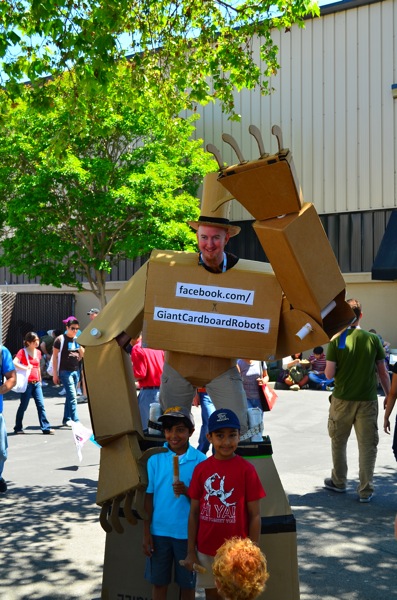
giant cardboard robot

clearly a case of truth in labeling: this guy is obviously a giant cardboard robot


R2-D2s

this little girl ran right up to R2-D2 and gave him (it?) a huge hug, after which he started beeping and rolling around


muffins

 these are actually electric vehicles, but oh, so delicious…

DSC 0214

I couldn’t get close enough to get a picture of the LEGO Kermit the Frog holding a banjo that was off to the left, which is a real pity

DSC 0216

if I had a garden, I would have bought several of these guys. Maybe next year.

DSC 0218

realistic-looking replica weapons from Halo

DSC 0220

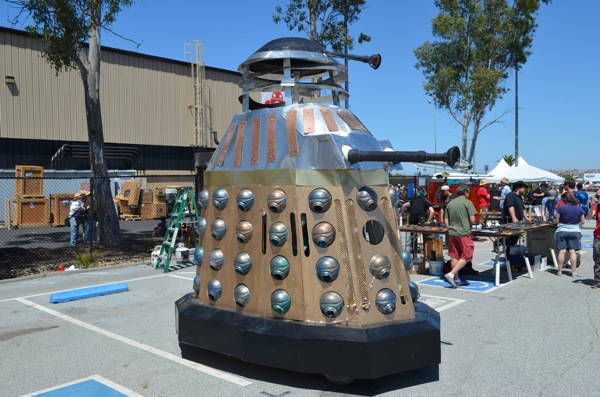
a Dalek you can ride in

DSC 0219

a bike you could ride, maybe


7 Comments

Filed under General Stuff

Airwork, 19 May

Any time a pilot talks about “airwork,” what they mean is what normal people think of as “flying.” Takeoffs and landings? No; instead, airwork is the performance of the basic maneuvers: climbs, descents, and turns. Saturday I had my first solo flight in the Bay Area; I’d had several in Pensacola, but the environment, airspace, terrain, and weather are different enough here that this felt a little like starting over.

I got to the airport, preflighted my airplane, and then had to wait for a few other airplanes in front of me to get out of the way; in total I spent about half an hour just doing those two things. The weather was a little iffy. Afternoons in Palo Alto tend to be somewhat windy. The runway I was using has a heading of 310°, and the wind was coming from 350° at 12 knots. That means that there was a 6.4 knot crosswind, and my solo privileges are limited to less than a 7 knot crosswind. Luckily the wind didn’t pick up any! 

Once I was cleared for takeoff, I flew a right Dumbarton departure– that means I took off from runway 31 at Palo Alto, flew to the west end of the Dumbarton Bridge, and only then turned to the course I wanted. In this case, about 51° to take me out towards Sunol and the practice area we use. Different airports have different departure procedures. For example, in Pensacola you fly the “Skip departure”, named after Skip Giles (the chief pilot at Pensacola Aviation), which takes you between the toll plaza and the cluster of antennae at Midway, thence to the beach. As I mentioned in my first journal, there are actually two bridges: the one on the left (which is to the north) is the auto bridge, while the rightmost bridge is the train bridge. On arrival, you fly to the train bridge; on departure, to the auto bridge. The departure end of KPAO’s runway 31 is just off the bottom-right corner of this picture. 

pick the correct bridge or face the wrath of air traffic control

Anyway, once I got to the practice area, I spent my time working on two different maneuvers. First is what we call slow flight. That’s just what it sounds like: you slow the aircraft down to minimum controllable airspeed (about 40 knots in this particular airplane), controlling power to climb or descend and using pitch to maintain the desired slow speed. In this flight regime the controls must be handled very gently, as the slow speed and high angle of attack means that they’re not as effective as they are at lower attitudes and higher speeds. It takes a delicate touch to turn, climb, and descend in this configuration, which is why I was practicing it, duh.

The other thing I was working on are steep turns. Normal banked turns in an aircraft use between 10° and 30° of bank. Steep turns per the FAA’s definition use at least 45°. The sharper the bank, the more vertical lift is lost, so you have to apply enough back pressure on the control yoke to keep the aircraft from descending during the turn. The FAA standard is that you should be able to do a 360° turn at a 45° bank angle, rolling out plus or minus 10° and losing or gaining no more than 100′ of altitude. This is harder than it sounds, but I learned the key is to watch the angle at which the horizon meets the cowling or dashboard. If you apply enough control force to keep a constant site picture, then all it takes is an occasional glance at the heading indicator to know when you’re about to roll out again. My turns rapidly improved once I figured this out, although I find it easier to do them to the left than to the right. Something else to work on!

Then I headed from the practice area over to the airport at Hayward, where I also have solo privileges. (In addition to weather and crosswind limits, your flight instructor will allow you to fly into a defined set of airports, which in my case includes Hayward.) KHWD is interesting for a couple of reasons: it has two parallel runways, which means that you must be careful to land on the runway you’re assigned to and not the one next to it. (See this picture to see what I mean.) Another is that it’s right under the approach airspace to Oakland International, which means that when you’re in the Hayward traffic pattern there will often be 737s (or even larger aircraft) 1000′-1500′ above you. I found the airport with no problem, got clear for runway 28L, made a great approach, and then blew it by starting my flare too high. The result: a bouncy landing, probably my worst landing ever. 

I did, however, maintain airspeed control. This is critically important because if the airplane’s speed gets too slow, it enters an aerodynamic stall, which is not what you want to happen on approach. I’ve struggled a bit with this but nailed the approach at a steady 70 knots. The bounce was embarrassing but luckily no one at Hayward knows me– so don’t tell ’em it was me, OK?

After taxiing back, I took off again and flew back towards Palo Alto; the airplane was due back so I only had time to shoot two landings there, plus one go-around. One thing non-pilots sometimes don’t understand is that going around, a procedure in which you follow the “four Cs”, is a pretty normal procedure. You don’t try to salvage bad landings; if your approach speed, angle, or height is bad, or if the runway isn’t clear, just go around and try again. (What are the four Cs, you ask? Cram in power; climb to a safe altitude; communicate to the tower that you’re going around; and comply with whatever they tell you.) In this case, the tower ordered me to go around because the aircraft in front of me was taking too long. My two landings at Palo Alto were good, despite the crosswind, in part because my airspeed control was good, so I felt pretty good about them.

Key learnings from this flight:

  • Use the horizon, not the instruments, and steep turns get much, much easier to perform
  • Performing maneuvers at minimum controllable airspeed is demanding but fun. If you can do it precisely, it’s a good feeling.
  • Bouncing your aircraft is bad.
  • Controlling your airspeed on approach is good.
  • Solo flight is very rewarding.

I have solo time on Tuesday and Wednesday this week– expect more journals! I’ll be doing more steep turns, emergency procedures, and probably some navigation work.

1 Comment

Filed under aviation

KPAO-O22-KPAO, 15 May

[ This is the first of a series of flight blog entries; each one will both cover what I did in a specific flight and try to explain what it means. It’s as much a review tool for me as a means of sharing my enthusiasm about aviation; feel free to leave questions in the comments…]

Tuesday morning I was scheduled to fly a cross-country flight with Andy. As with so many other things, “cross-country” means something completely different to normal people than it does to pilots. The FAA defines cross-country time in part 61 of the Federal Aviation Regulations (FARs). The magic distance in this case: 50 nm (that’s “nautical miles,” as opposed to “statute miles”, which normal people use for highway distances and so on.) In order for a flight to count as a cross-country flight towards your private pilot license, you need to fly at least 50 nm from the point of origin and land at an airport.

I planned a route from Palo Alto, whose airport identifier is KPAO. The “K” means it’s an airport in the US. Canadian airports are tagged with C, Mexican airports with X, and so on. This identifier, interestingly, is the same as is used for radio station call letters– go figure. Anyway. my route was from KPAO to the small airport in Columbia, Caifornia; its airport identifier is O22. (No K. Why? It’s a small, non-towered airport, and their identifiers don’t get the national prefix. Other examples include E16 down in Gilroy and 1M3 near Ardmore, Alabama.) The route would take us from Palo Alto to Columbia, then back to Tracy (KTCY), then back to Palo Alto. Here’s what it looks like:
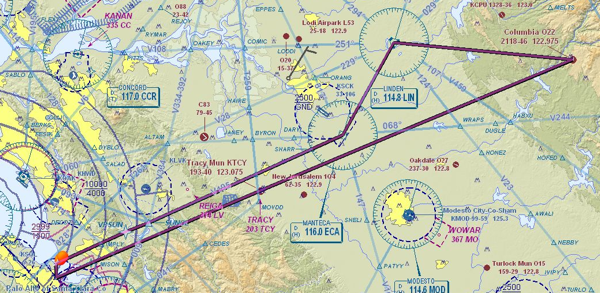
KPAO-O22

Andy wanted me to plan on using two radio navigation aids– known as VHF omni-range stations, or VORs. You can see ten in the upper right of the map above– they’re circles with a compass rose surrounding them. Lots more on VORs in a future installment…

What does it mean to plan a cross-country flight? Well, the FAA has a useful answer. Section 91.103 of the FARs has this to say:

Each pilot in command shall, before beginning a flight, become familiar with all available information concerning that flight.

“All available information” explicitly includes data about weather, runways, takeoff and landing distances (which are influenced by terrain, weather, aircraft loading, and runway conditions), and anything else that you need to know to conduct the flight safely. In the case of this flight, that meant getting a weather forecast (a subject for a future acronym-filled post), reviewing the airport data for Tracy, Columbia, and Palo Alto, plotting a course using landmarks for dead reckoning, and calculating estimated time and fuel usage for each leg of the flight. There are electronic tools that can automate flight planning, but I didn’t use any of them; I did it the old-fashioned way, using a chart, a pencil, and a Jeppsen navigation log like the one shown below. (OK, I did cheat; I used an Excel version of the nav log.)
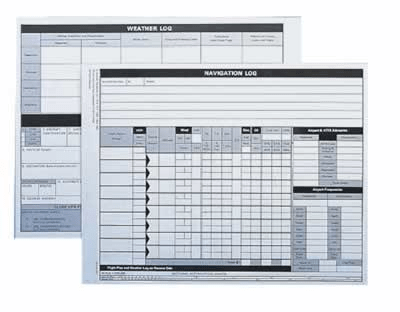
Jeppsen nav log

Tuesday morning dawned clear and cool; when I got to the airport, there was a scattered overcast near the airport but it was clear to the east, where we were going, so off we went. During the preflight, I’d programmed the G1000 with the planned route of flight so that it could give me steering cues… as long as it was working, that is. We took off to the north, made a right turn at the west end of the Dumbarton bridge (because that’s the standard departure procedure for this airport– if everyone taking off goes to the end of the auto bridge, and all the incoming traffic flies to the parallel train bridge nearby, it’s easier to keep the streams separate.) Winds were fairly light. The G1000 has a nifty display that shows you the winds aloft, which is good because the winds aloft forecast was wildly off. 

One important thing I learned: how to correctly adjust the air/fuel mixture at altitude. This is too complicated for me to explain here, but basically if you adjust the mixture adjusted properly you’ll get the optimum balance between engine temperature (too high or too low are both bad) and fuel consumption. The G1000 makes this pretty easy; it has a separate mode for leaning, so you bring that up and start tweaking the mixture until you hit the desired temperature. Anyway, this was a fairly new procedure for me. 

I had no problem flying to first the Manteca VOR and then the Linden VOR. All the while I was keeping track of our position on my paper chart too, which was useful because Andy simulated a failure of the GPS moving map display so that I had to rely on my primary VORs and charting to figure out where we were. My first problem came when we were about 10 miles away from Columbia and I needed to spot it… and couldn’t. Take a look at this picture to see why (the full-size version is better):
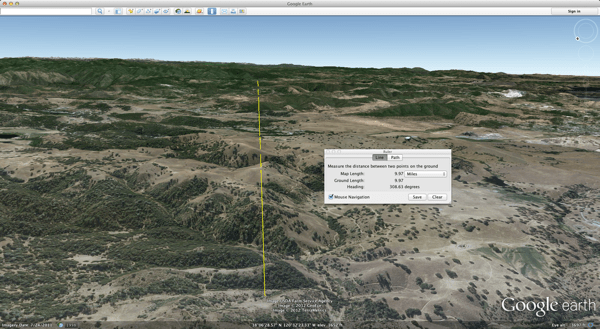
O22 10nm

See that yellow line: that marks the distance I was from the airport. At my altitude of 3500′ it was nearly impossible to see if you didn’t already know where it was. Which I didn’t. Luckily I’d noted that I needed to call Columbia’s traffic radio at 5nm west of the reservoir, so when I saw the reservoir I knew I was in the right general area. Andy had to point out the airport location, though he later told me that one of the reasons he sends students to that airport is because it’s hard to find.

Another thing about Columbia: there are hills all around it. The field itself is about 2100′ above sea level, which means the altitude at which you fly traffic patterns there is about 3100′. That still seems kinda low with the hills about; it is deceptively difficult to accurately judge your altitude above forested, crenellated landscape. I made a decent landing despite that, then we taxied back and took off again to Tracy, or so I thought.

I still didn’t have a working GPS, but thanks to my nav log I had navigational references, courses, and so on to help figure out where I was going so that wasn’t a big deal. There is very little to see in that part of the world, too– if you try hard you can see Copperopolis but that’s about it. On the way, Andy decided it would be fun for me to have a simulated emergency so he pulled the engine power to idle and said, rather cheerfully, “You’ve just had an engine failure.” Then he sat back and watched.

There’s a procedure for this, of course, in which I’ve been well drilled. First thing: fly the airplane. Every airplane has a characteristic speed known as Vy. This is the best glide speed; in a Cessna 172, Vy is 68 knots, and you’ll get about 9 feet of forward flight for every foot of altitude you lose if you maintain that speed. If you go faster or slower, you don’t get as much glide.

Step 2 was to figure out where to go. A little knob-twisting on the G1000 revealed that Oakdale was the nearest airport– about 7 nm away. Andy quizzed me to see if I thought we could make it; at 4000 feet, if I maintained Vy then we should be able to glide about 36000 ft, or close to 7nm. So that’s what I did. Meanwhile, step 3 was to run through the checklist for a failed engine, including checking the fuel tank selector, making sure the fuel cutoff valve wasn’t engaged, simulating a Mayday call, and– oh yeah– doing all this while maintaining the right speed and calling Oakdale traffic to let them know we were on the way in.

I arrived at the arrival end of the runway a little higher than I would have liked; Andy converted my approach by extending our downwind leg and landing in the opposite direction. I made another good landing, then we discussed the importance of flaps, which I hadn’t used enough of. More flaps would have increased my descent rate enough so that I wouldn’t have been too high on the approach end. We took off again and flew back to Palo Alto without any further emergencies or tomfoolery, then I made another good landing and put the airplane away.

Key things I learned during this lesson:

  • If you have a thorough nav plan, then losing your GPS is no big deal. Even if I had lost my VORs I could have navigated to Columbia and back to Palo Alto (though in that case I’d’ve stayed at Columbia until the airplane got fixed; in this plane, the avionics are all integrated and anything that would kill GPS and the VORs would make it unairworthy until repaired.)
  • Vy is critically important. There’s an old chestnut: “speed is life, but altitude is life insurance.” Very, very true.
  • I have a hard time judging my approach heights at airports in hills. This is just something I’ll have to get used to.
  • I need to get better about remembering to use my flaps during emergency landings. They’re part of the flow check, and my tendency is to check them off and then not return to put them down later when I need them.

Technorati Tags: ,

3 Comments

Filed under aviation

Thursday trivia #59

  • I’ve decided to start journaling my flying lessons. Look for the first entry in the next couple of days.
  • This weekend I’m headed to see my first live professional MMA bout: the Strikeforce Heavyweight Grand Prix final. I’m pretty excited about it.
  • Diablo III: sorry, couldn’t care less.
  • If you’re thinking about attending MEC 2012, the early-bird discount for registration ends tomorrow. Get it while the gettin’ is good. (And if you’re not thinking about attending, whyever not?)
  • And speaking of conferences: I’m moderating a panel discussion at Hewlett-Packard’s Discover 2012 conference next month in Vegas. I would have included a link to the session but H-P’s event website is so encrusted with JavaScript that I can’t get the links to work properly.
  • Beautiful 1971 letter from Ronald Reagan to his son Michael about marriage. If you are married, want to be married, or know someone who is married, read it.
  • A volcano. In a trash can. That fires rubber ducks into the air. Yes please.

Leave a comment

Filed under General Stuff, Musings

Thursday trivia #58

  • On Monday I went flying; during the flight, I shot some landings at the Hayward airport; it is more or less right across the bay from the Palo Alto airport. As I was flying downwind for an approach to land on runway 28L, I heard an unusual radio call: “Hayward Tower, Boeing 5017 November…” My CFI and I looked at each other, wondering what kind of aircraft it was. Turns out it was the Experimental Aircraft’s B-17, Aluminum Overcast, come to town for a visit! (Their tour is this weekend, when I’ll be in Huntsville, so I did the virtual tour instead. So should you.) He landed while I followed in trail, but it took him long enough to clear the runway that I had to go around– so I got to overfly a B-17. Bonus: I could see our friendly neighborhood Zeppelin about 10nm to the north as I executed the go-around. Some flights just can’t be improved on…
  • …but others can. Case in point: the Indian Air Force has purchased 872 MiG fighters since 1966. Since then, they have crashed 482 of them, killing 171 pilots. That’s a loss rate of 55%! I can’t find official data on accident rates (as opposed to total numbers of airframes lost) for the IAF, though an article (whose link I lost) cites a loss rate of somewhere between 0.83 and 1.07 per 10,000 hours. For comparison, see the USAF mishap data from 1947 to 2006 (see the “Destroyed” column), which appears to be calculated per 100,000 hours. It’s surprising both that the IAF has such high total losses and that their mishap rate seems to be pretty steady. (Interesting side note: the USAF apparently flew 25% more hours during “peacetime” in FY 1993 than in the midst of the Afghanistan and Iraq wars in FY 2007!)
  • From the “could you possibly find a more obvious research result?” department:  “…The surprising result is that relationships in which the man is happier than the woman are significantly more likely to come to an end relative to relationships in which both partners are similarly unhappy.” You don’t say. In other news: water is still wet, and Generalissimo Francisco Franco is still dead.
  • I was excited about Bo’s mention of Mad Anthony’s XXXTRA HOT Private Reserve hot sauce… but for $10 a bottle plus $10 shipping, Im thinking I’ll pass. That’s a high barrier to entry just to try it. On the other hand… mmm, delicious spice… so I might have to get some anyway. (Related note: just ordered a refill of Blair’s Death Rain habanero chips, yum!)
  • Great persuasive essay from Brian about willpower and desire in relation to fitness. Go read it. And then stay out of the snack closet.
  • Attention Tony: now that I know of the existence of The Aviator’s Guide to Ireland my interest in visiting Ireland has gone up about five notches.
  • I wish I could convince Amazon to stop cluttering up their home page with top-center ads for womens’ clothing and the Kindle Fire. I don’t want either of them, nor am I likely to suddenly change my mind; if they put up ads for things I might actually buy it would be better for both of us.

3 Comments

Filed under aviation, General Stuff, Musings

The Walking Dead videogame

Normally I am not a big fan of things that are bloody or gross. I don’t recall the last time I voluntarily watched a horror film, and I completely missed out on the epidemic of slasher and torture porn films like the “Saw” and “Hostel” series. Despite that, I started watching AMC’s “The Walking Dead” when it premiered and was immediately captivated. I have always been a fan of post-apocalyptic storytelling, which I blame on a childhood and adolescence spent eagerly absorbing Cold War-era science fiction, so the setting of the show suited me just fine. The ongoing emphasis on having to make the best possible choice from a set of bad alternatives, and often finding that that choice leads to a set of still more difficult choices, makes for compelling drama.

This is by way of scene setting: when I saw an Xbox 360 game based on the Walking Dead universe, I was curious enough to download it. It’s the first episode in a planned series of five. The game sets you in the role of Lee Everett, a convicted criminal who is on his way to prison when a car accident frees him from police captivity. He’s abruptly dumped into a world filled with zombies, where he quickly meets, and takes responsibility for, an 8-year-old girl named Clementine whose parents are missing. The story develops from there, as Lee and Clementine meet a variety of other survivors and travel to try to find Clementine’s parents and Lee’s family.

The story’s told in the visual style of the original comics, which I have not yet read; this is a bit jarring at first, because the graphics often look crude and, well, cartoonish, but that is by design. The ambient sounds and voice acting are both top-notch. I’m not sure what you would call it, but the scenery or set design is excellent as well; it very much evokes the feel of rural Georgia where most of the story is set.

There isn’t much I can say about the story without giving away key elements, so I won’t. I will say that the plot features a few characters from the television series, and that as Lee, you are forced to make some of the same kinds of difficult choices that other characters have encountered. The game developer claims that the choices you make in this first episode will influence the plot and gameplay both within this episode and in forthcoming episodes. I plan to go back and play it again, making different choices, to see how much truth there is to that. Interestingly, at the end of the episode, you see how your decisions compare to other players– for example, “You and XX% of players chose to…”. This is an interesting way to establish behavioral norms in the game world: did you make decisions the way other people did, or not?

The gameplay itself is fairly linear. If you remember old-school text adventures, where you would give the computer commands like “take rock” or “extinguish lantern” from a very limited vocabulary, you will feel right at home here. This is not an open world game: in each environment, the number of things you can interact with, and the number of things you can do with them, is quite constrained. Sometimes accomplishing your objectives is simply a matter of looking around until you find an appropriate object. Other times, you may find an object and have no idea what to do with it until you explore further. If you are used to a large open ended game like Fallout or Grand Theft Auto this can be frustrating. However, in this setting, the constraints are not too bothersome. I decided to look at this more as a television show (with lower resolution and more interactivity) then as a videogame (where I would expect to have a much broader range of action), so in that light it turned out to be pretty good.

One caution: the game is rated M for graphic violence and bad language. There is plenty of both. This isn’t a game for the kiddies by any stretch, although the violence is not as gross as the television show (though the language is far worse.)

I am looking forward to the next 4 episodes.

Leave a comment

Filed under Reviews

“See something, say something” stupidity?

This week a Delta Air Lines flight from Detroit to Chicago was quarantined upon arrival by the Centers for Disease Control and Prevention. Why? Because CDC thought the woman might have monkeypox. Why on earth would they think that? Therein lies the story.

First off: according to the CDC themselves, monkeypox kills between 1% and 10% of people in Africa who contract it. So, it’s worse than chickenpox, but not up to the level of Marburg or ebola. 

So, Lise Sievers went to Africa to work on her pending adoption of two special-needs children. During the four months she was there, she developed what the Minneapolis Star-Tribune  describes as a “bad rash” that she thinks was caused by bedbugs. One of the boys she’s adopting also has what her son, Roger, described as “pus-filled bumps.” Still with me? Lise has a rash. Her son-to-be has bumps.

In a phone call with her mother, Lise mentioned the rash and the bumps. Her mother, no doubt with the best of intentions, called a local hospital and asked them (and I’m paraphrasing here) “What kind of treatment do you need to get if you’ve been in Africa and have pus-filled bumps on your skin?” I’m sure that the hospital staff jumped at the chance to make a diagnosis over the phone; I hear doctors love that stuff. Anyway, somehow the story got garbled until the hospital staff thought that Lise, the passenger, had the pus-filled bumps. At some point, a bright star at the hospital decided “hey, this might be monkeypox,” so they did the natural thing: they called CDC… who then quarantined the airplane for a couple of hours. 

Is this a “better safe than sorry” thing, or an ignorant overreaction?

I don’t blame Lise’s mom; here’s what Lise’s son Roger had to say (a textbook example of “Minnesota nice” if I’ve ever seen it):

“It was all misinformation from a speculative call that my grandmother made,” Roger Sievers said. “She’s just a concerned old lady. As sweet as can be. And she makes a mean banana bread, I can tell you that right now.”

It should be said that I bow to no one in my respect for the CDC, particularly their Special Pathogens Branch, nor my desire to avoid a pandemic. However, if I recall, we weren’t even quarantining entire airplanes when there were known cases of H1N1 or SARS aboard. This seems like a bit of an overreaction to say the least. The CDC’s page on airline travel sets out their requirements for cabin or flight  crew aboard an airplane who suspect that someone aboard has communicable illness: basically the pilot’s supposed to call ATC and tell ’em that someone aboard has Belgian waffle disease or whatever. Seems reasonable enough.

On the other hand, it sure does seem like the hospital people jumped the gun a bit. This seems like a textbook case of “if you see something, say something” carried to an extreme. At least I can take some comfort from the fact that the TSA wasn’t involved.

(Bonus for those who read to the end: The Last Psychiatrist’s review of Contagion. Contains spoilers.)

Leave a comment

Filed under General Stuff, Musings, Travel

Thursday trivia #57

  • I have long been fascinated by the history of Bell Labs, perhaps one of the best-known research outfits in the history of the modern age. There’s a new book, The Idea Factory: Bell Labs and the Great Age of American Innovation, that looks like it might be interesting, so it’s on my Amazon wish list now.
  • Speaking of my wish list: I love it that I have a single location to keep track of every interesting-sounding book I run across. It’s much easier to add books to the list than to read them, though, so periodically I have to make a pass through the list and cull it a bit.
  • Yet another reason why I love O’Reilly Media: their newest book is the Illustrated Guide to Home Biology Experiments. It’s intended for home schoolers, but who wouldn’t want to read it?
  • And speaking of biology: Brain freezes are caused by dilation of the anterior cerebral artery. Yep, really. Now you know! (Reading that story did make me want some ice cream, however.)
  • And speaking of brains: I’ve been spending some time lately trying to wrap mine around the concept of storyboarding in iOS 5. There sure is a lot to learn; if you’re interested I recommend starting with this tutorial and working your way on from there.
  • Speaking of working: women may soon be working in the Marine Corps’ infantry, artillery, and other ground combat jobs. After thinking about it quite a bit, I’ve come to believe that they’re taking the right approach: try sending some women to the Infantry Officers’ Course and see how it goes. In parallel, they are developing new, gender-neutral fitness tests. In theory, these tests should make it possible to set a standard that applies to men and women. Meet the standard and you’re good to go; fail to meet it and you’re not. If this actually happens, fantastic. Gunpowder & Lead said it best: “I think women should have the same opportunities as men to serve in our military, provided they can meet the necessary standards to ensure the maximum possible safety and effectiveness of our combat forces.”. Me too. As with “don’t ask, don’t tell,” I believe that the Marine Corps will lead the way in integrating women into ground combat forces if that’s what we’re directed to do.
  • Twin-engine airplanes are supposed to be safer than single-engine planes, and in most flight regimes they are. But see this video of a horrible accident for a counterpoint: the pilot’s trying to land with one engine out. His turn to final approach is too tight, so he skids to try to make the runway. This causes the wing with the dead engine to enter an aerodynamic stall, which in turn causes a spin, with catastrophic results. Takeaway: don’t do this.
  • Another takeaway: subscribe to the Flying Lessons newsletter, which is a weekly compendium of annotated aviation accident reports. Great reading, though sobering.

Leave a comment

Filed under General Stuff, Musings

The Last Psychiatrist

No, it’s not a movie title, it’s the name of a blog: a very hard-hitting, complex, and yet highly readable blog. Here’s just one pull quote, from his (we all think the blog’s written by a man, but how can you tell?) review of The Descendants:

I’m simply posing the general question: since the audience has learned nothing from their own parents, and they don’t read 19th century Russian literature, what is their model for love in the 2nd decade of marriage? They don’t have one. Which is why when this demo finds themselves in the 2nd decade of marriage they feel unfulfilled, anxious, depressed, is this all there is? They have nothing to guide them except The Discovery Channel and mommy blogs, and they lack the courage to analyze their ennui, so these movies serve the important function of pretending that it’s normal. “Oh, yeah, that’s exactly what I’m feeling.” Fine, but don’t you also want to know why you feel that way? There are, of course, plenty of people with normal marriages who still love each other despite the absence of windfall inheritances and relentless drama. But they won’t be seeing this movie.

If that resonates with you, fire up your RSS reader and get on with it. You will find his articles frequently incisive, often maddening, occasionally inscrutable, and always provocative. (But why he hates pantyhose so much, I have no idea.)

1 Comment

Filed under General Stuff, Musings

Fog Creek Copilot

Sometimes I have to do remote computer support for friends and family members. In days of yore, this meant smashing the phone handset between my ear and shoulder while typing, and frequently asking the person on the other end of the phone questions like “well, what buttons do you see?” and “are you sure there isn’t a menu option that says X?”

Since about 2005, I’ve been using Fog Creek’s Copilot service instead. Copilot is simple, cheap, and fast; you go to the website, put in your name, and get a 12-digit code. You (as what Copilot calls the helper) either read that code to the person being helped or have the web site e-mail it to them. They put the code in too; both you and the other person download a small executable, which is prestamped with the code. When both ends have the executable running, you get a screen-sharing session with the remote machine.

Copilot essentially uses the VNC protocol to transfer screen images and mouse movements, which are all “reflected” off a Fog Creek server (details here). This approach works well through firewalls and proxies, and its performance is decent over low-bandwidth connections. The client has the ability to reconnect after temporary interruptions in network service, which is handy.

Pricing is reasonable: $5 for a 24-hour “day pass”, with free usage on the weekends. There are other pricing options too, but I don’t use the service often enough to need any of them. Fog Creek positions Copilot as a useful tool for corporate help desks, which is probably true.

One interesting thing to know about Copilot: when you purchase a day pass, it’s good for 24 hours. However, by default the helper can only use the day pass from the original computer. Suppose I start a session as a helper using my Mac at home, then I want to use the same session the next day (within the 24-hour window) from a different computer. Because the executable you run on the helper’s computer has a unique key, you can’t just start a new session, and there’s no place for the helper to put in an invitation code. The Copilot FAQ says to follow the instructions to reconnect, but there aren’t any! After a few fruitless minutes of poking around, I called their toll-free support number and within two minutes had the answer: if you start helping someone on computer A and then move to computer B, Fog Creek tech support has to send you an e-mail containing a link to the correctly-stamped version of the executable. They did, and I was able to use it without problems.

So, the next time someone asks you to help fix their computer (and you’re actually willing to do it– not always a given), give Copilot a try. I’m a fan.

2 Comments

Filed under General Tech Stuff, Reviews

On “Tweeting your insomnia”

Ah, Bo… you’re sounding like a grumpy old man:

I see a post nearly every day, usually in the morning, on Facebook or Twitter lamenting that the poster can’t get to sleep.

The poster, who is sitting upright, performing a task with his/her hands requiring considerable dexterity, and staring at a brightly lit and colorful screen can’t get to sleep.

Go figure.

See, here’s the thing: smartphones. It’s perfectly feasible to dash off a quick tweet, text, or Facebook status update in the middle of the night while remaining horizontal, and perhaps even using only one hand. Hell, you can even dim your phone’s screen before you go to bed so that it doesn’t blast you in the face like Ivy Mike.

Personally, I will often read and respond to texts, check Twitter, and occasionally even check in on Facebook or read e-mail when I can’t sleep. It doesn’t hurt, and sometimes it helps pass the time.

You don’t even have to be all the way awake, any more than you have to be completely sober (so I’m told.)

As for the quality of these communications, in both syntax and content: well, that’s another matter. If you get a garbled text from me, and it’s late at night where I am, that’s probably why.

Bonus image from Hyperbole and a Half.

responsibility6-600x450

1 Comment

Filed under General Stuff

Ten Things I’ve Done (That You Probably Haven’t)

This is admittedly an old meme. I missed the original round in 2006, and the revival in 2010, but maybe it’s time for another round. Even if not, here’s my list.

  1. Been interviewed on CNN.
  2. Sat in the captain’s chair of a nuclear-powered aircraft carrier.
  3. Gone pistol shooting with a member of the US Olympic pistol team. (He beat me, but not that badly. At least that’s what I tell myself.)
  4. Climbed the Harbour Bridge in Sydney.
  5. Received a meritorious spot promotion from the Commandant of the Marine Corps.
  6. Been mistaken for a local pediatrician. At the hospital. By a delivery nurse. Who asked me what to do with a patient.
  7. Performed CPR on an 18-month-old who had fallen into a swimming pool and drowned, successfully resuscitating him.
  8. Rebuilt a 1957 Chevy Bel Aire and a 1964 Corvette Stingray.
  9. Drove my rental car on the Monaco Grand Prix race course in Monaco the day before the race.
  10. Toured the “secret” tunnel system underneath Temple Square in Salt Lake City.

1 Comment

Filed under General Stuff, Musings

Thursday trivia #56

  • If you’re at all interested in computer forensics (and, really, who isn’t?), this piece from the Boston Phoenix makes for great reading; it describes how cops found the “Craigslist Killer.”
  • Microsoft is changing their professional certifications again, reintroducing the MCSE (this time branded as “Microsoft Certified Solutions Expert.”) It’s not completely clear to me what this means for people who hold the MCITP certification; there will be an upgrade path of some kind from Microsoft Certified Master to the new MCSM credential. I’ll write more about this when I understand it better.
  • “Deaths from traffic accidents around April 15, traditionally the last day to file individual income taxes in the U.S., rose 6 percent on average on each of the last 30 years of tax filing days compared with a day during the week prior and a week later.” Think about that for a second. (Note to self: file electronically and then stay home on April 17th.)
  • It’s nice to see this well-known principle getting better coverage: people make poor monitors for computers. Humans stink at repetitive monitoring of things that rarely change.
  • Turns out that Australia has a simple process for getting a “certificate of validation,” which allows you to fly about the country with a US pilot’s license. Hmmmm…

Leave a comment

Filed under Friends & Family, General Stuff

Thursday trivia #55

  • The Marines have landed in Darwin, Australia, and the situation is well in hand. I had an interesting discussion with a coworker about whether this was a provocation of the Chinese or a necessary move to register our continued interest in the Pacific Rim. I lean towards the latter, but not everyone agrees.
  • I’ve finally started watching Game of Thrones after having read all of the books. So far I’m delighted, in particular by the characterizations. Barristan Selmy, Syrio Forel, and a host of other characters are very much as I imagined them, and the set design is superb. (However, I did wonder why all the characters have British accents. The BBC has one possible answer.)
  • Why’d I take the plunge? U-Verse had a promotion: 3 months of free HBO. I signed up and immediately fired up the HBO Go app on my Xbox. It works superbly, including Kinect integration for voice control. The HBO Go app also works well on my Mac, so I connected it to the hotel-room TV here in San Diego and watched Game of Thrones on it too. WELCOME TO THE FUTURE.
  • I really like the new Trending app for iOS. It combines stock data with news about the companies in your portfolio. Since it’s free, go get it.
  • Fascinating story on ferries in Alaska. There’s more to it than you might have suspected.
  • Scalzi’s Fuzzy Nation: fun, quick read. Recommended.
  • Today’s fun cloud computing game: anyone can play.
  • Tuesday and Wednesday I went running at Shoreline Park in San Diego. It was beautiful: sunshine, sailboats, a few SH-60s. Here’s a panorama I took with Photosynth:

http://photosynth.net/embed.aspx?cid=d26f798e-29b5-428c-b7de-daa1632a21f1&delayLoad=true&slideShowPlaying=false

Leave a comment

Filed under Friends & Family, Musings, Travel

Thursday trivia #54

I have a large backlog of stuff to blog about but it’ll be a few weeks yet before I accumulate enough free time to do so. I’m in San Diego right now, working with the Institute for Defense Analyses to test our Digital Tutor students’ performance. It’s been a blast so far and I am very much looking forward to seeing the final results. Herewith a few assorted and mostly random notes.

  • Ever think about how you’d read a mathematical equation to a blind person? Me neither, but publishers of math textbooks have to make their materials accessible to all students. Think about it.
  • This article in Ad Age talks about how magazines are posting large gains in digital circulation. This may seem unsurprising, but I have found very few magazines whose apps on the iPad work really, really well. Most are inferior to the experience of reading a paper magazine. As a magazine writer, I am intensely interested in how this transition works for Windows IT Pro now that they’re all-digital.
  • If you’re not reading Lowering the Bar, you should be.
  • I’d like to think that if I had as much money as Jeff Bezos I’d do cool things like this: finding the F-1 engines from the Saturn V that launched Apollo 11.
  • John Carter deserves a bigger audience: it was a fun thrill movie, great for what it was. The boys and I found it quite entertaining in a summer-movie kind of way.
  • There’s a terrific iPad G1000 simulator in the App Store. The picture below shows it with a course laid in from the Palo Alto airport (KPAO) to Santa Clara-South County (KE16). It’s remarkably complete and I’ve had a great time using it along with Max Trescott’s G1000 book.

IMG 0013

Leave a comment

Filed under Musings