
- Why are the Chinese investing heavily in commercial real estate in and around Toledo? (And no, the answer is not “because no one else wants to.”)
- Got to take nephew Charlie to Fry’s Electronics for the first time yesterday. It was the quintessential Fry’s experience: wide-eyed wonder on the part of the first-time visitor coupled with surly-to-indifferent service from the floor staff, mixed in with a hearty helping of inaccurate information. (The cashier we had, bless her heart, solved the problem for us, though.)
- The NTSB wants you to know that in-cockpit NEXRAD weather may not be as timely as pilots think it is. OK, fine. I’d still rather have old NEXRAD than none at all.
- I’m very interested in Microsoft’s Surface products, but the timing of the introduction seems a little odd. Press reports say that no one was allowed to use the Touch Cover, one of the signature Surface features. That makes me think that it wasn’t ready for public handling– so why not wait until it was ready? One of the unique things that Apple’s done with their product introductions, and that Microsoft could easily copy, is having the product ready to ship the minute it’s announced. Imagine the impact of the Surface announcement if Microsoft had said “here it is, here’s what it costs, and you can buy one today” instead of “here it is; stand by for further details.”
- If you wonder why Pixar’s films are so successful, wonder no more– this list of “story basics” neatly captures the things they think about when crafting stories– and make no mistake, the stories are what make their films so good, not the technology.
- Switzerland as one giant booby trap. With fondue.
- Dick Collins’ writing is always thought-provoking, but never more so than here: “The ultimate responsibility: thoughts on family flying“.
Thursday trivia #62
In which I dispute Tony Redmond re Windows Phone upgrades
Microsoft just wrapped up the keynote for their Windows Phone Developer Summit. Following as it does on the heels of Apple’s Worldwide Developer Conference, comparisons are inevitable… so let me succumb to the inevitable:
- At WWDC, Apple announced iOS 6 and talked more about the forthcoming “Mountain Lion” release of OS X, which follows OS X “Lion”‘s lead by incorporating a number of iOS-like features. Many observers believe that Apple’s long-term plan is to provide as much of a unified core between iOS, OS X, and AppleTV as possible.
- At WPDS, Microsoft announced Windows Phone 8 (“Apollo”), which will share a common core with Windows 8– thereby beating Apple to the core OS-integration punch. They also highlighted some nifty new Apollo features that will depend on their hardware device partners, including new higher-resolution screens and support for NFC.
As they normally do, Apple was mostly quiet about the device upgrade path for iOS 6. Microsoft, on the other hand, was up front about the fact that current Windows Phone devices won’t be getting Apollo. Tony has a beef with this approach:
I think this is a brain-dead decision that looks pretty feeble when compared against Apple’s record of making sure that new releases of their O/S run on older versions of iPhones. For example, the iPhone 3GS that I used before making the now-lamentable decision to try Windows Phone 7.5, upgraded smoothly from iOS 3 to iOS5 over the time I owned the phone.
This is clearly a situation where Apple is right… well, except that they’re not.
It is true that iOS 6 will run on older devices. For example, my not-yet-two-year-old iPhone 4 will run iOS 6, as will all models of the iPad; even the relatively ancient 3GS will get the upgrade.
However, there are a number of iOS 6 features that will not work on anything older than an iPhone 4S. Among these: FaceTime over 3G and turn-by-turn directions in the mapping app, two features that exist either as App Store apps or hacks that can be applied to jailbroken devices.
Apple hasn’t said why they won’t ship these features for iPhone 4 users. It might be due to technical limitations (though I doubt it in the case of turn-by-turn directions), but I suspect it’s more likely to be as a tactic to drive sales of new devices. After all, Apple’s profit on iOS devices come from the hardware (and to a lesser extent, the attach rate of purchases from the App Store).
Microsoft, on the other hand, makes no profit on WP hardware except to the extent that they collect a license fee per handset. That raises the question of what Microsoft should have done with Apollo. You could argue, as Tony does, that at least the shiny new Lumia 900 should get the upgrade, and that ideally older devices should as well. But this approach poses some really interesting tradeoffs for Microsoft. They get to choose between two options, to wit:
- spending a large amount of money and engineering time to get Apollo running on older WP7 devices, such as the HTC Surround or the original Samsung Focus, from which they will never derive any additional revenue and for which carriers may decide not to give their customers the upgrade anyway? or
- spending money and effort on polishing Apollo to take full advantage of new hardware, sales of which will drive carrier efforts and directly put cash in Microsoft’s coffers?
I don’t think that Microsoft’s choice was a very difficult one. If you look at the list of Apollo features, some of them (such as NFC, new resolution support, on-device BitLocker encryption, and the new DirectX) require upgraded hardware. Some of them (such as deep VoIP integration, which I dearly wish Apple would copy, the new Nokia map experience, and support for native C++ code) do not, and could feasibly be backported, but only to the extent that they don’t depend on the new Windows 8 common kernel. Some of the new features, in fact, are actually apps, which means that Microsoft could potentially ship them as separate standalone updates in the future.
When Tony says
After all, we’re dealing with software here and surely a few IF… THEN… ELSE conditions could be incorporated into the code to support older devices?
I’m reminded of our earlier discussion about the pros and cons of requiring an Active Directory version update for Exchange 15, in particular the observation that the test burden of software changes is a lifelong obligation. Adding a feature isn’t always hard, but once it’s added you must test it on every device and configuration for as long as you support that feature– and that is even more true here when you consider the size of the WP test matrix, which contains dozens of devices and dozens of carriers. If I were Terry Myerson, the corporate VP at Microsoft who owns Windows Phone, I wouldn’t spend the money on backporting the core, even if it were technically possible. It doesn’t make sense as an investment, nor is the ongoing cost burden supportable.
(nb. Myerson, you may recall, is the fellow who made the at-the-time extremely unpopular decision that Exchange 2007 would require x64 hardware. This was widely hailed as being an arrogant and ignorant move on Microsoft’s part, but it was actually one made for solid technical reasons, and in retrospect it has proven to be the right decision; the scalability and performance benefits of that move have been critical improvements to Exchange 2007, 2010, and 15.)
While Tony thinks of Microsoft’s move as being a “sad and arrogant indication” of Microsoft’s contempt for its mobile customers[1], I instead see it as a realistic acceptance of the fact that even the mighty Microsoft has limits on what they can feasibly accomplish. They are fighting hard to stay relevant in the mobile device market, and they’ve apparently decided that their effort is better spent on net-new development work. Based on my outsider’s view, I can’t disagree.
Having said that: yes, I’m disappointed that my two-year-old HTC Mozart (and the Lumia 800 I’m going out to buy this afternoon for a project) won’t get the Apollo upgrade.. but no more so than I am that my iPhone 4 won’t get the full flavor of iOS 6. In fact, I am probably more likely to buy a new device to run Apollo than I am to buy a new device for iOS 6. Why? Look at the delta in features; absent some major new hardware improvement, or some as-yet-hidden iOS 6 features, it doesn’t make sense to shell out for a new device just to get Siri, turn-by-turn maps, and FaceTime over 3G. But at the end of the day, this is a business decision, not one that Windows Phone customers should take personally.
[1] You know who really has contempt for their mobile customers? The carriers. Yeah, that’s right; the same ones who do things like block Windows Phone and Android updates. Of course, you can argue that as an OS manufacturer that doesn’t make its own devices, Microsoft’s customers are the carriers, not consumers. Apple’s in a different space because they sell devices both through carriers and direct-to-consumer, as do Google and the increasingly-irrelevant RIM.
Filed under General Tech Stuff, Musings, UC&C
Airwork, 4 June
There’s an old saw in aviation: to be a successful pilot, all you have to do is make sure that your lifetime total of takeoffs and landings match. With that in mind, student pilots spend a fair amount of time practicing various kinds of takeoffs and landings to become proficient. In this particular session, we worked on soft-field takeoffs and landings.
One thing that many non-pilots assume is that airplanes can take off or land pretty much anywhere. This is true for some values of “airplanes” and “pretty much anywhere.” It’s true that almost any reasonably level surface of sufficient length can be used as a landing strip, but some airplanes are much better suited to what we call unimproved strips– those that aren’t paved– than others. If you watch almost any TV show involving Alaska, for example, you’ll see lots of video of airplanes landing on grass strips, dirt, gravel or sandbars in rivers, snow, and ice. Some of these airplanes will have tricycle gear (meaning a nose wheel and two main gear located under the fuselage), while others will be taildraggers (which use a steerable wheel under the tail, along with two main gear). Some will have skis, while others will have big bush tires. But what about your everyday, run-of-the-mill Cessna or Piper? It turns out that they can operate just fine from many kinds of unimproved runway, including grass and dirt strips. More to the point, though, in case of a precautionary or forced landing, it’s really important to know how to take off and land safely on soft-surfaced runways, so we practice it.
For a soft-field takeoff or landing in a tricycle-gear airplane, one key is to try to keep the nose wheel off the ground as much as possible by keeping the yoke back. As airspeed increases, keeping the yoke back raises the nose, lessening the load on the nose wheel and reducing the chance that it will dig in to the surface and flip the plane over. As you land, keeping the yoke back allows you to convert forward airspeed into lift, which has the beneficial effect of slowing the airplane down quickly without using brakes and while keeping the nose wheel out of the mud, or whatever is on the surface.
To accomplish a good soft-field takeoff, there are a few other things to do. First, momentum is your friend. Once you begin to turn onto the runway, you don’t stop to line up (provided, of course, that ATC hasn’t told you to “line up and wait,” which means that they’ve cleared you to line up on the departure end of the runway and wait for clearance to actually take off while another aircraft lands), and you control your taxi speed such that you don’t have to use the brakes as you turn to align with the runway. As you’re completing your turn, you advance the power smoothly to takeoff power while keeping the yoke back. Once you gain sufficient speed to take off, you add enough up-elevator to leave the runway surface and then immediately push forward so that you don’t climb.
“Wait, what?” I can hear you asking.
Flying machines can benefit from something known as ground effect. This is what makes hovercraft work; an airfoil moving within a certain distance off the ground will generate a sort of cushion of air that provides additional lift and reduced drag, beyond what the airfoil generates on its own. You might remember from a previous discussion that every airplane has a characteristic speed at which it climbs best— it gains the most altitude for each foot of forward motion at that speed. The goal of keeping the aircraft in ground effect is to keep it off the muddy/sticky/grassy surface– which would just slow it down– and allow it to accelerate to best-climb speed as quickly as possible, while surfing the cushion of ground-effect air. This takes some getting used to because your learned reaction to leaving the ground is to put in enough pitch to climb at the desired speed. Instead of doing that, you have to force the aircraft to stay close to the ground until it’s time to climb. This is easy to do; it just requires some extra thought. Once you’ve reached best-climb speed, you can trim the aircraft to maintain that speed, retract the flaps (if you added any), and transition to a normal climb.
Soft-field landings are all about speed. If you’re landing on a soft field it’s a good bet that the field is also shorter than you might like, so you’ll want to slow down your approach. Even if the field is long, though, you’ll still carry 5-10 knots less speed into the approach. For short-field approaches in the 172, I fly 70 knots with the first 10° of flaps, then I slow to 65 knots with 20° flaps and 60 knots with full flaps. If you do it right, you’ll end up in your landing flare doing no more than about 40 knots. Think of what this means in practical terms: if you’re landing on a plowed field (let’s say) because of an engine failure, if you can cut your touchdown speed by 20 knots, you’ve reduced the kinetic energy you’re carrying by a large amount, given that kinetic energy changes as the square of velocity (remember good ol’ KE = 1/2mv^2!)
Short-field takeoffs and landings are different beasts; here the goal is to take off or land within the minimum distance possible, perhaps including clearing an obstacle on the approach or departure. For example, the airfield at Milton, Florida (2R4) is a great place to practice short-field work because there are trees several hundred feet from each end of the runway. These don’t present any real danger, but they make a great target; in a short-field approach, you fly a steeper than usual descent to clear any obstacles, then land a bit firmer than usual– your goal is to avoid any unnecessary float, because float translates to additional distance flown down the runway. You may not have any additional distance to spare. Because it’s late, and I’m sleepy, rather than go on about short-field work I’ll leave this AOPA Flight Training article for those who are interested; it’s pretty good.
Filed under aviation
Thursday trivia #61
- I’m a robot guy– I am fascinated by industrial robots, but it hadn’t occurred to me to use them for photography and videography. Luckily there are other, more imaginative, people out there. This video is stunning– watch it in HD.
- Did you know the Chinese were thinking about building a manned space station? Yep. (For another time: this ties in neatly with the premise of James Fallows’ China Airborne, which is on my reading list.) Why would they do this? The Union of Concerned Scientists explains. (The full report is much more interesting than the summary.)
- I am not much interested in History-with-a-capital-H, but I do love the unveiling of a good story through diligent research into primary sources. Here’s a great example: an exploration of secrecy and leaks in the IVY MIKE H-bomb test. This discussion is, of course, applicable to the recent flapping about the (probably unlawful and certainly ill-advised) series of leaks from the White House about US intelligence and military programs, sources, and procedures.
- Oh, Apple. After doing such a good job of staving off device fragmentation, now you’re introducing it in spades with iOS 6. Many of the new features won’t work on older devices, including some that don’t seem to have any technical requirements that should prevent them from working. I’m not going to upgrade to a new phone just to get turn-by-turn maps, etc, though.
Filed under General Stuff
A tough travel experience
If you travel often, then you know something that more casual travelers often never learn: the law of averages always catches up with you in the end. Case in point: this weekend I went to Huntsville to visit the boys. I was scheduled to fly on American SFO-DFW-HSV on a Friday afternoon. My outbound flight was scheduled to leave at 2:20pm, and I had about a 40-minute connection for my DFW-HSV flight– the last one of the day.
This particular afternoon, SFO was windy– 31 knots gusting to 36. When I got to the airport, I noticed my outbound flight was delayed. Even though the airplane itself was there, the flight attendants were coming in on another flight, which had been delayed because of the wind. The delay was long enough that by the time the flight left, I would have missed my Huntsville flight and thus been consigned to spend the night in Dallas. The American gate agent helpfully offered to put me on a United flight SFO-DEN-HSV, so I let her and took off at a dead run for Terminal 3, where United/Continental’s SFO flights (mostly) leave from (some are now in Terminal 1, as I soon learned.) However, I only had about 25 minutes to exit terminal 2, enter terminal 3, clear security, and board the flight– clearly not possible. I found a helpful United agent who led me to the “additional services” desk. After a rather lengthy wait, which gave me a good chance to see how disorganized UA’s current SFO operations are, I spoke with an agent who told me I’d have to go back to American to get rerouted again… so I did. I ended up on the redeye SFO-ORD, which connected to a Huntsville flight that got me in about 10:20 the next morning– so only about 12 hours later than planned.
The flights were uneventful, but then when I got to Huntsville I discovered that my luggage was still in Chicago. Ooops. I gave the ticket agent a delivery address for my bag, picked up my rental car, got the boys, and went to the hotel. Later in the day, I noticed that large clouds of white smoke were coming out of the rental car whenever the engine exceeded about 3500 rpm. I called Avis and they quickly sent over a replacement, so that went well. It ended up being quite a good weekend, but it certainly reminded me that when you travel, you will occasionally, and inevitably, end up with a trip with a much higher than average hassle factor. Such is life. All things considered, this one wasn’t too bad; I was only 12 hours late and didn’t have any real major problems, just a string of annoyances. Hopefully now things will revert to the norm of trouble-free travel.
(Oh, and as I write this, I’m on an American flight DFW-SFO. It’s a new-ish 737-800, which means that it has in-seat power in coach. For some inexplicable reason, though, it does not have Gogo wifi. For some reason I always assume that such a new aircraft will have wi-fi. Delta has spoiled me in that regard, I suppose…)
Thursday trivia #60
- “A Russian City Always on the Watch Against Being Sucked Into the Earth“: um, OK. “We will fight the holes with science,” says the mayor.
- “Delta Air passengers unexposed to rabies from bat on board“: it’s not very nice of them to call the former Northwest flight attendants bats… wait, what? (Actually, Delta has only recently started staffing flights with mixed cabin crews of former Delta and former Northwest flight attendants.)
- R.I.P. Eugene Polley, inventor of the wireless television remote.
- I subscribe to American Airlines’ list of last-minute “saver” fairs. Every week, without fail, I get an e-mail from them telling me that there are no such fares out of San Jose. You’d think I would have smartened up and cancelled my subscription by now.
- Did you know that GPS satellites also carry sensor packages intended to detect nuclear explosions? Neither did I.
- I enjoyed this two-part article about the role of science (and scientists) in The Avengers.
- A fantastic new programming language: Objectivist-C.
Filed under General Stuff, Musings
Speaking at Hewlett-Packard Discover 2012
A quick reminder to those in the Hewlett-Packard-o-sphere: I’m moderating a roundtable discussion with Jeff Mealiffe from Microsoft and Donald Livengood and Stuart Ladd from H-P next week at H-P’s Discover 2012 event. Our session, RT3036, is on Wednesday morning. The abstract only hints at the Exchange-y goodness that awaits; we have an interesting list of questions to discuss, and we’ve saved a large chunk of time for audience questions. It should be a lot of fun, and I hope if you’re there you’ll drop by and say hello.
This roundtable session will assess, compare and critique the different options when deploying Microsoft Exchange 2010. Our goal is to highlight important criteria, including advantages and disadvantages, to use while planning. To provide a balanced perspective, we’ll feature technical experts from both HP and Microsoft. The session will be moderated by Paul Robichaux, a Microsoft MVP. The audience will have the opportunity to ask questions at the end of the discussion.
It’s a short trip so I won’t really have any time to sightsee, although I do plan to hit the Las Vegas Pinball Hall of Fame. H-P is holding a preview screening of Madagascar 3, which I believe was rendered on H-P hardware, but I’m going to hold off watching that until I can see it with the boys. So it’s pinball for me (though sadly they don’t have my favorite machine).
Filed under UC&C
MEC 2012 call for content opens
Microsoft has just put out the call for content for MEC 2012. This gives me a bittersweet memory of the many times I sent out calls for content for Exchange Connections: the sweet because of how much fun it was to see the innovative topics and sessions proposed and to haggle over them with my conference co-chairs and the bitter because there was never a way to get every good session onto the final schedule. Now, though, I get to be on the other side of the table, proposing sessions instead of evaluating other people’s proposals.
So far I’ve proposed three sessions. I won’t find out until 25 June whether any of them have been accepted, so it’s time to settle in for the wait.
Frequently asked questions:
- No, I’m not talking about the content of the sessions I’ve proposed because [REDACTED]
- No, I can’t give out the link to submit session proposals; Microsoft is only soliciting content from Exchange MVPs and graduates of the MCM | Exchange program.
- Yes, I am very much looking forward to going even if I don’t get to present.
- Yes, I hope MEC 2013 is not in Orlando.
Filed under UC&C
Pictures from my B-17 ride
I still have to write a more detailed post about my adventure flying in Nine O Nine, the Collings Foundation‘s immaculately restored B-17. I took 3 cameras: my iPhone, a Nikon D5100, and a ContourHD helmet cam (only without the helmet). It was my first outing with the D5100 and the ContourHD both, and I’m really pleased with the results. Check out my Flickr stream for airplane pics; as soon as I get the video edited (which will probably be a while), I’ll post it too.
Filed under aviation, California, General Stuff
What "supported" really means
If I had a nickel for every time I had had a discussion like the below…
<Customer> wants to <do something>. I don’t think it’s a good idea and tried to explain that to them. They want to do it anyway. Is it supported?
The particular discussion that triggered this post was a conversation among MCMs concerning a customer who wanted to know if they could configure an Exchange 2010 server so that it was dual-homed, with one NIC on the LAN and another in their DMZ. There are a number of good reasons not to do this, most related to one of two things: the inability to force Windows and/or Exchange to use only one of the installed NICs for certain operations, or the lack of knowledge about how to configure everything properly in such a configuration. For example, you’d have to be careful to get static routes right so that you only passed the traffic you wanted on each interface. You’d also have to be careful about which AD sites your server appeared to be a member of.
The big issue for me: that configuration would add complexity. Any time you add complexity, you should be able to clearly articulate what you’re gaining in exchange. Performance, scalability, flexibility, security, cost savings.. there has to be some reason to make it worth complicating things. This is a pretty fundamental principle of designing anything technical, from airplanes to washing machines to computer networks, and you violate it at your peril.
In this case, the gain is that the customer wouldn’t need to use TMG or a similar solution. That seems like an awfully small gain for the added complexity burden and the supportability issues it raises.
You might be wondering why I’d bring up supportability in this context. The cherry on the sundae was this comment from the fellow who started the thread: “It’s not written that you can’t do it, so they assume that means you can.” This is a dangerous attitude in many contexts, but especially so here.
I’ve said it before (and so has practically everyone who has ever written about Exchange), but it bears repeating:
Just because something is not explicitly unsupported, that doesn’t mean it is supported.
Microsoft doesn’t– indeed, can’t— test every possible configuration of Exchange. Or Windows. Or any of their other products (well, maybe except for closed consumer systems like Windows Phone and Xbox 360). So there’s a simple process to follow when considering whether something meets your requirements for supportability:
- Does Microsoft explicitly say that what you want to do is, or is not, supported?
- If they don’t say one way or the other, are you comfortable that you can adequately test the proposed change in your environment to make sure that it only has the desired effects?
Point 1 is pretty straightforward. If Microsoft says something’s explicitly supported, you’re good to go. If they explicitly say something is unsupported, you’re still good, provided you don’t do it.
Brief digression: when Microsoft says something’s unsupported, it can mean one of three specific things:
- We tested it. It doesn’t work. Don’t do it. (Example: a long list of things involving Lync device provisioning.)
- We tested it. It works. It’s a bad idea for some other unrelated reason. Don’t do it. (Example: going backupless with a 2-copy DAG.)
- We didn’t test it. We don’t know if it works. You could probably figure out some way to make it work. If it doesn’t work, on your own head be it. (Example: the prior stance on virtualization of Exchange roles.)
OK, where was I? Oh yeah: if Microsoft doesn’t make an explicit statement one way or another, that is not an unconditional green light for you to do whatever you want. Instead, it’s an invitation for you to think carefully about what you’ll gain from the proposed configuration. If what you want to do is common, then there will probably be a support statement for it already; the fact that there isn’t should give you pause right there. If you believe the gain is worth the potential risk that comes from an increase in complexity, and you can demonstrate through testing (not just a SWAG) that things will work, only then should you consider proceeding.
(n.b. permission is hereby granted for all you Exchange folks out there to copy this and send it to your customers next time they ask you for something dangerous, ignorant, unsupportable, or otherwise undesirable.)
A busy weekend: Strikeforce, Maker Faire
Saturday I worked a bunch, then went for my first solo flight here in the Bay Area (flight journal here). Saturday night I went to the Strikeforce Heavyweight Grand Prix. Sunday I went to the Maker Faire and then took a flight on a B-17.. now I feel like I need a nap.
So, let’s start with the fight. Strikeforce is the little brother of the MMA world, trailing UFC in both attendance and influence. Many of its successful fighters have gone on to compete in UFC; not a few UFC fighters have stepped back down to Strikeforce, sort of like a baseball player might spend some time in the minors before returning to the show. We had great seats and got there about 10 minutes before the fights started– just long enough to grab an H-P Pavilion hot dog. (Note to self: skip the hot dog next time.)
 floor seats: 13 rows back, not too shabby. Not shown: enormous overhead video screen.
There were a total of four fights scheduled. The first two were both over very quickly: one by knockout, one by submission. The third fight is when things started getting interesting; it pitted Josh Thomson against Gilbert Melendez. Both fighters are from the Bay Area, but the crowd was clearly favoring Melendez. However, a funny thing happened as the fight progressed: Thomson seemed to be winning. He was connecting with Melendez better, to the point where Melendez’s face was showing a lot of wear and tear. Melendez was also clearly not in the same physical condition as Thomson. However, at the end of the fight, the judges gave a 2-1 split decision to Melendez– and I say “gave” because that’s sure what it looked like. Booing ensued. In a classy move, though, when Thomson was interviewed ringside the first thing he said was basically “don’t boo Gilbert; it was a good fight and he’s a good fighter.” Very classy. (See the official summary here.)
The main event was Josh Barnett, a former professional wrestler, versus Daniel Cormier, a former Olympian. As soon as I saw that Cormier is from Lafayette, I knew who to root for. The fight started fairly slowly. Both of the fighters were above their ideal fighting weight by at least 20 lbs; there was a lot of flailing and bouncing flab but about the middle of the second round, Cormier started landing more punches. His advantage increased to the point that by the end of the fourth round he was clearly trying not to lose, no longer pressing to put Barnett out (though Barnett very nearly got him in a leg lock.) Cormier won a unanimous decision, as he should have; he clearly outfought and outpointed Barnett. (See official summary here.)
Now, about the Maker Faire: I guess the most appropriate adjective I can think of is “overstimulating.” Fire! Robots! Microcontrollers! Arts and crafts! Lots of people! I saw some very cool stuff; I also saw some things that made me think “well, all right, I guess some people are into that sort of thing.” I’m not particular artsy or creative so much of the artsy-creative stuff was wasted on me. However, I did take pictures of some excellent apparatuses of various kinds, to wit:
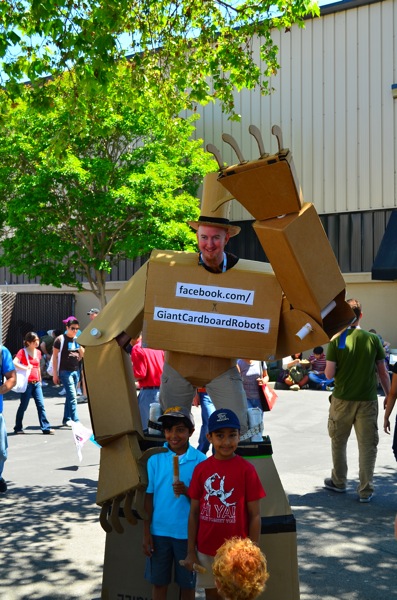
clearly a case of truth in labeling: this guy is obviously a giant cardboard robot

this little girl ran right up to R2-D2 and gave him (it?) a huge hug, after which he started beeping and rolling around

these are actually electric vehicles, but oh, so delicious…

I couldn’t get close enough to get a picture of the LEGO Kermit the Frog holding a banjo that was off to the left, which is a real pity

if I had a garden, I would have bought several of these guys. Maybe next year.
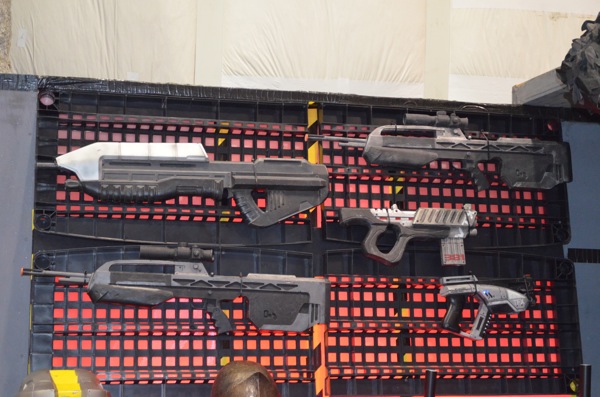
realistic-looking replica weapons from Halo
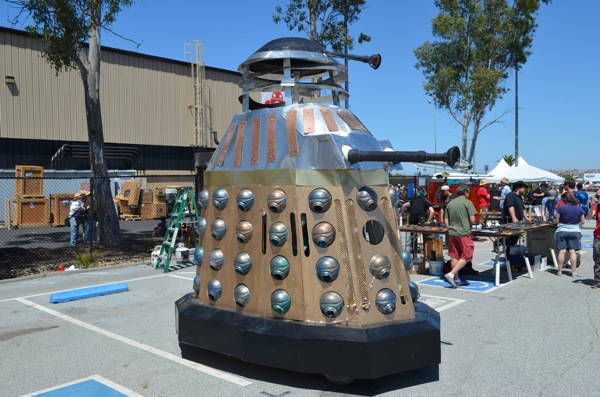
a Dalek you can ride in

a bike you could ride, maybe
Filed under General Stuff
Airwork, 19 May
Any time a pilot talks about “airwork,” what they mean is what normal people think of as “flying.” Takeoffs and landings? No; instead, airwork is the performance of the basic maneuvers: climbs, descents, and turns. Saturday I had my first solo flight in the Bay Area; I’d had several in Pensacola, but the environment, airspace, terrain, and weather are different enough here that this felt a little like starting over.
I got to the airport, preflighted my airplane, and then had to wait for a few other airplanes in front of me to get out of the way; in total I spent about half an hour just doing those two things. The weather was a little iffy. Afternoons in Palo Alto tend to be somewhat windy. The runway I was using has a heading of 310°, and the wind was coming from 350° at 12 knots. That means that there was a 6.4 knot crosswind, and my solo privileges are limited to less than a 7 knot crosswind. Luckily the wind didn’t pick up any!
Once I was cleared for takeoff, I flew a right Dumbarton departure– that means I took off from runway 31 at Palo Alto, flew to the west end of the Dumbarton Bridge, and only then turned to the course I wanted. In this case, about 51° to take me out towards Sunol and the practice area we use. Different airports have different departure procedures. For example, in Pensacola you fly the “Skip departure”, named after Skip Giles (the chief pilot at Pensacola Aviation), which takes you between the toll plaza and the cluster of antennae at Midway, thence to the beach. As I mentioned in my first journal, there are actually two bridges: the one on the left (which is to the north) is the auto bridge, while the rightmost bridge is the train bridge. On arrival, you fly to the train bridge; on departure, to the auto bridge. The departure end of KPAO’s runway 31 is just off the bottom-right corner of this picture.

pick the correct bridge or face the wrath of air traffic control
Anyway, once I got to the practice area, I spent my time working on two different maneuvers. First is what we call slow flight. That’s just what it sounds like: you slow the aircraft down to minimum controllable airspeed (about 40 knots in this particular airplane), controlling power to climb or descend and using pitch to maintain the desired slow speed. In this flight regime the controls must be handled very gently, as the slow speed and high angle of attack means that they’re not as effective as they are at lower attitudes and higher speeds. It takes a delicate touch to turn, climb, and descend in this configuration, which is why I was practicing it, duh.
The other thing I was working on are steep turns. Normal banked turns in an aircraft use between 10° and 30° of bank. Steep turns per the FAA’s definition use at least 45°. The sharper the bank, the more vertical lift is lost, so you have to apply enough back pressure on the control yoke to keep the aircraft from descending during the turn. The FAA standard is that you should be able to do a 360° turn at a 45° bank angle, rolling out plus or minus 10° and losing or gaining no more than 100′ of altitude. This is harder than it sounds, but I learned the key is to watch the angle at which the horizon meets the cowling or dashboard. If you apply enough control force to keep a constant site picture, then all it takes is an occasional glance at the heading indicator to know when you’re about to roll out again. My turns rapidly improved once I figured this out, although I find it easier to do them to the left than to the right. Something else to work on!
Then I headed from the practice area over to the airport at Hayward, where I also have solo privileges. (In addition to weather and crosswind limits, your flight instructor will allow you to fly into a defined set of airports, which in my case includes Hayward.) KHWD is interesting for a couple of reasons: it has two parallel runways, which means that you must be careful to land on the runway you’re assigned to and not the one next to it. (See this picture to see what I mean.) Another is that it’s right under the approach airspace to Oakland International, which means that when you’re in the Hayward traffic pattern there will often be 737s (or even larger aircraft) 1000′-1500′ above you. I found the airport with no problem, got clear for runway 28L, made a great approach, and then blew it by starting my flare too high. The result: a bouncy landing, probably my worst landing ever.
I did, however, maintain airspeed control. This is critically important because if the airplane’s speed gets too slow, it enters an aerodynamic stall, which is not what you want to happen on approach. I’ve struggled a bit with this but nailed the approach at a steady 70 knots. The bounce was embarrassing but luckily no one at Hayward knows me– so don’t tell ’em it was me, OK?
After taxiing back, I took off again and flew back towards Palo Alto; the airplane was due back so I only had time to shoot two landings there, plus one go-around. One thing non-pilots sometimes don’t understand is that going around, a procedure in which you follow the “four Cs”, is a pretty normal procedure. You don’t try to salvage bad landings; if your approach speed, angle, or height is bad, or if the runway isn’t clear, just go around and try again. (What are the four Cs, you ask? Cram in power; climb to a safe altitude; communicate to the tower that you’re going around; and comply with whatever they tell you.) In this case, the tower ordered me to go around because the aircraft in front of me was taking too long. My two landings at Palo Alto were good, despite the crosswind, in part because my airspeed control was good, so I felt pretty good about them.
Key learnings from this flight:
- Use the horizon, not the instruments, and steep turns get much, much easier to perform
- Performing maneuvers at minimum controllable airspeed is demanding but fun. If you can do it precisely, it’s a good feeling.
- Bouncing your aircraft is bad.
- Controlling your airspeed on approach is good.
- Solo flight is very rewarding.
I have solo time on Tuesday and Wednesday this week– expect more journals! I’ll be doing more steep turns, emergency procedures, and probably some navigation work.
KPAO-O22-KPAO, 15 May
[ This is the first of a series of flight blog entries; each one will both cover what I did in a specific flight and try to explain what it means. It’s as much a review tool for me as a means of sharing my enthusiasm about aviation; feel free to leave questions in the comments…]
Tuesday morning I was scheduled to fly a cross-country flight with Andy. As with so many other things, “cross-country” means something completely different to normal people than it does to pilots. The FAA defines cross-country time in part 61 of the Federal Aviation Regulations (FARs). The magic distance in this case: 50 nm (that’s “nautical miles,” as opposed to “statute miles”, which normal people use for highway distances and so on.) In order for a flight to count as a cross-country flight towards your private pilot license, you need to fly at least 50 nm from the point of origin and land at an airport.
I planned a route from Palo Alto, whose airport identifier is KPAO. The “K” means it’s an airport in the US. Canadian airports are tagged with C, Mexican airports with X, and so on. This identifier, interestingly, is the same as is used for radio station call letters– go figure. Anyway. my route was from KPAO to the small airport in Columbia, Caifornia; its airport identifier is O22. (No K. Why? It’s a small, non-towered airport, and their identifiers don’t get the national prefix. Other examples include E16 down in Gilroy and 1M3 near Ardmore, Alabama.) The route would take us from Palo Alto to Columbia, then back to Tracy (KTCY), then back to Palo Alto. Here’s what it looks like:
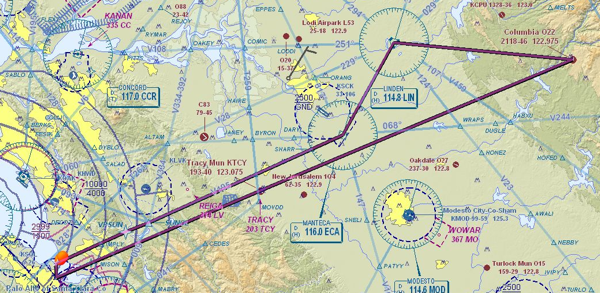
Andy wanted me to plan on using two radio navigation aids– known as VHF omni-range stations, or VORs. You can see ten in the upper right of the map above– they’re circles with a compass rose surrounding them. Lots more on VORs in a future installment…
What does it mean to plan a cross-country flight? Well, the FAA has a useful answer. Section 91.103 of the FARs has this to say:
Each pilot in command shall, before beginning a flight, become familiar with all available information concerning that flight.
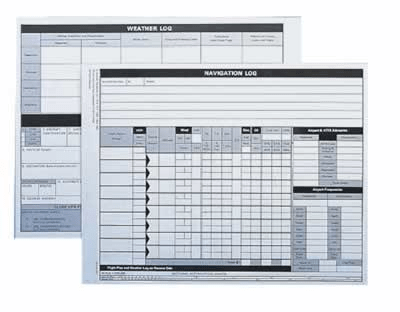
“All available information” explicitly includes data about weather, runways, takeoff and landing distances (which are influenced by terrain, weather, aircraft loading, and runway conditions), and anything else that you need to know to conduct the flight safely. In the case of this flight, that meant getting a weather forecast (a subject for a future acronym-filled post), reviewing the airport data for Tracy, Columbia, and Palo Alto, plotting a course using landmarks for dead reckoning, and calculating estimated time and fuel usage for each leg of the flight. There are electronic tools that can automate flight planning, but I didn’t use any of them; I did it the old-fashioned way, using a chart, a pencil, and a Jeppsen navigation log like the one shown below. (OK, I did cheat; I used an Excel version of the nav log.)
Tuesday morning dawned clear and cool; when I got to the airport, there was a scattered overcast near the airport but it was clear to the east, where we were going, so off we went. During the preflight, I’d programmed the G1000 with the planned route of flight so that it could give me steering cues… as long as it was working, that is. We took off to the north, made a right turn at the west end of the Dumbarton bridge (because that’s the standard departure procedure for this airport– if everyone taking off goes to the end of the auto bridge, and all the incoming traffic flies to the parallel train bridge nearby, it’s easier to keep the streams separate.) Winds were fairly light. The G1000 has a nifty display that shows you the winds aloft, which is good because the winds aloft forecast was wildly off.
One important thing I learned: how to correctly adjust the air/fuel mixture at altitude. This is too complicated for me to explain here, but basically if you adjust the mixture adjusted properly you’ll get the optimum balance between engine temperature (too high or too low are both bad) and fuel consumption. The G1000 makes this pretty easy; it has a separate mode for leaning, so you bring that up and start tweaking the mixture until you hit the desired temperature. Anyway, this was a fairly new procedure for me.
I had no problem flying to first the Manteca VOR and then the Linden VOR. All the while I was keeping track of our position on my paper chart too, which was useful because Andy simulated a failure of the GPS moving map display so that I had to rely on my primary VORs and charting to figure out where we were. My first problem came when we were about 10 miles away from Columbia and I needed to spot it… and couldn’t. Take a look at this picture to see why (the full-size version is better):
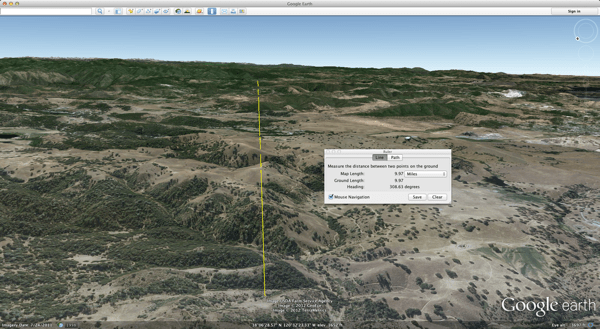
See that yellow line: that marks the distance I was from the airport. At my altitude of 3500′ it was nearly impossible to see if you didn’t already know where it was. Which I didn’t. Luckily I’d noted that I needed to call Columbia’s traffic radio at 5nm west of the reservoir, so when I saw the reservoir I knew I was in the right general area. Andy had to point out the airport location, though he later told me that one of the reasons he sends students to that airport is because it’s hard to find.
Another thing about Columbia: there are hills all around it. The field itself is about 2100′ above sea level, which means the altitude at which you fly traffic patterns there is about 3100′. That still seems kinda low with the hills about; it is deceptively difficult to accurately judge your altitude above forested, crenellated landscape. I made a decent landing despite that, then we taxied back and took off again to Tracy, or so I thought.
I still didn’t have a working GPS, but thanks to my nav log I had navigational references, courses, and so on to help figure out where I was going so that wasn’t a big deal. There is very little to see in that part of the world, too– if you try hard you can see Copperopolis but that’s about it. On the way, Andy decided it would be fun for me to have a simulated emergency so he pulled the engine power to idle and said, rather cheerfully, “You’ve just had an engine failure.” Then he sat back and watched.
There’s a procedure for this, of course, in which I’ve been well drilled. First thing: fly the airplane. Every airplane has a characteristic speed known as Vy. This is the best glide speed; in a Cessna 172, Vy is 68 knots, and you’ll get about 9 feet of forward flight for every foot of altitude you lose if you maintain that speed. If you go faster or slower, you don’t get as much glide.
Step 2 was to figure out where to go. A little knob-twisting on the G1000 revealed that Oakdale was the nearest airport– about 7 nm away. Andy quizzed me to see if I thought we could make it; at 4000 feet, if I maintained Vy then we should be able to glide about 36000 ft, or close to 7nm. So that’s what I did. Meanwhile, step 3 was to run through the checklist for a failed engine, including checking the fuel tank selector, making sure the fuel cutoff valve wasn’t engaged, simulating a Mayday call, and– oh yeah– doing all this while maintaining the right speed and calling Oakdale traffic to let them know we were on the way in.
I arrived at the arrival end of the runway a little higher than I would have liked; Andy converted my approach by extending our downwind leg and landing in the opposite direction. I made another good landing, then we discussed the importance of flaps, which I hadn’t used enough of. More flaps would have increased my descent rate enough so that I wouldn’t have been too high on the approach end. We took off again and flew back to Palo Alto without any further emergencies or tomfoolery, then I made another good landing and put the airplane away.
Key things I learned during this lesson:
- If you have a thorough nav plan, then losing your GPS is no big deal. Even if I had lost my VORs I could have navigated to Columbia and back to Palo Alto (though in that case I’d’ve stayed at Columbia until the airplane got fixed; in this plane, the avionics are all integrated and anything that would kill GPS and the VORs would make it unairworthy until repaired.)
- Vy is critically important. There’s an old chestnut: “speed is life, but altitude is life insurance.” Very, very true.
- I have a hard time judging my approach heights at airports in hills. This is just something I’ll have to get used to.
- I need to get better about remembering to use my flaps during emergency landings. They’re part of the flow check, and my tendency is to check them off and then not return to put them down later when I need them.
Filed under aviation
Thursday trivia #59
- I’ve decided to start journaling my flying lessons. Look for the first entry in the next couple of days.
- This weekend I’m headed to see my first live professional MMA bout: the Strikeforce Heavyweight Grand Prix final. I’m pretty excited about it.
- Diablo III: sorry, couldn’t care less.
- If you’re thinking about attending MEC 2012, the early-bird discount for registration ends tomorrow. Get it while the gettin’ is good. (And if you’re not thinking about attending, whyever not?)
- And speaking of conferences: I’m moderating a panel discussion at Hewlett-Packard’s Discover 2012 conference next month in Vegas. I would have included a link to the session but H-P’s event website is so encrusted with JavaScript that I can’t get the links to work properly.
- Beautiful 1971 letter from Ronald Reagan to his son Michael about marriage. If you are married, want to be married, or know someone who is married, read it.
- A volcano. In a trash can. That fires rubber ducks into the air. Yes please.
Filed under General Stuff, Musings
Thursday trivia #58
- On Monday I went flying; during the flight, I shot some landings at the Hayward airport; it is more or less right across the bay from the Palo Alto airport. As I was flying downwind for an approach to land on runway 28L, I heard an unusual radio call: “Hayward Tower, Boeing 5017 November…” My CFI and I looked at each other, wondering what kind of aircraft it was. Turns out it was the Experimental Aircraft’s B-17, Aluminum Overcast, come to town for a visit! (Their tour is this weekend, when I’ll be in Huntsville, so I did the virtual tour instead. So should you.) He landed while I followed in trail, but it took him long enough to clear the runway that I had to go around– so I got to overfly a B-17. Bonus: I could see our friendly neighborhood Zeppelin about 10nm to the north as I executed the go-around. Some flights just can’t be improved on…
- …but others can. Case in point: the Indian Air Force has purchased 872 MiG fighters since 1966. Since then, they have crashed 482 of them, killing 171 pilots. That’s a loss rate of 55%! I can’t find official data on accident rates (as opposed to total numbers of airframes lost) for the IAF, though an article (whose link I lost) cites a loss rate of somewhere between 0.83 and 1.07 per 10,000 hours. For comparison, see the USAF mishap data from 1947 to 2006 (see the “Destroyed” column), which appears to be calculated per 100,000 hours. It’s surprising both that the IAF has such high total losses and that their mishap rate seems to be pretty steady. (Interesting side note: the USAF apparently flew 25% more hours during “peacetime” in FY 1993 than in the midst of the Afghanistan and Iraq wars in FY 2007!)
- From the “could you possibly find a more obvious research result?” department: “…The surprising result is that relationships in which the man is happier than the woman are significantly more likely to come to an end relative to relationships in which both partners are similarly unhappy.” You don’t say. In other news: water is still wet, and Generalissimo Francisco Franco is still dead.
- I was excited about Bo’s mention of Mad Anthony’s XXXTRA HOT Private Reserve hot sauce… but for $10 a bottle plus $10 shipping, Im thinking I’ll pass. That’s a high barrier to entry just to try it. On the other hand… mmm, delicious spice… so I might have to get some anyway. (Related note: just ordered a refill of Blair’s Death Rain habanero chips, yum!)
- Great persuasive essay from Brian about willpower and desire in relation to fitness. Go read it. And then stay out of the snack closet.
- Attention Tony: now that I know of the existence of The Aviator’s Guide to Ireland my interest in visiting Ireland has gone up about five notches.
- I wish I could convince Amazon to stop cluttering up their home page with top-center ads for womens’ clothing and the Kindle Fire. I don’t want either of them, nor am I likely to suddenly change my mind; if they put up ads for things I might actually buy it would be better for both of us.
Filed under aviation, General Stuff, Musings


