- Last week’s 311 show was as good as I expected it to be. I’m already looking forward to their tour next year.
- Rwanda has an awesome national… I’m not sure what to call it. It’s not a holiday, and it’s more than a tradition. By law, on the last Saturday of every month, everyone cleans. Known as umuganda, it’s a long-standing event that goes back to colonial times. Business close, public transport shuts down, and all able-bodied people between 18 and 65 clean from 8am until 11am. What a fantastic idea.
- I learned the preceding, and much more, from this thoroughly interesting article on Rwanda. I think I’m going to have to add it as a bucket-list destination.
- If you are easily grossed out, do not read this article. No, seriously. I really mean it.
- If you’re a Breaking Bad fan, I commend this remix video to your attention.
- “Who would buy once-radioactive beer? I mean, besides me.” /raises hand.
- Last week I wrote about the process of preparing for my checkride. This guy passed his checkride… after two of the blades on his propeller fell off. I bet everything after the emergency landing was easy.
Category Archives: aviation
Thursday trivia #72
Filed under aviation, General Stuff
Checkride prep, 1 Sept
It’s getting close!
To get a pilot’s license or rating in the US, you have to pass a practical examination with an FAA examiner.
Side note: “What’s the difference between a license and a rating?” you ask. A license gives you flying privileges for a particular category and class, such as “airplane, single-engine, land” or “Zeppelin.” A rating gives you additional privileges for whatever licenses you hold, such as an instrument rating (which you use in conjunction with a single- or multi-engine airplane license, a helicopter license, or whatever.)
The examiner may be an FAA employee, but more often is what the FAA calls a DPE: a designated pilot examiner. Think of the DPE like a sort of super-instructor: a civilian instructor who handles practical exams for the FAA and has the power to grant, or deny, your license based on your exam performance. Each FAA field office has a list of DPEs to which it has delegated this authority (here’s the San Jose list.)
How do you know what the examiner will test you on? There’s a document for each license and rating known as the Practical Test Standard, or PTS, that tells you. For example, the parachute rigger PTS spells out exactly what a parachute rigger must know; likewise the PTS for various pilot licenses. The PTS I’m working on is here; it sets out three things:
- What the examiner may and must test the applicant on during the oral exam. Most of these descriptions are very broad, and include the phrase “exhibit knowledge.” The DPE can ask you pretty much anything as a means of seeing whether you can exhibit knowledge; there’s no category of things they cannot ask you.
- What maneuvers the examiner may and must test. Most of these are self-evident: climbs, turns, descents, straight-and-level flight, steep turns, and so on. In a few cases, the examiner can choose one (or more) maneuvers from a list.
- What performance standards each maneuver requires. For example, a steep turn requires 45° of bank, ±5º, and you must maintain altitude ±100 feet.
The PTS generally doesn’t tell you how to do any maneuver. For example, the PTS for emergency descent says the standard is to [establish] the appropriate airspeed and configuration for the emergency descent,” not what attitude, speed, etc. you must maintain. The overriding requirements, though, are that the completion of a maneuver can’t be unsafe, and its outcome cannot “seriously be in doubt.” In short: scare the examiner, fail the check ride.
Speaking of failing: if you fail any item on the check ride, you’re done. Suppose you get halfway through the ride and are doing well, then blow a simulated emergency approach. The DPE may discontinue the ride on the spot, although if you want to keep going and tackle the other things you haven’t gotten to yet, you can. This is pretty daunting; I plan to handle that situation by not failing anything so obviously that the DPE has to fail me on the spot!
As you might imagine, the practical examination is a big deal. Before you can take it, your CFI has to give you a logbook endorsement indicating that you’re ready. This endorsement means that your instructor thinks you’re prepared for both parts of the check ride: the oral exam and the practical flight test. Preparation is super important. I’ve been studying the PTS so I know the required precision for the maneuvers, practicing the maneuvers both with my instructor and solo, studying the ASA check ride exam prep guide, and watching the King Schools check ride prep course. Of these things, the most important is the flying practice. The two things I need to nail down are crosswind takeoffs and landings and short-field landings; more on those in the next post.
Filed under aviation
Long solo cross-country, 4 July
What better way to celebrate Independence Day than to exercise my Constitutional right of free travel? That’s right: “free” as in “not encumbered by TSA or any of their baloney.”
The FAA requires that private pilots know how to plan and safely execute what they call “cross-country” flights. I’d already flown one with Andy from Palo Alto to Columbia, but the FAA requires that private pilots plan and carry out a cross-country flight of at least 150nm total distance, with one leg being at least 50nm and landings at 3 separate airports.
Andy had originally asked me to plan a flight from Palo Alto (KPAO) to Paso Robles (KPRB) to Salinas (KSNS) and back to KPAO. The first leg to Paso Robles is 129nm, so the total trip distance would meet all the FAA’s requirements. In my earlier post I gave a quick summary of what it means to construct a VFR flight plan; here’s a slightly more detailed list:
- Puled out a bunch of paper charts: my San Francisco and Los Angeles sectional charts and my San Franciscoterminal chart. Sectional charts are large-scale charts that show terrain features, airports, roads, navigation aids, and other useful items at 1:500,000 scale. Terminal charts show a smaller area at double the scale, so they’re great for navigation planning in urban areas.
- Used the paper charts to plot a direct route of flight, using a straightedge and a Sharpie marker to lay out my course. Paper charts cost about $9 each, so you might wonder why I’d be willing to deface them with a Sharpie. The truth is, they expire after about 5 months, so you may as well mark on them.
- Used the route of flight to identify checkpoints– visual features on the ground that I can look at to tell where I am and what my progress along the course is. There are some well-known visual checkpoints already marked on the sectionals. For example, VPSUN is the golf course at Sunol, while VPMOR is the LDS temple in Oakland. You can use these as reporting points; for example, I can call the Palo Alto tower and say “Palo Alto, Cessna One Niner One Tango Golf, overhead Leslie Salt, landing Palo Alto with Juliet.” That doesn’t mean Juliet’s in the airplane; rather, it means that I’m reporting being overhead the Leslie Salt Company’s salt refinery with ATIS information— a radio broadcast telling me what the current airport weather and runway conditions are– Juliet.
- Measured the distance between checkpoints and put that into my navigation log.
- Got a weather forecast showing the projected winds aloft and used those to calculate the amount of wind correction necessary for each leg.
- Used the wind and airspeed data to figure out how long each leg would take to fly, or, in other words, the ETA to go between each pair of checkpoints
- Used the ETA data to estimate fuel consumption for each leg
- Reviewed the airport data, including which runways exist, whether they were open or closed, any restrictions on their use, what the standard traffic patterns and altitudes were, and so on.
After doing all that, I reviewed the weather forecast and saw that Salinas and Monterey were both fogged in. That didn’t bode well for my planned route, but I went to the airport anyway to meet with Andy and discuss my flight plan. Student pilots have to have an instructor’s logbook endorsement to legally do the long cross-country, you see, so meeting with him was a precondition to taking off. I reviewed the route of flight with him and pointed out some alternate options given that I couldn’t overfly the fog areas. He suggested a completely different route: over the hills to Tracy (KTCY), then down to Los Baños (KLSN), then to KPRB, and then back either direct (if the fog was gone) or by reversing that route. I replanned the route, got his endorsement, and went to check out the airplane I’d reserved… except that it was gone.
OK, OK, I exaggerate… a bit. The automated scheduling system that Advantage uses expects that you’ll sign out the airplane at the scheduled time. If you don’t do so within 30 minutes of your scheduled time, the system puts the airplane back in the available pool. I had an 0800 reservation, but at 0830 I was still meeting with Andy, so the plane became available and someone else grabbed it. Luckily there was another G1000-equipped 172 available at noon, so I took it instead.
Before I took off, I asked Palo Alto ground control for VFR flight following. This is essentially radar surveillance; air traffic control assigns you a unique transponder code that identifies your aircraft on radar. ATC will issue traffic and safety advisories, notifying you of other aircraft in your vicinity and so on. As you leave each bubble of radar surveillance, ATC hands you off to the next one. For my flight, I started out with Palo Alto and was handed off to NORCAL Approach, the TRACON (or terminal radar approach control center) that owns the airspace over most of northern California. I stayed with NORCAL until I got to an area outside their control, at which point they handed me over to Oakland Center, the air route traffic control center (ARTCC) that provides radar services outside of TRACON-controlled areas.
Anyway, one of the benefits of flight following is that you get traffic advisory calls. I got several on my route towards Tracy; that airspace is heavily traveled as people fly into and out of Palo Alto, Hayward, San Carlos, and the other airports in the area. My favorite call? That’s easy: “Cessna Two Hotel Golf, traffic your 1 o’clock, 2 miles, 5000 feet northbound, flight of two F-18. Hobo 51, traffic your 11-o’clock, 2 miles, 3000 feet eastbound, Cessna 172.” Sure enough, there went two F-18s zipping past, too fast for me to unlimber the camera and get a picture.
The flight itself was great! Good visibility on the outbound leg; I took off from Palo Alto, made a right Dunbarton, overflew Sunol, overflew the Livermore area, and headed to Tracy. AsHere’s what the Tracy airport looks like from 5500′ up; it looks small from the ground, but those two runways are 4000′ each.

My route of flight from metropolitan Tracy (!) down to Los Baños took me roughly along Interstate 5. To the west there are all kinds of interesting hills; to the east there are a string of smallish towns, plus lots and lots of cultivated land. From the air, the patchwork of different shades of green is absolutely gorgeous.

that salad you’re eating? it probably came from the Central Valley
My approach and landing at Los Baños were uneventful, with a good landing on their runway. The Los Baños airport is uncontrolled, meaning there’s no control tower or radar service. Each aircraft is required to vigorously “see and avoid,” of course, but there’s also a radio frequency on which aircraft in the vicinity announce their location and intentions. So you call to tell anyone listening that you’re approaching the airport, where you’re going, and where you are… i.e. “Los Baños traffic, Cessna Two Hotel Golf, 5 miles north of the field, two thousand five hundred, entering the pattern for landing runway 32”, or whatever. Then you call again when you get closer; meanwhile, other aircraft, if any, are making their own calls. I landed well, taxied back on the parallel taxiway, waited a minute for another aircraft to take off and clear the pattern, and took off to the south.
The route of flight that Andy and I had planned called for me to go from KLSN to New Coalingua airport, then turn southwest for Paso Robles.. so that’s what I did, being careful to stay out of the Lemoore military operating areas (MOAs). Andy warned me that I’d know when I was getting close to New Coalingua because I’d be able to smell Harris Ranch. I thought he was pulling my leg, but, sure enough, I could smell the stockyards from more than a mile up and several miles lateral distance. I made the turn before C80 and found Paso Robles right where it was supposed to be. I landed, taxied in to a parking spot, and went inside to find out if they had any food, having neglected to pack anything. They didn’t, but the kind folks at Paso Robles Jet Center loaned me a crew car so I could drive into town and eat at Margie’s Diner. As advertised, the diner had extremely large portions, which suited me just fine. I had a delicious grilled ham-and-cheese and two large diet Pepsis; meanwhile, the line crew refueled my plane so that when I got there (after a brief encounter with the airport’s resident cat) I was ready to go. I took off and headed to the northwest, towards Salinas, but there was a huge layer of haze that looked like it covered pretty much my entire route of flight.
Haze, of course, diminishes visibility rather than eliminating it. It wouldn’t have been legal for me to overfly an area of fog that obscured the ground completely, whereas I could have legally flown over the haze. However, “legal” and “prudent” don’t always mean the same thing, so I elected to go back the way that I came, mostly. Instead of going back to C80, I cut the corner by flying to the Priest VOR, then to the Panoche VOR, then telling the G1000 to take me back towards Tracy and thence to Palo Alto. On the way back, I practiced using the GFC700 autopilot in the airplane a bit. This might seem contradictory– why use the autopilot at all as a student? There are several good reasons. First, I want to know how every piece of equipment in the airplane works so that I can get the most utility from it. Second, for instrument flying the autopilot is a tremendous aid because it can keep the aircraft pointed in the right direction at the right altitude while the pilot aviates, navigates, and communicates. Third, one of the things you’re required to demonstrate on the FAA check ride is what the FAA calls “lost procedures”– in other words, what do you do if you get lost? I want the option to be able to tell the autopilot to keep the wings level and altitude steady while I’m rooting around looking for charts or whatever. Fourth, it’s cool. Anyway, I spent some time refreshing my knowledge of how to set up the autopilot to track a heading and maintain an altitude. There are many more sophisticated things it can do that I haven’t started exploring yet, like fly a profile such that you end up at a specific altitude over a specific point on the ground. That will come with time.
Coming back I had a great view of the San Luis reservoir, near Los Baños; see below.

There was a bit of haze, but off to the west I could still see heavy haze on my original planned route, and I was perfectly happy to see it over there instead of underneath me. My approach through the hills and the east side of the Bay went well, and I nailed the landing back at Palo Alto. 4.0 hours of pilot-in-command and solo cross-country time for the books!
Filed under aviation, California
Airwork, 4 June
There’s an old saw in aviation: to be a successful pilot, all you have to do is make sure that your lifetime total of takeoffs and landings match. With that in mind, student pilots spend a fair amount of time practicing various kinds of takeoffs and landings to become proficient. In this particular session, we worked on soft-field takeoffs and landings.
One thing that many non-pilots assume is that airplanes can take off or land pretty much anywhere. This is true for some values of “airplanes” and “pretty much anywhere.” It’s true that almost any reasonably level surface of sufficient length can be used as a landing strip, but some airplanes are much better suited to what we call unimproved strips– those that aren’t paved– than others. If you watch almost any TV show involving Alaska, for example, you’ll see lots of video of airplanes landing on grass strips, dirt, gravel or sandbars in rivers, snow, and ice. Some of these airplanes will have tricycle gear (meaning a nose wheel and two main gear located under the fuselage), while others will be taildraggers (which use a steerable wheel under the tail, along with two main gear). Some will have skis, while others will have big bush tires. But what about your everyday, run-of-the-mill Cessna or Piper? It turns out that they can operate just fine from many kinds of unimproved runway, including grass and dirt strips. More to the point, though, in case of a precautionary or forced landing, it’s really important to know how to take off and land safely on soft-surfaced runways, so we practice it.
For a soft-field takeoff or landing in a tricycle-gear airplane, one key is to try to keep the nose wheel off the ground as much as possible by keeping the yoke back. As airspeed increases, keeping the yoke back raises the nose, lessening the load on the nose wheel and reducing the chance that it will dig in to the surface and flip the plane over. As you land, keeping the yoke back allows you to convert forward airspeed into lift, which has the beneficial effect of slowing the airplane down quickly without using brakes and while keeping the nose wheel out of the mud, or whatever is on the surface.
To accomplish a good soft-field takeoff, there are a few other things to do. First, momentum is your friend. Once you begin to turn onto the runway, you don’t stop to line up (provided, of course, that ATC hasn’t told you to “line up and wait,” which means that they’ve cleared you to line up on the departure end of the runway and wait for clearance to actually take off while another aircraft lands), and you control your taxi speed such that you don’t have to use the brakes as you turn to align with the runway. As you’re completing your turn, you advance the power smoothly to takeoff power while keeping the yoke back. Once you gain sufficient speed to take off, you add enough up-elevator to leave the runway surface and then immediately push forward so that you don’t climb.
“Wait, what?” I can hear you asking.
Flying machines can benefit from something known as ground effect. This is what makes hovercraft work; an airfoil moving within a certain distance off the ground will generate a sort of cushion of air that provides additional lift and reduced drag, beyond what the airfoil generates on its own. You might remember from a previous discussion that every airplane has a characteristic speed at which it climbs best— it gains the most altitude for each foot of forward motion at that speed. The goal of keeping the aircraft in ground effect is to keep it off the muddy/sticky/grassy surface– which would just slow it down– and allow it to accelerate to best-climb speed as quickly as possible, while surfing the cushion of ground-effect air. This takes some getting used to because your learned reaction to leaving the ground is to put in enough pitch to climb at the desired speed. Instead of doing that, you have to force the aircraft to stay close to the ground until it’s time to climb. This is easy to do; it just requires some extra thought. Once you’ve reached best-climb speed, you can trim the aircraft to maintain that speed, retract the flaps (if you added any), and transition to a normal climb.
Soft-field landings are all about speed. If you’re landing on a soft field it’s a good bet that the field is also shorter than you might like, so you’ll want to slow down your approach. Even if the field is long, though, you’ll still carry 5-10 knots less speed into the approach. For short-field approaches in the 172, I fly 70 knots with the first 10° of flaps, then I slow to 65 knots with 20° flaps and 60 knots with full flaps. If you do it right, you’ll end up in your landing flare doing no more than about 40 knots. Think of what this means in practical terms: if you’re landing on a plowed field (let’s say) because of an engine failure, if you can cut your touchdown speed by 20 knots, you’ve reduced the kinetic energy you’re carrying by a large amount, given that kinetic energy changes as the square of velocity (remember good ol’ KE = 1/2mv^2!)
Short-field takeoffs and landings are different beasts; here the goal is to take off or land within the minimum distance possible, perhaps including clearing an obstacle on the approach or departure. For example, the airfield at Milton, Florida (2R4) is a great place to practice short-field work because there are trees several hundred feet from each end of the runway. These don’t present any real danger, but they make a great target; in a short-field approach, you fly a steeper than usual descent to clear any obstacles, then land a bit firmer than usual– your goal is to avoid any unnecessary float, because float translates to additional distance flown down the runway. You may not have any additional distance to spare. Because it’s late, and I’m sleepy, rather than go on about short-field work I’ll leave this AOPA Flight Training article for those who are interested; it’s pretty good.
Filed under aviation
Pictures from my B-17 ride
I still have to write a more detailed post about my adventure flying in Nine O Nine, the Collings Foundation‘s immaculately restored B-17. I took 3 cameras: my iPhone, a Nikon D5100, and a ContourHD helmet cam (only without the helmet). It was my first outing with the D5100 and the ContourHD both, and I’m really pleased with the results. Check out my Flickr stream for airplane pics; as soon as I get the video edited (which will probably be a while), I’ll post it too.
Filed under aviation, California, General Stuff
Airwork, 19 May
Any time a pilot talks about “airwork,” what they mean is what normal people think of as “flying.” Takeoffs and landings? No; instead, airwork is the performance of the basic maneuvers: climbs, descents, and turns. Saturday I had my first solo flight in the Bay Area; I’d had several in Pensacola, but the environment, airspace, terrain, and weather are different enough here that this felt a little like starting over.
I got to the airport, preflighted my airplane, and then had to wait for a few other airplanes in front of me to get out of the way; in total I spent about half an hour just doing those two things. The weather was a little iffy. Afternoons in Palo Alto tend to be somewhat windy. The runway I was using has a heading of 310°, and the wind was coming from 350° at 12 knots. That means that there was a 6.4 knot crosswind, and my solo privileges are limited to less than a 7 knot crosswind. Luckily the wind didn’t pick up any!
Once I was cleared for takeoff, I flew a right Dumbarton departure– that means I took off from runway 31 at Palo Alto, flew to the west end of the Dumbarton Bridge, and only then turned to the course I wanted. In this case, about 51° to take me out towards Sunol and the practice area we use. Different airports have different departure procedures. For example, in Pensacola you fly the “Skip departure”, named after Skip Giles (the chief pilot at Pensacola Aviation), which takes you between the toll plaza and the cluster of antennae at Midway, thence to the beach. As I mentioned in my first journal, there are actually two bridges: the one on the left (which is to the north) is the auto bridge, while the rightmost bridge is the train bridge. On arrival, you fly to the train bridge; on departure, to the auto bridge. The departure end of KPAO’s runway 31 is just off the bottom-right corner of this picture.

pick the correct bridge or face the wrath of air traffic control
Anyway, once I got to the practice area, I spent my time working on two different maneuvers. First is what we call slow flight. That’s just what it sounds like: you slow the aircraft down to minimum controllable airspeed (about 40 knots in this particular airplane), controlling power to climb or descend and using pitch to maintain the desired slow speed. In this flight regime the controls must be handled very gently, as the slow speed and high angle of attack means that they’re not as effective as they are at lower attitudes and higher speeds. It takes a delicate touch to turn, climb, and descend in this configuration, which is why I was practicing it, duh.
The other thing I was working on are steep turns. Normal banked turns in an aircraft use between 10° and 30° of bank. Steep turns per the FAA’s definition use at least 45°. The sharper the bank, the more vertical lift is lost, so you have to apply enough back pressure on the control yoke to keep the aircraft from descending during the turn. The FAA standard is that you should be able to do a 360° turn at a 45° bank angle, rolling out plus or minus 10° and losing or gaining no more than 100′ of altitude. This is harder than it sounds, but I learned the key is to watch the angle at which the horizon meets the cowling or dashboard. If you apply enough control force to keep a constant site picture, then all it takes is an occasional glance at the heading indicator to know when you’re about to roll out again. My turns rapidly improved once I figured this out, although I find it easier to do them to the left than to the right. Something else to work on!
Then I headed from the practice area over to the airport at Hayward, where I also have solo privileges. (In addition to weather and crosswind limits, your flight instructor will allow you to fly into a defined set of airports, which in my case includes Hayward.) KHWD is interesting for a couple of reasons: it has two parallel runways, which means that you must be careful to land on the runway you’re assigned to and not the one next to it. (See this picture to see what I mean.) Another is that it’s right under the approach airspace to Oakland International, which means that when you’re in the Hayward traffic pattern there will often be 737s (or even larger aircraft) 1000′-1500′ above you. I found the airport with no problem, got clear for runway 28L, made a great approach, and then blew it by starting my flare too high. The result: a bouncy landing, probably my worst landing ever.
I did, however, maintain airspeed control. This is critically important because if the airplane’s speed gets too slow, it enters an aerodynamic stall, which is not what you want to happen on approach. I’ve struggled a bit with this but nailed the approach at a steady 70 knots. The bounce was embarrassing but luckily no one at Hayward knows me– so don’t tell ’em it was me, OK?
After taxiing back, I took off again and flew back towards Palo Alto; the airplane was due back so I only had time to shoot two landings there, plus one go-around. One thing non-pilots sometimes don’t understand is that going around, a procedure in which you follow the “four Cs”, is a pretty normal procedure. You don’t try to salvage bad landings; if your approach speed, angle, or height is bad, or if the runway isn’t clear, just go around and try again. (What are the four Cs, you ask? Cram in power; climb to a safe altitude; communicate to the tower that you’re going around; and comply with whatever they tell you.) In this case, the tower ordered me to go around because the aircraft in front of me was taking too long. My two landings at Palo Alto were good, despite the crosswind, in part because my airspeed control was good, so I felt pretty good about them.
Key learnings from this flight:
- Use the horizon, not the instruments, and steep turns get much, much easier to perform
- Performing maneuvers at minimum controllable airspeed is demanding but fun. If you can do it precisely, it’s a good feeling.
- Bouncing your aircraft is bad.
- Controlling your airspeed on approach is good.
- Solo flight is very rewarding.
I have solo time on Tuesday and Wednesday this week– expect more journals! I’ll be doing more steep turns, emergency procedures, and probably some navigation work.
KPAO-O22-KPAO, 15 May
[ This is the first of a series of flight blog entries; each one will both cover what I did in a specific flight and try to explain what it means. It’s as much a review tool for me as a means of sharing my enthusiasm about aviation; feel free to leave questions in the comments…]
Tuesday morning I was scheduled to fly a cross-country flight with Andy. As with so many other things, “cross-country” means something completely different to normal people than it does to pilots. The FAA defines cross-country time in part 61 of the Federal Aviation Regulations (FARs). The magic distance in this case: 50 nm (that’s “nautical miles,” as opposed to “statute miles”, which normal people use for highway distances and so on.) In order for a flight to count as a cross-country flight towards your private pilot license, you need to fly at least 50 nm from the point of origin and land at an airport.
I planned a route from Palo Alto, whose airport identifier is KPAO. The “K” means it’s an airport in the US. Canadian airports are tagged with C, Mexican airports with X, and so on. This identifier, interestingly, is the same as is used for radio station call letters– go figure. Anyway. my route was from KPAO to the small airport in Columbia, Caifornia; its airport identifier is O22. (No K. Why? It’s a small, non-towered airport, and their identifiers don’t get the national prefix. Other examples include E16 down in Gilroy and 1M3 near Ardmore, Alabama.) The route would take us from Palo Alto to Columbia, then back to Tracy (KTCY), then back to Palo Alto. Here’s what it looks like:
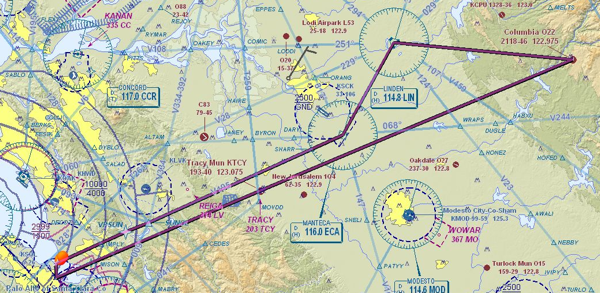
Andy wanted me to plan on using two radio navigation aids– known as VHF omni-range stations, or VORs. You can see ten in the upper right of the map above– they’re circles with a compass rose surrounding them. Lots more on VORs in a future installment…
What does it mean to plan a cross-country flight? Well, the FAA has a useful answer. Section 91.103 of the FARs has this to say:
Each pilot in command shall, before beginning a flight, become familiar with all available information concerning that flight.
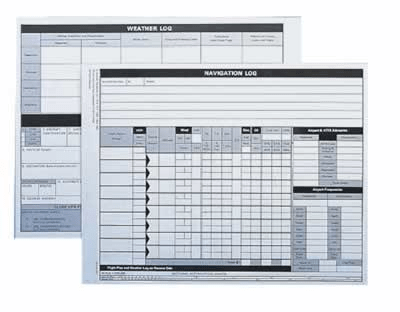
“All available information” explicitly includes data about weather, runways, takeoff and landing distances (which are influenced by terrain, weather, aircraft loading, and runway conditions), and anything else that you need to know to conduct the flight safely. In the case of this flight, that meant getting a weather forecast (a subject for a future acronym-filled post), reviewing the airport data for Tracy, Columbia, and Palo Alto, plotting a course using landmarks for dead reckoning, and calculating estimated time and fuel usage for each leg of the flight. There are electronic tools that can automate flight planning, but I didn’t use any of them; I did it the old-fashioned way, using a chart, a pencil, and a Jeppsen navigation log like the one shown below. (OK, I did cheat; I used an Excel version of the nav log.)
Tuesday morning dawned clear and cool; when I got to the airport, there was a scattered overcast near the airport but it was clear to the east, where we were going, so off we went. During the preflight, I’d programmed the G1000 with the planned route of flight so that it could give me steering cues… as long as it was working, that is. We took off to the north, made a right turn at the west end of the Dumbarton bridge (because that’s the standard departure procedure for this airport– if everyone taking off goes to the end of the auto bridge, and all the incoming traffic flies to the parallel train bridge nearby, it’s easier to keep the streams separate.) Winds were fairly light. The G1000 has a nifty display that shows you the winds aloft, which is good because the winds aloft forecast was wildly off.
One important thing I learned: how to correctly adjust the air/fuel mixture at altitude. This is too complicated for me to explain here, but basically if you adjust the mixture adjusted properly you’ll get the optimum balance between engine temperature (too high or too low are both bad) and fuel consumption. The G1000 makes this pretty easy; it has a separate mode for leaning, so you bring that up and start tweaking the mixture until you hit the desired temperature. Anyway, this was a fairly new procedure for me.
I had no problem flying to first the Manteca VOR and then the Linden VOR. All the while I was keeping track of our position on my paper chart too, which was useful because Andy simulated a failure of the GPS moving map display so that I had to rely on my primary VORs and charting to figure out where we were. My first problem came when we were about 10 miles away from Columbia and I needed to spot it… and couldn’t. Take a look at this picture to see why (the full-size version is better):
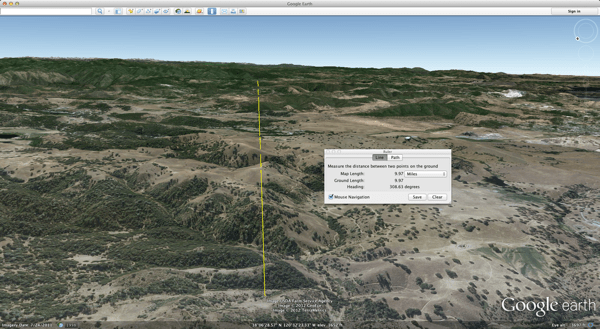
See that yellow line: that marks the distance I was from the airport. At my altitude of 3500′ it was nearly impossible to see if you didn’t already know where it was. Which I didn’t. Luckily I’d noted that I needed to call Columbia’s traffic radio at 5nm west of the reservoir, so when I saw the reservoir I knew I was in the right general area. Andy had to point out the airport location, though he later told me that one of the reasons he sends students to that airport is because it’s hard to find.
Another thing about Columbia: there are hills all around it. The field itself is about 2100′ above sea level, which means the altitude at which you fly traffic patterns there is about 3100′. That still seems kinda low with the hills about; it is deceptively difficult to accurately judge your altitude above forested, crenellated landscape. I made a decent landing despite that, then we taxied back and took off again to Tracy, or so I thought.
I still didn’t have a working GPS, but thanks to my nav log I had navigational references, courses, and so on to help figure out where I was going so that wasn’t a big deal. There is very little to see in that part of the world, too– if you try hard you can see Copperopolis but that’s about it. On the way, Andy decided it would be fun for me to have a simulated emergency so he pulled the engine power to idle and said, rather cheerfully, “You’ve just had an engine failure.” Then he sat back and watched.
There’s a procedure for this, of course, in which I’ve been well drilled. First thing: fly the airplane. Every airplane has a characteristic speed known as Vy. This is the best glide speed; in a Cessna 172, Vy is 68 knots, and you’ll get about 9 feet of forward flight for every foot of altitude you lose if you maintain that speed. If you go faster or slower, you don’t get as much glide.
Step 2 was to figure out where to go. A little knob-twisting on the G1000 revealed that Oakdale was the nearest airport– about 7 nm away. Andy quizzed me to see if I thought we could make it; at 4000 feet, if I maintained Vy then we should be able to glide about 36000 ft, or close to 7nm. So that’s what I did. Meanwhile, step 3 was to run through the checklist for a failed engine, including checking the fuel tank selector, making sure the fuel cutoff valve wasn’t engaged, simulating a Mayday call, and– oh yeah– doing all this while maintaining the right speed and calling Oakdale traffic to let them know we were on the way in.
I arrived at the arrival end of the runway a little higher than I would have liked; Andy converted my approach by extending our downwind leg and landing in the opposite direction. I made another good landing, then we discussed the importance of flaps, which I hadn’t used enough of. More flaps would have increased my descent rate enough so that I wouldn’t have been too high on the approach end. We took off again and flew back to Palo Alto without any further emergencies or tomfoolery, then I made another good landing and put the airplane away.
Key things I learned during this lesson:
- If you have a thorough nav plan, then losing your GPS is no big deal. Even if I had lost my VORs I could have navigated to Columbia and back to Palo Alto (though in that case I’d’ve stayed at Columbia until the airplane got fixed; in this plane, the avionics are all integrated and anything that would kill GPS and the VORs would make it unairworthy until repaired.)
- Vy is critically important. There’s an old chestnut: “speed is life, but altitude is life insurance.” Very, very true.
- I have a hard time judging my approach heights at airports in hills. This is just something I’ll have to get used to.
- I need to get better about remembering to use my flaps during emergency landings. They’re part of the flow check, and my tendency is to check them off and then not return to put them down later when I need them.
Filed under aviation
Thursday trivia #58
- On Monday I went flying; during the flight, I shot some landings at the Hayward airport; it is more or less right across the bay from the Palo Alto airport. As I was flying downwind for an approach to land on runway 28L, I heard an unusual radio call: “Hayward Tower, Boeing 5017 November…” My CFI and I looked at each other, wondering what kind of aircraft it was. Turns out it was the Experimental Aircraft’s B-17, Aluminum Overcast, come to town for a visit! (Their tour is this weekend, when I’ll be in Huntsville, so I did the virtual tour instead. So should you.) He landed while I followed in trail, but it took him long enough to clear the runway that I had to go around– so I got to overfly a B-17. Bonus: I could see our friendly neighborhood Zeppelin about 10nm to the north as I executed the go-around. Some flights just can’t be improved on…
- …but others can. Case in point: the Indian Air Force has purchased 872 MiG fighters since 1966. Since then, they have crashed 482 of them, killing 171 pilots. That’s a loss rate of 55%! I can’t find official data on accident rates (as opposed to total numbers of airframes lost) for the IAF, though an article (whose link I lost) cites a loss rate of somewhere between 0.83 and 1.07 per 10,000 hours. For comparison, see the USAF mishap data from 1947 to 2006 (see the “Destroyed” column), which appears to be calculated per 100,000 hours. It’s surprising both that the IAF has such high total losses and that their mishap rate seems to be pretty steady. (Interesting side note: the USAF apparently flew 25% more hours during “peacetime” in FY 1993 than in the midst of the Afghanistan and Iraq wars in FY 2007!)
- From the “could you possibly find a more obvious research result?” department: “…The surprising result is that relationships in which the man is happier than the woman are significantly more likely to come to an end relative to relationships in which both partners are similarly unhappy.” You don’t say. In other news: water is still wet, and Generalissimo Francisco Franco is still dead.
- I was excited about Bo’s mention of Mad Anthony’s XXXTRA HOT Private Reserve hot sauce… but for $10 a bottle plus $10 shipping, Im thinking I’ll pass. That’s a high barrier to entry just to try it. On the other hand… mmm, delicious spice… so I might have to get some anyway. (Related note: just ordered a refill of Blair’s Death Rain habanero chips, yum!)
- Great persuasive essay from Brian about willpower and desire in relation to fitness. Go read it. And then stay out of the snack closet.
- Attention Tony: now that I know of the existence of The Aviator’s Guide to Ireland my interest in visiting Ireland has gone up about five notches.
- I wish I could convince Amazon to stop cluttering up their home page with top-center ads for womens’ clothing and the Kindle Fire. I don’t want either of them, nor am I likely to suddenly change my mind; if they put up ads for things I might actually buy it would be better for both of us.
Filed under aviation, General Stuff, Musings
Happy Mardi Gras
The boys and I are just back from a wonderful trip to South Louisiana for a mini-family reunion. Missie started the ball rolling a few months ago, so I made precautionary hotel reservations just in case. Things worked out beautifully– the boys had Friday and Monday off, so I picked them up in Montgomery Thursday night, and we stayed overnight in Mobile. Friday morning, we got up and drove to Houma; along the way we stopped at the National World War II Museum. I’d been there before, but the boys hadn’t, and they were pretty much wide-eyed throughout the entire tour. A stop in Luling for a shrimp poboy, and poof! we were in Houma.
That night we went to the Krewe of Aphrodite parade. In case you hadn’t guessed, this krewe’s court is all-female, and all the floats were crewed by women. I’m not sure if that was a factor in the boys’ massive haul of beads, but it could have been. We all had a grand time; we then joined Doug, Shawn, Missie, Jody, and the girls for Mexican.

the boys ended up heavily laden with beads, plus all sorts of other random paraphernalia.

sadly, Piranha Rentals doesn’t actually rent piranhas.

not actual size
Saturday drove around to check out Houma, which has grown quite a bit since my last visit– to say nothing of how much it’s grown since I lived there. Terrebonne Parish as a whole had about 94,000 people in 1980, shortly before I moved away. The 2010 census says it now has around 112,000 people, but that seems low based on the size and bustle of what used to be a fairly quiet small town. We were supposed to marshal at Mr. Poboy (which I highly recommend), but we had some time to kill. I decided to drive out towards the airport, and what a good decision that turned out to be!
As we were driving, I saw what looked like a DC-3… then another one… then some other large propellor transport, all parked behind a hangar labeled “AIRBORNE SUPPORT.” We drove over to their hangar, and after a little poking around a gentleman (whose name, sadly, I didn’t write down) came out and offered us a tour of their operations. At first, he asked if we were with the media; I later learned that various media organizations were using shotgun mikes, pole-mounted cameras, and other surveillance devices to eavesdrop on their operations during cleanup of the BP Macondo oil spill. Once he was satisfied that we weren’t part of any sinister plots, he could not have been more helpful and friendly. I didn’t realize it at the time, but Airborne Support is a contractor that provides aerial spraying services to Clean Gulf Associates, an oil-industry-funded non-profit that maintains emergency response equipment and staff for spill cleanup. I’ll have to read up more on both of them when I have time.
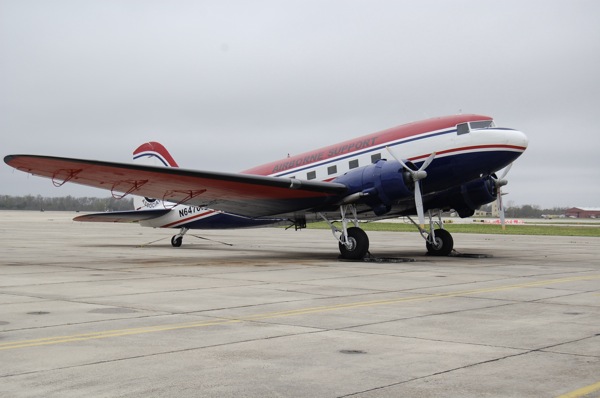
The aircraft shown above is one of the DC-3s we saw (its web page is here.). More properly, it’s actually a C-47A, the military variant of the DC-3. This one was built in 1944 and is still flying! That’s not uncommon, as aircraft have a much longer life than most people realize. It’s fitted with a large tank that holds chemical dispersant; the spray plane flies at low altitude (30-50 feet above the water) and sprays in a pattern determined by a spotter plane flying at a higher altitude. The interior is bare-bones: there’s a big tank for the dispersant and that’s it. The cockpit below is mostly original, too, with the addition of a Garmin 530, some 1970s-vintage radios, and an overhead-mounted agricultural specialty GPS. The seats, yokes, and so on are all original, though.

my sons have the rare distinction of having been both in the cockpit of an operational DC-3 and the captain’s chair of a Nimitz-class nuclear aircraft carrier
After the tour, we joined the family at Mr. Poboy for an excellent meal. I had the fried shrimp poboy, which was served with excellent soft French bread. The shrimp were apparently fried in Zatarain’s, which is my go-to seasoning, and were plentiful and of good texture. (I wasn’t sold on the fries, though; our Luling gas station fries were better). Then we went over to Ricky’s house, where Ricky and Carey cooked up two huge pots of food: seafood gumbo and pastalaya respectively. Both were superb, as was the lemon icebox pie that someone made (I’m not sure who, but it was certainly good).

Carey’s pastalaya pot is almost, but not quite, big enough to cook a small child in. Sadly you can’t see Ricky’s epic two-burner cooking stand but it was busy too.
One of the things I love about visiting my family is that it’s a given that all the men can cook well. I am by far the worst male cook in my family, but I’m working on it!
We stayed at Ricky’s until well after dark; the steady, heavy rain didn’t dampen our spirits, although it did force cancellation of the scheduled parades. We were too full to care, however. Sunday morning we had breakfast en masse at Waffle House, conveniently located next to our hotel, then went in search of another parade– this one the Krewe of Terraneans. We stayed for the first four or five floats, then headed west for A Cajun Man’s Swamp Tour, run by Black Guidry. I’d taken the boys on it before several years ago, and I don’t think Black’s jokes have changed much since then, but we got some great looks at wildlife, including turtles, young alligators, and nutria. The weather had cleared by the time we left the dock and it was clear, sunny, and very pleasant out on the water.
 Capt. Guidry playing his Cajun accordion

A third turtle decamped the log just as I was pressing the shutter button.

He looks pretty comfortable, doesn’t he?
Sunday night we had dinner at Boudreau & Thibodeaux’s in Houma. The food was excellent, and the wait staff did their best to feed all 30 of us in a reasonable amount of time. I had some delicious grilled catfish and a small number of Tom’s two pounds of crawfish. He certainly did them justice, as you can see in the before-and-after pictures below.

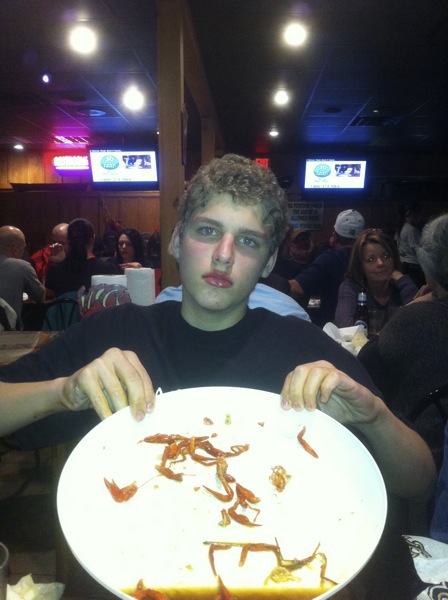
Monday all we did was drive back: Houma to Montgomery for me to drop the boys off, then back to Pensacola: just under 500 statute miles all told. Great trip, and we’re all looking forward to doing it again next year!
Filed under aviation, Friends & Family, Travel
Deer collisions at airports
Today’s random walk on the Internet produced some unexpected, and yet surprisingly interesting, results. I was checking the weather forecast at an airport and noticed that they had an AWOS (automated weather observation service) phone system. You can call the AWOS to listen to a computer-synthesized voice reading you the current and forecast conditions– so I did. The AWOS material was followed by a human-recorded message with additional information, including the advice “Use caution for deer on runways.”
I thought that was funny, so I texted a friend who lives near the airport. Her reply: “I wonder how many airplane-deer collisions there are each year?” That got me to wondering, so I started searching.
First, I found the FAA’s Wildlife Strike Database. Despite my recent and seemingly-exhaustive study of the FAA’s regulations and rules, I didn’t know they had one.. but they do. Pilots can voluntarily report strikes, and you can search the database by type of animal, state, or airline. The animal types include hummingbirds of various kinds, alligators, and yellow finches. The database is good for hours of fun; for example, I found no alligator strikes reported in Louisiana from 1960 to today, but 14 in Florida, 11 of which were at one airport (which I will now plan to avoid, thank you very much.) You can download the entire database for more detailed analysis, but I don’t have time to do so right now. Maybe on my next vacation…
Then I found this great paper: Deer on Airports: An Accident Waiting to Happen. First of all, it’s from the proceedings of the 18th Vertebrate Pest Conference. How cool is that? I wonder whether the definition of “vertebrate pest” includes lawyers, telemarketers, Lotus Notes administrators, and other kinds of common pests, or just those from the animal kingdom. (Note to self: this year’s conference is in Monterey in a few weeks; perhaps I should drop by. The conference program looks really interesting.) Anyway, the paper was published in 1998, so it’s a bit dated, but it describes findings from 343 deer strikes over a 14-year period. Conclusion: dusk at November is the time your aircraft is most likely to hit a deer, and the average cost of an aircraft-deer encounter is $74,583. The last sentence of the abstract sums things up nicely: “Deer removal by professional shooters, in conjunction with permanent exclusion with 3 m high fencing, is the preferred management action.”
Now, where’d I put that deer rifle?
Oh, sorry; back to the post. Anyway, I didn’t get a comprehensive answer, as I haven’t yet found more recent statistics on the number of deer strikes, but I’m going to keep looking.. and you better believe I’ll keep my eyes peeled for alligator, deer, elephants, and other vertebrates that might infest my takeoff, landing, and approach paths.
Let’s be careful out there.
Thursday trivia #46
Just because I can, let’s make this one an all-aviation edition!
- I cannot. Even. IMAGINE. doing what this guy did: ejecting from a crippled fighter over a thunderstorm and then descending through it by parachute. Learned a new vocabulary phrase, though: cloud suck.
- This superb post is about aviation all right, but it’s really more about life. Wonderfully written and quite moving.
- There’s a lot of debate in the military aviation world about whether the Marine Corps can afford to buy the F-35B. Here’s an example.
- Ever hear of the Corn Field Bomber? Surprising story of what happened to an aircraft whose pilot had to eject.
- Alexandria International is a fine airport, sources say. I’d have to agree.
- Apparently there’s a book called Abandoned and Little-Known Airfields. Actually, that sounds rather fascinating.
- James Fallows frequently writes about aviation, and, when he does, it’s always worth reading. I didn’t even hear of the I-287 crash until I read his post about it.
Merry Christmas!
Filed under aviation
Thursday trivia #44
Welcome to week 10 of my extended visit to Pensacola! Presented for your consideration:
- This excellent article summarizes what happened to Air France flight 447. My only quibble is that the author doesn’t explain what it means to be in “climb” or “TOGA” very well. Both of those refer to thrust lever positions– marked by detents in the thrust levers– that you can select. When you select TOGA, you’re commanding full power from the engine; when you select “climb”, you’re enabling the auto-throttle (which you can then manually enable or disable). From what I understand about the A320/A330/A340 series, one of the checklist items you’d want to verify in a situation like that of AF447 is that the thrust levers are in the “climb” detent and and that auto-throttles are enabled.
- Newt Gingrich? Really?
- “Knowledge which is acquired under compulsion obtains no hold on the mind.” — Plato
- The same personality traits that make someone a good pilot may also make them more prone to struggle with depression.
- I hope this guy isn’t right; I’d hate to see big-deck carriers go away given how important they are to our national defense.
- Yet another security flaw confirms why I don’t use or recommend Android devices.
Filed under aviation, General Stuff, Musings
ATOP part 2: flying the A320
I woke up at 0300. Not on purpose; sometimes that just happens. I couldn’t go back to sleep because I was so excited. I was going to fly a jet transport, I thought. Is it time to go yet? The time passed faster than I expected, and soon I was in my rental car (Dodge Avenger; underpowered and buzzy; smelled like a porta-john) headed for JetBlue University.

the place looks a bit different in the early dawn: welcoming and yet a bit foreboding
Our syllabus for the morning was simple: each of us would fly four takeoffs and four landings around the pattern at MCO: two from the captain’s seat on the left and two as the first officer (FO). The first takeoff would be with a warmed-up airplane positioned at the end of runway 36L; we would take off, fly an instrument approach to runway 36R (as shown below), do a touch-and-go, then circle back and shoot the approach to 36R again, this time landing to a full stop.

Do you know what all this stuff means? Yeah, me neither.
jetBlue, like most other commercial air carriers, has a distinct policy about who does what in the cockpit, but it’s actually not broken down into captain/first officer. Instead, there’s a pilot flying (PF) and a pilot monitoring (PM). The PM (often, but not always, the FO) handles radio calls and checklist items, while the PF actually flies the plane. The PM is in charge of things like calling out airspeed and altitude milestones, plus executing tasks the captain sets for him. For example, the PM’s job is to call out when the aircraft has reached its rotation speed– the speed at which it can be lifted off the runway. Once the aircraft is aloft, the captain may direct the PM to do things like adjust the wing flaps, retract the gear, and so on. We kept it simple; the captain would fly and the FO would be the PM. That meant I’d get two hops in: one paired with Dexter and the other paired with Steve. We’d also briefed having one other crew in the cab with us as observers; the other three pilots would be outside watching the training videos required for our high-altitude endorsement.

Blue Simsation, here we come (FFS stands for “full flight simulator”, not the other FFS)
First we met in a briefing room; each sim has one. Real jetBlue crews meet here to go over their flight plan and brief weather, routes, and so on. We used it as a place to hang out while we exchanged crews. The actual simulator cab can accommodate at least seven people; at one point we had one crew flying, one crew observing, two instructors, and one guy who didn’t get out before the simulator’s motion controls were activated (at which point the drawbridge goes up and you can’t easily leave.)
Then it was time to board the sim. As I mentioned in yesterday’s post, it looks exactly like an A320 cockpit (with a few minor exceptions, like the console that the instructor uses to position the plane, cause failures, and so on.) I was too excited to remember to take a picture of the empty cab so you could see what it looked like with people in it.
I don’t remember in what order we flew, and I’m sure . I do remember the sensations and sights of flying the A320 sim, though, and I will remember them until I die. The visual presentation is incredibly accurate, as are the motion cues. When you line up on the departure runway and advance the throttles, what you see, hear, and feel is as close to the real thing as you can imagine. In the picture below you can clearly see that the sun is beginning to rise in the east, and that it’s a relatively clear Florida morning.

Thanos and Adam flying into a dawn sky
This shot is a little blurry because I had the flash turned off, but it shows what Thanos’ approach to the runway looked like.

jetBlue 426, cleared to land runway 36R
For my first leg, I flew as PM with Dexter as the PF. As you can see from the video I will post soon (as soon as I edit out all the pauses), he did a very creditable job despite me missing a few radio calls. One thing that the video doesn’t capture well is that we occasionally had to pause the simulator to figure out why the airplane was doing something we didn’t expect. This was almost always the result of either the PM or PF failing to push a button or change modes on the flight management system (FMS). As Phil explained, flying as an airline pilot is as much about managing, programming, and monitoring the FMS as it is about airmanship. In the A320 (and its bigger siblings the A330 and A340 as well), if you have the FMS correctly programmed with your flight plan, Fifi will do much of the work for you, including tuning the navigation radios, locating and capturing the instrument landing system (ILS) navigation markers, and generally helping you focus on the big picture of safely flying the plane by taking away many of the minutiae.
Flying as PM was fun, but being the actual pilot of this beast was something else altogether. This was the coolest thing I’ve ever done in my whole life: flying a 169,000lb aircraft at speeds just under 250 knots is not something most people will ever get to do, even when it’s simulated. My first landing was decent, my second was superb, my third was mediocre (stupid crosswinds!), and my fourth was decent. All were exhilarating, though. There are many, many differences in systems and control behavior between the lowly Cessna 172 I normally fly and the A320, but the same skills apply to both: precise control movements, attention to detail, and a feel for what the aircraft is doing. Of course, it didn’t hurt that I had two very experienced instructors with me!
I have to give props to Adam and John, who I would say flew the two best approaches and landings. John had to deal with an APU fire on one approach, followed by terrible weather on the next two, while Adam (if I remember correctly) did the best job of planting Fifi right on the runway centerline, crosswinds notwithstanding.
For the last landing of the day, Wayne and Phil set Steve up for a category IIIB autolanding. In this mode, the aircraft can navigate to touchdown entirely by itself, including reducing thrust and applying brakes after landing. Wayne set us up with a very low cloud ceiling, and Steve engaged the autopilot and armed it for approach mode. We then watched nervously as Fifi executed a flawless ILS approach and landing. This video shows an actual cat-IIIB approach in an A320, and you’ll notice that a) you can’t see anything outside and b) it’s very hard to spot any differences between the sim and the actual aircraft.
Overall the ATOP experience was superb. I had a great time, met some interesting people, and learned an incredible amount about the A320, with which I am now completely infatuated. I think one look at the big stupid grin on my face below says it all:

ATOP part 1: in which Paul meets Fifi
I wanted to do something unique for my birthday this year. I have enough things already, and I didn’t really fancy buying myself anything in particular. Instead, I thought I’d rather have some kind of unique experience.
Several months ago, a friend of mine at Microsoft mentioned ATOP, the Airline Training Orientation Program. It’s run by Wayne Phillips, a pilot and FAA inspector from Michigan, and its mission is to give pilots of all experience levels exposure to airline training. The upshot: pay a fee, and you get to attend a 12-hour ground school, then fly a Boeing 737 or Airbus A320 simulator for an hour… an hour which you can log as simulator time in your pilot’s logbook.
When Rich first told me about the program, I didn’t know when I’d be in Pensacola so I couldn’t commit to a date. However, right before I left Mountain View I got an email from ATOP announcing their dates for the next six months– and one of them was right after my birthday. Problem solved.
I quickly signed up for the open date, a session training on the A320 (nicknamed “Fifi” by its pilots), booked a flight on Delta PNS-ATL-MCO (using miles, of course), and started reading up on the A320. The ATOP folks supply attendees with about 300 pages of A320 or B737 documentation, mostly garnered from line pilots at Delta, JetBlue, American, and Continental. I started reading and quickly learned more than I thought possible about the A320 systems, but certainly less than I’d actually need to fly the darn thing.
Logbook and papers in hand, I flew from PNS to ATL, had a quick snack at Popeye’s in Terminal B (where the same bald-headed manager has ruled with an iron fist in a velvet glove for at least the last 10 years), and continued on to MCO. My flight was uneventful, but sadly I wasn’t on an A320; instead I had two fairly decrepit old DC-9s.
After laying up at a nearby hotel (the Country Inn and Suites; not too bad, especially at the ATOP discount rate), I met the other attendees in the lobby bright and early Saturday morning. There were six other folks in the class: Steve’s retired and on his fourth ATOP class. Thanos is a Greek dentist and pilot from Florida. Adam is a private pilot who works for Royal Caribbean Cruise Lines. John and Johnny are aviation students from Jackson University, and Dexter’s a student as well. I wasn’t the oldest (that would be Steve, who’s just about to turn 70), but I was the second-oldest.
After a quick bus ride we arrived at JetBlue University, the training facility where JetBlue trains all of its pilots, flight attendants, and gate agents. The facility itself is new, large, and fancy. There’s a swimming pool for practicing with life rafts, for example, and a trainer for flight attendants to practice evacuations using the emergency slides.
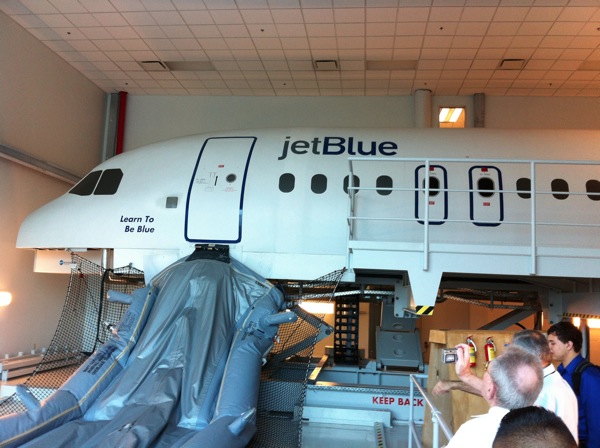
the emergency egress trainer, which moves side to side and back and forth– in two axes
There are two types of training devices that you can use for flight training. One is (surprise) known as a flight training device. It’s a replica of the cockpit, with instruments and controls that work like the real thing, but without the visual aids that a full simulator provides. The FTD isn’t much to look at– sort of like a disembodied airplane cockpit. There’s a control console (not visible below) that the instructor can use to set up various conditions… say, an engine fire or hydraulic failure.

one of JetBlue’s A320 FTDs. Displays and controls work as they do in the real airplane, with a few minor exceptions (e.g. you can’t turn on the windshield wipers)
We also toured the simulator hall. Each of JetBlue’s simulators is a full flight simulator at level D according to the FAA’s definition: full-motion, wide field of view, with sound. The sims themselves are mighty beasts; I doubt you could fit one in my apartment. Each has a name (the one below is “Varsity Blue,” but there are others, like “Welcome to the School of Blue”) and an FAA registration number– when you log simulator time in one of these, you log the sim’s registration number just like you would log time in an actual aircraft.
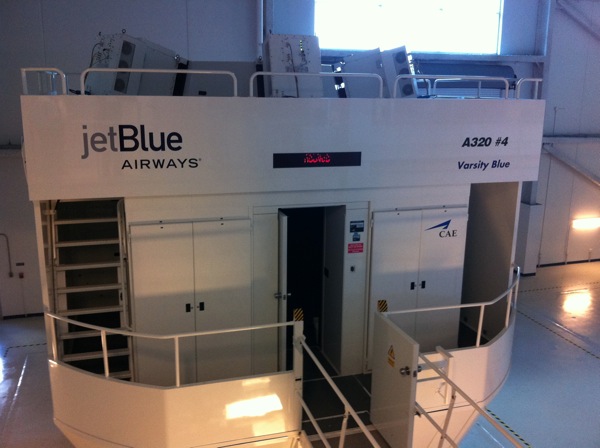
One of JetBlue’s full-motion, Level D flight simulators for the A320
You enter the sim through the bridge in the lower part of the picture, then they pull it up and lock the door. This isn’t so the pilots inside can’t escape; it’s so the simulator can move freely, but escape-proofing is a nice side benefit. Inside, the conventional cockpit layout is forward, and there are comfy chairs for an observer and the simulator controller. You can’t really tell from this picture, but the visual presentation is stunning– it’s exactly what you’d see from inside a real aircraft during all phases of flight. In this picture, the sim is parked at a gate in Orlando, so most of what you see is concrete and terminal building.

a view from inside the simulator; because of the narrow field of view of my camera you can’t see the side windows but there’s stuff happening there too
Note that all the aircraft screens are blank, just like they would be if you were taking the first flight of the day in an aircraft that was parked overnight. Good thing that we learned how to start a cold aircraft! Phil mentioned that most Airbus operators leave the aircraft powered overnight; with 150+ computers in the aircraft, the chances of something getting stuck or failing to boot properly from a cold shutdown are high enough that leaving some systems powered up makes more sense.
After the tour, we made our way to the classroom, which is festooned with posters of the A320’s flight controls, overhead console, and center pedestal. Each of us got a set of these for reference, and then Wayne started in on ground school. We went over each system in some detail. For example, I can now tell you how the packs (really PACKs, or pneumatic air cycle kits) work and how to control them. The thing that surprised me the most about the training is how automated the A320 really is, and how many mundane tasks it automates away in normal operation. If you do something out of sequence, or fail to set something up properly, the aircraft will tell you. Wayne described the A320 as a “lights-out” aircraft: during normal operation, almost none of the buttons on the center pedestal or overhead console will be lit. We covered all of the major systems: electrical, hydraulic, pneumatic, engine, and so on, learning how each works, how to control it, and what to do when things go wrong.
For lunch, we ordered in pizza, and what was supposed to be a working lunch turned into a fascinating career discussion. Wayne and Phil both believe that the job market for pilots will steadily improve over the next ten or so years because of the demographics of the current pilot base. Phil even mentioned that JetBlue had just hired a 59-year-old pilot, which certainly gave me hope that a career as a professional pilot isn’t off the table for me just yet.
After lunch we had more systems training, plus a bonus. Just because I could, I also signed up for the high-altitude endorsement. The FAA requires (in FAR 61.31.(g)) that you receive special training in high-altitude operations before operating a pressurized aircraft that can climb above FL250 (that’s 25,000 feet for those of you following along at home). This training consists of some ground school covering high-altitude physiology, including hypoxia, some time in a cockpit procedures trainer (CPT), colloquially known as a “wooden Indian”, and some time practicing emergency descents in the FTD. The CPT is basically a paper cockpit mockup– you can learn where things are and “chair-fly” your way through learning procedures. We each took a turn going through the profile we’ll fly in the simulator on Sunday: a takeoff from Orlando International, a series of maneuvers around the traffic pattern, a touch-and-go-landing, another lap around the pattern, and another landing.

from left to right: John, Phil, and Johnny in the CPT. Phil took the time to explain the control flows to us until we had them all down pat.
After we finished in the CPT, it was on to the FTD for emergency descents. Wayne set us up at FL350, then simulated an explosive decompression, at which point the fun started. We used the standard JetBlue emergency descent checklist, which only has 10 steps on it. First you don your oxygen mask, then you determine a new, lower altitude, tell the airplane to go there (optionally hitting the “expedite” button), call air traffic control, and make sure not to fly into any surrounding terrain. Once you set the commanded altitude, Fifi automatically deploys speed brakes, changes engine thrust, and adjusts the aircraft pitch and trim to maintain the correct rate of descent. It’s spooky to see the trim wheels move on their own.
Interestingly (to me, anyway), the engine thrust is controlled by a system known as autothrust, not auto-throttles. The thrust levers don’t move at all, but the autothrust system will change the engine power output as needed to maintain the correct speed during climb, cruise, and descent. Set the speed you want and off you go. As with other aspects of the A320, the flight control laws will try to keep you from doing anything stupid. For example, the FAA prohibits speeds over 250 knots under 10,000 feet, so the autothrust system won’t exceed that. During an emergency descent, it will automatically throttle the engines back to idle, and so on.
By the time we finished our runs through the FTD, it was about 7:15– so we’d been on the grounds training for nearly 12 hours. The JetBlue shuttle bus took us back to the hotel, I walked over to Friday’s for dinner, and hit the bed, tired as can be.
Tomorrow (or, really, later today) is the big adventure: two hours flying Fifi. (I originally signed up for one hour but bought a second hour after one of the registrants had to cancel due to illness– after all, it’s a birthday present.) More to come.. in the meantime, read lots more about Fifi from Captain Dave or Karlene.


 Paul's Down-Home Page