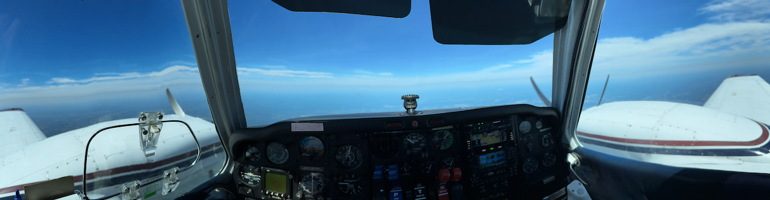
Long solo cross-country, 4 July

What better way to celebrate Independence Day than to exercise my Constitutional right of free travel? That’s right: “free” as in “not encumbered by TSA or any of their baloney.”

The FAA requires that private pilots know how to plan and safely execute what they call “cross-country” flights. I’d already flown one with Andy from Palo Alto to Columbia, but the FAA requires that private pilots plan and carry out a cross-country flight of at least 150nm total distance, with one leg being at least 50nm and landings at 3 separate airports.

Andy had originally asked me to plan a flight from Palo Alto (KPAO) to Paso Robles (KPRB) to Salinas (KSNS) and back to KPAO. The first leg to Paso Robles is 129nm, so the total trip distance would meet all the FAA’s requirements. In my earlier post I gave a quick summary of what it means to construct a VFR flight plan; here’s a slightly more detailed list:

  • Puled out a bunch of paper charts: my San Francisco and Los Angeles sectional charts and my San Franciscoterminal chart. Sectional charts are large-scale charts that show terrain features, airports, roads, navigation aids, and other useful items at 1:500,000 scale. Terminal charts show a smaller area at double the scale, so they’re great for navigation planning in urban areas.
  • Used the paper charts to plot a direct route of flight, using a straightedge and a Sharpie marker to lay out my course. Paper charts cost about $9 each, so you might wonder why I’d be willing to deface them with a Sharpie. The truth is, they expire after about 5 months, so you may as well mark on them.
  • Used the route of flight to identify checkpoints– visual features on the ground that I can look at to tell where I am and what my progress along the course is. There are some well-known visual checkpoints already marked on the sectionals. For example, VPSUN is the golf course at Sunol, while VPMOR is the LDS temple in Oakland. You can use these as reporting points; for example, I can call the Palo Alto tower and say “Palo Alto, Cessna One Niner One Tango Golf, overhead Leslie Salt, landing Palo Alto with Juliet.” That doesn’t mean Juliet’s in the airplane; rather, it means that I’m reporting being overhead the Leslie Salt Company’s salt refinery with ATIS information— a radio broadcast telling me what the current airport weather and runway conditions are– Juliet. 
  • Measured the distance between checkpoints and put that into my navigation log.
  • Got a weather forecast showing the projected winds aloft and used those to calculate the amount of wind correction necessary for each leg.
  • Used the wind and airspeed data to figure out how long each leg would take to fly, or, in other words, the ETA to go between each pair of checkpoints
  • Used the ETA data to estimate fuel consumption for each leg
  • Reviewed the airport data, including which runways exist, whether they were open or closed, any restrictions on their use, what the standard traffic patterns and altitudes were, and so on.

After doing all that, I reviewed the weather forecast and saw that Salinas and Monterey were both fogged in. That didn’t bode well for my planned route, but I went to the airport anyway to meet with Andy and discuss my flight plan. Student pilots have to have an instructor’s logbook endorsement to legally do the long cross-country, you see, so meeting with him was a precondition to taking off. I reviewed the route of flight with him and pointed out some alternate options given that I couldn’t overfly the fog areas. He suggested a completely different route: over the hills to Tracy (KTCY), then down to Los Baños (KLSN), then to KPRB, and then back either direct (if the fog was gone) or by reversing that route. I replanned the route, got his endorsement, and went to check out the airplane I’d reserved… except that it was gone.

OK, OK, I exaggerate… a bit. The automated scheduling system that Advantage uses expects that you’ll sign out the airplane at the scheduled time. If you don’t do so within 30 minutes of your scheduled time, the system puts the airplane back in the available pool. I had an 0800 reservation, but at 0830 I was still meeting with Andy, so the plane became available and someone else grabbed it. Luckily there was another G1000-equipped 172 available at noon, so I took it instead.

Before I took off, I asked Palo Alto ground control for VFR flight following. This is essentially radar surveillance; air traffic control assigns you a unique transponder code that identifies your aircraft on radar. ATC will issue traffic and safety advisories, notifying you of other aircraft in your vicinity and so on. As you leave each bubble of radar surveillance, ATC hands you off to the next one. For my flight, I started out with Palo Alto and was handed off to NORCAL Approach, the TRACON (or terminal radar approach control center) that owns the airspace over most of northern California. I stayed with NORCAL until I got to an area outside their control, at which point they handed me over to Oakland Center, the air route traffic control center (ARTCC) that provides radar services outside of TRACON-controlled areas.

Anyway, one of the benefits of flight following is that you get traffic advisory calls. I got several on my route towards Tracy; that airspace is heavily traveled as people fly into and out of Palo Alto, Hayward, San Carlos, and the other airports in the area. My favorite call? That’s easy: “Cessna Two Hotel Golf, traffic your 1 o’clock, 2 miles, 5000 feet northbound, flight of two F-18. Hobo 51, traffic your 11-o’clock, 2 miles, 3000 feet eastbound, Cessna 172.” Sure enough, there went two F-18s zipping past, too fast for me to unlimber the camera and get a picture.

The flight itself was great! Good visibility on the outbound leg; I took off from Palo Alto, made a right Dunbarton, overflew Sunol, overflew the Livermore area, and headed to Tracy. AsHere’s what the Tracy airport looks like from 5500′ up; it looks small from the ground, but those two runways are 4000′ each.

Overhead KTCY


My route of flight from metropolitan Tracy (!) down to Los Baños took me roughly along Interstate 5. To the west there are all kinds of interesting hills; to the east there are a string of smallish towns, plus lots and lots of cultivated land. From the air, the patchwork of different shades of green is absolutely gorgeous.

Somewhere in the Central Valley

that salad you’re eating? it probably came from the Central Valley

My approach and landing at Los Baños were uneventful, with a good landing on their runway. The Los Baños airport is uncontrolled, meaning there’s no control tower or radar service. Each aircraft is required to vigorously “see and avoid,” of course, but there’s also a radio frequency on which aircraft in the vicinity announce their location and intentions. So you call to tell anyone listening that you’re approaching the airport, where you’re going, and where you are… i.e. “Los Baños traffic, Cessna Two Hotel Golf, 5 miles north of the field, two thousand five hundred, entering the pattern for landing runway 32”, or whatever. Then you call again when you get closer; meanwhile, other aircraft, if any, are making their own calls. I landed well, taxied back on the parallel taxiway, waited a minute for another aircraft to take off and clear the pattern, and took off to the south.

The route of flight that Andy and I had planned called for me to go from KLSN to New Coalingua airport, then turn southwest for Paso Robles.. so that’s what I did, being careful to stay out of the Lemoore military operating areas (MOAs). Andy warned me that I’d know when I was getting close to New Coalingua because I’d be able to smell Harris Ranch. I thought he was pulling my leg, but, sure enough, I could smell the stockyards from more than a mile up and several miles lateral distance. I made the turn before C80 and found Paso Robles right where it was supposed to be. I landed, taxied in to a parking spot, and went inside to find out if they had any food, having neglected to pack anything. They didn’t, but the kind folks at Paso Robles Jet Center loaned me a crew car so I could drive into town and eat at Margie’s Diner. As advertised, the diner had extremely large portions, which suited me just fine. I had a delicious grilled ham-and-cheese and two large diet Pepsis; meanwhile, the line crew refueled my plane so that when I got there (after a brief encounter with the airport’s resident cat) I was ready to go. I took off and headed to the northwest, towards Salinas, but there was a huge layer of haze that looked like it covered pretty much my entire route of flight. 

Haze, of course, diminishes visibility rather than eliminating it. It wouldn’t have been legal for me to overfly an area of fog that obscured the ground completely, whereas I could have legally flown over the haze. However, “legal” and “prudent” don’t always mean the same thing, so I elected to go back the way that I came, mostly. Instead of going back to C80, I cut the corner by flying to the Priest VOR, then to the Panoche VOR, then telling the G1000 to take me back towards Tracy and thence to Palo Alto. On the way back, I practiced using the GFC700 autopilot in the airplane a bit. This might seem contradictory– why use the autopilot at all as a student? There are several good reasons. First, I want to know how every piece of equipment in the airplane works so that I can get the most utility from it. Second, for instrument flying the autopilot is a tremendous aid because it can keep the aircraft pointed in the right direction at the right altitude while the pilot aviates, navigates, and communicates. Third, one of the things you’re required to demonstrate on the FAA check ride is what the FAA calls “lost procedures”– in other words, what do you do if you get lost? I want the option to be able to tell the autopilot to keep the wings level and altitude steady while I’m rooting around looking for charts or whatever. Fourth, it’s cool. Anyway, I spent some time refreshing my knowledge of how to set up the autopilot to track a heading and maintain an altitude. There are many more sophisticated things it can do that I haven’t started exploring yet, like fly a profile such that you end up at a specific altitude over a specific point on the ground. That will come with time.

Coming back I had a great view of the San Luis reservoir, near Los Baños; see below. 

San Luis Reservoir

There was a bit of haze, but off to the west I could still see heavy haze on my original planned route, and I was perfectly happy to see it over there instead of underneath me. My approach through the hills and the east side of the Bay went well, and I nailed the landing back at Palo Alto. 4.0 hours of pilot-in-command and solo cross-country time for the books!

3 Comments

Filed under aviation, California

The case of the stolen stereo

So last Thursday, some knucklehead broke into my car and stole my stereo, my flight headset, and a few other small items. This post is about the process of replacing and/or repairing those losses, so you can consider it somewhat in the nature of a review.

The car was in the “secure” [sic] parking area at my apartment complex. However, it’s fairly easy to get into the parking area, so generally I lock the car. I left the driver’s rear window open about 2″, and that was apparently sufficient for the thief to get in. Another nearby car was burgled by the expedient of a brick thrown through the window (the owner had left spare keys in the ashtray so he lost the whole car!), so I suppose it’s a good thing that I’d left the window open.

I immediately called the Mountain View police non-emergency number; they told me to file a report online, which I did. That part of the process was painless and quick; the CopLogic system that MVPD uses worked well.

Next stop: insurance company. I use USAA for car insurance, and their online claim system worked just as well as CopLogic. I was able to file the claim in less than 10 minutes and got a call back from an adjuster about two hours later. She explained that in California, only items that are powered by the vehicle (or could be) are covered by auto insurance. Your GPS? Covered. Your laptop? Covered. Stereo? Covered. Headset? Nope. She punched a few buttons and told me that I’d be hearing from a company called Premier Services, and that I could get the dash repaired anywhere I liked but, OBTW, there was a USAA-approved shop right up the road in Palo Alto.

Sure enough, I got a call from Premier about an hour later. When I bought this car in December of 2009, I removed the factory stereo and replaced it with a Pioneer AVIC U310BT, the lowest-end Pioneer that had navigation and an iPod/iPhone input. It cost me about $400, plus cables and adapters and so on. I installed it myself, so my total cost including cables, etc., was probably about $550 or so. Pioneer discontinued that model, so the replacement cost they’re offering is substantially more, meaning I can buy something a little nicer. Off to Crutchfield I went, where I ordered a JVC KW-NT500HDT receiver. I’ve been buying from Crutchfield for nearly 20 years and have never had anything less than a great experience with them, so their recommendation of this particular deck carried a lot of weight. The Pioneer unit I had was slow and buggy, and Pioneer’s customer support is terrible, so I wasn’t about to buy another one.

I’m not sure why the thief took my headset, given that it’s only useful for flying in planes– maybe he thought it was a cool set of DJ headphones or something. The headset in question was a Pilot USA PA-1771T Liberty that I bought from Pilot USA as a refurb last year. It isn’t the most comfortable or fanciest headset, but it did a good enough job of providing active noise reduction (ANR) and was reasonably comfortable. I’d planned to treat myself to a newer, nicer ANR headset after I got my actual license, thinking that I’d consign the Liberty to passenger use. Rather than lay out the big bucks for a Bose or Lightspeed, though, I remembered how happy I’ve been with passive noise blocking for music on commercial airplanes, and I decided to try an in-ear headset instead. At first I was leaning towards the Clarity Aloft, but a little research at Aviation Consumer led me towards the Quiet Technologies Halo, which is nearly $200 cheaper than the Clarity. I promptly ordered one, asking on the order form whether it could be shipped faster. Sure enough, about two hours later I got a phone call from Quiet Tech offering me better shipping and a discount because the owner felt sorry for me. Wow.

Next came the body shop. USAA pointed me at Mathews Carlsen in Palo Alto, although they took pains to emphasize that I could use any body shop I liked. I drove to Mathews Carlsen Friday morning and walked out again in 10 minutes, estimate in hand.

Saturday I had planned to install the stereo myself, but I decided against it– I didn’t know what the thieves might have broken or otherwise jacked up when they pulled the old unit and I wasn’t at all interested in spending my time finding out. Luckily I found Custom Audio, which is about a mile from my apartment. I was there about 10 minutes after they opened on Saturday, and about three hours later I had a flawlessly-working stereo.

Over the weekend, I found out that the thieves also snagged my Contour HD camera, and that they’d managed to break the remote trunk release. A quick Monday call to USAA elicited the information that they needed a purchase receipt for the camera and an updated police report. MVPD makes it possible to edit police reports online, so I did, then uploaded the PDF of the report and the camera receipt to USAA’s web site. By Thursday, I’d received a payment from them for all of my expenses (exclusive of my deductible.)

Sadly, I haven’t had a chance to try my new headset yet; it hadn’t arrived by the time of my planned cross-country, but I’ll be testing it tomorrow night.

There are still a few things left to fix; Mathews Carlsen hasn’t gotten the replacement dash parts yet, so the dash isn’t back together, and I still need to get the remote trunk release fixed. However, I am delighted with how easy USAA made it to file and handle a claim, as well as with the speed of their payment. Crutchfield came through, as always, and I am happy with the job that Custom Audio did for me as well. All things considered, this was about as hassle-free an episode as you can reasonably expect.

(Side note: my apartment complex management company is now putting surveillance cameras in the parking area. Yay!)

1 Comment

Filed under General Stuff

Thursday trivia #65

3 Comments

Filed under Musings

RIP Exchange UPDATE

I am sad to report that I just got an e-mail from the lovely and talented Amy Eisenberg, executive editor at Windows IT Pro, letting me know that they are ending the publication of the Exchange UPDATE newsletter that I’ve been writing since 2002.

  The original UPDATE was delivered only via e-mail, and it was advertising-supported so that it made money for the magazine. Over time, the market shifted, with a much greater emphasis placed on delivery via RSS and a sea change in how advertisers spend (and how media outlets package and sell advertising.) Because of these changes, it doesn’t make sense for Penton to continue to publish Exchange UPDATE, so it has been moved to the great folder in the sky (and, no, I’m not talking about SkyDrive.) It’s a business decision, and not one lightly taken, but I understand the reasoning and don’t bear the magazine folks any ill will.

On the contrary– writing the UPDATE has been a terrific growth opportunity over the last 10 (!) years. When I first started writing it, I took over from the redoubtable Jerry Cochran, who had recently moved to a new role at Microsoft. At first I found the demands of writing a weekly column on Exchange to be almost insurmountable, but I soon came to realize that there’s always something going on in the Exchange world to write about. Companies introduce new products or leave the market altogether; Microsoft ships or delays products; interesting people create interesting things. This cycle will go on, of course, and I’ll still be writing about it here and for Windows IT Pro. Don’t be surprised if you also see some of my writing in new outlets as well, either…

Leave a comment

Filed under Musings, UC&C

Thursday trivia #63

  • From the department of giant robots: an industrial robot with an industrial laser. I know what I want for Christmas.
  • They don’t make ’em like these guys anymore: Watson’s Whizzers.
  • Knolling: something I’d like to do with my toolbox. I wouldn’t dare attempt it with my desks at work or home.
  • This interactive chart of the top 10 causes of death in the US from 1900-2010 is absolutely engrossing. The killers of yore– tuberculosis, influenza, “gastrointestinal infections”– have been supplanted by heart disease, cancer, and airway diseases.
  • What I hope everyone who reads this blog understands: the military has people whose job it is to plan for every imaginable contingency, from Plan Orange to Plan Red to Iraq. So this article shouldn’t surprise you too much. Don’t take the fact that we have contingency plans for attacking Iran as evidence that anyone in the military wants to do so, or thinks it’s a good idea.

Leave a comment

Filed under Musings

A strong recommendation for TripIt Pro

I travel a good bit: not as many as some folks I know (such as Scott Schnoll, Tony Redmond, or other members of the far-flung Exchange tribe), nor as much as I used to, but at least a couple of times a month I’m on a plane heading somewhere– often to Huntsville to see my sons.

On my last trip I had a bit of hassle occasioned by a crew availability issue. The problem: I have to be at my office all day (long story), so I need as late a flight as possible on Friday. That means the 2:20p departure from SFO to Dallas, then a connection on to Huntsville.. but with only a 40-minute connection time, any serious delay ex-SFO means I’m going to be stuck.

I thus decided to try TripIt Pro. I have happily used their free service for several years; it’s the best way that I’ve found to organize and keep track of travel itineraries. All I have to do is forward confirmation mails to plans@tripit.com and they magically appear in my mobile client, neatly sorted by trip and time. The Pro service costs $49 a year, but it offers several interesting features, including an alert service that promises to notify you of delays and the ability to notify you if the fare for a trip decreases.

This morning, I called American at about 9:45a to request an upgrade for my 2:20p flight. I got that done with no problem. By the time I got back to my desk, here’s what I saw in my inbox:

tripitpro

Sure enough, due to SFO weather (which was delaying inbound aircraft), my outbound flight was delayed by long enough to make me miss the Huntsville connection. The “Alternate Flights” link showed me all of my flight options, and I was able to call American and get an agent to rebook me to an earlier flight. Notably, at no time did American themselves send me a notification of the delay– no text message, no e-mail, no nothing. This is despite the fact that I’m signed up for, and usually receive, flight status updates from AA.

While I admire the potential of getting a notification telling me “oh, your fare decreased,” the notification feature just saved my bacon for this trip– well worth the $50. If you travel more than a few times a year, I strongly encourage you to look into TripIt Pro (which has a 30-day free trial). I am now a convert.

1 Comment

Filed under Travel

Thursday trivia #62

  • Why are the Chinese investing heavily in commercial real estate in and around Toledo? (And no, the answer is not “because no one else wants to.”)
  • Got to take nephew Charlie to Fry’s Electronics for the first time yesterday. It was the quintessential Fry’s experience: wide-eyed wonder on the part of the first-time visitor coupled with surly-to-indifferent service from the floor staff, mixed in with a hearty helping of inaccurate information. (The cashier we had, bless her heart, solved the problem for us, though.)
  • The NTSB wants you to know that in-cockpit NEXRAD weather may not be as timely as pilots think it is. OK, fine. I’d still rather have old NEXRAD than none at all.
  • I’m very interested in Microsoft’s Surface products, but the timing of the introduction seems a little odd. Press reports say that no one was allowed to use the Touch Cover, one of the signature Surface features. That makes me think that it wasn’t ready for public handling– so why not wait until it was ready? One of the unique things that Apple’s done with their product introductions, and that Microsoft could easily copy, is having the product ready to ship the minute it’s announced. Imagine the impact of the Surface announcement if Microsoft had said “here it is, here’s what it costs, and you can buy one today” instead of “here it is; stand by for further details.”
  • If you wonder why Pixar’s films are so successful, wonder no more– this list of “story basics” neatly captures the things they think about when crafting stories– and make no mistake, the stories are what make their films so good, not the technology.
  • Switzerland as one giant booby trap. With fondue.
  • Dick Collins’ writing is always thought-provoking, but never more so than here: “The ultimate responsibility: thoughts on family flying“.

1 Comment

Filed under Musings

In which I dispute Tony Redmond re Windows Phone upgrades

Microsoft just wrapped up the keynote for their Windows Phone Developer Summit. Following as it does on the heels of Apple’s Worldwide Developer Conference, comparisons are inevitable… so let me succumb to the inevitable:

  • At WWDC, Apple announced iOS 6 and talked more about the forthcoming “Mountain Lion” release of OS X, which follows OS X “Lion”‘s lead by incorporating a number of iOS-like features. Many observers believe that Apple’s long-term plan is to provide as much of a unified core between iOS, OS X, and AppleTV as possible.
  • At WPDS, Microsoft announced Windows Phone 8 (“Apollo”), which will share a common core with Windows 8– thereby beating Apple to the core OS-integration punch. They also highlighted some nifty new Apollo features that will depend on their hardware device partners, including new higher-resolution screens and support for NFC.

As they normally do, Apple was mostly quiet about the device upgrade path for iOS 6. Microsoft, on the other hand, was up front about the fact that current Windows Phone devices won’t be getting Apollo. Tony has a beef with this approach:

I think this is a brain-dead decision that looks pretty feeble when compared against Apple’s record of making sure that new releases of their O/S run on older versions of iPhones. For example, the iPhone 3GS that I used before making the now-lamentable decision to try Windows Phone 7.5, upgraded smoothly from iOS 3 to iOS5 over the time I owned the phone.

This is clearly a situation where Apple is right… well, except that they’re not.

It is true that iOS 6 will run on older devices. For example, my not-yet-two-year-old iPhone 4 will run iOS 6, as will all models of the iPad; even the relatively ancient 3GS will get the upgrade.

However, there are a number of iOS 6 features that will not work on anything older than an iPhone 4S. Among these: FaceTime over 3G and turn-by-turn directions in the mapping app, two features that exist either as App Store apps or hacks that can be applied to jailbroken devices.

Apple hasn’t said why they won’t ship these features for iPhone 4 users. It might be due to technical limitations (though I doubt it in the case of turn-by-turn directions), but I suspect it’s more likely to be as a tactic to drive sales of new devices. After all, Apple’s profit on iOS devices come from the hardware (and to a lesser extent, the attach rate of purchases from the App Store).

Microsoft, on the other hand, makes no profit on WP hardware except to the extent that they collect a license fee per handset. That raises the question of what Microsoft should have done with Apollo. You could argue, as Tony does, that at least the shiny new Lumia 900 should get the upgrade, and that ideally older devices should as well. But this approach poses some really interesting tradeoffs for Microsoft. They get to choose between two options, to wit:

  • spending a large amount of money and engineering time to get Apollo running on older WP7 devices, such as the HTC Surround or the original Samsung Focus, from which they will never derive any additional revenue and for which carriers may decide not to give their customers the upgrade anyway? or
  • spending money and effort on polishing Apollo to take full advantage of new hardware, sales of which will drive carrier efforts and directly put cash in Microsoft’s coffers?

I don’t think that Microsoft’s choice was a very difficult one. If you look at the list of Apollo features, some of them (such as NFC, new resolution support, on-device BitLocker encryption,  and the new DirectX) require upgraded hardware. Some of them (such as deep VoIP integration, which I dearly wish Apple would copy, the new Nokia map experience, and support for native C++ code) do not, and could feasibly be backported, but only to the extent that they don’t depend on the new Windows 8 common kernel. Some of the new features, in fact, are actually apps, which means that Microsoft could potentially ship them as separate standalone updates in the future.

When Tony says

After all, we’re dealing with software here and surely a few IF… THEN… ELSE conditions could be incorporated into the code to support older devices?

I’m reminded of our earlier discussion about the pros and cons of requiring an Active Directory version update for Exchange 15, in particular the observation that the test burden of software changes is a lifelong obligation. Adding a feature isn’t always hard, but once it’s added you must test it on every device and configuration for as long as you support that feature– and that is even more true here when you consider the size of the WP test matrix, which contains dozens of devices and dozens of carriers. If I were Terry Myerson, the corporate VP at Microsoft who owns Windows Phone, I wouldn’t spend the money on backporting the core, even if it were technically possible. It doesn’t make sense as an investment, nor is the ongoing cost burden supportable.

(nb. Myerson, you may recall, is the fellow who made the at-the-time extremely unpopular decision that Exchange 2007 would require x64 hardware. This was widely hailed as being an arrogant and ignorant move on Microsoft’s part, but it was actually one made for solid technical reasons, and in retrospect it has proven to be the right decision; the scalability and performance benefits of that move have been critical improvements to Exchange 2007, 2010, and 15.)

While Tony thinks of Microsoft’s move as being a “sad and arrogant indication” of Microsoft’s contempt for its mobile customers[1], I instead see it as a realistic acceptance of the fact that even the mighty Microsoft has limits on what they can feasibly accomplish. They are fighting hard to stay relevant in the mobile device market, and they’ve apparently decided that their effort is better spent on net-new development work. Based on my outsider’s view, I can’t disagree.

Having said that: yes, I’m disappointed that my two-year-old HTC Mozart (and the Lumia 800 I’m going out to buy this afternoon for a project) won’t get the Apollo upgrade.. but no more so than I am that my iPhone 4 won’t get the full flavor of iOS 6. In fact, I am probably more likely to buy a new device to run Apollo than I am to buy a new device for iOS 6. Why? Look at the delta in features; absent some major new hardware improvement, or some as-yet-hidden iOS 6 features, it doesn’t make sense to shell out for a new device just to get Siri, turn-by-turn maps, and FaceTime over 3G. But at the end of the day, this is a business decision, not one that Windows Phone customers should take personally.

[1] You know who really has contempt for their mobile customers? The carriers. Yeah, that’s right; the same ones who do things like block Windows Phone and Android updates. Of course, you can argue that as an OS manufacturer that doesn’t make its own devices, Microsoft’s customers are the carriers, not consumers. Apple’s in a different space because they sell devices both through carriers and direct-to-consumer, as do Google and the increasingly-irrelevant RIM.

4 Comments

Filed under General Tech Stuff, Musings, UC&C

Airwork, 4 June

There’s an old saw in aviation: to be a successful pilot, all you have to do is make sure that your lifetime total of takeoffs and landings match. With that in mind, student pilots spend a fair amount of time practicing various kinds of takeoffs and landings to become proficient. In this particular session, we worked on soft-field takeoffs and landings.

One thing that many non-pilots assume is that airplanes can take off or land pretty much anywhere. This is true for some values of “airplanes” and “pretty much anywhere.”  It’s true that almost any reasonably level surface of sufficient length can be used as a landing strip, but some airplanes are much better suited to what we call unimproved strips– those that aren’t paved– than others.  If you watch almost any TV show involving Alaska, for example, you’ll see lots of video of airplanes landing on grass strips, dirt, gravel or sandbars in rivers, snow, and ice. Some of these airplanes will have tricycle gear (meaning a nose wheel and two main gear located under the fuselage), while others will be taildraggers (which use a steerable wheel under the tail, along with two main gear). Some will have skis, while others will have big bush tires. But what about your everyday, run-of-the-mill Cessna or Piper? It turns out that they can operate just fine from many kinds of unimproved runway, including grass and dirt strips. More to the point, though, in case of a precautionary or forced landing, it’s really important to know how to take off and land safely on soft-surfaced runways, so we practice it.

For a soft-field takeoff or landing in a tricycle-gear airplane, one key is to try to keep the nose wheel off the ground as much as possible by keeping the yoke back. As airspeed increases, keeping the yoke back raises the nose, lessening the load on the nose wheel and reducing the chance that it will dig in to the surface and flip the plane over. As you land, keeping the yoke back allows you to convert forward airspeed into lift, which has the beneficial effect of slowing the airplane down quickly without using brakes and while keeping the nose wheel out of the mud, or whatever is on the surface.

To accomplish a good soft-field takeoff, there are a few other things to do. First, momentum is your friend. Once you begin to turn onto the runway, you don’t stop to line up (provided, of course, that ATC hasn’t told you to “line up and wait,” which means that they’ve cleared you to line up on the departure end of the runway and wait for clearance to actually take off while another aircraft lands), and you control your taxi speed such that you don’t have to use the brakes as you turn to align with the runway. As you’re completing your turn, you advance the power smoothly to takeoff power while keeping the yoke back. Once you gain sufficient speed to take off, you add enough up-elevator to leave the runway surface and then immediately push forward so that you don’t climb.

“Wait, what?” I can hear you asking.

Flying machines can benefit from something known as ground effect. This is what makes hovercraft work; an airfoil moving within a certain distance off the ground will generate a sort of cushion of air that provides additional lift and reduced drag, beyond what the airfoil generates on its own. You might remember from a previous discussion that every airplane has a characteristic speed at which it climbs best— it gains the most altitude for each foot of forward motion at that speed. The goal of keeping the aircraft in ground effect is to keep it off the muddy/sticky/grassy surface– which would just slow it down– and allow it to accelerate to best-climb speed as quickly as possible, while surfing the cushion of ground-effect air. This takes some getting used to because your learned reaction to leaving the ground is to put in enough pitch to climb at the desired speed. Instead of doing that, you have to force the aircraft to stay close to the ground until it’s time to climb. This is easy to do; it just requires some extra thought. Once you’ve reached best-climb speed, you can trim the aircraft to maintain that speed, retract the flaps (if you added any), and transition to a normal climb.

Soft-field landings are all about speed. If you’re landing on a soft field it’s a good bet that the field is also shorter than you might like, so you’ll want to slow down your approach. Even if the field is long, though, you’ll still carry 5-10 knots less speed into the approach. For short-field approaches in the 172, I fly 70 knots with the first 10° of flaps, then I slow to 65 knots with 20° flaps and 60 knots with full flaps. If you do it right, you’ll end up in your landing flare doing no more than about 40 knots. Think of what this means in practical terms: if you’re landing on a plowed field (let’s say) because of an engine failure, if you can cut your touchdown speed by 20 knots, you’ve reduced the kinetic energy you’re carrying by a large amount, given that kinetic energy changes as the square of velocity (remember good ol’ KE = 1/2mv^2!)

Short-field takeoffs and landings are different beasts; here the goal is to take off or land within the minimum distance possible, perhaps including clearing an obstacle on the approach or departure. For example, the airfield at Milton, Florida (2R4) is a great place to practice short-field work because there are trees several hundred feet from each end of the runway. These don’t present any real danger, but they make a great target; in a short-field approach, you fly a steeper than usual descent to clear any obstacles, then land a bit firmer than usual– your goal is to avoid any unnecessary float, because float translates to additional distance flown down the runway. You may not have any additional distance to spare. Because it’s late, and I’m sleepy, rather than go on about short-field work I’ll leave this AOPA Flight Training article for those who are interested; it’s pretty good.

Leave a comment

Filed under aviation

Thursday trivia #61

  • I’m a robot guy– I am fascinated by industrial robots, but it hadn’t occurred to me to use them for photography and videography. Luckily there are other, more imaginative, people out there. This video is stunning– watch it in HD.
  • Did you know the Chinese were thinking about building a manned space station? Yep. (For another time: this ties in neatly with the premise of James Fallows’ China Airborne, which is on my reading list.) Why would they do this? The Union of Concerned Scientists explains. (The full report is much more interesting than the summary.)
  • I am not much interested in History-with-a-capital-H, but I do love the unveiling of a good story through diligent research into primary sources. Here’s a great example: an exploration of secrecy and leaks in the IVY MIKE H-bomb test. This discussion is, of course, applicable to the recent flapping about the (probably unlawful and certainly ill-advised) series of leaks from the White House about US intelligence and military programs, sources, and procedures.
  • Oh, Apple. After doing such a good job of staving off device fragmentation, now you’re introducing it in spades with iOS 6. Many of the new features won’t work on older devices, including some that don’t seem to have any technical requirements that should prevent them from working. I’m not going to upgrade to a new phone just to get turn-by-turn maps, etc, though.

Leave a comment

Filed under General Stuff

A tough travel experience

If you travel often, then you know something that more casual travelers often never learn: the law of averages always catches up with you in the end. Case in point: this weekend I went to Huntsville to visit the boys. I was scheduled to fly on American SFO-DFW-HSV on a Friday afternoon. My outbound flight was scheduled to leave at 2:20pm, and I had about a 40-minute connection for my DFW-HSV flight– the last one of the day.

This particular afternoon, SFO was windy– 31 knots gusting to 36. When I got to the airport, I noticed my outbound flight was delayed. Even though the airplane itself was there, the flight attendants were coming in on another flight, which had been delayed because of the wind. The delay was long enough that by the time the flight left, I would have missed my Huntsville flight and thus been consigned to spend the night in Dallas. The American gate agent helpfully offered to put me on a United flight SFO-DEN-HSV, so I let her and took off at a dead run for Terminal 3, where United/Continental’s SFO flights (mostly) leave from (some are now in Terminal 1, as I soon learned.) However, I only had about 25 minutes to exit terminal 2, enter terminal 3, clear security, and board the flight– clearly not possible. I found a helpful United agent who led me to the “additional services” desk. After a rather lengthy wait, which gave me a good chance to see how disorganized UA’s current SFO operations are, I spoke with an agent who told me I’d have to go back to American to get rerouted again… so I did. I ended up on the redeye SFO-ORD, which connected to a Huntsville flight that got me in about 10:20 the next morning– so only about 12 hours later than planned.

The flights were uneventful, but then when I got to Huntsville I discovered that my luggage was still in Chicago. Ooops. I gave the ticket agent a delivery address for my bag, picked up my rental car, got the boys, and went to the hotel. Later in the day, I noticed that large clouds of white smoke were coming out of the rental car whenever the engine exceeded about 3500 rpm. I called Avis and they quickly sent over a replacement, so that went well. It ended up being quite a good weekend, but it certainly reminded me that when you travel, you will occasionally, and inevitably, end up with a trip with a much higher than average hassle factor. Such is life. All things considered, this one wasn’t too bad; I was only 12 hours late and didn’t have any real major problems, just a string of annoyances. Hopefully now things will revert to the norm of trouble-free travel.

(Oh, and as I write this, I’m on an American flight DFW-SFO. It’s a new-ish 737-800, which means that it has in-seat power in coach. For some inexplicable reason, though, it does not have Gogo wifi. For some reason I always assume that such a new aircraft will have wi-fi. Delta has spoiled me in that regard, I suppose…)

Leave a comment

Filed under Musings, Travel

Thursday trivia #60

Leave a comment

Filed under General Stuff, Musings

Speaking at Hewlett-Packard Discover 2012

A quick reminder to those in the Hewlett-Packard-o-sphere: I’m moderating a roundtable discussion with Jeff Mealiffe from Microsoft and Donald Livengood and Stuart Ladd from H-P next week at H-P’s Discover 2012 event. Our session, RT3036, is on Wednesday morning. The abstract only hints at the Exchange-y goodness that awaits; we have an interesting list of questions to discuss, and we’ve saved a large chunk of time for audience questions. It should be a lot of fun, and I hope if you’re there you’ll drop by and say hello.

This roundtable session will assess, compare and critique the different options when deploying Microsoft Exchange 2010. Our goal is to highlight important criteria, including advantages and disadvantages, to use while planning. To provide a balanced perspective, we’ll feature technical experts from both HP and Microsoft. The session will be moderated by Paul Robichaux, a Microsoft MVP. The audience will have the opportunity to ask questions at the end of the discussion.

It’s a short trip so I won’t really have any time to sightsee, although I do plan to hit the Las Vegas Pinball Hall of Fame. H-P is holding a preview screening of Madagascar 3, which I believe was rendered on H-P hardware, but I’m going to hold off watching that until I can see it with the boys. So it’s pinball for me (though sadly they don’t have my favorite machine).

Leave a comment

Filed under UC&C

MEC 2012 call for content opens

Microsoft has just put out the call for content for MEC 2012. This gives me a bittersweet memory of the many times I sent out calls for content for Exchange Connections: the sweet because of how much fun it was to see the innovative topics and sessions proposed and to haggle over them with my conference co-chairs and the bitter because there was never a way to get every good session onto the final schedule. Now, though, I get to be on the other side of the table, proposing sessions instead of evaluating other people’s proposals.

So far I’ve proposed three sessions. I won’t find out until 25 June whether any of them have been accepted, so it’s time to settle in for the wait.

Frequently asked questions:

  • No, I’m not talking about the content of the sessions I’ve proposed because [REDACTED]
  • No, I can’t give out the link to submit session proposals; Microsoft is only soliciting content from Exchange MVPs and graduates of the MCM | Exchange program.
  • Yes, I am very much looking forward to going even if I don’t get to present.
  • Yes, I hope MEC 2013 is not in Orlando.

Leave a comment

Filed under UC&C

Pictures from my B-17 ride

I still have to write a more detailed post about my adventure flying in Nine O Nine, the Collings Foundation‘s immaculately restored B-17. I took 3 cameras: my iPhone, a Nikon D5100, and a ContourHD helmet cam (only without the helmet). It was my first outing with the D5100 and the ContourHD both, and I’m really pleased with the results. Check out my Flickr stream for airplane pics; as soon as I get the video edited (which will probably be a while), I’ll post it too.

2 Comments

Filed under aviation, California, General Stuff