Category Archives: Fitness

Possibly more than you wanted to know about exercise, fitness, and so on.

Training Tuesday: Heel & Crank Duathlon (4/11/15)

Last year, I was delusional… I thought it would be a good idea to sign up for two races on consecutive days in order to qualify for the coveted 35.1 Challenge swag. To qualify, all I’d have to do is complete a duathlon on Saturday and a half-marathon the next day. Seemed simple enough from the comfort of my couch in October, so I signed up. The two goal races were the Heel & Crank duathlon and the Bridge Street Half Marathon.

Side note: biathlon is the cool Olympic sport where you ski and then stop every so often to shoot at targets. Duathlon is what triathletes call a run/bike/run event, as opposed to an aquabike (self-explanatory, that).

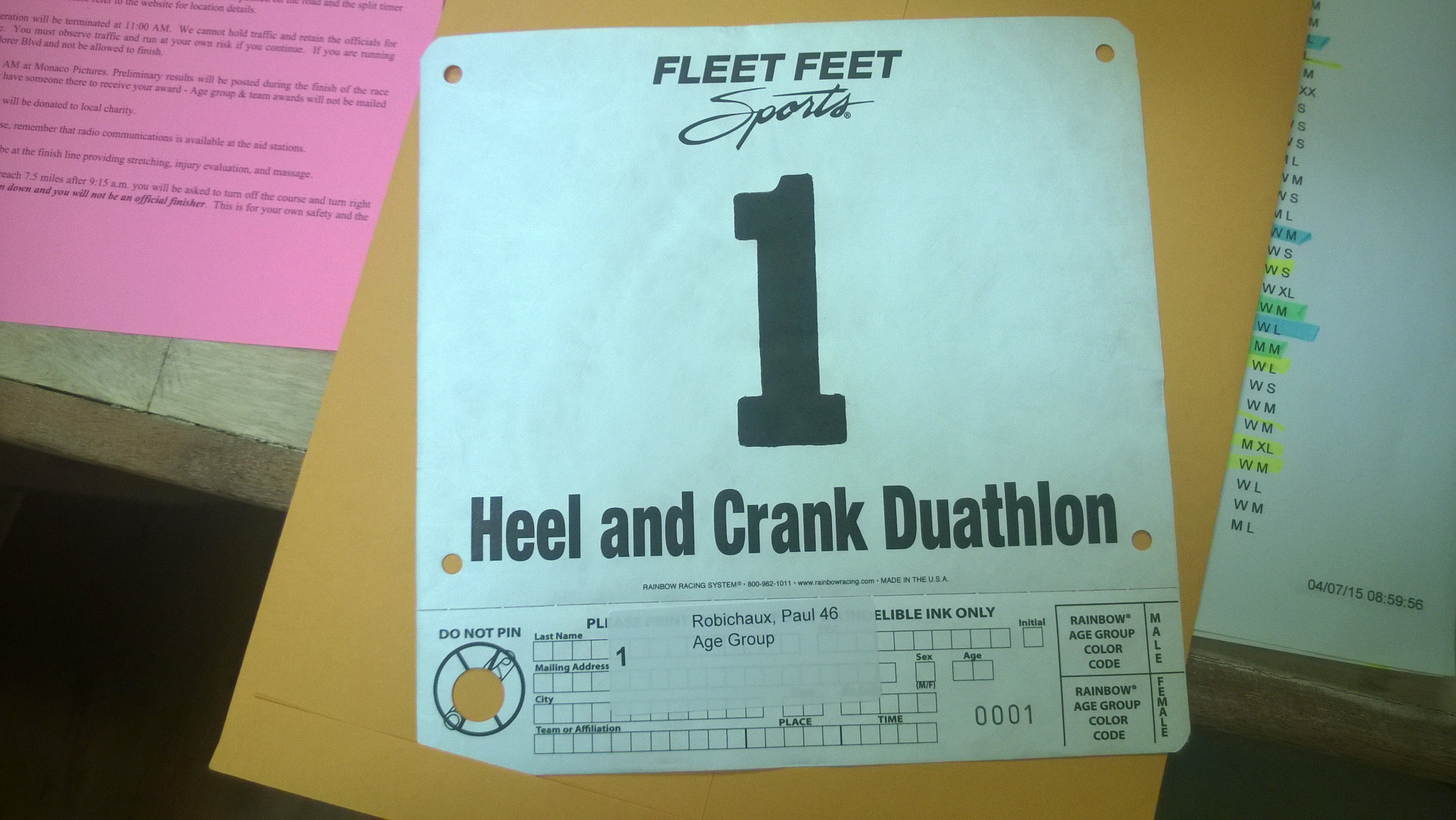
Fast forward to late March. I’d been training for the Bridge Street Half and the running was just wrecking my calves and Achilles tendons. I reluctantly decided to skip Heel & Crank. Thus it was that I went to volunteer at packet pickup for the half-marathon. “As long as I’m here I’ll pick up my Heel & Crank packet,” I thought. When I opened it, this is what I found:

WP_20150410_003Through pure luck and/or overeagerness in registering, I’d scored race number 1. At that point I felt obligated to run the race, so.. I did.

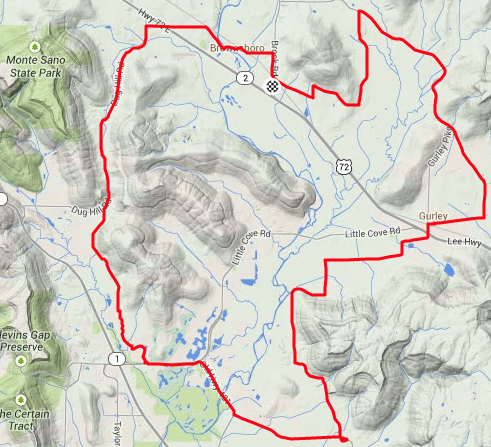
The weather race morning could not have been better: clear and cool. The H&C course has changed a bit over the last few years; what hasn’t changed is that the start is in historic Mooresville (site of Alabama’s first post office, among other things). This year the run was an out-and-back on a hard-packed dirt road that was somewhat muddy after recent rains. I wore my trail shoes, so that wasn’t going to be a problem. The bike course was a loop around some lesser-traveled Limestone County roads. Part of the course covers territory I’d ridden before on the weekly Jetplex group rides, so I knew that apart from a few gentle rollers there wasn’t much to worry about.

My plan was to hold a slow pace for all 3 events– just hang in there and finish without doing too much damage to my chances of finishing the next day’s half. I got set up in transition, lined up for the start, and ran the first 5K in just under 31 min– a comfortable pace, although my calves were complaining after about the first mile. I had a leisurely transition to the bike and rode well, but with uneven cadence, for almost exactly an hour. There was a stiff wind from the west for most of the race, which helped going out but hurt coming back in. Overall, though, the flatness of the course worked in my favor.

2015 Heel & Crank (821 of 1401)-L

Surprisingly, on the second run I was able to maintain a 10:44/mi pace, which was faster than I expected given that I was planning on taking it realllly easy.

I finished in 2:07:29, which was barely acceptable to me considering that I was going slowly on purpose– it was still frustrating to notch a low finish though. The excellent post-race setup took some of the sting out, though; the organizers had provided not only the traditional pizza and fruit, but also pancakes and beer from a local craft brewery. It was delightful to munch and talk with my local friends, standing in the warm sunshine while the sweat dried. Thus fortified, I went home to get all my real running stuff together and get ready for the next day’s half-marathon….

2 Comments

Filed under Fitness

Training Tuesday: New Orleans Sprint Triathlon (3/28/15)

I’m really behind on my race reports; as I write this, I’m resting after my fourth race of the season, but better late than never, etc.

For my first race this year, I wanted to do a sprint triathlon, and the stars aligned perfectly so that I could run the New Orleans Sprint. The timing would be tight; Dana wanted to accompany me, because she’d never been to New Orleans before, but she had the McKay Hollow Madness trail race on Saturday morning, and I had to get the airplane to Atlanta on Monday so I could catch a flight to Nebraska for customer meetings. We decided to leave right after her race, spend the rest of Saturday sightseeing, and come back Sunday right after my race. My mom was able to arrange her schedule to drive over from Alexandria and meet us, which added a lot to the overall fun factor.

Our flight was lovely; we had stable air and great visibility, although on our descent into New Orleans Lakefront we came uncomfortably close to another plane who wasn’t talking to ATC and obviously wasn’t watching where he was going. Mom met us there and after a little fiddling with the bike rack, we were off to find the hotel, have lunch at Deanie’s, and enjoy some sightseeing. We spent ome time touring the French Quarter (including Dana’s first walk down Bourbon Street; luckily it was in the afternoon so we only saw one dude passed out in the middle of the street).

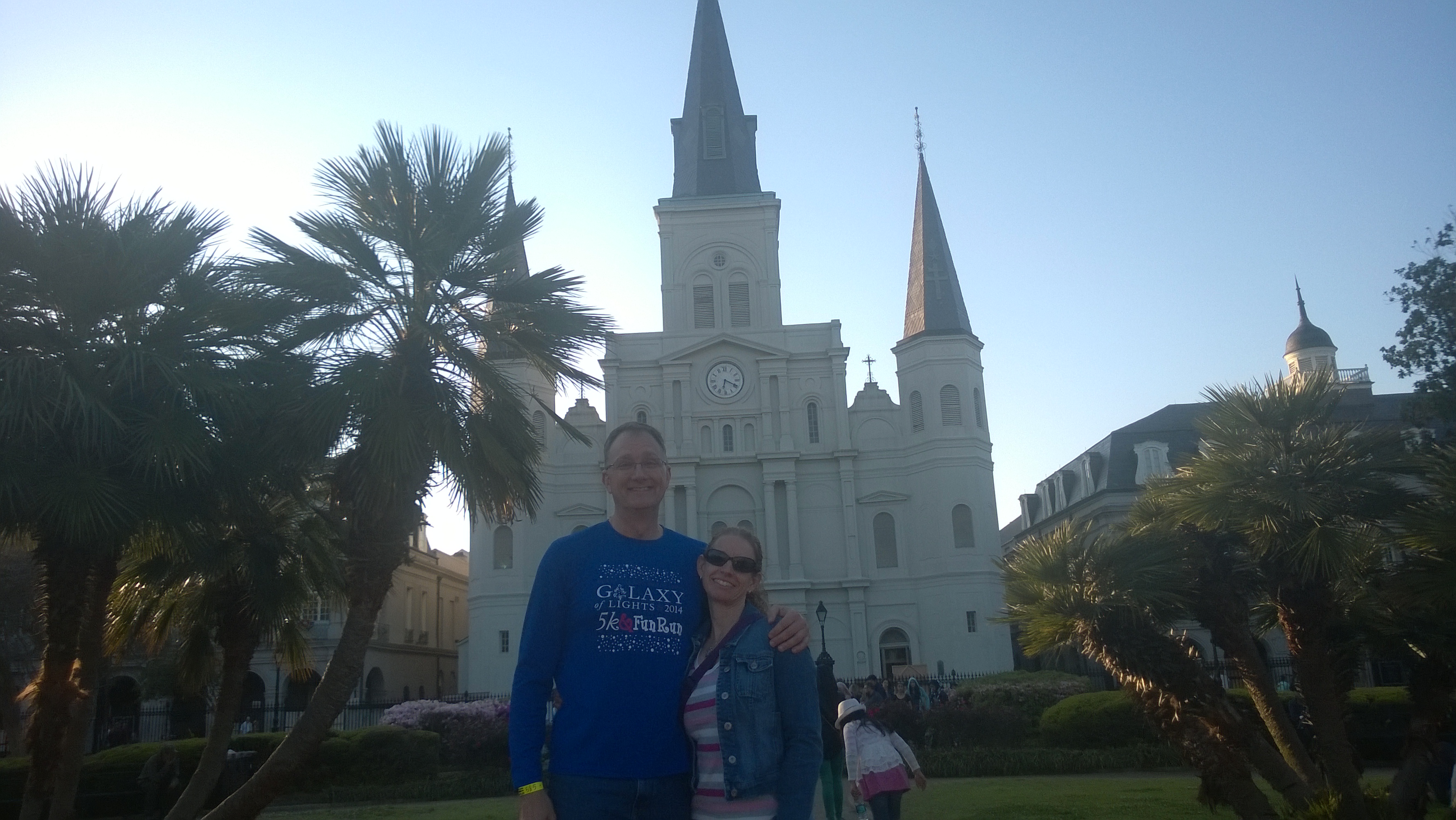
WP_20150328_005Right after we took this picture, a teenage boy walked up to us and asked, in an impeccable British accent, if we knew where the cathedral was.

By day’s end we were too tired to go restauranting, so we had dinner at the hotel– surprisingly good nonetheless. I suppose hotel chefs have to up their game to stay relevant in a city so dedicated to food.

The next morning we all saddled up and drove to the South Shore Marina for the race. The swim was held inside the marina, which is part of Lake Ponchartrain. The water temperature was forecast to be in the low 60s, so I wore my wetsuit and was very glad of it. As is typical of mixed distance races, the Olympic-distance swimmers started first, so I spent a fair amount of time in line with the other sprint distance men from my age group. Finally I was at the end of the pier, got the signal, jumped in the water, and.. promptly forgot pretty much everything I knew about swimming. A combination of adrenaline and the shockingly cold water propelled me to start out at almost double my normal 100m pace.. which would have been great if I could have sustained it. In the pool, I can normally turn out a steady 2:00-2:05/100 time and I averaged 2:26/100. Not at all what I was looking for.

Transition was an easy run up the dock and into the corral. The race organizers had thoughtfully provided wetsuit strippers, which greatly eased my transition, but I was tired already as I got onto the bike. That was reflected in my craptacular 4:40 time for T1: almost inexcusably slow. Once on the bike, I regained a bit of my equilibrium as I headed out, buoyed by seeing Dana and Mom cheering for me on the outbound chute. The course paralleled the lakeshore, which was nice, and passed very close to the airport, which I enjoyed. I was feeling pretty good as we reached the halfway point and that’s when it hit me.. the wind, that is. Take a look at the upper right corner of this picture:

new-bike

That little “16” with the arrow indicates that we had a 16mph wind (with higher gusts, of course) from the east. That made for a lovely tailwind on the way out and a very unpleasant headwind on the way back. Let’s just say my enthusiasm wilted more than somewhat. The wind was strong enough that I had trouble controlling my bike (especially on the gridded metal road deck on the Seabrook bridge). I was glad to get back into the corral, transition (with another terrible time: 3+ min), and hit the road.

About the run: let’s just say I finished it. It was neither my worst nor my best; the route wasn’t very scenic either. I did appreciate seeing spectators on both legs of the course, and my Waffle House jersey provoked a lot of comments, so that was fun.

My entourage met me at the finish line, where I scored a really spiffy finisher’s medal and a towel inexplicably labeled “NEW YORK CITY TRIATHLON.” Maybe they ran out of the New Orleans-branded ones, or maybe they were promoting the NYC event? Who knows?

The post-race corral area was nicely set up, with pizza, fruit, soft drinks, and beer, but it was kinda flat– I think most finishers headed out to celebrate elsewhere as soon as they could gather up their stuff and get on the road.

My total time was 1:38:50, which was on a par with my races from last year. Still some room for improvement, especially on the swim but also on the run. I’ve got to work on building my pace off the bike; even running 9:30/mi off the bike would let me pick up an easy 3+ minutes, which in this case would have put me in the top 5 for my age group. Something to work on.

After the race, it was back to the hotel for a badly needed shower, then we walked over to Manning’s for a very pleasant al fresco lunch. Mom drove us to the airport and we had a perfectly unexceptional flight back– a calm end to a somewhat harried, though very enjoyable, trip.

1 Comment

Filed under Fitness

Training Tuesday: the software and services

It should come as no surprise to anyone who’s known me for more than 5 minutes (or read more than one article on this blog): I’m a nerd and I like gadgets. In an effort to get the most out of my training, I’ve tried a variety of different services to track, analyze, and store my workouts, and I frequently see people asking questions about services such as Strava and TrainingPeaks online, so I thought I’d jot down a few Cliffs Notes to help people figure out which services might be right for them.

First, let’s stipulate that pretty much every fitness device manufacturer (Garmin, Jawbone, Withings, Suunto, et al) has their own branded website. I don’t use any of these (except Garmin’s, about which more in a minute). Most devices require you to sync them with the manufacturer’s website. Sometimes those websites can sync to others (more on that in a second), and sometimes they cannot.

The latest trend in this market is the emergence of services such as Apple Health and Microsoft Health that want to aggregate all sorts of your fitness data (with some surprising omissions), analyze it, and then give you “actionable insights.” The things I’m writing about here are all targeted specifically at fitness, not necessarily overall health. For example, none of these sites directly lets you track the foods you eat (though some partner with food trackers). I’m not writing about the Microsoft or Apple services (or Google’s for that matter…. hahahahaha, like I’d give Google all my health data) because I don’t use them, but that might be a good topic for a future article.

Garmin ConnectGarmin recently updated their Connect service, so the version I’m writing about is labeled the “modern” version on the service itself. There’s also a “classic” version which seems to mostly have the same features, but I don’t use it.

Garmin ships a very wide range of products that plug into Garmin Connect: from fitness trackers to multisport watches to action cameras to special-purpose swim and golf watches, if it says “Garmin” on the front and isn’t a GPS, it probably will display data in GC.

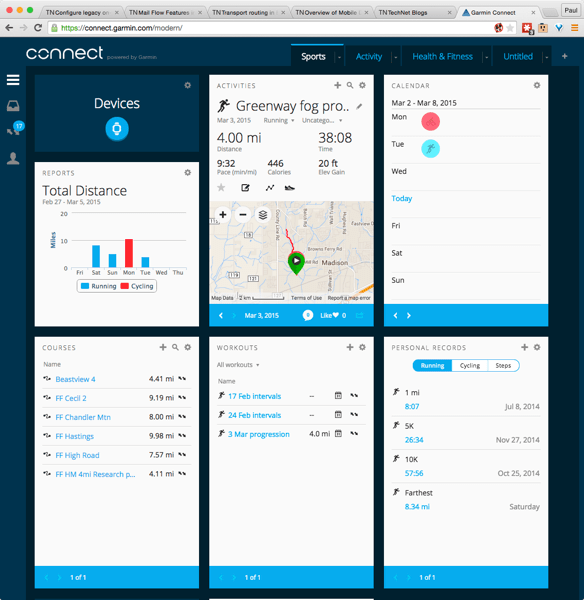
The screenshot below gives you an idea of what GC looks like. You can customize each of the tabs across the top (“Sports” being shown in this case) with data blocks, adding, removing, and positioning blocks as you like. The other day, a new block labeled “Golf” showed up, but I gave it the heave-ho posthaste since, of all the fitness activities I enjoy, golf is not one of them.
Google ChromeScreenSnapz002

When I got my first Garmin device, I went to the GC site, signed up for an account, downloaded the sync software, and plugged in. This was all seamless, and the instructions provided were clear. Keep in mind that Garmin requires you to use sync software on your PC or Mac to sync your device, although if your device supports Wi-Fi or Bluetooth sync you may not need a computer at all. This sync software has nothing to do with the GC website itself, which you can use from anywhere.

(Personal note to my WP posse: there’s a decent Windows Phone app called Astro Fitness that can sync with GC.)

Overall, GC is my favorite of the connected-device services. While its social features are poor compared to Strava, and it lacks some of the specialty features from MapMyRide/MapMyRun (such as the ability to automatically choose a route if you give it a starting point and a distance), it looks good and is highly customizable. It also integrates pretty broadly into the wider fitness ecosystem; it can automatically sync with TrainingPeaks and Nike+ and can import food data from MyFitnessPal. Garmin’s support is forum-based and has done a good job answering the few issues I’ve raised.
Suunto MovescountIf you own a Suunto device, you’ll be using this to sync workouts from your device and to change many of the settings for the device itself. Suunto, in general, prefers a simpler on-device UI, so you need the website for things such as specifying which activities you want to track or what data fields to display on the watch. On the other hand, that makes the device a bit easier to use, though it means that if you forget to change a critical setting before a race or event, you can’t change it on the watch.

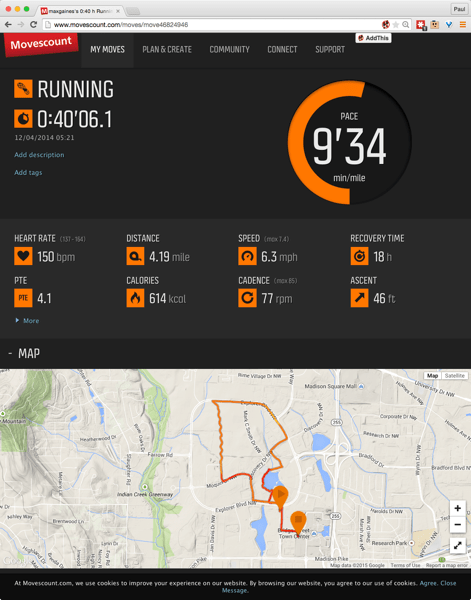
Below, you can see what a typical activity on Movescount looks like. Note that while Garmin Connect uses tabs, Suunto prefers a scrolling vertical layout, so you’re not seeing everything in this picture that would actually be displayed on the page.
Google ChromeScreenSnapz001

Like GC, Movescount shows you the pace, speed, distance, and location of your activities. It’s important to remember that what you’re seeing is based what the device recorded. While some Garmin devices will compute recovery time themselves, Suunto’s devices don’t, so the recovery time and PTE figures you see here are calculated by the service. On the other hand, the Ambit 2s can calculate “swolf” swim metrics, so Movescount will show them to you.

One persistent issue I had with the Movescount web site is that the distances shown for swims don’t necessarily match what the watch says or what gets synced to external services. For example, if I swim 300m according to the watch, it’s common for the site to say that I swam 275m (or maybe 325m, if it’s feeling generous) but then to display the correct distance when I sync through Tapiirik. Suunto’s support is aware of this problem, but hasn’t fixed it in the six months or so since I reported it. That’s sadly typical of my experiences with their support; the staff seems friendly, but they don’t get stuff done. In addition, the site had multiple weekend-long outages during the nine months or so I was using it daily. While these outages are harmless, they were quite annoying

Movescount has fairly weak social features, although it can automatically post links to your workouts on Facebook and/or Twitter. The site has a ton of groups for various sports, but the ones I was interested in had very few people— a testament to Suunto’s niche status in the fitness world. (Perhaps the groups for diving, hiking, etc were better populated?) Overall, a decent tool but not up to the standard of GC in my opinion.

Strava

Strava’s tagline is “Prove it.” The goal of the site is to help you “analyze and compare your data against yourself, friends, and pros.” To do this, you can either use the iOS or Android app, or a compatible Windows Phone app such as CycleTracks, or a GPS device (which can be a watch, a bike computer, or any of the other supported devices) to track your workouts. As you ride and run, Strava tracks your performance; the fastest person on a given route is labeled as the “king (or queen) of the mountain” (KOM or QOM) and gets a little badge.

Post-workout, you get a display similar to the below. There are three interesting things about this summary. First is the data panel just to the right of the ride title. It shows average and max speeds, heart rates, etc. This is very similar to what you see on other similar sites. Second, notice the “top results” list above the map. Strava automatically tracked my progress across designated parts of the route (known as “segments”) and noticed when my performance was good.

Google ChromeScreenSnapz009

Third is the segments list itself, which you can’t see on this page because the window wasn’t big enough. As you can see below, in the expanded view, for each segment I can see how I performed compared to other people who have ridden or run the same segment. The “Analyze” button zooms in on that segment to show graphs of speed, power, cadence, and elevation for the segment alone, while the “Compare” button lets you track your performance against the KOM or against anyone on your friends list. You can break your performance down to see how it stacks up against people in your age group, weight bracket, friends list, and so on. This is both powerful and motivating, especially when you couple it with the goals feature, which allows you to set a time goal for a particular segment.

Google ChromeScreenSnapz010

Speaking of friends: Strava has the best social features of any of these sites. You can follow (and/or be followed by) your friends, but there are also extensive features for forming clubs. For example, our local “We Run Huntsville” group has a Strava club, so when I look at the activity list I see what my real-world running friends have been doing. Same with my Complete Human Performance coaching posse, and so on. Strava also has a healthy environment of challenges (such as “complete a half-marathon this month” or “bike 250Km”). These challenges don’t win you anything except a little digital badge, plus bragging rights,  but as part of the overall goal-setting ethos of the site they’re valuable as spurs.

The basic Strava site is free, although you can pay more for the Premium version, which includes more analytical features, plus videos, workout plans, and other goodies. If you’re interested in giving Premium a try send me an email; I have a few codes that are good for a free month each.)

TrainingPeaks

I use TrainingPeaks (or TP, as it’s universally known) because my coach makes me. He puts workouts in, and they appear on my calendar, as you can see in the screenshot below. Because TP syncs to Garmin (and other services), when I complete a workout its data is almost always automatically assigned to the correct workout; in rare cases, I have to manually download an activity file and then attach it in TP. TP calculates a bunch of metrics that my coach can use to keep my training workload where it should be. As an athlete, I don’t necessarily see all of this data (nor, as a novice, would I know how to interpret it), but the overall ability to plan and track workouts is very useful. You can use this solo just by putting in your workout schedule (and TP has training plans for marathons, various triathlons, etc. that help automate this process). I’d love to see the local Fleet Feet start using this for workout tracking, for example. One very nice feature of TP Premium is that it can export an iCal calendar, so when I tag a workout on TP with a time, it shows up in my calendar— a very useful aid to overall time management.

Google ChromeScreenSnapz007One complaint I have about TP is that there’s no Windows Phone app, and their web site doesn’t work well at all in mobile IE. I typically copy weight workouts to OneNote (then turn them into checklists, yay!) but it would be nice to be able to see workout details on a device without that extra step. I also have often heard my coach and my fellow CHP athletes complain about refresh and stability problems with TP but haven’t had many problems with it myself. I will say that TP’s support staff are excellent; every time I’ve had a question or problem, they have quickly and efficiently resolved it. The premium version of TP is $10/month.

TrainerRoad

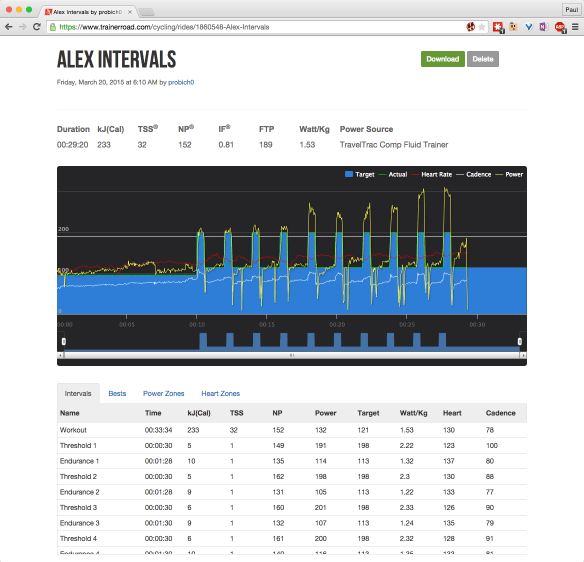
I LOVE THIS SERVICE and have written about it a couple of times before (most recently here). It combines bike workout plans with power measurement (either using a power meter or an algorithm that estimates power output based on your wheel speed and the resistance profile of your indoor trainer), then gives you immediate feedback about your power on the bike. You run the TR app on your iOS device or PC, and you immediately see what your performance looks like. The center graph in the screenshot below is basically what you see during a workout: the yellow trace is your power output. During a workout, you also see your cadence, heart rate, and other useful data. It makes working out to a specific standard much easier: you ride until the yellow line is where you want it over the blue, then hold it— easier said than done, but much easier (at least for me) than trying to figure it out on my own.
Google ChromeScreenSnapz011

TR costs $10/month, which gives you access both to the service (and its ability to sync directly to Garmin Connect, which is nice) and its workout library, which includes all sorts of cycling-specific training plans. I recommend it highly.

Tapiirik

Tapiirik is very simple: it syncs services. You can choose to sync any supported service to any other supported service, in any combination. For a while, I had RunKeeper, Strava, TrainingPeaks, and Endomondo all set up. Suunto would sync to RunKeeper, which would sync through Tapiirik to the other services I use (some of which had their own sync relationships, such as the link from RunKeeper to Fitocracy). Now that Garmin, Strava, and TrainingPeaks all talk to each other, I don’t use this much any more but it’s a valuable tool if you want to talk to any of the services it supports.For $2/year this is a superb value.
Google ChromeScreenSnapz008

Everything else

MapMyFitness: this is really a collection of very similar sites: MapMyRide, MapMyRun, etc. My favorite feature here is the “route genius”, which will lay out a route of the specified distance given a starting point and workout type. This service costs around $30/year for the premium version, which is required to use “route genius”. I use it because I got a year for free when I bought my headphones, but you may not find the features that compelling.

Nike+: this is the software I first started with. I liked it, but it only does running, and it only works with the Nike+ app for iOS (and maybe Android?) While the presentation is top notch, it lacks many of the features in Strava and Garmin, so I ditched it. Garmin recently added sync with Nike+, so if I ever go back to an iOS device I might take a look at it again.

There are lots of other services in this same mold: Runkeeper is another example. And then there are tons of apps that work with these services on various platforms… and more coming all the while. So this article isn’t comprehensive, and it will probably be outdated sooner than I’d like, but such is life with cloud services.. even when those services are supposed to be for something fun.
 

Leave a comment

Filed under Fitness

Training Tuesday: first week with the Garmin Fenix 3

Not long after I got my Garmin 920xt, Garmin announced the Fenix 3, which combines the same Connect IQ software platform with a round face and (to me) a much more attractive industrial design. I ordered one in January, figuring that I could probably sell the 920xt without too much trouble, then I settled in to wait for its arrival. I’ve had it about a week now, just long enough to get a sense of how it compares to the 920xt.

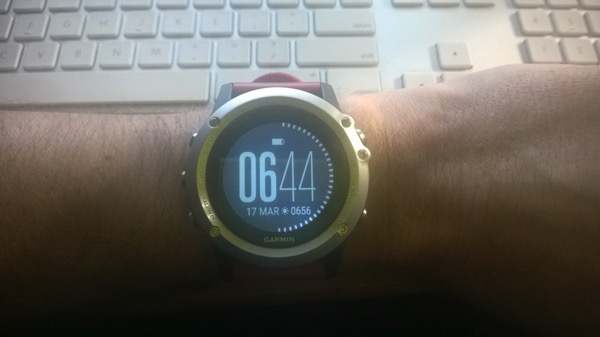
WP 20150317 002

First,I love the physical appearance and build quality of the watch. It reminds me of the Suunto Ambit 2s, though it’s a bit heavier. Whereas the 920xt felt plastic-y (makes sense, given that it was plastic), the Fenix 3 feels like a real watch. Screen brightness and clarity are excellent; the screen is a different shape but has the same resolution as the one in the 920xt. One significant difference is that the 920xt has six hardware buttons, while the Fenix 3 only has five. They’re also arranged very differently; for example, the “up” button on the 920xt and the “start/stop” button on the Fenix 3 are in the same location, on the upper right side of the watch. The difference in button location has been the hardest thing for me to get used to. Starting and stopping activities is easy, but there’s no longer a single-button shortcut for “connect to wifi” and there’s no dedicated button to bring up settings— instead, you hold down the “up” button. I’m still trying to master the button combo to enter drill mode when swimming and have occasionally fumbled with the other buttons in the midst of an activity, but I’m getting used to it now.

In terms of functionality, the Fenix 3 does everything the 920xt does for tracking runs, swims, and so on. However, it has four additional sensors: an altimeter, a barometer, a compass, and a temperature sensor. The Fenix 3 software thus has several features missing from the 920xt, including the ability to display data from all those sensors, “trail run” and “hike” activity modes that track your altitude using the altimeter instead of GPS altitude, and a slightly different UI paradigm for interacting with the sensors: each sensor type has its own dedicated widget, which you page through using the “up” and “down” buttons. Here’s a quick video I shot showing what the widget displays look like. The widget labeled “VIRB” is there for controlling Garmin VIRB action cameras. I much prefer having a separate widget for this than the 920xt approach of having the VIRB controller be a data page that appears within an activity. Here’s a quick video I shot showing a little of what the user interface looks like.


There’s about a $50 cost difference between the 920xt and the Fenix 3, assuming you buy just the watch and not the bundle with the heart-rate strap (and that you buy the basic Fenix 3, not the fancier and heavier one with sapphire glass). For me, the cost was well worth having a nicer-looking watch. One downside to the form factor of the Fenix 3 is that there currently isn’t a quick-release kit, as there is for the 920xt, so if I want to use it while riding the bike I’ll need to improvise a mount. That’s a small disadvantage, though, for the way I use the watch.

Of course, the back-end Garmin Connect service doesn’t care which watch you use to gather your data as long as it has the Garmin logo on the front, so switching the 920xt for the Fenix 3 was a non-issue there.

If you’d like to know more about the Fenix 3, I highly recommend this lengthy review at dcrainmaker. It goes into much more detail about the watch, how it works, and how it compares to its peers.

1 Comment

Filed under Fitness, Reviews

Training Tuesday: putting TrainerRoad on my handlebars with the Dell Venue 8 Pro

A few weeks ago, I wrote about the basics required for indoor bike training. I recently made a couple of tweaks that have made my setup much more pleasant to use and I thought I’d document them.

First, I still use TrainerRoad whenever I ride indoors. Their training plans have a huge variety of workouts for whatever you need, and the custom workout creator makes it easy to build whatever odd interval combinations Alex assigns me. I’d been using it by either propping up my Surface Pro 3 or MacBook Pro in front of the TV, which was suboptimal because it required me to drag a laptop over near the TV, set it up, and hope that Pancake didn’t knock it over.

Then it hit me: I had a perfectly good solution right on my bedside table in the form of my Dell Venue 8 Pro.

First, I needed a mount. A little poking around on Amazon yielded the Arkon SM632 for $18. It has four little prongs, two of which are spring-loaded, that hold the tablet or phone in place. There’s also a safety strap that goes across the device for extra security, but I didn’t bother with it. It installed easily in about 2 minutes and easily held the Venue 8 Pro. So far it seems quite sturdy, but I’m not about to ride on the road with a 7″ tablet on my handlebars.

The Venue Pro 8 has a single micro-USB port, so I needed an adapter (and had been meaning to buy one anyway). For $7, Amazon was happy to sell me a two-pack of USB On-The-Go (OTG) adapters.

The hardest part of the install turned out to be getting TrainerRoad set up. It installed easily but I had to tell it to use the virtual power feature, which required me to pick the trainer I use from a drop-down list. It is impossible to do this using the on-screen keyboard (since it doesn’t have up/down arrow keys) and there’s no way to scroll. I ended up plugging a mouse into the USB adapter and that did the trick.

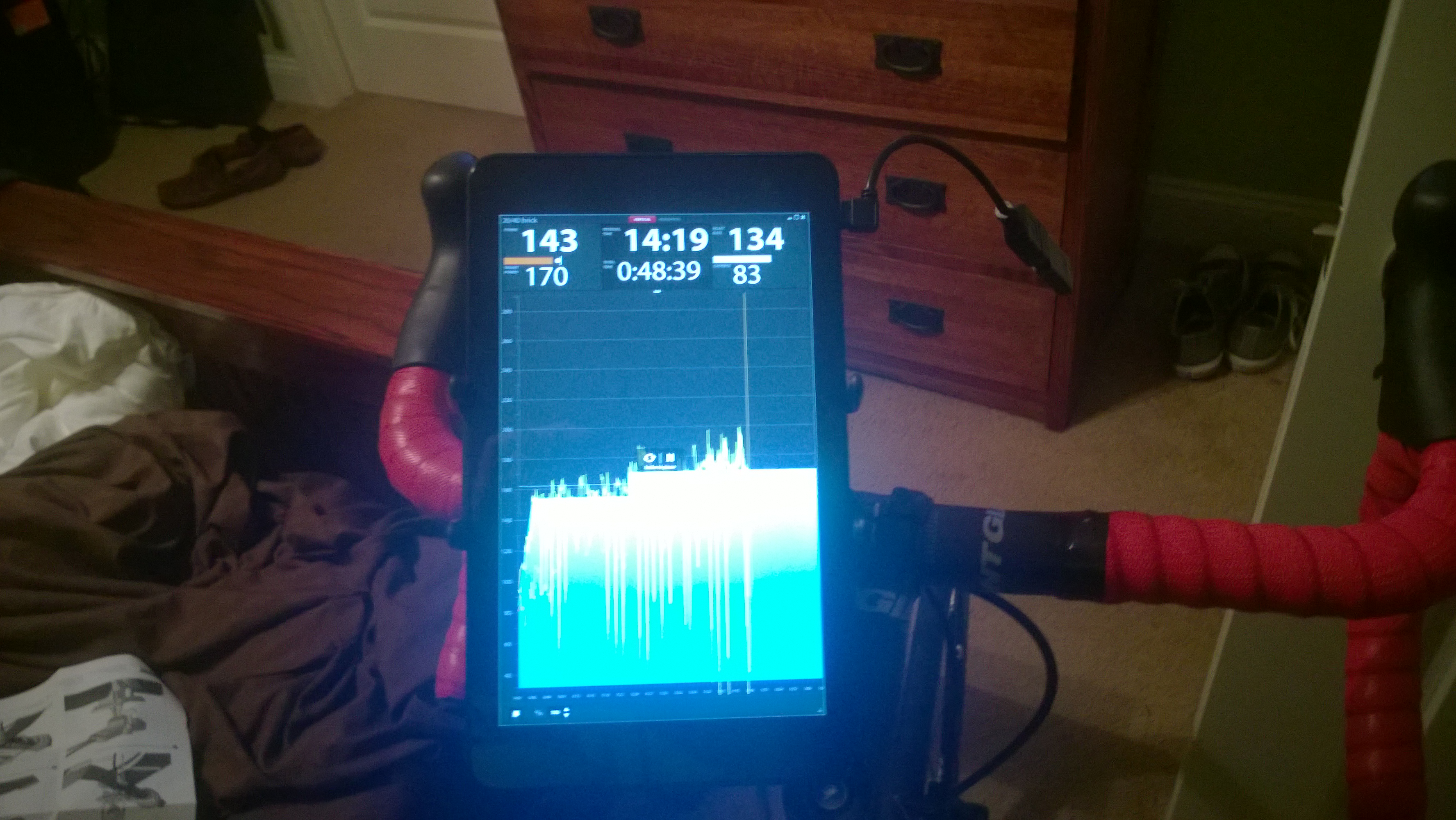
The picture below shows what I ended up with; you can see the USB adapter and ANT+ stick just to the right of the tablet screen. Works like a champ!

TrainerRoad on the Dell Venue 8 Pro

TrainerRoad on the Dell Venue 8 Pro


2 Comments

Filed under Fitness

Training Tuesday: half-marathon now, triathlon soon

Time for a progress check-in on my training plans.

First, CHP. I am still delighted with the coaching I’m getting from Alex and the accomplishments and support of my fellow athletes is very motivating. For example, Dani Overcash, a 123lb woman, just set a new US record for deadlifting 402lbs at the RUM powerlifting meet this weekend. It is really cool to look in the FB group and see how many people are setting PRs, winning competitions (in powerlifting, strongman, Brazilian jiu-jitsu, and triathlon, among other sports), and generally being badasses.

Second, I started the Fleet Feet half-marathon program a few weeks ago. The program is pretty typical of half-marathon training programs: one long, slowish run on weekends, speed work one day a week, and a couple of shorter tempo runs. There are a few people in the program I know from the local running / triathlon community, which is fun. The long runs are Saturday mornings at 6am, which I semi-resent since that would otherwise be one of the few days when I don’t get up early. The program overall has a different vibe from TRI101, too, in part because of the different mix of coaches, and there have been a few hiccups with organization and logistics, but I am enjoying it and it should be good preparation for the Bridge Street half-marathon.

Third, I signed up for my first two triathlons of the season: the New Orleans Sprint on March 29 and the Lake Pflugerville Sprint in late June. There will undoubtedly be others in between (including the Issaquah Sprint, I hope!) Signing up was sort of a forcing function; I have been doing mostly weights and running, with occasional rides on the trainer, but I knew it was about time to switch to a more tri-focused regimen. I told Alex Sunday that I’d signed up and he immediately scheduled me for a brick Monday– and tomorrow I swim. Time to get back to it!

Fourth, I’m still debating which of the two local Olympic-distance training programs to sign up for. Note that I’m not debating whether or not I want a local group program. I do, because I like the energy and social connection of training with others. Fleet Feet is doing their TRI201 program, which I expect to be just like TRI101 with different distances, and local tri legend Rick Greif is doing his own program. Rick’s program is more expensive but includes some extras (including race registration for Renaissance Man), so I am leaning towards that.

I have a bunch more posts that I need to write, including an explanation of the setup I ended up with for bike training and a race report for the most excellent Tick Ridge Trek trail 10K I ran this past weekend, but this’ll do for now. See you on the road (or in the pool, or on the trail, or maybe at the pasta buffet!)

2 Comments

Filed under Fitness

Getting started with indoor bike training

A coworker was asking me about indoor cycling, so I took a few minutes to put together some notes on the configuration I use. He wanted a basic setup that would let him train indoors and minimize time spent away from his family. Here’s what I told him.

First, you should know that you can train in two ways: 

  • Structured workouts that target a particular power level (your functional threshold power, or FTP). An example workout is here. For example, you might ride a warmup for 10min at 60% of your FTP, then do interval sets of 80-115% FTP, then a cooldown.
  • Workouts where you ride for a set distance or duration while keeping your heart rate and/or pedal cadence in a certain range. These are akin to what you might do in a spin class, although a good instructor will provide a much more structured experience with intervals.

Both of these depend on having a way for something to measure how fast the pedals are going (cadence) and, optionally, your heart rate. Structured power-based workouts require you to have some way to either measure or estimate how much power you’re putting on the pedals.

Assuming you want to spend as little as possible, here’s what you need to get started with bike trainer workouts:

  1. A bike trainer. This DC Rainmaker article is the canonical list of recommendations for every price range. I got one of the Performance Bike TravelTrac units for about $100. I had borrowed a Kinetic Road Machine and loved it; it is much smoother than the TravelTrac but also costs 2x as much. 
  2. Speed and cadence sensors for your bike. There are two sensor protocols: ANT+ and Bluetooth Low Energy. You may be able to use BLE sensors with your phone and selected software, and it might work with your laptop, depending on what kind of gear you have. ANT+ is much more widely used for these sensors. I have a Wahoo ANT+ speed/cadence combo sensor but Garmin and several other companies make them. (Ignore the price at that link; sensors cost from $35-75 depending on brand).
  3. If you want structured workouts, TrainerRoad or some other training software. TR is $10/month, has a full money-back guarantee, and is very well worth it. TR will calculate what they call “virtual power” based on your pedal cadence, wheel speed, and the type of trainer you have. You will also need an ANT+ USB stick for your laptop so the TrainerRoad app can see your cadence and heart rate data. I use a $17 one from Amazon.
  4. If you want cadence / HR-based workouts, you need some way to see what your cadence and/or heart rate are. You can use a phone app for iOS or Android such as Strava or Wahoo Fit, the TrainerRoad app if you’ve subscribed, or a bike computer or watch that speaks ANT+. Beware that not every ANT+ device can display all types of sensors. For example, the Garmin Forerunner 15 running watch will display ANT+ heart rate data but ignores cycling sensors because it’s a running-only watch.
  5. If you want to gather heart rate data, you’ll need a heart rate monitor. I use the Scosche RHYTHM+ because a) it’s an arm/wrist strap and not a chest strap and b) it can transmit both BLE and ANT+.

There are lots of other ways to spend money on this stuff: there are computer-controlled trainers that adjust the resistance to give you realistic uphill and downhill rides, power meters that measure your power using strain gauges, bike computers that display your cadence, speed, etc. on a handlebar-mounted unit, and so on. But with the basic stuff above (which I’d estimate will cost less than $200 all in) you can get a terrific training experience without leaving your house.

Leave a comment

Filed under Fitness

Training Tuesday: a few odds and ends

No time for a real post this week, so instead you get the dreaded random-list-of-bullets…

  • I’m still loving the Garmin 920xt. After teaching it about my phone’s tethered wifi network, I can now upload workouts from wherever I happen to be, which is handy when I’m on the road. The ability to set high/low alerts for pace and heart rate is very useful too.
  • I’ve been working with Alex Viada and his posse at Complete Human Performance for about six weeks now and I am already seeing some differences that I really like. I thrive on structure so having a training plan to follow works really well for me: I just show up, do whatever workout I’m assigned according to my TrainingPeaks calendar, and call it good.
  • The other day I deadlifted 315 lbs. While this is a small amount in the grand scheme of the powerlifting universe, it was a huge milestone for me. The bar actually bent when I lifted the weight. I had a huge ear-to-ear grin after completing the lift, and it inspired my 13-year-old (who was trying to reverse-psych me before the lift by saying “I don’t think you can do it, Dad”) to hit 135 x 5 for his own deadlift PR. Then I followed that up by setting a new bench PR of 135×2. Headed in the right direction!
  • Last night I had a 45-minute run where my target was to keep my heart rate in zone 2. I set a high/low alert on my watch and kept it right around 150 for a steady 45 minutes without stopping. If you had told me a year ago that I could run 4.5 miles without stopping I would’ve laughed in your face.
  • My Z2 pace is about 10:00/mi, while my flat-out race pace is about 8:30/mi for 5Ks. I need to do some more 10K distances to see what feels good at that distance; I’ll get the opportunity when I start my half-marathon training in a few weeks. My tentative goal for my first half is to get it under 2:15.
  • I need to spend more time in the pool. I always say that, and yet I rarely do it.
  • Working in an office has made it harder for me to consistently eat well. Since we have a full kitchen, this is more of an excuse than an actual problem; I can cook proteins, mix shakes, and so on at work just like I can at home, assuming a) I remember to bring the ingredients and b) my coworkers don’t eat them.
  • Is it triathlon season yet?

Leave a comment

Filed under Fitness

Training Tuesday: Upgrading to the Garmin Forerunner 920xt

When I saw that Garmin had a new triathlon watch on the way that included an SDK, I thought “hey, that might make a neat upgrade” and ordered one. Unfortunately, production delays dragged the release date out, so I ended up canceling my original order and reordering. I got the new watch about two weeks ago and have been putting it through its paces since. I’ve used it on the bike indoors and out, for outdoor runs, and while weightlifting. It’s also an activity tracker that tracks steps and sleep and uses that data to estimate calorie burn. Here are a few of my thoughts based on my experience so far.

First, IMHO it is ugly compared to the Suunto. That’s partly a result of the white/red color scheme but also because there are lots of little 1970s-style touches (the GARMIN logo, the little red pinstripes around the bezel) that don’t need to be there. It is substantially smaller than the Garmin 910t and about the same thickness as the Suunto. The band is comfortable enough for daily wear.

Paul robichaux net 20141214 001

Side by side, I prefer the appearance of the Suunto.

Setup was very straightforward. I signed up for a Garmin Connect account, plugged in the watch, and that was about it. Suunto requires that you set up most aspects of its watches (including which activity types will be available on the watch) using their web site. This is very flexible, and generally easier than punching buttons on the watch, but it means that you can’t customize anything on the watch itself— a drawback if you get to a race and notice “oops, I forgot to enable open water swim mode” (which I’ve done!)

As typical, the first thing I did with the watch was play with all the settings. For example, at first I thought I’d want the “auto scroll” option on so that the watch would flip through all available data pages. It turns out that auto scroll means whenever I looked at the watch, it was likely to be showing me anything other than the data items I was most interested in at that point in time, so I turned it back off.

A few things I particularly liked:

  • Garmin’s Connect web site is much more attractive and more useful than Suunto’s. I love seeing weather conditions recorded along with my workout. (Take a look at this workout as an example).
  • Being able to set a target pace, then have the watch buzz / beep any time I deviated from it, is a great help. I’m still not quite sure at what interval the watch checks pace.
  • Wireless sync via wifi is brilliant. I was on the street corner outside my house, walking back in, and the watch buzzed to tell me it had uploaded my workout.
  • It was trivial to pair the watch with my bike sensors, my HRM band, and the TrainerRelay feature in TrainerRoad.
  • GPS acquisition seems just as fast as the Ambit 2s, which is noteworthy for its fast sync.

The watch has a few drawbacks, too. I don’t have a phone that works with the 920xt’s Bluetooth features, which means I don’t get notifications on my wrist, can’t use live tracking, and so on. The chances that Garmin will support Windows Phone are just about nil, so I have to decide if I am willing to switch to a supported platform if I want to have these features. The jury is still out; there are lots of things I prefer about WP compared to iOS, and I am loath to give them up just to have wrist notifications. I suppose that’s not the watch’s fault though, especially since the Ambit 2s lacks those features altogether.

Another annoyance: you can’t customize the data fields in the same way that you can with the Suunto. There I was able to set up a custom screen that had exactly the data fields I wanted, no more and no less. On the 920xt it looks like you can enable individual data pages, but you can’t customize the fields that appear in those pages. For example, when cycling I want a page that shows current speed, current cadence, and total distance. The 920xt has all that data, but not in a single page.

There are some things I don’t understand about creating workouts in Garmin Connect and sending them to the watch, too. It looks like the workflow is to log in to GC, create the workout, then plug your watch in for USB sync. When I do this, sometimes I get the workout on the watch and sometimes I don’t. This may be a watch problem, a Mac sync connector problem, a GC problem, or some combination thereof. I haven’t done it enough yet to have a really solid repro case.

The social features of Garmin Connect are poor, too. In fairness they are no worse than Suunto’s, but compared to the features in Strava, MapMyRun, RunKeeper, and Fitocracy, they stink. It’s hard to find friends, to name just one flaw. I’d love to see them fix this in a near-term update.

A few tips for things that were not obvious to me at first:

  • You turn the backlight on by pressing the power button. By default, it shuts back off after 8 seconds. This is adjustable: go to Settings > System > Backlight and you can change the delay. The Ambit 2s had a lock button that you could use to lock the light on; there doesn’t seem to be an equivalent.
  • On the Suunto, you define a multisport activity on the web site, load it to the watch, and transition between activities. You can do that on the Garmin as well, but you can also just switch modes on the watch— so you can go from weightlifting to running to open water swim to cycling all within a single activity. The Garmin Connect web site still seems to have some issues dealing with multi-activity files, or it’s possible that I have something set up wrong.
  • The activity monitor knows when you’re moving your body, but it doesn’t know when you’re unable to move, e.g. sitting in a car in traffic, so it will buzz you anyway. Such is life.

Overall I’m delighted with the watch so far. Garmin has been the gold standard for multi-sport watches and I expect that, as I learn to use it, I’ll get more useful training data from it. The ability to easily do intervals and to track my pace are already making a different. Bring on race season!

14 Comments

Filed under Fitness

Developing apps for the Garmin ConnectIQ SDK

Early on this triathlon season, I bought a Suunto Ambit 2s. I loved the idea of having accurate workout data for my training, plus more accurate time/distance data for my races, and the Suunto has delivered. But it’s missing a few things: its support for interval workouts is poor, and the Movescount website is less reliable than I’d like. Luckily Suunto added export to Strava, but you still have to use their computer-based app to transfer workouts from the watch to the computer to the Movescount site, so when the site’s down you can’t see your workout data. (There are also various website bugs, including one in computing swim distance that means that the results on the website don’t match the results on the watch, but I digress). Having said all that, I was planning on sticking with the Suunto because I like the industrial design; it’s comfortable to wear, looks good, and has all the basic functionality I need.

Then I read this: Garmin announces ability to develop apps on wearables, with Connect IQ.

Coupled with my native lust for all shiny gadget things, the availability of the SDK opened a whole range of possibilities, not only for apps I could get for the watch but for apps I could write. I immediately started pondering what kinds of useful apps I could build and came up with one that I thought would be very useful: a flight timer. There are at least two different flight times that I need to log for every flight: how long the propeller was turning (because that drives how much money I put into our engine reserve fund) and how long I was actually in the air (which is what I actually log as flight time).

The GPS in 706 can automatically calculate flight time from takeoff to touchdown… provided you remember to look at it after landing and before turning off the avionics master switch. We also have a Hobbs meter that measures the time when the propeller’s actually turning. However, an app that automatically records time in flight, along with the origin and destination airports, would be useful. CloudAhoy does something similar, based on ForeFlight track data (and for all I know, ForeFlight can do this already). However, a timer that’s not tied to the aircraft would have the advantage of not losing its data when you turn off the airplane, and not being tied to a phone, external GPS, or iPad greatly reduces the risk of losing data due to battery or device failures.

So, I ordered a Garmin 920XT and downloaded the Garmin SDK. On first inspection, it looks like the SDK and development model are both pretty tractable for what I want to do. I’ll be blogging about my development efforts as they progress. For now, if I can get basic logging to work in the device simulator, I’ll be happy. There are a few features I’d like to have in the app to make it useful: it should automatically log flight time from takeoff to touchdown, geocode the origin and destination points so that the log file reflects airports and not just GPS points, and provide a timer function for things such as switching fuel tanks in flight. If I can extend that to include automatically logging flights into Safelog, that’d be even better but that might be some time away.

The 920XT itself will be a nice upgrade from the Suunto, which I am going to loan to my pal Jay for use in his training, but it won’t ship until sometime in November, so I’ll be running on the simulator for a while yet (and using the Suunto to log workouts, too!)

The SDK includes a comprehensive set of API docs, the device simulator, an Eclipse plugin that runs the command-line compiler, and assorted sample apps. I’ll have ore to say about it once I get my environment set up and running and start playing with the samples. Garmin’s clearly thinking about this the right way, though; in addition to their own developer forum, they are actively encouraging the use of StackOverflow.

Stay tuned for updates!

3 Comments

Filed under aviation, Fitness

Training Tuesday: a new bike and my first long bike ride

Wow, lots has happened since my last Training Tuesday entry. Maybe I should call it “Triathlon Tuesday,” since not every post is about training? But then again, not every post is about triathlon, either, as you’ll soon see.

I’d been wanting a new bike for some time. My previous ride, a Specialized Crosstrail Sport Disc, is a big, heavy beast of a bike. Its gearing is designed for trails; it has 3 chainrings (more on which later) with 9 gears in each. In addition, the frame geometry is such that you sit up straight and tall, which is fine for riding to work (the reason why I bought it) but not so great for riding fast in races or training. After my debacle at Rocketman, and my successful experience at Nation’s Tri with a rented Cannondale road bike, I knew I wanted to try to find a road bike before my last two races: Racin’ the Station and Rocketman Florida.

To save you lots of tedium, I’ll cut my description of the shopping process short. Suffice to say I did a ton of research, hit all the local bike shops, test rode a bunch of bikes, and spent an unhealthy amount of time looking at bikes on SearchTempest and eBay. The keys to finding the perfect bike are that you should pick a bike:

  • that fits you. This is a bit of a problem since I am tall. Bike geometry is complicated, so I quit trying to predict what would fit me in favor of riding bikes to see. how they felt
  • that’s in your price range. You can spend many thousands of dollars on super-fast racing bikes with all kinds of fancy crap, but that wouldn’t do me much good. To get faster, I need more time riding, not an uber-bike. All I wanted was a basic entry-level road bike, so I set a budget limit of $1000.
  • that you like. This was tricky. I saw lots of bikes that I liked that weren’t in my price range, and some that I liked and were in my price range didn’t fit me (including a really sweet all-carbon Douglas).

I pretty much struck out at the local bike shops. The model year for bikes changes over in August or September, so there were very few 2014 bikes in my size left, and most manufacturers hadn’t shipped many 2015 bikes in my size and price range. So I narrowed things down to a couple of 2014 models at two local shops– a Trek Madone 2.1 and a Cannondale CADD9–  and was planning on going to pick one out when I got back from Exchange Connections. In the meantime, though, a mechanic who works for one of the local shops told me about a sweet-sounding bike he had: a 2013 Giant Defy 1. It was in my price range, and I liked the idea of getting a slightly used bike for less than retail. We met Wednesday, I test-rode the bike for a few laps around the parking lot, and made the deal. Thus this picture from Wednesday night:

What a sexy beast! And the bike is nice too.

What a sexy beast! And the bike is nice too.

I didn’t get a chance to ride Thursday, but Friday afternoon after work I put on my SPD pedals and speed/cadence sensors and got in about a 2-mile ride. After a few tweaks to the seat position, I packed up the bike and went to bed. Saturday morning, I got up bright and early to meet Wendy (one of my Tri101 coaches), her husband, Teresa (another 101 alum), and her husband to convoy over to the All You Can Eat ride sponsored by the Spring City Cycling Club. I hadn’t really planned on riding this ride, but after I told Wendy that I bought the bike, she encouraged me to give it a shot. I decided to go for it. I only signed up the 34-mile loop, but I figured that would be plenty. The 50-, 67-, and 103-mile groups rolled out at 8am, and I joined them so I could ride with Wendy and Mike. The weather was absolutely perfect: mid-70s, with a nice breeze and plenty of sunshine. The first 6 miles or so were pretty slow, as we were riding in a big mob. However, about mile 7, there was a long downhill (with a sharp left at the bottom, yikes), and that spread the group out a good bit. I hit about 30mph downhill and could easily have gone faster if I weren’t so chicken!

Doesn't look like much from here…

Doesn’t look like much from here…

This ride was much different from what I’m used to. In triathlons, you’re not allowed to bunch up or draft, and everyone rides hell-for-leather. In this kind of ride, you can ride abreast, clump up, ride right of the centerline, and pretty much do what you want as long as you’re not unsafe. It was great to be able to ride along chatting with people, the more so because I actually knew some of the people I was talking to!

Another big difference: in this kind of ride, there are rest stops WITH FOOD. That’s right: we rode about 15 miles, stopped for a snack, rode another 8 miles, snacked again, and then rode about 9 miles to the finish. At the first stop, I had half a PB&J, a banana, a big cup of Gatorade, four or five Fig Newtons, and a brownie. Longer distances thus mean more snacks, giving you a built-in incentive to push your distance. As it was, 34 miles is about double my previous long ride distance, so that was enough pushing for me.

After rest stop 2, the ride went fine until we turned onto Salty Bottom Road (great name, huh?) The turn put us into the teeth of a stiff headwind, which slowed me down, and then I had to stop and walk up about half the hill around mile 32– I was just gassed at that point. I definitely felt the difference in chainrings on this hill; on the Crosstrail I would have just dropped to the lowest ring and blasted up the hill (well, OK, “blasted” probably isn’t the right verb). Having only 2 rings is going to take some getting used to.

The scenery was incredible: a hundred shades of green in the grass and fields, a squadron of planes overhead flying into Moontown for the EAA 190 pancake breakfast, and mountains, or at least what passes for mountains here, in the background. The course was very well marked and the support volunteers did a wonderful job of feeding us, providing a sag wagon, and handling all the pesky logistics.

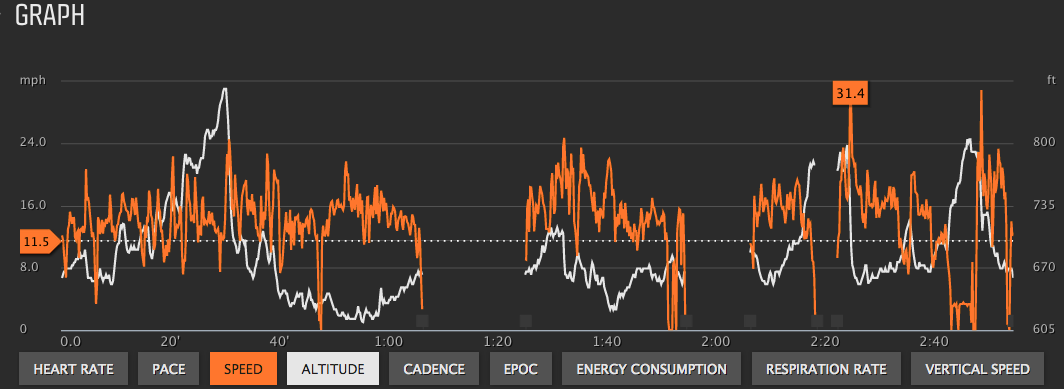
This graph nicely summarizes the overall ride for me. The white line is elevation; the orange line is speed. The gaps indicate rest stops. You can clearly see the big downhill around mile 7 (look for the steep white cliff), plus a few later hills. My average speed was 14.3mph, which was pulled down by the long stretch of chat-riding  at the start. I was routinely hitting 20+ mph on the flats, something that would have been improbable, if not impossible, on the Crosstrail, so I’m really pleased with the results.

Tale of the tape

Tale of the tape

Now I need to log some more miles before Rocketman Orlando, which features a 32-mile bike course. On Sunday, I rode the Racin’ the Station course with a group, just to get a feel for it; I wasn’t pushing hard at all and averaged around 14.5mph. I need to get a few more rides in this week (along with RtS this Saturday). I’ll definitely be on the lookout for other sub-metric-century rides– I may have accidentally caught the club-ride bug!

Leave a comment

Filed under Fitness

Rocketman 2014: my epic fail

In idle conversation with my friend and fellow TRI101 attendee Alex, we started kicking around the idea of forming a relay team to do the Rocketman Olympic-distance triathlon. The Olympic distance is the next step up from sprints; it combines a 1500m swim, a 40Km bike ride, and a 10Km run. I figured I could do either the bike or run, but not both back-to-back, and I knew I didn’t want to attempt the swim… but Alex is a strong swimmer and he jumped at the chance. We recruited Ryan, another TRI101 member who runs ultradistance races, and we were all set.

In the weeks leading up to the Huntsville Sprint, I’d been thinking about buying a new bike. Instead of splurging I decided to rent one from Madison Cycles and give it a try for this race. I picked it up on Wednesday, but didn’t get to ride it until Friday, at which point it scared me badly! At nearly 10lbs lighter than my normal ride, and with much narrower tires, different geometry, and different gearing, it felt much less stable, and after my first ride my shoulders ached from gripping the handlebars so hard. On Saturday I rode it again and felt a lot better, though. I packed my stuff, attended the race brief with Alex and Ryan, and got to bed at a reasonable time. Sunday morning found me up at 0430 to finish my last-minute prep and drive out to the Arsenal’s recreation area, which abuts the Tennessee River. I’d signed up for a volunteer shift at the packet pickup booth, where I had a grand time visiting with friends and helping triathletes get their packets and swag for the race. The morning was cool and overcast, and as dawn broke I was excited about the race.

I met Alex and Ryan at the transition area, got everything set up, and headed over to the swim area. In a relay race, the swimmer starts with the timing chip and hands it to the cyclist in T1,  then the cyclist hands off to the runner in T2. Rocketman has a separate transition area for teams, which is handy.  Once Alex started the swim, Ryan and I hung out in the transition area until he came out, then I was out the chute and on the bike. By this time it had warmed up a bit, but it wasn’t too bad, and I felt great. Fresh breeze! Beautiful scenery! I’d violated my normal “nothing new on race day” rule and was sporting a Camelbak for hydration; I figured it, along with two water bottles on the bike, would keep me well hydrated.

The first mile of the course went by smoothly and quickly. I was keeping an eye on my pace because 40Km was about a third farther than my previous longest ride, and about half again as long as my previous longest race, but I was still feeling great as I rounded the turn near mile 2… and then suddenly it seemed like the bike was slowing down. I pedaled faster. This had no effect other than to rock me back and forth in the saddle. “Maybe I need to shift some more,” I thought. So I did, fiddling with the bike’s four shift levers in a fruitless effort to stop decelerating. Finally I had to unclip and pull over, where after some experimentation I found that the freewheel gear inside the rear hub had broken or something. Pedaling turned the crank, which moved the chain, which turned the rear cassette, which did nothing to the back wheel. I fiddled with it for another 10 minutes or so, to no avail; then I reluctantly turned the bike right side up and started the Walk of Shame back to the corral.

Along the way, I am happy to say, probably 4 out of 5 cyclists who passed by me asked me if I was OK. I appreciated their support a great deal, though they were moving too fast for me to do more than shout “THANKS!” at their rapidly receding backs. At one intersection, world-famous race photographer Gregg Gelmis was set up and captured the moment:

Me after my rental bike crapped out during Rocketman 2014

Me after my rental bike crapped out during Rocketman 2014

Thanks to my distinctive jersey (which I love, so shut up, haters), Alex and Ryan could see me before I made it back into the corral and they knew something was wrong. I am very grateful to them for how gracious they were; the mechanical failure of my bike meant that I officially did not finish (DNF’d) and so our team was marked as DNF’ing. Ryan ran the 10Km leg anyway and turned in an excellent time; while he was killing it in the 90-degree sun, Alex and I got to cheer a number of our TRI101 friends and coaches as they crossed the finish line. (Results are here if you want to see how fast everyone was.)

The Madison Cycles folks were very apologetic, and I’m sure they’ll settle up with me when I get back home. Mechanical issues happen. as anyone who’s owned any device more complex than a pencil knows well, so I don’t blame them, but it was still frustrated because I was excited to compete. I still had a great time; I especially enjoy the social aspect of triathlons because, while it’s a very competitive sport, the competitors tend to be very friendly and incredibly supportive. It’s a sport where you can take genuine pleasure in the successes of your friends, which suits me just fine.

The only thing to do: come back next year and DO THE WHOLE RACE. That will show ’em.

3 Comments

Filed under FAIL, Fitness

In which I become a repeat offender

Yesterday marked a milestone: my second triathlon, the Tarpon Tri in Houma, Louisiana. I was fooling around one day on TriFind and noticed that there was a race there, so I signed up– I thought it would be a fun trip to see family and visit my hometown again. But you know what they say: one triathlon and you can explain it away as harmless experimentation, or perhaps a temporary indiscretion… run TWO, though, and you’re a repeat offender, well on your way to “serial triathlete” status.

I’d planned to make the 359nm flight from Decatur to Houma on Friday afternoon, so after a great conference call with a potential new customer (more on that next week, I hope), I loaded up the plane. With the two rear seats removed, it was easy to fit my giant road bike, my tri bag, and backpack in; I parked the car and off I went. I’d like to say a lot of neat stuff about how interesting the flight was, but the fact is that it went flawlessly: no major weather, a smooth ride, and some really interesting scenery, including a beautiful crossing of Lake Ponchartrain right alongside the Causeway. After an easy landing, I headed to my hotel to drop off my stuff, plug in all my gadgets, and make plans to see family.

(Side note: I cannot possibly say enough good things about how well the folks at Butler Aviation took care of me. When I arrived, they had a rental vehicle ready because I’d emailed ahead– no mean feat since the nearest rental agency is 10 mi or so away.  When I got ready to come home, the plane was fueled and ready to go, and everyone there was super friendly. Highly recommended.)

Dinner Friday night was excellent: my Aunt Norma, my cousin Ricky, and his wife Tonya went to Dave’s Cajun Kitchen. The name gives it away, of course: it’s Cajun food, but the kind that people actually eat. Gumbo, fried catfish, white and red beans, jambalaya, and so on. I have never had a meal there that was less than excellent. This one was so good that I ate more than I should have, for which I would pay later.

After a visit back to Ricky’s, I headed to the hotel, got my gear ready for the morning, and went to sleep… then spent all night having reflux-y burps of white beans and catfish. Key learning #1: don’t eat so damn much before the next race.

Saturday morning I got up, hit Walgreen’s for some Tums, and headed to the race site for packet pickup. The place was packed! I should’ve gone to get my packet Friday night; after 20 minutes or so in line, I got my packet and chip, got body marked, and headed to set up in transition. Thanks to all the practice with the TRI101 coaches, I had no trouble getting my gear laid out, so I headed to the pool to get in a quick warmup.

This race had staggered pool starts: the fastest swim time was #1, the second-fastest was #2, and so on. If you didn’t put down a swim time, as I didn’t, you went to the back… so I ended up being #180, meaning that I had about a 35-minute wait to get in the water. Key learning #2: put down the right swim time. I had a very pleasant time visiting with the triathletes in line near me, including a multiple half-Ironman finisher and a guy who was running his first race to celebrate his birthday weekend (he didn’t say what birthday but he was no spring chicken!)

The swim went well– 150 yd in the pool in 3:57. Oddly, Movescount showed me with 125 yds (how? it gets its data from my watch, which showed 150 yds!), and the official time for the swim was 4:36:37. The info packet said:

The timing chips are all pre-set as to when they begin your time according to the seeding chart that we give to the timing guy. Please pay attention & listen to the volunteers who are starting you. They have a list of what time each participant is to start his/her swim.

That makes me wonder if for some reason the swim times were off based on the expected time at which I was supposed to get in the water. In any event, the swim felt good. I got through T1 in a leisurely 3 minutes, partly due to my decision to try my new USMC cycling jersey as racewear. Turns out putting on a clingy bike jersey when wet is really hard– and it reminds me of key learning #3: nothing new on race day. (For reference, the fastest T1 time in my age group was 19.9 seconds!) I also forgot to grab my race belt, which turned out to be OK because we were issued number stickers for our helmet, though at first I had paranoid visions of being DQ’d for not having a visible number.

The bike course was great: flat, hot, and sweaty, just like my first girlfriend. We got a steady light rain for about the first 25 minutes I was on the bike, so the pavement was a little damp but not unmanageable. The course runs right along the bayou, so there was lotsto see: egrets, various other birds, cypress trees, and the whole nine yards. There were plenty of volunteers along the course, great course markings on the pavement, and very little traffic. I averaged 15.6mph on the bike course, for a time of 38:28, which was a little frustrating because I thought I’d be faster. I didn’t take the time to mount my Suunto on the handlebars during transition, though, so I couldn’t easily see my cadence or pace. Next race I think I’ll mount the watch during setup and just go without in the pool.

Coming back in from the bike, I got through T2 in 1:02, then headed out for the run, which was also flat. The sun was powering through the clouds by this time, giving runners the sensation of being tucked snugly in Satan’s armpit. Luckily, the organizers had planned for this: there was a water station at the half-mile mark, then again at the turnaround. I spotted a roadside portatunity (that’s a porta-potty for those of you who don’t speak the lingo) and made an emergency diversion, then got back to it. I spent a few stretch breaks walking– more than I wanted to– but still finished the run in 31:51. During the run I noticed some pain on my chest; afterwards I found about a 1/4″ cut on my nipple! I have no idea how it got there, but I bet it was because of the new jersey and/or not using BodyGlide under my HRM strap. Ouch. Key learning #4: you can never have too much BodyGlide.

Overall, I came in 13th in my age group and 96th overall, with a total time of 1:19:00.2. I would have needed to pick up about 2min to move up to the next place. My goals were to finish and to be in the top half, so I was pretty pleased. Swag-wise, I got a nifty tech shirt, a coffee mug, and a can coozie, all of which I can add to my collection.

After the race, I took Ricky and his son Seth for a sightseeing flight. The ceilings at HUM were only about 3500′ and it was drizzling, but we did a couple laps around the pattern and overflew Gulf Island Fabrication, where Ricky works. This might have been the high point of the trip, because the two of them were so clearly enjoying it. I wanted to beat the weather heading north, so after I dropped them off I immediately took off to the north. There was heavy weather directly over the New Orleans airport, which I would have overflown, so I ended up diverting well to the west to get around it. As I worked my way further north, the ADS-B weather from my Stratus showed that there were storms all along my route from about Tuscaloosa north, so I landed at Demopolis to refuel and take a short break. After that, it was a simple matter to dodge a bit (as you can see below) by flying from Demopolis towards Courtland, then turning east once past the storms. Note that the magenta line shows the GPS track, not where I actually was; I had flown well to the west to clear the tail of the storm (the red blocks near the “6nm” label).

20140802_232620000_iOSKey learning #5: datalink weather is strategic, not tactical. It isn’t updated in real-time, so you can’t use it to thread through closely spaced storm cells. The weather was gorgeous when I got to Decatur, so I landed easily, put the plane away, and headed home– with another triathlon and another 7 or so flight hours under my belt. All in all, a great trip, even if I am on my way to a life of crime triathlons.

Leave a comment

Filed under aviation, Fitness

Training Tuesday: it’s all about finesse

[note: I meant to post this after TRI101 yesterday but got sidetracked with RAGE, for reasons which I’ll explain shortly.]

I’ve been super busy since my last Training Tuesday post with a variety of projects (new job means finishing up the old job’s work!), so I skipped a couple of weeks. I did, however, join Strava, so if you’re on there feel free to follow me.

TRI101 has continued to rock right along. Two weeks ago we did a timed mile (8:08, a new PR for me) plus about 2.5 miles worth of hill work; last week we did two 2-mile runs at Indian Creek, with some core work in between, and tonight we did a brick. I finally got back into the pool and am slowly cranking up my distance. You don’t get a lot of training benefit from just swimming super long distances without stopping; instead, the best advice I’ve seen is that you should swim for whatever the total time you expect in the race is. For example, if you swim 400m in 8 minutes, and you’re getting ready to swim a 1500m race, swim at least 3×400 with short rests and you’re good to go. I’m trying to work up to swimming 1000m in one session, even with rest breaks. That will cover me for any of the sprint-distance events I’m doing this year or next, and will give me a solid base for next season if I move up to Olympic distance races, which feature a 1500m swim.

My friend Rachel loaned me her Garmin heart rate strap, which, when paired with my Ambit 2s, gives me a good idea of how hard I’m working. It turns out that at my normal pace of between 8 and 8:30/mi, I am working pretty dang hard; my heart rate runs in the 140-160bpm zone. For my age, that’s nearly max effort. Interestingly, I don’t work nearly as hard on the bike as I do in the run. I think that means I’ve got a lot of potential speed improvement ahead on the bike if I can get my legs to cooperate; my cardio isn’t the limiting factor there. I think I’ve mastered the trick of getting the Ambit to correctly measure pool swims, too (you need a hard push off the wall when turning), so all my remaining races and training will hopefully be logged correctly.

NewImage

Maximal effort for great justice

Right now I’ve got two more races coming up: one in Houma week after next, then the Huntsville Sprint two weeks later. At this point I don’t feel like I have a lot of new stuff to learn; instead, I am trying to polish what I do know and focus on my technique. For example, my swim technique still needs some fine tuning; that’s still my biggest weak point, although the more I swim, the more confident I feel about it. The only way to get good at swimming is to swim, of course. On runs, I’m working in fartleks for speed. On the bike, I’m still working on not falling over when I unclip.

Although I’ve been trying not to make any more equipment changes, I finally got around to doing something I’d been planning for a while: I put road tires on my bike. Those of you who have seen my giant bike know that it had big knobby hybrid trail/road tires on it. I pulled those and put on a pair of Continental 28s. At yesterday’s workout I was killing it on the bike— my speed on the route (a loop around the Arsenal) was a good 3-4mph higher than normal, with no more effort expended. I felt great, right up until I dismounted and tried to switch my watch into transition without looking… resulting in erasing my workout altogether. I was roughly keeping pace with my pal Alex, so I know it was about 11.2 mi in just over 44 minutes, but I lost all the pace and HR data. By the time I got home, I was so mad that I didn’t feel like finishing this post, thus its appearance on Wednesday.

(The good news about the delay in posting is that I can sum up today’s swim lesson with Lisi: enlightening. Unlike running or riding, where my form is pretty natural and just needs a few tweaks, my swim form is poorly developed. It’s improving, for sure, but there are lots of little tweaks that Lisi has been able to point out. After my last session with her a few weeks ago, I’ve felt more at ease in the pool so I’m looking forward to working on the 3 things she identified for me today: earlier head rotation when breathing on the right, keeping my hips lower in the water, and being sure to get my full extension before I start the pull. She’s also given me some new drills and workouts that I will do twice a week; I think they’ll make a big difference.)

I’ve been trying to rest my left Achilles tendon a bit, so I skipped my regular long run last week and have been icing it at night. I think it’s about back to normal, so this week I’ll hit my long run, at least one long ride, and another swim or two. It didn’t bother me at all yesterday, though it was a bit tender after the bike/run brick last night.

What will all this polishing and tweaking lead to? There are a bunch of upcoming races in various places, and at various distances, so I’ll probably continue doing sprints until the end of the season and work in at least one 10K. It’s not too early for me to start thinking of what races I want to run next year, too. I found this article to be super helpful; this year I didn’t really have an A race, but I need to pick one for next year: probably an Olympic. I love poking around on trifind.com and looking at all the races, so this will be a lot of fun.

Fun note: I like to try to work races into my training schedule, so last weekend I flew up to Providence and ran the Craft Brew 5K with Julie and her friend Sigrid. This was a fun race, with a large emphasis on post-race beer drinking as opposed to record-smashing running. Despite that, I turned in a smoking time, at least for me: 2.9mi in 25:22, an 8:42 pace. The race chip time scored me at 25:18 and gave me an 8:08 pace, so I am thinking that the last-minute change to the race course shortened it a bit. The post-race beer tasting was fun, although the quality varied quite a bit. My favorite was Dragon’s Milk Bourbon Barrel Stout, for what that’s worth; I may have to lay in a post-race supply!

Leave a comment

Filed under Fitness

Today I am a (slow) TRIATHLETE: my first triathlon

Phew. What a race!

First, the setup. My sister Julie and her family live in Vermont. I was idly poking around trifind.com (yay for the “sort by date” option) and saw that there was a triathlon over the July 4th weekend in Shelburne, not far from her home in Montpelier. I had originally thought about running Tri for Old Glory in Huntsville, but the mountain biking portion of the course put me off a little bit. A Vermont triathlon sounded like a great excuse for a visit, so I registered and started making plans, which included buying a wetsuit, flying, and so on. The organizer’s pre-race mail described the course as “rolling and challenging – Vermont isn’t flat!” That worried me more than a little, since this particular race had a long bike leg and a 500m swim (longer than I’m used to) and it was my first wetsuit swim and my first open-water swim. Oh, and it was my first triathlon, period. So I was a little disconcerted by that message. Julie was kind enough to drive me over to Shelburne to take a look at the course. We found the swim entrance easily enough, but the race map provided by the course organizer didn’t seem to match what we were seeing on Julie’s in-dash GPS. As it turns out, what we drove was not the course, but I didn’t know that at the time, so I went to bed last night thinking “hey, those hills aren’t too bad.”

Pregame

Last night I ate a normal meal: steak salad (plus some extra steak), some guac, a Fourth of July-themed cupcake, and a Heady Topper. I went to bed at a reasonable time and woke up, for no good reason, at 3am. I managed to get back to sleep until about 330am, but after that it was game over. I finally got up at 445, showered, put on my tri suit, and hopped in the car with Julie. We got to the race staging site half an hour early (who knew there wouldn’t be any traffic?) so we headed back into Shelburne for a Dunkin’ Donuts coffee stop. Registration was quick and easy, and I got a good spot on the rack with plenty of time to set everything up.

WP 20140705 008

My setup in transition; note camera on handlebar mount

WP 20140705 013

Julie, acting as my pit crew (she was super helpful— thank you very much, J!)

The weather was cool and windy, as you could see from the video I shot if my balky computer would upload it. However, the scenery on the beach was gorgeous— mountains in the background, a nice variety of low clouds, and the water itself, complete with whitecaps.

WP 20140705 07 11 10 Panorama

a panorama of the lakeside pre-race

After posing for a few pre-race pictures, I got my wetsuit on and got ready for the warmup swim. Several of my TRI101 peeps had recommended taking a warmup swim before any open-water action, and I’m glad I did. The water wasn’t as cold as I expected, thanks to my wetsuit and earplugs. It was, however, choppy, but the course was set so that the longest leg was parallel to the shoreline, so we were swimming parallel to the waves too. The race marshal herded everyone out of the water and gave us a quick safety brief, during which he described the bike course thusly: “You’ll go under the railroad overpass, then get to the first big hill…”

Uh oh, I thought. We didn’t see a railroad overpass yesterday. Maybe we went on the wrong bike course… But at that point there was nothing I could do about it, so I joined the single-file line for the swim and marched down the boat ramp into Lake Champlain.

The swim

The swim started in a single wave. The water was no more than about 2’ deep where we started, so it was easy to wade out to the starting point. I deliberately hung back because I knew if I got in front, I’d get run over by faster swimmers. Laura, Rachel, and a bunch of my other TRI101 peeps had all advised me to just treat the swim as a fun outing, so I did.This proved to be a good decision. At the starting gun, we all started swimming: 100m out to the first buoy, a sharp right turn followed by a 300m leg parallel to the shore, another turn, and 100m back to the boat ramp. I was surprised at how good I felt during the swim, though I got a couple of snorts of lake water from poorly timed breathing. I didn’t have much of a sighting technique, in large part because I hadn’t practiced; shame on me. (I hope Lisi isn’t reading this!) The only negative to the swim was that the inbound leg got shallow really quickly so I had to wade in because it was too shallow for me to swim. This made my legs get wobbly in transition, but I still felt pretty fresh overall. I exited the water, dropped off my provided swim cap, unzipped my wetsuit on the run, and got into the chute.

DSC 2424

As far as you know, I’m up in the front

T1

Coach Rick was right: it’s hard to put socks on wet feet. It’s also hard to remove a wetsuit without a) looking like a stork or b) falling over. I chose option a). The TRI101 transition training was really helpful here, as I had already neatly laid out shoes, socks, helmet, and sunglasses so I could get everything together. However, my transition time was longer than I wanted. It didn’t help that the camera fell off the mount that Paul and I had attempted to repair the night before, so I had to pick it up, adding a little bit of time. Then I stupidly forgot to push the right button on my watch, so my transition time and bike leg measurements are a bit jacked up.

DSC 2442

Luckily I didn’t fall over

The bike

ACK. The course was indeed “challenging”.

Sure enough, after the initial outbound leg, I went under the railroad overpass and… damn, that’s a long hill. And double damn… there was another one after it. The course also featured a long downhill stretch where I set a new speed record on the bike (29.8 mph), plus a stretch with an epic crosswind, plus beach scenery. The whole thing was rough, mostly because I had been riding exclusively on the flats in Alabama. It didn’t help that I stopped a couple of times: on the outbound leg I noticed that my watch wasn’t giving me speed data, so I stopped to adjust the speed sensor, which had gotten knocked out of position. (The cadence sensor, which Paul helped me fix yesterday, performed flawlessly, so yay.) A few miles later I stopped to move my watch to my Cajun handlebar mount, and then later still a cyclist passing me said “your back wheel looks loose!” as he passed. Or maybe he said “That’s a big heel goose.” He was going faster than me so anything’s possible. To be on the safe side, I stopped and checked it too. For the record, it was not loose and there were no geese evident.

I went back later (in the car, of course) and took a video of the course that I hoped would illustrate the hills, but it doesn’t; it looks like driving in the car, so you can’t really see the badness. The route is on MapMyRide, if you use it. Here’s an elevation map that helps tell the tale. That big knuckle around the 3.16mi mark is the first big hill, and the one before the 9.47mi mark is the second one. I had to walk up the first hill on the second course loop, as my legs were just gassed. As I found out when the official results were posted, I finished last on the bike— a little embarrassing, but I finished the ride and that’s what counts. (Plus, since this race didn’t have any professional photographers there is no record of my facial expression on the hills, for which I am grateful!)

NewImage

T2

T2 was slick as maple syrup: I got in, parked the bike, put on my running shoes, strapped on my belt, and took off. It could have gone faster; I think my time was around 1:50, but I didn’t drop anything, fall over, swear audibly, or drop dead, so I consider it a success.

The run

The run was a simple out-and-back, with a little bit of elevation on the first leg (the same road as the first 1/2 mile of the bike course, in fact). I took an easy pace, with several walking breaks, but still managed to turn in a respectable time: just under 30 min for 3.0 miles. I drained both of the bottles in my race belt, though, because I had very little water on the bike. I froze my water bottle overnight because I figured that way I’d have plenty of cold water to drink. Sadly, the 3 hours between taking the bottle out of the freezer and trying to get my first drink was not enough to melt the ice, so I got periodic trickles of melted water on the bike but that was it.

Results: “Who you gonna believe, me or your lyin’ eyes?”

78th overall (out of 80). My goals for the race were a) finish and b) not be last.  These might not seem super ambitious, but I expected both the bike and swim to be harder than anything I had done to date. And I was right, so yay me! I ran the race at close to my normal training pace, which I thought was pretty good after the abusive bike ride, and I’m pleased with my performance in the swim.

Event Official result Paul’s watch
Openwater swim 14m20s 292yd, 10m53s
T1  — 3m49s
Cycling 1h13m 13.83mi, 1h11m
T2 1m50s
Run 32m49s 3.0mi, 29m49s

My struggle with the Ambit 2S continues. The results it gives me don’t always agree with what I expect, particularly in pool swims, but today represented a new low. I was careful to make sure that I had “triathlon” loaded as one of the two multisport activities, and I gave it plenty of time to get a GPS lock before the race. The race organizers claimed the swim distance was 500 yards, and the watch credited me with 292. It’s possible that the course buoys were, accidentally or on purpose, sited to make the course shorter, but it’s also possible that the watch just gets confused by swim distances. Once I can plug it in (I didn’t bring the sync cable, oops), I can look at the track it recorded and figure out where things went amiss.

Interestingly, they didn’t time transition separately. The swim was a gun start, and we didn’t have individual chips, but the bike had a chip tag and so did my run bib, so it seems like they should’ve been able to calculate the T2 time at least.

Important things I learned during and after the race

  1. Before you register for a triathlon, look carefully at the course map. This is the most important tip I can possibly give you.
  2. If you freeze your bike water bottle the night before, it might not thaw before the race starts and you will have nothing to drink on the bike.
  3. If you leave your glasses on your transition mat, the very nice lady next to you might stomp on them; if you are very lucky, your brother-in-law will fix them for you.
  4. The salted-caramel flavor of Gu is pretty decent, at least as energy gels go.
  5. The water in Lake Champlain tastes way better than the water in the Madison Wellness Center pool. It’s probably because of all the zebra mussels.

Executive summary

I am a triathlete. Suck it, Blerch!

DSC 2539

3 Comments

Filed under Fitness