Category Archives: aviation

Writings about aviation, including chronicles of my flight lessons, product reviews, and so on.

A simple test of real-world LLM utility

I don’t have any firm plans for next weekend, so I thought I’d see if I could remedy my FOMO a little with an airshow visit. Without looking up the answer beforehand, I decided to test a few different LLM tools to answer what should be a simple question:

are either the Blue Angels or the Thunderbirds performing at a US airshow in the next three weeks?

I was looking for 3 elements in the response:

  • did the tool correctly identify the parameters (“next three weeks”, “US”, and “airshow”?)
  • did it give a factually correct response?
  • did it leave out anything important?

For reference, the Blue Angels are at Milwaukee 19-20 July and then at Seafair 1-3 August. The Thunderbirds are at Ft Wayne today (12 July), at Kingsley Field 19-20 July, and in Cheyenne 26 July.

Grok 3 got the date range right, told me “Based on available information, neither the Blue Angels nor the Thunderbirds are scheduled to perform at a US airshow in the next three weeks (from July 13, 2025, to August 3, 2025).”, and then went on to tell me that the Blues are performing at Seafair 1-3 August and the Thunderbirds in Oregon next weekend. It missed one show for the Blues and two for the Thunderbirds, counting today.

The free, no-login version of ChatGPT told me it couldn’t search the web and so I should look up the answer myself. After logging in, still with the free version, it quickly identified both teams’ shows 19-20 July, but that was all. It was faster than the other models but still didn’t produce a complete, correct answer.

My paid Claude subscription got the date range correct and found the Thunderbirds in Oregon and the Blues at Seafair, but didn’t get any of the others.

The free, no-login version of Copilot Chat got the date range correct, and was the only tool to spot the Thunderbirds’ performance today. Bizarrely, it included yesterday’s Blue Angels performance at Pensacola, but not their Seafair date.

This problem didn’t require advanced reasoning or searching. It’s disappointing that all of the tools produced incomplete and/or incorrect results for something this simple. We’re clearly not past the point of having to double-check factual results to queries.

Leave a comment

Filed under aviation, FAIL, General Stuff

Flying Friday: flying with Starlink

tl;dr: Starlink is an amazing addition to my airplane that makes my flying safer.

Last year, I bought a Starlink Mini antenna with the intention of using it in the plane. For $50/month, it sounded too good to be true… and it was, since Starlink nerfed the service after about a month by reducing its speed limit to 100mph. Over that speed, you’d get a petulant message telling you to slow down. The least expensive plan that would work at Baron speed was $250/month, and it wasn’t worth it to me.

The good news is that Starlink was apparently paying attention to the GA community and introduced a new “local priority” plan. For $45/month, you can use Starlink in motion, over land, at speeds of up to 250mph. You buy data in blocks of 50GB, for $20 each, so $65/month gets you up to 50GB of in-motion data. That’s about perfect for what I wanted.

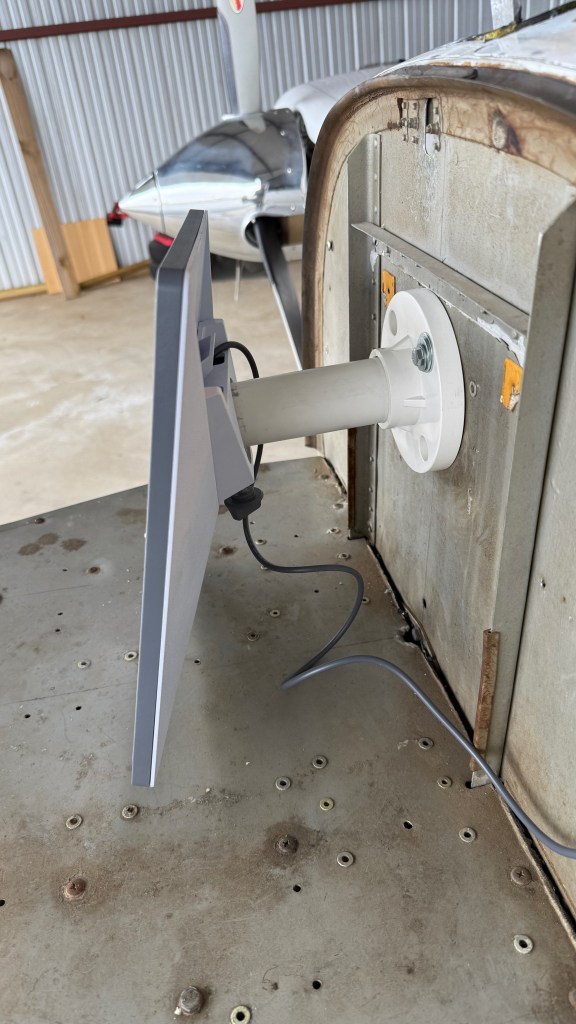
The Starlink Mini hardware draws between 20 and 40 watts in normal operation, with a draw of up to 60W at startup. I have a 28V airplane, so I bought a 100W-capable USB-C PD cigarette-lighter plug and I was in business. I’m still working on a mounting solution that I really like; I’ll post more about that another time. Here’s a teaser picture of one attempt that didn’t work very well.

I wrote an article that should appear in next month’s Aviation Consumer that talks about how the system works in more detail. Instead I wanted this post to reflect on two recent flights where having Starlink in the plane made a measurable difference.

Before I get to that, let me briefly digress about in-flight weather data. The FAA operates a system called ADS-B. Part of that system is a subsystem called FIS-B that rebroadcasts weather data from the ground to airborne aircraft. This includes both information about current conditions, but also forecasted warnings. The most important thing to know about this data is that it is not guaranteed to be in real time. There is typically a delay of between 5 and 20 minutes for radar updates. The data comes from the National Weather Service network of WSR-88D radar systems and then is processed in various ways. That processing takes a while. And so what you see in FIS-B is what things looked like at the time that radar image was taken. As famous aviation writer Richard Collins was known to say, “The only weather report you can trust is what you see out the window.” Many pilots have come to grief by trying to use this time-delayed radar image to navigate around storms and instead ending up in the storm area.
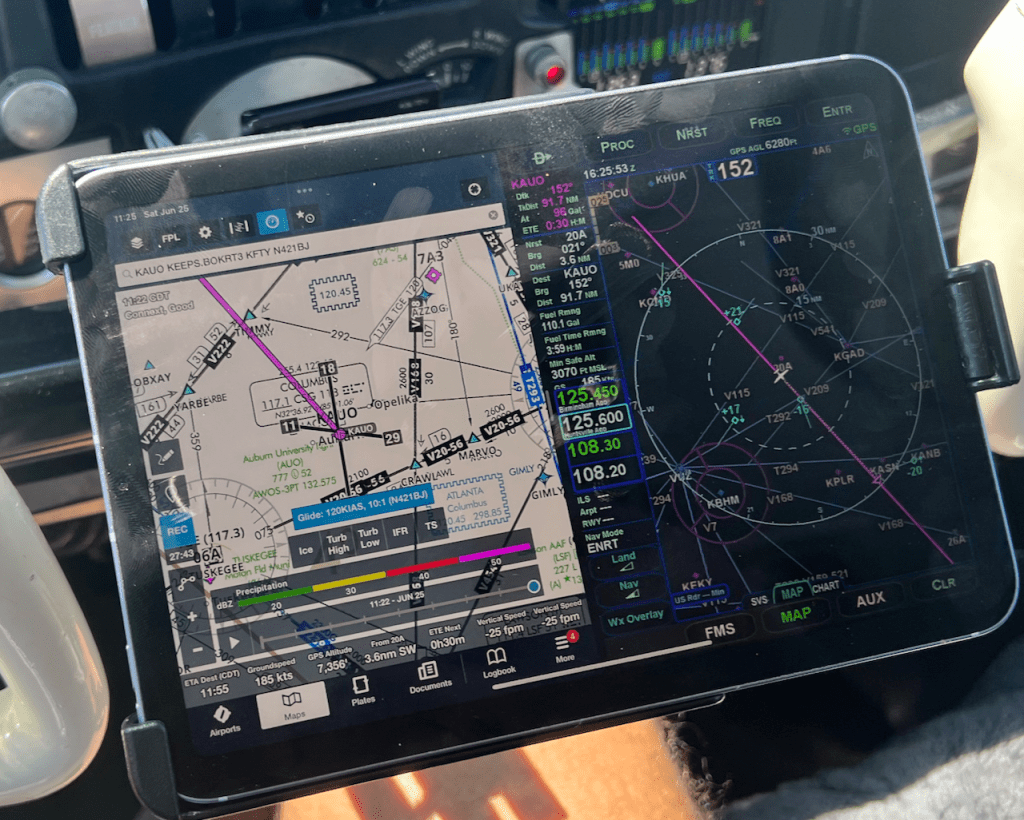
I don’t have onboard radar, but I do have onboard lightning detection. The combination of the FIS-B radar data, the onboard lightning detection, and my eyeball usually works pretty well to help me make tactical decisions. But eyeballs and sferics don’t do any good for long-distance planning. FIS-B has a lower-resolution radar feed that includes the entire continental US, but that’s also time-delayed. My electronic flight bag (EFB) app, ForeFlight, has higher-resolution radar layers available via the Internet, but that doesn’t help in flight… until now.

The first case was when I was flying back from Dallas for work. There were storms forecast for western Mississippi and northwestern Alabama, and it looked like I would, just maybe, beat them home. I wanted to have a plan in place in case I didn’t, though.

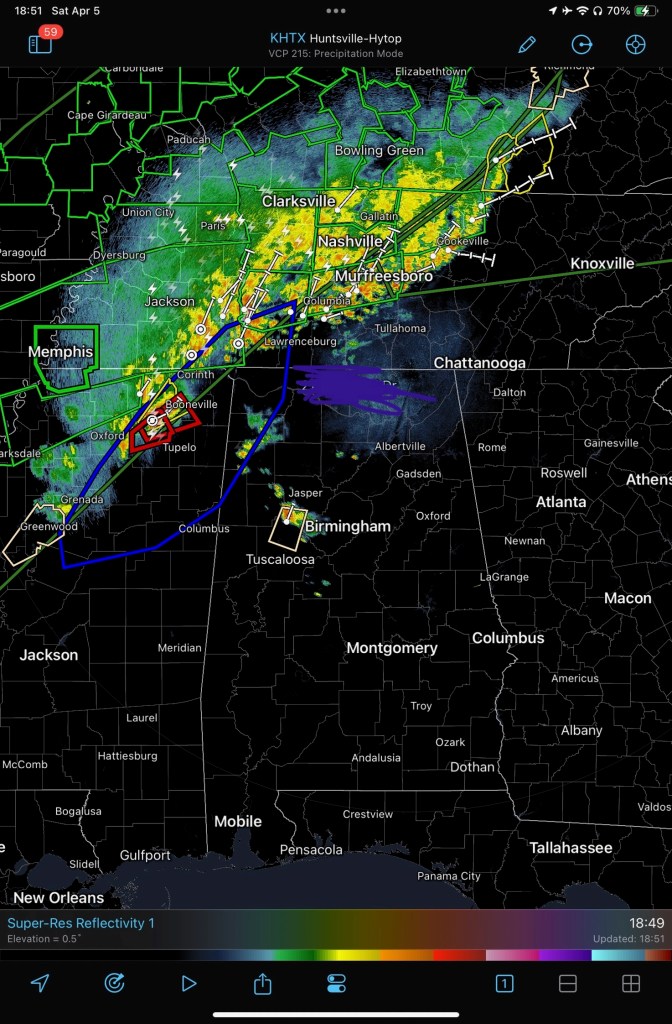
Enter Starlink. Here’s a sample screen shot from the RadarScope app, showing minimally-processed output from the WSR-88D at Hytop. This data is still not quite real time, but it’s much higher resolution than the FIS-B feed. RadarScope lets me see additional radar data types, not just reflectivity, so it’s much easier to figure out whether the radar returns actually represent a growing storm, a more benign area of rain, or a dangerous full-grown embedded thunderstorm cell. I pulled up RadarScope and was able to look at the radars across AL, MS, and TN to get an idea of what the storm line was doing. Then I swapped over to watch a Facebook Live broadcast by local meteorologist Brad Travis. He was predicting the storm arrival time, severity, and impact across the area west of Huntsville, exactly where I was going to be flying. The combination of updated radar data and a real-time review of that data by an expert told me it was time to land and wait the storm out. I diverted to the airport at Haleyville, waited about an hour in dry safety while the storm blew through, and had an uneventful return to Huntsville.

The second case was on a recent trip to visit my mom and sister in Galveston. The weather at Galveston had been gusty and cloudy thanks to two large low-pressure systems with a high trapped in between them. Here’s a comparison of what I saw from FIS-B versus what I saw in Foreflight radar data. First the ForeFlight image: there’s a storm cell to the upper-right of my flight path (past KBMT), and another off to the left, but no serious precipitation, and no storms, along my route of flight.

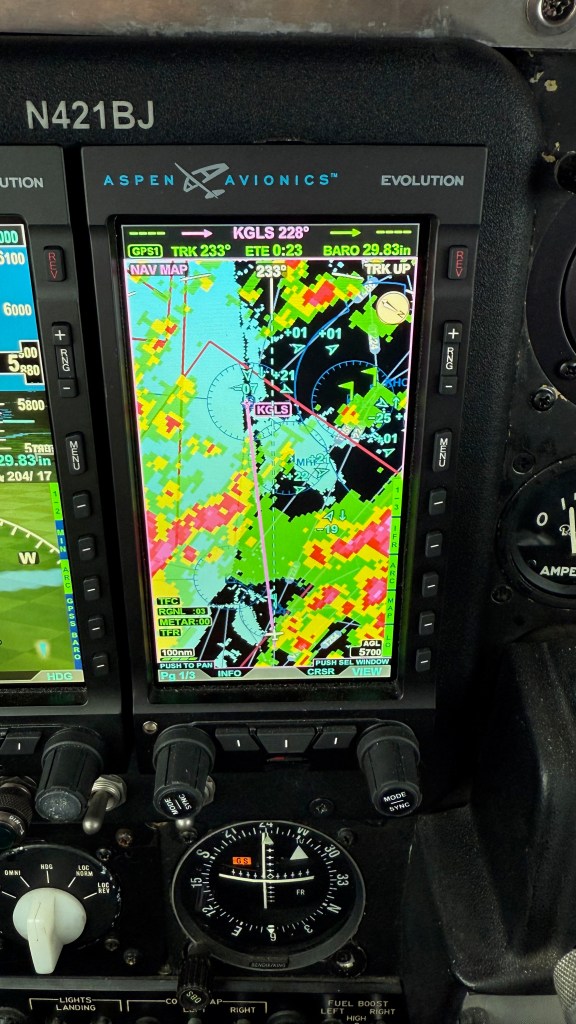
Compare that to what I was seeing from FIS-B. Some of the difference is one of scale (I had the Aspen display set to a 100nm scale, and it’s a physically smaller display). Some is due to the different resolution of the data. But the FF image made it obvious that I’d have good clearance from the storms to my southwest.

On the way home, I had the same problem; those two low-pressure areas were boiling up a 400-mile-long line of storms to my north. I planned to leave Galveston southbound and then turn east to fly along the lower edge of the Louisiana coast. Unfortunately, the weather at Lake Charles, and to the north, was terrible, so I ended up getting routed to Grand Isle. Here’s ForeFlight, showing the FIS-B data. You can see how much lightning there is in and around the straight-line path from Galveston to Huntsville.

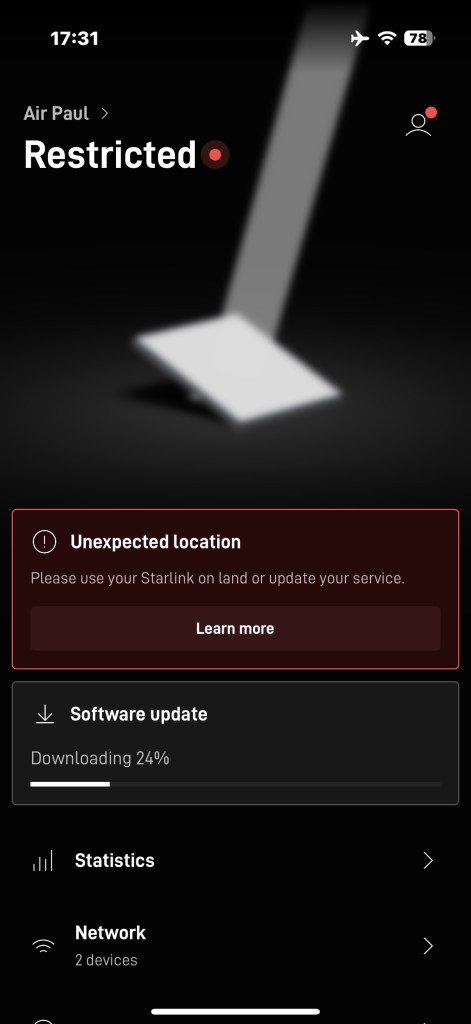
You might wonder why this image shows the FIS-B data. It turns out that the local priority plan for Starlink only works over land and in coastal waters and I was about 40 miles offshore, well outside the 12-mile coastal-water limit. I didn’t get service back until I was nearly to Grand Isle. In fairness, FIS-B is only available in CONUS too; for example, if you fly to Canada or the Bahamas, you won’t have FIS-B weather data.

Starlink complaining that I’m out over the water

There were a number of pop-up thunderstorms along my route; the easy availability of updated and timely radar data helped me proactively ask for route changes to stay well away from them.

I’m not even touching on the utility of being able to use the Internet in cruise flight. Running behind schedule? Call the FBO and tell them. Diverting for weather? Book a hotel at your new destination. Bored passengers? Let them watch Netflix. All of the same capabilities that make in-flight Internet so useful on commercial flights apply here too, but to me, the safety benefits of getting better-quality weather data, and more of it, and in less time, make Starlink a must-have.

Leave a comment

Filed under aviation

2024 year in review: flying

On the surface, by comparison with last year, this year was sort of mixed. I didn’t fly as many hours (110 vs 128 last year), and I didn’t go to as many interesting places. However, with that said, it was still a terrific year.

The biggest highlight was passing my commercial multi-engine check ride with FAA examiner Charles Welden. I was having lunch one day with my friend John Blevins, a fellow pilot and a great American, and he asked how my training was going. I told him I hadn’t had any luck lining up a multi-engine instructor who was a) qualified in my plane and b) available when I was. John chuckled and said he had me covered. He did, as he introduced me to Anand Iyer out of Atlanta. Anand is a Ph.D. candidate at Georgia Tech, a former NASA employee, and a terrific instructor. I spent two weekends flying and studying with him and then popped down to Shelby County to take my check ride. It was by no means easy, but it was doable. Mr. Welden was a personable and fair examiner and I’m looking forward to (spoiler alert) going back down to Shelby County to do my seaplane rating later in 2025.

While I didn’t travel as far north or south this year as I did last year, I still covered a fair bit of ground. I did day trips to Dallas and Houston for work; trips to Alexandria, New Orleans, Lexington, Savannah, Covington, Gainesville, St Augustine, and Panama City for fun; and Olive Branch, Newnan, Nashville, and Birmingham for Angel Flight missions. Bonus, I also flew to Starkville and Columbus a bunch for shuttling Anna back and forth. All told I flew a little under 17,000 miles.

Thankfully all the equipment and systems on the plane functioned pretty well this year. I had a couple of minor nits (like a flat inner tube on one main gear tire) but no real showstoppers. I think I had pretty close to a 100% dispatch rate, although I traveled so much for work that it’s sort of hard to tell.

One fun fact: I had a precautionary shutdown last year, the cause of which I thought was fixed at the January 2024 annual. I had to cage the engine again in May, on the way to visit my mom for Mother’s Day. My local shop did some troubleshooting and found that … I had shut down the good engine.

See, what had happened was…

The engine monitor I have in the plane has two cannon plugs on the back, one for the A/D converter for each engine. Apparently the last time the monitor was worked on, the plugs were cross-connected. So when I felt an odd vibration and saw unusual engine parameters for the left engine, it was actually showing me data for the right engine. When I shut down the left engine, it was actually the normal one. Big thanks to Andrew Yost of Revolution Flight for catching that little error. Once he got the plugs swapped into the correct positions, it got a lot easier to troubleshoot the source of the problem, a partially clogged fuel injector.

The biggest negative from a maintenance standpoint was the untimely death of my friend and mechanic, Jon Foote, in July. Jon took great care of me as a customer and of the airplanes he worked on, and I’ll miss him.

As I write this, the plane is down at Baker Aviation in New Smyrna Beach undergoing a comprehensive annual inspection, from which I hope I’ll emerge only a little poorer. Baker is a very-well-known Beechcraft speciality shop, and when I went there there were about two dozen Barons and Bonanzas either being worked on, waiting their turn, or waiting for pickup. I have a list of about a dozen squawks that I want them to address, time permitting– almost all small things like “replace the magnetic compass” or “adjust the microswitches for the landing-gear warning horn”. I think the flight controls, engines, and other major systems are all pretty solid, but I’ll know more once I get the preliminary report from them with borescope photos and so on.

They will also be sending oil samples to ALS for analysis of wear metals; by measuring the (hopefully microscopic!) amounts of various kinds of metal in the oil, it’s possible to analyze the wear trends and get early warning of some types of problems. It’s the same idea behind the regular bloodwork your doctor probably subjects you to: regular sampling builds a baseline for trend identification.

In 2025, my goals are to fly at least one Angel Flight mission per month; to go up to the FAA headquarters in Oklahoma City and do their aviation physiology training seminar; to fly myself to Oshkosh and the American Bonanza Society convention; and to get at least one additional rating or qualification. Onwards!

Leave a comment

Filed under aviation

2023 year in review: flying

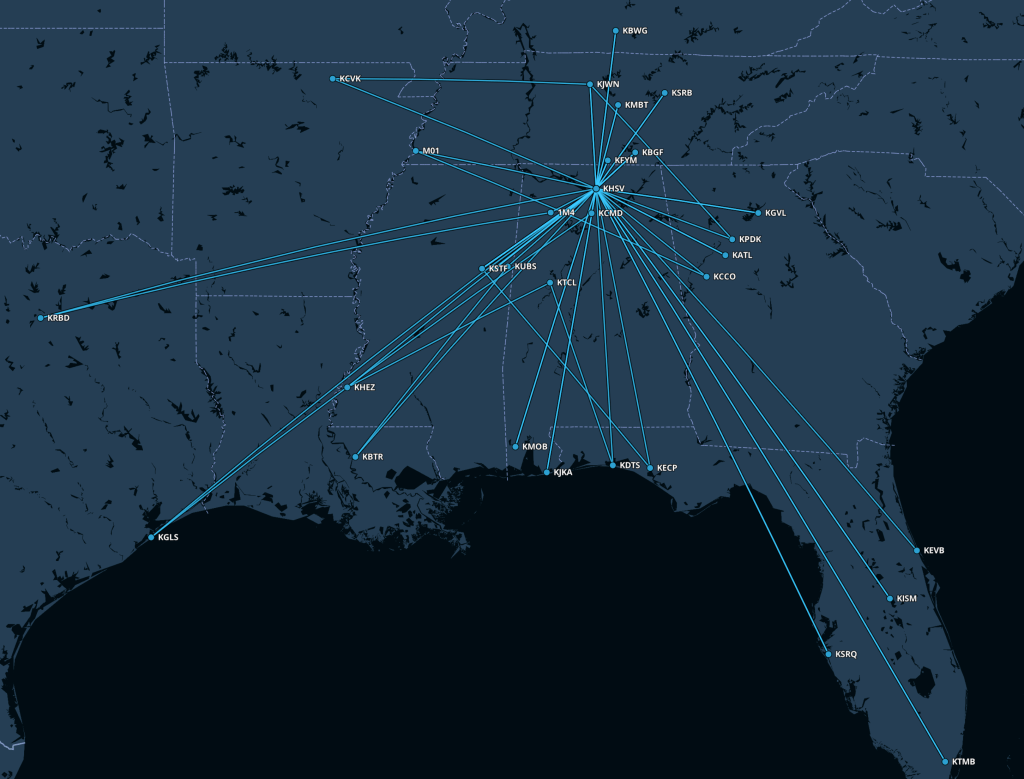
Let’s start with the high level: 128.7 hours flown, 12.9 of which were training hours flown with an instructor. 15 hours were in actual instrument conditions, and 10 hours were at night. Not bad, but could have been more. The map view is instructive too: I made it as far north as Montpelier, Vermont and as far west as Dallas, Texas.

Despite the modest number of hours, there were lots of things to highlight, both positive and negative.

My best trip of the year was, hands down, flying the girls to NYC, Niagara, and Vermont, including doing the Hudson River exclusion. It was an amazing trip, and one which wouldn’t have been at all possible without a personal airplane. Bonus points for flying into Teterboro and just missing Taylor Swift’s arrival.

In the same vein, the rapid-fire combination of going to New Orleans, rural Arkansas, and Alexandria, with returns home in between, made it possible to do a family photo shoot in New Orleans City Park, attend my cousin’s wedding, and go to my mom’s for Thanksgiving while still accomplishing all the other Thanksgiving-week things we had to do (including Erica’s departure for Romania. This was another set of trips that wouldn’t have been possible without a plane.

I made a renewed effort to get my commercial multi-engine rating, training for my commercial multi-engine rating with Brian Frederickson of Elon Aviation. I’m happy to count Brian among my friends– he’s a great guy and I learned an amazing amount from him. We hit a few obstacles along the way (more on that in a bit).

Finally, I was able to squeeze in a few desired and/or needed upgrades throughout the year. The biggest, both in time and cost, was adding two Aspen displays installed to provide redundancy in instrument flight. The safety and situational awareness improvements are significant, but it wasn’t cheap or easy.

What about the less-positive parts of the year? There were a few. I did have to miss a few trips due to maintenance, something I always hate. The plane was down for a new alternator for a couple of weeks (an adventure in itself– thanks to Tim Blount of Tim’s Aircraft Service in New Orleans for getting me fixed up!) and I had to cancel one planned checkride flight with Brian because of a broken flap bumper. The Aspen installation took an extra few weeks over the original estimate, which meant I missed a planned trip to Orlando and a couple of last-minute pop-up opportunities. The overall installation process was a bit of a mess, since my autopilot was down after the installation, meaning a lot of hand-flying back and forth for my November trips. I think it turned out OK in the end. I’ll do a longer post on the process, and what I learned, once I know for sure that everything is properly installed, but here’s a preview.

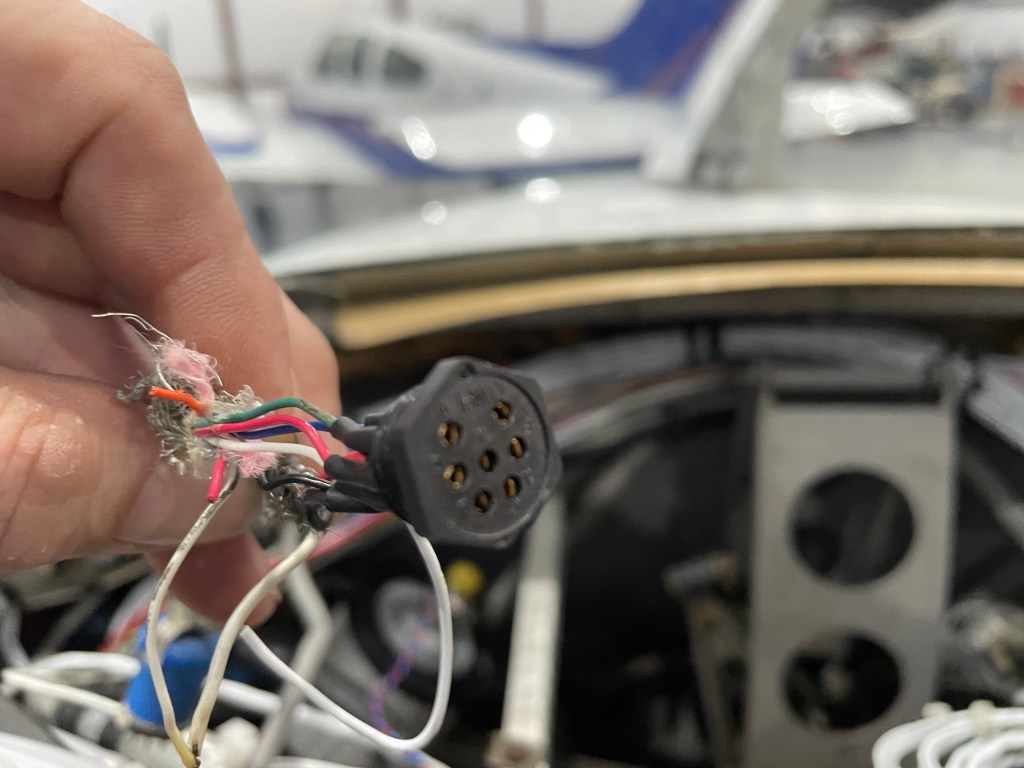
For those of you who aren’t avionics technicians, just know that the red wire shouldn’t be loose, there shouldn’t be any pink fuzz or silver shielding visible, and the whole thing looks like it was wired by a drunk one-eyed monkey wearing oven mitts. To be super clear, my shop didn’t do this; they fixed it when they found it in this condition.

The biggest aviation lowlight of the year was when I failed my oral exam for the commercial multi. I’ll be doing a longer post on the process of getting my multi once I take the actual checkride, but it’s fair to say that I didn’t adequately prepare for the oral exam and the examiner figured that out pretty quickly.

What did I learn this year? Well, let’s start with that oral exam. I learned I didn’t retain as much of the basic private-pilot-level knowledge about VFR charts and flight rules as I thought. In my partial defense, I don’t typically use that information when I’m blasting through the clouds on a cross-country flight, but that’s not an excuse. My first learning is therefore “I need to keep learning.” It’s trite, but it’s true.

Second learning: I know a lot more about the systems in my airplane as a result of doing some work on it myself and researching the maintenance issues I had this year. This knowledge is useful in troubleshooting, but also in getting the most out of the plane when I want to plan a trip.

Third learning: practicing emergency procedures is a must, as when I had my first real one-engine-inoperative (OEI) landing. The time I spent reviewing and practicing with Brian paid off big time. Knowing that I can be proficient with OEI flight, approaches, and landings is super important. I’ll be doing more of that kind of training in 2024.

Goals for 2024? Simple. Get my commercial multi; average at least one day trip down to Louisiana to see my mom each month; have a 95% dispatch rate for planned trips; continue to learn about and enjoy my Baron. Stretch goals are to attend some combination of Sun-n-Fun, the Beech Bash, and Oshkosh.

1 Comment

Filed under aviation

Flying Friday: my first precautionary engine shutdown

A couple of weeks ago, I had my first real in-flight engine shutdown, with a bonus declared emergency as a cherry on top. I wanted to write up what happened and what I learned from it. I have about 1300 hours of total flight time, about 200 of which is in this airplane, so I am experienced enough to know that I can always learn and do better. I posted the below account on BeechTalk, and am also sharing it here, in the spirit of learning from the experience, both for me and possibly for others.

The planned flight was from Huntsville (KHSV) to Newnan County (KCCO, about a 40-minute drive south of Atlanta-Hartsfield). That’s about 50 minutes of flying time. I wanted to drop the plane off at Oasis Aviation for an autopilot repair. Weather was excellent– clear, sunny, and light winds– but I filed an IFR flight plan anyway, mostly so I’d have ATC support in case I needed it. My friend and former airplane partner was going to pick me up there and fly me back home.

I took from KHSV normally, with the usual weird Huntsville-to-Atlanta routing (a radial off GAD, followed by another radial off RMG, thence direct), and climbed to my planned altitude of 5000′. I eventually got cleared direct KCCO, and everything was awesome until it wasn’t.

About 20min into the flight, I noticed a slight but persistent shaking from the left engine. I didn’t like it because it was new. Checking the engine monitor showed me that the cylinder head temperatures (CHT) on cylinders 4 and 6 was significantly lower than normal, which I also didn’t like. The CHT reflects how hot the engine is running; when the fuel/air mixture is properly set, my CHTs run anywhere from 280ºF to 340ºF, depending on the outside temperature.

I tried adjusting the fuel mixture, which didn’t make the vibration any better or worse, and I tried switching magnetos, which also did nothing. Each engine has a pair of magnetos, and each cylinder has two spark plugs, so switching magnetos to see if the temperature of any cylinder or exhaust changes can be a useful diagnostic tool for things like broken spark plugs, bad wiring connections on the plug wires, and so on.

I flew along for a few more minutes and then the exhaust gas temperature (EGT) on cylinder 6 started dropping significantly too, to the point where the engine monitor was squawking about the difference in EGT between the highest and lowest temperature. That told me that something more serious might be wrong.

At that point, my mind was made up: grab the checklist, flip to the “abnormal procedures” page, and run the “engine shutdown in flight” checklist. That much was a total non-event. The checklist itself is simple: you cut off the supply of fuel to the engine by retarding the mixture control, shut off the engine fuel valve, feather the propeller (so that it turns sideways, thus reducing drag), and turn off the magnetos.

With the left engine shut down, I slowed up to about 135kts and lost a couple of hundred feet, which I was able to gain back. I called Atlanta Center and told them I’d lost an engine. For some reason, they were having great difficulty hearing me and they got another plane to relay communications back and forth until I had time to switch radios, after which they heard me OK. They gave me a block altitude of 4000-5000′, which was handy.

Learning point #1: Because I was headed adjacent to the ATL class B, and didn’t do it on my own, ATC declared an emergency for me. I could have done so myself, but, as God is my witness, I didn’t feel like it was an actual emergency at that point– it was just an inconvenience. The other engine was running fine; the weather was good; there were other airports within easy distance. There’s a lot of misunderstanding about what happens when you declare an emergency to ATC, but, in brief, it gives the controller latitude to move other airplanes out of your way and give you whatever services you need to ensure the best possible outcome. I didn’t think I needed any of that, so I didn’t ask for it.

Many pilots, not including me, are worried that if they declare, the FAA will get all in their grills. More on that later.

In retrospect, what I should have done is declared earlier. (Cue the scene where Maverick’s getting chewed out in Top Gun: “WHAT YOU SHOULD HAVE DONE IS LAND THAT PLANE.”)

At first I planned to continue on to Newnan. I knew they have maintenance on the field, and it was only about another 20 minutes. I flew on for another 5 minutes or so, then the thought dawned on me: how stupid would I look explaining my decision to the NTSB after an incident? I noticed that West Georgia Regional Airport (KCTJ) was pretty much directly in front of me. So learning point #2: my first reaction should have been to head for the nearest airport instead of even considering continuing the flight. Yes, it was only another 20 minutes, but still.

As I was heading towards KCTJ, I decided to try restarting the engine. It started easily but was showing the same symptoms, so I shut it right back down again. This is learning point #3: I had no reason other than blind optimism to think that whatever was wrong had magically fixed itself. I wouldn’t have tried a restart if there had been any indications of problems with fuel or lubrication. In retrospect, I should’ve just left it shut down since the rule I was taught was always not to restart an engine unless you know, and have corrected, what was wrong with it.

Throughout, ATC was super helpful. I didn’t need vectors to the airport because I could see it clearly, and I was already aligned with the one runway there. In fact, because I was darn near on top of the approach end of 17 at KCTJ, I had to fly a teardrop pattern to slow down and lose some altitude. I made a rather good one-engine landing (which is a little more challenging than it sounds) and taxied to the ramp.

After landing, I secured the plane, went inside, and opened an AOG (“aircraft on ground”) ticket with Savvy.

Picture of a twin-engine airplane with the left engine visible. The propeller is feathered.
See how the propeller is turned sideways? That means it’s feathered. Much sadness.

Here’s what the engine data looked like. The EGTs are shown in the top graph, and the CHTs on the bottom. The big dip in the EGT cyan line just after 35min marks the shutdown; before that you can see the discrepancy in CHT (the purple and cyan lines on the bottom graph) and EGT.

graph showing exhaust gas and cylinder head temperatures. There's an unwanted big dip in both values.

Savvy quarterbacked having the on-field shop take a look at the engine. There were several possible causes for the symptoms I saw, but the most likely was something that blocked the flow of fuel to the cylinders. If you don’t put enough fuel in, the cylinder won’t generate as much power, or get as hot, as its peers. This leads to vibration and suspicious temperature readings. Other possible causes included a stuck exhaust valve (where exhaust leaks out when it’s not supposed to, reducing the cylinder’s ability to make power) or damage to the camshaft or pushrods that operate the valves. The shop cleaned the fuel injectors and did a visual inspection using a borescope to verify that the cylinders and valves were OK. I flew the plane on to Newnan and it worked flawlessly.

Then last week, I got a call from an aviation safety inspector at the FAA. Remember, I mentioned that FAA action is a common worry that leads pilots of small planes not to declare an emergency when they need to. The ASI was courteous and asked me for a short statement of what happened and a log entry from the shop that implemented the fix. I sent it to him and that was that.

2 Comments

Filed under aviation

Flying Friday: fall break at Niagara Falls

Every year, my wife’s daughters have a school break the first or second week of October. Last year, we’d planned their first visit to Canada, but work intervened and instead we all went to Denmark. Sorry, not sorry. This year, we’d planned a makeup trip to visit Niagara Falls, plus a side trip to Vermont to see my sister and her family. It ended up being a terrific trip that vividly demonstrated the value and utility of GA airplane travel.

Our parameters were pretty simple: we had from Saturday morning until Thursday evening, bookended by football games, to do whatever we were going to do. The Baron has about 5 hours flying range (including IFR reserves) but, for everyone’s comfort, I prefer a maximum stage length of about 3.5 hours. That meant a fuel stop somewhere in the mid-Atlantic region. We went through several iterations of plans, based on the availability and cost of lodging in Niagara and Montpelier, before we arrived at our final plans. For example, originally we wanted to fly up and stop overnight at the Flying W Airport to take advantage of their unique pool… but it closes for the season on Labor Day, and there’s no hotel there anyway. Here’s how the trip went.

Day 1: Huntsville to Hagerstown to Jersey City

Our first leg was easy: Huntsville to Hagerstown, 526nm in 3:17. The weather was clear and ATC sent us direct. We landed and parked at Rider Jet Center so we could have lunch at their restaurant, The Grille at Runways. In fact, we picked Hagerstown specifically because of this restaurant, and it lived up to expectations. I also bought a can of Prist glass cleaner, and I’m glad I did: it worked far better than Plexus, which is hard to find nowadays anyway.

Erica had booked us a room in Jersey City at a Hyatt that’s right on the Hudson River waterfront. I had been debating whether to fly into Linden or Teterboro. This was a fun planning exercise. The diagram below helps to illustrate why. Teterboro is in the upper-right corner; Linden is at the bottom left. Our hotel was right near the green flag labeled “CLOCK”– so from a ground transport perspective, either would do. Teterboro is much busier, but Linden is often more difficult to use because of its position next to Newark’s airspace. What finally decided me in favor of TEB was that their fuel was significantly cheaper. I filed and briefed to Teterboro while the Rider crew topped off the tanks and we took off.

I had filed a direct routing because I know the secret: in complex airspace, it doesn’t matter what you ask for in your flight plan. The FAA’s computers will spit out a route based on a bunch of factors, including letters of agreement between adjoining ATC fiefdoms, expected traffic, terrain, and weather, and you may end up flying a different route anyway (more on that later!) The route they assigned was actually KHGR SCAPE ETX FJC STW KTEB–we actually approached Teterboro from just north of the Essex County airport shown above. We ended up flying that route. Teterboro typically uses different runways for arrival and departure, so they were having all arrivals fly the ILS Z approach to runway 6.

Every little blue arrow is an airplane. Note how many of them are around the area we’re going to.

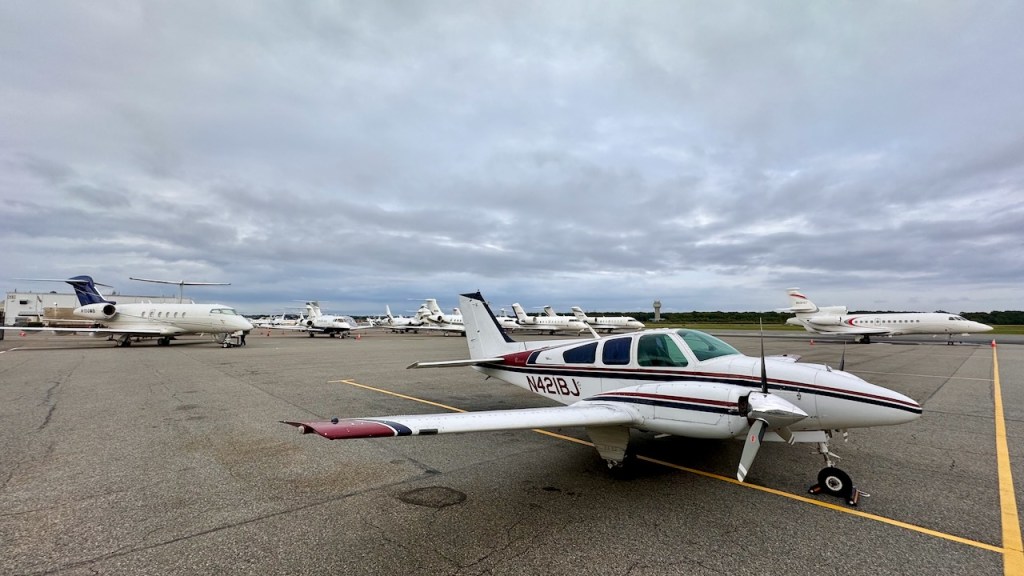
Although the NYC airspace is super busy and the controllers talk fast, the en route, arrival, and approach were all straightforward. We parked at Meridian, where I’d made us a reservation, and grabbed a Lyft to the hotel. I snapped a quick photo showing the hundreds of millions of dollars of business jets parked just on one side of us– my whole airplane costs less than the landing gear on that plane directly behind me.

The hotel was perfectly nice; by far the best thing about it was its location. As promised, it was right on the riverfront, with easy walking access to restaurants and a few shops. We dropped our bags off and went out to go wander around and explore.

view from the sidewalk outside our hotel
nighttime view across the river

We walked down to the Colgate clock, took a bunch of selfies and photos with the city in the background, and then went to bed.

Day 2: Teterboro to Niagara International

Erica had booked tickets for the pedestal tour at the Statue of Liberty, but with the threat of a government shutdown looming we decided to cancel the advance tickets to make sure we didn’t lose out. As it turned out, there weren’t any pedestal tickets available, so we settled for the standard tour of Ellis Island and the Statue of Liberty island. Both were fantastic– I thoroughly enjoyed Ellis Island and learned a great deal from the museum exhibits. (Example fun fact: between 1896 and 1924, there was 3x as much immigration to the US from Canada as from Mexico.)

We had a late lunch at the White Horse Tavern, then headed back to Teterboro, where sadly the airplane wasn’t ready as promised. There were three or four uniformed security guards milling around, and our suspicion was that they were there because Taylor Swift was due in town for the Jets-Chiefs game. Unfortunately we left before she got there. I wasn’t too sad, though, because I had planned to fly the Hudson River corridor on the way out.

The FAA has defined two routes that you can take to overfly the river (along with a required training course you have to do before you fly it!) The low route (“Hudson River exclusion”) doesn’t have air traffic control services, and it’s quite busy with sightseeing helicopters. The slightly higher route (“Skyline route”) keeps you in contact with ATC. You’re allowed to do either route, as long as you follow the rules. Because we were leaving Teterboro, which is in controlled airspace, the easiest arrangement was to depart Teterboro with VFR flight following, fly the Skyline route while talking to the various air traffic domains, and then pick up an IFR clearance for the flight to Niagara. I had planned for us to leave Teterboro to the north, fly to the Alpine Tower, and then follow the river south down to the bay, turn around, and fly north on the east bank of the river. I attached a GoPro to the tail tiedown to capture it, and that was a great decision– the video looks terrific. The segment below is midflight– just before overflying the Verrazzano bridge and making the turn in the bay.

Originally, I wanted us to fly to the St Catherine’s airport on the Canadian side of the falls. I got a US customs sticker and did all the CANPASS paperwork (pro tip: send the paperwork to the British Columbia office, they’ll turn it around in a couple of days) in anticipation, but then I found out that St. Catherine’s is a limited-service airport. No rental cars, no real Uber service, and no tie-downs. Reluctantly, I instead planned to go to Niagara Falls International (KIAG), which turned out to be a perfectly nice airport. I had filed an IFR plan from Newark to Niagara, which I activated once we were off the Hudson skyline route. 1.9 hours of flying time total got us there just as the sun was setting, then we picked up our rental car and headed across the border.

Days 3-4: Niagara Falls

Since this is Flying Friday, I’ll confine my recap of our time in Niagara to the real highlights: seeing the falls from Maid of the Mist, eating donuts and wonton soup at Country Fresh, doing the free walking tour at Niagara-On-the-Lake, and touring the Niagara Parks Power Station. By design, we completely avoided all the tourist-trap stuff on Clifton Hill. We did an all-day bus tour that included the boat trip, a visit to the Skylon Tower, and lunch at the (I am not making this up) Hungry Moose.

apparently this is one of the most-photographed sights in the Niagara region
the views from the Skylon Tower were breathtaking

One thing I didn’t do: overfly the falls. You have to be at or above 3500′, and there’s a steady procession of sightseeing traffic right at 3500′. I didn’t think the sight would be all that great, so we skipped it.

Day 5: Niagara to Montpelier

When it was time to go, we crossed back over to the US side, handed the keys to our rental car to the friendly FBO staff, and headed out. Remember earlier how I talked about how ATC will just assign you whatever they want to? I had originally filed a route that I thought would keep me out of the military operating areas (MOAs) along my route (those brown polygons in the map extract below). What did ATC clear me for? A direct route. As soon as Niagara Approach handed me off to the next sector, guess what I heard? “N421BJ, I have an amendment to your route…” We ended up flying up and over the MOAs, but the girls were all heads-down reading and fiddling with their phones, and we had a nice tailwind, so no one except me cared.

Montpelier is an interesting little airport. It’s sited in some fairly high terrain, and if the weather had been IMC I probably would have just flown into Burlington instead. As it was, I passed Burlington just as an F35 was arriving, and there was quite a bit of other traffic in the area, so Montpelier worked out really well. We parked, shut down, and took off with my sister for lunch and some sightseeing, including the Ben & Jerry’s factory tour. (For discussion another time: our hilariously weird AirBnb in Montpelier and the steady parade of tour buses carrying leaf peepers.)

Day 6: Montpelier to Latrobe to Huntsville

I posted on BeechTalk to ask for route suggestions, and a couple of people recommended stopping at Latrobe, PA to eat at DeNunzio’s, the restaurant there. So we did! Our first leg was about 3.1 hours with a noticeable headwind, but nice clear skies and no hassle from ATC. After landing, we walked over to the restaurant and, reader, let me tell you: it was fantastic. I had the lasagna, and it was more than I could finish– which is pretty rare. The airplane and pax were both full, so off we went back into the headwinds, with increasing cloud coverage. The leg home took a little over 3 hours; we landed, unloaded, and gratefully made our way home to see the dogs.

Summary

This trip is a terrific example of how well GA can work for travel. It would have been both expensive and inconvenient to do a similar itinerary by commercial air, and I don’t even want to think about the hassle (and exhaustion) incumbent on driving a trip like this. In the end, I logged 14.2 hours total. I didn’t total up my fuel costs (which is a good thing; avgas is significantly more expensive in the northeastern US than it is where I usually fly), but I’d guesstimate it was probably about $1500. For that price, maybe I could have gotten us all to and from NYC. I’ll call this one a win, and I’m already looking forward to our next trip.

1 Comment

Filed under aviation, Travel

Flying Friday: A visit to RAM

I’m going to start this post with an apology: I should have taken about a million pictures, and now I’m sorry I didn’t. Now, on to the good stuff.

RAM Aircraft is really well known in the airplane engine aftermarket. They make engine parts (under what the FAA calls “PMA,” or “parts manufacturing approval“), including entire crankcases, and they have a very well-earned reputation for high-quality engine builds and overhauls. They sell a variety of upgrades for different aircraft, sadly not including my model of Baron, and they’ve been in the business since 1976, which is pretty rare in the aviation market.

They’re also a service center, and one of the things they do is what they call a “service check.” Think of the service check like the 14-point service that your local oil-change place does when you bring your car in; RAM’s service check includes an oil and filter change (including cutting the filter open to look for contamination or metal residue caused by unusual engine wear), but it goes well beyond that. They remove and clean the spark plugs, check the engine cylinder compressions, remove and clean the fuel injectors, adjust the fuel metering system to factory specs, test the intake and exhaust system for leaks, and wash the engine. If you bring in a twin-engine plane, they do all that twice… and, of course, they can fix any problems they find.

RAM were generous enough to donate a couple of gift certificates for service checks to the American Bonanza Society. I saw one for sale on BeechTalk and that sparked an idea: RAM is in Waco, Waco is near Dallas, I needed to be in Dallas for work, and I needed an oil change. What a happy chain of circumstances! I called RAM to schedule a service visit for when I needed to be in Dallas, bought the certificate and planned my trip: I’d fly the plane to Waco on Monday, drive back to Dallas for my meetings, and then pick the plane up on Thursday.

My flight to Waco was perfectly uneventful but hotter than blazes– it was 104º when I landed, and even at 3000′ it was still above 90º. In my particular airplane, temperatures above 90º on the ground call for a few differences in takeoff procedure, and climb performance (especially on one engine!) is significantly reduced, so I had to bear both of those in mind.

I landed and taxied over to the RAM ramp, and after a short wait John Sartor, RAM’s customer service manager, came out to meet me.

My personal opinion: you will never meet a more friendly or pleasant person in the aviation industry than John. He immediately made me feel like an honored customer even though he’d just met me 5 minutes before. After a short verification of what work RAM was going to do, we went out for me to show him my plane only to find that it had already been towed into the RAM hangar. That was a foretaste of how efficient their operation is! After verifying that he had the keys and access to the plane, he drove me to the Texas Aero FBO so I could pick up my rental car and I was off to Dallas.

The next morning, John called about 815a. I first though “oh no, something’s wrong”… but no, he was calling to tell me they’d already drained the oil and wanted to verify what oil I wanted to use. Efficiency again!

A later call brought the slightly unwelcome news that some of my spark plugs were worn to the point where the RAM QA department wouldn’t sign them off as airworthy. Aviation spark plugs are very similar in design to the ones in your car, lawn mower, boat, etc., but because piston aviation engines use leaded fuel, the plugs can foul faster, and over time the electrodes can wear. The electrodes on a few plugs were worn past their limits. A less conservative shop would have put the plugs back in and said “hey, you should change these,” but the good news is that RAM had the plugs in stock and changing them had zero labor cost.

Thursday morning John texted me to say the plane was ready, so after work I drove back to Waco (stopping at In-n-Out on the way, since I’d missed lunch). When I got there, he was kind enough to give me a 90-minute tour of their entire facility. The tour started in the lobby, where they have cutaway models of three engines with all the rotating parts intact. Turn the prop, and you can see the crankshaft turn, the movement of cylinders, camshafts, and valves, plus movement of the oil pump, turbocharger, alternator, and other accessories. The machinework on the models is amazing, and it was really fascinating to see the parts of the engine I don’t normally see.

We then made the rounds: the order and processing department, accounting (where I paid my bill, yikes), and the various assembly, test, and disassembly areas. The most junior RAM engine builder I met had been there 9 years. The most senior had been there 34 years! The shop spaces were meticulously organized and clean; the parts and tools were clearly labeled to keep the right things in the right places, and overall the impression I got was of a smooth-flowing workplace where people are expected to take time to do the work properly and to spec.

Each rebuild starts as a cart full of parts, so when the builder starts work, all of the components required for that particular engine are already together. There are a number of interesting touches to the build process, including custom-made carts that let them roll the engine from the build area into the (small, scary) elevator to take it down to the test cells. Those were cool too– in the cells, they do the engine break-ins for you, using a water dynamometer instead of a propeller or “club”. When the engine arrives it’s ready to be installed and flown, with no further break-in required. Considering that properly breaking in a new engine is a tricky process, this is a valuable addition. At the end of the process, there’s a hallway full of beautifully painted, perfectly clean, freshly rebuilt engines ready to go back into service.

I hated to leave, because I could’ve poked around all day asking questions and generally being a nuisance, but it was already after 5pm and I didn’t want to be that guy. I shook John’s hand, preflighted the plane (which had been fueled by Texas Aero while I was on tour), and blasted off for home. As one does, I kept a hawk eye on the engine parameters but they were refreshingly normal, and I landed about a half-hour after a beautiful sunset and went home happily.

Summary: if RAM rebuilt the kind of engines my plane has, I’d use them; if they support your engine type, you should take a very close look at them for repair / rebuild services. They do good work and they’re good people.

Leave a comment

Filed under aviation

Flying Friday: Carmen goes to the doctor

A couple of weeks ago I dropped Carmen off at the airplane doctor for an annual inspection. “What’s that?” said no one. Well, I’ll tell you what it is, since you didn’t ask…

The FAA requires regular inspections of most airplanes. That sounds vague, but the truth is that the requirement varies according to what the airplane is used for, whether it’s an experimental or amateur-built (E/AB) airplane, and so on. For my purposes the FAA regulation that applies is FAR 91.409:

…no person may operate an aircraft unless, within the preceding 12 calendar months, it has had (1) An annual inspection in accordance with part 43 of this chapter and has been approved for return to service by a person authorized by § 43.7 of this chapter

That seems straightforward enough. Back in February, I hired a mechanic in California to perform what’s commonly called a “pre-purchase inspection”, and then I had the excellent experience of taking Carmen to one of the service clinics sponsored by the American Bonanza Society, where master mechanic Wayne Whittington did a very thorough checkout using the ABS clinc checklist. However, neither of these are considered to be an “inspection in accordance with part 43,” as the FAA says above.

FAR part 43 annual inspections are required every 12 calendar months; the last one on this plane was done 4 November 2021, so a new one is required before 30 November 2022– you get until the end of the month when the last annual was signed off. It’s bad to let a plane go “out of annual,” because legally it is considered unairworthy and can’t be flown without a special permit at that point. It’s easier and cheaper just to make sure that doesn’t happen.

One part of the annual ritual of inspection prep is to make a comprehensive list of all the things you might want to have the mechanic inspect, fix, or change. This is just a starting point, because more often than not a thorough inspection by a trained professional will find things that the pilot’s missed. Here’s the list I gave to Jon, with my notes to you in italics:

  1. Annual inspection per the Beech maintenance manual (this manual is what FAR part 43 says you have to use to make the annual legal)
  2. 3 common items that seem to have been done each preceding annual. (I didn’t check to see if these were in the manual or not)
    • Check and service unfeathering accumulators (these accumulators are small tanks of nitrogen that apply pressure on demand to push the propeller out of its “feathered” position)
    • Check and service shimmy dampener (think of this dampener like a horizontal shock absorber mounted on the nose gear to keep it from wobbling)
    • Borescope inspection of all cylinders
    • Compression test of all cylinders. (If any are low, we’ll talk about whether to replace the cylinder or try another way to fix the underlying problem, depending on whether it’s the rings, the intake valve, or the exhaust valve)
  3. Fix a small crack in the skin of left aileron. (Although this sounds scary, it’s not; the crack is in a little piece of cosmetic metal that sits over a bracket to hide it, not part of the structure of the aileron)
  4. Replace the instrument air filter (this filter keeps crap from the carbon vanes of the vacuum pump from getting into the vacuum-driven flight instruments)
  5. Verify compliance with AD 2007-08-08 and AD 91-17-01 (more on this below)
  6. Oil change both engines 
  7. Replace main tires 
  8. Service brakes, using new pads; replace discs if necessary 
  9. Replace fuel cap O-rings (each fuel cap has two O-rings to help seal it, and these wear out over time)
  10. Install fluorosilicone washers on 2 main tank fuel caps
  11. Check front seat inertial reels; fix if needed (the pilot side seems awfully slack)
  12. Fix socket/bulb/wiring of leftmost glareshield panel light
  13. Fix “hitch” in electric trim in “Down” mode—it is binding or hanging. “Up” mode works OK, manual trim in both directions works ok.

A good mechanic will help you identify things that are legitimate airworthiness or safety issues and prioritize those. In the above list, probably the most safety-critical item is the seat belt reels– the accumulators, dampener, oil change, air filter, and so on all need to be done eventually. I’m thankful that the prior owners maintained Carmen to such a high standard so there aren’t any known lurking horrors– but Jon may find some, which is the whole point of doing annual inspections.

One key part of the annual is that the mechanic will verify compliance with airworthiness directives, or ADs. These are important maintenance actions that must be complied with– for example, AD 2007-08-08 requires periodic inspection of a part that locks the landing gear in the “up” position to ensure that it will work properly when needed. This inspection must be done every 100 hours; there are other ADs that must be performed periodically, so Jon will check all of the ADs that apply to this plane (and its engines, and propellers) and make sure that they’re complied with.

I also decided to have the propellers overhauled. The manufacturer recommends that these particular props be overhauled every 6 years or 2400 hours. These props were installed in 2008 and have close to 2400 hours on them, so it’s time– but, as with engines, the “time between overhaul” (TBO) is a recommendation– for ordinary general aviation operations under part 91, owners aren’t required to observe that TBO. It’s legal for me to keep flying engines and propellers as far past TBO as I want to. With engines, you can do compression checks, borescope inspections, and oil analysis to get a good idea of the engine’s health– but with propellers, you can only see the visible parts of the prop, and that’s it. There’s no good way to non-destructively inspect the propeller’s components, other than the blades. That’s because the propeller hub isn’t visible when the propeller’s mounted, not to mention that it contains a bunch of seals, springs, and other parts. That’s because this plane uses constant-speed propellers, where the propeller governor changes the blade pitch so that the propeller maintains the commanded RPM even as the engine power changes. (For more on how constant-speed propellers work, this explainer is pretty good). With all that in mind, I decided to go ahead and have the props overhauled since the plane would be down The overhaul process can take a while– the shop I chose, First Flight Propellers in Mississippi, is currently estimating about 4 weeks. This seems like a long time, but the overhaul process is quite involved, plus once the overhaul’s done I’m good for another 6+ years.

Once the propellers have been overhauled, Jon will reinstall them, run the engines for a leak check and general test, Then I’ll pick the plane up when the weather is good and do a test flight of at least 30 minutes, staying in the vicinity of the airport just in case something is amiss. Assuming that goes well, I’ll fly Carmen back to the hangar and enjoy another year of being in compliance with 91.409. I’m looking forward to it!

Leave a comment

Filed under aviation

So I got a new engine cylinder

As I was working on another post, it dawned on me that I hadn’t finished the story of why I didn’t fly to the Bahamas. As you might recall, in that post I talked about how the ABS service clinic found an anomaly in the cylinder, one that my local mechanic thought was no big deal. To be cautious, I sent the cylinder back to Superior for them to look at it. Then I promptly forgot about it, because I was busy flying to Asheville, Dallas, New Orleans, Atlanta, Auburn, Memphis, and Augusta before I bothered to ask Superior for an update. Turns out the cylinder lining was in fact cracked, but on the inside where the crack wasn’t visible. My precautionary cylinder change turned out to be a necessity, one which saved me the potential for an unpleasant in-flight event and a bunch of additional costs driven by one bad cylinder trying to turn the whole engine into junk.

I noticed that after the cylinder repair, the right engine was leaking small amounts of oil. North Alabama Aviation couldn’t be bothered to try to fix it, so I had Revolution Flight take a look and they identified it as an upside-down gasket installed on the rocker arm cover. This is exactly the kind of small but infuriating maintenance error that every pilot has to learn to deal with. While I could have flown the plane over to Decatur and stormed into the shop to demand that they fix it, I decided instead to write this short note to memorialize their poor performance (along with the ridiculously long time it took them to do the repair in the first place) in hope that future generations will see it when they’re shopping for a maintenance shop.

Back to cylinders. For many engine types, having a cylinder replaced is super common. For example, the large turbocharged TIO-540 used in many models of the Piper Malibu is notorious for requiring frequent cylinder changes because of the operating conditions: the engine’s crammed into a small space with marginal cooling, then operated at high altitudes where turbocharging is used, which increases the heat and pressure regime that the cylinders run under. It’s less common to have to replace them on the normally-aspirated IO-470 engines that my Baron uses, but it’s not uncommon. So far, since the two engines were installed, there have been 3 cylinder changes (out of 12 cylinders total): this cracked one in 2022 and two others back in 2013 or so due to low engine compression. That’s not too bad.

Maybe that’s a good topic for a future post: why cylinders get low compression in the first place, and what you can do about it. Hold that thought…

Leave a comment

Filed under aviation

Flying Friday: the one with thunderstorms

I lived in the Bay Area for about five years. Among the many weird things I experienced there, one that particularly sticks with me is the way people acted when we got a thunderstorm. They’re quite rare in that part of the country and the arrival of even faint thunder was considered quite an event.

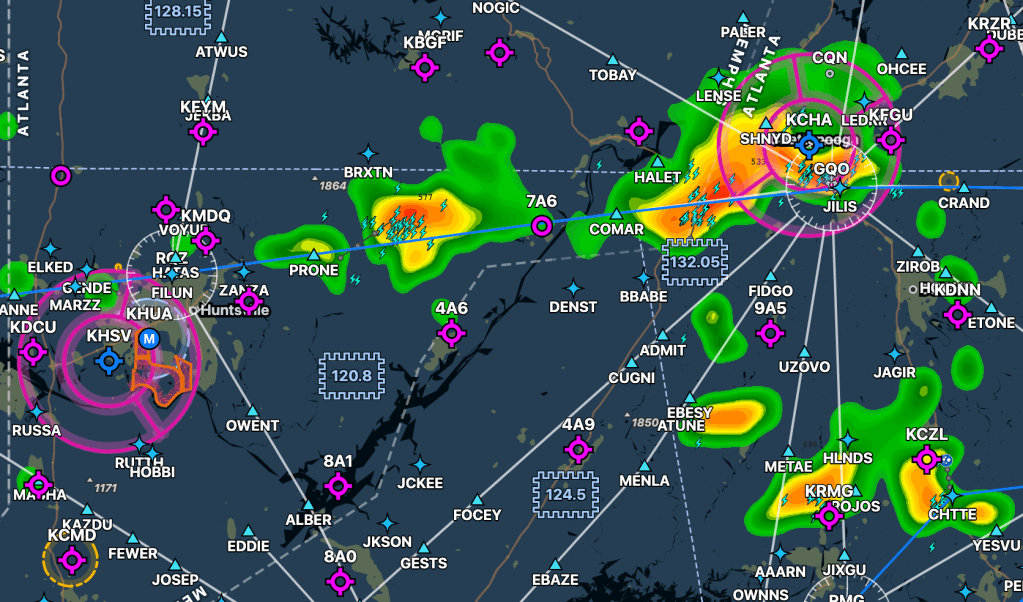
Of course, here in the southeastern US, thunderstorms are as common as pickup trucks, especially in the spring and summer. As I write this, here’s what the airspace near me looks like. When I look out my window, there are plenty of building cumulus clouds, but the real action is off towards Chattanooga.

It’s not necessarily intrinsically harmful to fly into, through, or under falling rain or snow. (Hail isn’t great, though!) However, when rain falls, it displaces air, and the result is that you get updrafts and downdrafts. Those can be harmful. In fact, the common rule of thumb is to avoid flying within 20 nautical miles of the boundary of a thunderstorm (like the one just northeast of the PRONE intersection above). That’s because, in the FAA’s words, “All thunderstorms have conditions that are a hazard to aviation. These hazards occur in numerous combinations. While not every thunderstorm contains all hazards, it is not possible to visually determine which hazards a thunderstorm contains.”

Notice that I was careful to use the word “thunderstorm” and not “rainstorm” or “rain cloud” in the preceding paragraph. That’s the crux of the problem: your eyeball alone can’t tell the difference. Thankfully, we have radar, which is where the image above comes from. There’s lots to say about modern weather radar, and all the modes and capabilities it has, but the best way to think about it from an aviation perspective is that it can show you two important things: is there precipitation in the area you’re going towards, and what are the winds doing?

If you shoot a beam of radar energy into a cloud, some will be absorbed, some will scatter off in various directions, and some will be reflected back to the receiving antenna. By magic, it’s possible to figure out quite a few things about a storm cell based on this reflection and a few other parameters, like the tilt of the antenna. For example, if you look at the Doppler shift of the returned reflections, that tells you something about the relative movement of air and water masses in the beam, which you can use to figure out which way the storm’s moving and, oh yeah, if it is showing signs consistent with the formation of tornadoes.

Anyway, enough about that. What I wanted to talk about today is something radar can’t tell you.

Before I get into that, though, I should spill a dirty little secret. Most of us don’t even have radar in our planes. The FAA broadcasts radar images through a ground-to-air datalink system known as FIS-B. This is worlds better than not having any radar imagery in the cockpit, but it’s super important to know that it’s not a real-time picture. FIS-B datalink images can be up to 15 minutes delayed, which means that they show you where the weather was. That means that what you see out the window is king, not what your FIS-B receiver shows. This is extra true because what the FIS-B radar shows you is a composite picture that tells you there’s precipitation (and if so, roughly how much). It doesn’t tell you at what altitude the cloud based or tops are, how much precipitation is reaching the ground, or much else of use.

With these limitations in mind, you can’t depend on ground-based weather data to distinguish between a rain shower and a giant thunderstorm, the more so because that ground-based data won’t show you where there’s lightning.

In the image above, you can see little blue lightning icons. Each one indicates a lightning strike picked up by what is basically a bare-bones radio receiver– lightning strikes make a hell of a lot of radio-frequency noise (as any AM radio listener can tell you). This noise is in the form of radio waves called sferics. With the right receiver you can pick those sferics up and triangulate their source– even better, you can do that in flight and get accurate, instantaneous real-time lightning data.

Why do you need to know where the lightning is? Because that’s where the thunderstorms are. Thunderstorms can have lightning (duh), extreme turbulence, hail, wind shear, and/or icing– and the only one of these that is easily detected from a distance is lightning. So it’s a pretty good proxy: you won’t ever see lightning if there’s no thunderstorm.

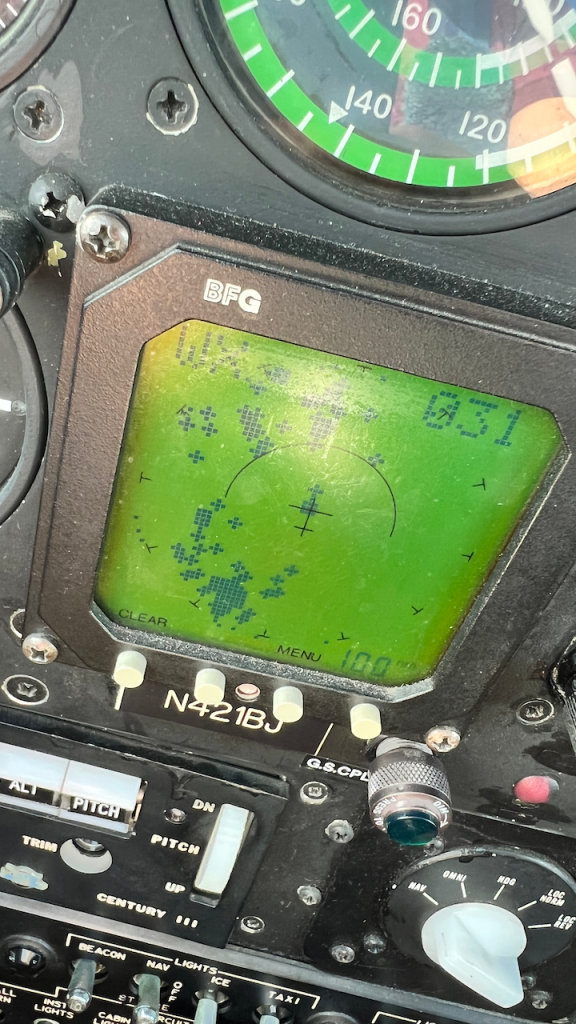
The picture above shows a live display from a recent flight I took from Decatur to Auburn. Each one of those little crosses is a lightning strike. It doesn’t take a Ph.D. to figure out that the more little crosses there are in an area, the less you want to be there. This screen is from a BFGoodrich (yes, them) Stormscope, which is basically this small LCD screen, a small box with a primitive computer in it, and a small array of antennas inside a flat enclosure on the outside of the airplane. The antennas pick up sferics, the computer estimates distance and bearing, and the screen shows you a +. There are newer, fancier models than this– mine was made in 1991– but they all work essentially the same way. In this case, I get a real-time, 360° view of lightning activity at up to a 100-nautical-mile radius, which is pretty great.

Compare what you see on the Stormscope view above with what the FIS-B picture looked like, below. On the bottom display (which is set to “track up”– so that the airplane’s southerly track is towards the top of the display) you can see a bunch of awful-looking red and yellow. I took these pictures a few minutes apart, so they don’t line up precisely, but they’re close enough to get the point across.

Of course, the best solution would be to have real-time in-flight radar and lightning data and ground-based FIS-B. Why?

  • Radar shows you what’s in front of you now, with good resolution and detail
  • A Stormscope shows you whether is lightning (and therefore, thunderstorms) embedded in the clouds you see via eyeball or radar
  • FIS-B feeds can show you radar imagery from the area where you are (including beyond immediate radar range), or over all of the continental US, which is really handy when you want to look ahead towards your destination.

Remember that earlier I said lightning is a good proxy for the presence of thunderstorms. The absence of lightning doesn’t mean you’re good to go, though. You can still have a thunderstorm with no lightning. That’s why a Stormscope alone isn’t enough to keep you out of trouble.

I don’t yet have radar, although this airplane did at one time and still has a good-condition nose radome. Until I equip a radar (which, let’s be honest, probably won’t ever happen), having the Stormscope along makes it much easier to decipher what’s happening in those clouds so I can give them an appropriate berth.

Thunderstorms are a hell of a lot more fun to watch from the ground than to fly through.

Leave a comment

Filed under aviation

Flying Friday: the one where I didn’t fly to the Bahamas

Some of you may remember two previous articles here: one about dispatch reliability and one about piston engines. If you like, you can consider this one to be titled “on aircraft piston engines, part 3”

One of the best reasons to buy an airplane is to use it to go places. In my case, a big part of the reason for buying a twin was so I could comfortably fly over water, mountains, and other places where a single-engine plane might leave me as an involuntary glider pilot. Not long after I bought Carmen, I started roughing out plans to fly to the Bahamas with Erica, since neither of us had been and there are many out-islands with small airports to visit. Unfortunately, then I made a critical mistake.

See, what had happened was…

The American Bonanza Society is the largest national club for owners of Beech aircraft, including Barons. I could go on for pages about how valuable their magazine and tech support forums have been, but I’ll ask that you take it as stipulated. One of the services they offer is the ABS service clinic, a comprehensive review of an airplane hosted by a master mechanic with long Beech experience. For another post, I’ll talk about the details, but for now, let me just say I was blown away by how much Wayne Whittington taught me in a 90-minute exploration of the guts of my airplane. One of the bonus services included in the clinic is a borescope inspection, performed by a technician from Continental Motors, the company that makes the engines.. This inspection is conceptually simple: you pull out a spark plug, stick a borescope inside, take some pictures, and then examine them looking for signs of badness. These signs might indicate damaged, sticking, or fouled intake and/or exhaust valves, corrosion, space aliens, rude graffiti, and so on. There’s lots of lore concerning how to interpret these pictures and signs. In my case, the examination found this:

This is a thing you do not want to see in your engine

“What is that?” you ask. Well, to the inspector, it looked like a crack in the plating of the cylinder barrel. That brown discoloration is a little unusual but not in itself a bad sign, but a crack in the plating is bad because it might allow part of the plating to break loose and go ricocheting around the engine. Armed with that picture, I ordered a replacement cylinder and made plans to take the plane up to Winchester to let Jon Foote work on it.

A quick digression. Continental makes engines, including the IO-470-L engines on this plane. But these particular engines were built by a gentleman named Bill Cunningham at PowerMasters. He used stock Continental parts to start with but added some other, better parts along the way, including Millenium cylinders from Superior Air Parts. See, one design feature of most piston aircraft engines is that the cylinders aren’t cast into a single block– they bolt on individually and can thus be repaired or replaced individually.

Anyway, I emailed Bill, who said that he hadn’t seen a similar defect and that he would definitely replace the cylinder. For fun, I decided to ask Superior, the cylinder manufacturer, if they wanted to have a look at the cylinder once it was pulled. The gentleman I spoke to there, who owns their QA team and has been manufacturing parts for aircraft engines for nearly 40 years, said he definitely would like to see it and that he definitely wouldn’t fly the cylinder in that condition.

Instead of going to Winchester, I had the cylinder diverted from Winchester to Decatur and dropped the plane off at the local shop. This caused a double-barreled delay: first UPS took a solid week to change the delivery address on the cylinder, then the shop, which is shorthanded just like every other aviation shop on this blessed blue planet, had to fit me into their complicated schedule. I begrudgingly booked tickets on Delta to Nassau. (More on that later.)

The truth is revealed

Finally, the day before we were supposed to leave, the mechanic called. “I pulled that cylinder,” he said. “That’s not a crack or a scratch; it’s just a tooling mark.”

Silence.

“Wait,” I said. “You mean that there’s nothing wrong with it?”

“Nope,” he said cheerfully. “Want me to put it back on?”

Reader, I did want that very much. But in the interest of aviation safety, I decided to put the new cylinder on instead. These engines have been around a while, and I didn’t see the value in putting the old one back on when I already had a new one handy. There’s a degree of risk any time you remove a cylinder, but that ship had already sailed, so overall it was less risky to put the new one on instead, especially because I did want the manufacturer to check out that beauty mark.

Then we went to the Bahamas. Amazing trip, about which more another day. I was a little sad each time I saw the empty apron at Staniel Cay, where my Baron would have fit perfectly, but that didn’t diminish my enjoyment of the trip. What most certainly did diminish it was when Delta cancelled our return flight, then booked us onto another flight that got us home about 1am on Monday morning, 6 hours later than scheduled.

Anyway. later that same Monday morning I texted the mechanic. One of the bushings on the rocker arm for that cylinder was worn and needed to be replaced, so they were waiting on a part which was hopefully going to arrive “early this week.” By the time I got to the airport about 1130 to drop off some oil filters so they could change the oil, the new part had arrived and was installed. By Tuesday afternoon, they’d done a thorough ground run and leak check, and it was time for me to go fly it.

Breaking it in

A brand-new cylinder has to be broken in. The piston rings and the cylinder lining will of course rub against each other; at a microscopic level, you want there to be a nice cross-hatched pattern that allows some oil to lubricate the cylinder-ring interface. so the goal of the break-in procedure is to accelerate this process so that the rings form a tight seal against the cylinder wall. It’s important to keep the cylinder temperature high, but not too high. Superior has a detailed procedure for this, which I followed religiously.

(You might wonder why you don’t have to break in car engines. Fair question– which this article about cylinder finishes helps answer. tl;dr the car engine already has the right finish machined in from the start.)

I flew a break-in flight, following Superior’s recommendation to the letter, in the form of a big triangle: Decatur to Monroe County (KY) to Clarksville (TN), ending up at Thom Duncan Avionics in Fayetteville. They put in a new Avidyne IFD440, which was an adventure in itself, and then I flew home again.

What I learned

I still would much rather have flown myself to the Bahamas, and I hate having spent money replacing a part that, by all appearances, was still serviceable. However, when the guy who built the engine and the engine manufacturer and the cylinder manufacturer all say “I wouldn’t fly that” I am certainly not going to argue with them. I’d make the same decision again today if faced with the same facts. Insh’allah, this cylinder will last for many more years.

The old cylinder has gone back to the factory for inspection. When they’re done with it, I plan to have them overhaul it so I can keep it as a spare; lead times on new factory cylinders can be 4+ months so it’ll be good to have an extra on hand. No word on them quite yet what’s wrong with it.

In the meantime

A postscript: as I mentioned, I finally did make it to Thom Duncan Avionics for a bit of an upgrade. We replaced one of the two ancient Garmin GNS430Ws with a shiny Avidyne IFD440, the smaller sibling of the IFD540 that did so well for me in 706. We had a weird problem where the display and bezel lights of. the IFD would blink off and back on, but the unit worked fine on the bench. After a bunch of trial and error, we determined that was because the cross-fill setting that allows automatic sync of flight planning data between the two GPS units wasn’t working. If you have two Garmin units, or two Avidyne units, great. If you have one of each, you can’t do the sync (which isn’t unexpected) but you’ll get the blinking (which was unexpected, and is also undocumented in the Avidyne install manual).

One of the drawbacks of the 440 is that its screen is smaller, but Avidyne has a very clever solution for this: the IFD100 iPad app, which you can think of like a remote desktop session for your IFD. I found that putting ForeFlight and the IFD100 app side-by-side on my iPad mini worked wonderfully well. As you can see below, there’s a lot of information available. I can use the IFD100 app to have a completely independent view of the data that the in-panel GPS has while still looking at charts, airport info, and so on in ForeFlight.

Because the iPad mini is mounted on a RAM mount on the yoke arm, I can easily flip it 90º. If I want to use both apps together, I put it in landscape mode; if I’m just using ForeFlight (as when I’m briefing and preparing an approach and want to see all the plates), then portrait mode.

I put the new configuration to the test by flying down to Auburn to pick Matt up for his birthday, then flying to Atlanta to go have a bison burger at Ted’s, and then back. It works better than I expected, and it’s making me rethink my original plan to put the larger IFD540 in the panel– I can save quite a bit by keeping the 440 and using the iPad display instead.

In our next episode: what’s a Stormscope, and why would you want one? Stay tuned!

4 Comments

Filed under aviation

Flying Friday: the one where I bought another airplane

Meet Carmen!

2022 has been pretty damn exciting so far; I started a new job in January, got married in March, and bought an airplane today. Carmen is a 1968 Beech Baron 55. She got the name after I told my family I was going to San Diego to look at a plane. My sister asked what I was going to name it. I said I didn’t know, and she suggested Carmen… from San Diego… because where in the world… and thus it was done.

The previous owners took great care of the plane, and were willing to let me lease the plane while we got all the loan paperwork squared away, so I’ve already accumulated just over 25 hours, including trips to Texas, Florida, Auburn, and Washington DC. She’s a joy to fly, burning about 45% more fuel to go about 40% faster but with the additional safety of a second engine. My plan is to make minimal upgrades or changes for the next several months while I get more familiar with the equipment that’s already installed, then decide what (if anything) I want to change. As with any 50-plus-year-old airplane, I expect that there will be minor squawks and tweaks required but, because David and Charles stayed on top of major items, I don’t expect anything too heinous.

If you need me for the next few months, I’ll probably be at the airport.

It’s still a little disconcerting to see the propellers on the wings and not right in front of my face

4 Comments

Filed under aviation

2021 year in review: flying

In a year when a lot of things weren’t all that great, it turned out to be a pretty good year in the air for me.

First, the top-line totals: 138 hours flown, 21 of which were in multi-engine airplanes. By comparison, in 2020 I flew 78 hours. And, of course, the biggest top-line item: Erica proposed to me, in flight, on our way down to Florida. (If you’re keeping track, that marks the second proposal to take place in my plane while I was flying it, the other being my friend Eric popping the question to his then-girlfriend).

It would have been a gross understatement to say I was surprised
ATC amended my route to include the HEVVN intersection and, upon hearing “heaven,” Erica just went for it.

Second-biggest flying milestone: I got my multi-engine rating. Interestingly, I guess #becauseCOVID, the FAA’s database doesn’t show the new rating yet; thankfully I have a piece of paper signed by my DPE that makes it official, though.

There were some other neat milestones this year as well, including several trips to New Orleans for wedding planning, a half-dozen Angel Flight missions, a midmorning flight into Atlanta Hartsfield-Jackson for a visit to the Delta Museum and lunch with my boss, visits to my mom for Mother’s Day and Thanksgiving, an unplanned stop in Mississippi for the worst thunderstorms I’ve ever driven through, and a few trips down to Auburn to visit Matt.

This year’s map is pretty heavy on the southeastern US…

Operationally, the airplane did well this year– no major maintenance problems, no cancelled trips due to maintenance, and no unreasonable expenses. We replaced the old Avidyne MLB100 with a shiny new SkyTrax 200, which means we now have dual-band ADS-B In for traffic, and we took advantage of Aspen’s very generous upgrade offer to replace our EFD 1000 with a new Pro MAX unit that all 3 of us love. We also put in a new set of LED strobes and lights courtesy of Gallagher Aviation and they’re a huge improvement over the old incandescent ones.

Any honest review of this nature has to include a few things that didn’t get done, too. I made two attempts to go back to GATTS to complete my commercial single-engine rating. On the first, the weather was uncooperative; on the second, I just wasn’t prepared to take the checkride and elected to go home instead of blowing up my schedule to extend my visit. There were a couple of trips (including to DC for the Marine Corps Marathon) cancelled #becauseCOVID, and two where we went commercial (Maine and Miami) due to weather-vs-schedule. Those kinds of cancellations are part of flying general aviation, though– it’s not Delta.

2022 goals? Easy. Fly as much as I can; average at least 1 public-service flight (whether that’s for Angel Flight, Pilots and Paws, or whatever) a month; get more multi-engine time, and get either my single or multi commercial rating.

Leave a comment

Filed under aviation

Flying Friday: Aircraft multi-engine land: done

It’s trite, but true, that your pilot’s certificate is a license to learn. If I had a nickel for every time I have heard, or said, that, I’d be writing this from a warm beach somewhere instead of while looking out at the frost in my back yard. There’s always something more to learn about aerodynamics, weather, regulations, flight planning, the systems of the aircraft you fly, and so on. One way to get some applied learning is to pursue additional ratings or certifications, since every FAA-issued rating or certificate requires at least some degree of additional education or learning.

(brief digression: a “certificate” is a class of what normal people would call a license. The FAA issues private, sport, commercial, and airline transport pilot certificates. A “rating” adds on to your certificates. Ratings may be issued for the category (airplane, helicopter, balloon, etc), class (single- or multi-engine), and/or type (land, sea, etc). For example, the FAA-approved way to list my current qualifications is that I hold a private pilot certificate with the airplane multi-engine land (AMEL), airplane single-engine land (ASEL), and instrument rating airplane (IRA) ratings.)

For some ratings, it’s hard to say whether they’re practical. I’ll probably never own a seaplane or an airplane with a tail wheel, but there’s still valuable learning to be gotten from pursuing those ratings. Thomas Haines wrote a great column about this in the December 2021 AOPA Magazine. Depending on what you want to fly, though, those ratings may be practical– thus my interest in getting my multi-engine rating.

My original plan was to go do my commercial single-engine training at GATTS, then add my multi rating locally. For a variety of reasons that didn’t work out well, so my backup plan was to get my multi rating over the summer here in Huntsville and then finish my commercial training with the famous and internationally known John A Blevins. My goal was to start the multi training July 15… and that’s where the fun started.

The first factor is that most flight schools don’t have any twin-engine airplanes. There’s a grand total of one rental twin here in Huntsville. Fortunately it’s at Revolution Flight, which is about a six-minute drive from my house. The second factor is that, at least around here, there aren’t that many multi-engine instructors. It wasn’t until the beginning of August that my schedule, the airplane schedule, and the instructor’s schedule all meshed for me to start flying. I flew with John Kilcrease, who was an excellent and patient instructor (and a retired Army helicopter pilot).

The multi-engine rating requires a practical test but there’s no written test. However, there’s a ton to learn about aerodynamics and aircraft performance before you can safely operate a twin. That’s because, for most light twins, 80% of the excess thrust comes from the second engine– so when you lose an engine the flying characteristics change pretty drastically. This is especially true at high density altitudes, i.e. when the air is hot. Flying a twin when it’s 90° outside is very different than when it’s 50°. Since I live in Alabama, hot weather is the norm.

I started with the Sporty’s multi-engine video course, which is what Revolution uses. It’s beautifully filmed and animated, and it’s a good introduction to the basics but it didn’t go into enough depth on the systems of my particular airplane, or on the aerodynamics of single-engine operation. The YouTube videos by PrettyFlyForACFI were super helpful as supplemental material, and I read everything I could find about the 1967 Beech Travel Air that I was going to be flying.

Finally it was the appointed day for my first flight. I met John at the airport, preflighted the airplane, and started the engine. I mean the first engine. Man, it was weird not having a propellor spinning in front of me. Then I started the other engine and we taxiied out for takeoff.

One of the maneuvers you have to demonstrate for the checkride is an aborted takeoff. We got to do that on my very first takeoff, because John’s door popped open. (In case you’re wondering, the procedure is simple: call out “ABORT ABORT ABORT,” close both throttles, and stay on the runway centerline. I did it flawlessly, yay me). We fixed the door, taxiied back, and simulated an engine failure on takeoff, then taxiied back again to take off for real… at which point the door popped open again so we called it a day. Not the greatest introduction.

Later flights went much better. John led me through normal and short-field takeoffs and landings, in-flight engine shutdowns and restarts, single-engine landings, single-engine instrument approaches, and all sorts of failure scenarios. Thanks to smoke from western wildfires, I got a good deal of actual instrument time, and the sweaty Alabama weather made a great laboratory for seeing how the performance data in the pilot’s handbook translated to real-world airplane performance. As an example, the Travel Air can climb at just about 50 feet per minute with one engine on a hot day with two people aboard– 50fpm is a lot if you’re climbing stairs but it’s a recipe for meeting trees if it happens to you on takeoff and you’re not exceptionally quick.

During training we had a few assorted maintenance issues, as is common for rental trainers. The biggest was a 4-week wait for a new set of left engine control cables, which started about a week before my original checkride appointment. Factor in my work and personal travel, and John’s travel, and I wasn’t able to rebook my checkride until the beginning of November.

DPE Max Gurgew has a really good reputation in our local area, although I’d never met him. My first positive impression, from booking the checkride, was that he has a good web site that clearly lays out the required items and lets you request a time slot online.

I’d reserved the plane from 7a-noon on a Taco Tuesday, with the plan being that I’d pick it up at KHSV and fly over to KMDQ to meet Max. I got to the school at 0705 and…. no airplane. Despite calling the day before to confirm that it’d be on the line at 0700, and despite wearing my lucky shirt (“it’s a great day” on the front, “for tacos” on the back) someone had parked it in a far-away hangar, so I had to wait for the Signature line guys to go get it. By the time I was done getting the logs, having the plane fueled (which also was supposed to be done the day before), and preflighting, it was 815. I got a clearance, taxied out to 36R, started my takeoff roll and, oops, the door popped open.

ABORT ABORT ABORT, throttles to idle, stay on the centerline.

At least that was a familiar scenario. I taxied clear and wrestled the door back into position, called tower again, and took off uneventfully for 0.2 of flight time over to KMDQ. Easy normal landing.

Then the door wouldn’t open to let me out. That was fun. Eventually I got it unstuck and walked in to meet Max.

As his reputation foretold, Max was pleasant and engaging in person. We chatted for a few minutes, then started the review of my certificate application. (brief digression: any time you add a rating, you’re really reapplying for a newly issued certificate, which means there’s more paperwork than you might expect. The FAA uses a system called IACRA for certificate applications and, although no one likes it, we’ve all learned to work around its many quirks and misfeatures.)

This took a bit of time because I’d made a mistake on my application: for category/class upgrades, you have to fill in total flight time and pilot-in-command (PIC) time in the category/class. In my case, I’d gotten the PIC time field wrong, since you can’t log PIC time in a category or class where you aren’t rated unless you’re the sole occupant and have the correct endorsement. This took a few minutes to fix, then Max went over what we’d be doing on the checkride. He also asked me to sign a liability waiver, which I haven’t had to do on other checkrides (but it’s been a while since my last one so maybe this is more common now).

The oral exam was very straightforward. We started with a discussion of Vmc, the minimum controllable airspeed. Vmc is super important because if you drop below that speed, there won’t be enough air flowing over the rudder for you to maintain directional control. We discussed how manufacturers certify Vmc for an airplane (requiring me to walk through a discussion of SMACFUM), and the balance between controllability and performance. I used a whiteboard to discuss how the critical engine is determined (PAST), and we discussed the Vmc controllability-versus-performance table but he didn’t ask me to draw or recite it from memory. He quizzed me about various single- and twin-engine speeds and limitations, which was a weak area for me (e.g. I knew Vmc and Vyse but didn’t remember Vsse offhand).

We covered some basic performance: what service ceilings are, what accelerate/stop and accelerate/go distances were for this plane (trick question: there’s no published accel/go for this plane, so I calculated that as the sum of accel/stop and normal takeoff distance over a 50’ obstacle under the given conditions). He then gave me a scenario: “you’re flying IFR cross-country from Huntsville to DC at 9000’ and you have an engine failure. What do you do?” In this case, the single-engine service ceiling for this airplane is 4400′, which means that’s the maximum altitude you can expect to climb to on one engine. Since there’s terrain between here and DC that’s higher than that, the correct answer was “get away from terrain and land ASAP”.

The systems discussion covered fuel (how many tanks, capacity, how does crossfeed work), landing gear (power system, emergency extension, sensors/switches, actuation), and propellers (how feathering works, how the prop governor in a twin differs from a single). Having flown the plane for a dozen hours or so meant that I had some practical understanding to go along with my book learning, which is exactly what the oral exam is meant to determine.

After a short break, we walked out to preflight. Wind was 12G20 but nearly right down the runway centerline, and sky conditions were 4500’ scattered. Max had prebriefed me on the sequence to expect. After a normal and successful preflight, I did a short safety brief (I’m the PIC, we will use positive exchange of controls when needed, alert me if you see/hear/smell anything funny/odd/dangerous, eyes outside), started up, and did a standard takeoff brief covering what I’d do in case of a failure before or after liftoff. I did a short-field takeoff to the north, followed by a long climbing turn to get around some patches of clouds, called KHSV approach for flight following, and climbed to 5500’ for maneuvers. We never got further than maybe 7nm from the airport throughout the maneuvers.

We started with slow flight, then power-off and power-on stalls, steep turns, and the Vmc demo. Even though I’d beat it into my head already, Max did me the favor of asking for clearing turns for each maneuver—so we’d fly a maneuver to the north, do a clearing turn to the south, then do the next thing, then back north, etc. After the Vmc demo, he had me demonstrate an in-flight shutdown of the failed engine, followed by a restart. I was following the checklist procedure, which requires use of the boost pumps, but he had me turn them off to avoid flooding the engine.

After the restart, we flew back towards the south to let the engine warm back up, then I demonstrated an emergency descent. In this airplane, you extend the gear below 130kts and pitch down for 130kts. That worked fine, until I recovered and retracted the gear. At that point, we both heard a Satanic grinding coming from the gearbox. (In this plane, the gear is driven by an electric motor, which drives a reduction gearbox, which drives a star gear linked to all the actuating rods– this video shows it in detail). I looked at him, he looked at me, we both made faces, and he said “Let’s see if we can put the gear back down.” We did, and we got a green light (this airplane only has 1 gear light, not 3, but there’s a nosewheel mirror), but we also got more grinding. My heart plummeted because I knew I was about to get the Big Disco.

See, when you’re doing a checkride, there are 3 possible outcomes. You can pass, you can fail, or you can get a “discontinuance,” which just means that you couldn’t finish the ride for some reason that wasn’t your fault… like demons possessing your landing gear. Think of it like pressing “pause”. You still get credit for anything you did successfully before the discontinuance… but the examiner can ask you to redo anything she wants to at any time, meaning that you could essentially have to repeat the entire test.

Anyway, with the gear down, he took the controls so I could brief the RNAV 36 approach back into KMDQ; about 5nm from the IAF he failed my right engine and I flew a fairly sloppy approach to a full stop. I think he gave me a few charity points here because although I was stable, I was just a hair under ¾ deflection above the glideslope until inside the FAF. In the debrief he pointed this out, and said that in a real-world situation it would be better to stay above glidepath if possible, but to keep in mind that doing so might make it impossible to get all the way down on a short or confined runway. Fair point.

After landing, I secured the plane and we debriefed. Once my MEI arrived, he ferried the plane back to KHSV; the school requires all maintenance ferry flying be done by their staff. Maintenance jumped all over the plane (I was climbing out the door when they hooked up the tug and started towing). They couldn’t identify anything wrong with the gearbox after an inspection and swinging the gear two dozen times, so they serviced it, put on two new main tires for good measure, and gave me the plane back.

I spent the rest of the day and the next morning fidgeting while waiting to see if I’d be able to fly again this week. A combination of weather, the DPE’s travel, my travel, and the airplane availability meant that I could either finish the ride in the next 5 days or wait until Thanksgiving week. Another instructor graciously gave up his reservation so I could grab a time slot late Thursday afternoon, with the caveat that weather might require me to take an MEI with me to fly over IFR, then work the pattern. Unfortunately, we had crap weather so I couldn’t fly that day, or for the rest of the week.

Cue annoying hold music. (In reality during that time, I had an amazing trip with Erica to Romania, which made the waiting significantly easier!)

On Monday, I flew with John again just to make sure I wasn’t rusty. The weather was beautiful and I flew well. The cool weather granted me the novel experience of actually being able to climb well on one engine. More importantly, Satan had left the area and the gear functioned flawlessly. I verified with the Revolution staff that the plane would be ready at 0630 the next morning and arranged to meet John there.

On checkride day, I rolled up to Signature at 0635; the plane was waiting, so I flew to MDQ and met with Max. After a few minutes of chit-chat, he quizzed me from memory on V speeds, asked a few scenario-based questions about performance based on the current weather, and then it was time to fly. We stepped out and did the remaining maneuvers: engine failure on takeoff, normal takeoff, normal landing, normal takeoff to an engine failure in the pattern and a one-engine landing, and a normal takeoff to a short-field landing. I flew really well. The debrief was short and to the point, he handed me my temporary cert, and it was time to fly home again.

A few specific items of gouge about Max as a DPE. Like every DPE there are specific things he wants to see.

  1. Don’t change airplane configuration until you’re clear of the runway and stopped. When you do, ask the PM to confirm that your hand is on the flaps (not gear) before you bring up the flaps.
  2. Do a takeoff briefing for each takeoff covering normal and engine failure scenarios.
  3. Do a runup on every flight, even if you just flew in from an airport 10nm away.
  4. During one-engine approaches, keep your hand on the good throttle as much as possible. This prevents you from accidentally moving the wrong throttle.
  5. Know power settings, not just speeds, for various phases of flight. I was embarrassed about this, since I use memorized power settings in my plane and never even thought to wonder about them while training in the BE95.
  6. Fly good and don’t suck. (OK, I might have added this one on my own.)

On to my CMEL next!

1 Comment

Filed under aviation

Flying Friday: country mouse goes to the big city

I sometimes describe my airplane as a time machine: in some cases, it lets me get things done in less time, and in others makes possible things I couldn’t do at all without it. One of my recent flights was a great example.

Last year, I learned that the Delta Flight Museum exists. Even better, they have monthly surplus sales, where they sell off all manner of airline-related stuff-n-junk. These range from the desirable (airplane seats! monogrammed coffee mugs!) to the maybe-not (those paper-thin blankets they used to give coach passengers) to who-would-want-that (wooden coffee sticks with the Delta logo). Each month has a more-or-less random assortment of stuff, announced only a few days in advance. The sales are always on the second Friday of each month, but despite knowing well in advance when the sales would be held I hadn’t been able to squeeze in a visit. I decided that the May auction was going to be my first visit and booked the plane for that Friday.

In completely unrelated news, my employer has banned almost all work-related travel. I’ve met exactly three of my coworkers, not including my boss, since the acquisition. My boss happens to live in Atlanta and had to go to Hartsfield to pick up a family member the same day as the auction.

Did I mention that the Delta museum is across the street from the Signature FBO at Hartsfield?

So my trip plan was semi-complete: fly to ATL, visit the museum, have lunch with my boss, fly home.

Then a wrinkle intruded: Matt wanted to come back home for the weekend to attend a graduation party but didn’t want to drive. No problem— Auburn is a 45-minute flight from Hartsfield, so I’ll swing by and pick him up, then return him Sunday.

Plan complete, I filed a flight plan from Decatur to Atlanta Hartsfield-Jackson Intergalactic Airport. One thing people sometimes don’t realize about aviation in the US is that everyone has (or is supposed to have!) equal access to the National Airspace System. It is perfectly legal for me to fly my little single-engine Cherokee Six into the World’s Busiest Airport. In fact, I did so in the midst of the pandemic-induced drop-off in air traffic last year. However, that ability comes with the responsibility not to a) screw up and do something stupid and b) not to impede the flow of all those big ol’ jet airliners. Because of the way Delta groups flights into blocks, some times of day are less busy than others, so I picked one of the less-busy times and filed for arrival during that time. Atlanta’s airport layout is fairly complicated, with five parallel runways and a maze of interconnecting taxiways. However, they happened to be using runway 8R for arrivals, and that’s the one closest to where I was going.

FAA airport diagram for KATL

The airport diagram for Atlanta— if you zoom in you get a sense of how much stuff is going on there

The flight over was completely uneventful— I filed for a direct flight from point A to point B, and flew exactly that until I was about 30 nautical miles outside Atlanta. Then ATC sent me to an intermediate intersection for a few miles, then told me “706 is cleared direct KATL, max forward speed.” What does that mean? Well, in my plane, normal cruising speed is 135 knots, or 155 mph. The absolute minimum airspeed for an Airbus A320 is about 115 knots— so if I’m going as fast as I possibly can, it’s only a little faster than the speed at which an airliner will drop from the sky. So “max forward speed” is definitely a relative concept. 

Foreflight

See those little blue arrowheads in front of me? They all have “DELTA” painted on the side

Perfect approach, normal landing, and an easy taxi to Signature. Like most other large airports, there are landing fees at ATL, but it’s only $11 for a single-engine piston airplane— compared to hundreds of dollars at Boston or SFO. Signature normally charges a $39 handling fee, but they waive it if you buy 15 or more gallons of fuel. The downside is that their fuel is ~$2/gallon more expensive than elsewhere, so there’s a little calculus required to figure out what’s cheaper. In this case, it worked out best to buy the fuel, so I did. Signature graciously used their crew van to run me over to the Delta museum area (it’s only about a half-mile walk) and dropped me off right in front of the surplus sale.

The sale? Well, what can I say. It was exactly what I expected. There was an A320 ADF antenna, a bunch of Delta-logo T-shirts, some cocktail napkins, coffee mugs from the Sky Club, and other assorted stuff. I bought a wall-mounted automatic soap dispenser ($5), a 747 farewell tour shirt ($5), a Delta-logo knit cap ($2), a backpack ($10), and a 4-pack of those little cocktail napkins you get in flight ($1). They had retired MD90 aircraft seats, but I reluctantly passed them by because I’m not sure where in our house I’d even put them.

Shopping done, I was able to wander around the museum grounds. Although it’s closed, you can walk right up to the static displays, so I did.

Delta static 747 display

This is a retired 747 that’s been outfitted as an event space— you can rent it for meetings, wedding receptions, parties, and so on. Sadly it’s closed for now.

IMG 5542

For some reason I found this hilarious. Why a Mini Cooper? I wish they would showcase the BBQ grill built from a PW2000 jet engine.

IMG 5544

I walked back to Signature and stashed my stuff in the plane. I noticed a bunch of black Suburbans and some cop-looking people wandering around, but then my boss showed up and we went to Malone’s to grab a burger. (Excellent choice btw— very solid bar food.) We had a very pleasant lunch, then he dropped me off at Signature to fly my next leg to Auburn. 

Side note for some pilot jargon. Normally when you’re getting ready to depart an airport that’s in controlled airspace you need a departure clearance. The traditional way to get this is to call someone on the radio (or, worst case, the phone), have them read your clearance to you, copy it down, and read it back to them. The FAA has slowly been rolling out a program called PDC, where your clearance is automatically generated and sent to you via an app or an SMS message. Not every airport has it, but Atlanta does, so instead of calling them on the radio, I just waited for the clearance message to arrive… except it didn’t, because I was leaving about an hour before my original planned departure time. I called the clearance delivery frequency, told them my call sign, and in about 2 minutes had a poppin’ fresh PDC. I programmed it into my panel-mount GPS and then noticed a flurry of activity off to my right on the ramp— the Secret Service gang was milling around. The reason was the arrival of “Coast Guard 101,” which you can see below. I never did find out who was on it but I assume it was a civilian DoD or USCG official, as military officers don’t usually get Secret Service protection.

IMG 5547

In any event, I got my taxi clearance, which was for the second of the five parallel runways. This required me to taxi to the end of one runway, watch a couple of airplanes to land on it, wait to be cleared to cross that runway, and then hold short of the runway I wanted to be on before I could leave. That made for some excellent views.

IMG 5548

yet another big jet

My departure clearance was pretty straightforward: radar vectors from ATC took me out near the Atlanta Motor Speedway (and its attached airport), then turned me on course to Auburn. I had a completely uneventful flight there, landed to pick up Matt, and flew home again. Within the space of about six hours, I was able to go from home to Atlanta to Auburn to home again, which would take me at least 8 hours of time on the road alone, plus I was able to visit the surplus store, meet my boss, and pick up my kid.

It’s a time machine, I tell you.

Leave a comment

Filed under aviation