MEC 2014 wrapup

BLUF: it was a fantastic conference, far and away the best MEC I’ve attended. The quality of the speakers and technical presentations was very high, and the degree of community interaction and engagement was too.

I arrived in Austin Sunday afternoon and went immediately to dinner at County Line on the Lake, a justly famous Austin BBQ restaurant, to put on a “thank you” dinner for some of the folks who helped me with my book. Unfortunately, the conference staff had scheduled a speakers’ meeting at the same time, and a number of folks couldn’t attend due to flight delays or other last-minute intrusions. Next time I’ll poll invitees for their preferred time, and perhaps that will help. However, the dinner and company were both excellent, and I now have a copy of the book signed by all in attendance as a keepsake— a nice reversal of my usual pattern of signing books and giving them away.

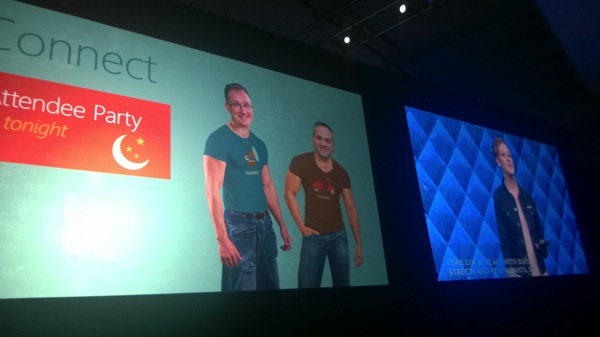
Monday began with the keynote. If you follow me (or any number of other Exchange MVPs) on Twitter, you already know what I think: neither the content of the presentation nor its actual presentation was up to snuff when compared either to prior MEC events or other events such as Lync Conference. At breakfast Monday, Jason Sherry and I were excitedly told by an attendee that his Microsoft account rep insisted that he attend the keynote, and for the life of me I couldn’t figure out why until the tablet giveaway. That raised the energy level quite a bit! I think that for the next MEC, Julia White should be handed the gavel and left to run the keynote as she sees fit; I can guarantee that would result in a more lively and informative event.  (For another time: a review of the Venue 8 Pro, which I like a great deal based on my use of it so far). One area where the keynote excelled, though, was in its use of humor. The video vignette featuring Greg Taylor and David Espinoza was one of the funniest such I’ve ever seen, and all of the other bits were good as well— check them out here. The keynote also featured a few good-natured pokes at the community, such as this:
Ripped

For the record, although I’ve been lifting diligently, I am not (yet) built like the guy who’s wearing my face on screen… but there’s hope.

I took detailed notes on each of the sessions I attended, so I’ll be posting about the individual sessions over the next few days. It’s fair to say that I learned several valuable things at each session, which is sort of the point behind MEC. I found that the quality of the “unplugged” sessions I attended varied a bit between sessions; the worst was merely OK, while the best (probably the one on Managed Availability) was extremely informative. It’s interesting that Tony and I seemed to choose very few of the same sessions, so his write-ups and mine will largely complement each other. My Monday schedule started with Kamal Janardhan’s session on compliance and information protection. Let me start by saying that Kamal is one of my favorite Microsoft people ever. She is unfailingly cheerful, and she places a high value on transparency and openness. When she asks for feedback on product features or futures, it’s clear that she is sincerely seeking honest feedback, not just saying it pro forma. Her session was great; from there, I did my two back-to-back sessions, both of which went smoothly. I was a little surprised to see a nearly-full room (I think there were around 150 people) for my UM session, and even more surprised to see that nearly everyone in the room had already deployed UM on either Exchange 2010 or 2013. That’s a significant change from the percentage of attendees deploying UM at MEC 2012. I then went to the excellent “Unplugged” session on “Exchange Top Issues”, presented by the supportability team and moderated by Tony. After the show closed for the day, I was fortunate to be able to attend the dinner thrown by ENow Software for MVPs/MCMs and some of their key customers. Jay and Jess Gundotra, as always, were exceptional hosts, the meal (at III Forks) was excellent, and the company and conversation were delightful. Sadly I had to go join a work conference call right after dinner, so I missed the attendee party.

Tuesday started with a huge surprise. On my way to the “Exchange Online Migrations Technical Deep Dive” session (which was good but not great; it wasn’t as deep as I expected), I noticed the picture below flashing on the hallway screens. Given that it was April Fool’s Day, I wasn’t surprised to see the event planners playing jokes on attendees, I just wasn’t expecting to be featured as part of their plans. Sadly, although I’m happy to talk to people about migrating to Office 365, the FAA insists that I do it on the ground and not in the air. For lunch, I had the good fortune to join a big group of other Dell folks (including brand-new MVP Andrew Higginbotham, MCM Todd Hawkins, Michael Przytula, and a number of people from Dell Software I’d not previously met) at Iron Works BBQ. The food and company were both wonderful, and they were followed by a full afternoon of excellent sessions. The highlight of my sessions on Tuesday was probably Charlie Chung’s session on Managed Availability, which was billed as a 300-level session but was more like a 1300-level. I will definitely have to watch the recording a few times to make sure I didn’t miss any of the nuances.

Surprise!

This is why I need my commercial pilot’s license— so I can conduct airborne sessions at the next MEC.

Tony has already written at length about the “Exchange Oscars” dinner we had Tuesday night at Moonshine. I was surprised and humbled to be selected to receive the “Hall of Fame” award for sustained contributions to the Exchange community; I feel like there are many other MVPs, current and past, who deserve the award at least as much, if not more. It was great to be among so many friends spanning my more than 15 years working with Exchange; the product group turned out en masse and the conversation, fellowship, and celebration was the high point of the entire conference for me. I want to call out Shawn McGrath, who received the “Best Tool” award for the Exchange Remote Connectivity Analyzer, which became TestExchangeConnectivity.com. Shawn took a good idea and relentlessly drove it from conception to implementation, and the whole world of Exchange admins has benefited from his effort.

Wednesday started with the best “Unplugged” session I attended: it covered Managed Availability and, unlike the other sessions I went to, featured a panel made mostly of engineers from the development team. There were a lot of deep technical questions and a number of pointed roadmap discussions (not all of which were at my instigation). The most surprising session I attended, I think, was the session on updates to Outlook authentication— turns out that true single sign-on (SSO) is coming to all the Office 2013 client applications, and fairly soon, at least for Office 365 customers. More on that in my detailed session write-ups. The MVPs were also invited to a special private session with Perry Clarke. I can’t discuss most of what we talked about, but I can say that I learned about the CAP theorem (which hadn’t even been invented when I got my computer science degree, sigh), and that Perry recognizes the leadership role Exchange engineering has played in bringing Microsoft’s server products to high scale. Fun stuff!

Then I flew home: my original flight was delayed so they put me on one leaving an hour earlier. The best part of the return trip might have been flying on one of American’s new A319s to Huntsville. These planes are a huge improvement over the nasty old MD80s that AA used to fly DFW-HSV, and they’re nicer than DL’s ex-AirTran 717s to boot. So AA is still in contention for my westbound travel business.

A word about the Hilton Austin Downtown, the closest hotel to the conference center: their newly refurbished rooms include a number of extremely practical touches. There’s a built-in nightlight in the bathroom light switch, and each bedside table features its own 3-outlet power strip plus a USB port, and the work desk has its own USB charging ports as well. Charging my phone, Kindle, Venue 8 Pro, and backup battery was much simpler thanks to the plethora of outlets. The staff was unfailingly friendly and helpful too, which is always welcome. However, the surrounding area seemed to have more than its share of sirens and other loud noises; next time I might pick a hotel a little farther away.

I’ll close by saying how much I enjoyed seeing old friends and making new ones at this conference. I don’t have room (or a good enough memory) to make a comprehensive list, but to everyone who took the time to say hello in the hall, ask good questions in a session, wave at me across the expo floor, or pass the rolls at dinner— thank you.

Now to get ready for TechEd and Exchange Connections…

Leave a comment

Filed under UC&C

Getting ready for MEC 2014

Wow, it’s been nearly a month since my last post here. In general I am not a believer in posting stuff on a regular schedule, preferring instead to wait until I have something to say. All of my “saying” lately has been on behalf of my employer though. I have barely even had time to fly. For another time: a detailed discussion of the ins and outs of shopping for an airplane. For now, though, I am making my final preparations to attend this year’s Microsoft Exchange Conference (MEC) in Austin! My suitcase is packed, all my devices are charged, my slides are done, and I am prepared to overindulge in knowledge sharing, BBQ eating, and socializing.

It is interesting to see the difference in flavor between Microsoft’s major enterprise-focused conferences. This year was my first trip to Lync Conference, which I would summarize as being a pretty even split between deeply technical sessions and marketing focused around the business and customer value of “universal communications”. In reviewing the session attendance and rating numbers, it was no surprise that the most-attended sessions and the highest-rated sessions tended to be 400-level technical sessions such as Brian Ricks’ excellent deep-dive on Lync client sign-in behavior. While I’ve never been to a SharePoint Conference, from what my fellow MVPs say about it, there was a great deal of effort expended by Microsoft on highlighting the social features of the SharePoint ecosystem, with a heavy focus on customization and somewhat less attention directed at SharePoint Online and Office 365. (Oh, and YAMMER YAMMER YAMMER YAMMER YAMMER.) Judging from reactions in social media, this focus was well-received but inevitably less technical given the newness of the technology.

That brings us to the 2014 edition of MEC. The event planners have done something unique by loading the schedule with “Unplugged” panel discussions, moderated by MVP and MCM/MCSM experts and consisting of Microsoft and industry experts in particular technologies. These panels provide an unparalleled opportunity to get, and give, very candid feedback around individual parts of Exchange and I plan on attending as many of them as I can. This is in no way meant to slight the many other excellent sessions and speakers that will be there. I’d planned to summarize specific sessions that I thought might be noteworthy, but Tony published an excellent post this morning that far outdoes what I had in mind, breaking down sessions by topic area and projected attendance. Give it a read.

I’m doing two sessions on Monday: Exchange Unified Messaging Deep Dive at 245p and Exchange ActiveSync: Management Challenges and Best Practices at 1145a. The latter is a vendor session with the folks from BoxTone, during which attendees both get lunch (yay) and the opportunity to see BoxTone’s products in action. They’re also doing a really interesting EAS health check, during which you provide CAS logs and they run them through a static analysis tool that, I can almost guarantee, will tell you things you didn’t know about your EAS environment. Drop by and say hello!

Leave a comment

Filed under UC&C

“Ceres” Search Foundation install error in Exchange 2013 SP1

When deploying the RTM build of Exchange 2013 SP1, I found that one of my servers was throwing an error I hadn’t seen before during installation. (The error message itself is below for reference,) I found few other reports, although KB article 2889663 reports a similar problem with CU1 and CU2, caused by a trailing space in the PSModulePath environment variable. That wasn’t the problem in my case. Brian Reid mentioned that he’d had the same problem a few times, and that re-running setup until it finished normally was how he fixed it. So I tried that, and sure enough, the install completed normally. In most cases I wouldn’t bother to post a blog article saying “this problem went away on its own,” but the error seemed sufficiently unusual that I thought it might be helpful to document it for future generations.

Warning:
An unexpected error has occurred and a Watson dump is being generated: The following error was generated when "$error.Clear();
            if ($RoleProductPlatform -eq "amd64")
            {
                $fastInstallConfigPath = Join-Path -Path $RoleBinPath -ChildPath "Search\Ceres\Installer";
                $command = Join-Path -Path $fastInstallConfigPath -ChildPath "InstallConfig.ps1";
                $dataFolderPath = Join-Path -Path $RoleBinPath -ChildPath "Search\Ceres\HostController\Data";

                # Remove previous SearchFoundation configuration
                &$command -action u -silent;
                try
                {
                    if ([System.IO.Directory]::Exists($dataFolderPath))
                    {
                        [System.IO.Directory]::Delete($dataFolderPath, $true);
                    }
                }
                catch
                {
                    $deleteErrorMsg = "Failure cleaning up SearchFoundation Data folder. - " + $dataFolderPath + " - " + $_.Exception.Message;
                    Write-ExchangeSetupLog -Error $deleteErrorMsg;
                }

                # Re-add the SearchFoundation configuration
                try
                {
                    # the BasePort value MUST be kept in sync with dev\Search\src\OperatorSchema\SearchConfig.cs
                    &$command -action i -baseport 3800 -dataFolder $dataFolderPath -silent;
                }
                catch
                {
                    $errorMsg = "Failure configuring SearchFoundation through installconfig.ps1 - " + $_.Exception.Message;
                    Write-ExchangeSetupLog -Error $errorMsg;

                    # Clean up the failed configuration attempt.
                    &$command -action u -silent;
                    try
                    {
                        if ([System.IO.Directory]::Exists($dataFolderPath))
                        {
                            [System.IO.Directory]::Delete($dataFolderPath, $true);
                        }
                    }
                    catch
                    {
                        $deleteErrorMsg = "Failure cleaning up SearchFoundation Data folder. - " + $dataFolderPath + " - " + $_.Exception.Message;
                        Write-ExchangeSetupLog -Error $deleteErrorMsg;
                    }
                }
            }
        " was run: "Error occurred while uninstalling Search Foundation for Exchange.System.Exception: Cannot determine the product name registry subkey, neither the 'RegistryProductName' application setting nor the 'CERES_REGISTRY_PRODUCT_NAME' environment variable was set
   at Microsoft.Ceres.Common.Utils.Registry.RegistryUtils.get_ProductKeyName()
   at Microsoft.Ceres.Exchange.PostSetup.DeploymentManager.DeleteDataDirectory()
   at Microsoft.Ceres.Exchange.PostSetup.DeploymentManager.Uninstall(String installDirectory, String logFile)
   at CallSite.Target(Closure , CallSite , Type , Object , Object )".

4 Comments

Filed under UC&C

Stuck! (or, why I need an instrument rating)

Earlier this week I suffered an indignity common to all VFR pilots who fly cross-country: I got stuck someplace by weather.

I’d flown into Houston on Saturday evening, planning to hop down to Corpus Christi the next day and then back to Alexandria Sunday night. The weather Saturday night when I arrived (after a loooong flight featuring a steady 40kt headwind) was marginal VFR, with ceilings of just under 3000’, but the weather cleared a good bit Sunday afternoon to the west. I wasn’t able to get to Corpus, but I had hopes that the weather would clean up Monday morning so I could make it to Alex to surprise Julie before she arrived.

Long story short: not only did the weather not improve, it got quite a bit worse and stayed that way until midmorning Wednesday.

This picture from Tuesday morning sums it up nicely. In the foreground on the left, you see N1298M, my trusty steed. Pretty much everywhere else, you see clouds. The weather at the time I took this was 600’ ceilings with visibility of 3/4 statute miles. Needless to say, that is not legal weather for flying under visual flight rules. Later that day, it started to rain, and rain, and RAIN. I wasn’t the only plane stuck on the ground, but at least the FBO operated by Gill Aviation had a good restaurant (try the pecan-crusted catfish!) and free cookies.

PaulR  Dell 20140224 001

Wednesday morning the weather cleared a bit; it was 2800’ broken and 7SM visibility when I took off. I had to pick my way around a bit; instead of going direct I first went north to Conroe/Lone Star Executive, thence more or less direct to Bastrop (which has an almost deserted airport with a super helpful attendant), thence direct to Redstone. The flight home was perfectly uneventful, with weather steadily clearing as I got further to the east. But being pinned on the ground was aggravating, and it’s clear that I need to work on getting my instrument rating sooner rather than later. Luckily I have a plan…

1 Comment

Filed under aviation

Thursday trivia #106

Busy, busy, busy. Just a few quick hits this week:

  • Great article on Mountain View, my former home in California. I agree with its characterization of MTV as “Googletown,” and anyone who’s been there for more than about 15 minutes can testify that the traffic problems mentioned in the article are a) real b) worsening and c) largely a result of Google’s campus location and size. 
  • Could Columbia have been rescued on orbit?
  • MEC is just a few weeks away— I need to get to work on my slides. 
  • I note that all 3 panes of the animation now showing on the MEC home page talk about Office 365 and none mention on-prem. I’m sure that’s just an oversight.
  • My most recent cross-country trip put me over the 250-hour flying mark, with 141 hours as pilot-in-command and nearly 101 hours of cross-country time. Not much, but it’s a start.


Leave a comment

Filed under aviation, General Stuff

Office 365 Personal Archives limited to 100GB

There’s a bit of misinformation, or lack of information, floating around about the use of Office 365 Personal Archives. This feature, which is included in the higher-end Office 365 service plans (including E3/E4 and the corresponding A3/A4 plans for academic organizations), is often cited as one of the major justifications for moving to Office 365. It’s attractive because of the potential savings from greatly reducing PST file use and eliminating (or at least sharply reducing) the use of on-premises archiving systems such as Enterprise Vault.

Some Microsoft folks have been spreading the good news that archives are unlimited (samples here and here), and so have many consultants, partners, and vendors– including me. In fact, I had a conversation with a large customer last week in which they expressed positive glee about being able to get their data out of on-prem archives and into the cloud.

The only problem? Saying the archives are unlimited isn’t quiiiiite true.

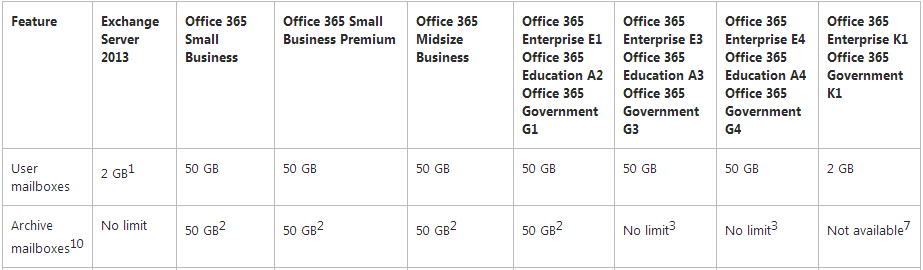
If you read the service description for Exchange Online (which we all should be doing regularly anyway, as it changes from time to time), you’ll see this:

Clip from Nov 2013 O365 service description

Clip from Nov 2013 O365 service description

See that little “3”? Here’s its text:

Each subscriber receives 50 GB of storage in the primary mailbox, plus unlimited storage in the archive mailbox. A default quota of 100 GB is set on the archive mailbox, which will generally accommodate reasonable use, including the import of one user’s historical email. In the unlikely event that a user reaches this quota, a call to Office 365 support is required. Administrators can’t increase or decrease this quota.

So as an official matter, there is no size limit. As a practical matter, the archive is soft-limited to 100GB, and if you want to store more data than that, you’ll have to call Microsoft support to ask for a quota increase. My current understanding is that 170GB is the real limit, as that is the maximum size to which the quota can currently be increased. I don’t know if Microsoft has stated this publicly anywhere yet but it’s certainly not in the service descriptions. That limit leads me to wonder what the maximum functional size of an Office 365 mailbox is– that is, if Microsoft didn’t have the existing 100GB quota limit in place, how big a mailbox could they comfortably support? (Note that this is not the same as asking what size mailbox Outlook can comfortably support, and I bet those two numbers wouldn’t match anyway.) I suppose that in future service updates we’ll find out, given that Microsoft is continuing to shovel mailbox space at users as part of its efforts to compete with Google.

Is this limit a big deal? Not really; the number of Office 365 customers who will need more than 100GB of archive space for individual user mailboxes is likely to be very small. The difference between “unlimited” and “so large that you’ll never encounter the limit” is primarily one of semantics. However, there’s always a danger that customers will react badly to poor semantics, perhaps because they believe that what they get isn’t what they were promised. While I would like to see more precision in the service descriptions, it’s probably more useful to focus on making sure that customers (especially those who are heavy users of on-premises archives or PST files) know that there’s currently a 100GB quota, which is why I wrote this post.

For another time: a discussion of how hard, or easy, it is to get large volumes of archive data into Office 365 in the first place. That’s one of the many topics I expect to see explored in great depth at MEC 2014, where we’ll get the Exchange team’s perspective, and then again at Exchange Connections 2014, where I suspect we’ll get a more nuanced view.

5 Comments

Filed under Office 365, UC&C

Conquering the instrument written exam

BLUF: this was one of the most difficult written exams I’ve ever taken, far harder than any IT certification exam I’ve done,

Back in December I wrote about the instrument written, widely alleged to be the most difficult of the FAA’s written exams.

There’s a lot of disagreement over the “right” way to earn a new rating or pilot certificate. What works for me is to study the knowledge base that I have to demonstrate mastery of while I’m working on the airmanship portion. Some folks advocate completing the written before any flight training starts, while others prefer to put the written off until right before the check ride. I guess my approach is somewhere in between. At the time of my December post, I had envisioned taking the test sometime in the first quarter; right after Christmas, I had the opportunity to sign up at a reduced rate for the Aviation Ground Schools program, so I signed up and set a goal of taking the exam on 10 February, the day after the school ended.

My path to the exam involved several different sources of information. The FAA doesn’t publicly post its pool of test questions, but the exam has been around long enough, and the knowledge areas are well-enough known, that all of the major test prep products have more or less the same questions. Each provider has a different approach to how they teach the material; some prefer Gleim, some swear by ASA, and so on. I spent a lot of time with Sporty’s Study Buddy app, which is a pretty faithful simulation of the test, and I read everything about IFR I could get my hands on, including the excellent AskACFI web site and the forums at the Cessna Pilots’ Association web site. Caroline, one of my two flight instructors, gave me a list of stuff to read that was very helpful, and I started working my way through both the FAA Instrument Procedures Handbook and the FAA Instrument Flying Handbook. It’s fair to say that I was stuffing my head with a lot of somewhat disconnected facts and factoids, so I was a little concerned when I headed off for my test prep seminar last weekend.

The seminar I chose is run by Don Berman, who started flying the year I was born and started instructing before I was housebroken.  Online registration was simple and quick, and I got ample preflight notification of everything I needed: what to bring, where the class would be held, what the cancellation policy was, and so on. The seminar I attended was held at the Comfort Inn near Houston Hobby: not a fancy hotel, but adequate for what we needed. When I arrived, Don introduced himself, gave me a fat stack of material, and got us started right on time. He’s an extremely lively presenter and his long experience as a pilot, flight instructor, and classroom teacher shines through, both in his delivery and in the quality of his presentation and visual aids. He’s also clearly got a lot of experience with classroom management; he started and ended on time, gave us adequate breaks, and kept everyone on task. He handed out optional quizzes at lunch both days and Saturday at the end of class, along with a final exam (again optional) on Sunday. The questions were hand-selected by him from the pool of questions in the ASA book; he said that if we could handle them, we should have no trouble with the actual exam.

In fairness, I should point out that Don bills his seminars as test preparation seminars— that’s exactly what they deliver. There were a few areas (like how to interpret an HSI, a navigation instrument that I’ve never flown with) where I came into the seminar with weak skills. Don taught me what I needed to know to dissect and answer test questions about HSIs, but I’m still not ready to jump in an HSI-equipped airplane and use it for a cross-country flight. Which is fine— the test covers all sorts of other things that I will probably never use, including automatic direction finding (ADF) equipment. With the test out of the way, I can now focus on building skills with the equipment I do fly with.

One of my biggest customers asked that I be in Raleigh on the 10th, so I flew there straightaway and stayed there Monday and Tuesday (escaping just in time to avoid their snowmageddon). Today was my first window of time to schedule the test. I was a little concerned that I would forget some of the more esoteric material, and I did. However, my basic knowledge was pretty solid, and I think the random selection of test questions was feeling friendly since I only got a handful of questions on my weaker topics. One interesting aspect of the test is that a new set of questions, with associated diagrams, was just added to the test pool on Monday, so there were some question types that were new to me.

I passed the exam with an 87%, a score I am delighted with. That said, I have a few problems areas that I need to work on as I continue my training, and I realize that passing the written doesn’t mean that I know anywhere close to all that I need to pass my check ride… but I’m getting there!

1 Comment

Filed under aviation

Getting ready for Lync Conference 2014 (bonus Thursday Trivia #106)

So, first: here’s the view from my second-floor home office:

PaulR  Dell 20140213 003

Actually, I had to walk across the street to get this particular shot, but it was worth it. We got about 4” or so of snow in my neighborhood; I got out of Raleigh just in time to miss their snowmageddon, which suits me fine. The boys and I had a good time about 10pm last night throwing snowballs and watching big, fat flakes fall. The roads are passable now and will get better as it warms, but tonight it’ll be cold again and they’ll probably refreeze.

I’m making my final preparations for Lync Conference 2014 next week. I’m presenting a total of four times:

  • VOICE401, “Deep Dive: Exchange 2013 and Lync 2013 Unified Messaging Integration”, is on Wednesday at 1pm in Copperleaf 10. This session will cover some of the internals of Exchange UM; it’s targeted at Lync admins who may not have much knowledge of Exchange but are already familiar with SIP signaling and the like.
  • SERV301, “Exchange 2013 and Lync 2013: ‘Better Together’ Demystified”, is on Tuesday at 2pm in Copperleaf 9, and there is a repeat scheduled for Wednesday at 430p (also in Copperleaf 9). This session covers all the places where Exchange and Lync tie together so that you get a bette experience when both are deployed.
  • On Tuesday at 430p, I’m taking part in an informal session on Exchange-y stuff at the Microsoft booth in the exhibit hall. This is super informal, so it’s probably the best place to drop by and say hello if you can.

Dell has a pretty heavy presence at the show; Michael Przytula is presenting a session covering the Lync device ecosystem (Wednesday, 230p, Bluehorn 1-3) that I think will be pretty neat, because who doesn’t love shiny devices? George Cordeiro and Doug Davis are both doing sessions around how to identify the actual ROI of a Lync deployment, which is something customers often ask about before deployment. Even if that doesn’t sound interesting, the Dell booth will be staffed by some of our hotshot Lync guys (including Louis Howard and Scott Moore), and we’re giving away a Venue 11 Pro and a bunch of very nice Jabra and Plantronics headsets.

Now, your trivia for the week:

Leave a comment

Filed under General Stuff, UC&C

On aircraft engines, part 2

A couple of weeks ago, I wrote a post about piston aircraft engines (tl;dr: ancient and expensive technology but generally very reliable). The fact that the general aviation fleet is still powered almost exclusively by these engines may have surprised you, and I wish I could say that it’s getting better right away.. but it’s not. There are some encouraging signs on the horizon, though.

One alternative is to just replace the engine (or its components). This can be done through a process known as supplemental type certification (STC), an existing airframe/engine combination can be changed, often in significant ways, provided you can prove to the FAA’s satisfaction that the changes are not unsafe. For example, there is a well-known STC for many models of Cessna 182 that allows you to run plain auto gas in the engine. There are others covering all sorts of engine upgrades and replacements: Electroair makes an electronic ignition system, Peterson, Texas Skyways, and P.Ponk make kits to replace the 182’s engine with larger and more powerful versions, and there’s even an STC to put an SMA diesel engine up front. At the high end, O & N Aircraft will happily sell you a turbine engine that will turn your Cessna 210 into a real beast (and set you back several hundred thousand dollars, too.)

The problem with STCs is that they tend to be expensive (since the manufacturer has to run the entire FAA approval gauntlet) and very specific (the STC allows you to make the specified changes only to the exact make and model specified in the STC). The expense of STC engine swaps raises the question of how much sense it makes to put an expensive engine into an inexpensive airframe, e.g. Peterson quoted me more than $80,000 to put a new engine into a 1969 182 with a market value of just under $50,000. That didn’t seem to make a lot of sense to me. Less expensive STCs, such as the Electroair electronic ignition, may have reliability or efficiency benefits that make sense, but it’s hard to see that happening for an entire engine.

A few manufacturers have made other attempts to give us better engines. One that I remember well was the Mooney PFM, a collaboration between Porsche and Mooney that put an air-cooled Porsche flat-six into the Mooney M20. The PFM had a single-lever throttle (with no manual mixture or prop adjustment), was fuel-injected, and could optionally be turbocharged. However, it wasn’t very successful in the marketplace despite its advantages.

My longtime friend Phil asked a great question in a comment to the previous post: what about turbine and diesel engines? Why don’t manufacturers just use them instead? Well, they do in new aircraft. For example, Piper will happily sell you a Meridian (with a Pratt and Whitney PT6 turbine, the gold standard in turboprop engines) starting at about $2.2 million dollars or a Mirage, which is about 40 knots slower, uses a piston engine, and costs roughly half as much. Turbine engines, of course, are mechanically and operationally simple and very robust, but they are expensive to acquire and maintain, which pretty much rules them out for the class of airplanes that most GA pilots have access to. Diesels are starting to make inroads too; the only model of Cessna 182 you can now buy is the Cessna 182 JT-A, which replaces the old-school piston engine with a 227-hp SR305 diesel (the same as the one available via STC for older 182s). The history of diesel engines for general aviation is long and complicated; suffice to say that Cessna and Diamond are the only two manufacturers I can think of who are currently selling diesel-powered aircraft despite their efficiency advantages. However, the idea of a drop-in diesel STC replacement for the O-470, IO-540, and other popular engines is gaining traction in the market, with both Continental and Lycoming developing products.

More interestingly, Redbird’s RedHawk project is converting Cessna 172s by putting diesel engines and improved avionics in them; I suspect that Redbird will be very successful in selling these refurbished aircraft as primary trainers, and that may serve as an effective tipping point both for generating demand and demonstrating the potential market for diesel STCs for other lower-cost/older aircraft. We can only hope…

1 Comment

Filed under aviation

A flight simulator primer

I had originally planned to write more about engines this week, but reality— or simulated reality— has intruded, and this week I’m going to talk about flight simulators.

For your convenience, I’ll skip the part of this post where I would wax lyrical about how cool it was the first time I played Sublogic’s old Flight Simulator on an Apple II. It was cool but it wasn’t much of a simulator experience. Fast forward from the mid-80s to today and the state of the art in PC-based simulators is X-Plane, an almost infinitely customizable simulator that can handle aircraft from gliders up to the Space Shuttle. (The demo video on their web site is well worth a look to see some of what can be done with suitable hardware). There are hundreds of different airplane types available, including military, general aviation, biz jets, and big iron such as the Boeing 7×7 line. Each aircraft has its own customized flight model and appearance, so what you see can be as realistic as the designer of that model feels like building in (and as realistic as your graphics hardware can support). Here’s a fair example of what the sim looks like on my setup:

Cherokee Six approach into KAEX

Daylight approach to runway 32 at Alexandria International Airport

This is a daylight approach (created by checking the box that says “use the current date, time, and weather”) to runway 32 at Alexandria International. You can see the runways, taxiways, other airport stuff, ground features, and the Red River. The more powerful your computer, the more graphical features you can turn on. Since I am running on a 3-year-old MacBook Pro, I have the detail level set to “medium” but perhaps one day I’ll have enough hardware to turn up some of the visual fidelity knobs.

However, visual fidelity isn’t why I wanted a simulator. There are people, including many non-pilots, who like to hop in the sim and pretend that they are airline pilots, fighter pilots, or whatever. I wanted one as a means to practice instrument flying, which often involves being in conditions where you can’t see a darn thing outside. For example, right now the weather at KMGY (Dayton-Wright Brothers) is 1.5 miles visibility, an overcast layer at 300 feet, and light snow. Here’s what the approach to runway 2 there looks like right now; It doesn’t take much GPU horsepower to draw solid gray, as you can see:

On final for rwy 2 at KMGY

Same daylight, different weather, this time at KMGY

So why bother? If you take a look at the approach plate for the GPS approach to runway 18R at Huntsville, you’ll see that there are specific lateral and vertical points to hit: inbound on the approach, you fly to the JASEX intersection, and you cannot arrive there below 3000’. From there, you fly a course of 182° to GETEC, where you arrive at 2500’, and so on. Understanding where you need to be during the approach, and then putting the airplane in that position, is the key to a safe arrival. Practicing the skill of mentally visualizing your aircraft position and orientation relative to the approach layout, then controlling the aircraft as needed, is really valuable, and in a simulator you can repeat it as often as necessary without delay, even pausing it when needed. For that reason, the FAA has allowed you to log up to 20 hours of simulator time as part of the requirements for an instrument rating, provided you spend that time with an instructor and are using an approved simulator. (They recently announced that they will only allow 10 hours of time to count, effective February 3, but the AOPA and other groups are fighting that proposed rule change.)

Without going into all the boring details, suffice it to say that there are many different gadgets to practice your flying with, from the massive, super-high-fidelity simulators used by airlines to the home-brew rig I’m using, with a $50 piece of software and another $200 in controllers, all running on a commodity laptop. This article from IFR Refresher explains the difference nicely: a simulator is a full-size replica of a specific type of aircraft cockpit, with motion and high visual fidelity. Training devices (TDs) don’t have to have motion, and there are several subtypes, including PC-based devices (PCATDs) and basic and advanced training devices (BATDs and AATDs, respectively).

For your simulator practice time to be loggable, you need a PCATD, BATD (such as this Redbird TD or FlyThisSim TouchTrainer), or AATD. My slapped-together rig is not FAA-certified as any of these, so I can’t log the practice time, and therefore it doesn’t count towards the requirements for my rating. However, being able to practice approaches before I fly them is invaluable, and I plan to make heavy use of the ability to do so. To help with that, I’ll probably spring for the FlyThisSim analog Cessna pack, which includes higher-fidelity models for several of the aircraft I normally fly. In particular, the pack includes the Garmin G430 and G530 GPS systems, which are very useful when flying approaches since they give you a moving-map rendition of your location and position and they can be coupled to the autopilot so that the GPS provides lateral guidance (though the airplanes I fly don’t have vertical coupling so the pilot still has to control altitude). Coupled with judicious use of the expensive and fancy Redbird FMX AATD at Wings of Eagles, this should help me (eventually) master the complex process of safely flying an IFR approach.

Leave a comment

Filed under aviation

1Fit Fitness (Madison)

Over the summer, I was looking for a gym. Since I hadn’t been a member of a gym in probably 20 years, I wasn’t really sure what criteria I should use to pick one, but I liked Brian’s review strategy of testing gyms before signing up, so  I started with the gym that was closest to my house: 1Fit Fitness on County Line Road in Madison. I met with Chuck, the owner, and got a quick tour. First, a word about Chuck, who is a retired Army officer and super nice guy. He and his staff keep the gym clean and neat, which was apparent when I waked in the door. The gym is divided into two large areas: on the left, there are dumbbells (12.5-100 lbs), a Smith machine, a squat rack, and a couple of benches. On the right, there’s an incline bench, a big combo cable machine, a rack for doing pull-ups and dips, a variety of selectorized machines, and half-a-dozen assorted pieces of cardio gear. Each side has at least one TV, and the left side has a counter area with a small fridge with drinks for sale. The decor is extremely basic, although there are plenty of mirrors, which always bugs me a little bit. However, there are none of the typical meathead trappings: no diamond plate or posters of gigantic ripped dudes.

I signed up for their family plan, which is about $40/month for me plus two kids. For that price, I get unlimited, 24/7 use of the gym. It is rarely busy; I’ve never seen more than 4 other people there, and most of the time when I go I’m by myself. If you want a social gym, this probably isn’t the best choice. The place is staffed in the afternoons, Monday through Saturday— while “afternoon” sounds vague, I chose it because the actual hours seem to start anywhere between noon and 4pm and end at 6pm. I’ve seen the owner in a few times outside that time, but that’s unpredictable. However, since your key fob gets you 24/7 access, unless you need company, staffing hours are pretty much irrelevant.

There are a variety of classes offered, and several personal trainers who work out of the gym, but I don’t have anything to say about them because I haven’t used them.

Cons? Sure, a few. The gym doesn’t have some equipment that I wish it did: there’s no leg press machine, no trap bars, and only one curl bar (which is broken). This isn’t a huge deal, but it does point out the drawback of using a small locally-owned gym; at least in this case, Chuck can’t afford to invest the same kind of money as the big-box gyms. However, the ease of access makes up for that in my opinion; I love having a nearby gym that I can go to whenever I want, and I prefer supporting the locals. It might be easier to sign up for a chain such as Anytime Fitness so that I have better gym access when I travel, but for now I’ve had good luck finding gyms in each city where I travel.

In the meantime, I’m toying with the idea of adding a second membership at Workout Anytime or Planet Fitness just up the road; $10/month or so would get me some equipment I don’t currently have access to, plus better gym access when I travel. However, when I start triathlon training in the spring, I’ll want access to a pool, which means I’ll probably be stuck with switching to a bigger gym (or the local Y), so I’ll probably wait.

Bottom line: 1Fit is a solid gym and I’m happy with the value I get for the cost. I recommend it.

140608 update: 1Fit closed in March 2014 and has been replaced by an IronTribe location.

1 Comment

Filed under Fitness, Reviews

On piston aircraft engines, part 1

If you’ve noticed, car manufacturers often brag on the technology or fuel efficiency of their engines. If you recognize phrases like “fuel-injected,” “variable valve timing,”  “double overhead cam,” or “turbocharged,” then the automotive industry’s marketing has succeeded— even if you don’t know what those things are you probably think of them as desirable.

Now forget most of that. The basic design of most aircraft piston engines are stuck solidly in the 1930s.

Take, for example, the 1975 Cessna 182P I often fly, N1298M. Its engine is a Continental O-470-U variant. No electronic ignition. No fuel injection. It weighs 390 pounds, makes 230 horsepower, and costs about $21,000 to overhaul (more if you replace your timed-out engine with a remanufactured or factory-new one).

Yep, that’s right. The engine in that airplane costs as much as many cars do, and yet from an efficiency perspective it’s terrible— 470 cubic inches to make only 230 horsepower! (In fairness, the O-470 is capable of more; in the 182 it’s derated to 230hp). By comparison, the Nissan Altima— hardly a supercar— has a 213 cubic-inch engine (well, 3.5L, really) that makes 270hp and can be completely replaced for about five grand. Now, in fairness, the Nissan engine is a much newer design. Maybe a better comparison is the engine from a 1975 Corvette, which made 205hp from 350 cubic inches and weighed about 325lbs. I won’t hazard a guess at the original cost, but overhauling a small-block 350 would cost maybe $1500 in parts today.

Behold the mighty O-470

Newer aircraft of course have somewhat more modern engines. For example, a 2012 Cessna 182 (identical in performance to the 1975 model I normally fly) uses a Lycoming IO-540-AB1A5 engine that still makes 230hp, but features fuel injection and a somewhat more modern design than the O-470. An overhaul for this engine will run you about $24K, while a brand-new one lists for just under $77K. (In 2013, Cessna stopped selling the piston 182 and moved to a new diesel engine, a topic I’ll have more to say about in part 2.) Another example: the Cirrus SR22G5, the latest version of the best-selling piston single, runs a fuel-injected Continental IO-550N that, apart from being fuel-injected, is still just as noisy, heavy, inefficient, and expensive as its predecessors.

Besides the expense, these engines require much more management than you might think. In flight, whether your engine is fuel-injected or carburated, you have to adjust the fuel-air mixture as you change altitude. You must also monitor the cylinder head temperatures (CHTs), and in some aircraft you have to adjust cowl flaps or other cooling devices. When was the last time you had to do that in your car? You don’t; in pretty much every car built since the late 1970s, a computer takes care of adjusting spark timing, mixture, and a number of other parameters to get the best performance or economy from the engine. All you do is press the accelerator. In a piston airplane, that’s a different story (something I’ll also talk more about in part 2).

The reasons for this sad state are many and complex, but the biggest two are easy to describe succinctly: reliability and cost.

Despite the fact that these engines use ancient technology, they are superbly reliable because their basic design is so mature. Engine and airframe manufacturers have 50+ years of data about their behavior, and when the possible consequences of an engine failure escalate from “pull over and call a tow truck” to “fall screaming out of the sky and die in a fireball,” you can see why that reliability is so desirable.

Cost is a multifaceted factor. First, it is exceptionally expensive to certify anything for aviation use. The FAA has a demanding and complex set of rules (known as “part 23”), backed by a fairly arbitrary process, for certifying things such as engines, propellers, and avionics. It’s prohibitively expensive for most new entrants to get a new engine and airframe combination certified. Manufacturers such as Cessna and Piper have little incentive to spend millions of dollars certifying new engine designs for their 50+-year-old airframe designs. Second, these engines are produced in very low volumes by modern manufacturing standards. In a really, really good year, Lycoming or Continental might sell a number of new engines measured in the low thousands (perhaps more, but it’s certainly fewer than 10K units/year). In that volume, it’s hard to see much improvement from scale, and given that these engines are largely hand-built, this is unlikely to change.

I haven’t touched on another drawback, one which really requires its own post: piston engines normally run on leaded fuel. This has several related consequences: economic (it’s more expensive because it’s a lower-volume product), environmental (duh), political (various satraps in California have tried several times to ban or legislate leaded aviation fuel out of existence), and technical. Some engines, such as the ones for the 182, can be made to run on ordinary auto gas (known as mogas), but higher-compression engines in larger airplanes need the lead to prevent pre-detonation, so we’re stuck with it for now.

Like the weather, the state of engine tech in general aviation is often discussed but there is little individual pilots and owners can do about it. Manufacturers, though, have a variety of tricks up their sleeve, which I’ll discuss in part 2.

6 Comments

Filed under aviation

Thursday trivia #105

Welcome, 2014! So far my year’s off to a great start; I ran a race at midnight New Year’s Eve; I have some idea of what my major 2014 goals are, and I now have a pet again. I hope you’ll join me in welcoming Pancake the cat to the blog. I promise not to be one of those tiresome people who regales unwilling audiences with tales of their pet’s accomplishments and behavior, but I must say the boys and I are excited to have a family pet again.

WP 20140102 001

  • I bit the bullet and signed up for an accelerated IFR ground school with Aviation Ground Schools. Why them in particular? They had a schedule that fit my needs, they got good reviews, and then they had a one-day sale. Expect a full report once I attend the seminar next month.
  • The hardest thing I ever had to do as a business owner was fire people. Firing people in your personal life can be just as difficult, but sometimes it’s necessary.
  • After nearly six months I am finally feeling settled into the house: everything is unpacked, there are doormats, pictures are hung, and so on. I celebrated New Year’s Day by replacing the fill mechanisms in all 3 toilets. (Cue the “you know you’re a homeowner when…” jokes)
  • I’m excited to start the next round of group training with Roman and Mike Vacanti. Here’s to crazy gainzzzz.

Leave a comment

Filed under Musings

Office 365 token disclosure flaw: patch your desktops now

Happy New Year! To start the year off right, let’s talk about security. More to the point, let’s talk about Office 365 security.

One of the ways I often talk about Office 365 to customers is this: any time you move to a hosted service, you’re placing a bet that your hosting provider can do something better or cheaper than you do. Maybe they’ll deliver better uptime than you can afford to provide, or they’ll offer global reach, or some feature or function that you don’t currently have. As with any other bet, you have to carefully evaluate the odds and your counterparty (the person offering the bet). One of the big arguments in favor of Office 365 has been its security: Microsoft has invested a huge amount of money in physical and logical security for Office 365. Tie this in with the huge investment (several billion dollars and counting) brought about by Trustworthy Computing and you can see why Microsoft is eager to tout the security of their products: they have made huge strides over the last ten years. (Sadly, many other vendors are still as bad as they were back in 2005… let that thought sink in for a few minutes.)

In December, Microsoft released a patch, MS13-104, which every organization using Office 365 should immediately deploy. Microsoft rated this bulletin as “important” using their severity scale. While I understand that the “critical” severity is usually reserved for flaws that could allow remote code execution, I think this is just as bad because it allows an attacker to silently steal every document you have in a SharePoint Online document library.

Wow.

Keep this tab open, then open a new tab and use it to start figuring out how to patch your clients ASAP if you’re using SharePoint Online. Then you can come back.

I won’t repeat the excellent analysis performed by Adallom Security, the folks who reported the flaw to Microsoft in May 2013. That’s right: they reported in May 2013, and the patch was issued in December 2013. That’s a minimum of 7 months of days-of-risk, which is bad enough without considering how long this flaw was being exploited before Adallom found it. However, I do want to make a couple of additional points.

First, they wrote their post before the recent spate of disclosures surrounding the NSA’s Targeted Access Operations (TAO) team and their catalog of exploits. There is of course no evidence that NSA developed or was using this particular exploit, but this is exactly the kind of silent, virtually undetectable attack that is the specialty of nation-states. The fact that Adallom’s customer is a large, high-profile enterprise is potentially bad news for Office 365 sales efforts, given that those customers are already a little leery of cloud services because of a perceived lack of security controls.

Second, this exploit apparently doesn’t work against Exchange Online or Lync Online, but that hasn’t been proven conclusively. Don’t hold off patching Office 2013 just because you aren’t using SharePoint Online.

Third, it seems to me that this kind of flaw is the natural consequence of breaking new ground. Seamlessly tying together on-premises and cloud services through a complex desktop suite is something that no other software company has even attempted: the major Office 365 competitors, such as Box.net and Google, don’t offer traditional desktop productivity apps, preferring instead to run inside the browser, where the design patterns and potential vulnerabilities of authentication are much better understood. So I don’t think of this as sloppiness necessarily on Microsoft’s part: sometimes in complex systems, people make mistakes. 210+ days-of-risk makes me a little nervous though.

My overall takeaway: if you have truly sensitive data that you want to protect, putting it in the cloud is not necessarily any more risky than keeping it on-premises. That may seem counterintuitive, but an entity that is determined to get your data has many potential avenues of attack, and my experience tells me that the vast majority of sites have a number of local vulnerabilities (such as poor patching practices, poor intrusion detection, or inattention to basic security practices) that put them at higher risk than a relatively esoteric, hard-to-exploit flaw like this one. if you don’t believe me, just look at the number of sites hit by Cryptolocker and various banking-related Trojans. Put another way, you don’t need to worry about defending yourself against NSA if you can’t even manage to defend yourself against script kiddies.

Now go forth and patch!

Leave a comment

Filed under Office 365, UC&C

2014: my major goals

I am a big believer in the SMART system for goals: any time you make a goal, it should be specific, measurable, attainable, relevant, and time-bound. The counterpart to that is another “A” that’s missing: accountable. Both academic research and practical experience show that accountability helps make it easier to achieve those goals. I’ve seen this principle in action throughout my professional and personal life so I wanted to set out some of my 2014 goals here as a means of making myself accountable for progressing towards them. So, in no particular order, here are some of the things I plan to accomplish by the end of 2014.

On a professional level, my SMART goals revolve around specific things I need to do at work, including getting my MCSE certification, producing a certain set of internal IP documents, and a few other things that are related to our internal processes. They’re not necessarily things I can discuss in depth here. However, in my professional-but-not-at-Dell role as an MVP and author, I’m planning on doing at least one book in 2014. I have discussions underway with a couple of publishers and my agent about possible topics.

On the skills front, I will complete my instrument and commercial ratings in 2014. I will do this by continuing to train and fly with my instructors, setting a regular schedule to fly so I can maintain proficiency, and learning as much as I can about every aspect of IFR operations. Once I get the ratings, I will fly with them regularly to remain proficient. My target is to fly at least 120 hours of pilot-in-command time in 2014, with more if my schedule and budget allow.

From the health, fitness, and activity department: I want to train for and complete a sprint triathlon (probably this one). I will do this by taking advantage of Fleet Feet’s training programs and continuing my weightlifting and exercise regimen. I’m doing another increment of the Fitocracy group coaching program from January through April, when triathlon training season starts. (I’ve also signed up for several 5K races spread throughout the first quarter of the year.) I also want to continue to maintain a healthy body weight and appearance. I will do this by continuing to lift weights and track what I eat to ensure that I’m getting the right mix of macronutrients to support my activity level and goals. (Obligatory numbers: bench my bodyweight of 185, deadlift 300, and squat 275. I have no idea whether these are reasonable numbers or not since I am not used to setting goal weights, but I’ll stick with them for the time being.)

To help support those goals, I’ll continue to learn to cook new things. This is a squishy, non-SMART goal because I don’t have (or want) specific targets for learning to cook N new dishes.

Turning to the personal: I want to be more generous with my charitable giving of both money and time. I have some ideas about how to do this, and be accountable for it, but I’m still puzzling through what I think will work best. More on that another time, perhaps. The rest of the personal goals I have are, well, personal, and mostly non-SMART, so I’m leaving them out as well.

Expect a progress post each quarter so we can see how I’m doing on the specific things I’ve listed here. That’s the “accountable” part, y’know.

Leave a comment

Filed under Friends & Family, Musings