Category Archives: aviation

Go and no-go decision making

(Yes, I know it’s not Friday. That’s because on Friday I was busy… flying. Not flying myself, you understand; rather, I was being flown by the fine folks at Delta from SFO to ATL and then on to HSV.)

I had already planned my weekend around the trip to Alabama to see the boys, but early Thursday morning received some bad news: my Uncle Edgar had passed away in Houma, Louisiana, and his funeral service would be first thing Monday morning. That seemed like a great opportunity to get some cross-country time; I could rent a 172 from the Redstone flying club, fly KHUA-KHUM in about 3.5 hours, and easily make both the Sunday night wake and the Monday service. I jumped online, reserved an aircraft, and went about my business… at least until I saw the weather.

AviationWeather.gov showed a strong chance of rain and scattered thunderstorms Sunday in Huntsville. So did the Weather Channel, but the WAAY-TV forecast called for scattered light rain. The local forecast for Houma for my arrival time looked good. What to do? I had a few options:

  • Adjust my flight time to get out of town before the bad weather. Of course, if I ran into any delays, that could be a problem.
  • Wait and see how the weather developed, planning on flying if there was no convective weather developing or forecasting.
  • Call Delta and book a flight to New Orleans.

As much as I wanted to fly down there myself, I chose option #3. That turned out to be exactly the right move, because the weather across southern Louisiana deteriorated Sunday morning. Here’s what the weather looks like right now, as I sit comfortably aboard my Delta flight. All that green crap in the lower right corner of the map has been forming and blowing up from the Gulf into north Alabama over the last 36 hours or so—but the forecast I saw on Thursday didn’t predict that.

wx

It might have been possible for me to adjust my departure time either earlier or later and still make the flight safely. However, the old adage that “it’s better to be down here wishing you were up there than up there wishing you were down here” certainly applies. At this time of year, convective weather can be unpredictable, and tackling it at night as a non-instrument-rated pilot in an aircraft without onboard weather display or radar would be foolish.

As WOPR said, sometimes the only winning move is not to play. So I sat this flight out, and I’ll build my cross-country time another day.

3 Comments

Filed under aviation

Heading to see Fifi!

Short entry today– I’m packing my bags and my charts to go see Fifi again. When the ATOP folks contacted me and said that they were offering a two-day advanced course, consisting of an instrument proficiency check for IFR-rated pilots or a line-oriented flight check (LOFT) for VFR pilots, I jumped at the chance. It’ll take me all night to get to Orlando, then a short nap before ground school, but it’ll be worth it to spend two glorious hours in the A320 sim on Sunday. More news when I return.

Leave a comment

Filed under aviation

The secret to emergency landings

Rule #1 in aviation, as recounted to me by my first flight instructor: Don’t hit anything.

Rule #2, of course, is If you have to hit something, pick the softest object you can find and hit it as gently as possible while going as slowly as possible.

It turns out that both of these rules are surprisingly applicable to the art of making good off-airport emergency landings.

First, I should distinguish between a forced landing (one in which you have no choice, usually because the engine has quit) and a precautionary landing. The latter are undertaken when something is wrong and you need to get on the ground ASAP, but where the issue isn’t yet a full-blown emergency such as an in-flight fire or a dead powerplant.

Forced landings are where rule #2 really comes into effect. There are really only two tasks in conducting a successful forced landing. First you find someplace to land, and then you land there. This, of course, obscures much of the real complexity of getting the job done, but it’s easy to let the other tasks you have to perform along the way overshadow these two major requirements.

What’s a good place to land? Well, it has to be within range of your aircraft, and ideally it will be a nice, flat, unoccupied, soft surface with no obstacles or bumps. The odds of finding something like that varies greatly according to where you are. For example, in the area around the Palo Alto airport, you have water to the east, with marshes and power lines to the immediate north and south of the runway, in a heavily urbanized area. On the other hand, out of Madison County Executive you have lots of nice soft farm fields. One key trick is to always be looking around while en route and thinking “OK, if I needed to land, where’s a good spot?” This is both a good habit and a fun game to play, especially in unfamiliar terrain.

“…then you land there” is the more challenging part. During my primary training, one of my major obstacles was my lack of airspeed discipline. Each airplane has a characteristic best-glide speed: maintain that speed and you will get the maximum forward motion per foot of vertical descent. If you go slower or faster than that speed, you’ll get less gliding distance. While your instinctive reaction might be to look around for a landing site, the very first thing you should do is grab the trim wheel, get some nose-up trim in place to reduce the control force required, and slow the airplane to its best-glide speed. Do that and then you’ll have more time to find an ideal landing spot. You have to use that time to do other things, like run through the emergency landing checklist, call Mayday, and so on, but those are all optional… maintaining the best-glide speed is not.

The other problem I had was my approach to the selected landing spot. Ideally you want to pick a spot and arrive abreast of it at about 1000′ above the terrain. In the diagram below, you want to be at the position labeled “2”. At that point, you’re in exactly the same position you’d be in if you were performing a normal landing, and one of the things you practice all the time is power-off landings from exactly that position. For some reason, though, it just didn’t sink in that I needed to approach the landing spot as though I were entering a traffic pattern; I was perpetually too close to, or too far away from, my selected landing spot.

airport traffic pattern

airport traffic pattern; diagram courtesy http://www.cfidarren.com

Why it took me so long to figure out, I don’t know. Once my instructor pointed that out to me, though, my emergency landings improved about 1000%. That’s what I would describe as the secret, at least for me: pick a spot and then navigate to it, at best-glide speed, just as though I was planning a landing on an ordinary runway. Doing that made all the difference in the world. Now I just have to keep following rule #1 and I’ll be in good shape!

3 Comments

Filed under aviation

Going NORDO

You may not realize it, but the commercial airliners we fly on have redundancy for virtually every onboard system. This, of course, is no accident—it’s a popular saying that the history of aviation improvements is written in blood, so the reason why we have redundant electrical systems, pressurization, and so on is because in the past, single points of failure have caused catastrophic accidents.

Even light airplanes often have more redundancy than the casual observer might suspect. For example, the engine ignition system in piston airplanes has two redundant magnetos, wired so that each magneto is independently providing spark to both cylinders. If one mag fails, no worries; you’ve got another one.

Luckily, the same is true with radios, as I found out on a recent night flight. My mission: leave Palo Alto, fly up to Napa to pick up my cousin, and continue on to Willows for dinner. I was in a fairly new G1000-equipped 172, one that I hadn’t flown before. When I listened to the ATIS broadcast on COM1 during my preflight, I noticed quite a bit of audio clipping, but I wrote it off as due to my position on the airfield– behind a large metal hanger with an electrical box that causes an audible squeal in the audio system as you taxi past it. I preflighted, started, and called ground; I could hear them OK, so I taxied to the runup area. Runup was normal, and then I switched to the tower frequency and called them for a takeoff clearance.

Silence.

I called them again.

More silence.

That’s odd, I thought. Even a busy controller will usually respond after a second call, and I’m the only guy out here anyway. A few seconds later the controller answered but his audio was unintelligible. I tried a couple more times, then switched back to ground and told them I was taxiing back to parking. When I got there, I started playing with the squelch controls on the audio panel while listening to the ATIS frequency and eventually got a squelch level that gave me clean audio… or so I thought.

Taxi back, runup, and takeoff were uneventful. I was talking to Norcal Approach the entire time; they vectored me over the San Mateo bridge, then over the runway 29 numbers at KOAK, then past the Nimitz Freeway, then VFR direct to the Napa airport. The trip was gorgeous, and I made a good landing at KAPC. Sadly I had forgotten my spare headset, and the local FBO didn’t have one, so Chris and I decided to have dinner in Napa instead of flying to Willows. We had a great visit while devouring burgers at Gott’s (where I had the best milkshake ever), then I dropped him back at the airport and got ready to fly back.

In the meantime, the Napa control tower had closed. This isn’t uncommon; many airports are towered only during part of the day. The normal procedure is to use the tower frequency (or another freq, if designated) to announce your position and intentions to any other aircraft in the area. I did so and had an uneventful takeoff. As I turned back towards the Bay Area, I tuned in the Norcal Approach frequency and called them.

Silence.

Uh oh, that’s not good, I thought. I knew I hadn’t gotten the frequency wrong because I used the G1000 to enter it directly from the airport  diagram, but I looked it up anyway and tried again.

Silence.

By this time I was getting uncomfortably close to controlled airspace, and I didn’t want to enter it without being in radio communication with ATC, so I started a nice, gentle standard-rate turn to keep me out of trouble while I troubleshot.

First I tried calling Flight Watch, the nationwide FAA enroute advisory service that uses the same frequency, 122.0 MHz, everywhere. No joy.

Next I switched over to COM2 and called Flight Watch again. “Four Lima Bravo, we could hear you a minute ago but you couldn’t hear us. How copy?”

Bingo! My primary radio had gone dead.

While this was a little disconcerting, it wasn’t a problem; I had another completely functional radio, so I switched back to Norcal’s frequency, called them, got cleared along my route, and went about my business. If my secondary radio had failed too, I wasn’t without options; I could have changed my transponder code to 7600 to indicate that I was NORDO, then I would have flown a route and altitude to keep me away from Oakland and SFO. In this case, that basically means about 1500′ straight down the middle of the Bay. The Palo Alto tower was closed by the time of my arrival, so I would have had to be very careful about entering the traffic pattern (and as it turned out there were a couple of other planes working the pattern there).

Although this wasn’t an emergency by any stretch, I was glad to have that second radio. Operating in busy controlled airspace at night is not a good time to be muzzled. It might be time for me to pick up a handheld nav/comm radio to keep in my flight bag as a backup. (Of course, then I’d need a bigger flight bag…)


Leave a comment

Filed under aviation

Drone strikes on criminals

For my first Flying Fridays post, I want to return to a favorite topic: drones. My first-ever published work was an article for the Georgia Tech Research Institute (GTRI) on some research work done there on unmanned aerial vehicles. I sure wish I’d kept a copy (their archives were no help, sadly). Ever since then I’ve had an abiding interest in the mechanics, ethics, and practical use of unmanned aircraft.

Anyway, here’s a little snippet from the New York Times this week:

China considered using a drone strike in a mountainous region of Southeast Asia to kill a Myanmar drug lord wanted in the killings of 13 Chinese sailors, but decided instead to capture him alive, according to an influential state-run newspaper.

Sound familiar? To put this in context: the publicly-disclosed criteria for droning a US citizen are that it must be infeasible for US or allied forces to capture or kill the target; the target must be a “senior member” of Al-Qaeda, and the target must pose an imminent threat of violent attack against the US. Non-citizens are subject to a different set of rules, detailed in this handy flowchart. In either case, the US government explicitly reserves the right to use unmanned aircraft to kill people who have acted against US interests.. and now the Chinese are copying us.

Thought experiment: imagine a search-and-replace of “Al-Qaeda” in the above paragraph with some other criminal or terrorist organization. Suppose a nearby country (say, Mexico, or Venezuela) becomes a base for violent, criminal-but-not-terrorist, attacks on US citizens. Internal governance is too weak to allow the local authorities to arrest the bad guys. Do you drone them? In other words, could this policy conceivably extend to pre-emptive strikes on drug lords or other violent criminals?

If so, who’s next? If not, why not, given the current legal framework?

If you think this is an unrealistic scenario,  here’s a question to ponder. Law enforcement agencies can, and have, used manned aircraft carrying snipers to fire on suspects. What practical difference is there between an FBI HRT helicopter carrying a sniper and an armed FBI HRT drone? If it’s OK for US to stage armed counternarcotics missions into, e.g.  Honduras and shoot people, why wouldn’t it be OK to just send a drone instead?

(nb. I am not arguing that it is a good idea for the US to be doing these things, merely positing a logical extension of our current policies.)

Meanwhile, the FAA is still trying to figure out how to integrate drones safely into the National Airspace System. There’s a ton of interesting commentary on this AVweb opinion piece that I commend to your attention; there seems to be an emerging consensus in the aviation world that mixing drones and manned aircraft is a recipe for disaster because current unmanned aerial systems (UAS) don’t implement the see-and-avoid behavior drilled into human pilots from day 1. Large, remotely-operated drones such as those operated by Customs and Border Protection are relatively safe: they are large (and thus somewhat easier to see), have elaborate command-and-control systems, operate in predictable areas, and generally fly at medium to high altitudes. What I’m more worried about are smaller, less-visible, less-well-equipped drones (such as the kind operated by police departments in Houston, Dallas, and various other locales). Small drones offer so much potential utility for surveying, traffic monitoring and control, crop monitoring, aerial application, and burrito delivery that their arrival is inevitable; I just don’t want to have to play dodge-a-drone when I fly.

1 Comment

Filed under aviation, Musings

Welcome to Flying Fridays!

One of my goals for 2013 is to continue my aviation education and skill-building. Another is to do more writing (and photography) on aviation-related topics. To do this, I’m kicking off a new habit: Flying Fridays. While it would be great if I could guarantee that I’d get to fly every Friday, that’s not likely to happen right now. I can, however, guarantee that I’ll have a new blog post every Friday on an aviation-related topic. This might be as simple as a trip report or a tip on how to use a particular feature of an app or avionics device, or it might be more involved. With that in mind, I’d love to hear what my readers are interested in knowing about aviation. I’ve gotten several private e-mails asking questions about various aspects of my flight training, and I’m happy to write about that, or any other topic that catches your interest– leave me a comment here or send e-mail and I’ll add it to my queue.

1 Comment

Filed under aviation

Coming soon: do-it-yourself armed drones

I recently finished Daniel Suarez’s excellent thriller Kill Decision. The major plot point: parties unknown have been releasing autonomous, armed drones that are killing people in a variety of ways. The drones are capable of insect-level intelligence and swarming behavior, and of autonomously finding human targets and bombing or shooting them. Suarez asks a fairly provocative question: would America’s love affair with drones change if other countries, or criminal syndicates, or even individuals had them and used them as freely in the US as we use them elsewhere? Great plot, well-written, and solid characterizations– by far the best of his books so far. Highly recommended.

Anyway, with that in mind, I saw an article on the Lawfare blog about a guy who equipped an inexpensive commercial drone with a paintball marker. This video shows it in action, hitting targets easily while maneuvering slowly. The video’s a little fear-monger-y, but the narrator is right: “it seems inevitable” that these drones will be used in ways the manufacturer didn’t anticipate.  I sent the video to a couple of coworkers, one of whom asked “I wonder how hard it is to shoot accurately with it?” That got me to thinking… so off the top of my head, I jotted down a few factors that would affect the accuracy of a firearm-equipped drone. Note that here I’m talking about an autonomous UAV, not a remotely-piloted, man-in-the-loop drone. 

  • What’s it for? What kind of range and endurance do you need? It would be easy to build a sort of launch rack that would launch a drone to check out a target that triggered a tripwire, motion detector, etc. It’d be a little harder to build one that could autonomously navigate, but definitely doable– as Paul proved with his Charlie-following project. See also: the Burrito Bomber, which can follow waypoints and then deliver a payload on target.  Drones to sneak into somewhere and snipe a single target would have different range/payload requirements than a patrol or incident-reponse drone. This drives the weight of the drone (since more range requires more fuel).
  • What’s it packing? The purpose of the drone dictates what kind of firearm you want it to carry. Some of Suarez’s drones had short-barrelled .38 pistols, which are plenty good enough to kill from close range but wouldn’t be very accurate past around 35 feet or so. A longer barrel and a heavier round would provide better accuracy, at the cost of weight and size.
  • How much range do you need? A sniper drone that can shoot targets from 1500yds is definitely feasible— use a .50 Barrett, for example. It would be heavy and range-limited, though, unless you wanted to make it bigger. In general, heavier bullets are more stable and give you better accuracy, but they’re heavier to carry and shoot.
  • How stable is the drone? A light drone that’s sensitive to wind, etc. will be harder-pressed to make accurate shots. Gyrostabilizing the gun platform would help, but it would add a weight and cost penalty (including for power for the gyros, plus the gyros themselves). The bigger the drone, the more sensors, power, and ammo you can carry… but the more noise, infrared, and visual signature it creates. A small sneaky drone may be a better deal than a large, more powerful one.
  • What can you see? In other words, what kind of sensors do you have for aiming? How good is their resolution and range? Do they have to be automated? If so, you need to be able to either fire at the centroid of the target or track interesting parts, like wheels of a truck or a person’s head), using machine vision. 
  • Where are you pointing the gun, and how accurate can you be? What kind of angular resolution does the gun-pointing system have? If you’re willing to slow to a dead hover, or nearly so, you can be very accurate (as in the video above). If you want to go faster, you’ll have a more challenging set of requirements– you have to be able to point the gun while the drone’s moving, and changing its aim point means fighting inertia in a way you don’t have to worry about in a hover.

There are lots of other more subtle considerations, I’m sure; these are just what I came up with in 5 minutes. Any engineer, pilot, or armorer could come up with a couple dozen more without too much effort. Of course, you could just buy a pre made system like this one from Autocopter. Isn’t it great to know they’ll lease you as many UAVs as you need? Just for a ballpark figure, Autocopter quotes an 8Kg payload on their smallest drones– figure 3Kg for a cut-down M4 and that leaves you a reasonable 5Kg for sensors, guidance, navigation, and control.

What could you do with such drones? The mind boggles. Imagine that, say, your favorite Mexican drug cartel cooked up a bunch of these in their machine shops and used them to guard the pot farms they run in national forests. Or say the white-supremacy militia guys in Idaho built some for sovereign defense. Or suppose you built 100 or so of them, staged them inside an empty 18-wheeler with a tarp over the top, then launched them into Candlestick Park during a 49ers game. There are all sorts of movie-plot-worthy applications for these drones, to say nothing of the ones Suarez wrote about.

Meanwhile, the February 2013 NASA Aviation Safety Reporting System (ASRS) newsletter is full of safety reports filed after drones got into airspace where they weren’t supposed to be… and these were piloted, unarmed drones. How careful do you think these hypothetical armed drones would be about respecting the National Airspace System? I think I’ll be extra careful when flying around… that smudge on the windscreen might turn out to be an armed autonomous drone.

Leave a comment

Filed under aviation, General Tech Stuff, Musings

Checkride: a drama in two parts

Executive summary: I am now a certificated private pilot, airplane, single-engine land (what the FAA refers to as the PP-ASEL rating). 

I’d originally planned to take my checkride on 11 December, just a few days after my previous checkride post. The DPE, Sherry Diamond, met me at Palo Alto right at 9; I had arrived earlier to preflight the airplane and pull the maintenance records to verify that the airplane was airworthy.

Sherry did a great job of concisely explaining the process: we had a few minutes of get-acquainted time, then we reviewed the paperwork necessary for the checkride (including the IACRA application), and she explained that we’d do the oral portion of the exam then proceed to the flight test portion. At any time, she told me, I could discontinue the test without penalty– yeah, right, I thought.

Briefing done, we started the oral portion of the exam. There were no surprises here: she asked me questions about weather, night operations, aircraft systems (example: “does this airplane have any deicing equipment?” “Not really; just a heater and defroster, but it’s not approved for flight into known icing anyway.”), and other topics specified in the PTS. I reviewed the maintenance records with her, then we discussed the planned route of flight: from KPAO east across the Bay to the east side of I-880, then south to pick up US 101, then continuing on along a route I carefully plotted with checkpoints. As I briefed her on the route, I explained why I’d chosen that particular route, what the weather briefers had told me about enroute and destination weather, and so on. She asked a few additional follow-up questions and then asked me if I was ready to go to the plane. Was I ever!

We went to the plane, where I gave her a quick passenger brief ( a required element of the PTS). After that, we strapped in and I started the plane, completed my pre-taxi checklist, called Palo Alto ground to get taxi instructors, and taxied out for takeoff. After the runup, Sherry asked for a short-field takeoff and I gave her a good one, then I demonstrated power-off and soft-field landings.

On my next takeoff, I started flying the planned route… but not for long; Sherry told me that the weather at our destination was below minimums and that I should divert to Hayward. I planned the diversion without incident, then it was off to the practice area for airwork.

My airwork was a little raggedy; in fact, I muffed the power-on stall, a maneuver that’s supposed to simulate an accidental stall during takeoff. I didn’t take off enough power at stall entry, so my pitch angle was too high. I knew right then that I’d failed, which was aggravating for two reasons– the obvious one, plus the fact that I hadn’t failed on the recovery from the stall but on the entry. The whole point of that maneuver is to test whether you can safely get out of a situation that you should never get into in the first place.

We headed back toward Palo Alto and she gave me a simulated engine failure over Fremont. I was rattled from my previous failure, so I put the flaps down too early and failed to maintain the correct airspeed (a topic on which I’ll have a lot to say in my next aviation post, in fact). I wasn’t too upset about that, since I’d already failed the ride. We headed back to the airport for a debrief; Sherry and Andy were both encouraging, but I was crushed.

It’s fair to say that I went through the standard mourning process over the next couple of days, but it didn’t take me long to realize that it was no one’s fault but mine: I had failed to meet the practical test standards, so I determined to redouble my efforts and fix the deficiencies.. and that’s exactly what I did! We rescheduled the checkride for 21 December, but the weather was terrible; with the intervening holidays, 8 January was the first date that Sherry had open.

In the interim, I practiced a whole bunch. As promised, I’ll cover that in another post later.

Tuesday morning dawned bright and clear; I packed my flight gear and went to work until it was time to meet Sherry at the airport. This ride promised to be shorter since we didn’t need to repeat the oral exam or any of the other stuff I’d previously practiced. After reviewing the paperwork again, a process made more challenging by a balky computer, we headed out to the airplane. After a normal takeoff, I took us to the practice area, avoiding conflicting traffic twice, demonstrated recovery from both power-on and power-off stalls, and headed back across the Bay towards Palo Alto, whereupon Sherry promptly gave me a simulated engine failure. I handled this one much more gracefully, maintaining the right airspeed throughout. With that done, she had me fly back to Palo Alto, whereupon I stuck a very nice short-field landing– one of my best ever, in fact.

We taxied back to the parking area in silence; after I shut down the airplane, Sherry extended her hand and said, simply, “Congratulations.”

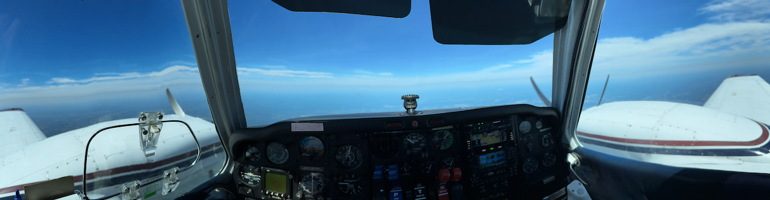
We had a short debrief that covered her impressions of my performance, then we used the computer to print out my Temporary Airman Certificate. This is exactly like a temporary driver’s license; I’ll use it until I get the nice laminated plastic one from the FAA in Oklahoma City. In the meantime, though… I’m a pilot!
2 Comments

Filed under aviation

“Go or No-Go: Heading North”

Air Facts Journal is one of my favorite web publications. I’ve been reading Richard Collins since I was a wee lad (thank you, FLYING Magazine) and the other authors and editors there are every bit as good– I learn something from just about every article. One of my favorite features is their “Go or No Go,” in which you’re presented with a realistic scenario involving a flight: you’re in city X, you want to get to city Y, here’s the weather, here are any other pertinent facts… do you go or not? The discussions around these articles have been really helpful in pointing out to me what my personal minimums and comfort levels are at this stage of my aviation career (which I intend to be long-lived, thus my interest in learning from the experiences of others).

This week’s “Go or No-Go” involves the world’s most famous freight pilot:

Talk about “get-home-itis.” Your trip today is the final leg of a marathon freight dog run, with over 1 billion legs in the logbook so far. The flight has gone flawlessly, but you’re dead tired and would really like to get home to the Mrs. (Claus, that is). But just because you’re the big red man doesn’t mean you can skip the weather briefing, so you take one last glance at your iPad before takeoff.

It shows a good deal of white stuff out there and some serious fog, so it looks like your last flight won’t be easy. The good news is you are very current (23 hours in the last day) and your Mark IV sleigh is in excellent condition. You also don’t have to worry about running out of fuel tonight–you started using renewable energy sources long before it was fashionable–so you can deviate if you need to.

Read the report below and then tell us if you’re going or canceling.

Even if you aren’t a pilot, it’s worth looking at the scenario to get a sense of some of the factors that can influence, positively or negatively, a decision to complete a planned flight. The other scenarios they’ve published make for interesting reading too.

Leave a comment

Filed under aviation

Santa’s checkride

The FAA requires that pilots have what’s known as a biennal flight review, or BFR. Every two years, you have to fly with an instructor, who’s supposed to point out anything you need to work on. Of course, pilots who fly charter, passenger, or cargo flights may have additional “line checks” or other check flights.

To prepare for his checkride, Santa had the elves wash the sled and bathe all the reindeer. Santa got his logbook out and made sure all his paperwork was in order. He knew the examiner would examine all his equipment and truly put his flying skills to the test…

The morning of the checkride arrived. The examiner arrived promptly, introduced himself, and started the inquisition with a barrage of questions. Moving to the hangar, the examiner walked slowly around the sled. He checked the reindeer harnesses, the landing gear, and Rudolph’s nose. He painstakingly reviewed Santa’s weight and balance calculations for the sled’s enormous payload.

Finally, they were ready for the checkride. Santa got in and fastened his seatbelt and shoulder harness and checked the compass. Then the examiner hopped in carrying, to Santa’s surprise, a shotgun.

“What’s that for?!?” asked Santa incredulously.

The examiner winked and said, “I’m not supposed to tell you this ahead of time,” as he leaned over to whisper in Santa’s ear, “but you’re gonna lose an engine on takeoff.”

(hat tip to John at Golf Hotel Whiskey).

Leave a comment

Filed under aviation

Endeavour fly-by

[ this is pretty old– the flyby was 21 September 2012, and I just found this post lingering in my drafts folder. I wrote it with the intention of finding an aviation outlet for it. It would have been much more interesting had I posted it sooner– sorry about that. It turns out that no one wanted a “real” article on the flyby, so I’m publishing this– better late than never.]

“Once in a lifetime” is a perhaps overused phrase. However, with the demise of the Space Shuttle program, almost everything associated with the program has entered its last phase. Endeavour was the last of the shuttles to be built; it was a replacement for Columbia. It is thus fitting that it was the last Shuttle to be retired, and when I found out that its farewell flight would take it through the Bay Area I made plans to see it. NASA announced the route of flight and a tentative schedule a couple of weeks in advance, but I didn’t start planning seriously until a couple of days ago. My first stop: an email to the press coordinator at NASA Ames, asking for press credentials on behalf of Windows IT Pro. Astute readers will know that they don’t usually publish aviation stories (and I am working on a real article for a real aviation publication) but I figured it was worth a shot. Sure enough, they put me on the press access list. 

A few coworkers and I got to talking about how to best take advantage of this once-in-a-lifetime opportunity, and the game was afoot.

The first decision: where would the best viewing be? The route of flight was supposed to take the Shuttle from south to north. At first it looked like the Palo Alto airport might be the simplest place to go: limited crowds, no problem with parking. However, we weren’t sure exactly what path it would take, and I was worried that we wouldn’t get a good angle from the accessible areas. Eric suggested a spot in the wildlife refuge but we ruled that out as well. With press credentials, we reasoned, we shouldn’t have any problem getting on base or getting a good spot.

Eric picked me up at a nearby Taco Bell about 8am and we made our way to the Ellis gate, where we were quickly admitted and directed to the press area. The helpful NASA PAO staff gave us credentials, and we bumped into fellow Acuitan Tim, whom we deputized as a backup photographer. We tried to buy breakfast, but the food trucks were largely out of food since they had opened at 0600, thus illustrating something about early birds and Belgian waffles. As we walked through the line of booths that NASA Ames had set up to showcase their work, I was surprised and pleased at how many young kids were there. The crowd vibe was surprisingly upbeat given the fact that, when you think about it, this was a sad occasion: the final flight of the last of the United States’ fleet of man-rated spacecraft.

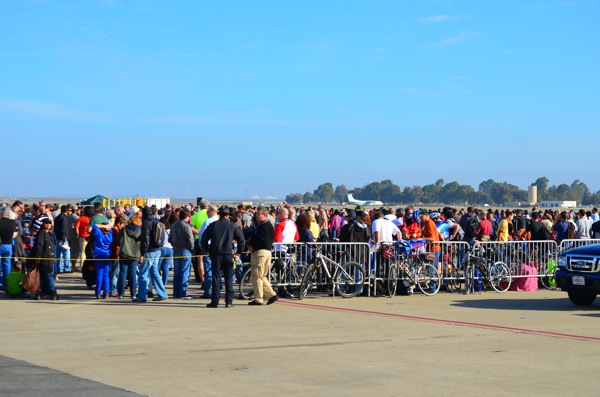
The flight operations building was where we’d planned to watch the flyby. Our press credentials got us in and we made our way through the building to the back apron. Here’s a sample of what it looked like from ground level. 

DSC 0506

We heard estimates of the crowd size ranging from 13,000 to 20,000; I didn’t get a final count from the Ames PAO but it was a large and cheerful crowd.

I made a few exploratory forays to the parking apron to see if anyone yelled at me for being out there. No one did, so our first plan was to set up our tripods out there when the Shuttle got closer, on the theory that setting up too soon might get us ordered back to the seating area. In the meantime, though, we went inside the building to have a look around. Seeing a stairwell, Eric suggested we go see what was on the second floor; Tim volunteered to watch the camera gear and Eric and I went upstairs. The second floor is dedicated to offices for the control tower– Moffett Field, of course, has its own Class C airspace with a control tower, and that tower happens to be located on top of the building we were in. At the end of the hall, we came to another stairwell; a quick exchange of glances was all it took to convince us to go up and see what happened. There we were greeted with an imposing site: a big, black metal gate with a sign warning us not to enter. The gate, however, was open, and we could hear voices coming from above– so after a bit of consultation, during which I believe the word “bail” may have been used once or twice, up we went.

Soon enough we found ourselves on the outside of the control tower. There were some other folks on the east side of the tower, in full sun; we had a shady corner on the west side to ourselves. Amazed at our good fortune, Eric went to go get Tim and the camera gear. He then got to meet the tower chief, who was a little aggrieved that the media was invading the outside of his tower. Eric and Tim were able to convince him to let them rejoin me up top, as you can see below.

Eric and Tim

Here are Eric and Tim  enjoying a moment of peace and quiet before they started slinging camera equipment around.

(I should note that this picture was taken with a Nokia Lumia 800, the camera software for which is about a million times better than the iPhone’s built-in app.) The elbow you see in the extreme right of this picture belonged to Pat, one of the tower managers; he was very friendly and was kind enough to keep us informed about where the Shuttle was during its flight. We had been expecting the Shuttle to fly down the length of the runway from the south; turns out it was going to approach from the north, meaning that it should have  come from right next to Tim’s head in the picture above. We set up our cameras: Eric and Tim had theirs on tripods; I had a camcorder on a monopod and my D5100 around my neck.

We waited; the PA announcer would occasionally give the crowd updates, and at last the call came telling us the aircraft were only a couple of minutes out. We readied our cameras. Surprise! Rather than flying along the runway centerline, as the PAO (and announcer) had repeatedly told us would happen, the Shuttle stack flew along 101– to the west of Moffett– on our side of the control tower! Our seeming bad luck at getting a spot away from the runway turned out to be perfect luck indeed. The Shuttle’s chase aircraft flew down the runway centerline, but I doubt anyone was paying much attention to it.

The actual flyby… wow. I was too busy taking pictures with my camera to notice which way the camcorder was pointed, so I didn’t get any video, and some of my pictures are poorly composed because I was eagerly watching the flyby with my Mark 1, Mod 0 eyeballs instead of looking at the camera. Here are the two best of the resulting pictures:

DSC 0522

DSC 0525

After the flyby, the crowd slowly dissipated; it took us about half an hour to exit Moffett and get back onto 101. 

Leave a comment

Filed under aviation, California

Checkride: the last days

Part of the reason I’ve been so quiet lately is that I’ve been preparing for the check ride for my private pilot’s license. I’ve written before about the requirements for the check ride; just as with your driver’s license, to get a pilot’s licenses you must  demonstrate competency by passing a practical test. Before you are allowed to take the practical test, you must pass a written exam and meet some minimum requirements for the amount and kind of training you need. I have met all the minimums– including flying at night and flying without outside visual reference, using flight instruments alone– and have a check ride scheduled for next week. Since early September, I’ve been practicing various maneuvers and studying the body of knowledge that the examiner will expect me to demonstrate competence in. About a month ago, I got the nod from my instructor: “It’s time. Call the examiner and schedule your check ride.” 

Of course, I did so immediately and was crushed to find out that she couldn’t schedule me until mid-December. Undaunted, I took the first available date and kept on studying and learning. One big focus area for me was landings. The practical test standards require that the applicant demonstrate four kinds of landings:

  • the “regular” kind
  • power-off landings: at a point on the downwind leg of the traffic pattern, you pull the throttle to idle and glide to a landing on the selected runway
  • short-field landings, in which you must pick a point on the runway and land within a specified distance after (but not before) it. This simulates approach and landing to a short runway, or over an obstacle such as a tree, crane, or tower in the approach path. The key to making great short-field landings is airspeed control: if you are going too fast when you cross the runway threshold, your airplane will float on seemingly forever, causing you to miss your touchdown point.
  • soft-field landings, which you might use to land on grass, sand, a plowed field, or other non-paved surfaces. The key here is to land the airplane as softly as possible, which requires quite a bit of finesse (not to mention excellent airspeed control) and to use aerodynamic braking instead of the wheel brakes to slow down.

For extra fun, you can combine these– imagine, for example, that you need to land in a plowed field after an engine failure and you have a power-off soft-field landing. And, of course, there are short- and soft-field takeoffs, too. Being able to do these consistently is critical, because each type of takeoff and landing has characteristic speeds and distances that the examiner will evaluate. I can honestly say that my landings have improved beyond the point I thought possible– if you’d told me a year ago that I could land my airplane safely in 500′ of runway I wouldn’t have believed it.

FAA check rides are supposed to be based on realistic scenarios. Here’s the extent of the guidance I got from the examiner:

I’m planning on meeting you at 9am (traffic permitting).  You can plan xctry to KPRB, calculate takeoff and landing distances over a 50ft obstacle and I’m 120lbs with no bags for weight and balance.  Go ahead and preflight and assure fuel is as desired.

I have a destination and I know how much payload I need to haul (in this case, right about 300 lbs). Other than that, the route, fuel on board, altitude, intermediate stops if any, and every other aspect of the flight are up to me as the pilot-in-command (PIC). This nicely reflects the common uses for light aircraft: go to a specified destination with a passenger, with all the other factors being subject to the PIC’s judgement. To meet the requirements for this scenario, I need to be able to show the examiner a solid flight plan, taking into account weather, terrain, airport availability, and any other considerations that might impact my ability to get us safely there and back. (The only slightly unusual aspect of this plan is that my flight plan needs to include obstacle clearance; there currently aren’t any obstacles at Palo Alto or Paso Robles, but the FAA requires that applicants show that they know how to plan for obstacle clearance, so thus it shall be.) I need to show that I can file a flight plan and deal with air traffic control (ATC) as we fly, including canceling the flight plan when we divert and dealing with any instructions that ATC may give us en route. 

Before we get to that point I have to prove that the airplane is airworthy, which I’ll do by showing that its maintenance records are up to date and that any required inspection or maintenance has been performed. This is really part of the oral exam, which is more or less continuous: the examiner will be evaluating my knowledge from the minute I shake her hand and say “hello” until she signs my temporary license. The examiner can ask anything she likes about any aspect of what private pilots are supposed to know, and I’d better be able to answer correctly. She is also expected to create what the FAA calls a “realistic distraction” to see how I handle it; this means she can try to distract me by talking, dropping an object and asking me to pick it up, or anything else that a passenger might reasonably do in flight. 

Will we actually fly to Paso Robles? Nope. At some point along the route, the examiner will divert me to an alternate destination, simulating a change in weather at the destination or perhaps a passenger who has to go to the bathroom RIGHT NOW I MEAN IT. The examiner will also simulate an in-flight emergency that requires a simulated emergency landing. She can also fail, or simulate failure of, anything else in the airplane, including navigation and communications systems. I’ll also have to demonstrate the maneuvers called for in the PTS, which will be done somewhere along our route of flight. 

There’s a surprising amount of paperwork that has to happen first. The FAA uses a system called IACRA to process applicant paperwork. I had to fill out an application in IACRA, then my flight instructor had to log in to IACRA and approve it; along with an endorsement in my logbook, this signals the examiner that I’ve met the skill and knowledge requirements to attempt the practical test. Updating my logbook and completing the IACRA paperwork took me a couple of hours, but I finished it this morning. All the paperwork is done, so all I need now is a good night’s sleep on Monday and good weather on Tuesday! 

3 Comments

Filed under aviation

Air traffic control call signs

I am a huge fan of LiveATC.net. I often listen to the San Jose airport control tower and/or NORCAL Approach as background noise at home, in the office, or while driving; it is always interesting and often educational. One of the most interesting things I’ve heard is the variety of callsigns for different aircraft and operators. Some of these are pretty prosaic– if you hear “UPS 9336 Heavy” or “Southwest 229” that tells you everything you need to know. There are some others that are more colorful, though:

  • “Traffic Watch” is a popular call during rush hour.
  • Stanford (“Stanford One”) and several other medical helicopter operators are unpredictably active; you never know when they’ll pop up.
  • There’s at least one Boeing Business Jet operating out of SJC with the call sign “Boeing 1 Tango Sierra”; I haven’t taken the time to figure out whose it is, but I’m betting Google.
  • “Redstripe” is the call sign for JetSuite, a private fractional-ownership jet company.
  • I’m not sure who owns the “Starbase” call sign but it sounds cool on the radio. The only references I could find to it were here and here, and they’re inconclusive. (Looks like the FAA thinks the second one is dispositive.)
  • “Dotcom” is an umbrella call sign offered by FltPlan.com; you can sign up for their service and then use one of their calls (e.g. “Dotcom 521”) instead of your aircraft registration number. This is useful to keep your competitors (or other interested parties) from performing physical traffic analysis on your airplanes.

There’s a pretty good list of airline callsigns that covers many international airlines, and it looks like the FAA’s official list is here (for some reason it doesn’t seem to be well indexed in Google). Other fun callsigns on the FAA list: Sputter,  Jigsaw, Flapjack,  Raptor, and Argonaut. Maybe I should print out a copy and start checking off the ones that I hear!

2 Comments

Filed under aviation

Please stay home, Mr. President

Our dear leader, President Obama, is coming to the Bay Area on Monday. (Why he’s coming is unclear to me; it’s not as though Romney has any chance of winning California, so I presume it’s so Obama can raise money from his legions of wealthy fans out here.)

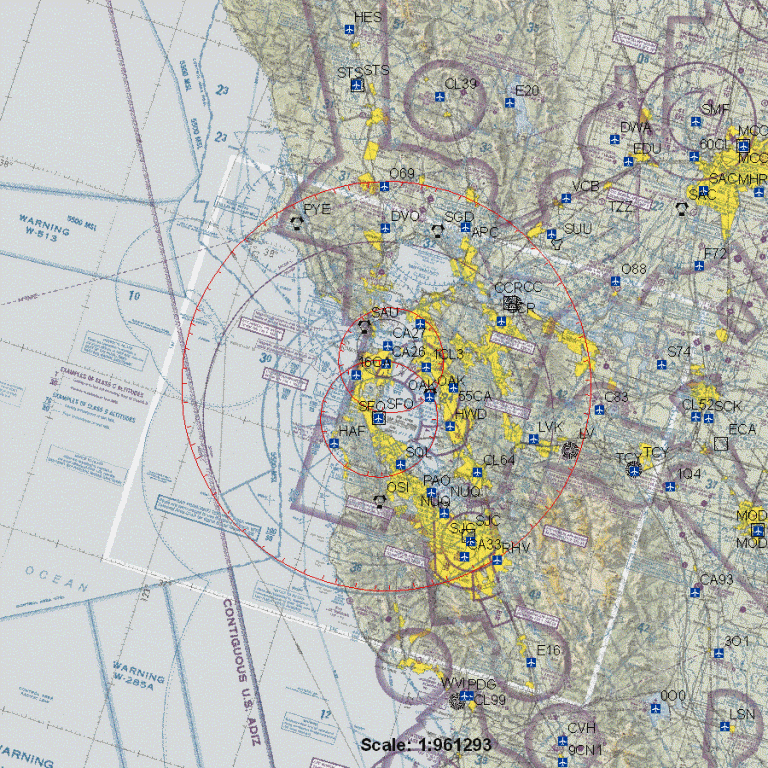
Anyway, the point of this post is to point out what happens when he’s here. The picture below will help illustrate my complaint.

oct-tfr

See those red rings? During his visit, most private aircraft are essentially not allowed to fly within those rings; flight training (and cropdusting, and animal control, and a long list of other operations) are specifically prohibited, and there are other restrictions. Commercial passenger and cargo flights are exempt, luckily (otherwise AA passengers departing SFO Monday would be in even more trouble, hey ho!)

The largest ring is a 35-nautical-mile radius centered around the San Francisco (SFO) VOR. That takes in the Palo Alto, San Jose, Oakland, and San Carlos airports. So from 1pm Monday until 10am Tuesday,  the dozens of instructors and hundreds of students training at those airports are grounded. That means an immediate loss of several thousand dollars per instructor– and the losses are greater for flight schools themselves.

More to the point, this is just a further delay in my pursuit of my license, as I can’t fly during that time unless I am actively, y’know, going somewhere.

Oh, and the best part: the geographic and time restrictions of this temporary flight restriction can change at any time. So I could, in theory, inadvertently and innocently violate it if it changes while I am in flight. This is rare and unlikely, thank goodness.

So thank you, Mr. President. I’m glad you’re doing your part to help the economy. See also previous helpful contributions here and here. (substitute “Bush”, “Romney,” or the name of your favorite post-9/11 president above if it makes you feel better, although President Obama has been a worse offender in this respect than was President Bush.)

1 Comment

Filed under aviation, FAIL

Thursday trivia #72

  • Last week’s 311 show was as good as I expected it to be. I’m already looking forward to their tour next year.
  • Rwanda has an awesome national… I’m not sure what to call it. It’s not a holiday, and it’s more than a tradition. By law, on the last Saturday of every month, everyone cleans. Known as umuganda, it’s a long-standing event that goes back to colonial times. Business close, public transport shuts down, and all able-bodied people between 18 and 65 clean from 8am until 11am.  What a fantastic idea.
  • I learned the preceding, and much more, from this thoroughly interesting article on Rwanda. I think I’m going to have to add it as a bucket-list destination.
  • If you are easily grossed out, do not read this article. No, seriously. I really mean it.
  • If you’re a Breaking Bad fan, I commend this remix video to your attention.
  • Who would buy once-radioactive beer? I mean, besides me.” /raises hand.
  • Last week I wrote about the process of preparing for my checkride. This guy passed his checkride… after two of the blades on his propeller fell off. I bet everything after the emergency landing was easy.

Leave a comment

Filed under aviation, General Stuff