Race report: 2018 Marine Corps Marathon

I had an idea earlier this year: “I should think about trying to run the Marine Corps Marathon.”

Like many of the ideas I have, this one was of questionable value, but it happened this past weekend so I thought I’d write about how it came to fruition.

In truth, I’d always thought that, in the unlikely event I ever ran a marathon, I’d like it to be the MCM. The “unlikely event” part went away back in 2016 when I ran Rocket City, but I didn’t have any burning ambition to do another one. Then I saw that the Marine Corps had added a new race: the Marine Corps 17.75K (1775 was the Corps’ founding year). Finishing it granted automatic entry to MCM. I entered the lottery for the 17.75K and, to my surprise, got in… but the race itself fell on the same day as the funeral of my beloved Aunt Norma, so I didn’t get to run it. I begrudgingly entered the lottery for MCM, not expecting to get in… and then I did.

Training

I strained a hamstring 2 weeks before the Chattanooga 70.3— so since late April, I have been intermittently unable to run more than a couple of miles. My coach has kept me on the bike to continue to keep my cardio base, along with some weight work, and the hammy seemed to be getting steadily better. Two weeks before MCM, I’d planned to run the London Royal Parks 13.1, which went swimmingly. I was encouraged that my hamstring didn’t hurt, and that I felt good during and after that race… to a point.

(skip the below if you’re not a runner or don’t care about running shoes)

See, last year I had a persistent, nagging problem with my right knee’s IT band. Skipping the boring details, let’s just say I eventually figured out that it was caused by my shoes, so I switched shoes but then started having a different problem with my calves. Welcome to distance running! I finally found a pair of Nike Structure 21s that seemed to work really well for me… until I started doing runs of longer than about 8 miles. Then I started having soreness in the outside of my left foot… so back to the shoe store I went, returning this time with a pair of On Cloudflow shoes. They seemed to work really well, except that after the London race I felt the calf pain returning. I waffled for a solid week before my coach finally suggested I run the marathon in them anyway, since they worked fine during the race. This seemed reasonable… after all, who cares if they’re sore after the race? That’s what I planned to do.

(ok, it’s safe to start reading again)

Coach Jon didn’t follow the usual gospel of having increasingly long runs as marathon prep— my longest scheduled run was 15mi, the week after London. I made it through 10 before my hamstring was bothering me too much to continue. For the 4 or 5 weeks preceding the race, I kept seeing people in the MCM group on Facebook talk about their 18, 20, 22, etc. mile runs and so I was a little nervous about being undertrained. However, I knew that, barring a serious injury, I’d be able to complete the race and cross the finish line, even if it wasn’t in the time that I had wanted, so I wasn’t unduly nervous (or so I thought at the time!)

Travel and arrival

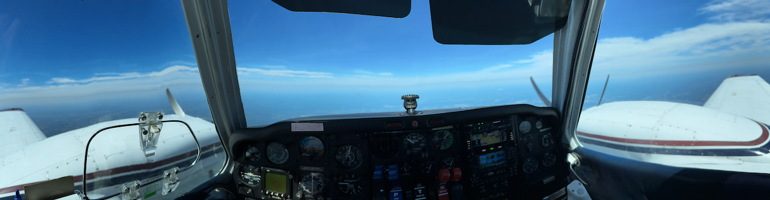
My friend Ashley had deferred her MCM entry last year and decided that this would be her year to run it as well. Our mutual friend Erica came along as cheerleader and sherpa, so we loaded up the airplane on a cloudy Friday morning and set out from Decatur. 
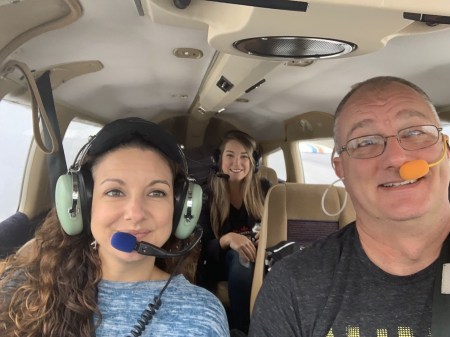
 

In the plane

taken while the weather was still nice

We flew into Potomac Friendly (so named because it’s in Friendly, MD). I’ll do a separate Flying Friday post on the flight itself, which was the most difficult flight I’ve ever flown. The weather was, shall we say, not awesome, but I got plenty of solid time in IMC, all hand-flown because our autopilot is down for maintenance. I picked Potomac because it’s one of the so-called “MD3” airports that are closest in to downtown DC (the others being Hyde Field and College Park). Potomac is a small airport with a short runway, but it has inexpensive fuel and is a short drive from downtown (by DC standards). We parked the plane and then Ashley’s BFF Candice picked us up and drove us to the runners’ expo at the Gaylord convention center. 

The expo was fun. Packet pickup was quick and efficient. Each runner got a clear plastic bag (to be used later for gear drop-off) with a mock turtleneck race shirt, a race patch, and a very nice printed race guide. All the major vendors and sponsors were at the expo, including Brooks (the main running-gear sponsor), Carb Boom (the nutrition sponsor), USAA, and so on. I managed to limit my expo spending to one T-shirt, one Christmas tree ornament, and one coffee mug, mostly because I’d already bought a race jacket directly from Brooks. There was a lot of other stuff I could happily have bought, though!
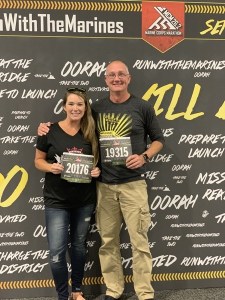
at the logo wall

proud to say I had the only Waffle House shirt in the place— thanks, Anna

Candice suggested Succotash for dinner, and it was superb. The chicken and waffles were the best I’ve ever had. Portions were generous, which is good because it was fairly expensive. (Drink prices are ridiculous, a trend I noted throughout DC, but what are you gonna do.) 

On the advice of my friend Ingrid, I’d booked a room at the Ritz-Carlton Pentagon City, because it’s easy walking distance to the start line. Thankfully I had stashed away enough Marriott points to get it for free. My expectations of the “Ritz-Carlton” brand name were sky high, so I was a little disappointed that the hotel is basically a nicer-than-usual Marriott property, not the oasis of luxury I’d pictured. The staff were extremely friendly and pleasant, and it was marvelous being right next to the Fashion City mall, which has both a DC Metro stop and a Starbucks. 

The day before

There’s a tremendously active (and welcoming!) Facebook group for MCM participants, and they’d scheduled a shakeout run on Saturday morning. I took a Lyft over (funny story for another time about when Lyft thinks you’ve been in an accident in one of their vehicles) and met the group near the Smithsonian metro station. The weather was windy, rainy, and cool— low 50s— but it was a fun run anyway. I hadn’t brought any rain gear, so I was pretty drenched by the time we got done, but in a good way.
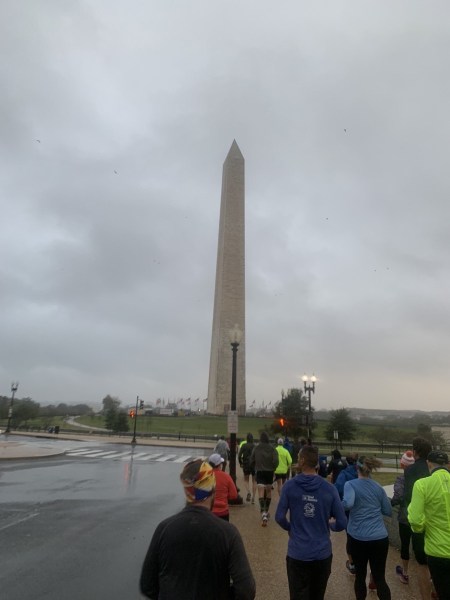
IMG 0263

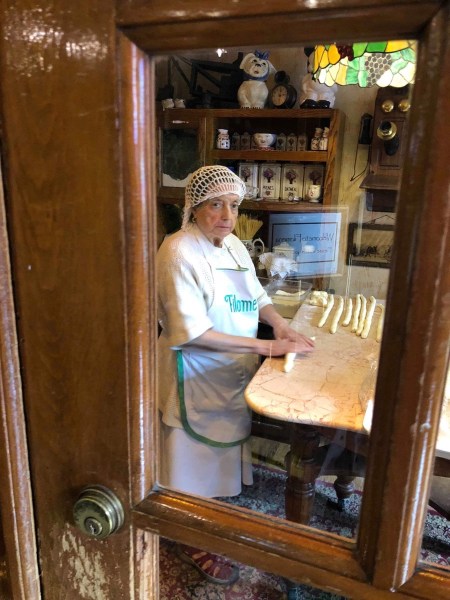
After another Lyft ride back to the hotel and a quick cleanup (and a giant coffee), we met up for a little sightseeing. First (because hello, have you met me?) we went to Port City Brewing to give them a try; after all, their motto is “We put the ‘ale’ in ‘Alexandria.’” Good beer and a nice atmosphere, but they didn’t have any food, which was a bit of a problem. Then it was off to Georgetown for lunch. Candice had suggested an Italian restaurant called Filomena. Let me just be clear and say that this was, unequivocally, the best-decorated restaurant I’ve ever been to and had the best Italian food I’ve ever had.

When you walk in the door, the first thing you see is the room where the pasta is made. In our case, that included an Italian grandma giving us malocchio

IMG 0281

Don’t mess with grandma

Besides the food, Filomena is famous for their elaborate holiday decorations. There’s a discreet little sign at the entrance cautioning parents that they may want to consider their kids’ maturity levels before entering the restaurant proper. Here’s a small sample…

56235539856 FD9FC1EE 4CA1 41F4 8CF1 56BE386CBD1D

at this point I was so hungry that no amount of demon decoration would spoil my appetite

The food! I ate a large plate of cannelloni with Italian sausage, plus what seemed like a loaf and a half of table bread, then the remaining half of Candice’s lasagna. I only stopped because I was in literal fear of bursting. This wasn’t just ordinary gluttony, of course; I’d had a very light breakfast and a late lunch, with the intention of having a big lunch and a very light dinner, all with a goal of not having to rush to the porta-potties on race morning. (Look up “ileal brake” if you want to know why this strategy works.)

Neither Ashley nor I wanted to do a lot of walking pre-race, so we drove over to the Navy Yard and explored a bit, then I made an early night of it— I watched maybe the first 15 minutes of the Saints game and then was out like a light, but not before doing one last gear layout to make sure Flat Paul was good to go:
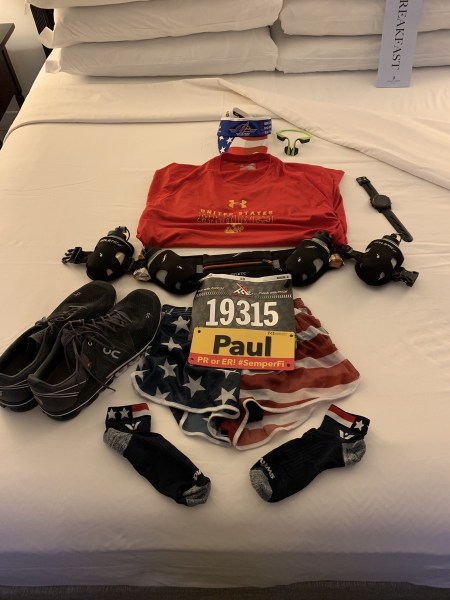
IMG 0260


Race day

Normally I don’t have race nerves. This time, I did, but not for any good reason; I woke up about 4a and tossed and turned for a bit, mostly just because I was excited. Then it was time to get up and get my race prep on. I’d already mixed up 4 bottles of Gatorade Endurance and stashed them in the room fridge, and I’d loaded up my belt with 7 Gu packets. I didn’t do a good job of prepping for breakfast though; I ended up eating a Payday bar, a protein bar, some applesauce from the runners’ expo, and a Gu. The DC Metro opened at 6, so promptly at 6 I was lined up for the turnstile and then took the train to the Pentagon station.
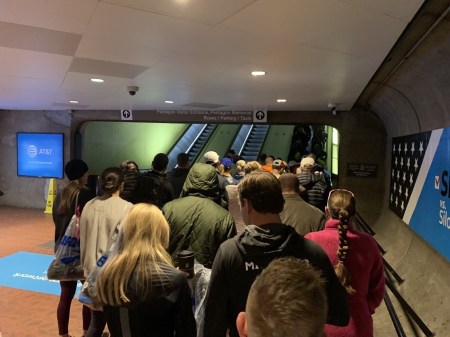
IMG 0282

the first of many lines for the morning

The layout of the race is such that the start is on highway 110 between the Pentagon and Arlington National Cemetery. When I got off the train, I followed the giant herd of runners to the runners’ village, where I checked in the provided clear plastic bag of post-race gear. One neat thing about this process is that each race bib has a UPS sticker on the back with a truck number (mine was 19). To check your gear, you take your bag to the matching truck, then the trucks move to the finish area. Simple and quick. I had plenty of time to mill around the runners’ village, which was pointless since there was nothing there— so instead, I headed out to the start line area, another 10min walk away. It was a scenic walk, though.

IMG 0283

For the first time this year, MCM was using a corral start, but they only had 3 corrals. I wanted to try to grab on to the 4:30 pace group and see how long I could hang on, but they were in the next corral up. Even though I got to the front of my corral, the polite yet firm young second lieutenants stationed there weren’t letting anyone move up a corral. (Somehow Ashley managed to sneak through though.)

IMG 0286

my people at the head of the green corral

This positioning turned out to be pretty much perfect— to my left was a small tower. The event announcer kept up a continual patter leading up to the 745a start for the wheelchair and handcart division, which was immediately preceded by an MV-22 flyover. After their start, we had a few more minutes before the 755a main start, which was filled by another MV-22 flyover and two parachute jumps: one mass jump and one pair carrying a large American flag. Both were aiming for a blue smoke grenade, which was at the small tower near my position, so I had a great view.

Promptly at 755a, the starter fired the howitzer and it was race time.

The race

Some race reports tediously go over every single mile. I won’t do that here (but you can see all the race data, my mile splits, and so on here if you’re interested.) Instead, I want to capture some impressions.

First, the crowd. As in London, I was running with and near people at all times, and it was amazingly energizing. The spectators were a spectacle in themselves. The variety and quality of supportive race signs, and the volume of cheering, far exceeded my expectations. Any time the course ran through a city area, the sidewalks were packed— the only time we didn’t have large crowds were when we were on the open road or a bridge. Take a look at the picture below, taken on Rock Creek Parkway, and you’ll see what I mean.
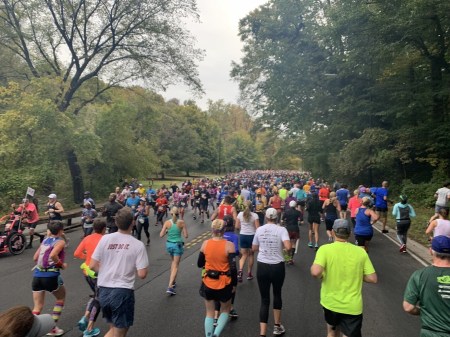
IMG 0291


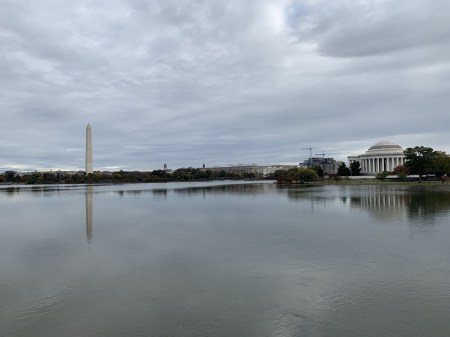
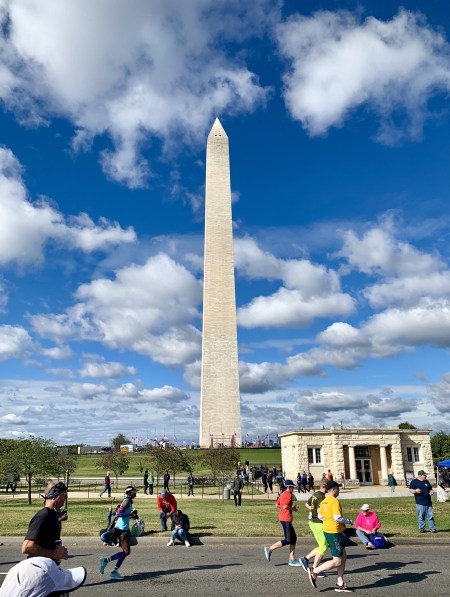
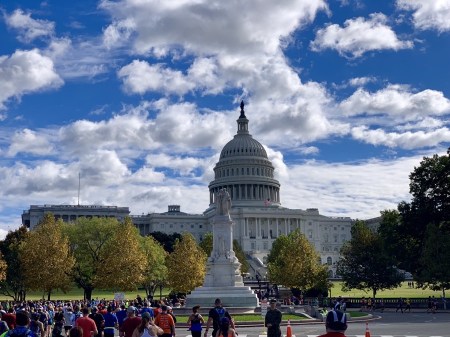
Second, the course itself. What a gorgeous tour of our nation’s capital.

IMG 0290IMG 0296IMG 0299IMG 0301

Third, the wear blue Mile. Words can’t capture the emotions of running this part of the course. I took my headphones off and silently read the name of each fallen American to myself as I ran by, not in any particular hurry. It was a tremendously moving part of the course and I’m getting a little teary just thinking about it as I type this.

Overall, I felt really good for the first 14 or so, then started to flag a little coming out of Hains Point. My average pace got a bit slower, and in Crystal City (starting about mile 23) I took a couple of walk and stretch breaks.

And, of course, because this is the Marine Corps Marathon, it ends on a hill. Seriously.

A note on race gear and strategy

I have been really frustrated lately by my Stryd pod. When I use it with my Garmin Fenix3 HR, I get power dropouts just like I did with my Stages power meter on the bike. When I use the Stryd app on my Apple Watch, the pod often disconnects, and when it’s disconnected the app thinks you’re not running— so in London, the app recorded my run as 10ish miles. So I did what any reasonable person would do: I ran with both the Garmin and the Apple Watch. (And my phone, although that was for music and cheers.) This turned out to be a good strategy, because the Stryd app on the Apple Watch just flat-out stopped recording my run when I rebooted my phone, which I didn’t think it was supposed to do.

My original plan was to try and hold a steady power with the PowerRace app on the Garmin. This was torpedoed when I discovered the dropout issue. My backup plan was to set the Garmin to give me an alert if my heart rate went over 150 and then run based on that. I’d also set a 5:00 run/1:00 walk interval timer, just in case I needed it late in the race… but I didn’t, so that was awesome.

My original goal was ‘beat my previous marathon PR.’ My A goal was to go 4:30 or better. I didn’t quite accomplish that, mostly because I ran an extra mile. That’s right. I managed to turn a 26.2 mile race into a 27.2 mile race. At my average pace of 10:49/mile, that cost me just under 11 minutes. However, I also took lots of pictures on the course, stopped for a few stretches, and even drank some whisky, so I am not at all dissatisfied with how things turned out.
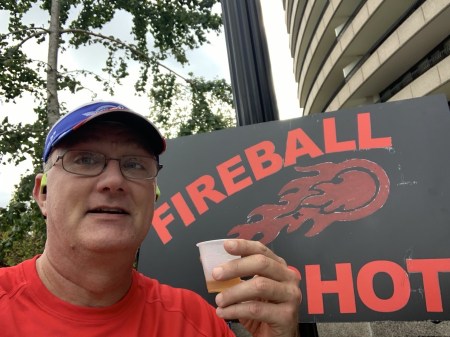
IMG 0303

The finish line experience

After running up the aforementioned hill and through the finishers’ corral, each finisher is presented the coveted race medal by a Marine. I got a fresh-cheeked second lieutenant newly sprung from Quantico; he hung the medal around my neck, shook my hand, and called me “sir.” The corral dumps runners out at the base of the Iwo Jima monument, a perfect photo spot.
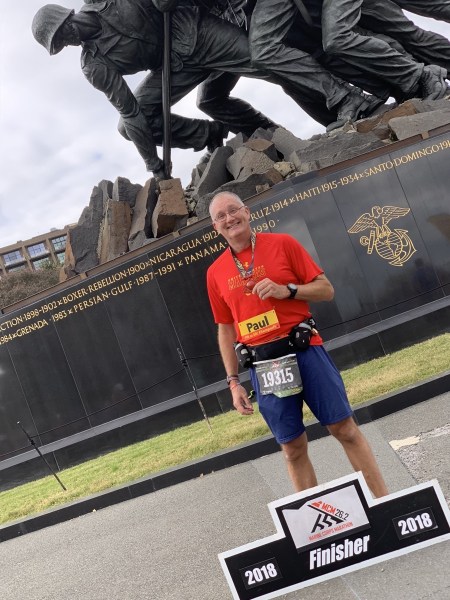
IMG 2440

Ashley had finished the race before me (of course), but she found me for some photo opportunities.
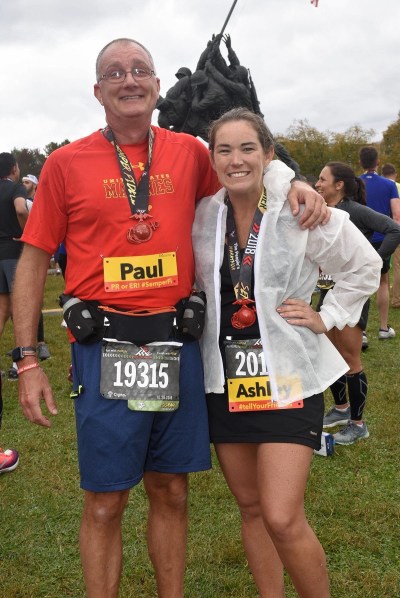
857688 282461256 XLarge

Post-race

Surprisingly, I had very few mobility or soreness problems immediately post-race. None of us wanted to walk around a whole lot, so after a badly needed hot shower and some coffee, we met fellow complete human Zach at Farmers Fishers Bakers, another excellent Candice selection, for a celebratory dinner. Once again, I was in bed by 8 and asleep shortly thereafter.

In the following days, I’m delighted to say that I’ve had zero hamstring pain, zero side-foot pain (except some mechanical wear on my toes—no lost toenails etc), and felt great in my recovery work this week.

Overall, I couldn’t have asked for a better experience. I am eager to run this race again next year.

Oh, right— I didn’t mention my finish time yet. 4:55:20, so a solid 14 minute PR. If I’d cut a few more tangents and taken a few less pictures, I could easily have gone sub-4:45, and with a bit more training 4:30 is within striking distance. That’s my goal for the Rocket City Marathon in December. See you there!

Leave a comment

Filed under Fitness, Travel

Training Tuesday: Royal Parks Half Marathon race report

I very much enjoy running in new places, and I love destination races. With that in mind, it’s not surprising that I was excited to find out that there’s a giant half-marathon in London, the Royal Parks Foundation Half Marathon. It’s a fundraiser for the foundation that maintains London’s 8 Royal Parks (including Hyde Park, Kensington Gardens, and so on); in the 10 years of its existence, it raised more than £36 million for the upkeep of the parks and for other charities. Because the race is run by a nonprofit, seemingly every charity in the UK (and many global ones as well) have fundraising efforts and charity teams for the race. The race course cuts through four of the eight parks, and is almost completely flat. Runners start in Hyde Park, run east through St James’s Park (and past Buckingham Palace!), up the Strand and then back again, with detours through Trafalgar Square and down to Downing Street, then through Hyde Park and Kensington Gardens. The photos on the race web site show an abundance of fall colors and sunshine… which is not exactly what happened.

I’d registered for the race lottery and didn’t get in, so the Royal Parks folks kept my entry fee and sent me a nice hoodie to cushion my disappointment. It didn’t, given that the hoodie arrived in July, which is not usually hoodie weather in Alabama. Quadrotech decided to sponsor a corporate team, so I got in through that route. I later learned that most runners get into the race through charity registrations, and in future my plan is to raise funds for London’s Air Ambulance (which is a charity!) so I can get one of these exceptionally cool running shirts:

327C2F98 06B4 44C2 AD56 D052D31EC51D

I got to London Thursday morning before the race and worked in our London office Thursday and Friday, running 5 miles Thursday. Both days were cool and gloomy, and there was lots of discussion about Sunday’s forecast of temperatures in the low 50s and rain. Saturday turned out glorious— I ran 8 miles along the Regents’ Canal in lovely sunshine, with temperatures in the high 60s. The scenery was pretty grand…

The Regents Canal

IMG 0137

IMG 0138

After my run, I went out for pizza and watched First Man (pretty good; maybe wait for Netflix though.) A good night’s sleep and I awoke to… exactly the promised weather. Lot 50s, steady wind, and rain. I donned the rain gear I’d brought and headed out to the Moorgate Tube station. Once I hit Piccadilly, the Tube was completely jammed with runners and spectators making their way to Hyde Park. That’s one thing I hadn’t considered: even in a city the size of London, a race with 16,000 runners means that there are a ton of people packed into a relatively small area.

Now, a brief sidebar on race organization. The race organizers will mail race packets ahead of time, for free, if you ask them to, which I did; however, because we’d re-registered me as a team member, my packet went to our office instead, so when I got to the race site, I had to meet my teammates to get my bib so I would know what corral I was in, then drop off my post-race clothes at the baggage drop, then make my traditional pre-race pilgrimage to the portapotties, then go to the start.

f you’ve never run a large race, you may not realize this, but most large endurance races group runners by pace and then send them into corrals so runners of similar speed start together. This race had… 3 corrals total. That’s not a lot for 16,000 runners. There were long lines at baggage drop and for the toilets, and I got increasingly nervous as we got closer and closer to the 9am race start time. I needn’t have worried though— it turns out that even with those two long waits, I got into the line for my corral at 915am and actually crossed the start line at 927am. This was fine because the race is chip timed, so the time doesn’t start until you actually cross the timing mat. Here’s what the corral looked like before I started:

The corral

Once I crossed the start line, I was in a crowd until I finished. That’s a major difference from the races I normally run, especially triathlons— since you’re running after swimming and biking, differences in individual speed means people tend to be pretty spread out on the race course. Here’s an example from the leg through Hyde Park late in the race:

IMG 0167One of the best things about the race was the spectator presence. There were people pretty much lining the course whenever it was along a road, and for maybe 80% of the course length through parks. Lots of signs, and at least three or four bands (three drum corps I can recall). Several of the corporate and charity sponsors had big cheering stations set up, which was fun. Overall the race had a remarkable energy to it, the more so considering that the weather wasn’t great.

And then there was the race course scenery…

IMG 0163

Did not see any members of the Royal Family

IMG 0169IMG 0164

This cracked me up. I’m quite surprised it was deemed necessary

A word about race gear: I ran in a pair of On Cloudflows that I bought a week or so before the race, a pair of generic shorts, and my Rocket City Marathon race shirt. I started the race with a light rain jacket and a hat, but shed both of those mid-race— but I was glad to have them when it started raining just after I crossed the finish. The Cloudflows really felt good during the race, but I have since discovered that as I build volume, they aren’t cushioned enough so they’ve gone back to the store. I also bought a pair of Trekz Titanium bone-conduction earphones using some accumulated Amazon gift cards, figuring they might be worth a try. They sound good but feel a bit odd, and I’m not convinced that they’re better than the Plantronics BackBeat Fits I had been using. The Trekz would be great for cycling though, so I may keep them just for that.

I also ran with my Apple Watch paired to my Stryd footpod. This has been my normal daily running setup since April or so, and it’s worked very well, but for some reason on this race, the pod kept disconnecting— my final run showed up as only 10.2 miles. Best guess is that the pod doesn’t gracefully handle the case where my phone and watch are both connected to it. I only take my phone running when I want to take pictures… and I’ll absolutely want to take pictures at the Marine Corps Marathon. In many ways, this race was a dry run for MCM: I tried to use the same gear, nutrition, etc that I plan to use there, thus the test of the new shoes. This particular race prides itself on sustainability, so the race medals are made of reclaimed wood; the shirts are ring-spun bamboo; and so on. there’s nothing available on the course except water (no bananas, gels, sports drink, etc). I ran with a Fitletic bottle belt with 2 extra bottles; the one problem with this belt is that with all 4 bottles on it, the weight of the bottles stretches the belt enough for it to gradually work its way down towards my knees. The solution is to drink from the back bottles first (or just fill them halfway); I’ve already got the length adjusted to its shortest extent. That’s really good to know, since I don’t want to spend 26.2 miles in DC hitching my belt back up where it belongs.

I haven’t said anything really about the run itself so far. It was great. I held a much faster pace than I expected to be able to and ran my second-fastest half marathon time ever: 2:03:14. I took time to take pictures on the course, so that might have shaved another 2 min off my time, but I wasn’t running this for a PR, and I wasn’t wrecked after the race. In fact, I had a great run the next morning before leaving to go to the airport.

IMG 0175

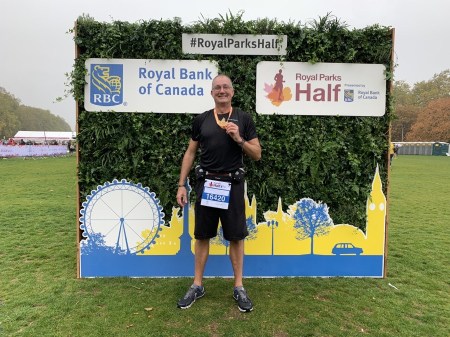
See, I even look happy here despite standing in the rain for an inordinate amount of time.

706ec1eb 2f93 4016 b854 3b120d72c5ce

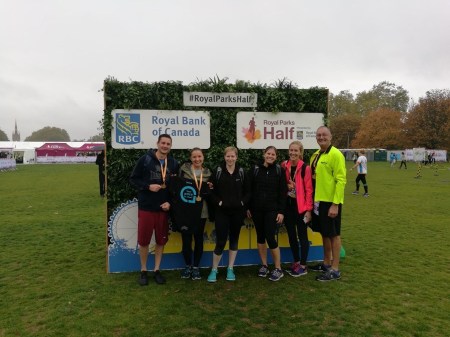
The Quadrofam!

IMG 0184

My reward for a good run: a Sunday roast (not shown: the incredible dessert brownie they brought after I cleaned my plate)

Overall, it was a fantastic experience— I loved the crowd energy and can’t wait to carry forward what I learned to the Marine Corps Marathon! I will absolutely be entering the lottery for the 2019 Royal Parks event, too.

3 Comments

Filed under Fitness, Travel

Office 365 Exposed, episode 12:

As per tradition, Tony Redmond and I got together at Microsoft Ignite 2018 in Orlando to record a new episode of “Office 365 Exposed” podcast. The Ignite organizers make studios available for this purpose, which is most appreciated. We were joined by special guest and noted humorist Greg Taylor, recently-appointed Microsoft Director of Marketing for Exchange and Exchange Online, to discuss the conference, some announcements made at the event, what Exchange 2019 means for on-premises customers, and what’s happening with Microsoft 365. It’s an easy 45-minute listen.

1 Comment

Filed under Office 365, Podcasts

Training Tuesday: riding the Cote d’Azur

Recently I had the opportunity to do something remarkable: go for a bike ride in Provence! I had to be in the UK for business one week and in Nice the following week, so I was debating what I should do with a free weekend in Europe. Once I learned that there were bike-tour operators near Nice, I quickly decided to find one that could get me out on the road for some portion of the weekend.

Thanks to a recommendation from my local triathlete friend Kate, I found Azur Cycle Tours,  whose guided-rides option sounded perfect. There are a fair number of other tour operators that do longer multi-day tours, too, but Azur was the first I found that could set me up for a one-day ride, including use of a rental bike. I made all the arrangements via email with Justin, the owner, who was prompt and communicative in our exchanges.

I planned to arrive at the Nice airport Friday evening, spend Saturday poking around the area, and then ride on Sunday. Justin agreed to supply a road bike, and I planned to bring my PowerTap pedal power meter, a bike computer, and clothes and shoes. I booked a room at the Azur Cycle Tours apartment for two nights, packed my bags, and arrived there shortly after midnight– a good four hours later than originally planned. Justin was kind enough not to snap at me and gave me a quick tour of the apartment, which was exactly as promised on the web site: modern, comfortable, and well situated near shopping, restaurants, the beach, and the Beaulieu-sur-mer train station.

The next morning I woke up to this glorious view…

Balcony view from the apartment

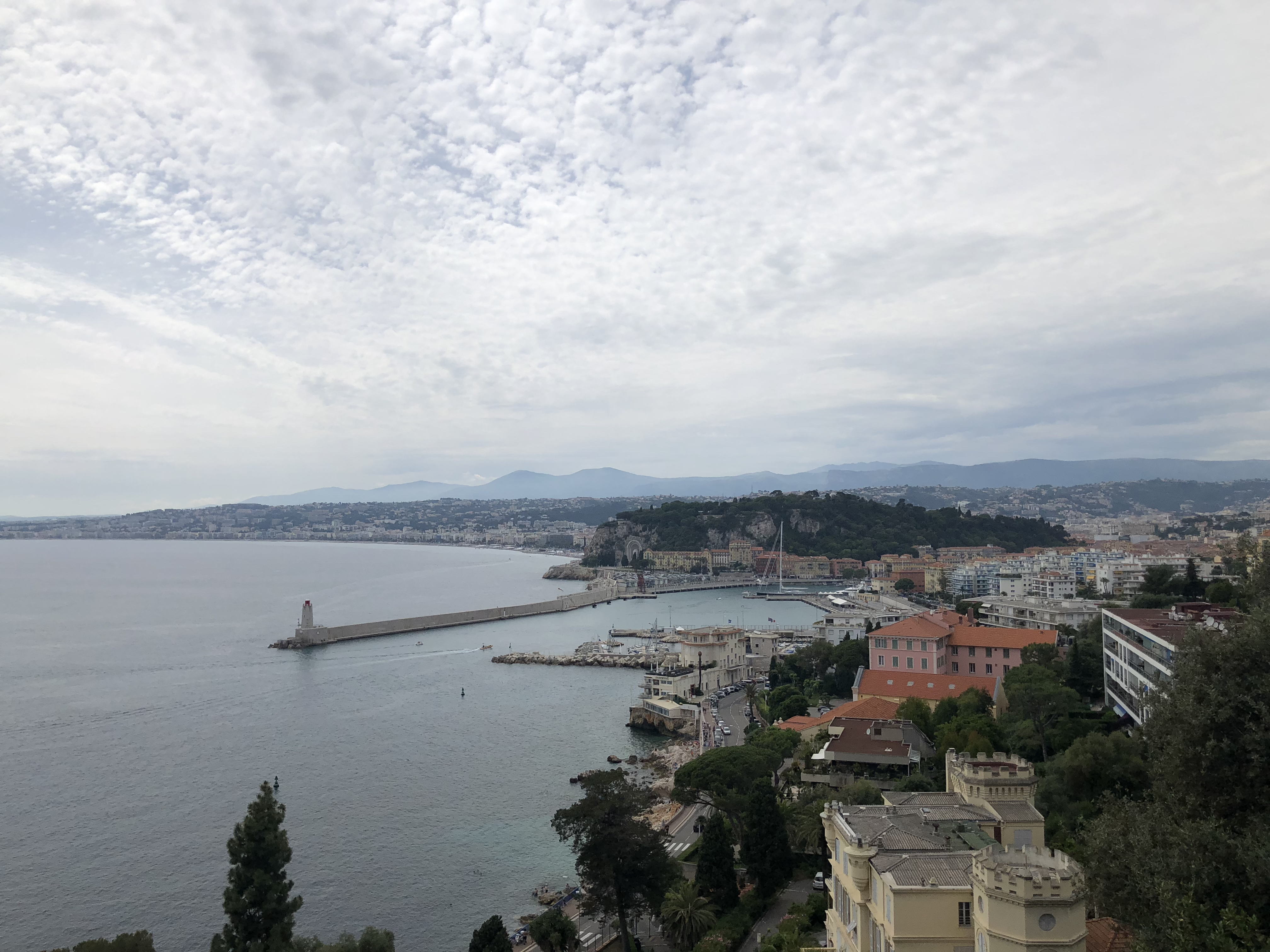
Justin, as promised, had prepared a hearty breakfast of oatmeal, fresh berries, and bread from the boulangerie up the road. We had a pleasant chat about the local area, then he left to go lead rides and I donned a 10kg weight vest and went for a walk around town. I strolled down along the beach (named “La Petite Afrique” for some reason) and then walked along the Basse Corniche up over a hill for a ways. This treated me to some splendid views of the water and the dozens of large seagoing yachts anchored at various spots.

After I walked back to the apartment and dropped off my weight vest, I decided to walk into Beaulieu and find lunch. As I passed the train station, I had a better idea: why not go have lunch in Monaco? I bought a train ticket and headed off, and in 20 minutes or so I was disembarking at the Monaco station. It became clear pretty quickly where I was when I saw this:

20180602_131233701_iOS

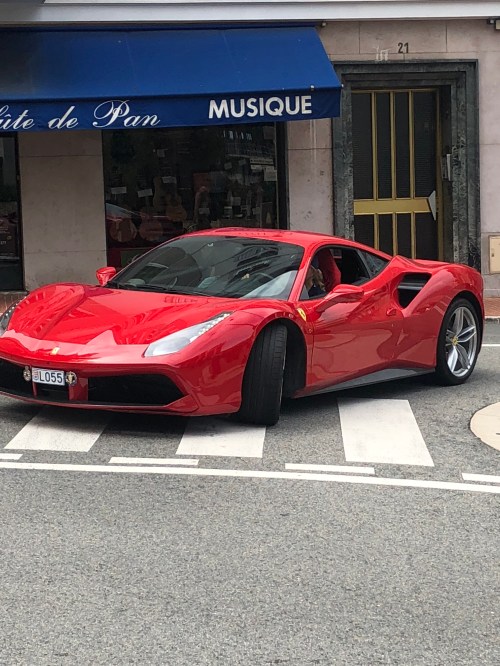
I walked down to the Casino, where I was surprised and delighted to find a classic-car rally in progress. For a “modest” donation to the Prince’s favorite charity (something to do with heart disease, as I recall), you could rent any of a number of privately owned classic cars and drive them around. Here are a few of the stunners on display.

My favorite was the Aventador, though; without a doubt it is the most beautiful manufactured object I’ve ever seen in person. Sadly this photo doesn’t do it justice.

20180602_133037223_iOS

The casino itself isn’t too shabby either.

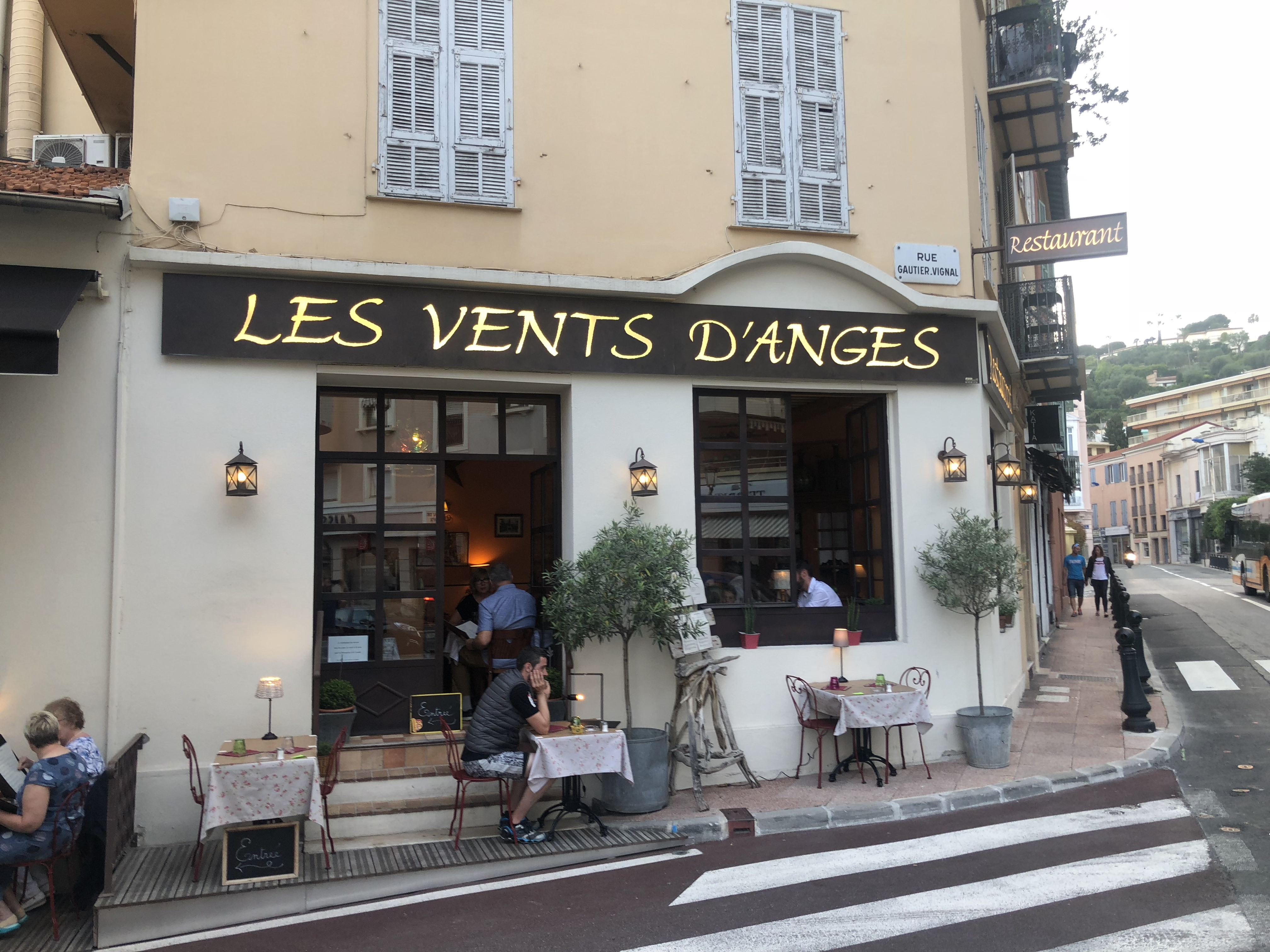
I walked around the casino area for a while, taking pictures as the mood struck me. It’s a delightful area for people-watching, of course, and there was plenty of that on offer. I saw and heard tourists from all over the place. Then I took the train back to Beaulieu, where Justin suggested to me that I try dinner at Les Vents des Anges in town. The highlight was this salad, consisting of warmed rounds of goat cheese on toasted local bread with fresh greens and peppers. It was, hands down, the best salad I’ve ever eaten, and the wine and entree (saltimbocca, in this case) were equally good. A short walk back home, and then it was bedtime.

The next morning dawned sunny and clear. Justin and I had planned to meet for breakfast at 730 then roll out shortly thereafter. It took 20 min or so to mount my pedals, bike computer, and camera on the bike, get it adjusted, and so on, then we rolled out. Check out this route….

Relive ‘Do Epic Shit: Beaulieu to Tourrette and back’

//cdn.embedly.com/widgets/platform.js

We were able to leave Beaulieu and head west into Nice, starting with a short climb into Villefranche and then riding along Nice’s excellent cycle path that parallels the famous Promenade des Anglais. Then the ride started in earnest. Our first stop was in La Colle-sur-Loup for a snack, which in this case was a marvelous berry tart and a cup of poisonously strong coffee. The whole town square, and most of the surrounding streets, were filled with… a PTA fundraiser for the village school. Yep. You read that right. Change the language on the signs, bring in some box-mix cupcakes, and turn all the volunteering moms into non-smokers and the whole event could have been plucked right from suburban America.

Best. dessert. ever,

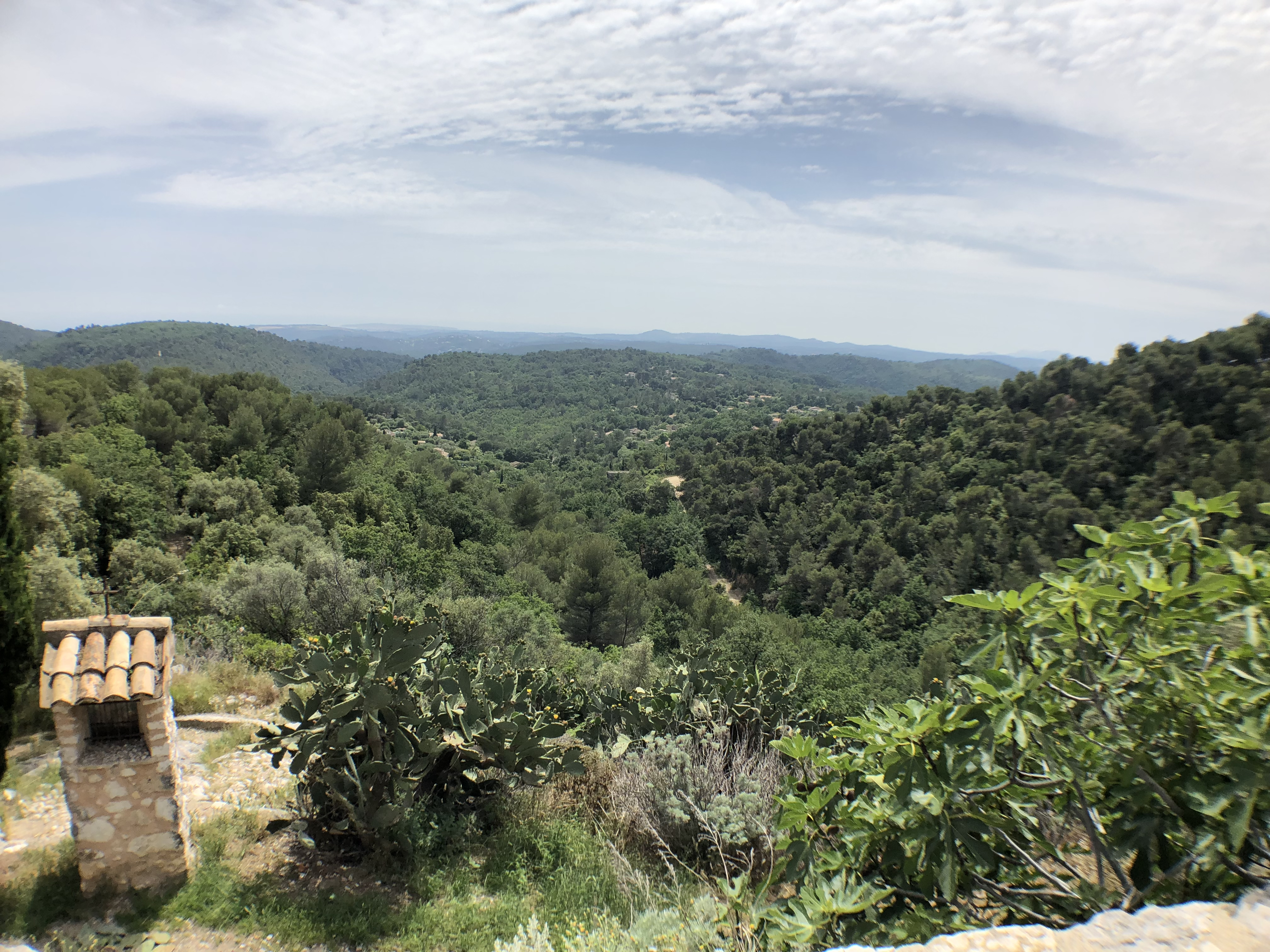
Then back on the road! The toughest part of the ride was just ahead: the long climb into Tourrette-sur-Loup, which interestingly enough is part of the Ironman Nice course. This offered remarkable scenery in all directions, including up and down.

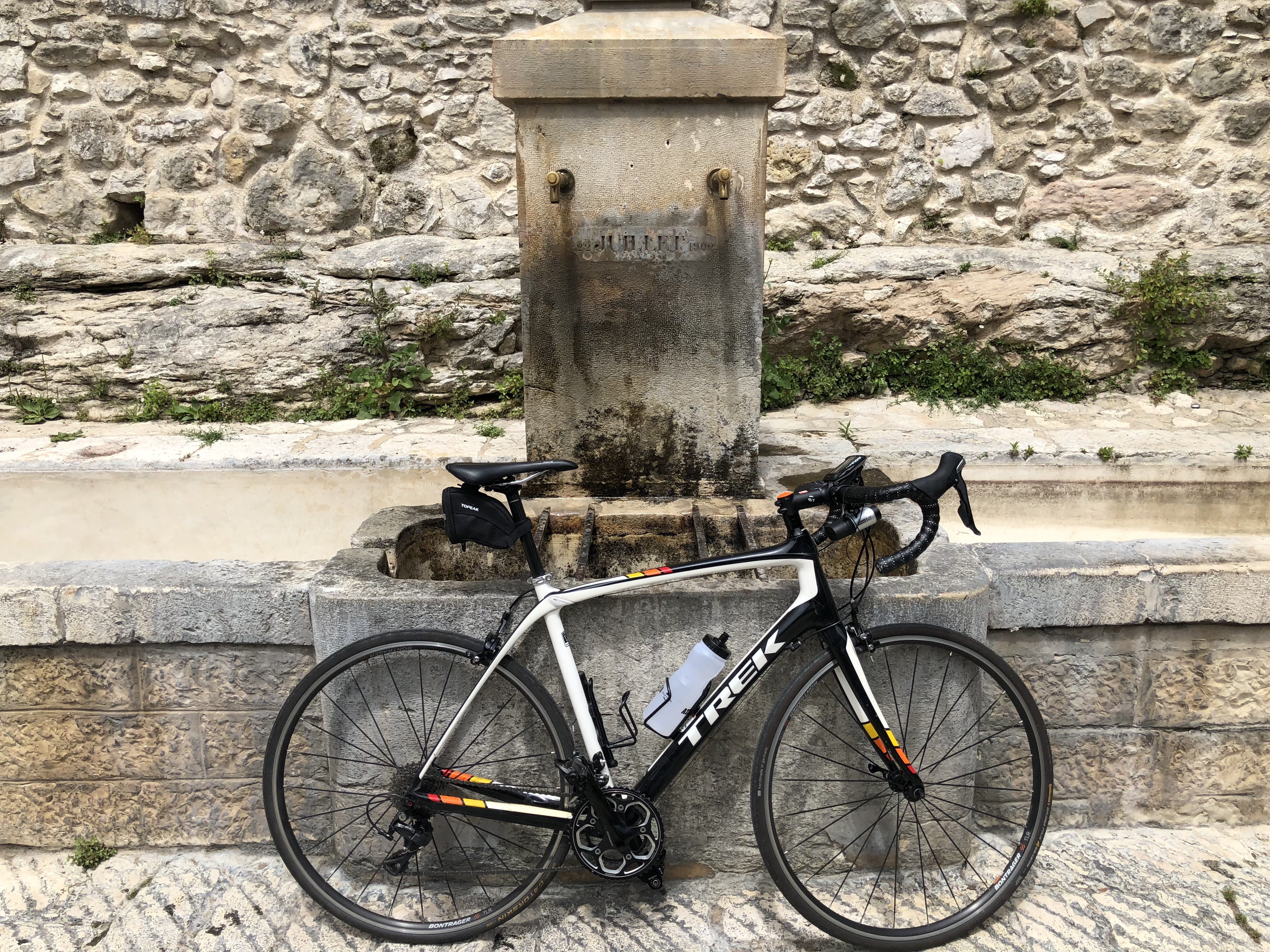
We stopped in Tourrette-sur-Loup for a splendid lunch: another great salad and a marvelous lasagna. (Italian food is pretty common in this part of France, perhaps unsurprising given how close Italy is). We also filled our bike bottles at the municipal fountain. Nearly every village has one, and the water at each of the ones we sampled was clear, cold, and delightfully fresh.

After lunch, we rolled back into Nice along a slightly different route– no steep descents, but a very pleasant series of switchbacks and hairpins. It took me nearly this long to understand why the bike Justin rented me seemed so smooth and quiet compared to my Cervelo P2: I have race wheels with a racheting freehub, so when I coast, they make that super-cool clicking noise. This bike didn’t have that, plus the drivetrain was adjusted to approximately the precision level of the Space Shuttle, so it was a delightfully smooth and quiet ride.

Along the way, I was able to pause to take a couple of photos of scenic spots. Also along the way, we made one final stop for ice cream, which I sadly forgot to take a picture of.

A note about the roads: even in this rural area, the roads we rode on were marvelously smooth and well-maintained, with good markings and signage. About 99% of the drivers we encountered gave us a wide passing margin, and I never felt unsafe or threatened. We saw a few dozen other cyclists along the route and everyone was friendly.

Back at the apartment post-ride, I used the provided laundry machines to wash my kit while I drank a beer and looked out at the water, then, reluctantly, I packed my stuff and departed for my next leg of the trip.

Overall, I could not be more pleased with the Azur Cycle Tours experience. Justin was an excellent host, with encyclopedic knowledge of the local area and route. He kept up an informative and interesting commentary about what we were seeing as we rode; he chose a route that was appropriate for my skill level but still challenging, and he made me feel like a welcome guest instead of the tour du jour. I am looking forward to returning and riding a more challenging route in the future!

[ed. note: I wrote this using a Windows machine and I refuse to deal with its stupidity when it comes to entering accented characters– please be reassured that my French spelling is better than shown here.] 

Leave a comment

Filed under Fitness, Travel

Training Tuesday: riding bike courses with Rouvy

I got a smart trainer (a Wahoo KICKR SNAP) last November but didn’t really start trying to use it until a couple of months ago. Since then, I’ve had a few different experiences getting it to work with various accessories and features. I now have it working reliably with three different programming sources:

  • I can manually control the trainer using the Wahoo ELEMNT bike computer. This lets me set the trainer to hold a particular effort level so I can just steadily pedal, or to load interval workouts that I’ve created or been assigned in TrainingPeaks.
  • I can drive the trainer using the Zwift app. This allows me to ride through a video-game-looking world with other virtual riders; there are courses that cover London and Richmond, along with a mythical island kingdom known as Watopia.
  • I can ride Sufferfest videos, which I love doing, and the app can control the resistance of the trainer according to whatever workout I’m supposed to be doing.

However, there’s one programming source I hadn’t tried yet– I wanted to experiment with riding a real-world route. Specifically, I wanted to ride the IRONMAN 70.3 Chattanooga bike course on the trainer, so that I could see the course and get used to the hills, but the weather was bad on the course-preview-ride day and the logistics didn’t work out for me to get there another time. I figured I’d try doing it in software.

First I downloaded Bkool, because a friend of mine had recommended it. After signing up for the free trial, I found that the app would crash immediately after sign-in 100% of the time on my iPad. Thank goodness for free trials.

Then I went to poke around the DC Rainmaker site and found this typically thorough guide to trainer apps. After reading it, I downloaded 2 more apps: FulGaz and Rouvy. Like Bkool, they both have free trials.

I tried FulGaz first and was really impressed with how pretty it was– but it didn’t have the Chattanooga course, so that was that.

Next I tried Rouvy. Signup went flawlessly and I found the Chattanooga course, loaded it, and started riding.

What I didn’t notice is that it was the Chattanooga 70.3 World Championship course. I couldn’t figure out why it was so damn hilly and tough. Eventually I did figure it out. But that’s another story.

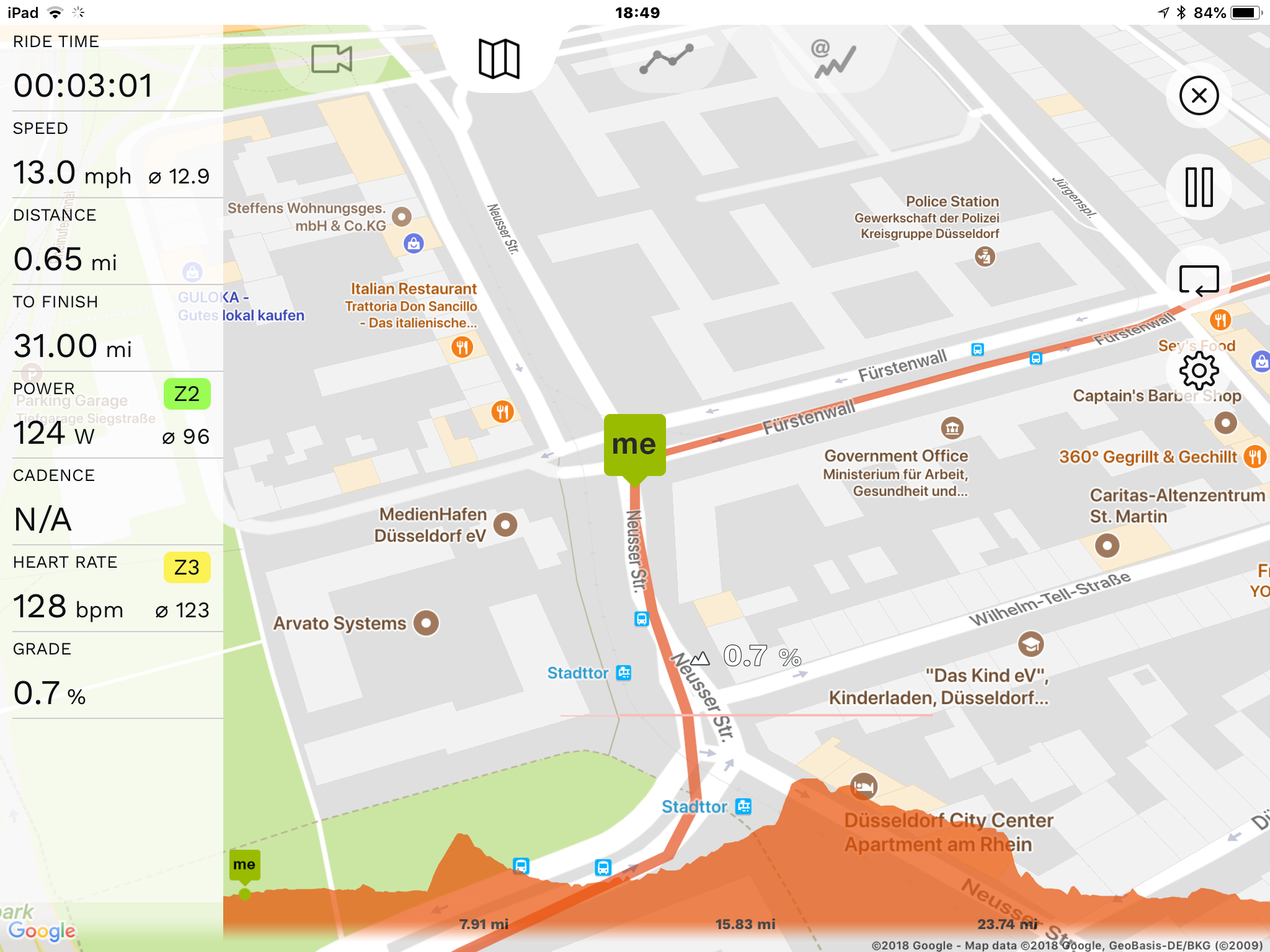
Below are a few screen shots from a ride I did the other day along the route for stage 1 of the 2017 Tour de France. Rouvy shows three or four views, depending on how the course is set up. The first view is the default, showing you a Google Maps-based view of the area, with a data pane on the left showing pace, power, etc. You can see that I’m at the very beginning of the stage, which started in Dusseldorf. You’ll see this view any time there’s no video associated with the course.

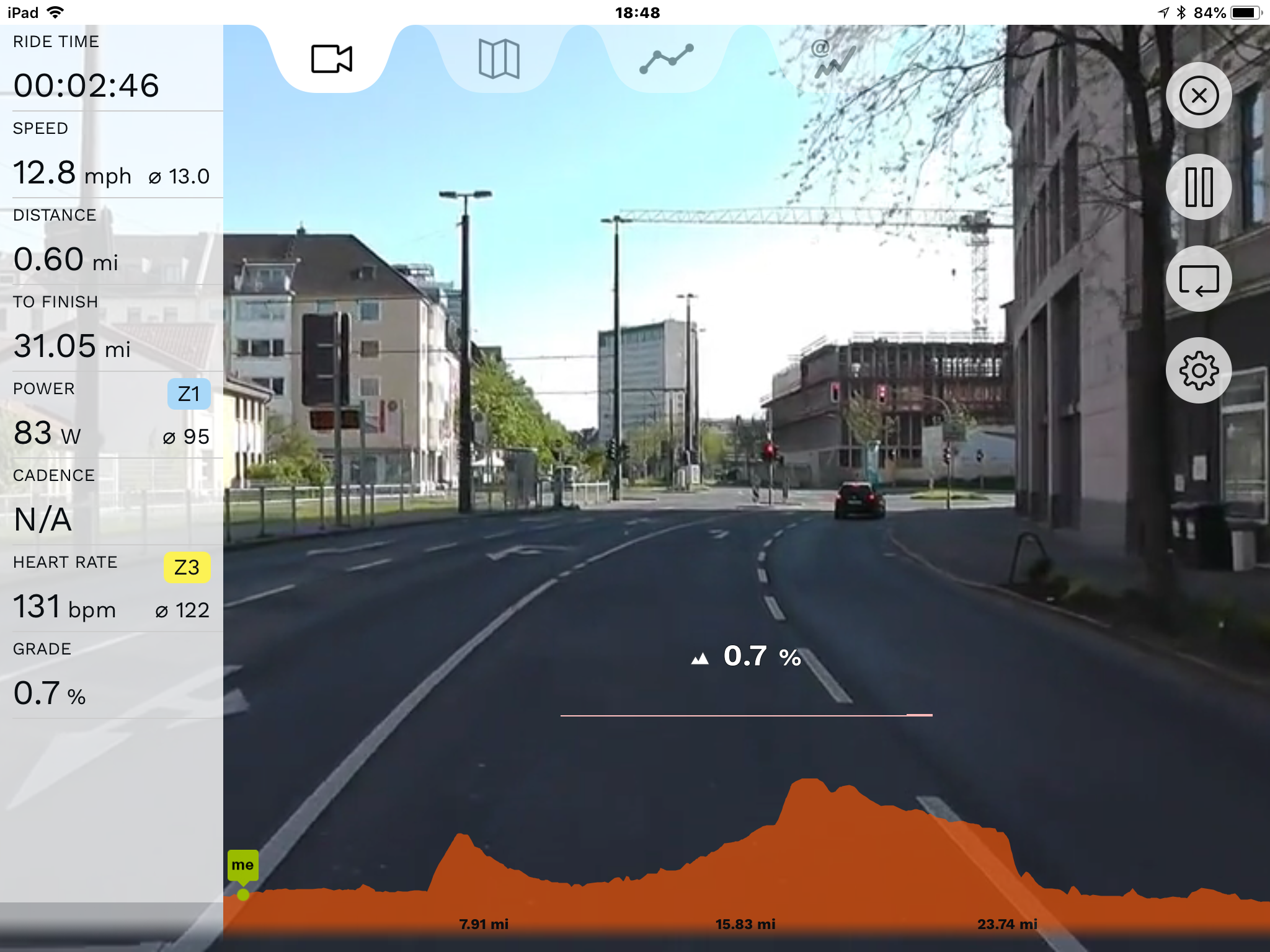
The course view shows you what you’d see if you were actually riding on the course. You can see power, pace, and so on in the left pane, and there’s a helpful horizontal scale that shows you the current incline (0.7% in this case) along with the upcoming incline. The video is synchronized to your pace, so the faster you pedal, the faster you appear to be riding. Different routes have different video quality, depending on what kind of camera the rider used, whether it was stabilized, and so on.

Rolling through Dusseldorf

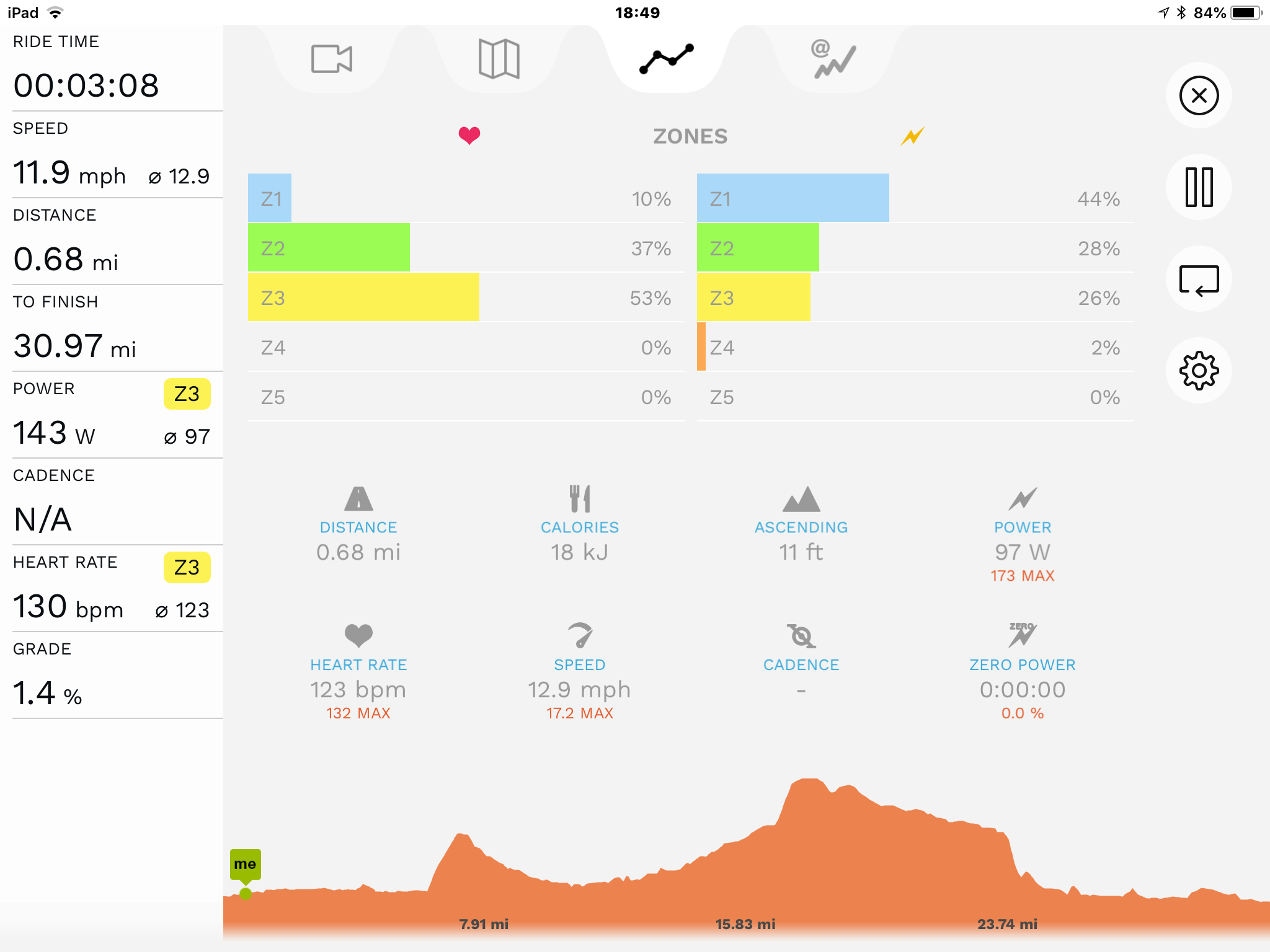
The next view is all data. I don’t really want to look at this view when riding, but it’s there if you like it.


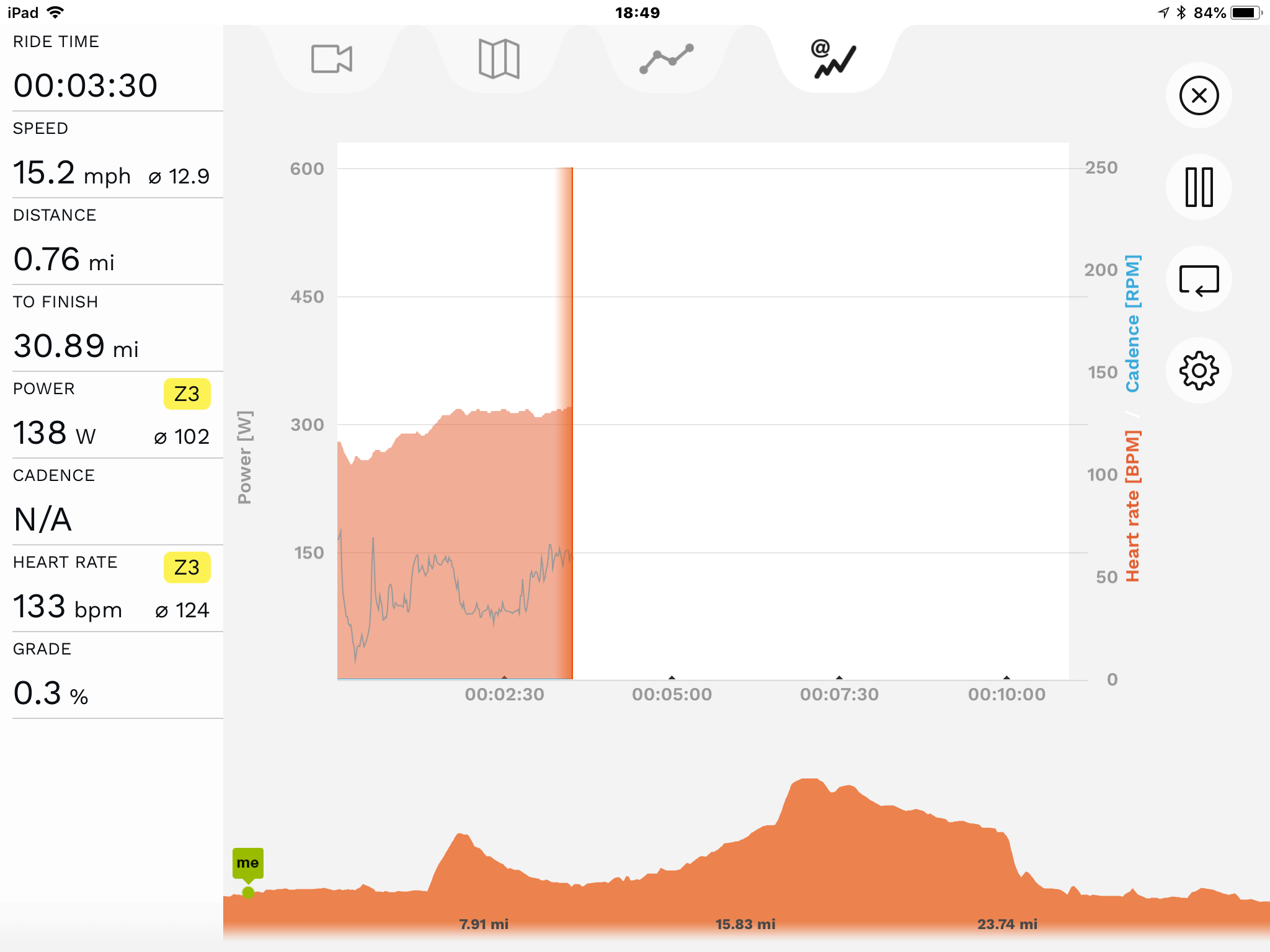
The fourth view, shown above, shows you a real-time strip-chart-style view of your 3 key metrics: heart rate, pedal cadence, and power output. You also get the profile view along the bottom to show you the terrain you’re riding over.

Everything I did with Rouvy worked flawlessly: when I finished my rides, they were automatically uploaded to Strava and TrainingPeaks, the auto-pause and auto-resume features worked well mid-ride, and I didn’t have any problems with video dropouts or freezes, application crashes, or other ill behavior.

I need a few more rides with it to make sure, but I love the idea of being able to ride a real course, with video when I want to see it. Typically if I’m doing an interval workout I’ll use a Sufferfest video and stream it to the projector; if I’m doing an endurance ride I’ll put on Zwift (so I get some variety in the route and terrain) and leave it on the iPad while I watch Netflix or something on the projector. The ability to ride a real route, with high quality video on the projector, might be enough to get me to change that habit.

Leave a comment

Filed under Fitness

Azure Portal search: a tale in 4 pictures

Sorry that my first blog post in a while is a complaint, but, hey, at least you’re not paying a subscription fee for it.

We ran into an odd problem with our work Microsoft Teams environment. (I’ll blog more about the details once I confirm that it’s fixed; we’re still troubleshooting it.) Thanks to valiant efforts by Tony Redmond and the Teams engineering team, the root cause was tentatively identified as one of the Teams microservices being disabled. I needed to re-enable it.

First stop, the “Enterprise Applications” blade of the Azure portal. Note the list below is the default view, and it’s all you get– a naive user might assume that the list shows all applications in the AAD tenant because the filters are set to “application status any” and “application visibility any,” and the list appears to go from A through W.

portal-01

But noooooo. Notice that there’s no entry for “Microsoft Teams,” which I know perfectly well is enabled. OK then, let’s try setting the “Show” pulldown to “Microsoft applications.” Set that filter, click “Apply,” and check out the results.

portal-02

Huh. Still no entry for Teams. This time I notice the text in the search field: “First 20 shown, to search all your applications, enter a display name or the application ID.” All right, fine, I’ll try searching for “Teams”. Type that in, hit return, and…

portal-03

Well, that seems wrong. Let me try “Microsoft”. That produced a good-sized list of results, very few of which showed up in any of the preceding screenshots.. but only one entry showed up with a name of “Microsoft Teams.”

Finally, Vasil Michev took pity on me and told me to search for “Microsoft Teams.” Et voilà…

portal-04

There’s the problem child. A couple of clicks later, the service was enabled as intended.

Now, sure, in the grand scheme of things this is a minor issue. There’s so much stuff in the Azure portal, and so many great Azure services, that I can understand that maybe search in this one little corner of the portal isn’t a priority.

Having said that: this is an embarrassing thing to get wrong, and it’s emblematic of similar problems across other Microsoft properties (let’s not even talk about how bad content search is in the Teams client, or why I can’t search Exchange Online archive mailboxes on the Mac Outlook client).

Seriously– fix it, Microsoft.


1 Comment

Filed under General Tech Stuff, UC&C

Office 365 Exposed, episode 11: Spectre, Meltdown, and the O365 Admin

This episode was recorded at the Continental Hotel in Budapest, where Tony and I were joined by Office 365 MVPs Alan Byrne and Vasil Michev. We explore the wonders of the Spectre/Meltdown vulnerability and learn how it affects– or doesn’t affect– Exchange and Office 365 administrators– and we finally have a name for our “point/counterpoint” segment. Tune in to find out what it is.

1 Comment

Filed under Office 365, Podcasts

RIP Bob Thompson

I was very sorry to learn today that my friend Robert Bruce Thompson passed away last night after a short illness. Bob and I worked together on a number of book proposals, none of which ever made the cut. We both had the same agent and wrote books for O’Reilly and Associates during their heyday, so we had many long conversations about writing and life. Bob’s probably best known for his books on PC hardware troubleshooting, but he wrote on a wide variety of other technical topics.

Bob was a very early adopter of blogging and maintained a regular daily blog for many years. For the last few years, his site contained a wealth of information about food storage and prepping, with a practical and fact-based vent often absent from prepper sites.

Bob had impeccable personal integrity and a strong sense of right and wrong. While we disagreed on more than a few things, I appreciated his willingness to learn new things and consider different viewpoints.

Bob’s survived by his wife, Barbara, and his faithful border collies.

I will miss you, Bob.

Leave a comment

Filed under General Stuff

2017 in review: flying

2017 was a moderately busy flying year: I got to 670 TT, with 100.5 PIC hours this year. 8.9 hours of night time and 12.6 actual instrument.

My flights in 2017

Highlights for the year included flying to Charleston to see my family just before the eclipse; discovering how birds build nests while flying my team to American Odyssey; taking my friends Tony and Alan on sightseeing flights over Orlando at sunset, having two in-flight alternator belt failures, taking my mom for her first flight in the plane, and sneaking over for a quick day trip to Atlanta to see one of my oldest friends for lunch– all things that would have been impossible without an airplane.

At the end of 2016 one of my 2017 goals was to get my commercial license. That’s still on my list for this year, along with getting to the big Oshkosh airshow, a long cross-country trip to Vegas, and logging as much time going interesting places as I can. Here’s to a flying year!

Leave a comment

Filed under aviation

2017 in review: my reading list

Earlier I posted my top-10 book list for 2017. Now here’s the rest of what I read, more or less in chronological order. I think there are probably a few other books that I missed somehow (e.g. I remember reading a book about the practicalities of emigrating to Costa Rica but can’t find it on my list).

Underground Airlines. What if the Civil War had never happened? Gripping tale of a present-day system of smuggling slaves out of the slave states, and what the commercialization of forced labor might look like in the US.

Dark Matter. Well-plotted thriller with some strong SF elements.

It’s a Long Story: My Life. If you like Willie Nelson you’ll probably like this. If you don’t, not so much. Heavy on the folksiness.

A Girl In Time. Meh. A time-traveling cowboy abducts a Seattle game designer to help him find his lost daughter. Not one of Birmingham’s better efforts IMHO.

No More Mr. Nice Guy. Thesis: there’s a condition known as “nice guy syndrome” that causes many men to become resentful and unhappy. Interesting read with a lot of immediate applicability in my life.

Only the Truth. Confusing plot but hey, it was free on Kindle Unlimited.

Amerika. WW II alternate history: the Nazis get atomic weapons and we don’t, so a thriving American resistance emerges, led in part by a Pan Am flying-boat pilot. Fast-paced and atmospheric.

The Prisoner. Another excellent John Wells novel from Alex Berenson.

To The Bright and Shining SunOne of James Lee Burke’s earliest novels, this has nothing to do with the Robicheaux or Holland families but is still well worth reading– a complex tale of a young Kentucky coal miner’s coming of age.

At Speed. Cyclist Mark Cavendish’s memoirs. Interesting at a technical level but made me think that I wouldn’t enjoy hanging out with him very much.

A Grain of Truth. Set in Poland and featuring Teodor Szacki, one of my favorite literary anti-heroes. Revealing portrayal of modern Polish culture.

Amerika: Call to Arms. The American resistance rides again.

Fields of Fire. Book 5 of Marko Kloos’ excellent military sci-fi series.

Entanglement. The first of the Teodor Szacki crime novels. Better to read this first before tackling A Grain of Truth.

War Shadows. Enjoyable if predictable yarn about valiant soldiers fighting The Bad Guys.

Prince of ThornsKing of ThornsEmperor of Thorns: Medievalist fantasy series that puts a nifty twist on the Prodigal Son story. This genre isn’t my usual fare but I enjoyed the series.

Sleeping Giants. Aliens come to Earth. A little girl discovers one of their artifacts, then grows up to be an eminent physicist who helps unravel the mystery behind their presence. Not too shabby.

Anansi Boys: re-read this classic Neil Gaiman retelling of the trickster legend. Still just as good as it was back in the day.

Anathemre-read this one too. For my money, this is probably Stephenson’s best world-building, although it is slow to develop and there are a lot of Gibsonesque leaps that require you to pay careful attention to new terms and concepts that are just thrown in.

Split SecondThoroughly enjoyed this twist on familiar time-travel themes: a physicist discovers time travel but it only lets you send objects back a few milliseconds. Hijinks ensue.

Snapshot. Detective novel set in a world where high-fidelity simulations allow cops to recreate murder scenes with perfect accuracy. Not bad but didn’t love it.

Beach Lawyer. Well-written legal thriller– there are a ton of plot twists in this so I had to go back and re-read some passages to make sure I didn’t lose the bubble.

Carrier Pilot. Fascinating memoir of a World War II Corsair pilot in the RAF. Nice change from my typical diet of WW II reading from the American perspective.

The Brave OnesAffecting memoir by a man who joined the Army at age 41 and ends up in the 82d Airborne Division.

The War Planners, The War StagePawns of the Pacifictrilogy in which the Chinese mount a false-flag operation to get a group of brilliant US engineers and scientists to devise a foolproof war plan to attack the US. A novel concept, well-plotted and nicely executed.

Sled DriverThis book by Brian Shul covers his time as an SR-71 pilot. Fascinating if you’re interested in airplanes, otherwise not so much.

On TyrannyShort, simple, practical list of examples of tyranny through the 20th century, along with tips for resisting similar instances in our own century.

The Black Widow. Another excellent Gabriel Allon adventure from Daniel Silva. Get this one as an audiobook and revel in the quality of the narration.

Soho DeadSuppose you’re 60 and an out-of-work private investigator living in London. Can you find some new ways to get in trouble? Yes. Yes, you can. Fun read.

Devil at my HeelsAutobiography of Olympian and WW II bomber pilot Louis Zamperini, immortalized in Unbroken. Moving and thought-provoking.

The Naked DameNoir novel by my friend Jason Bovberg. That tells you everything you need to know whether you’ll like this or not.

Working Stiff. Written by a New York City medical examiner, this book is exactly what you’d expect: gritty, occasionally morbid, and absolutely fascinating.

Devil Said Bang. Sandman Slim rides again.

Zero Sum. Legendary assassin John Rain didn’t start out that way… so this book takes us back to 1982 when he was just starting out.

Unbreakable. Meh. Like “The Truman Show” but not as interesting. 

The Boy Who Played With FusionI really wanted to like this but the overall effect of this biography of a young scientist is sort of creepy.

Into Everywhere. Another book in the Jackaroo universe, this one features a plot twist midway through that stunned me for a few minutes– not something most authors can pull off. Well worth reading but read the first book in the series first.

Beneath a Scarlet SkySuperb, lightly fictionalized account of the life of Pino Lella, a World War II partisan who helped run the rat line that smuggled Jews out of Italy over the mountains. Terrific atmosphere.

The Caine Mutiny. Somehow I had managed to not read this for the first 48 years of my life. I wish I’d read it sooner.

The Nightmare Stacks. The amount of enjoyment I get from the Laundry Files novels scales up as the amount of Bob Howard goes down. This book scores very highly on that scale.  

The Last ParadiseI wish this were better-written– it’s a fascinating story of a Depression-era auto engineer who goes to work for Ford’s factory in the Soviet Union. Terrible dialog and a clunky plot.

The Last Pilgrim and Hell is OpenCrime novels set in Norway featuring a likable but not very pleasant detective. Tommy Bergmann is the kind of guy about whom my mother might say “well, bless his heart.”

Time Heals No WoundsSet on the Baltic coast, this is a pretty run-of-the-mill crime novel. I enjoyed it but, apart from the setting, nothing memorable.

The Year’s Best Science Fiction, 34th annual editionEvery year I order this with trepidation- will it be a good year or a bad one? This year’s edition was quite good.

GlidepathHacker terrorist bad guys take over an autonomous passenger aircraft. The only thing standing between them? Some dude who happens to be the son of the manufacturer and a target of Russian mercenaries. Not bad but nothing really original here.

Solar Clipper books: Quarter Share, Half Share, Full Share, Double Share, Captain’s Share, Owner’s Share, In Ashes Born. Enjoyable space opera, with memorable and witty characters. Heinleinesque in a good way. Good for middle-school kids and up.

Station Breaker and Orbital. Ridiculous, but in the best way. Insanely fast paced, implausible, and breezy stories about an almost-accidental astronaut who ends up saving the world not once, but twice, in space.

The ExtraditionistThe protagonist is a thoroughly unlikable human being: he helps drug lords cut deals with the US government to reduce their sentences in exchange for cooperation. I felt a little slimy when I was done reading this.

The Saga of Pappy Gunn1950s-era retelling of the life of one of World War II’s most colorful and memorable characters– Paul “Pappy” Gunn. I’d never heard of him before this book.

Mona Lisa Overdrive. Another classic that I re-read. If anything, it holds up better now than either of the other two books in the trilogy.

The Man of LegendsA neat twist on the “Wandering Jew” legend: an immortal passes through history trying to make the world a better place so… he can finally die.

Cold HarborThe third book featuring hacker and former Marine Gibson Vaughn, this story centers around Vaughn’s quest for revenge after being rendered and held in solitary confinement at a CIA black site. Thought-provoking

Slovakia: Culture SmartApproachable, detailed, informative guide to the history and culture of one of Central Europe’s lesser-known countries. It was extremely valuable to me before my first trip there.

The Berlin Project. Disappointingly slow and turgid alternate history of WW II– what if the Allies had found a shortcut to creating atomic weapons and were able to ready them in time for use against the Nazis?

The Last Good ManI like Linda Nagata’s fiction but it’s just sort of, well, jumpy. She’s all over the place. Ethics in combat, forgiveness, the rise of autonomous bots in warfare, the role of private military contractors… this book has an awful lot going on and suffers as a result.

The Freedom Broker. Interesting look at the world of kidnap & ransom (K&R) specialists. Apart from the unique informational touches related to K&R, a pretty standard thriller.

The Point of a GunCompletely implausible tale of a shadow cabinet of US government officials who go off the reservation to hunt terrorists, doing such a good job that the President has no choice but to make them official. The ending reminds me of the problems I used to get in college calculus: once you know the trick to solving them, the solution is obvious but, until then, it’s a grind.

Yesterday’s Kin. I’ve very much enjoyed Nancy Kress’ books in the past but just couldn’t love this one. The heroine is shrill and unsympathetic, and the ending is a giant fizzle.

Not so much, said the cat. I adore everything I’ve ever read by Michael Swanwick. I’m not sure how I missed this collection of short stories before but it’s superb.

Slow Bullets. Skip this space opera. Reynolds has written better, and so have many others.

The Lieutenant Don’t Know. People who have never been in the military generally have no idea how many supposedly non-combat jobs actually involve combat. Clement’s memoir of his time as a Marine logistics officer in Afghanistan is well-written and makes that point very, very clear.

Beyond the RiftShort-story collection from Peter Watts, who writes challenging but often distasteful science fiction. Some of the stories here were excellent, some were awful (I don’t mean poorly written, I mean awful.)

Heat and Light. Wow. This complex novel traces a group of characters in rural Pennsylvania as they struggle with the problems caused by hydraulic fracking in the community. Unflinching. Very highly recommended.

In Calabria. Suppose unicorns were real, and that you found one hanging around your farm in rural Italy? Beagle has written a charming and moving story that revolves around the answers to those two questions. Much more enjoyable than I thought it would be at first.

The Mote in God’s Eye. I re-read this after nearly 20 years and it is still one of the best-plotted SF novels I’ve ever read.

Gold CoastWhen you read Elmore Leonard you know what you’re going to get. Like eating at Chili’s: predictable quality but, if that’s what you want, you’ll walk out happy.

Afterlife. This is the first Marcus Sakey book I cannot unreservedly recommend. It was merely OK, whereas his others (such as the Brilliance trilogy) are excellent.

Fly by Night. Enjoyable aviation-themed thriller about an NTSB investigator sent to poke around for evidence of a lost CIA drone in Africa.

Quantum Night. Robert J. Sawyer has had a long and distinguished career, so I suppose we have to allow him an occasional clunker every so often… and this would be it. Not recommended.

Hunter Killer. Very good 17th book in the Dan Lenson series. Ends too soon– it’s clear that Poyer hit his page count and knocked off work for the year. I’d rather see him write complete narratives that come out every two years than half a book released yearly.

Autonomous. Very good– it’s been called “the Neuromancer of biotech” and that’s not wrong. Touches on some critical issues of patent and IP law, as well as what it means to be autonomous as a human or a bot.

The Force. Rich, complex, and affecting. Winslow pulls no punches. Complicated and believable characters, crackling dialogue, and a logical yet unpredictable plot push us along to the inevitable end. Would’ve been on my year’s 10 best list if I had read it earlier in the year.

1 Comment

Filed under General Stuff

Office 365 Exposed, Episode 10

Tony and I decided to do a special holiday edition of the podcast to celebrate a banner 2017. In 2018, we have some big things planned– but until then, enjoy this episode where you can learn what our favorite new Office 365 features were, hear Tony fulminate about the Teams PowerShell extension, and find out whether we actually believe that Teams will kill off email (spoiler: nope.)

1 Comment

Filed under Podcasts

Viewing events for Windows 10 Controlled Folder Access

I wrote about Controlled Folder Access not long ago. Since then, I’ve seen it throw a few dialogs telling me that a particular application was blocked from doing something, but I generally didn’t pay much attention unless I found something that didn’t work. The desktop notification doesn’t show the full path of the blocked executable if it’s anywhere in \program files or \users\appdata. There just isn’t enough room.

Today I saw a message pop up that had some Chinese characters in it– you’d better believe that got my attention. I wanted to see what CFA had blocked. A little digging around led me to an article that explains how to easily create a custom view that shows CFA events. Sure enough, here’s what it showed:

Someone’s up to no good

Since I don’t use Internet Explorer, it’s pretty clear that something is on my machine that shouldn’t be, but, at least for now, CFA has prevented it from doing anything too nefarious. Off to the malware scanner I go!

Leave a comment

Filed under General Tech Stuff, Security

2017 in review: my top 10 reading list

I decided to post my 2017 reading list a little earlier because there are some real gems here that would make great holiday gifts for people who enjoy various genres. for today, my top 10. In a day or two, the rest of the year’s haul; expect another post around the 31st with the books that I finish between now and then.

Here are my top 10 for 2017 in the order in which I read them:

  1. John Wayne: The Life and Legend. Superbly rich and detailed bio of an American icon– I came out of this with new respect for his wit and grit.
  2. Eccentric Orbits: the Iridium Story. Excellent in every way. Reads as much like a thriller or murder mystery at some points as a business book. (Spoiler: Motorola did it, or tried to).
  3. Spaceman. Lovely autobiography by astronaut Mike Massimino. Uplifting and motivating. Great for kids who might be interested in the space program or STEM in general.
  4. Dreamland: The True Tale of America’s Opiate Epidemic. Enraging and sad. I can’t tell whether I was more angry at the companies and people who profited from the explosion of prescription opiates or the Mexican cartels who simultaneously flooded the US with cheap heroin, both driving and benefiting from demand for prescription pills.
  5. Walking the Amazon. Bugs! Machetes! Killer natives! Exactly what the title implies: a man walks the length of the Amazon river. Fascinating look into something I never want to have to experience myself.
  6. Mississippi Blood: like getting in the boxing ring with Evander Holyfield in his prime, this book is a continuous series of hammering body blows. Unrelenting conclusion to the three-book “Natchez Burning” arc. Grab a cup of coffee because this will take a while to get through.
  7. The Fireman: I was initially skeptical of this post-apocalyptic novel, but in the first few pages the wit of the writing won me over.
  8. The Jealous Kind. I am a lifelong James Lee Burke fan but this is probably his crowning achievement. Set in 1950s Houston, the novel is at once a romance, a coming of age, and a polemic, and it has an ending that for me hit the perfect note combining the three. Burke has a tendency sometimes to make his villains cartoonishly, over-the-top bad guys but the ones here have understandable motivations, and all except the worst are clearly struggling to redeem themselves. And his main characters… wow. Read this.
  9. Atomic Accidents. I have a pretty solid layman’s understanding of atomic power technologies and their history. At least, I thought so until I read this book. One of the clearest, most interesting, and least biased scientific histories I’ve ever read, and absolutely bursting with little-known facts (example: high-speed power-plant turbines are cooled with gaseous hydrogen!)
  10. Stonemouth: atmospheric novel centering on a man’s return to his boyhood home in Scotland, very much against the wishes of a local crime family. Well plotted with vivid characters and a terrific sense of place.

Yesterday’s Kin

1 Comment

Filed under General Stuff

Quick impressions of the Harman Kardon Invoke Cortana speaker

I’m an early adopter. This is both a blessing and a curse.

Thanks to John Peltonen, I installed some X-10 home automation gear back in the early 90s and have long wanted a more automated home, so when Amazon started shipping the Echo I bought one and threw together an ad hoc home automation system. My “robot girlfriend” Alexa can control various devices, including the kitchen and master bedroom, floor and desk lamps, my security system, and my thermostats (a Nest downstairs and an el cheapo Honeywell upstairs). I have a mix of LIFX bulbs (wouldn’t buy them again), WeMo switches, TP-Link smart plugs, and Lutron Caseta dimmers/switches, plus a GoControl garage door controller. It all works pretty well.

The Alexa devices have pretty quickly blended into my normal home workflow. I use the one in my bedroom like a clock radio, and to control the temperature when I’m in bed; the one in my office gets frequent use for adding items to my grocery list when I remember them, and the kitchen unit is an all-around music player, news source, multi-function timer, grocery-list keeper, and audiobook reader. Overall I’m well pleased with the Alexa devices and ecosystem.

But.

Alexa as an assistant is far behind both Microsoft’s Cortana and Apple’s Siri. (For another time: my thoughts on what each smart-assistant platform is good and bad at, e.g. Siri is dumb and has poor voice recognition, for example, but has a few idiot-savant skills that are useful and both benefits, and is limited by, Apple’s strong emphasis on on-device processing). It’s safe to say that Alexa is mostly a portal to Amazon’s services, which is fine; as a heavy consumer of Amazon services I’m OK with that.

However, I got spoiled by the quality of Cortana’s assistant functionality on Windows Phone and have continued using it on Windows 10, so when I saw that Microsoft and Harmon Kardon were partnering to make the Invoke, a Cortana-powered competitor to the Amazon Echo, I was intrigued. For Black Friday, Microsoft was selling the Invoke for $99, and I had a $50 Microsoft Store credit, so I figured for $50 it was worth taking a flyer. The Invoke got here yesterday and I spent a few hours setting it up and playing with it. Here are my initial short-term impressions.

  1. The device build quality and packaging are excellent. I prefer the physical design and finish of the Invoke to the Echo. They are similar in size.
  2. The Invoke has a power brick instead of a wall wart. That is inappropriate for kitchen use.
  3. The out-of-box-experience and initial setup for the Invoke are very smooth, better than the initial experience for an Alexa device. All I had to do was power on the device and tap “set up my speaker” in the Cortana app. Whereas the Echo/Dot require you to manually switch wifi networks, the Invoke just magically figures out how to set itself up. (The Invoke immediately had to download an over-the-air update but this was painless and fairly fast.)
  4. The sound quality of the Invoke is much better than that of the original Echo. The new Echo 2 supposedly sounds better. The Invoke produces rich, clear highs, solid midrange, and decent bass for such a small unit and it seems louder than the Echo at max volume.
  5. The Dot and Echo have an LED ring around the top that lights up to indicate when the device is listening. The Invoke has a small touch-sensitive screen on the top. The ring is easier to see from a distance (and can be used to indicate when there are notifications, etc) but the touch-sensitive screen is an easy way to interact with the device. I’ll call this one a draw.
  6. Cortana functionality seems to be on par with the iOS Cortana app, and somewhat behind the Win10 app’s functionality.
  7. Cortana has very few skills compared to Alexa’s skills library. On both platforms, many of the skills are either stupid (I don’t need a skill to play the Notre Dame fight song, thanks) or not useful to me (I’m not a Capital One customer so their skill doesn’t do me any good).
    1. Cortana doesn’t have skills to control TP-Link smart plus, LIFX light bulbs, or WeMo switches– all of which I use heavily.
    2. It is completely non-obvious how to add or manage skills. Some skills are built into the device, like Spotify and Skype. Some require you to install an app or to authorize an external service. The process is much more consistent for Alexa devices.
    3. Obviously the Invoke doesn’t have any Amazon skills. I use those heavily too. Being able to reorder cat food, or check on the whereabouts of a package, or listen to an Audible audiobook is very handy.
    4. You enable smart home skills through the Cortana notebook. This isn’t obvious. None of the skills I have seem to recognize individual devices, e.g. the Wink skill just ties Cortana to the Wink hub, and there’s no way I can find to tell Cortana to find new devices through the hub.
  8. Within the first 30 minutes, I ran into a bug– the device would say it couldn’t understand me, no matter what I said. I’ve seen other people mention this online so it’s a legit bug.
  9. I couldn’t get the Wink skill to control my garage door. This might just be because I didn’t know what to say to it; the same skill works fine with my Caseta dimmers and switches though.
  10. You can only set one kitchen timer at a time. Multiple concurrent timers is a key Alexa feature for me because I lack the skill to coordinate cooking multiple dishes without timers.

One feature I really like and can see myself using a lot is the integrated Skype calling. A simple “Hey Cortana, call person” is all it takes. I’m not 100% sure where Cortana is getting contact data from. If I say “call Delta Airlines,” it calls the local Delta Cargo office instead of the number in my contacts. If I say “call Walmart,” the device looks up the nearest Walmart and calls it, which makes sense because I don’t have Walmart in my contacts list. If I name a person in my contacts list, it calls them. Alexa has a very similar feature, along with the ability to send voice or text messages directly to other Alexa devices, but I never got in the habit of using them. (It doesn’t look like Invoke calls show up in my Skype history; I’m not sure if that’s a feature or a bug).

(Fun side note: if you call either device by the other name, it tells you about the upcoming Microsoft-Amazon partnership.)

For now, the Invoke is definitely a second-class citizen here at the fortress of solitude– with limited smart home integration, I can’t do a 1:1 replacement of any of my Alexa devices yet. But it sounds great, and Microsoft has a long history of rapidly improving their 1.0 releases, so I am optimistic that it will get better rapidly. I’ll keep it.


1 Comment

Filed under General Tech Stuff, Reviews

Using Windows GitDesktop with Windows 10 Controlled Folder Access

The Windows 10 Fall Creators Update has a very useful new feature that can dramatically reduce the impact of ransomware: Controlled Folders. You should turn it on (Ed Bott’s article tells you how). Once it’s on, any attempt by an unauthorized program to modify files in controlled folders (including your OneDrive and OneDrive for Business folders and your Documents folder) will fail with an error message like this:

Controlled Folders doing their thing

The problem is, sometimes you want an application to have access to those folders. No problem: you can get there by opening the Windows Defender Security Center app, clicking “Virus and threat protection”, then clicking “Virus and threat protection settings,” and then finally selecting the “Allow an app through Controlled folder access.” It’s an easy enough process.

Unfortunately, you may find that the app you added to the list isn’t the app that actually runs when you try to do something. For example, when you run GitDesktop you’ll see a message like the one above because that app is actually a bundle that includes several binaries. You might think you can just add the binaries themselves, and you should be able to, but instead I got an error saying that the path I had entered wasn’t valid. That’s probably because I (lazily) installed the GitDesktop client on my… desktop… so its binaries are tucked away in my Users directory.

I spent some time scratching my head trying to figure out what to do, then discovered that you could enable Controlled Folder Access with the Set-MpPreference cmdlet. Of course, where there’s a Set- cmdlet, there’s usually a Get- cmdlet, and sure enough…

Get-MpPreference is your friend

A little more digging turned up the Add-MpPreference cmdlet and the associated ControlledFolderAccessAllowedApplications switch. A little digging to figure out which actual copy of git.exe  was being run and I was all set… until I started writing this post and found that SnagIt has the same problem!

Adding a new application

Thus I ended up solving two problems (“why doesn’t GitDesktop work?” and “why won’t SnagIt work?”), learning something new (*-MpPreference), and, at least hopefully, protecting myself and others against ransomware. Onwards!


4 Comments

Filed under General Tech Stuff