Apple and customer service

Apple gets a lot of flak from the technology press and a certain segment of users. Their complaints range from the fact that Steve Jobs comes across as an arrogant jerk to Apple’s refusal to support Flash on its mobile devices to its walled-garden model for apps on the iTunes App Store.

I’m perfectly prepared to cede many of these points. Yes, Jobs seems arrogant, which is why I haven’t invited him over for dinner. Yes, Apple hardware isn’t always as expandable as competing products; no, you can’t run Flash on iOS devices. (Of course, running Flash means you’d be much more likely to need that expandable battery that Apple won’t provide.)

Having said that, I am a huge Apple fan. Let me share a few stories, and you might see why that is. I’ll note the fan reasons, or FRs, in line.

Story #1: I have an iPhone 4 that I bought last year. Its home button was only working intermittently, so I took it to the Apple Store in Huntsville. I made an appointment using the Apple Store app (FR 1: you can schedule service appointments online at any time, and the service hours are generous, not just 8-5) (FR 2: every Apple store has access to all your purchase and maintenance records, so you can take any product to any store for service.) They looked up the phone and determined that I was out of warranty by one day. FR 3: they replaced the phone anyway.

Story #2: the week after I got my phone fixed, it fell from my pocket onto the kitchen floor, cracking the screen. Thankfully I’d purchased an extended warranty from SquareTrade, but to activate the warranty I needed a copy of my purchase receipt and the replacement work order for the warranty replacement. I went to the Apple Store at Oakridge to get the work order. When I explained why I needed it… they replaced my phone! Broken screens are not, of course, Apple’s problem, and they were under no obligation to do this, but I was certainly delighted by their doing so. Call that FR 4, with a big fat asterisk next to it.

Story #3: my MacBook Pro’s optical drive had been failing to ingest disks properly, so I took it to the Apple Store at Valley Fair to have it checked out. The Genius Bar folks determined that the drive needed replacement. I dropped it off about 4:30pm on Saturday and was given a 1-3 business day repair window. At 10:45am Sunday, they called: the laptop was ready for pickup. FR 5: under promising and over delivering.

These anecdotes don’t mean that Apple’s perfect; they’re not. They don’t speak to the design or implementation of Apple products, which often have flaws (yes, Mac OS X Server, I’m looking at you.) They ignore all the hullabaloo about Apple’s policies, corporate behavior, and so on. But they point out why I am a satisfied Apple customer: Apple provides a degree and level of customer service that very few other companies match. Notice I didn’t say “can match”; Apple-style service is well within the reach of Microsoft, Samsung, Sony and other consumer electronics companies that have similar retail models.

4 Comments

Filed under General Tech Stuff

My comments to the FCC on LightSquared

There’s been quite a debate raging recently between two powerful interest groups. No, I’m not talking about the budget; I’m talking about GPS. A company called LightSquared is about to roll out a nationwide wireless Internet system, apparently in partnership with Sprint. This sounds great… except that the frequency band LightSquared is planning on using overlaps part of the spectrum allocated for GPS use. In practice, that means that LightSquared transmitters work as fairly effective GPS jammers.

There’s no question about whether LightSpeed’s equipment interferes with GPS– it does, as their own tests prove. Their attitude is that the interference is partly due to the GPS industry’s failure to provide adequate filtering, although they don’t explain how the cost of this filtering would be borne, nor how it would work with the highly sensitive GPS receivers used in commercial and general aviation aircraft.

GPS is so widely used that any interference with it would have a huge impact on the people and companies that depend on it. Check out the member list of the “Coalition to Save Our GPS” and you’ll see what I mean: the aviation industry, farmers, surveyors, and city and county governments are all well-represented.

Here are my comments to the FCC. You can file your own if you’re so inclined:

When GPS was originally introduced, only visionaries thought it would be used beyond defense applications. Now it’s a critical part of our country’s economic fabric. It’s used to deliver precision timing, location, and navigation services to a huge range of users, including farmers, pilots, ambulance drivers, and telecommunications systems. Every day, GPS helps enable life-saving emergency services, efficient transport of goods and people, economical production of food, and hundreds of other vital activities.

Personally, my family and I depend on GPS signals to safely navigate the National Airspace System, both as passengers aboard commercial aircraft and while flying general aviation aircraft. We use it for navigation and location services when traveling. We depend on it in case of emergencies that require police, fire, or EMS response. In all of these cases, unavailability or degradation of GPS signals could potentially be quite dangerous, and even fatal.

LightSquared’s proposed frequency plan puts GPS at risk. For that reason I urge the FCC to deny their request to use the current proposed frequency range. GPS and LightSpeed’s current design are fundamentally incompatible. Although making high-speed wireless Internet service available over broad geographic areas is highly desirable, enabling the current GPS system to continue to work safely and reliably is even more reliable given how many industries and activities depend on it.

1 Comment

Filed under General Tech Stuff

Returning to Huntsville

This weekend was my first visit back to Huntsville in many years– I think the last time I was there was in 2005 or so. I will be visiting there regularly to see the boys, and eventually relocating there, so I was quite curious about what had become of the place.

I was scheduled to fly AA SFO-DFW-HSV, arriving about 10pm. AA was kind enough to match my Delta Platinum Medallion status and make me an AAdvantage Platinum, the equivalent of Delta’s Gold Medallion. Unlike DL, which gives their elite members unlimited access to upgrades, on AA Platinum and Gold elites have to buy 500-mile upgrade coupons– so a 1000-mile flight needs two coupons, a 1501-mile flight needs 4, and so on. I elected to request upgrades for the SFO-DFW and DFW-SFO legs, since the DFW-HSV leg is short enough not to bother with.

My flight ex SFO left 25 minutes late, with no announcements or explanation. Surprisingly, the aircraft I was on, a 757, didn’t have onboard Wi-Fi. That’s something Delta has led me to expect on pretty much every flight; even on what must be a heavily traveled route with lots of business customers, AA didn’t provide Wi-Fi equipment. Luckily, though, the plane did have in-seat power, using a standard 3-prong outlet, so I was able to plug in and get some work done en route.

Unfortunately, my flight DFW-HSV was delayed by an hour, so I didn’t get to pick the boys up until nearly 11:30pm. I had in mind that we’d make a tradition out of going straight to Dairy Queen each time I picked the boys up for a visit, but unfortunately I forgot to inform the local DQ, which closes at 10pm sharp. Luckily we went to Sonic instead. Thus began a great weekend. We ate well and thoroughly enjoyed each others’ company (well, except for a few minor fraternal disputes, but those are par for the course.)

One of the highlights of the trip for me was a return visit to the US Space and Rocket Center, one of my all-time favorite museums. They have completely redesigned the place since my last visit; there’s a beautiful new building that houses the Saturn V that used to be out on the back lawn, rusting away. It’s been repainted and refreshed and now occupies a place of honor in the main hall– as it should. We saw “Legends of Flight” (needs moar 787) at the IMAX theater and “Sea Rex” (not bad; fairly educational, though the 3-D effects made the picture a bit dim) at the 3-D theater in the new building.

Another highlight was the huge thunderstorm system that swept through Madison Sunday night. As I was driving the boys back to their mom’s house we were marveling at the lightning strikes, which were frequent, violent, and intense. The rain was so heavy that I had to slow down to below 20mph. This morning I learned that the storm had claimed a casualty in the form of one of Bo’s neighbors. That tempered my enjoyment quite a bit, but it was still quite a dramatic show– something we just don’t get in the Bay Area, along with good BBQ, Dairy Queen, and decent rock radio stations (why does Huntsville have 2 while the huge SF market has none? beats me!)

We made it out to KMDQ to have a look around; I got my first look at a G1000-equipped Cessna 172 (which rents for only $140/hour– considerably less than at KPAO!) I learned that, payload considerations aside, there’s no way to shoehorn me and the 3 boys into a 172, and I saw some really interesting “for sale” notices on the bulletin board. More on that another time.

Of course, it wouldn’t be a trip report if I didn’t talk about food. I was surprised to see which restaurants had survived since I moved away and which hadn’t. No more Green Hills Grille, for example, and Tim’s Cajun Kitchen was closed when we went there (turns out they’re still operating, just not on Sunday evenings). Kings Buffet in Madison lives on, as does Ivey’s. Even Tai Pan (formerly known as “Tight Pants”), my old standby Chinese place near Intergraph, is still there. The rest of the area has grown tremendously overall, too; the airport was booming when I left this morning, and there’s all sorts of new construction, including Bridge Street, a swank open-air shopping center near Research Park, and a ton of new defense contractors sprouting around various parts of town. More on the military-industrial aspect of Huntsville another time; for now suffice to say that drone wars are apparently quite good for business.

I’ll be heading back in a couple of weeks to see the boys again; this time I’ll do a bit more research to look for some specific places I remember.

4 Comments

Filed under Travel

DC day 4

[OK, so I am terribly delinquent about not posting this, y’know, within a month of the actual trip. So sue me.]

Wednesday, Wednesday, Wednesday. What a day!

Here’s what we did: the Capitol tour, the National Museum of the American Indian, the National Air and Space Museum, and the Library of Congress. That’s a pretty full schedule. A few brief notes because I’m too tired to write a long post rhapsodizing about it all.

First, the Capitol: it’s quite imposing, but the tour was wonderful. The Great Hall is amazing, and the statuary gallery is quite striking as well. Unfortunately, our elected servants were taking an extended vacation so we didn’t get to tour the House or Senate chambers, but the building and grounds were well worth seeing.

I loved the Library of Congress. David thought it would be like a public library, only bigger, so he was somewhat disappointed that he couldn’t just waltz in and pick out an arbitrary book to read. However, there are a ton of interactive exhibits, including one that traced the development of the Gulf Coast under Spanish and French rule; that was worth a good look. The interactives are all computerized touch-screen kiosks that are very well done.

For lunch, we went to the National Museum of the American Indian. This was surprisingly interesting, although I was a bit saddened to see that there wasn’t much in the way of buffalo-related displays, although they did have a really nifty collection of Native American art . However, the Mitsitam Cafe there was probably the best place we ate all week. I had a pulled buffalo sandwich that was superb, and everything everyone else had– wild salmon, a buffalo burger, and I-forget-what-else– was well-prepared and tasty. (In fact we went back to the cafe later in the week for another lunch.) The cafe was packed, which is a pretty good indicator that we weren’t the only ones who liked it.

After our lunch it was time for the National Air and Space Museum. What a fantastic place! I’d been to the Udvar-Hazy Center before, which is excellent in its own right, but getting to see artifacts like the Wright Flyer and the Spirit of St. Louis literally sent chills up my spine. They even have UAVs now, as you can see from the photostream. David and I flew in a 2-man F-4 Phantom simulator and had a blast, scoring the highest number of kills for the day (a whopping, not really, 7.) Like all the other Smithsonian museums, NASM closes at 5pm, so we left and went back to the hotel for a swim.

For dinner, we walked over to the waterfront area just south of L’Enfant Plaza. There are a number of seafood stands there, and I’d heard it was a good place to eat. It would have been, too, had it not started to thunderstorm. We sought refuge inside Phillips Seafood Buffet, one of the only restaurants to actually offer indoor seating. The seafood was delicious, and I’m pretty sure, given the quantity we all ate, that we represented a net loss to the restaurant despite the stiff prices.

Then it was time to head back to the hotel (thankfully, it had stopped raining) for a little TV and rack time. We had to rest up for Thursday, which was going to pack a 1-2 punch.

Leave a comment

Filed under Friends & Family, Travel

Volume encryption and Exchange

Computer security’s a complex and fairly arcane topic, but it’s become a mainstay of press coverage in outlets like the Wall Street Journal and the New York Times. There’s one area of security that gets comparatively little press, though: encrypted stored data so that an attacker who has physical access to the data and can copy it can’t read it.

This encryption of “data at rest” is of particular interest to Exchange admins because the Exchange public folder and mailbox databases can easily be mounted and inspected through a variety of methods. Thus an attacker who can connect to your server and steal the databases may end up being able to read every message that users in those databases have sent or received. (Of course, Exchange already supports TLS, IPsec, and other methods of encrypting data in transit, so I’m going to skip over them here.)

This risk is exacerbated by Exchange 2010’s support for DAGs. Why? DAS, that’s why. If your Exchange database is on a SAN, or a RAID array, an attacker who steals a single drive probably won’t end up with anything useful. On the other hand, if you subscribe to the one-disk-per-database DAS model, an attacker who steals a drive may get an entire, completely usable, database in her pocket.

Of course, strong physical security is a good way to mitigate this risk. Gates, guards, and guns FTW! Not everyone can apply a high level of physical security to their servers, though, and some of us like to have defense in depth anyway.

Enter disk encryption.

There are four primary methods for encrypting data at rest on a disk. The goal of all these solutions is to protect stored data on disk, not to protect messages in transit, provide non-repudation, or improve your golf game.

First, consider two solutions that we can’t really use with Exchange:

  •  third-party full-volume encryption (FVE) products. These solutions, such as TrueCrypt and PGP,  typically work by installing a Windows driver that handles volume encryption. They encrypt the entire disk volume, which means that they may also need a custom boot loader. The individual vendors may claim their solutions are supported, and they may be right.. but not by Microsoft, and not for Exchange. These solutions can be very useful for desktops and mobile PCs, but avoid them on your Exchange servers.
  • the Encrypting File System (EFS) , the Old Faithful of Windows-related encryption technology. EFS has been part of Windows for a long time now and is very mature. EFS has the advantage of being tightly integrated with Windows and taking automatic advantage of group policies, the Windows PKI, and other technologies. There’s one small fly in the ointment, though: it’s not supported for use with Exchange.

Next up, we have self-encrypting disks (SEDs). Over time, hardware always wins. Software functions that can be assimilated into hardware generally  will be. Think of how we used to do floating-point math in software, for example… or polygon fills, or SSL handshaking, or any number of other operations that can now be performed directly by hardware. Encryption’s no different. Vendors such as Seagate and Hitachi offer disk drives that incorporate encryption as part of the drive controller.  You plug the drive in, and from the minute it’s initialized the data on it are encrypted by the drive controller. Key management is an issue for SEDs, though. If you store the key on the drive, it goes with the drive and is thus available to an attacker. To prevent the drive from being reused in another server after being stolen, there’s usually an authentication step that must take place, either via a BIOS password or a boot loader. You can also use a controller, such as LSI’s SafeStore line, to provide more advanced key management.

Then there’s BitLocker, Microsoft’s FVE solution. It’s designed to be used with computers that have a TPM for securely storing the volume encryption key and performing boot-time measurement to prevent tampering. One weakness of software-only FVE systems is that it’s very difficult to detect when the boot chain has been tampered with in some manner; the TPM allows BitLocker to measure boot-time parameters and compare them with stored values from the TPM. (That’s why in its default configuration, a BitLocker-protected machine won’t boot with a CD-R or DVD-R in the boot drive– changing the boot source represents a change to the boot parameters.) BitLocker has a number of other interesting security features that I don’t have space to go into here, although the Data Encryption Toolkit for Mobile PCs does a good job of explaining them.

One important aspect of BitLocker is that’s it’s fully supported for use with DAG members (see the bottom part of this Exchange team blog post). In fact, it’s supported for use on Exchange 2007 databases as well. That automatically makes it my preferred solution. It’s true that BitLocker imposes a very small performance penalty (on the order of 3-5%) compared to SEDs, but it’s also true that BitLocker is disk-agnostic and can be used to protect all the volumes on a server, irrespective of their type.

One additional, and very useful, feature of both SEDs and BitLocker is that they provide essentially instant secure drive erasure for decommissioning drives. If you instruct an SED to erase its onboard encryption key, or remove a BitLocker-protected volume from the machine to which it’s sealed, the drive is no longer decryptable. At that point, the encrypted data is indistinguishable from random noise. As described here, this benefit is attracting a great deal of attention because it reduces the risk of inadvertently leaking sensitive data when removing drives from service for repair or reuse.

If you’re not currently encrypting your Exchange data on disk, I believe you should strongly consider doing so. BitLocker and SEDs both provide solid protection against theft or unauthorized access to machines that are shut down (though admittedly this doesn’t help Exchange much), and given the potential cost of lost data, the cost of deploying them may be money well spent.
8 Comments

Filed under UC&C

Thursday trivia #35

  • As a private pilot in the US, you can get an instrument flight rating that allows you to fly in all sorts of undesirable weather. This rating is an outgrowth of techniques developed starting in the 1930s. I didn’t know this, but most other countries don’t have a private IFR rating at all; if you want to fly in bad weather, you need a pan-European air transport pilot (ATP) rating, which is very expensive. Thus France’s announcement that they would provide one is kind of a big deal, especially since IFR-rated US pilots can get an endorsement allowing them to fly IFR in France. That means I have until next summer to get rated because…
  • Next summer I want to take the boys to Normandy for the anniversary of D-Day. My friend Ron, an Army Ranger who served a mission in Switzerland and is fluent in French, took his sons this summer and has had some remarkable stories to tell. Gotta go before we run out of veterans. Being able to tour the area by air would be the icing on the cake, so to speak.
  • And speaking of cake: ordering groceries directly from your phone? It’s like the future… a tasty, tasty future.
  • And speaking of future: I found my jetpack. It’s water-powered, but still, I’d love to try this out.
  • And speaking of trying things out: did you know that Amazon has a site called SmallParts.com that bills itself as “the hardware store for researchers and developers”? Happy shopping!

1 Comment

Filed under Musings

Thursday trivia #34

  • Apparently Bellefonte #1, a never-finished nuclear plant in northern Alabama, may be rising from the dead. I’ve seen it often while driving the road between Huntsville and Atlanta; hard to imagine that TVA will make worthwhile out of this zombie. (The Union of Concerned Scientists doesn’t think much of their proposal.)
  • As many of my friends in Redmond are discovering today, it doesn’t matter how much redundancy you have inside your buildings if you have single points of failure outside the building.
  • I love summer, not least because it brings tons of books by my favorite authors. On tap: new books from Clancy, Silva, and a bunch of others that I’m too lazy to look up at the moment. Bonus: it’s also time for the latest Year’s Best Science Fiction.
  • Do you know the story behind the Polaroid SX-70 instant camera? My dad had one of these and it was an amazing piece of equipment. Check it out.
  • Lots of people are just now catching on to what Microsoft has been pushing for a while: the death of the phone number. You don’t have to know Amazon’s IP address to use their service; why should you have to know my phone number to call me?
  • If you are at all interested in the mobile device market, you should be reading this. His free analysis is so good I can only imagine what his paid stuff is like.
  • “In a newly published study, three University of Oklahoma researchers report there is a higher rate of accidental deaths among whites (but not nonwhites) in the American South and West — regions where a “culture of honor” makes backing down from a challenge problematic for many males.” Well, duh. I’m gonna go out on a limb and guess that none of those three researchers is actually from the American South or West or they’d’ve known this already.

2 Comments

Filed under Musings

Quick Exchange 2010 Licensing Survey

I recently wrote an Exchange UPDATE column on licensing. After I did so, I was contacted by someone from Waggener-Edstrom, Microsoft’s PR agency, offering to put me in touch with a product team spokesperson who could help answer my questions.

Yesterday I spoke to the spokesperson, and I was a bit surprised by what I learned. I’d venture to guess that many others will be surprised too. (I won’t spoil the surprise yet, though.)

If you’re an Exchange administrator, please take this short (9-question) survey on Exchange licensing. I’m using it as research for a couple of upcoming UPDATE columns, and the more survey responses I get the better.

http://954812.polldaddy.com/s/exchange-server-licensing-survey

Leave a comment

Filed under UC&C

The Conversation Action Settings folder

I recently got a query from a Mac-using coworker:

When looking at my email account, I see an extra folder called Conversation Action Settings. Is this something I can safely dispose of?

If you’re used to using Outlook on Windows, you may never have seen this folder. In fact, you might not have seen it if you are a WIn Outlook user, because it’s only present on Exchange 2010 mailboxes. Outlook 2007 doesn’t display it, but Outlook 2011 for Mac OS X does, as does Apple’s Mail.app. This has engendered a lot of discussion about what the folder is and whether it’s safe to get rid of it.

So let me answer those points in reverse order. Yes, it’s safe to remove the folder… but if you do so, it’s just going to come back again. I expect that Apple will update Mail.app in Mac OS X “Lion” to hide the folder; they’ve done similar work to hide other Exchange/Outlook-specific folders in the past.

It’s arguably more interesting to talk about what’s in the folder in the first place. The Conversation Actions folder holds (drum roll)… conversation actions. These actions tell Exchange 2010 (and compatible clients, which for now means “OWA 2010” and “Outlook 2010”) what to do with message items under specific circumstances.

One action is the now-famous “ignore” button (see Clint Boessen’s description if you’re not hip to this very useful feature.) When you hit the mute button, Outlook creates a conversation action that automatically moves messages in the target thread to your Deleted Items folder. It can do this because Exchange 2010 automatically tags incoming messages with a conversation ID. Related messages (like replies or forwards of an existing message) get the same conversation ID. It uses a variety of heuristics to do this, and in general they work well to keep related messages together even when people do things like change the subject line mid-thread.

The other data items stored in this folder are Outlook 2010 Quick Steps. I love this feature and use it heavily; in fact, it’s one of the things I miss most when I’m using OWA 2010 and Outlook 2011.

If you’re not using a client that supports these features, then there won’t be anything in the Conversation Action Settings folder. However, just as nature abhors a vacuum, so does Exchange, so if you delete the folder expect to see it come back.

There’s more on conversation actions, and some other interesting Exchange 2010 and Outlook 2010 features, in this article.

1 Comment

Filed under UC&C

Legoland

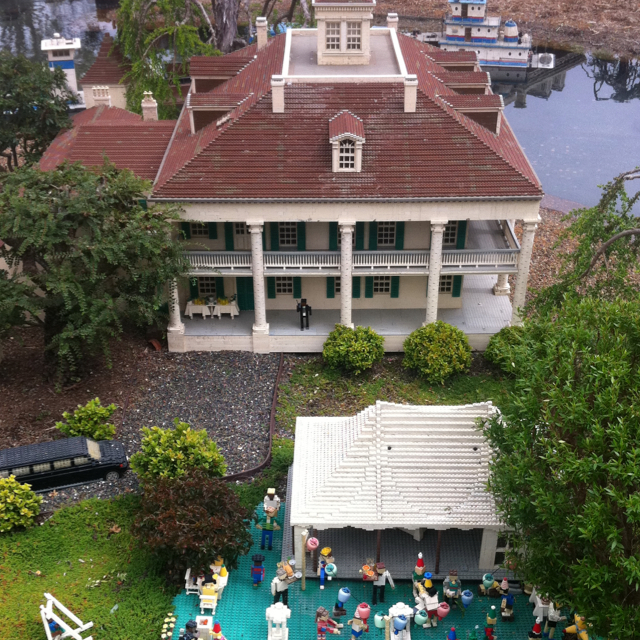
Lego's version of the famous Houmas House

Lego’s version of the famous Houmas House

Legoland was 100% worth the trip!

We drove down from Morgan Hill on Friday, taking the I-5 route. Because of construction at CA-58, we were a bit delayed en route, so we stopped overnight at the Rodeway Inn in Castaic, CA. It was a bit dingy, but given that we arrived after midnight I was prepared to relax my standards a bit.

Saturday morning we got up bright and early and made a beeline for Legoland. We arrived shortly after the park opened, and it was surprisingly crowded. Legoland’s crowd skews pretty young; there were lots of under-6-year-olds.

Our first stop was the aquarium. We’re undoubtedly spoiled, but I found it mediocre. Had it not been included in our ticket price I might have been disappointed.

The park, however, was well worth the price of admission. The models are jaw-dropping (see my Flickr stream for a few examples from Miniland, the model city area.) The rides are clever and well-designed, although the lines were long because there’s no equivalent to Disney’s FastPass system.

The boys’ favorite was probably the large, well-appointed water park. I sat in the sun and relaxed while they shivered in the water and claimed that they weren’t cold (the lazy river’s heated, however.)

A note about Legoland food: mediocre and expensive. Take your own if you can.

We closed the joint down, which was easy given that it closes at 6. Our hotel, Carlsbad by the Sea, was delightful; clean, beautifully landscaped, and well located. Breakfast the next morning was included, too, always a plus.

I’m posting this from iBlogger on my phone, so this update is too short to capture the full flavor. Suffice it to say that I highly recommend Legoland.

Leave a comment

Filed under California, Travel

HP E5000 videos finally released

You may remember that back in February Tony, Brian, and I shot some videos with Hewlett-Packard’s new E5000 messaging appliance. You might even have been wondering, as we have, where on earth those videos had gotten to. In an age where people routinely post unedited video on YouTube within seconds of an event, and where even highly-polished videos can be built and uploaded in a day, it seems that these videos took an awfully long time.

I was happy to see e-mail from Don Wilson at HP telling us that the final version of the videos are now available. Our two days of filming ended up providing material for six videos:

  • Introduction to HP E5000 Hardware, featuring lots of oohing and aahing over the E5000’s chassis. Although HP’s Dean Steadman is in this video, I don’t think you can see the bandage he had to put on after an unlucky encounter with a sharp edge on the E5000 prototype. Too bad; we had great fun mocking him because of it.
  • HP E5000: Complete and Optimized: a roundtable discussion of why HP designed the E5000 the way they did, and what they were attempting to accomplish with it.
  • HP E5000: Simple and Cost Efficient, in which we explore the thorny question of how you get support for something that combines an operating system and application from Microsoft with HP’s hardware.
  • HP E5000: Resilient/Highly Available, in which we explore whether you can safely use the word “appliance” to describe the E5000 (I voted that yes, we in fact could.)
  • HP E5000: Large Low Cost Mailboxes. Do you want to go back to 100MB mailboxes? Neither do Microsoft’s Jeff Mealiffe or HP’s Karl Robinson, both of whom join our roundtable discussion of ways to deliver large, cheap mailboxes to sate users’ unceasing demands.
  • HP E5000: Installation & Startup, in which HP’s Karl Robinson and I walk through the out-of-the-box setup process. (Hint: we skip the boring parts, like installing Exchange.)

Although I might be biased in saying so, the videos are short enough to remain interesting, and the E5000 is quite an interesting piece of equipment. I invite you to check out the videos and let us know what you think. If you liked them, tell me; if you didn’t, tell Tony.

Leave a comment

Filed under UC&C

DC day 3

Tuesday was our first car day. I didn’t want to hassle with renting a car for the entire trip, so I reserved a car with Avis at Union Station. A quick cab ride later, I drove back to the hotel, picked everyone up, and we were off to Annapolis. (This is glossing over some details, like how one of my children, whom I will not name, took an inordinate amount of time to get ready so that we got a really late start.) Our late start meant that we missed our planned breakfast at McDonald’s, but as we headed north we found a convenient Chick-Fil-A and had an early lunch instead.

We tried to drive directly to the US Naval Academy (USNA) visitor center, but this proved to be impossible because none of us knew where we were going. We backtracked to Navy-Marine Corps Memorial Stadium and took the free shuttle to the visitors’ center. Actually, Mom and the boys did that while I stayed with the car to conduct a short Q&A for a webcast I’d done for Windows IT Pro. This turned out to be a real problem because I’d planned on using my iPhone as a tethered Internet connection for my laptop. This seemed like a reasonable plan, and I tested it at the hotel, where tethering worked fine. (Well, OK, the truth: it was slower than I liked but it was also cheaper than hotel wi-fi, so it was adequate.) However, I had a hard time maintaining a connection, and when I did it was unusually slow. I eventually got in to the webcast site about 5 minutes before it was scheduled to be over, so I missed the Q&A– my apologies to anyone whose question went unanswered.

That done, I caught the shuttle bus and met everyone at the visitors’ center. It has a terrific array of Navy-related artifacts, including the Freedom 7 capsule flown by Alan Shepherd (USNA 1945) and a wonderful gift shop. Everyone else had already seen that stuff, though, so we went right to the tour. (David is really interested in attending USNA, so he went to an admissions presentation instead, though he rejoined us later.)

Our tour guide was terrific. He clearly knew a great deal about Annapolis and Navy history, and we got to see all the highlights, including the crypt of John Paul Jones beneath the chapel (fascinating story alert here), the Lejeune Building (a/k/a the gym; he got bonus points for properly pronouncing it “Luh-jern”), Dahlgren Hall, and the enormous Bancroft Hall dorm complex. We arrived shortly before the end of the formal class day, so we got to see lots of midshipment strolling around. “Strolling” isn’t quite the right word, but neither is “marching”… perhaps I should stick with “walking” and leave it at that.

After our tour, we went back outside to catch the shuttle bus, just in time to see the local police arresting four people for dropping beer bottles off their roof onto the street. This proved a valuable learning opportunity for the boys, who had never actually seen 5-0 roll up on someone and cuff them. The drive back to Union Station to drop off the car was almost anticlimactic after that episode.

For dinner, we decided to go to Chinatown… where we ate at Fuddruckers. It’s pretty funny, but the Chinatown gate is flanked by a Starbucks on one side and Fuddruckers on the other. Despite the incongruity, we had a great meal, then went back to the hotel to watch a little CNN and zonk out for the night.

Leave a comment

Filed under Friends & Family, Travel

DC day 2

Monday morning started with a quick breakfast at the hotel’s coffee shop. David and Mom made a quick run over to the Bureau of Engraving and Printing to try to get tickets for their tour, which was rumored to be pretty cool. They ended up buying tickets from a scalper, but that was OK in the event because the tour was super– more on that in a minute.

Brief aside: if you’re going to visit DC, you really, really do need to request tickets to things as far in advance as you can. We couldn’t get tickets to the Washington Monument or the White House tour because we just didn’t apply early enough. Six months wouldn’t be too early, in fact. The simplest way to get tickets is to ask your Congressman’s office for help; they arranged our Capitol and Pentagon tours. Anyway…

We walked over to the Bureau of Engraving and Printing. Along the way, we stopped at the headquarters of the US Forest Service, which had probably the friendliest staff of anyplace we visited (plus: lots of Smokey the Bear images, a bonus). A kindly old man gave Mom a Colorado blue spruce seedling as a souvenir. The BEP tour itself was superb: there’s a short film talking about the process by which paper money is made, then you walk through the tour space, which looks down on the various parts of the printing and packaging process. There’s a strictly-enforced no-photography rule, but that’s OK, as the machines themselves aren’t all that interesting. It’s just a bit jarring to see people handling huge sheets and stacks of currency, and very cool to see the process by which they take blank paper (which is illegal for private citizens to possess– see, the tour was educational!) and turn it in to cash money. The last step is called “monetization,” in which the Federal Reserve takes ownership of the currency and makes it “real” money. I was snickering thinking of how my friend Paul Miller would react to that line.

After the BEP tour (did I mention it was fantastic?) we had some time to kill before our scheduled Pentagon tour. We took the Metro to the Pentagon City stop and had lunch in the food court at the Fashion Centre mall. Big deal; it’s a mall, it’s big, yada yada. However, they have a Popeye’s, so I was pretty happy. Back on the Metro, a short ride took us to the Pentagon visitor’s center. Security, as you might expect, is pretty tight. You go into the visitor’s center through a magnetometer and after an ID check to ensure that you’re on the tour list. When you get to the visitor’s center, you assemble with the other people in your tour in an area where photography isn’t allowed (well, except of one side of the room where there are some static displays.) Then you’re assigned to a guide. Our guide was a nice, exceptionally young, Air Force airman from Nebraska. He did a terrific job of leading us through the tour, walking backwards the entire way. The tour itself is mostly unremarkable. I mean, sure, it’s cool to be inside THE PENTAGON, but the corridors the tour passes through don’t have much interesting stuff in them except for quilts sent after the 9/11 attacks. Speaking of which, the most important part of the tour (IMHO anyway) is the trip to the 9/11 memorial room. It was a moving reminder of the lives lost in that attack. The boys’ favorite part was learning that the snack bar in the Pentagon courtyard was once thought by the Soviets to be the entrance to an underground bunker complex; as a result a large megatonnage of commie hardware was pointed at the hot dog stand.

After the Pentagon, we made our way on the Metro to Arlington National Cemetery. There are no words to describe this, really. We were able to see the guard mount, changing of the guard, and the laying of a new wreath, at the Tomb of the Unknowns. Despite the large audience, there was a spirit of reverence there that’s hard to describe. As much as I like to talk trash about the Army, Navy, and Air Force, the troopers of the Third Infantry Regiment did a marvelous job. (Disclaimer: I skipped the Kennedy gravesites on the tour.) The sheer expanse of the place is kinda mindblowing, too, though it makes sense when you think of how long Arlington has been used as a national cemetery.

By the time we got done at Arlington, we were all ready for a break, so we retreated to the hotel for a swim. Monday’s dinner was at Carmine’s, a family-style Italian restaurant on 7th Street. The food was superb, and there was certainly a lot of it– we ordered the cold antipasto (which I’d skip next time), the country-style rigatoni, and the veal scarpaccio with angel hair. We couldn’t eat it all, which tells you something about how much food there actually was. We all left happy and stuffed. Then back to the hotel to stack some serious Zs– we were all tired after another full day.

(side note: I’ve posted pictures to Flickr, so they appear in the “photos” section of the page sidebar. It’s more trouble than it’s worth to embed them in the body text right now. Sorry!)

Leave a comment

Filed under Friends & Family, Travel

DC day 1

So the boys and I traveled to Washington, DC for spring break. Our plan was to meet Mom there and spend the week sightseeing and generally having a high old time.

Our flight SJC-ORD-DCA was delayed by nearly 3 hours: the inbound aircraft was delayed by weather, then diverted to LAX for a mechanical. By the time we got to DCA, it was about 0115 Sunday morning. This was not my favorite. However, we’d planned to stay at the L’Enfant Plaza hotel because of its location, so it was super easy to get from the airport to the hotel. We checked in and got into bed so fast I’m surprised the other guests weren’t disturbed by sonic booms.

The next morning, we had breakfast at the hotel restaurant. It was only mediocre, sad to say. In fact, the best thing about the hotel (as I write this on day 5 of our trip) has been its location: it’s right above a Metro station and a short walk from most of the major DC attractions, including the Smithsonian complex, the Washington Monument, and the Holocaust Museum. The staff is friendly, and the hotel is in decent shape, but it’s not a star property. Anyway, enough hotel reviews and on to the good stuff.

After breakfast, we walked past the Smithsonian buildings along Independence Avenue to the Washington Monument. We weren’t able to get tickets for the full tour, but the monument itself is stunning up close, and the surrounding grounds help give a sense of its scale (being able to see it from practically everywhere in downtown DC doesn’t hurt either.) The boys had fun people-watching (as did I); as diverse as the Bay Area is, the tourist-y areas of DC are even more so.

A short walk later, we arrived at the Holocaust Memorial Museum. I can’t adequately explain how sobering and moving this museum is. I wanted the boys to see it so they had some sense of the history behind the Nazi regime, and I think they did. Matt and Tom more-or-less sprinted through, not unexpected at their ages, but David and Mom kept a more leisurely pace. I can’t say this was a highlight of the trip, because it’s certainly not a feel-good kind of place, but it was probably the most educational (and certainly the most emotionally resonant) of all our stops.

After another short walk, we arrived at the National Museum of American History. Paydirt! We had lunch at the Stars and Stripes Cafe; it was well-rated in Mom’s guidebook and we were all hungry, so that went well. The rest of the museum was fantastic. There’s a superb exhibition of Lincoln memorabilia, in which I was reminded that at the time of his election he was viewed as a bumpkin from the far west– Kentucky and Illinois being far west at that point in American history. There are too many other wonderful exhibits and collections here to list, though I would be remiss if I didn’t mention “The Star-Spangled Banner,” which contains the original flag that flew over the Battle of Baltimore and inspired Francis Scott Key. (My second favorite: “The American Presidency: A Glorious Burden.” The boys were commenting last night on how gray President Obama has gotten since his inauguration, and now we know why.)

We came back to the hotel and hit the pool, which inexplicably closes at 6pm each day. That didn’t stop the boys from enjoying the water, or me from enjoying the sun. Given that most of the museums and attractions close at either 5pm or 5:30pm, this isn’t terrible, but it would be nice to have a bit more flexibility.

For dinner, we trekked to Ben’s Chili Bowl, which has been in the same location since 1958. The chili fries were excellent; the chili itself was awfully good too, though it was quite spicy. Dinner really reinforced the value of the Metro, too; it was simple to go from the hotel to dinner and back again without the hassle of parking or getting lost. The milkshakes at Ben’s are excellent too.

After that, it was time for bed! Everyone was tired from our late night, so no one complained and we all slept really well. More tomorrow…

Leave a comment

Filed under Friends & Family, Travel

Panoramas with Photosynth for iPhone

I have had a blast on our DC trip making panoramic photos with Microsoft’s Photosynth application. The basic idea is simple: you point your iPhone at something, move it according to the on-screen prompts, and get a beautiful panorama when you’re done. Here’s an example: the Great Hall at the LIbrary of Congress.

Photosynth makes it really easy to take panoramas, and it does a fine job of stitching them. I’d love to see this app running on a device with a better camera (hint, hint, Windows Phone 7 from Nokia…) but it’s well worth the price: $0.

If you want to see the panoramas I’ve created so far, they’re here.

Leave a comment

Filed under General Tech Stuff