Category Archives: aviation

Writings about aviation, including chronicles of my flight lessons, product reviews, and so on.

First real instrument lesson

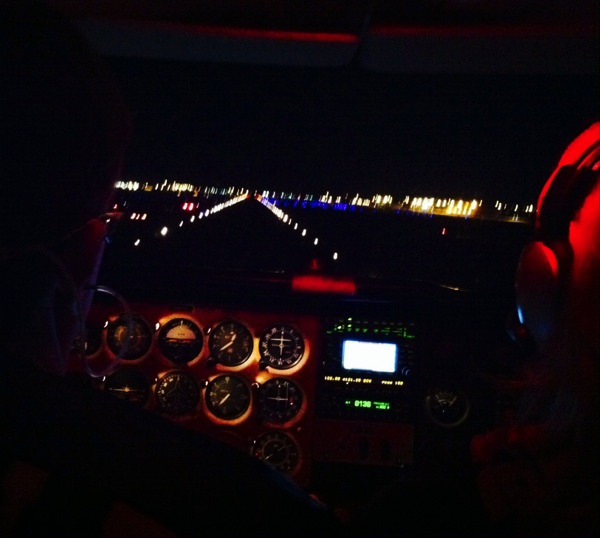
I took the boys down to Tuscaloosa last weekend to visit David. The weather was fine, and we had a lovely visit, but it ran a bit long, and then I couldn’t get the plane started. It’s finicky, but it was my fault, not the plane’s. Then I wouldn’t have been able to get back to Redstone before dark, and I’m not night current, so we ended up leaving the plane and driving home (a process made much harder by the fact that it’s impossible to rent a rental car after 6pm in Tuscaloosa on a Sunday). The next day I needed to go back down to pick up the airplane, so I called my instructor to see if he wanted to fly me down there. The flight turned into an instrument training lesson, which was exactly what I was hoping for.

Weather at Redstone on departure was fair: ceilings were about 3500’ with visibility of 4 miles. It started raining just as I was finishing the preflight. John had filed an IFR flight plan direct to Tuscaloosa at 5000’, which turned out to be ideal for getting me some actual instrument time, including flying through rain. This turned out to be a nonissue because when you’re only using your cockpit instruments for navigation, not being able to see because of rain doesn’t pose a probem.

I say “actual” because you can log both simulated instrument time (in which you wear a view-limiting device such as this) or actual time. “Actual” in this context means you’re flying completely on instruments, without visual reference to the ground. In our case, that meant we were flying through a layer of clouds for a total of nearly 50 minutes. That meant that I had to control the airplane’s altitude, attitude, and course using only the instruments in the cockpit. All pilots are required to receive training on this, and to demonstrate proficiency in doing it, as part of the initial training process, but doing it in actual is quite a different matter. It’s very demanding work; you have to keep a consistent scan pattern on your instruments to make sure you’re holding course and altitude.

One key difference is that the best way to do this is to use predetermined engine settings: at a certain RPM and manifold pressure at a given altitude, you can predict how fast the plane will go and to make it climb or descend at a predictable rate, you know how much power to add or remove. Flying on an instrument flight plan often involves reaching very specific altitudes at specific points in space, i.e. you may be told to cross a fix at a given altitude, and you need to figure out how to make that happen.

I did reasonably well; I didn’t have any trouble maintaining my altitude, and my heading control was generally good except for a couple of minor excursions when I got over-focused on altitude or airspeed. You really have to divide your attention between all of the instruments to maintain a consistent flight path, and that’s very much a learned (and perishable) skill.

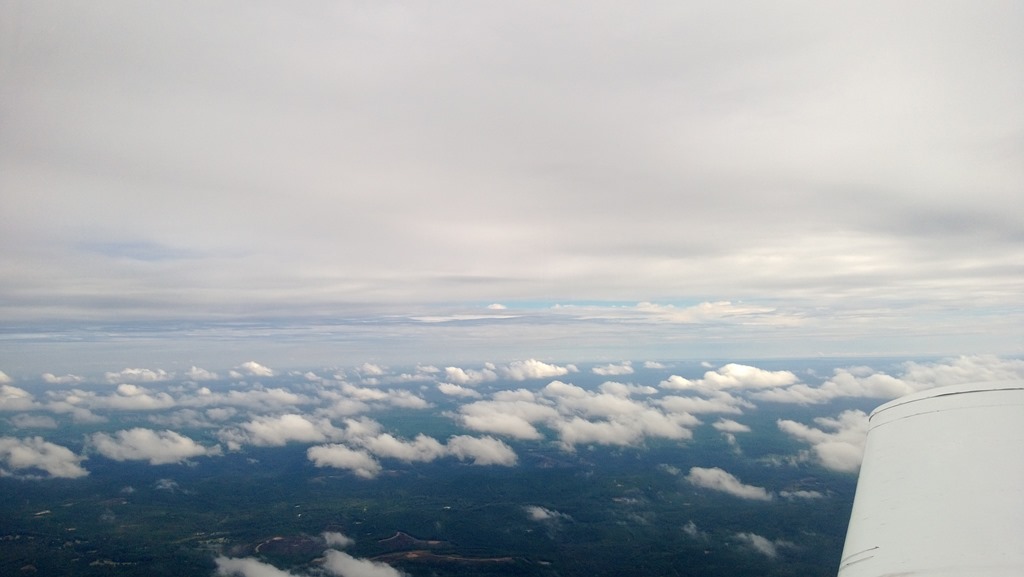
We made it safely to Tuscaloosa, landed, and I got the Arrow started. I took off first, flying VFR back to Huntsville at 3500’. In the Arrow, I was averaging about 145kts groundspeed on the return, and the flight, which took place between a high layer of solid overcast and a lower layer of broken clouds, was quite nice.

WP_20130930_004


between the layers en route TCL-HSV

After a smooth and uneventful flight, and a decent landing, I logged 0.2 simulated instrument, 0.8 actual, 0.2 VFR for the leg down, plus another 1.0 for the return VFR flight. I’m looking forward to more instrument time… make mine actual!

Leave a comment

Filed under aviation

My new favorite word: “unable”

Sometimes one word can speak volumes. This is especially true when there’s a well-defined and mutually understood vocabulary that all parties in a conversation are using– which is exactly what happens when you talk on the radio with an air traffic controller. Although it often sounds bizarre to outsiders, the back-and-forth between pilot and controller can be incredibly information-rich. The FAA has a standard glossary that pilots and controllers are supposed to use, and you can’t go far wrong by sticking with it. Many of the terms in the glossary compress a great deal of meaning into a few syllables, which is important when you’re busy– which, as either a pilot or controller, you will be!

For example, the controller at a busy training airport such as Palo Alto (which usually has between 500-700 takeoffs/landings per day, a lot for a small airport with a 2500′ runway) could say “One Tango Golf, there’s a 172 on final. If you go right now, then you can take off on runway 31”, or he can say “One Tango Golf, landing traffic, expedite, cleared for take off, 31”. Now consider the workload of a pilot flying into an airport like Atlanta or Dallas, or a controller in the tower cab at Chicago-O’Hare or Newark, and you see why brevity is so important.

My favorite of all these expressions is simple: “unable”. The glossary defines it thus:

Indicates inability to comply with a specific instruction, request, or clearance.

Depending on how you use it, it can mean “I won’t do that” or “I can’t do that.” Rather than provide a long explanation, all you have to say is “unable.” Suppose I’ve filed a route from point A to point B and the controller wants to have me deviate to point C, and I happen to be low on fuel? “Unable.” Want me to turn towards an area of built-up clouds? “Unable.” Because the pilot in command has ultimate responsibility for the safety of flight, as PIC you have unlimited authority to accept, or reject, controller requests or instructions– with the very significant caveat that you may be required to account for doing so. If the controller tells me to sidestep to a parallel runway on approach, and I don’t, and I cause an accident, having said “unable” isn’t going to get me out of trouble.

The magic word works both ways, of course: when you ask a controller for something (“Niner Eight Mike, request lower” to get a lower altitude, for example) the controller can merely say “Unable” and that’s it. Of course, whoever receives the U-word can always ask for something different, or explain why they want whatever it is.

Now I just need to brief the people I talk to most frequently so they know what the word means to. “Dad, can you take me to the mall?” “Unable.”

Leave a comment

Filed under aviation

Speed, time, and cost

Recently I had the opportunity to fly down to Louisiana to see my mom, grandmother, and uncles. This was an easy trip: straight-line, it’s 411 miles from airport to airport. It took me 3:12 to get down there and 3:00 to get back. Why the difference? In a word, wind. In the northern hemisphere (and, more particularly, in the US, since that’s where I’m flying), prevailing winds tend to follow predictable patterns: west-to-east for much of the country, and (in general) onshore in coastal areas. The strength and direction of winds aloft vary, of course. For example, the definition of a frontal boundary (the line demarcating where a cold or warm front actually starts or ends) is an area where the wind suddenly changes direction and speed. It’s generally true that you’ll face headwinds when flying from east to west and tailwinds when flying from west to east, but the strength and direction of the winds can change quite a bit as you move across different types of terrain, through different weather systems, and so on.


PaulR  Dell 20130901 004

astute readers can figure out exactly where I was when this picture was taken

In the picture above, the “GS” number in the lower right shows that I had a groundspeed of 148 knots. Since one knot is 1.14 statute miles/hour, that’s just over 170mph. That seems pretty good, considering that it’s more than double the speed limit on any of the roads that link Huntsville and Alexandria (and triple, or more, the speed limit for the West Monroe-Alexandria leg). The 128kts average groundspeed I had going westbound still equates to 147mph. Although a 20-knot difference is nothing to sneeze at, the practical impact is that it saved me… exactly 12 minutes, mostly because the winds kept changing.

That brings up the question of fuel usage. Every powered airplane has a set of performance charts that show you, for a given altitude and power setting, how fast you can go in still air (and remember, airspeed isn’t the same as groundspeed; that’s a topic for another post) and how much fuel you’ll burn while doing so. Book fuel burn for the Cessna 182P is between 12 and 14 gallons per hour, depending on your altitude and power setting. Most rental aircraft are rented “wet”; that is, the hourly rental rate includes gas and oil. In a rental, you therefore have an incentive to configure the engine for best speed even if you burn a couple more gph. When it’s your airplane (or when it’s a “dry” rental) you’re paying for the fuel, so you get to choose: would you rather burn more gph or get there a little later?

The correct answer is “it depends.” Aviation gasoline costs anywhere from $5 to $7/gallon in the US. (Why so much? Why the variance? Those are topics for another post too.) Suppose I can cruise at 130kts for 12gph, or 150kts for 15gph. That extra speed is going to cost me, let’s say, $18/hour. For a 411nm trip, that means I can get there in about 3 hours 9 minutes for just under 38 gallons (so, call it $228). On the other hand, at 150kts I could get there in only 2 hours 44 minutes, but it would cost me 41 gallons of fuel, or $246. In my case, since I was renting a plane, I went pedal to the metal, adjusting the engine for max speed rather than best fuel efficiency.

Now, this is an oversimplification, of course. It ignores the time spent climbing and descending (you burn more fuel in the climb, and less in a descent, but not enough to equal what you burned climbing), it assumes that ATC doesn’t reroute you anyplace inconvenient, and so on; it’s a good enough estimate for our purposes.

Let’s compare, now, the cost/mile of flying versus driving. I drive a 2005 Nissan Altima that gets 30mpg on the highway. Bing Maps says the fastest road route is 514 statute miles. So, that’ll cost me about $60 in gas, as opposed to $384 for the airplane rental. I’m leaving out all the other fixed and variable costs of the car; if I wanted this to be more precise I’d compare the cost of driving a rental car from here to there, but who would do that if they didn’t have to? Anyway, flying is considerably more expensive until you figure the time savings. Bing calls this an 8-hour trip, assuming no stops for fuel, food, or bathroom breaks. I can make it in a hair over 3 in the plane, though I have to take my own food. As with the car, that price stays the same whether I fly solo or with passengers (or cargo, such as the excellent banana pudding I brought back– thanks, Mom!)

Clearly I could come up with a business rationale that values my time at what Dell bills customers for it, or what I bill for it on standalone projects, but the right way to think about it, I think, is that the time I gain is priceless: being able to get to see family and friends, or attend important events, or just get out of town for a trip, is important, and the airplane gives me the flexibility to go farther, faster, more often than I could in a car, for considerably less money (usually) than it would take to fly commercial.

For another time: does it make sense to spend more money to rent or buy a faster airplane? It depends.

Leave a comment

Filed under aviation

The Perrysburg Express

The boys and I had been discussing where we should go on vacation. As usual, they wanted to go someplace exotic, like on a cruise. I counteroffered with a trip to our former home in Perrysburg, reasoning that it was an easy flight and that they’d like to visit friends. It turned out to be a great trip and a good example of the utility of personal aviation. The plan was for David, Tom, and I to fly to Ohio, where Matt would join us, then we’d all fly back together.

We left on a Sunday mid afternoon, loaded up our rental 182 with full fuel and our bags, and departed HUA for Bowling Green, Kentucky, 158nm to the north. There were some rainstorms moving from west to east near Nashville, so we had to dodge them a bit, but between guidance from ATC and the onboard weather data provided by my Stratus/Foreflight combination, that was no problem. It’s worth pointing out that the value of datalink weather in the cockpit is not for real-time storm avoidance. It’s to see where storms were the last time the weather data was updated and to plan routes so that you stay well away from potential trouble spots.

Anyway, the flight to KBWG was uneventful; when we landed, we called a taxi to take us to the National Corvette Museum, which I hadn’t previously visited. I think it’s fair to say that my jaw was at least partially agape the entire time. There are some spectacular cars there, and their memorabilia collection is excellent. Our lunch at the museum cafe wasn’t bad either. In fact, my only gripe with the entire stop was the taxi service; if you plan a trip through the Bowling Green airport be forewarned that taxis there are hard to come by and (at least for the two we had) decrepit nearly to the point of unsafeness.

From Bowling Green, our route of flight took us another 340nm to the northeast to the Wood County airport (1G0), coincidentally located in Bowling Green. As with many other county-owned airports, the Wood County airport is clean, modern, small, and lightly used, although Bowling Green State University has a flying club there and there’s a small FBO on the field. By the time we arrived, the building had closed but thankfully the vending and restroom areas are open so we could clean up a bit. Our friends Matt and Anita were kind enough to come get us, since there’s no good way to get a rental car in Bowling Green, Ohio on a Sunday evening; we had a great visit on the way to the hotel, the first of several.

The trip itself was marvelous. We went to a Mud Hens game, ate at all our favorite restaurants (yay for Mr. Freeze!), and saw many of our friends. I was shocked to see how much the “little” kids I used to teach in Sunday school had grown, and likewise I could tell that my adult friend were surprised to see David, Tom, and Matt in their 2013 editions. Perrysburg and the surrounding area didn’t seem to have changed that much. In fact, when we visited Imagination Station, the former COSI, it was surprising how little it had changed.

PaulR  Dell 20130813 006

take me out to the ball game… (not shown: chili dogs, scoreboard showing Mud Hens’ loss)

PaulR  Dell 20130814 019

just because I love sunflowers– this was taken next to the parking garage across the street from the science museum

On the trip back, we had too much stuff– Matt had brought 2 weeks worth of luggage with him back from Vermont, and we were already close to the weight limit on the 182, so we shipped some bags back via UPS. The 182 is a forgiving airplane but that’s no excuse for overloading it or loading it outside its acceptable center of gravity (CG) range, as difficult as that might be to do. For trips with all four of us, it looks like we’ll need a bigger plane, or to pack lighter.

On our return flight we planned a fuel step at the Springfield-Lebanon airport in Kentucky. As with 1G0, this airport seemed scarcely used. The very friendly attendant gave us the keys to a crew car and said “oh, I’ll be gone by the time y’all get back from dinner, so just leave the keys here on the counter”. True to her word, when we returned from an excellent lunch at Mordecai’s, she was gone, so we parked the car, fueled the plane, and departed again for the 220nm leg back to Redstone. Here’s how the flight went on the way back:

WP 20130815 008

see, naps do make the trip go faster

As a pilot and a father, that’s exactly what I’m aiming for: to make flights with my family so routine and uneventful that the kids fall asleep, get bored, and even quarrel a bit, just as they would in the car.. with the added bonus that a trip that would have taken 8+ hours each way in the car took less than half that. That’s one of the best parts of personal aviation: it’s a time machine, enabling you to go places in less time and thus making trips feasible that would otherwise be impossible. What’s not to love?

2 Comments

Filed under aviation

Thursday trivia #96

  • Apparently people with lots of self-control are happier. Makes perfect sense to me.
  • Butterscotch pudding popsicles? Yes please.
  • Or maybe key lime pie popsicles would be better.
  • I need to do a longer post on my progress so far with the coached fitness program I started a couple of weeks ago. So far, however, I am noticeably stronger (my best deadlift is now 245!), with better muscle definition. Despite eating like a horse on workout days, I’ve lost about 8 pounds so far.
  • Apropos of fitness: I loooove Fitocracy. What a great community. On the other hand, my local gym (1Fit) is almost always deserted; this is good for lifting, but not so good for community purposes.
  • I am starting transition training to the 182RG, meanwhile looking around for a weekend prep course for my instrument written. I’ve also decided to write a book (a short one, I hope) about the process of getting an instrument rating. It’s going to be self-published through Amazon. Stay tuned.

Leave a comment

Filed under aviation, Friends & Family, Musings

Time flies…

I just got back from a great flying trip from Huntsville to Perrysburg, Ohio (more on that in a later post today if I have time). In reviewing my logs, I was shocked to see that I have as much pilot-in-command (PIC) time in the Cessna 182 that I’ve been flying here in Huntsville as I do in the Cessna 172s I was flying in Palo Alto, Pensacola, and Huntsville– just over 50 hours in each. I just went over the 100-hour PIC mark, which means that by any standard I am still a novice; at the same time I am delighted to see the rate at which I’ve been accruing time, experience, photos, and memories.

Leave a comment

Filed under aviation

Weiner’s Laws

Aviation Week recently ran an article listing 15 laws developed by Earl Weiner, an aviation safety pioneer I had not previously heard of. Some of them will be immediately familiar to anyone who’s worked with computers for any length of time, while some are aviation-specific. All of them are worth pondering, though. I have long experience with computers that do exactly what you tell them to, but coupling such computers to the controls of an airplane mean that if you are ignorant or careless about how you interact with the computer, you may end up with a bent airplane.. or dead. (For example: AA 965, AF 447). Worth considering every time I sit down to prepare for a flight, and especially worth thinking about as we wait for the NTSB to release more details on the Asiana 214 crash. In the meantime, a partial solution: know your autopilot.

(and no, I don’t know why numbers 1-16 are blank either!)

WIENER’S LAWS

(Note: Nos. 1-16 intentionally left blank)

  1. Every device creates its own opportunity for human error.
  2. Exotic devices create exotic problems.
  3. Digital devices tune out small errors while creating opportunities for large errors.
  4. Complacency? Don’t worry about it.
  5. In aviation, there is no problem so great or so complex that it cannot be blamed on the pilot.
  6. There is no simple solution out there waiting to be discovered, so don’t waste your time searching for it.
  7. Invention is the mother of necessity.
  8. If at first you don’t succeed… try a new system or a different approach.
  9. Some problems have no solution. If you encounter one of these, you can always convene a committee to revise some checklist.
  10. In God we trust. Everything else must be brought into your scan.
  11. It takes an airplane to bring out the worst in a pilot.
  12. Any pilot who can be replaced by a computer should be.
  13. Whenever you solve a problem you usually create one. You can only hope that the one you created is less critical than the one you eliminated.
  14. You can never be too rich or too thin (Duchess of Windsor) or too careful what you put into a digital flight guidance system (Wiener).
  15. Today’s nifty, voluntary system is tomorrow’s F.A.R.

2 Comments

Filed under aviation

PIREP: my first “real” cross-country

Last weekend I took my first “real” cross-country flight. Executive summary: this is the one of the major reason I got a pilot’s license: fast travel, on my schedule, to do things that otherwise would be prohibitive. It’s been a lifelong dream of mine, but one with a practical side.

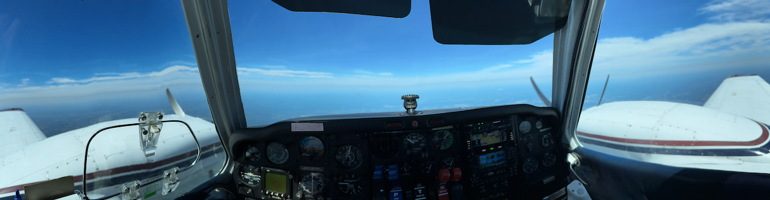
I recently earned my high-performance endorsement and got checked out in the Redstone Arsenal Flying Activity (RAFA) Cessna 182. This plane is bigger and faster than the Cessna 172 I’ve been flying. RAFA’s C182 is an older model, and the interior shows it, but it is mechanically in great condition, and it’s nicely equipped with a moving-map GPS and a decent autopilot. It can travel at up to about 145 knots, and its endurance is about 5 hours when fully fueled… longer than mine!

All of my XC time so far has been within California (with the exception of two short legs in the Mobile/Pensacola area early on in my training). The longest leg I’ve flown so far was Palo Alto-Bakersfield and back, a distance of about 220 miles. However, all of my flying so far has been casual. This was my first “real” XC: I had a defined mission, a longer distance, a time window to hit, and all my sons aboard. I’d aborted a previously planned trip on a similar route because the weather was just awful, so I was eager to make this trip if possible.

We’d planned to depart sometime Saturday morning. The forecast was for IFR until around 11am, gradually clearing. Sure enough, the morning started with IFR here in Huntsville, with low IFR (meaning even worse weather) further to the west along our planned route: direct from Redstone Arsenal Army Air Field (KHUA) to Jackson, Mississippi (KJAN) and then on to Alexandria (KAEX). By about 1pm it had cleared enough for us to head to the airport, but actually getting there took 3 tries as various kids remembered that they forgot important things such as contact lenses.

By the time we got to KHUA, visibility had improved to around 5mi but ceilings were still 3500′, which is low but manageable. I’d planned the flight to take place at 6500′, but that wasn’t gonna happen; however, the forecast called for higher ceilings further west, and I had a brand-new Stratus aboard for inflight weather, so we fueled and launched. After takeoff, we turned west on course and climbed to 2500′, where there were a few light bumps but nothing too serious. I noticed right off that the Stratus was connected but not displaying GPS or ADS-B data. Turning the iPad’s WiFi off and back on fixed it; it did this periodically throughout the trip, so I’ll have to figure out what’s going on. About halfway to KJAN were were able to climb up to 4500′, and things smoothed out considerably. There was a line of storms about 45nm to the south of our course, but they were moving NNE fast enough so that they were never a factor. Being able to see radar and METARs for en route airports on this leg was absolutely invaluable. At every point I had a good picture of what my options looked like if I needed them. Here’s what the Stratus data looks like when displayed in ForeFlight; The airplane icon displays our position from the Stratus onboard GPS; the green and blue dots represent airport weather results (tapping on the dot displays the detailed information), and the weather radar data is just like you’d see from a NEXRAD display.

IMG 0029

We landed at Jackson, taxiied to Atlantic Aviation, parked, and went inside. Nice FBO, friendly people… but key learning #1: check fuel prices beforehand! I am used to flying out-and-back legs from a single FBO, where I rent wet, and it didn’t occur to me that there might be dramatic price differences. After filling up at $6.90/gallon (with a club rental reimbursement rate of $5.11/gal), I now know better.

After a quick snack and a pee break, we loaded back up and took off for Alexandria. We were able to stay at 3000′ until about Vicksburg, when we asked for higher. Our arrival and descent into KAEX was smooth, but I had a sterile cockpit problem: the kids were bantering and I got distracted enough to begin an approach to runway 36 when I was cleared to runway 32. I caught the mistake in time, went around, and was lucky to have an understanding controller, but key learning #2: shut your passengers up as part of your descent checklist.

We parked at Million Air. They treated us like we’d rolled up in a Gulfstream. I am now a huge fan.  Unlimited soft drinks, popcorn, and soft serve ice cream? Why, yes, thank you. We needed it because, like a doofus, I’d neglected to pack any water for the flight. Key learning #3: if you pack snacks, pack drinks too, duh.

Our visit with the family was superb; we had a feast of BBQ chicken, got some great visiting time in with my mom, grandmother, uncle, and cousins, then got a good night’s sleep. Sunday we just relaxed and visited, at least until the 32 pounds of boiled crawfish arrived. After a delightful meal underneath a big tree in the backyard, it was time to head back to Million Air.

I’d planned a single leg back, without the Jackson stop, but on preflight noticed that the oil was lower than I’d like, and none of the Alexandria-area FBOs had 15W50. That necessitated another stop, and since I was familiar with Jackson I planned to stop there. (Key learning #4: carry spare oil. ) This worked out OK because the kids all needed a bathroom stop. I had filled up with fuel at Million Air ($4.81/gal), so I didn’t buy any fuel at Atlantic… so they charged me $20 for stopping by. I don’t think I’ll be back.

Coming back we were able to fly at 3500′ to just east of Alexandria, then 7500′ from there on out. Great, smooth ride with a beautiful view of the Mississippi River crossing, the flooded bottomlands near it, and all sorts of farm and agriculture happening beneath us. I started teaching David how to work the radios, and he did a creditable job (although I think there are some guys at Memphis Center wondering what kind of aircraft a “Skyliner” is).

I used the return legs to get some practice in driving the 530W and the autopilot; I am used to flying a G1000/GFC700 172 so the knobology is quite different. This particular 182 doesn’t have electric trim so I had to do a bit of trim wheel judo to keep the autopilot happy in altitude hold mode but it was good practice. While I love hand-flying, learning to use an autopilot effectively, in the right modes at the right times, is critical to safe single-pilot IFR operations, so I want to start getting better at it ASAP.

The eastern approach to KHUA crosses several restricted areas (some for drone flights, some over propellant storage areas), so we had to turn north, fly past the Decatur airport, then remain north of I-565 until we passed Huntsville International. We landed, refueled, hit Taco Bell, and poof! A trip for the books. 

The 182 burned about 13gph and gave me an average groundspeed of 133kts over 7.5hrs on the meter. While this isn’t exactly exciting compared to faster aircraft, it beats the hell out of driving, and it let the four of us deliver a great Mothers’ Day surprise. The kids enjoyed the visit and tolerated the cramped quarters pretty well, so we’ll be doing this run again soon.
Leave a comment

Filed under aviation

Taking pictures in the air

Last week, Doug Mahugh posted this great blog entry on taking pictures from commercial airplanes. He’s done some excellent work. I don’t usually take my real camera on commercial flights, but I think I’m going to have to start. In the meantime, here are two of my favorite airborne pics. I have some other great ones but my iPhoto library is so disorganized that finding them would take more time than I can spare at the moment.

DSC 0251 

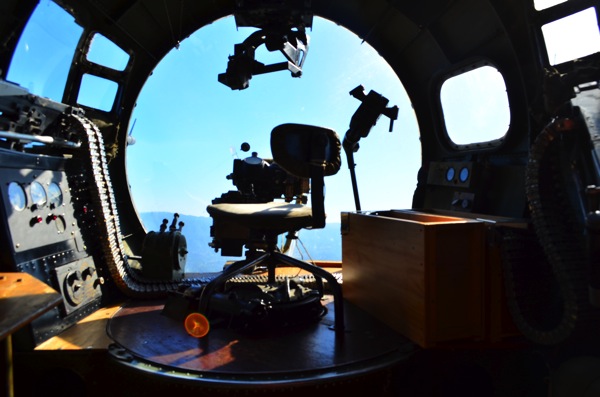
the business end of a B-17


DSC 1188

en route to Petaluma; that’s Alcatraz in the foreground


Leave a comment

Filed under aviation

“There is always room for improvement” in aviation

Bonus double Flying Friday post today. Why? Because this article is too good not to share.

…these NASA pilots were always at 350 when needed. It wasn’t 349 or 351. They always flew on-speed. For me, sitting in the backseat for my first couple of missions in ACTIVE, a whole new skill level was revealed. They flew this way all the time. They were always on parameters. They were always on-altitude. No 34,900 ft or 35,100 ft for them. It was 35,000 ft and not a foot higher or lower.

The author goes on to talk about how this precision inspired him to fly more precisely– “Why not,” he asks, “endeavor to fly as perfectly as possible? In fact, why not endeavor to fly as well as you possibly can all the time, versus ‘just good enough’?”

Exactly. That’s what I want, and what I try to do.

1 Comment

Filed under aviation

Dealing with partial loss of power

Andy, my primary flight instructor, has always described a pilot’s license as “a license to learn”. This may sound trite, but it’s true… if you’re doing things the right way.

This week’s FLYING LESSONS newsletter contained an interesting factoid: the Australian Transport Safety Bureau says that partial loss of power is three times more likely than complete engine failure. After reading the report, I am forced to agree with Thomas Turner that partial-power operation is under-taught; I know that in my relatively limited experience none of the instructors I’ve flown with mentioned how to deal with it or even how to recognize it.

Recognition, of course, sounds like it should be pretty easy: is the engine making as much power as it should? In a car, you can tell by your forward speed and/or acceleration: does the car accelerate normally when you push on the accelerator? There are also audible cues that may tell you whether the engine is working normally. In an airplane, the same audible cues may exist, but airspeed and climb performance are just as useful as the sounds you hear. If you have fancy engine instrumentation, then it may give you information such as cylinder head temperatures that tell you what’s going on.

The ATSB report calls out a fairly straightforward procedure for dealing with partial power loss: lower the nose to maintain best glide speed, find a place to land, and do so as soon as practical. No turns under 200′, and no troubleshooting the engine unless you have sufficient altitude to do so. It also goes into some detail about potential causes of partial power loss, including spark-plug fouling, fuel contamination, and problems with carburetor heat. All of these are things I will be more mindful of as part of my preflight and in-flight operations.

Always something new to learn…

Leave a comment

Filed under aviation

Go or no-go revisited

Thomas P. Turner is a flight instructor and businessman who publishes an exceptionally useful weekly aviation newsletter called Flying Lessons. Recently he’s been focusing on trying to help pilots understand what’s truly risky about flying, and to provide some standards to help improve proficiency in those situations. As part of that process, in this week’s newsletter he linked to a matrix of go/no-go rules that I really like: the Categorical Outlook Flying™ matrix. The basic point of this matrix is to provide a simple, clear set of guidelines to help pilots of all experience and skill levels make good decisions.I don’t want to reproduce the entire matrix, but here’s a snippet:

If the outloook is… …and you’re flying… over   during… then suggest:
  VFR VFR   flat land   day GO  
        flat land   night GO  
        unfamiliar area day GO  
        unfamiliar area night GO  
        mountains or water day GO  
        mountains or water night NO-GO  
    IFR   flat land   day GO  
        flat land   night GO  
        unfamiliar area day GO  
        unfamiliar area night GO  
        mountains or water day GO  
        mountains or water night GO  

This doesn’t seem that instructive– after all, all but one of the suggestions are “go”. However, the real beauty of this approach is that it breaks down the go/no-go decision into multiple factors, including weather, time of day, terrain, and flight rules. These factors correspond pretty well with some of the major risk factors associated with flight. Night VFR over mountains is more risky than day VFR over mountains– not because of the airplane, which doesn’t know it’s dark, but because of the difficulty of finding a safe place to land if there’s a problem.

The full set of matrices is well worth looking at. I like this approach and plan to incorporate it into my own personal minimums; the matrix above is already pretty much how I plan, but the “marginal VFR” matrix, which I haven’t shown here, is where things start to get a bit more interesting…

2 Comments

Filed under aviation

Palo Alto-Petaluma and back

Tuesday afternoon I was working and decided to check out LiveATC.net, a web site that plays air traffic control audio for a huge range of airports worldwide. Soon enough I had fired up the Palo Alto tower, which led to looking out the window, which led to me reserving an airplane for a quick flight to Petaluma. Why there? It was just over 50nm away from Palo Alto, meaning that I could log the flight as cross-country time towards my instrument rating.

I got to the airport, preflighted the airplane, and enjoyed a smooth takeoff; departure had me do a right 45° departure and head towards the Oakland airport. I got on the radio with NORCAL Approach, who routed me over the runway 29 numbers at Oakland International and then cleared me further to the north. The sun was lowering in the western sky, which gave me a few pretty nice photo opportunities:

DSC 1167

Approaching KOAK rwy 29 from the south; the numbers are just out of frame on the lower right

DSC 1179

the city of San Francisco; that’s the Bay Bridge in the foreground

DSC 1192

the Golden Gate Bridge, with bonus freighter

DSC 1178

Both bridges, plus shafts of light through the city fog (you might need to see the full-size version to see them)


The Petaluma airport was easy to see, and I had a good landing on runway 29. Sadly, the diner there closes at 3pm, and I got there about 7:30pm. So, my key learning for this flight: verify the status of your proposed dinner destination before takeoff. I got out, stretched my legs, and fired the plane back up to return to Palo Alto; the night view was absolutely stunning, but I didn’t take any pictures.. maybe next time. Since it was dark, I went ahead and shot 3 landings to update my night currency; my last landing was a power-off, short-field squeaker that would have pleased even my  picky CFI.

An evening well spent…

Leave a comment

Filed under aviation

A beautiful meditation on flying

I grew up reading Flying magazine. There always seemed to be copies around the house, along with books written by stalwart columnists such as Gordon Baxter (“File IFR even if you’re just going to the men’s room.”) and Dick Collins. I learned a great deal (mostly about what not to do) from reading the “I Learned About Flying From That” series, and I’ve happily enjoyed the magazine as it’s evolved to its present form, with a few minor nits that I’ll talk about another time.

Dick Collins is still writing. A couple of years ago, Sporty’s relaunched “Air Facts,” a magazine once run by Dick’s father, Leighton Collins. It’s now a web site and not a print magazine, but I still read and enjoy it. Earlier this week, Dick wrote a beautiful piece on a lifelong romance. No, not him and his airplane… him, his airplane, and his wife Ann, who sounds like a marvelous woman.

Read it.

Leave a comment

Filed under aviation

Go and no-go decision making

(Yes, I know it’s not Friday. That’s because on Friday I was busy… flying. Not flying myself, you understand; rather, I was being flown by the fine folks at Delta from SFO to ATL and then on to HSV.)

I had already planned my weekend around the trip to Alabama to see the boys, but early Thursday morning received some bad news: my Uncle Edgar had passed away in Houma, Louisiana, and his funeral service would be first thing Monday morning. That seemed like a great opportunity to get some cross-country time; I could rent a 172 from the Redstone flying club, fly KHUA-KHUM in about 3.5 hours, and easily make both the Sunday night wake and the Monday service. I jumped online, reserved an aircraft, and went about my business… at least until I saw the weather.

AviationWeather.gov showed a strong chance of rain and scattered thunderstorms Sunday in Huntsville. So did the Weather Channel, but the WAAY-TV forecast called for scattered light rain. The local forecast for Houma for my arrival time looked good. What to do? I had a few options:

  • Adjust my flight time to get out of town before the bad weather. Of course, if I ran into any delays, that could be a problem.
  • Wait and see how the weather developed, planning on flying if there was no convective weather developing or forecasting.
  • Call Delta and book a flight to New Orleans.

As much as I wanted to fly down there myself, I chose option #3. That turned out to be exactly the right move, because the weather across southern Louisiana deteriorated Sunday morning. Here’s what the weather looks like right now, as I sit comfortably aboard my Delta flight. All that green crap in the lower right corner of the map has been forming and blowing up from the Gulf into north Alabama over the last 36 hours or so—but the forecast I saw on Thursday didn’t predict that.

wx

It might have been possible for me to adjust my departure time either earlier or later and still make the flight safely. However, the old adage that “it’s better to be down here wishing you were up there than up there wishing you were down here” certainly applies. At this time of year, convective weather can be unpredictable, and tackling it at night as a non-instrument-rated pilot in an aircraft without onboard weather display or radar would be foolish.

As WOPR said, sometimes the only winning move is not to play. So I sat this flight out, and I’ll build my cross-country time another day.

3 Comments

Filed under aviation