Tag Archives: writing

Flying Friday: Four Years with Carmen

Pet owners talk about “gotcha day”: the day when a new pet joins the family. We use it in lieu of “birthday” because, as the keeper of 2 rescue beagles and a rescue cat, of course I don’t know their actual birthdays.

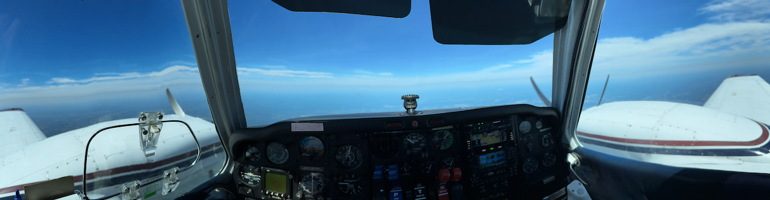
Yesterday was a gotcha day too: four years since I picked up Carmen, my 1968 Beech Baron 55, and it seems like a good time to reflect on what I’ve learned since that day I flew her home from Dallas.

(If you’re new here: the name “Carmen” came from my sister. I told the family I was flying to San Diego to look at a plane, and she immediately came back with “Carmen Sandiego… because where in the world…” and the name stuck.) I liked it enough to have stickers made, so I can leave them in breweries, bars, FBOs, and other places where people tend to leave “Kilroy was here”-style stickers. (It is no accident that the woman in the picture looks like my lovely wife cosplaying as Carmen, btw.)

The airplane as teacher

When I got my multi-engine rating in 2021, flying a 1967 Travel Air, I thought I had a pretty solid understanding of how twins work. I was wrong — or at least, incomplete. Owning a twin is a different kind of education entirely. The Travel Air and the Baron are siblings so they are similar in many ways, but the level of knowledge and investment of time and money required to move from flying a flight-school mule to your own airplane is very significant.

Four years in, I’m still learning. Every time something breaks, every time I research or buy an upgrade, every inspection I do or have done: they all teach me something new about the airplane’s systems. Working alongside the mechanics, looking at the guts of a 58-year-old airplane, is a kind of continuing education you can’t get from a textbook. I’ve gotten to know the plane and engines well enough to have opinions about things I barely even know existed when I started.

The people you find along the way

One high note of owning this plane has been the chance to meet new people.

I want to start by recognizing David Peterson, who sold me the airplane and did my transition training. Great guy who handed me a well-maintained, solid airplane and has always been there to answer my often-ignorant questions.

The online Beech community has been a constant bright spot. The folks on BeechTalk have been generous with advice — route suggestions, maintenance tips, and the occasional nudge in a useful direction. To cite one of many examples, when I posted about a planned Niagara Falls trip, a couple of people recommended stopping at Latrobe, PA to eat at DeNunzio’s — the kind of local knowledge you only get from a broad community like that.

Training with different instructors has been invaluable too. I practiced emergency procedures extensively with my friend Brian Fredrickson (who has since started a very successful flight school), and had the great experience of flying with Anand Iyer to train for my commercial multi-engine rating, which I earned in 2024.

During this stretch of time, though, I’m sorry to say I lost two friends: Nikul Desai was a fellow pilot and multi-engine instructor killed in a training accident, and Jon Foote took great care of the Baron for me at Elevation Flight until his untimely death.

Going places

One of the best reasons to buy an airplane is to use it to go places. A big part of my reason for buying a twin was so I could comfortably fly over water, mountains, and other places where a single-engine plane might leave me as an involuntary glider pilot.

Carmen has taken us to some wonderful places over these four years. Fall break 2023 was Niagara Falls with a side trip to Vermont to see my sister and her family. The Baron has about 5 hours of range including IFR reserves, but for everyone’s comfort I prefer a maximum stage length of about 3.5 hours, which meant a fuel stop somewhere in the mid-Atlantic. We’ve been to all sorts of interesting places…
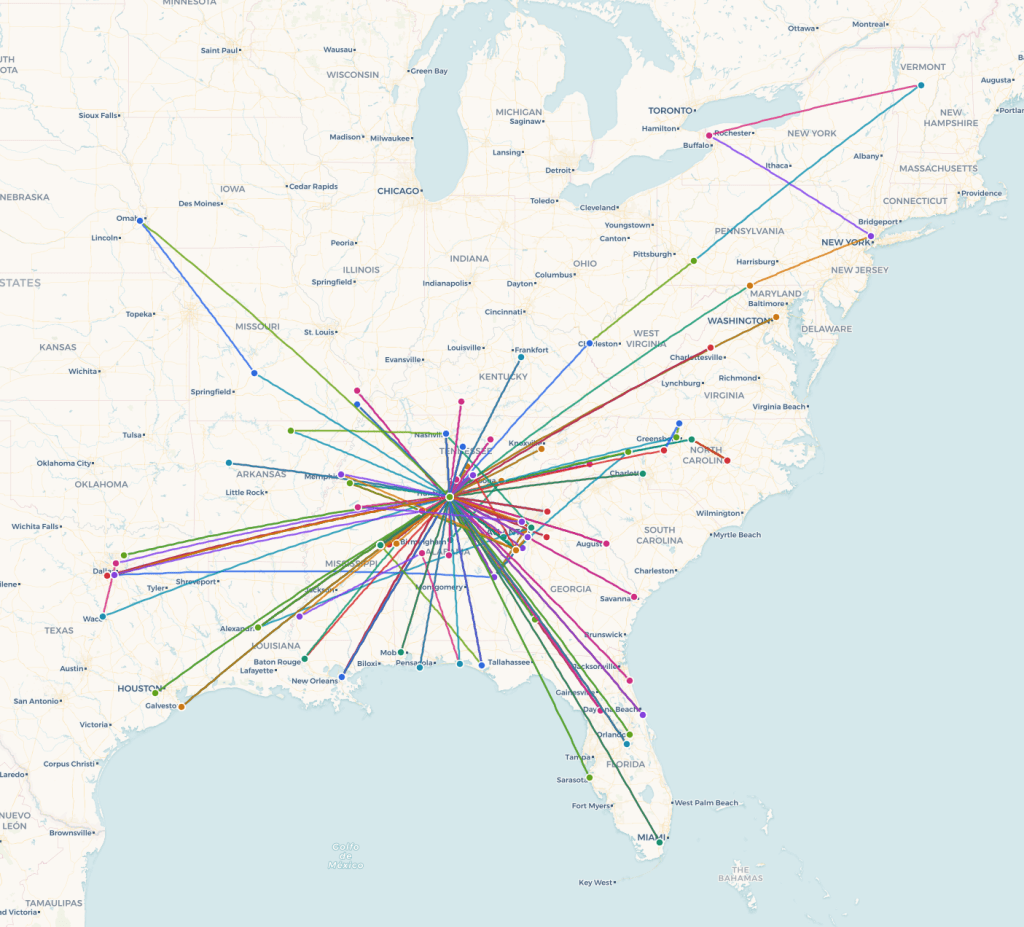
Image showing where I've flown Carmen.

(nb I couldn’t find a good way to generate the map I wanted so I wrote one: check out www.flightmap.online.)

I’ve also flown Angel Flight missions all over the southeast (LA, AR, FL, GA, MS, and TN, at least), ferrying patients who need to get to medical care. I first flew an Angel Flight mission back in 2019, taking a two-year-old boy named Dawson from Enterprise, Alabama to Aiken, South Carolina on his way to heart surgery in Boston. Having a twin-engine airplane that can reliably make these trips in a wider range of weather conditions means I can say “yes” to more missions, and that’s deeply satisfying.

Not without incident

I missed a few trips and had a couple of exciting moments, all for maintenance-related reasons. My first Bahamas trip was aborted because the shop I was using couldn’t finish the required cylinder change in time; the second Bahamas trip was scrubbed due to a brake problem. I missed the opportunity to fly myself to Vegas for work because of a leak in one of the fuel filters, and on a couple of other occasions (like an unexpectedly flat tire!) I had to scramble to get a fix in place. These things have taught me patience, as well as reinforcing the idea that if I really have to be somewhere I need to pad my travel schedule and have an airline ticket in my back pocket for contingency use.

Both “exciting moments” were precautionary engine shutdowns, of the same engine but at different times, due to noticeable engine roughness. The cause turned out to be a clogged fuel injector, itself caused by junk from an improperly sealed fuel strainer. The nice thing about a twin is that a precautionary shutdown is an annoyance and not immediately an emergency.

What’s next

Looking ahead, my goals keep evolving. I’m planning to pursue a seaplane rating, I want to keep up the Angel Flight missions, and 2026 is the year I finally fly myself to the Bahamas. I want to keep learning about Carmen and flying her to new places. After four years, the airplane still surprises me — sometimes with a new squawk, sometimes with a sunset over the clouds that makes me glad I’m up there.

If there’s one thing these four years have taught me, it’s that buying an airplane is not a destination. It’s an ongoing relationship — part mechanical, part financial, occasionally abusive, but entirely worth it.

Happy gotcha day, Carmen.
1 Comment

Filed under aviation

2025 year in review: flying

Let’s start with the bad news. Here’s what I said at the end of last year’s post:

In 2025, my goals are to fly at least one Angel Flight mission per month; to go up to the FAA headquarters in Oklahoma City and do their aviation physiology training seminar; to fly myself to Oshkosh and the American Bonanza Society convention; and to get at least one additional rating or qualification. Onwards!

Soooo… I didn’t accomplish any of those. For Oshkosh and the ABS convention, work conflicts prevented me from attending, the confluence of the FAA’s scheduling and my own work schedule prevented me from going to OKC, and I was overall too busy to follow through with getting another rating, although I did start studying for the first two exams required to become a flight instructor.

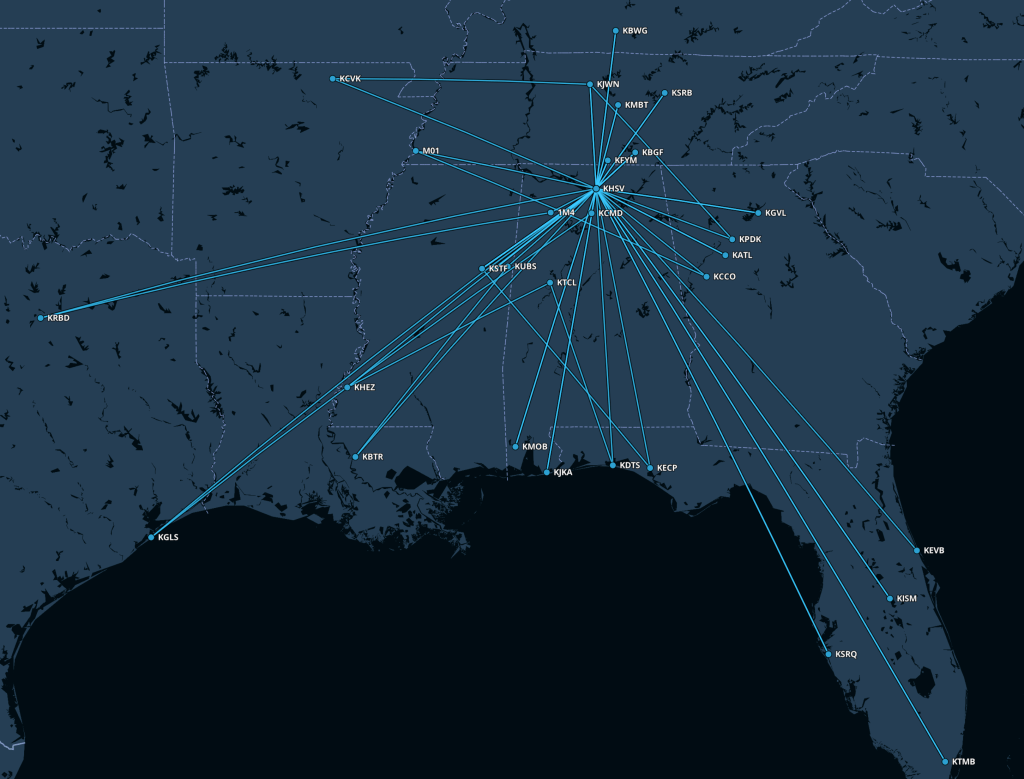
But! It’s a new year! The possibilities are limitless. And overall, 2025 was a pretty good flying year. I flew 102 hours, all throughout the southeastern US, including four Angel Flight missions, as shown below:

Highlights of the year included a pop-up trip to visit my mother and sister on their own trip to Galveston, taking Erica and the girls to see Lady Gaga in Miami, several flights to Starkville to pick up, drop off, or visit Anna, and work trips to Orlando and Dallas. I also got to do a few discovery flights with people interested in becoming pilots, and those are always terrific fun.

Overall the plane performed and flew beautifully. I added a second Avidyne IFD440 GPS in the spring, so I now have flight instruments, navigation, and a flight management system (FMS) roughly comparable to what United and Delta have, which is nice. I also have made heavy use of Starlink in the plane, including writing about it for Aviation Consumer. Speaking of writing, I had my first article published in AvWeb, too, and there are several more in the queue.

There were a few lowlights, too. My annual inspection took six weeks (until mid-February), which I didn’t love– winter in the southeast is often great flying weather thanks to abundant high pressure. Maintenance problems killed my planned flights to Las Vegas and The Bahamas, both of which I had looked forward to for quite a while. And planning for engine upgrades is looming as a depressing and expensive topic for 2026.

What about the rest of 2026? I’m still very much enjoying my Angel Flight missions; besides the four I did fly, I had five others scheduled but cancelled by the patient, which often happens. There are often long stretches when either no one needs to go anywhere or where other volunteers snap up the flights first, too, but I’m recycling the same goal of an average one mission per month for 2026. I want to make some progress on my flight instructor rating by passing the first two exams (Fundamentals of Instruction and Flight Instructor-Airplane) And, by god, I am going to fly myself to The Bahamas in 2026 if I have to flap my arms the whole way!

Leave a comment

Filed under aviation, Travel

Exchange 2013 Inside Out enters “early release” period

NewImage Lately I have been busy working on Exchange 2013 Inside Out: Clients, Connectivity, and Unified Messaging. More precisely, I’ve been dividing my time between performing technical review on Tony’s book, Exchange 2013 Inside Out: Mailbox and High Availability, and writing new content for my book. It’s all Exchange, all the time! To be more precise, right now I am about 55% done with the book: the chapters on unified messaging, Lync integration, message hygiene, client management, and mobile device management are done, and I’m working on the transport chapter now. That leaves me with chapters on CAS, load balancing, and Office 365 yet to do– certainly enough to keep me busy!

Microsoft Press is offering an early access program for these books (and a number of others). If you buy the ebook now, you get immediate access to the parts of the book that have been completed (meaning they’ve been through at least the first part of the editorial pipeline), with access to the remaining chapters as they’re finished. When the entire book is released in its final form, you get an electronic copy of it as well. I’m excited to see Microsoft Press offering early access to the book, because all signs point to gathering interest in the practical aspects of deploying Exchange 2013– something both books talk about quite a bit. We are targeting the final version to cover SP1 when it’s released, so there will be updates to the early access versions as well.

Now, back to writing!

Leave a comment

Filed under General Stuff, UC&C

Blacklist blacklist blacklist: the forbidden word

I just got chapter 6 of Exchange 2013 Inside Out: Clients, Connectivity, and Unified Messaging back from Microsoft Press. Like most other major publishers, Microsoft Press has a strict process to try to catch potentially offensive, libelous, slanderous, or sensitive terms before they appear in print. In this particular chapter, the editors requested many changes because of the odd vocabulary associated with message hygiene. For example, it’s OK to say “spam” to mean “an unwanted commercial e-mail message,” but it’s not OK to say “ham” to mean “a legitimate or desired commercial e-mail message” because in some book markets, ham is either unheard of or regarded as offensive.

However, they also busted me for using “blacklist,” as in “real-time blacklist.” This is the accepted term of art for a DNS-based system that allows an e-mail server to look up IP addresses of senders in real time to decide if they appear on a list of known or suspected spammers. Apparently “blacklist” is an offensive word in some contexts, although I’m having a hard time figuring out where or why.

Imagine my surprise when I fired up my Xbox tonight and saw this:

NewImage

Now, to be clear, I get it– Microsoft Press is not the same as IEB, Microsoft’s behemoth of a business unit. I’m sure they have different rules or something. And my editor, bless her heart, is only enforcing the rules forced on her by some clique of zampolits…but seriously?! Xbox LIVE has tens of millions of worldwide customers who are seeing this forbidden word. On the other hand,  my book, if I am very lucky, may sell as many as 25,000 copies (that would make it a runaway hit by computer book standards), and yet I can’t use a well-known and commonly accepted term in context.

Sheesh…

3 Comments

Filed under FAIL, UC&C

How I got into the writing business, part 2

In part 1, I started talking about how I got into the writing business. Part 1 ended with me having written a couple of non-Windows-related books (including this) and contributing to several Windows-oriented books (like this). I began to wonder if it made sense for me to get an agent, so I started talking to David Rogelberg, the owner of StudioB. He offered me the tempting possibility of being able to write for O’Reilly, something I had always wanted to do. I signed on as a StudioB client and, true to his word, David got me in touch with O’Reilly about writing a book on programming for the Palm Pilot.

Of course, I didn’t know anything about programming for the Pilot, but I wasn’t about to let a minor technicality stop me.

What did stop me was a communications mixup between Robert Denn, my editor at O’Reilly, and another ORA editor who shall remain nameless. This other editor had signed Rhodes and McKeehan– the experts who had written a book on Newton development too– to write a Palm programming book. That left them in the position of having two PalmOS books under contract, only one of which would be written by, y’know, people who knew what they were doing.

Robert offered to let me write a book on another topic. In fact, he even gave me my pick of topics. I wish I could say that I jumped at the chance to write about Exchange, but I didn’t. I had to be more-or-less bullied into it my my agent, who realized the long-term potential of working in the Exchange market. I didn’t know anything about Exchange either, but I was quickly determined to learn, given that I had just signed a contract to write about it. I started joining every Exchange-related mailing list in sight, printed out all the product documentation, and set up Exchange using Virtual PC on my Powerbook. (Yes, that’s right; my O’Reilly Exchange book was written on a Mac– a trend which continues to this day).

I learned sooooo much from the folks on the swynk Exchange list. Not only were there rock stars like Andy Webb, Missy Koslosky, and Ed Crowley there; there were also a ton of Exchange developers. Just to cite one example, one of the primary perpetrators of the Exchange 5.5 MTA was on the list, as was Laurion Burchall, one of the key ESE developers. Everyone on the list was super generous with their time and knowledge, and it didn’t take me long to get up to speed. (My first “live” exposure to the community, though, was attending the 1998 MEC. I was there when Tony Redmond made his famous “I’ll pass on the clap” remark, and I heard Pierre Bijaoui explain that the average human has one breast and one testicle!)

Coincidentally, at about the same time I got a call from O’Reilly: Windows NT Pro magazine was looking for someone to write a regular Exchange column. Was I interested? You bet I was! I started writing it in September of 1998 and it’s been in print ever since, although it’s morphed into a few different forms.

All this time I was still holding down a real job at LJL Enterprises, writing crypto code on the Mac. Eventually my agent brought me an offer that was too good to refuse: Ford Motor Company wanted someone to write a book about their CAD system. I gave my two weeks’ notice, set up my home office, and got ready to hang out my own shingle as a full-time author. That’s when the real adventures started…

3 Comments

Filed under General Stuff, Musings