Havana, day 1

My first “you know you’re in Cuba when…” moment was the customs agent wearing fishnet stockings. Before that point, José Martí International Airport in Havana looked mostly like any other airport terminal. As we got in line for customs clearance, though, I noticed that all of the agents were female, and most of them were wearing uniforms that were considerably shorter and/or tighter than I’d expect to see on a TSA agent. Then Warren pointed out Agent Fishnets and I knew: I was someplace really different.Clearing immigration itself was very straightforward: I turned in half of my tourist card, had my picture taken, and was cleared out into the baggage claim area. Our bike boxes eventually appeared on one end of the terminal and our bags on the other, and we proceeded to the declaration line. No one inspected our bags.. well, except for the TSA.

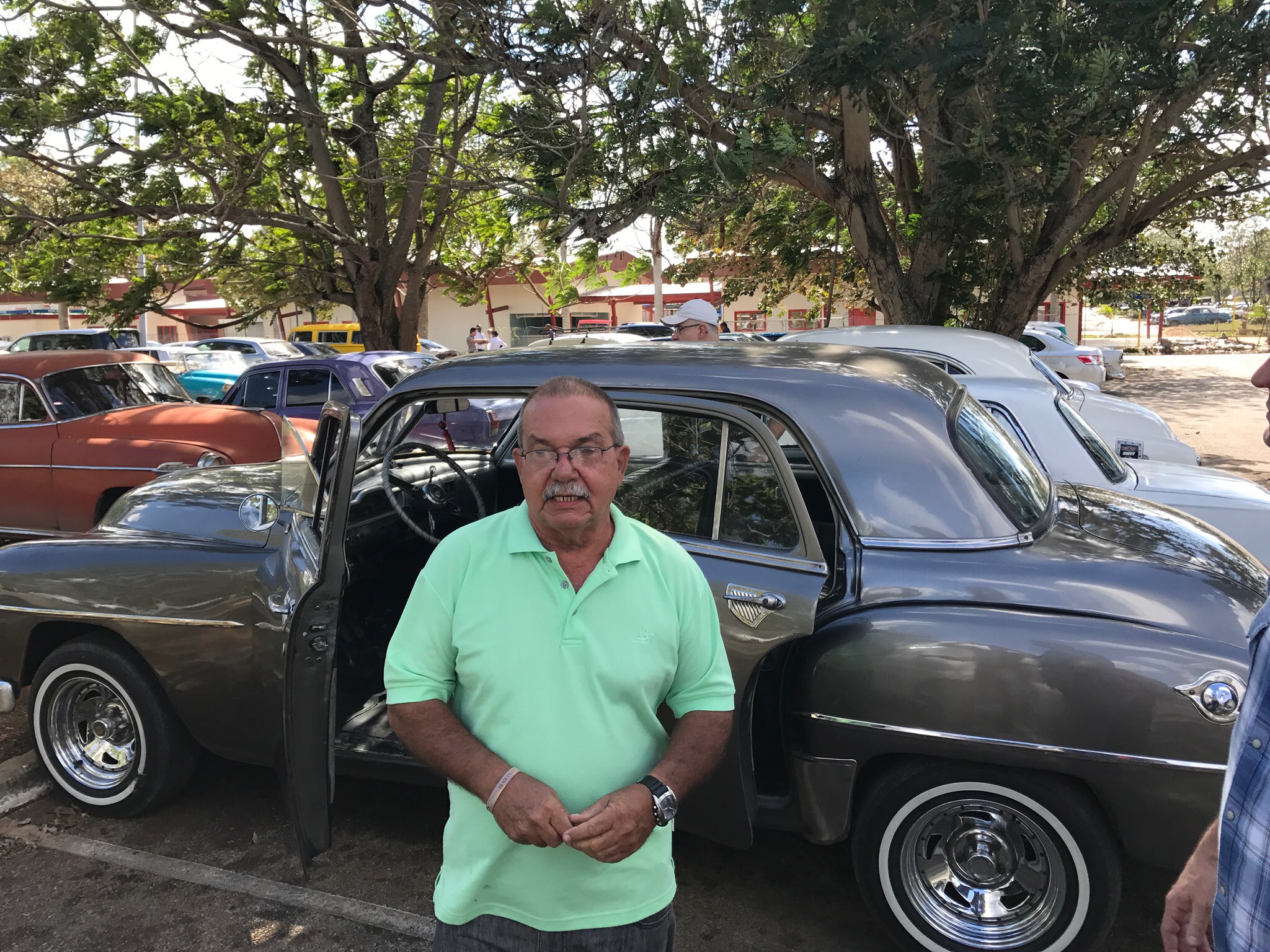
Outside immigration we met Eric, the driver that Tony had arranged to pick us up. He had an immaculate gray 1952 Plymouth coupe for us, or at least for 4 of us, plus a friend with a van to take the other 2 of our party, plus all 6 bikes.


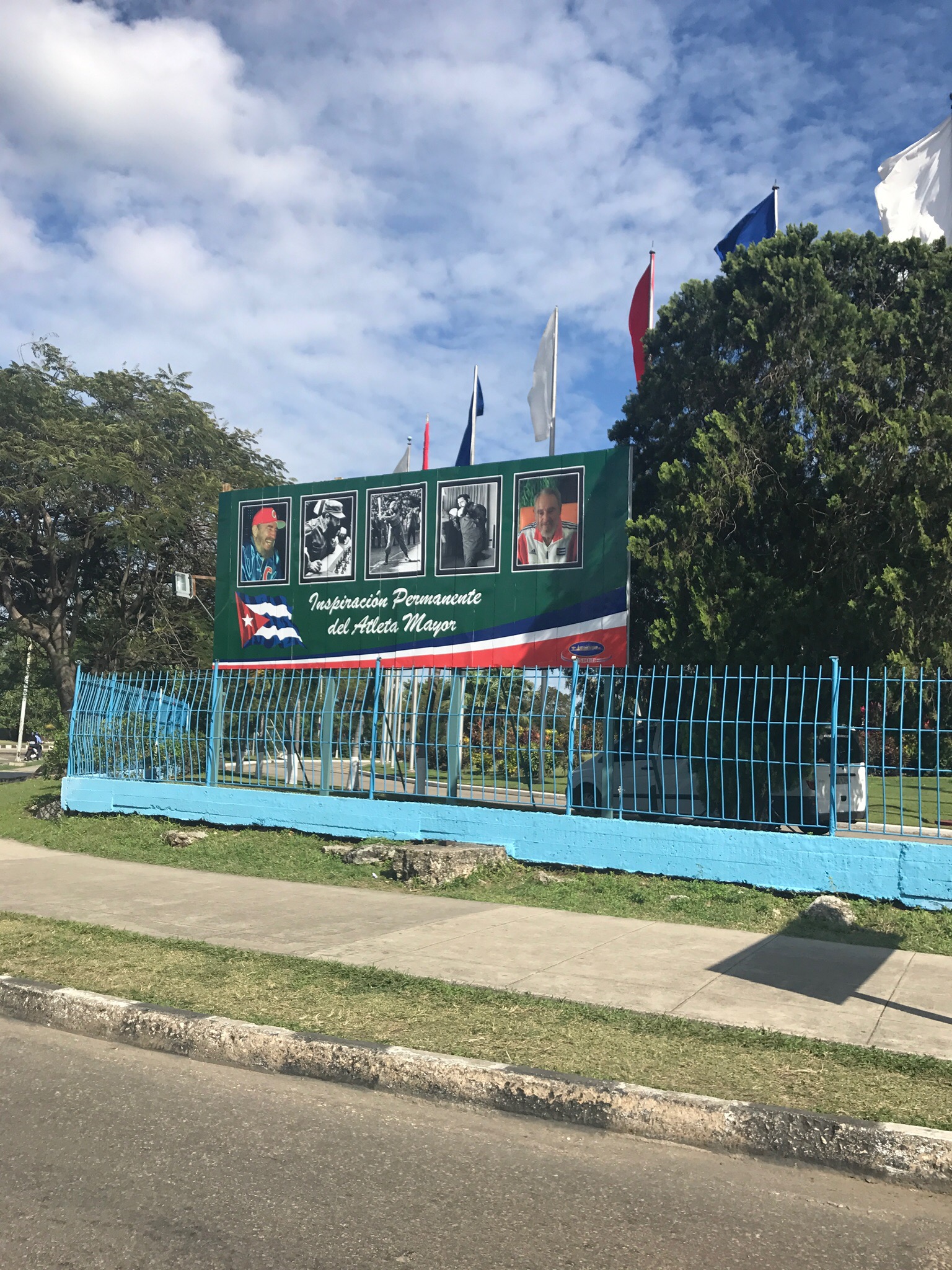
 Eric gave us a well-narrated tour through Havana, which simultaneously looked exactly like I thought it would (lots of classic cars, plenty of exhaust, bright colors, crumbling Soviet-era buildings) and nothing like I thought it would (packed streets, thriving businesses, a fair number of new-looking Chinese Geelys and other cars). Then we went by the big stadium, featuring this sign hailing Fidel as the “permanent inspiration of the best athlete” and showing him in various uniforms. 


Eric expertly navigated us to the Airbnb we’d reserved, “Casa Hendrik.” I can’t say enough good about this place– when I write the review it deserves I’ll post it here. Hendrik was a marvelous host and the apartment was perfect for what we needed. It doesn’t look like that much from the outside but had two marvelous terraces with a view of the water. This photo shows the view from right outside the door of my room, where there was a small porch, looking down onto the 2nd floor terrace; you can see water in the upper-left corner.


Next to the rocking chair is a small cage with two birds. Why? Because Havana, I guess.


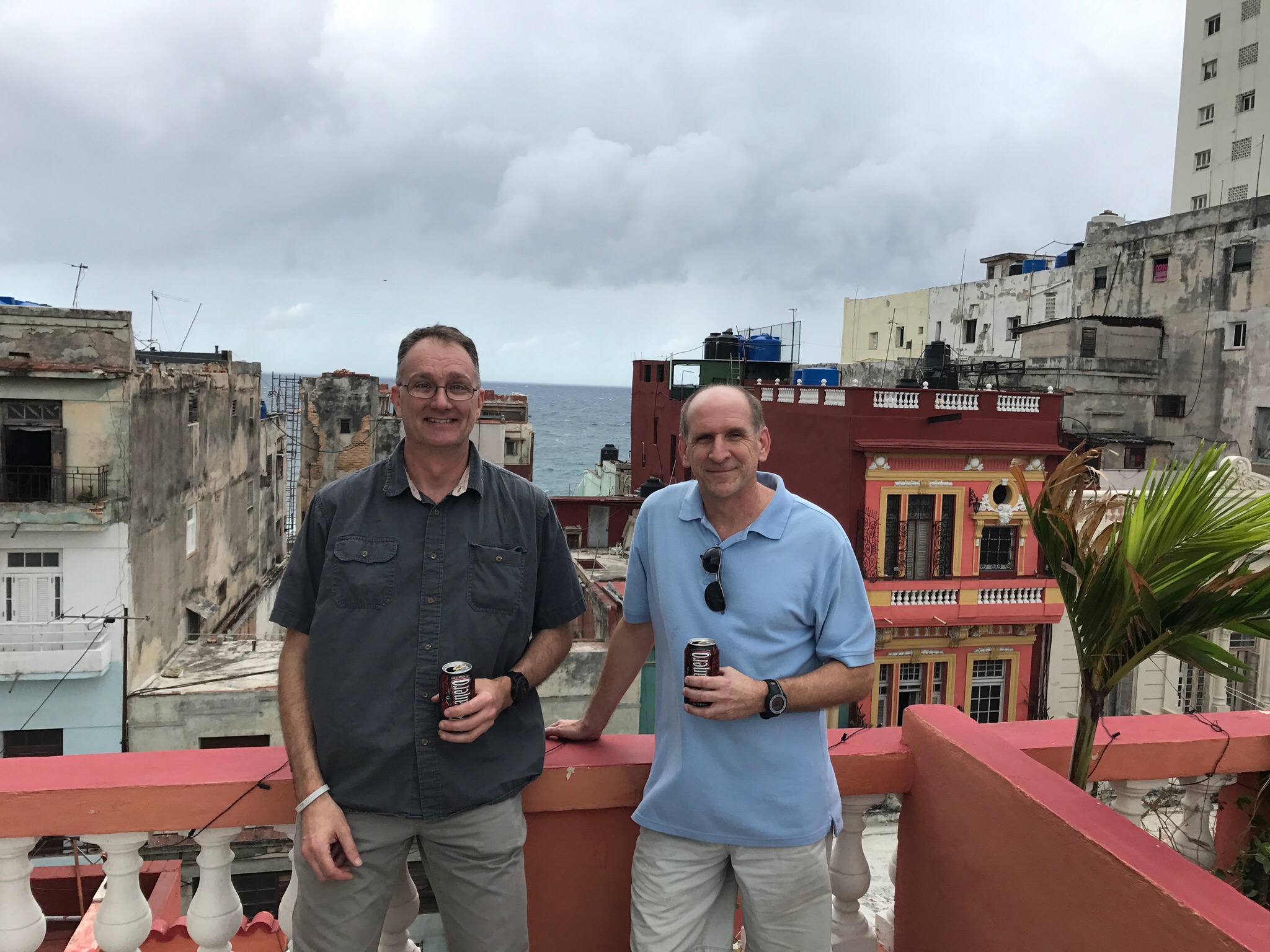
The photo shows Craig and me on the top-floor terrace, which is reachable by a tiny and completely unsafe concrete spiral staircase. No handrail, nothing on the outside other than a 30-foot drop, and a stair pitch and size completely incompatible with size 13 feet. So of course I went up there as often as possible. 

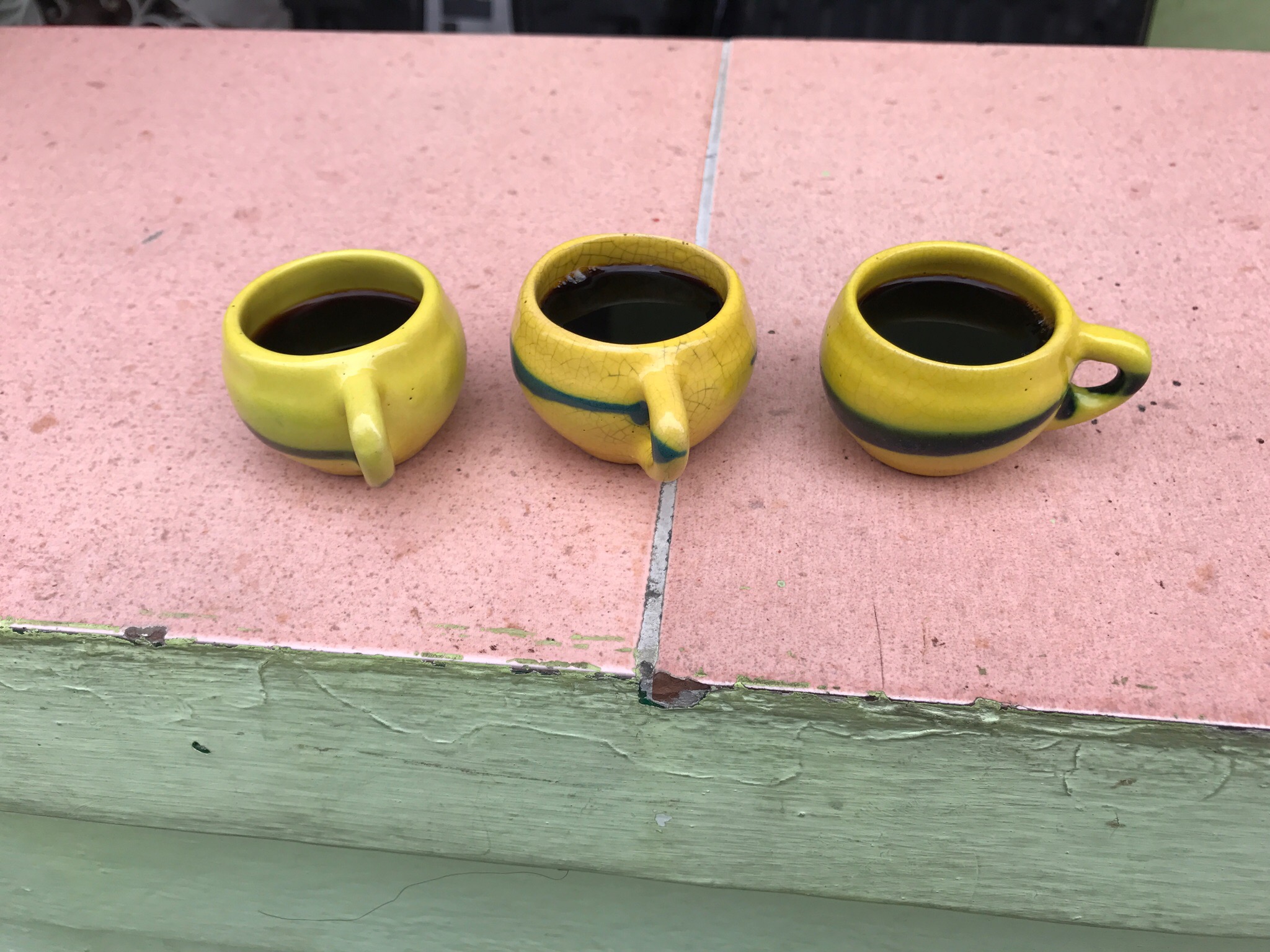
Hendrik introduced us to Tia (Spanish for “auntie”), the 95-year-old woman who lives on the ground floor. Her vocation is neighborhood coffee lady, so whenever we needed a shot of her coffee, which tasted like what they must drink in heaven, we’d go see her. Little cups packed a big punch.


Lance quickly started putting together bikes on the tiny front porch, gathering a fair amount of curious stares from passers-by. Our neighborhood had a number of other casas particulares (private rooms that the owners are allowed by the government to rent), along with small shops and so on. It was a good mix to give us a taste of Cuban life.

For dinner, I’d asked Hendrik to make reservations at Paladar Torreson. Paladars are licensed private restaurants, often located in people’s homes (as this one was). Dinner was quite good; for about $12 US I had a plate of 3 small lobster tails, bread with an excellent hummus-like spread, arroz Moro, and a (watery) Cuba Libre.


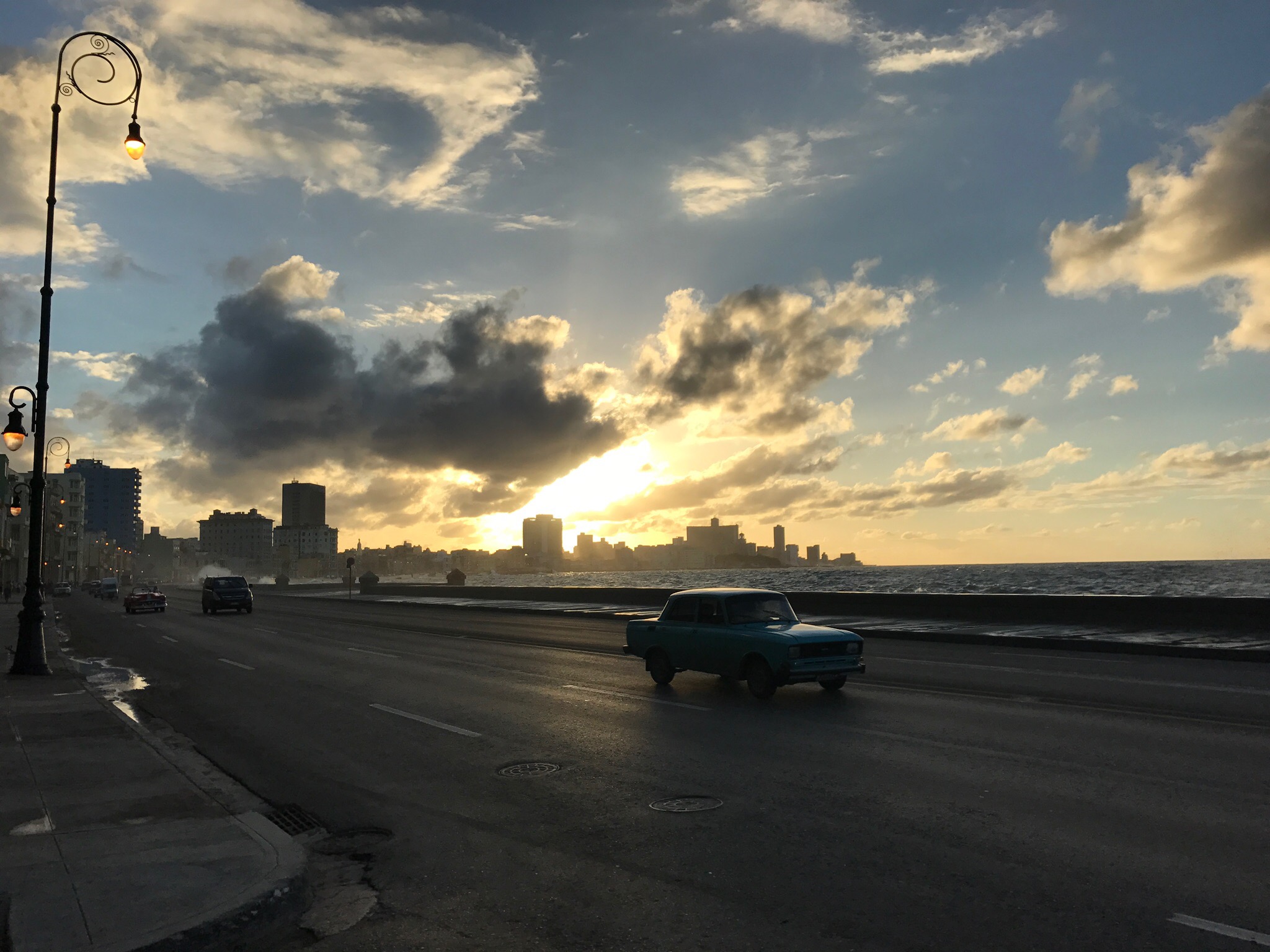
Best of all, the paladar overlooked the Malécon, Havana’s famous waterfront road, so we got to people- and traffic-watch while we waited for the sunset… which was spectacular.


After dinner, we went to walk the Prado, one of the main drags in Old Havana. Most of the big tourist hotels are near there, as is the National Grand Theater and the Capitol building. It was crowded with skateboarding kids, strolling lovers, tourists, locals, and the occasional street dog.

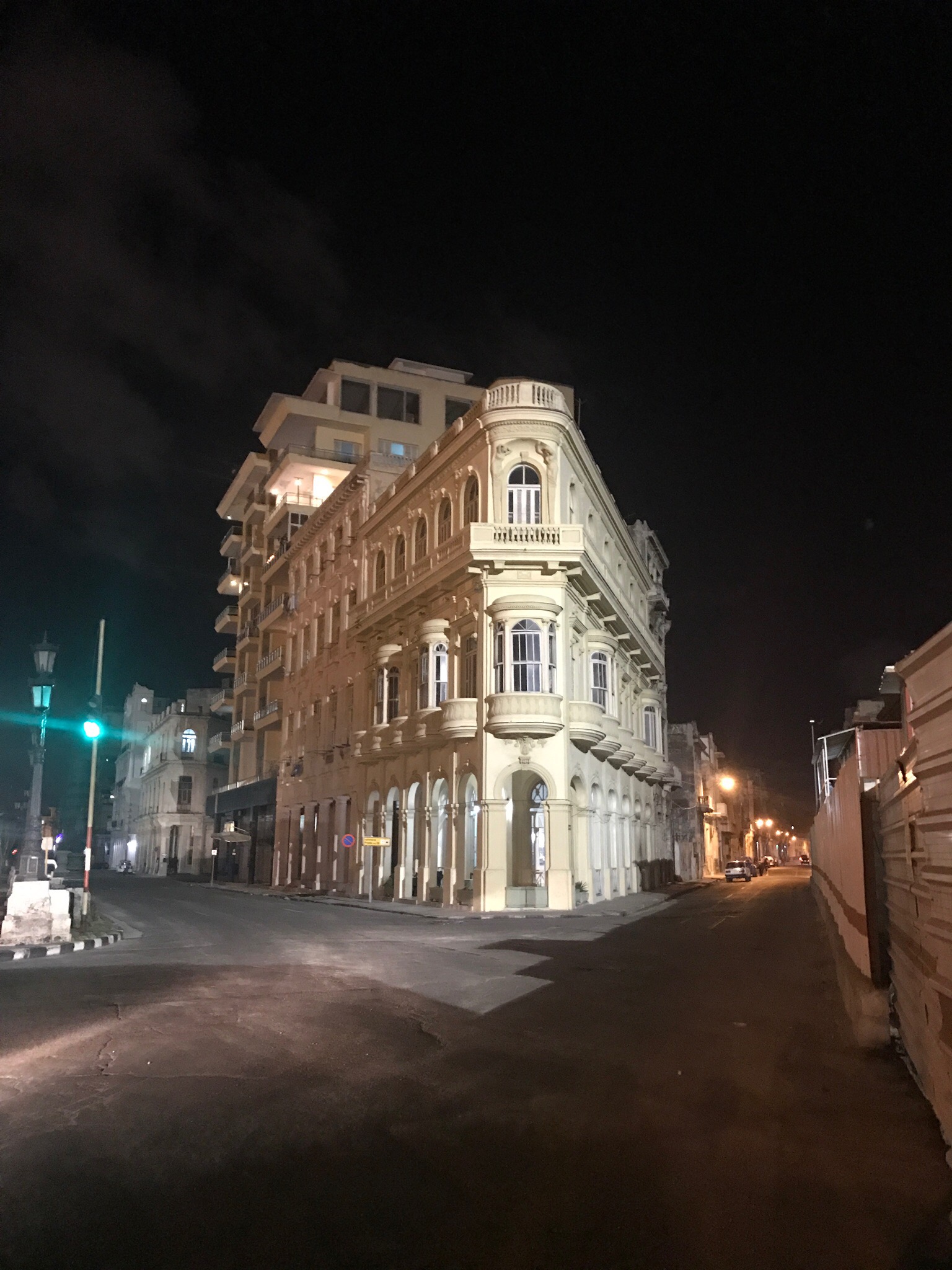
This is a building whose name I forgot to write down:


And here’s the Hotel Inglaterre:


After the Prado, Craig and I went back to the Malécon to look for some of the famous wifi parks. We found some but couldn’t get them to work… more on that in another post.

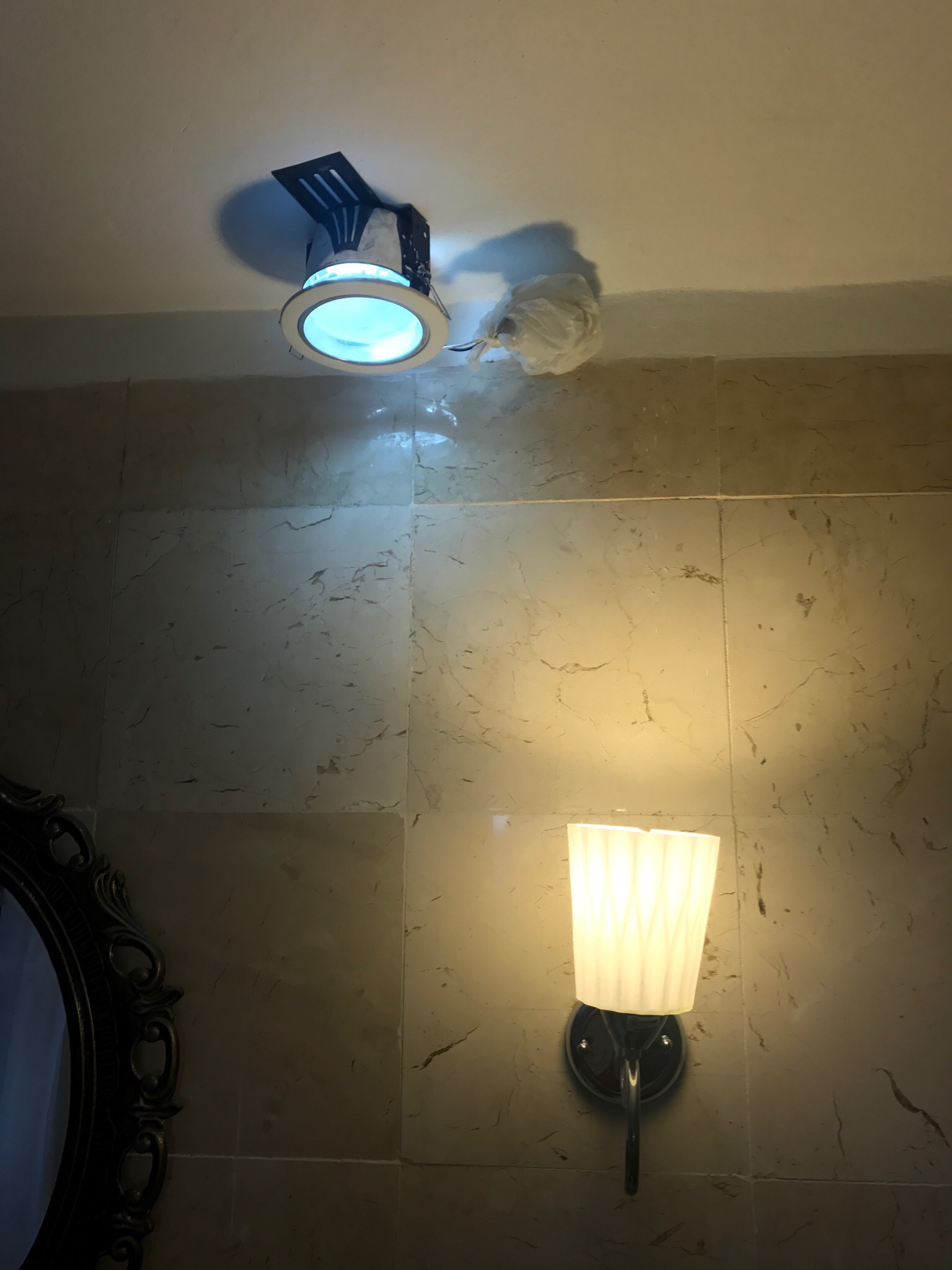
One final note. Cubans are absolute masters at making stuff work with very limited resources, as evidenced by the light in our bathroom. There was a nice wall-mounted finial, but someone decided to add an LED can light… so they did. An angle bracket, some wire, and a plastic bag to wrap it in… done!


I hit the bed exhausted but intrigued by what we might see the next day. I was not to be disappointed.

6 Comments

Filed under General Stuff, Travel

Training Tuesday: Havana Triathlon race report (25 Feb 2017)

(The Garmin Connect app doesn’t work on Cuban government wifi, so I can’t post course maps, etc. The final race results aren’t up, and since I didn’t have my phone I don’t have any pictures from the race itself, so this report is all you get for right now.)
Summary: great experience, awful performance. 8:12 for a 70.3 is nothing to get excited about. I guess I was not as well prepared as I thought, but there were a couple of other external factors. First is the fact I was sick. I didn’t realize how sick until today (Tuesday), 3 days post-race, when I’m feeling normal and comparing it to how I felt the day before and the day of the race. I had been sniffling and snuffling all week, since maybe 2 days before we left, and was regularly taking 12hr pseudoephedrine for a solid week before race day… not a great setup for the race. I was short on sleep ( people here don’t really get their nights started until midnight or so, so we’ve had significant traffic noise and street noise each night), averaging about 5hrs of real sleep each night for the 4 days pre-race day. I also ate poorly, out of necessity, the day and a half before the race. Those aren’t excuses, but they were definitely factors.

Prep

We spent the entire day before the race getting registered, dropping off our bikes and transition stuff, and so on. I logged about 10 miles of walking. This was not a good idea. Race registration was at the marina; it took about 2 hours to get through packet pickup, then we had to drop off our bikes. The best word to describe the race was “disorganized.” There was a lot of mis-information and non-information, and the whole experience really made me appreciate how hard RDs have to work to put on a smoothly running race. This is only the 3rd year for this race so I am confident that they will improve.

This was a point-to-point race: all our bike stuff went in 1 bag, and all our run stuff in another. We dropped the bike bag off with the bike and gave the run bag to the organizers, who staged it at T2 for us. This put a very high premium on making sure the right stuff was in the right bag, which for the most part I got right. However, that process adds some mental stress, even if you’re a heavy checklist user, as I am.

I had a small lunch (shrimp pasta in an interesting but odd not-tomato sauce) and a good but small dinner (grilled chicken, rice, black beans, a few slices of fried plantain) and got to bed about 830p, where I slept for maybe 5 hours total.

Pregame

I got up at 410a, had breakfast (small pack of honey roasted peanuts, a protein bar, plenty of water), and met the others downstairs for our van ride to the marina. The organizers had told us that we’d have access to our bikes so we could fill bottles, etc, and this turned out to be true. They had also said we’d have access to our run bags, which was not, so I started the run with no water… more on that later. There were nearly 800 participants in the race, for which the organizers thoughtfully provided two (2) portapotties. With no toilet paper. That was awesome. Luckily I had some Kleenex with me.

There was a great deal of confusion over where the swim was supposed to start. Nothing was marked, and none of the volunteers seemed to know what was what. Once the sprint swim started, the RD eventually herded everyone to the right area and collected our after-race bags. Before the swim, I put my glasses, street clothes, etc. into that bag for access later.

Weather and conditions

It was mid-70s at swim start, with a water temperature of about 76. The wind was calm until later in the day– it started to pick up about 11a and reached its peak when during the run leg on the Malécon. The forecast high temperature was 85. I don’t know how hot it got, except that the temperature sensor on my watch registered a max of 105. When it’s on my arm, it reads about 15 degrees higher than ambient FWIW.

Swim

The RD said wetsuits were optional, so I swam with my sim shorts. The plan was to jump in the water at the land side of one of the marina’s berthing lanes, swim down that lane, across the mouth of the adjacent lane, and back down the next lane, for a total of 2100 yards or so. I don’t have good data from the swim– my watch showed I swam 1375 yards in 48:08, but the other guys with me all had correct distances, and the race results aren’t posted online so I can’t cross-check. I felt pretty good on the swim overall, at least until last night when Lance told me he saw two of the yachts in the lane we were in pumping gray water overboard as we swam past. One interesting note: when I jumped in, I forgot to hold my nose and so pumped my sinuses full of marina water. My nose was fine for the rest of the race, go figure.

T1

T1 took 11:08. FAR TOO LONG. This consisted of a 1/4mi or so run from the swim exit to the bike area. Our bike bags were hung on numbered hooks, and volunteers were checking numbers so that by the time each athlete got to the hook, they’d pulled the correct bag. ITU rules don’t allow setting up transitions in advance, so I had to dig through my bag to get socks, shoes, chamois cream, a shirt, sunglasses, bike computer, and nutrition, then get it all put on or tucked in pockets, then run out to the bike and set it up the rest of the way.

Bike

The bike course started with a couple of short climbs that I wasn’t expecting. I’ll put the route map on my blog later when I have Internet again (or you can look it up if you follow me on Strava), but basically we rode around a residential district, then up Linea (one of the main drags) and through El Tunel Linea, then turned around and reversed the route and diverted onto the main east-west autopista. There were tons of volunteers and cops managing both vehicular and pedestrian traffic; they had shut down our side of Linea for racing, so all the traffic was squeezed into the opposite side of the boulevard. I give the race organizers full points for this.

Havana is not what I’d call a polluted city but there is much more vehicle exhaust than Americans are used to– lots of poorly tuned 2-stroke gas engines and big diesels. Riding through that was not my favorite. In addition, there are tons of road hazards. I would describe the overall road conditions as fair– the worst of the roads we rode are no worse than some of the hot spots on Redstone Arsenal or the area near my house (I’m looking at you, Burgreen Road). There are lots of potholes, sunken manhole covers, and so on, and none of them were marked, but they were easy to see.

On the autopista, the course was a series of very long 1-3%climbs and short, quick descents out to about 35mi, then a turn back into the city. As the day wore on it got hotter and windier, with a moderate cross headwind on the way back in.

There were 5 or 6 aid stations with bottled water on the bike course. I drank probably 6 bottles of water on the bike, had a Honey Stinger waffle each hour, and had a small banana (maybe 5″ long) at the turnaround rest area. At the first rest stop (maybe 20mi in) I stopped, put on my arm sleeves, and soaked them, my head, and my jersey with water. That helped a bit. At the turnaround rest stop I stopped again and drank an incredibly tasty can of the local equivalent of orange Gatorade– muchas gracias to the volunteers who thought to have that on hand.

After the highway the route took us back up Linea and through the tunnel again. (I did shout “TUNNELLLLLLLLL” each time I rode through it, like the kids and I used to do when driving through tunnels, so that was fun). There were several groups of uniformed schoolchildren along the route who went nuts whenever they saw a cyclist, so that was really fun.

I tried to stay in the prescribed power range but on the back half of the bike course was trying to make up time and started pushing harder. This was a critical mistake. 3:41 on the bike, when I was hoping for 3:15 or better, was rough.

T2

T2 was set up right near the US embassy and Monte de las Banderas, a local monument with some Fidel-era slogans. Racers biked in and handed their bikes to a handler, who racked it, then ran down the chute to get their run bags. I did that, found a changing tent, and started trying to change, but I was in a fog– I put my belt on backwards, couldn’t get my shoes on the right feet, and went the wrong way leaving the chute. There was no water in T2, so I started the run with empty bottles. 8:05 in T2, most of which was spent sitting trying to catch my breath. I was so hot I actually had goosebumps. I’m lucky it wasn’t longer.

Run

I ran for, maybe, half a mile and then my legs just gave out and I walked. Occasionally I burst into a dispirited sort of trot but I was having trouble moving my legs. Eventually I shuffled through the first aid station and got some water in my bottles, on my arm sleeves, over my head, and down my back. I wish I could say that I magically revived but no. I nearly quit about a dozen times but kept shuffling to a 3:20 finish. That is by far the worst half marathon I’ve ever run, both in terms of time and of quality. There is no way to dress it up or make it look better.

Oh, did I mention that there were no bathrooms on the bike or run courses? No? Because there weren’t. I barged into a restaurant on the Malécon for my run potty break. Twice. Hope they didn’t mind.

The finish

All my friends finished before me, so I had a great welcoming committee as I crossed the finish line and got my medal and finisher’s shirt. I plopped down and collected myself for a few minutes, then Craig and I took a cocotaxi back, which was like riding inside the Devil’s lawnmower, with lots of exhaust and swerving. Warren was kind enough to ride my bike back for me and put it away. 

Post game

Literally all I could do when I got back to the apartment was sit in a chair, stretched out. I couldn’t really turn my head because my shoulders and neck were so tight, and I didn’t even have the energy to banter. I have never felt so sick or tired after a race. I eventually straggled upstairs for a shower and a half-hour nap, which helped. The thought of food was absolutely repulsive, so when the posse went out for dinner I went to bed instead about 830p and slept for maybe 7 hours total. The next morning, I got up and picked my way listlessly through the excellent breakfast buffet at the Parque Central hotel and then shuffled through the Museum of the Revolution (more details on both of those in a later post), then went back to the apartment for a big long nap. I didn’t really start feeling normal until Monday afternoon but am now fully recovered. Lots to learn from the overall experience, including a) don’t race when you’re sick and b) make sure your race prep is strong. Onwards!

1 Comment

Filed under Fitness, Travel

Havana, day 0

I woke up at 0315, 45 minutes early. Why? Who knows. I was thoroughly packed so I had time for a leisurely shower and a last-minute gear check. Warren picked me up right on time and we headed for the airport, where we were soon joined by Lance, Warren, and Craig.

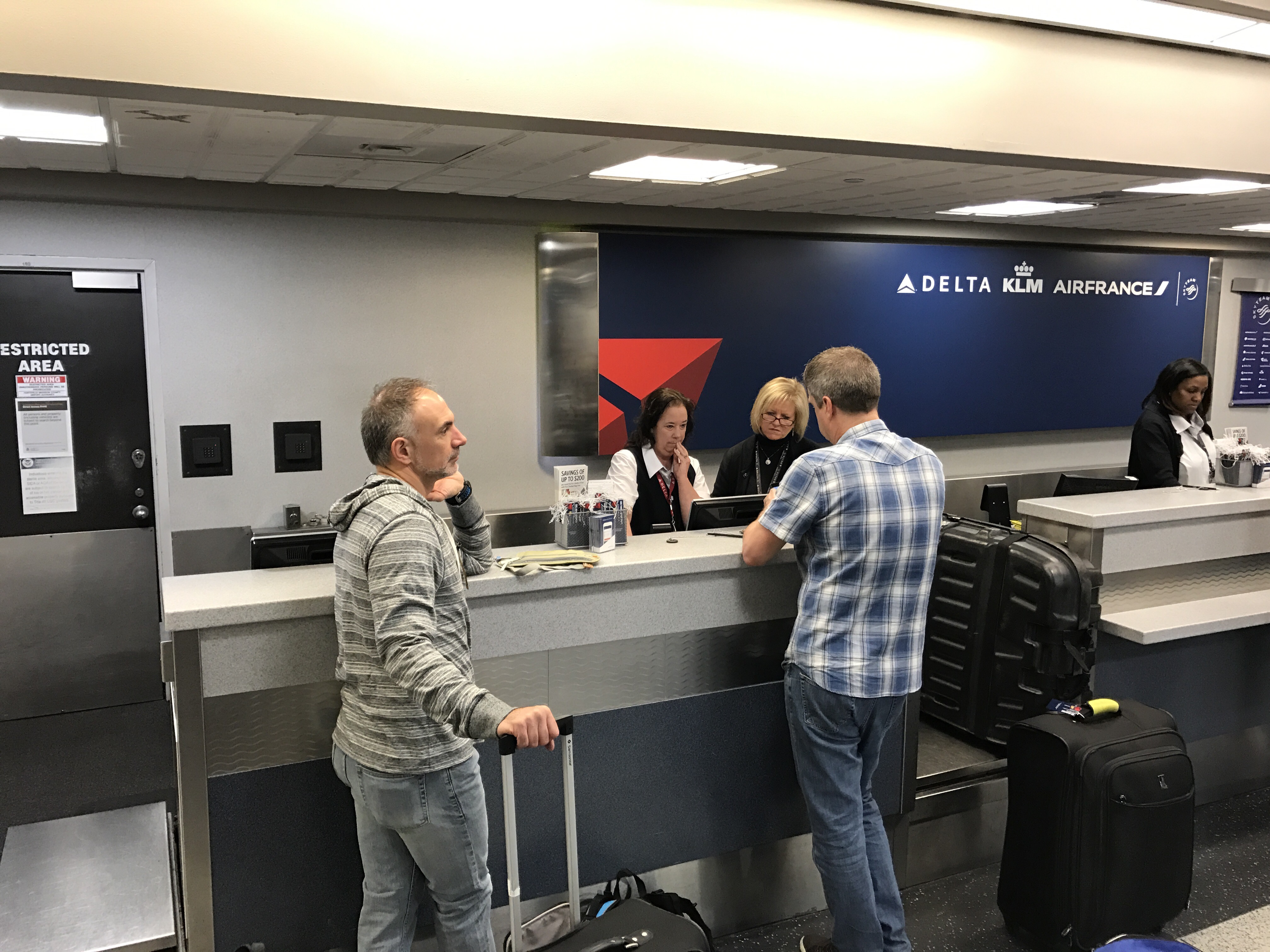
At checkin, Delta didn’t know how to handle us. First, they had to figure out how to sell us a Cuba travel card (CTC).. more on that in a minute. Once that was done, our agent discovered that the computer said “no bikes are allowed for transport to Cuba.” This directly contradicted what Warren had been told by Delta on the phone and what I’d been told both in email and via Twitter DM. The agents were patient and helpful but ultimately couldn’t override the computer without getting the local redcoat to come fix us up. 

Delta’s standard fee for bicycles is $150, and they cheerfully applied that on this flight to each of us. The agent apologetically pointed out that my suitcase was 6lbs overweight (because it has about 15lbs of donated clothing, a skillet, and some other stuff for our Cuban hosts) so I had some last-minute juggling to do to make weight. (Meanwhile, Julio was doing the same thing departing Louisville, except that they accepted his bike without question.)

Once that was finally done, we had an uneventful flight to Atlanta and a walking breakfast en route to the international terminal.

We stopped at the currency exchange booth and found that they didn’t carry Cuban currency– not a huge surprise. Tony had coordinated a bulk purchase of Euros, because it worked out slightly better for us to buy Euros in the US and then change Euros to Cuban pesos (CUC).

Now, back to the CTC. Cuba doesn’t issue visa per se for US citizens. Instead, you need a CTC. The airline can’t let you board a flight to Cuba without one, so you either have to buy in advance through a consolidator (which costs $85 or so) or from the airline, usually $50. Delta charged us the $50 fee at checkin, so all we had to do was fill out a form certifying that we had a legitimate reason to go to Cuba and show our receipt for the $50. The gate agents gave us the actual CTC and checked to make sure we’d filled it out properly– apparently lots of people get the date format backwards and end up having to buy another CTC. The form is in two parts: Cuban customs collects part 1 when you arrive, and you turn in the matching part 2 when you depart.


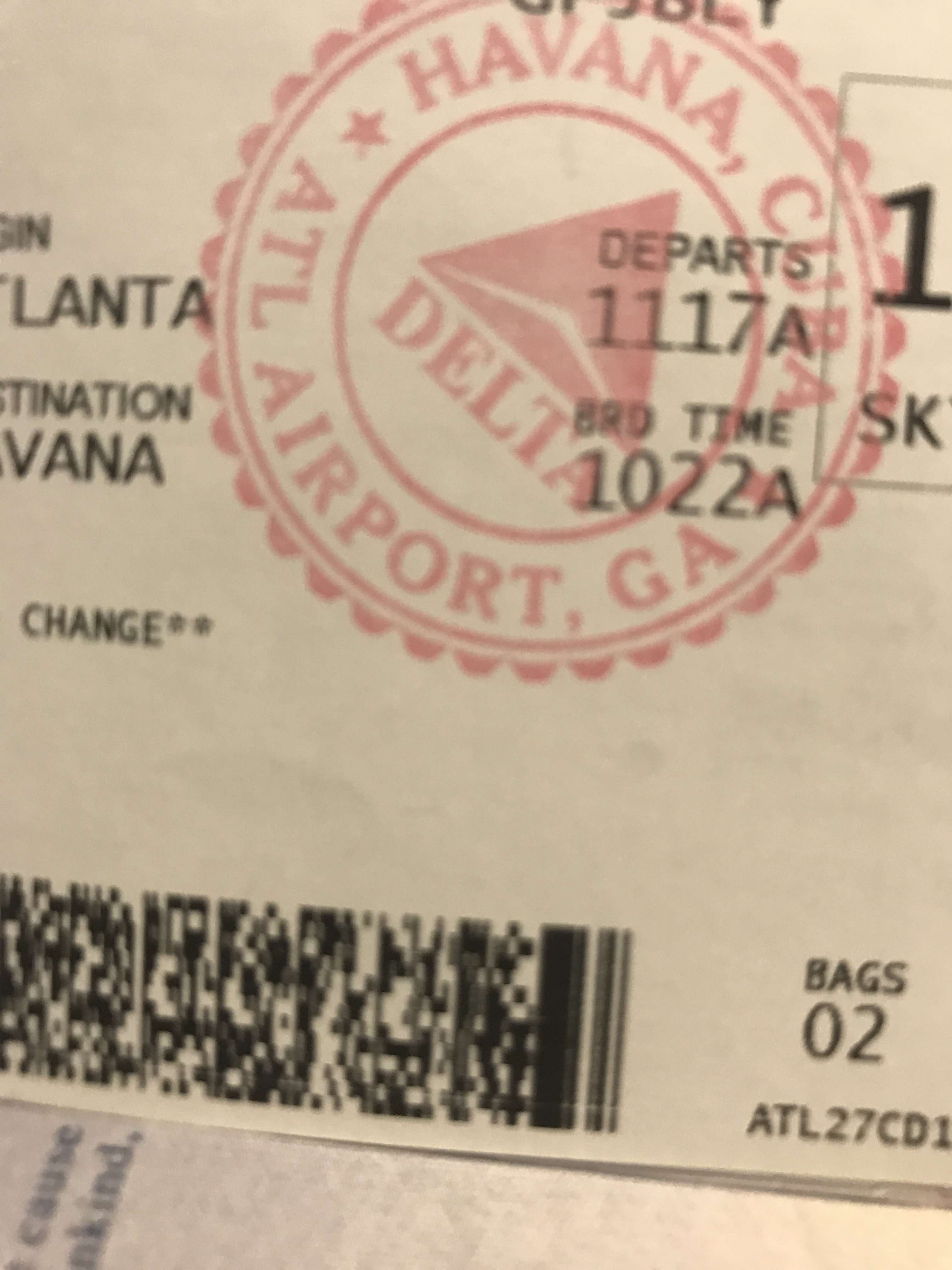
After checking all the documents, that’s when you get your boarding pass, which is stamped to indicate that you’ve passed the documentation checks and can legally board the flight. US citizens traveling to Cuba are required to have medical insurance, since they aren’t covered by Cuba’s government insurance system. The $25 fee for this insurance is included when you purchase a ticket on Delta, and your boarding pass is proof of purchase.. so you’re legally required to keep your boarding pass with you at all times in country.


Apart from the documentation procedures (which are really very similar to any other Delta international flight), the boarding process and aircraft are identical to what you’re used to. We flew a domestically configured A319 with wifi, although wifi only works in US airspace. To make sure that this gets posted, I’m going to actually post it while we’re still in the air over Florida; you’ll have to wait until the next installment to learn about our arrival in Havana, race packet pickup, and our (planned) dinner at Paladar Torreson.

5 Comments

Filed under Fitness, Travel

Training Tuesday: pre-Havana smorgasboard

In two days I’ll be headed to Havana for my first 70.3 of the season: La Habana Triatlón. Things here at la casa have been fairly chaotic as I’ve tried to clear my work backlog, learn and prepare for travel to a completely unique country, and get my normal training and race prep together. Here are a few highlights:

  • Alex handed me over to a new coach, Jon Fecik. Jon is a professional triathlete. I can’t summarize how excited I am to be working with him– even after only two weeks it’s clear that he is going to be a great match for my training needs. So far I’ve learned a ton from him and I think I have a solid race plan.
  • The weather in Havana this weekend: forecast high of 85 degrees and sunny. The water temperature will almost certainly not be wetsuit-legal, plus that’s kind of warm for a 70.3. Jon has given me a pretty solid hydration plan and we’ve talked extensively about my race pace strategy so I think I’ll be good to go.
  • Packing has been interesting because I assume that I will not be able to get anything locally except for bottled water and fresh food. Everything from bike parts and tools to race nutrition to clean underwear (and toilet paper!) has to go with me, or I have to do without it. This has raised my packing anxiety to a previously unknown level.
  • I’m traveling with a group of 5 other local triathletes, and we’ve got an Airbnb with a housekeeper. We’ve also been able to book a driver/guide. This is going to be important because none of us have been there before and we have a fairly complex set of logistical problems to solve– getting 6 people, plus their bikes and gear, from point A to point B, thence point C, then back to B, several times, then back to A is going to be non-trivial. Having local guidance will be extremely useful.
  • There’s a ton of stuff to see and do in Havana– it’s a city of over 2 million people. Anything I have time for will be a bonus.
  • Cuba has very, very limited Internet access. Simple tasks (like sending one of my fellow travelers a message to ask where we’re meeting for lunch) will be impractical at best. We’ve all got paper maps, as well as offline copies of city maps on our phones. I posted the other day about my proposed email/blogging rig, and I’m confident it will work, but you may not be hearing much from me over the next several days.

I’ll be posting a full race report sometime between the end of the race and the end of March. Stay tuned!

Leave a comment

Filed under Fitness, Travel

Test of my Havana setup

This is a simple test post to see how well my planned tech setup works. I’m typing this on a Logitech K380 Bluetooth keyboard, with my phone in a Stump stand. Wifi and cellular data are turned off. Here’s an embedded picture:


Why am I doing this? Well, Cuba doesn’t have much of an Internet infrastructure, both by design and by lack of investment. There are public wifi hotspots operated by ETESCA, the national PTT, and a functioning cellular data system. However, wifi access is limited to about 200 hotspots nationwide, and roaming data on AT&T is $2.05 per megabyte. My plan is to write blog posts and email while offline at la casa, then find a telepunto to upload and download once a day or so. I’ll still be able to send and receive ordinary texts and phone calls, but I don’t plan to given the expense. 

It’s an open question which real-time communications will work– I’ve read that consumer Skype and FaceTime are blocked, and that WhatsApp works. I don’t know about Signal, Facebook Messenger, or Skype for Business. My working assumption is that I’ll be reachable through at least one of these methods while I’m in wifi coverage, but if you really need to get a hold of me, use email.

1 Comment

Filed under General Stuff

Office 365 Exposed, episode 7

In this episode, Tony and I welcome special guest and Office 365 MVP Alan Byrne, who comes off the top rope on Microsoft and their Office 365 reporting APIs. We discuss something Citibank has that you don’t, wonder where some promised Office 365 features have gone, and tell bad jokes. Actually, I don’t think there are any jokes in this episode at all– probably worth listening to it just for that.

Leave a comment

Filed under Podcasts

Focused Inbox in Office 365: making mail harder

About two and a half years ago, Microsoft rolled out a new mail-sorting feature called Clutter. It was intended to use machine learning to filter important mail from newsletters, shipping notifications, and other… well, clutter, leaving your inbox filled only with mail that required your attention. It was a great idea, and, although it had a few bumps in its implementation, soon evolved into a useful and dependable feature. Now Clutter is gone, and Focused Inbox has replaced it. How’s that working out so far?

First some history: in 2014, Acompli introduced what they called “Focused Inbox” in their mobile client. This represented a different take on inbox cleaning; machine learning would still be applied to sort important mail from clutter, but the important and unimportant mails wouldn’t be logically separated into different folders. This had the advantage of working across multiple email systems. Fast forward to today: Acompli was purchased by Microsoft in December 2014, the former Acompli team has been crushing it with their Outlook Mobile app, and key ex-Acompli folks have taken over some key positions on the Outlook team. Focused Inbox has become the new sheriff in town, and Microsoft is rolling it out to Office 365 tenants. One of my tenants was recently upgraded, so I wanted to write about my experience working with it as an end user. (Keep in mind that, as I write this, Microsoft’s January 26 announcement that they didn’t have a firm timeline for rolling out Focused support for Outlook for Windows is still in force.)

I use three primary clients: the Outlook Mobile client for iOS, Outlook 2016 for Windows, and Outlook 2016 for Mac OS X. I mostly use the mobile client to triage mail while away from my desk– I can quickly respond to important items and delete or file stuff I don’t need. In that role, I’ve been depending on Focused Inbox for a while, and I got used to the disparity between what I’d see on the Focused tab on my phone versus what showed up in my inbox– the desktop inbox showed all my messages, not just the Focused ones, but that wasn’t a big deal, as I was usually grooming my inbox by throwing away or otherwise dealing with the contents of the “Other” tab frequently enough to avoid ugly buildup.

When your tenant’s enabled for Focused Inbox, OWA and Outlook for Mac will display a prompt telling you so; when you click to acknowledge it, you’ll see the new Focused and Other tabs in the UI, just like in the mobile app. Here’s where the fun starts.

First up, Clutter is turned off when you accept that prompt, and it’s turned off permanently… so every message formerly  filtered into the Clutter folder now goes straight to your inbox. That means you’ll get a  notification (if that feature’s enabled) for each new message, much more frequently than you’re probably used to. I’ve long had mail notifications turned off on my phones, but now I have to turn them off on my Windows machine too.

Second, the mobile client doesn’t currently have a way to focus or unfocus a message– so now that Clutter isn’t filtering my inbox traffic, I get crap that I want to mark as “other” but I can’t until I get to a desktop. This is the exact opposite of what I want, and it breaks my normal triage-on-the-go workflow. Alert reader Dang Le Duy pointed out that you can focus or unfocus a message from the mobile client– tap the “overflow” icon (the three little dots) and you’ll see a popup that lets you change the message state, like this:

Yay! I didn't know this feature existed but it makes me happy

Yay! I didn’t know this feature existed but it makes me happy


Third, the Mac version of Outlook has long had a feature that combines the contents of the Inbox folder from each account into a single über-inbox (which the team calls the Unified Inbox). IMAP, POP, Exchange, gmail, whatever, all your messages appear in a single handy list. Unfortunately, you only get Focused Inbox in Exchange Online accounts that have the feature enabled– so when you switch back to the Unified Inbox view, all those messages that were neatly tucked away in the “Other” tab come back into your message list. When you select an individual account that has Focused Inbox enabled, you see what you’d expect to:

screen-shot-2017-02-05-at-07-29-35

However, if you go to the Unified Inbox view at the top level, you get something completely different– 6 of the 20 displayed messages appear when they would normally be hidden in the “Other” tab of their parent account:

Focused Inbox doesn't work in the Mac Outlook Unified Inbox

Focused Inbox doesn’t work in the Mac Outlook Unified Inbox

This to me is a significant loss of utility. It’s a complicated problem, to be sure; trying to figure out the right behavior for a mix of accounts (some with Focused Inbox, some without) is tricky. I hope the Mac Outlook team is working on a solution.

With these gripes, you may believe I’m down on Focused Inbox as a feature. I wouldn’t say that’s true. It is useful, and it has tremendous potential, especially when coupled with other machine-learning-driven filtering and prioritization capabilities. But the current client-side implementation takes away some of the utility we had with Clutter, and I want it back. Hopefully we’ll see not only a return to feature parity, so that all my unwanted messages stay tucked out of sight, but improvements that make Focused Inbox clearly superior.

(edited 2-8-17 to reflect that you can, indeed, focus or unfocus messages from the mobile app)

2 Comments

Filed under UC&C

Training Tuesday: What I learned from my gait analysis

Like most runners, I’ve gradually accumulated a catalog of minor aches and pains as I run. Distance, pace, and terrain all influence how you feel during and after a run, and so do accumulated injuries– once you sustain an injury, you’re generally going to be more susceptible to re-injuring the same part. One solution: quit running. HAHAHAHAHAHAH I know, right? Not gonna happen. Another solution: see a professional to figure out what’s causing my issues, then fix them. I liked that plan better, so I embarked on a two-pronged strategy.

First, I visited Andrew Walker at PhysioWorks HSV to address a problem I’ve been having with my left Achilles tendon. Andrew put me through a battery of static and range-of-motion tests and told me, in summary, that I am a hot mess: poor left ankle mobility (which explains the foot cramps I get on long swims), excessive external rotation of my right foot, and some muscular imbalances in my glutes and hamstrings. Now I’ve got a set of targeted exercises to address the muscle imbalance (more on that in a future post). He also said “you know, your running cadence is low”. He then explained that increasing your running cadence significantly decreases the dynamic load on the ankle and knee joints by reducing impact forces– I was sold.

The following week, I took advantage of my coaching team at CHP to have Nickademus Hollon do a video gait analysis. Matt shot video of me running towards and away from the camera as well as left- and right-facing lateral views. Nickademus sent me back a 20-minute annotated video pointing out several issues with my running:

  • Too much external rotation of my right foot. this is caused by the same issues Andrew spotted with my right hip and glutes.  The excess rotation is putting extra stress on my right knee and IT band, which explains the soreness I often have after long runs.
  • My cadence is low (but I knew that already). Apart from the impact-force increase caused by the slower cadence, this also causes me to “overstride”, or take steps that are too long. The longer your stride, the more you’re in the air, which means the harder you land and the more energy it requires for you to push off again. Because I’m pushing off so hard, I’m putting too much energy bouncing up instead of forward– so write down “excessive vertical oscillation” on my list.
  • I’m crossing my arms over the midline of my body. When my arms swing, my hands are crossing close to my bellybutton, which causes my torso to twist. This both wastes energy and imparts extra torque to my hips, which is contributing to the right-foot rotation.
  • I’m heel striking.

While this seems like a long list of problems… well, actually, it is. The good news is that there are really only two things I need to work on to improve my form. First, I need to raise my cadence. The standard value that most runners aim for is 180 steps/minute. I normally run at about 150, which explains the overstriding problem quite nicely. I’ve started running with the iSmoothRun app, which includes an audio metronome that will warn me when my cadence drops below my target of 160. After a week or two at 160, I’ll move to 170, thence 180. Second, I need to concentrate on keeping my arms from crossing over the midline. This just requires mindful attention; there’s no real technique involved other than “don’t do that.”

Once I start to ingrain those two changes in muscle memory, and after a few weeks of PT exercises to strengthen the underprivileged, I’ll do another gait analysis to see if anything’s changed. I am betting that these changes will pay off, though, and I look forward to seeing the results. Ne

3 Comments

Filed under Fitness

2016 in review: flying

Summary: this year I only flew 84 hours (4 actual IMC, and 12.4 night), which is not nearly as much as I’d like, but there was some quality flying included. A few highlights:

  • I continue to be thrilled with the functionality and situational awareness we get from the avionics upgrade, even though it cost a ton and kept the plane in the shop for three months (with a couple of return visits). When Dana and I flew to Tampa in the RAFA 182, I really missed having ADS-B In and the FMS planning features of the IFD540.
  • Being able to fly from home to Wilmington to run a race, then fly the next morning to Atlanta to see one of my oldest friends for a quick cup of coffee, then be home before lunchtime.
  • Flying to Ohio to see Matt and Anita and their family, then spending a day watching the Blue Angels and then flying home through a clear and spectacular night sky (with a freshly made key).
  • Making my first international flight as PIC, from Decatur to Toronto and back.
  • Taking Matt to the fly-in at Columbus AFB, where we got to fly the T-1 and T-38 simulators and hang out with a bunch of instructor pilots.
  • Trips for races and to visit family and friends to New Orleans, Tampa, and various other parts of the southeast

In 2017, my plans are to get my commercial rating (which I’ve been studying for) and fly more. I’ve already got a medium-long trip planned for January and another for April. Over the summer I’d like to fly from home to Orange County, thence Seattle, thence home, making an extended business/pleasure trip out of it. Lots to look forward to!


Leave a comment

Filed under aviation

2016 in review: athletics

It was a busy year: two 70.3 (or “half-Iron distance”) races, a marathon, a bunch of shorter road races, and some PRs. Highlights:

  • completed my first marathon. My left Achilles tendon is still a little sore, but now that I’m not scared of the distance, maybe I’ll try another one next year.
  • Ran a really tough 70.3 in New Orleans, then improved my 70.3 time by 46 minutes in North Carolina.
  • Set course PRs at Rocketman and Renaissance Man (which was also my Olympic-distance PR).
  • Went 1:58 in a half marathon.
  • Completed my Knighthood quest, earning the title Knight of Sufferlandria.
  • Got my first age-group win in a 10K (52:35) and placed in a couple of other local races.
  • Outran the International Space Station at the Racin’ the Station duathlon.
  • Ran intervals on the Golden Gate Bridge.
  • Bought a used triathlon bike, a sweet Cervelo P2. I am not fast enough to take full advantage of it but I’m getting there.

I finished the year with a few new weightlifting PRs too; my max squat moved to 325, max bench to 220, and max deadlift to 395. This was all incidental, since I didn’t plan for or compete in any meets this year.

Distance-wise, as I write this post I’m at 990 cycling miles and 440 running miles for the year. These are ridiculously low numbers for avid cyclists or runners, but not a bad combined total. I don’t believe in setting mileage goals for their own sake. Every mile I run or ride is for a specific reason, not just to increase my mileage count. (Disclaimer: the reason for some of those miles is “to enjoy being around people I like,” not for training reasons.) Based on my workout calendar for the rest of the year, I’ll go over 1000 cycling miles and maybe hit 455 or so on the run.

(I didn’t say anything about swimming because I have nothing to say. I didn’t get any faster, but I didn’t drown or get any slower either).

It’s pretty amazing that I was able to get faster and stronger and gain endurance over the course of a year.

What about next year? I’m still working through my goals for next year with my coach, but I plan to insist on setting 3 goals: go over 1000lbs on my 3-lift total, go sub-6:30 on a 70.3, and go sub-3 on an Olympic. I also have some distance-specific running goals but those are definitely subordinate to those 3. Once I nail things down with Alex, I’ll post a specific goals post so the two or three people who read these things will be able to help hold me accountable.

3 Comments

Filed under Fitness

2016 in review: my reading list

Inspired by my mom, last year I started keeping a list of the books I read throughout the year. (See 2015’s list here). This year, I did the same, and I’m publishing it now in case anyone out there needs last-minute gift suggestions for a reader on their list. As with last year, I’ve added a brief summary for most of the books. Unlike last year, I’ve separated the books into categories, including a new “top 10” category. Although my list started in chronological order, unlike last year’s, it’s more or less random now.

Top 10

  • Boys in the Boat tells the story of the team that captured the Olympic men’s rowing medal at the Nazi-run 1936 Olympics. I never cared about rowing as a sport before. Riveting.
  • The Hybrid Athlete: the bible for concurrent strength and endurance training
  • Tyler Dilts‘ “Long Beach Homicide” series: A King of Infinite Space, The Pain Scale, A Cold and Broken Hallelujah, and Come Twilight. Superb writing and resonant, memorable characters.
  • Don Winslow’s two novels about the Mexican drug cartels, The Power of the Dog and The Cartel, are epic, almost literally (they aren’t poems, but they chronicle a hero’s journey). Except the hero is more of an anti-hero. Not light reading by any means, but rewarding.
  • Stephen King‘s Bill Hodges trilogy: Mr Mercedes (excellent audiobook, if that’s your thing), Finders Keepers, and End of Watch. This is King’s best stuff in a while— on a par with 11/22/63. King gives a master class in plotting, dialogue, and characterization throughout the 3 volumes.
  • Being Mortal: a difficult and thought-provoking read. Summary: we all die, so how can we make that process less wrenching for ourselves and our families?
  • Frozen in Time: combine the story of a doomed World War II bomber crew struggling to survive in the Arctic for months and the effort, 60 years later, to find their crash site, aircraft, and remains. Masterfully told.
  • Dave Hutchinson’s Europe trilogy: Europe in AutumnEurope at Midnight,  Europe in Winter. If you liked Gibson’s The Peripheral, you’ll love these. They’re far too rich and complex for my poor summarization skills to do them justice. Just read the first one, and you’ll see what I mean.
  • Redeployment: Phil Klay’s incredibly hard-hitting collection of short stories about the wars in Iraq and Afghanistan should be required reading for everyone who’s ever put an “I SUPPORT OUR TROOPS” magnet on their minivan.

Nonfiction

  • You Are An Ironman: inspiring, but ultimately formulaic, chronicle of six athletes who train for the 2007 IRONMAN Arizona race. Still worth reading.
  • The Next Hour: The Most Important Hour in Your Logbook: if Richard Collins writes it, I want to read it. Not only is he an excellent writer, he is an extremely experienced pilot and this book taught me a great deal.
  • Full Body Burden: Growing Up in the Nuclear Shadow of Rocky Flats: a memoir that juxtaposes the story of the author’s family disintegration and the growth of Rocky Flats… and the terrible pollution that followed.
  • Surely You’re Joking, Mr Feynman: a classic. I wish I could have met Feynman.
  • Masters of the Air: America’s Bomber Boys Who Fought the Air War Against Nazi Germany: I know a reasonable amount about aviation history, but until I listened to this book, I had no idea about the realities behind the bomber war in WW II. I am now doubly thankful for men like my grandfather, who flew and fought in an environment few of us can even imagine.
  • Thinking Pilots’ Flight Manual: interesting and useful collection of magazine columns. Some of the material’s not relevant to me (I won’t be landing ski-equipped airplanes any time soon) but there’s a lot of good stuff here.
  • Doper Next Door: summary: ordinary athlete starts testosterone replacement therapy. Hijinks mostly do not ensue. The author comes across as a self-involved man-child.
  • To Hell on a Fast Horse: meticulously researched history of the real story behind Billy the Kid and Pat Garrett. Pretty much everything I thought I knew about those two turned out to be wrong.
  • The Red Circle (audio): memoir of a Navy SEAL sniper. Tiresomely self-promotional and overall not nearly as good as I was hoping.

Science fiction

  • The Cat Who Walks Through Walls: one of Heinlein’s final books; sadly not as good as I remembered it
  • Farmer In the Sky: a Heinlein juvenile that holds up quite well 50+ years later
  • Imhotep: surprisingly enjoyable… think “A Connecticut Yankee In Pharoah’s Court”
  • Crux: terrific, complex thriller with tons of plot twists
  • Fold (audio): this narrowly missed my year’s top 10. I wish the protagonist were a real person so we could hang out.
  • Written in Fire: final volume in Sakey’s “Brilliance” trilogy. Superb.
  • Exigency
  • Going Dark: third volume of the Red Trilogy
  • Chains of Command: for my money, Marko Kloos writes better military science fiction than anyone else since Joe Haldeman
  • The Forever War: hasn’t lost any of its bite since its debut. People will still be reading this book in 50 years.
  • Rich Man’s War, Poor Man’s Fight, Dead Man’s Debt: Can’t pay your student debt? Join the military to work it off. Not as good as Kloos but not bad.
  • Ctrl-Alt-Revolt: skip this. Now I know I don’t need to read any more Nick Cole books.
  • Slavemakers: what if there’s an apex predator that threatens humanity’s survival? Gripping.
  • The Black: mysterious deep-sea life form emerges, starts tearing stuff up. Nice mix of horror and tech.
  • Flex: “interesting” is the right word to use here.
  • Year’s Best SF: a mixed bag. Three stars at best. Loved some of the stories, while others were super tedious (if I never see another Aliette de Bodard or Kelly Link story in this anthology, I’d be delighted).
  • Dave vs the Monsters: Emergence: completely implausible, featuring a crude and unpleasant anti-hero. Birmingham is a better writer than this would indicate.
  • Dave vs the Monsters: Resistance: worse than the first one.
  • Anomaly: more like a philosophy lesson than an SF book.
  • Something Coming Through: if aliens appeared on earth and said “we’re just here to help,” would you believe them? Should you?
  • Windsweptsurprisingly enjoyable tale of a labor organizer on a faraway planet. She’s a badass.
  • Extremes: tedious second novel in the Retrieval Artist series. Liked the first one, but probably won’t bother with the others now.
  • Stalin’s Hammer: Paris: novella set in the “Axis of Time” universe. Good, but too short.

Thriller / spy

  • The English Spy (audio): Silva never disappoints, and the narration on this is terrific.
  • The Fall of Moscow Station: I hope Mark Henshaw writes more books, and very soon. Terrific spy thriller.
  • The Wolves: Berenson’s yearly John Wells thriller. Reliably good.
  • Darknet: meh
  • Little Sister: if James Bond were a hacker, this might be a Bond novel. Enjoyable but lightweight.
  • Unforgettable: what if a weird quantum effect made it impossible for anyone to remember your existence? You could be a spy. But you probably couldn’t have a girlfriend. A clever idea, well executed in this book.
  • Tier One: a decent thriller, if predictable.
  • Ghost Fleet: naval and cyber war with China. Not nearly as good as I was expecting based on its hype. Poyer’s two Lenson novels dealing with the same topic are far better.
  • Traitor’s Story: a deceptively quiet but clever book
  • Disciple of the Wind: Steve Bain’s latest “Fated Blades” novel. Just as good as the others.
  • The Low Bird: novel of USAF pararescue operations in Vietnam. Quite good.
  • Onslaught: Navy Captain Dan Lenson and USS Savo Island are back on the job. Excellent depiction of battle at sea in the modern Navy.
  • Red Sparrow: very good debut by a former CIA officer. I look forward to more from him.
  • Lights Out
  • Hard Road

Mystery / crime

Other fiction

Leave a comment

Filed under Friends & Family, General Stuff

Training Tuesday: that one time I ran a marathon

[n.b. edited to add “pros and cons” section at the end…]
Summary
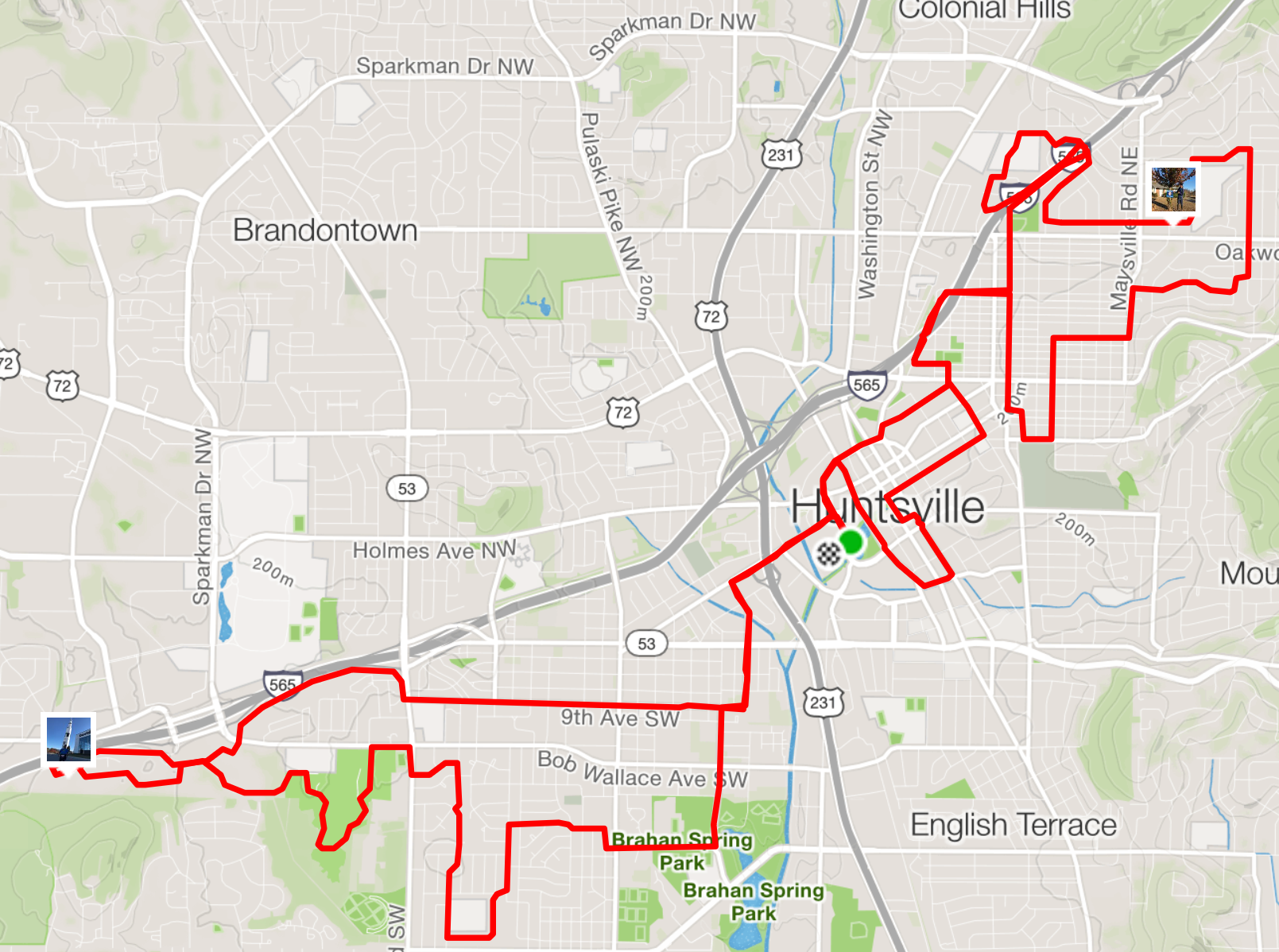
I’m a triathlete, and I’ve never run more than a half-marathon distance, even in training. So of course I ran my first marathon this weekend, three days after deciding to do it. Finish time was 5:09:53, well under my goal time of 5:30: https://www.strava.com/activities/798790580
The marathon course in all its glory

The marathon course in all its glory

“See, what happened was…”
The annual Rocket City Marathon is a big deal in Huntsville. 2016 marks its 40th year, and I knew a ton of people who were running. It has a reputation as a well-organized, well-supported race, and the RD is co-owner of the local Fleet Feet, so it is well sponsored too. After seeing a couple of “who’s running the race?” posts in various Facebook groups, I started thinking (always a dangerous endeavor). “If I can run a 70.3, that’s about 6-7 hours of steady effort– so I bet I could handle the workload of a marathon.” When I suggested this in the Complete Human Performance discussion group, my fellow complete humans all said “that’s a terrible idea and you should absolutely do it.”
Then I made the mistake of mentioning to a few of my local friends that I was thinking of running it. A few were horrified, a couple were supportive but skeptical, but the majority were positively gleeful at the thought of having a new victim join their ranks.
Prerace
I went to the pre-race expo on Friday, paid my $100 registration fee, and got a clear plastic bag containing a race shirt (a nice Brooks tech shirt, with their coarse-looking mesh weave), a course map, a race bib, and a few other local information sheets. The expo had several assorted vendors selling stuff– shoes, clothes, and so on– but nothing that I wanted or needed. Critically, they were selling race finisher shirts, but I didn’t buy one because why would you want a finisher shirt until you’d finished? (Hold that thought…)
Friday night’s dinner was Chick-Fil-A, always a good pre-race choice. The boys and I hit Fleet Feet, where I bought a Nike jacket of some description because I was assured it would be warmer than what I had.  I got about 7 hours of sleep and woke up to see that the outside temperature in my backyard was a balmy 23 degrees. I dressed accordingly: a merino wool base layer (top and bottom) from good old Costco, with CW-X tights and a pair of running shorts on the bottom and a local race tech shirt plus the Nike jacket. An old wool hat, a pair of Costco gloves, and my trusty ballistic sunglasses rounded out my kit. (Oh, and my ancient but much loved Fitletic belt, which I’d loaded with BASE Salt, lip balm, and snacks.) I drank a cup of coffee, ate 2/3 of a Tri-O-Plex protein bar, and headed to the Von Braun Center. I got there a good 45 minutes beforehand and had plenty of time to find a bathroom and say hello to various local folks who were running.
The plan and the start
My plan was to hold a steady 11-12:00/mi pace and to do a 3-minute run / 1-minute walk interval.  I figured that would put me around 5:30 or so, depending on my walk pace. For nutrition, I’d brought a bunch of Bonk Breakers and Gu chews; I knew the course would have water and Powerade but wasn’t expecting any on-course nutrition. I figured that I wouldn’t need to eat a ton on the go, though.
Right before the race started, I found Dana and her kids for a pre-race hug and, hooray, some hand warmers for my gloves. All suited up, I found the 5:15 pace group, put in my headphones, and waited for the start gun. My neighbor-friend Ashley was also running the race and we decided to stick together since, like me, she hadn’t trained for this race. (Unlike me, she had run RCM twice before, so she had that going for her.)
I was able to stay with the pace plan with no problem for the first 13, with occasional misfires when I didn’t hear my Garmin beep to tell me to switch intervals. Even without headphones, and even on quiet residential streets, it just isn’t loud enough to consistently get my attention. I was really worried that I’d go out too fast in the first few miles, as is my habit, but the combination of running with someone at the same pace and my nervousness about being able to finish the distance kept me in check. About mile 9, we caught up with the 5:00 pace group and stuck with them for a while.
Along the way, I saw this delightful sign and couldn’t pass up the opportunity to capture it for posterity. WAKE UP SHEEPLE!
Chemtrails: not just for breakfast any more

Chemtrails: not just for breakfast any more

Mile 13.2 and beyond: terra incognita
At the halfway mark, the Panera Pounders, my local running tribe, had a spirit station set up, with everyone dressed up as Santa Claus. Seeing my friends was a terrific morale boost, especially because my neighbor-friends Erica and Rese had brought me an ice-cold bottle of Coke. Normally regular Coke is too sweet for me, but on long runs and bike rides I love the stuff. I drank the Coke, had some SportsLegs and Advil, ditched my jacket, hat, and gloves, pulled up my pants again, and headed out for the second half. It was a little weird realizing that every yard I ran past this point was contributing to a distance PR for me. However, I felt good and was sure that I’d be able to continue holding my target pace.
Interlude: mental race management
Coaches hate this one weird trick! Not really; I learned this from a coach. One effective strategy for managing long endurance events is to break them up into chunks. Instead of saying “oh lord, I have a marathon to run,” you say “I have a half marathon, and then another one.” When you finish the first half, you say “oh, I only have 2 10Ks to run now,” and so on. This sounds stupid, but it’s a remarkably effective way to focus on what you need to be doing for the next little while instead of the immensity of the whole task.
The first half of the back half
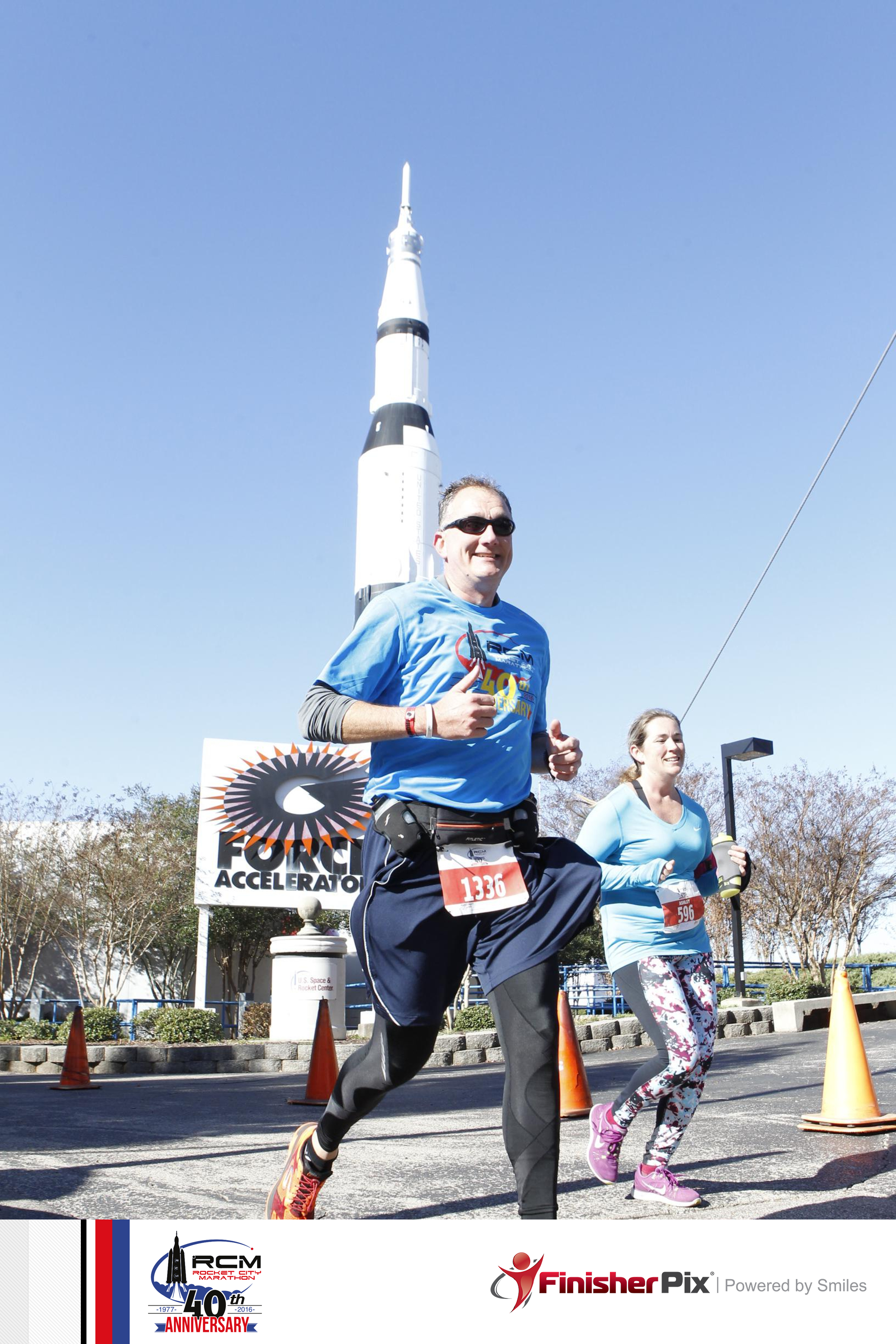
The back half of the race course is very different than the front half. First, it’s arguably more scenic, since it runs through some projects, past Lowe Mill, then on to Huntsville Botanical Garden and the Space and Rocket Center, whereas the front half is mostly through residential areas. Second, to the extent that there are any hills, they’re on this part of the course. There’s about a 2.5mi stretch on 9th Avenue westbound that turns into a long-ish hill; it’s not very steep but there’s a lot of it. I was able to hold a decent pace through this section. It was motivating seeing the Saturn V off in the distance and watching it get closer, and closer, and closer, silhouetted against the stunning blue of the sky. Mile 19 was even more motivating, as I ran through the SRC parking lot and back through the “Rocket Garden,” one of my favorite places to visit in Huntsville.
Who doesn't love a good rocket?

Who doesn’t love a good rocket?

 It’s hard to say exactly where I became sure that I was going to finish the race. I’d guess it was somewhere around this portion of the course– I felt good, I was holding the pace I wanted, and barring an injury or mishap, I knew I’d be both physically and mentally able to cross the line.
Interlude: pants
The two-handed pants yank

The two-handed pants yank, with bonus levitation

I spent a distressing amount of time hiking up my compression tights during this race. I was wearing them over a thin and smooth merino wool base layer, and the drawstring in the tights had come out of one eyelet so they weren’t really tied. As a result, the motion of my legs would pull the damn things down and every mile or so I’d have to hike them back up where they belonged. I’m sure glad the photographer caught me in the act.
The second half of the back half
I thought I felt myself slowing down about mile 20, and the evidence bears that out– from mile 20 onwards, I only had two-sub-12:00 miles. I wouldn’t say it was the famous wall we’ve all heard about– I wasn’t in any danger of falling out, just a progressive dragginess, coupled with increasing discomfort in my hip flexors and my left Achilles tendon. About mile 23, I also started feeling some pain in my right instep, just forward of my heel. I walked a good bit of miles 25 and 26; I didn’t think the few minutes I might gain by running through the pain would be worth the possible downside of a lingering injury. One thing I liked about the race course: they had mile flags every mile, with an extra “25.2” flag one mile from the finish line.
The finish
The RCM course has you run into the Von Braun Center and finish on the arena floor. This is a neat idea, and it’s probably a lot of fun when there’s a big crowd… but by the time I got there the crowd had largely dissipated. Luckily Dana and a few other stalwarts were still there cheering. Through the chute, a volunteer handed me my finishers’ hat and medal, plus one of those nifty Mylar blankets (a space spinoff, so definitely appropriate for the venue).
The best thing about the picture below is also the worst thing: the official picture timing clock broke, so everyone who finished after 3:57:28 got the wrong time in their finish line picture. I wish I could run a marathon that fast; perhaps someday…
The time is a lie

The time is a lie

Not all heroes wear capes. But most marathoners do

Not all heroes wear capes. But most marathoners do

I hung out in the arena to cheer on more finishers with Dana, the kids, and a few other finishers for half an hour or so, munching contentedly on a really excellent PB&J. When it was time to go, I hobbled over to the Fleet Feet booth to buy a finishers’ shirt, only to find that they’d sold out of my size the day before. This really, really pissed me off. I am still angry about it, in fact. I’d much rather have the cost of the shirt included in the registration fee, but, failing that, the race organizers at least should have bought enough shirts to ensure that all finishers would be able to buy them. Making them a scarce commodity is a terrible idea.
Post-race
After the race, I went home and relaxed for a while. I was pretty sore, but not debilitatingly so. I purposefully hadn’t planned anything for the rest of the day. Sunday morning I woke up with moderate stiffness in my quads and some tenderness in my left Achilles; by Monday those were both pretty much gone. I still get pain in my right instep when I put my running shoes on, so the short shakeout run I planned for after squats and deadlifts last night didn’t happen, but overall I am much less sore than I was after running my first half-marathon. In fairness, I was racing that one, while this time I was just running to finish.
Pros and cons
  • Pros: great race course, with excellent markings and signage. Free professional race photos. Superb volunteer support. Heavy police presence for traffic management. Clear and effective communications from RD team. Lots of aid stations and plenty of port-a-potties. Great support from the spirit teams.
  • Cons: poor shirt inventory management; very limited food at aid stations.
Overall, it was a great experience and I’m glad I did it. I’m happy to have RCM, my hometown event, be my first, and I am grateful for all the support, encouragement, and love from friends and family. I’m not in any real hurry to do another one though.

4 Comments

Filed under Fitness, Oops!

Multi-factor authentication for Exchange Online PowerShell

Everything at the Microsoft MVP Summit is automatically under NDA, so rather than talk about all the secret stuff, I thought I’d share something I learned there that isn’t under NDA because it was already public. Somehow I missed this announcement before, but: there’s a public preview of a new Exchange Online PowerShell module that supports Azure multi-factor authentication (MFA). If you have turned on MFA for administrators in Office 365, you’ve probably found that they can’t use PowerShell to manage Exchange objects. Now you can: download and install this module and you’re all set. Here’s what it looks like in action:

adal-ps

I found out about this when I complained publicly in Tim Heeney‘s session that this doesn’t work. Thankfully Tim set me straight posthaste; after I got the link to the preview, a little searching turned up fellow MVP Vasil Michev’s article describing it, which I either forgot about or never saw.

7 Comments

Filed under Office 365, UC&C

Race report: 2016 IRONMAN 70.3 North Carolina

Summary: At the end of my season in 2015, I decided that I wanted to try a 70.3 in 2016. I’d heard about how great the Beach2Battleship 70.3 in Wilmington, North Carolina was… in large part because they give pajama pants to all finishers. I signed up in December, right after WTC bought the race and renamed it to IRONMAN 70.3 North Carolina, and then mostly forgot about it because my friend Ingrid was “encouraging” me to sign up for IM 70.3 New Orleans (which I did). I didn’t have a great race at New Orleans and wanted to do better this time. I did, by 46 minutes.

Sunday: new wheels, part 1

My friend Tony finished his season at AtomicMan by smashing the course, and he was kind enough to offer to loan me his race wheels, a Zipp 404/808 pair. I put them on the bike and took off for a ride the day before I was supposed to leave for California. PROTIP: when you change wheels, you have to adjust the derailleur limit screws. If you don’t do this, here’s what happens: you break the derailleur hanger, ruin your chain, put a big dent in your friend’s borrowed wheel, and break several spokes. On Sunday, when no bike shops are open. And while you’re 10 miles from home. A quick Uber ride home and I was left to sort out my plan: Dana would drop my bike off at the shop, they’d fix it, and I’d pick it up Thursday when I got back.

A broken derailleur is a terrible thing

A broken derailleur is a terrible thing

Thursday: new wheels, part 2

Hosanna to the crew at Bicycle Cove. Chris, Parker, and Nick got the parts in and got the bike fixed. When I went to pick it up, though, I was surprised; instead of Tony’s Zipps, it was wearing a pair of Bontrager Aeolus 5s. They wanted Chris to look at Tony’s wheel again before clearing it for riding, you see, so they loaned me a set of their shop wheels to make sure I wouldn’t miss the race. “We’ll settle up later,” they said. “Now go have a great race.” Because we were having thunderstorms at the time, I didn’t get a chance to ride the new wheels; I had to load up and go.

Friday: flying and being pathetic

On Friday, I packed up 706 and filed direct HSV-ILM. A cold front had just passed through Huntsville, and I knew I’d be going through it again en route, but I was looking forward to a nice tailwind. That’s just what I got, with 15-25 knots of wind speeding me along. I landed at ILM after a beautiful flight with only a few bumps. Air Wilmington has a strict 1-hour limit on their courtesy cars, so I grabbed an Uber and headed to the downtown convention center for race check-in. Unfortunately, I failed to note the line in the athlete guide that said check-in closed at 1pm, and I got there about 1:45p. After some nervous waiting in line, Caroline from IRONMAN was kind enough to check me in anyway. She gave me 3 bags: one for T1, one for T2, and one for “morning clothes.” I found a niche to spread out my stuff and started the process of filling the bags. See, this race is a point-to-point-to-point race: you swim from point A to point B, get on the bike and bike to point C, and then run to point D. At each point, you have to change into the appropriate clothes, so before the race you have to stage all your stuff in the right bags. If you forget something, or put it in the wrong bag… well, too bad.

I got my bags packed and found that points B, C, and D were farther apart than I expected. While wandering around, I ran into Nancy and Paula, two fellow members of the Pathetic Triathletes group on Facebook. Nancy recognized me when I mentioned taking an Uber– I’d previously asked her whether Uber was in Wilmington. Thank goodness they found me; they were invaluable in showing me the ropes of this particular race. They were also kind enough to drive me and my bike over to T1 so I could stage my stuff. Then we had a lovely Pathetic meetup at Poe’s Tavern on the beach, where I met several other Pathetics and had a delicious burger. We went to check out the swim exit, where we met a volunteer who explained the swim course to me in great detail. The course was well marked with buoys, which I appreciated since my open water sighting technique still needs some work.

Seems placid, doesn't it?

Seems placid, doesn’t it?

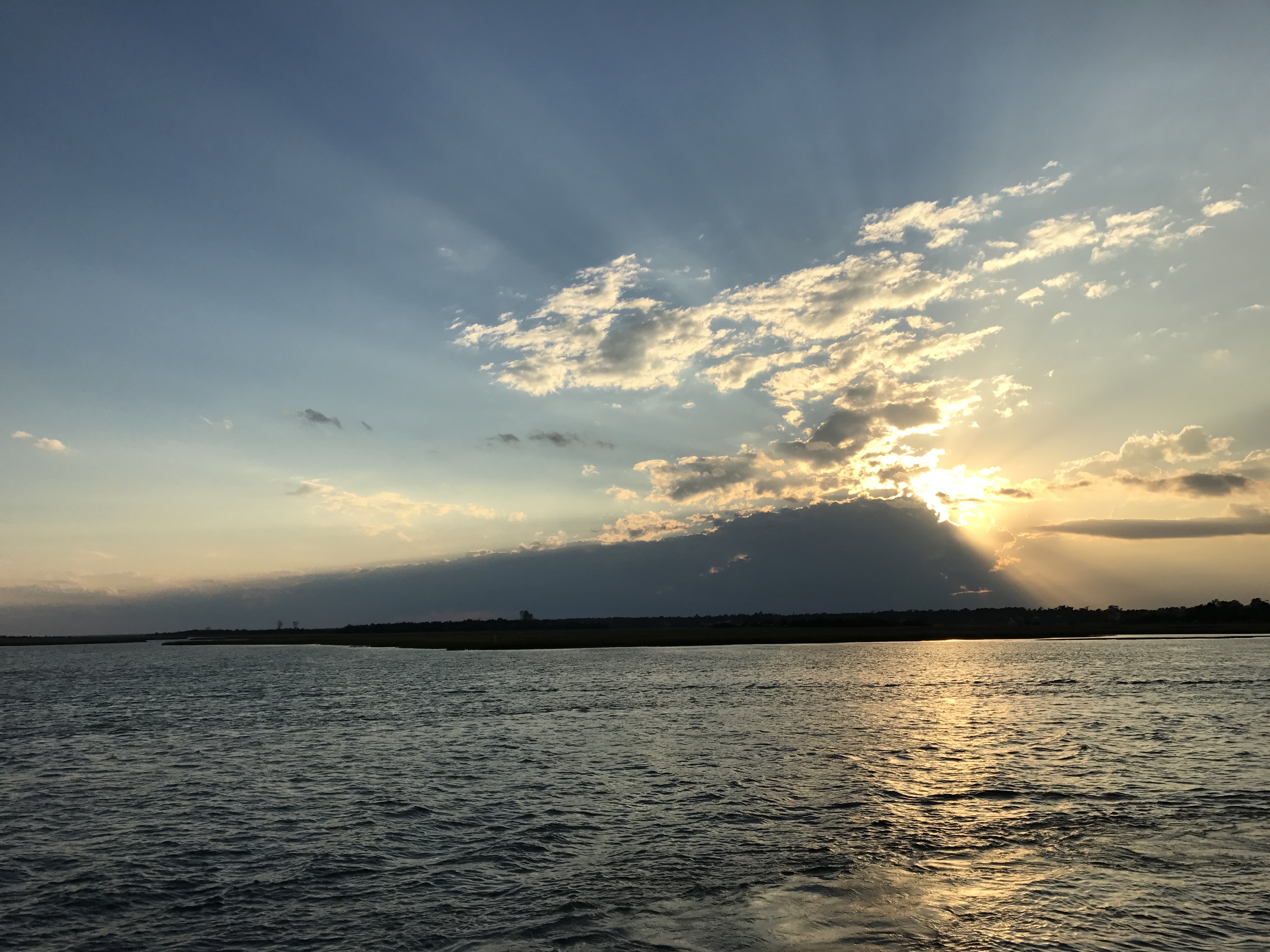
The sunset was pretty impressive, too.

Yay for bonus sunsets

Yay for bonus sunsets

Nancy and Paula dropped me off at my Airbnb (summary: nice and quiet, no New Orleans-style murder) and I was in for the night, modulo a quick run to CVS for some Advil. I checked the weather forecast a few dozen times to get some idea of what the winds would be like. As I tried to drift off to sleep, I mulled over what reasonable goal times for the day would be. All I really wanted was to beat my NOLA 70.3 time, but I

Saturday pre-race: patheticness everywhere

Stan, Karen, Paula, and Nancy were kind enough to let me carpool with them, then stop so I could grab some breakfast, then to loan me $5 because I had pathetically forgotten my wallet. I had a gas station protein bar and a 20oz Coke… breakfast of champions, right? We got to T1 in plenty of time for me to fill my bike bottles with Mercury, pump up my tires, and check once more to make sure I had everything in my “morning clothes” bag that I wanted. See, at the swim start, you leave that bag there, and you don’t get it again until after the race. It’s a good place for things like eyeglasses and cell phones. T1 was crowded, as you’d expect for a race with nearly 3000 athletes. I was way in the far left back corner, which turned out to not be so bad because it was easy to find.

Transition 1 on race morning

Transition 1 on race morning

Last-minute preparation accomplished, I caught a shuttle to the swim start and met up with my pathetic pals there.  Stan had loaned me a cap, which I was glad to have because it was chilly; I put on my wetsuit earlier than I normally would have, and it helped quite a bit while we waited. I got to the swim start about 8:10, and my wave wasn’t due to start until 9:06, so I had some time to mill around. I found that I still had my chapstick with me, even though I should’ve left it in my run bag. Solution: put it in the top of my swim cap. It survived, luckily, and didn’t get too much extra ocean flavor. Almost before I knew it, they were herding our swim wave across the street and into the waist-high water behind the start line. The water was warmer than the air, and it felt great after I’d been standing outside being cold for an hour.

The swim

39:53, a new PR for me at this distance and roughly 20 minutes faster than my New Orleans performance. This course was linear so my poor sighting didn’t put me at much of a disadvantage, and there was a fast current to boot. I swallowed a good bit of salt water so I was worried about having to vomit– usually an automatic cause for the support staff to pull you– but I ended up OK. At swim exit I was wobbly from all the time spent swimming through chop; the second half of the swim was mostly into the surface chop so I was a little, if not seasick, then seasickish. When I exited the water, I noticed that my watch said “Resume?” and had recorded only about 1030 yards of the swim. I guess I accidentally hit a button with my wetsuit cuff or something. So much for an accurate swim distance.

T1

14:28? Jeez. The run from the swim exit to the bike corral was long, and I did stop in the changing tent to put on sunscreen, a dry shirt, and lots of chamois butter… but I had no idea I was in T1 for this long. I felt really stupid when I saw my race results, because this should’ve been no more than a 5-minute stop. Once I got all my stuff together, I got to the mount line and headed out on the bike.

The bike

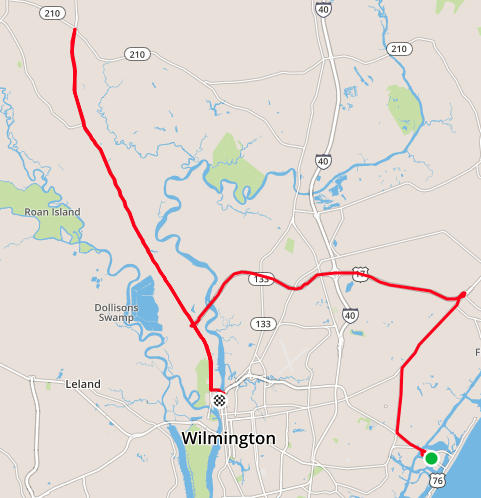
Before the race, there was a great uproar because of IRONMAN’s decision to shorten the full-distance bike course. During race week, they announced a couple of route changes (and more were rumored), but by race day they’d settled on one 56-mile route for both half and full-distance races. It was windy, with forecast winds of 13-15 mph from the west. We got all that and more– the wind history at ILM was 12.1mph for 24 hours, with a highest sustained wind of 22mph and peak gusts of 27mph. The bike course itself was a big part of the problem– its structure meant that we went out, did a loop, and then came back, starting from the green dot. The loop was south on 421, then north to the turnaround (where a gas station was selling fried chicken that smelled indecently delicious), then south again. Since the wind was coming from the west, we had very significant wind exposure– more miles than I think we got in the out-and-back New Orleans course.

the bike course

the bike course

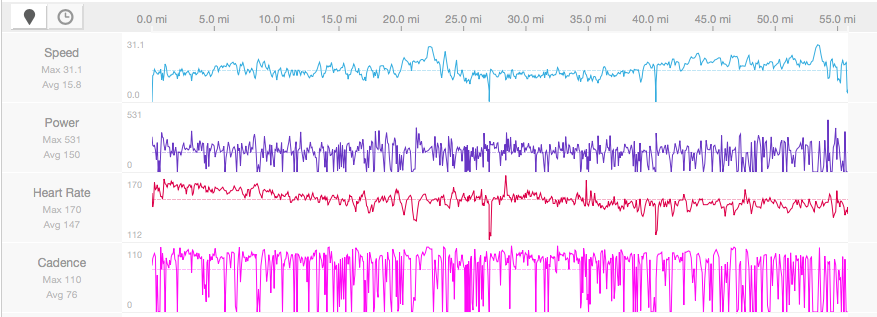
If you look at my lap times you can absolutely see the last 8 miles of tailwinds… and the other 48 or so of cross/head winds. I averaged 14.5mph on the first 39 miles and 17.6mph on the way back. Despite that gap in speeds, I felt really good on the bike. I passed nearly 100 people, which was an absolute first for me– I usually start at a deficit when coming out the water that I can’t make up on the road. I held the power target that I wanted, I didn’t wreck in the strong crosswinds, and with the winds, I came in just over my target time of 3:30. (obtw, those Aeolus race wheels were excellent.)

bike data… too many cadence spikes

bike data… too many cadence spikes

There was a fair bit of (justified) complaining online because the aid stations weren’t were the athletes’ guide promised, and each one only had 2 porta-potties.

EDITED TO ADD: here’s a video of the bike route provided by relive.cc.

T2

Back through the changing tent and out again; this time it only took me 9:21… still ridiculously slow. That time comprised walking my bike down a long string of rubber mats overlaid on top of the gravel/dirt construction mix on the street where the bike finished, getting into the corral and getting my run bag, hitting the changing tent, and actually changing, then leaving again. I’m still not really sure where the timing mat was.

The run

2:28. That’s really all I have to say about that. Faster than NO, but still ~ 30min slower than my standalone 13.1 pace. Lots of room for improvement here. The run course was semi-scenic; the first leg went through downtown, where there was a moderate crowd, then along an ugly industrial section of Front Street, then over to Greenfield Lake, which is ringed with city-provided signs that say “YES, there are alligators in this lake. Do not feed, harass, or tease them.” It’s a delightfully scenic lake, though, and (unlike the bike) there were plentiful, well-stocked aid stations. The full-distance racers had to do two loops of the course, whereas I only had one, for which I was grateful. I tried Red Bull for the first time on the course; while it didn’t give me superpowers, it also didn’t make my stomach convulse, so I’ll score that as a draw. I saw Pathetic Nancy on the run (I spotted the “#P” marked on her calf as I passed her), and I met Robert Moore, one of the “PPD Heroes” featured by the race sponsor. Then I ran the last mile or so with a lady who was finishing the full-distance race and we chatted a bit– that was a pleasant way to get to the finish line. Oddly, there were fewer spectators out when I came back through downtown on the return, which surprised me a bit.

YES, there are alligators in this lake

YES, there are alligators in this lake


Post-race

The finish line experience was great– I crossed, got my medal and pajama pants, and wandered around for a bit catching my breath. Unfortunately, soon I had to go pick up 3 bags of stuff: my run, bike, and morning clothes bags were all in different places. It took me close to 30 minutes of schlepping around to collect the bags and my bike, which was far longer than I wanted to spend. I grabbed an Uber back to the house, took a badly needed hot shower, and headed over to Hops Supply for dinner. I wasn’t up late.

The trip home

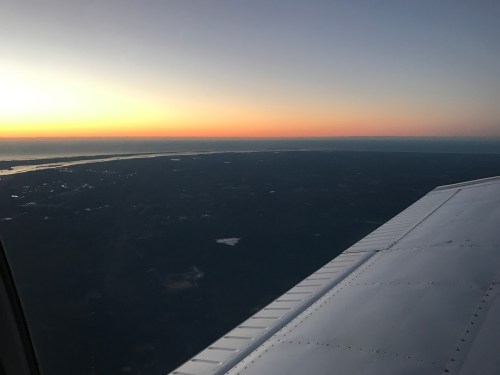
This morning, I woke up at 5 with a goal of being wheels-up by 6. Plot twist: there aren’t any Uber drivers awake that early, apparently. I eventually got a car and got to the airport to find that my plane was parked out on the back 40 and had to be towed to where I could access it. 45min after my desired time, I was airborne for Peachtree-DeKalb to meet my best friend from high school, the illustrious Brian Albro. We had a fantastic but short visit (thank you, Flying Biscuit, for breakfast), then I headed back. My flight was smooth and beautiful. I got to see some Harriers parked on the ramp at ILM, some great river fog, and a lot of greenery.
img_1378

The fog follows the river path exactly

The fog follows the river path exactly

Summary
A great race and a worthy effort. There were a lot of logistical hiccups; for example, the 70.3 athlete tracking on the IM website never worked, and the bike course caused a ton of traffic problems for locals that mean this will be an unpopular race next year. I got 7.5 flying hours and 7.2 hours on the triathlon route, so it was a good trip.
3 Comments

Filed under aviation, Fitness

Flying Friday: the great Gulfstream migration

Y’all may have heard of a little thing called Hurricane Matthew (or, as the Weather Channel continually called it, to the great amusement of my son Matthew, “DEADLY HURRICANE MATTHEW.”) And you may have heard of Gulfstream, the wildly successful purveyor of extremely expensive and capable business jets. But did you know that, for a while, our own Huntsville International Airport hosted nearly a billion dollars worth of Gulfstream hardware?

See, Gulfstream is based in Savannah, Georgia. They have a large factory there, with a satellite facility at Brunswick where they do paint and interior work. With a category 4 hurricane headed their way, Gulfstream made the very wise decision to find another place to park their airplanes until the storm passed, and Huntsville won the toss. On October 6th, I was listening to LiveATC and noticed a few airplanes checking in to Huntsville Approach with callsigns of “Gulftest XXX.” Neat, I thought. These must be test or acceptance flights. Then I heard a few more. Then one of the controllers asked a pilot how many more flights to expect– the pilot nonchalantly replied “oh, 30 or so.” That led me to check FlightRadar24 and, sure enough, the migration was well underway. (Sadly I didn’t think to capture any screen shots).

Last Sunday I drove out to the airport to take a few pictures of the shiny goodness on the ramp. These are links to my Flickr stream, which has lots of other airplane pictures if you’re into that sort of thing:

I was out of town this past week, so I missed the return flight, but sadly they’re gone now. It was fun to see them here, as that’s probably the closest I’ll ever be to such expensive hardware.

Leave a comment

Filed under aviation