Last weekend I took my first “real” cross-country flight. Executive summary: this is the one of the major reason I got a pilot’s license: fast travel, on my schedule, to do things that otherwise would be prohibitive. It’s been a lifelong dream of mine, but one with a practical side.
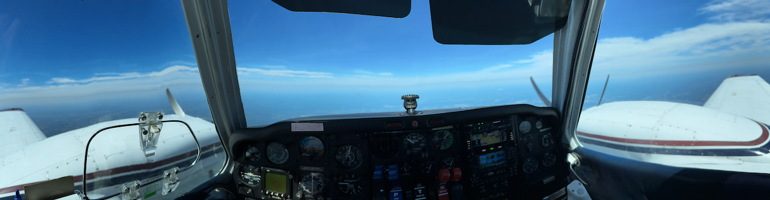
I recently earned my high-performance endorsement and got checked out in the Redstone Arsenal Flying Activity (RAFA) Cessna 182. This plane is bigger and faster than the Cessna 172 I’ve been flying. RAFA’s C182 is an older model, and the interior shows it, but it is mechanically in great condition, and it’s nicely equipped with a moving-map GPS and a decent autopilot. It can travel at up to about 145 knots, and its endurance is about 5 hours when fully fueled… longer than mine!
All of my XC time so far has been within California (with the exception of two short legs in the Mobile/Pensacola area early on in my training). The longest leg I’ve flown so far was Palo Alto-Bakersfield and back, a distance of about 220 miles. However, all of my flying so far has been casual. This was my first “real” XC: I had a defined mission, a longer distance, a time window to hit, and all my sons aboard. I’d aborted a previously planned trip on a similar route because the weather was just awful, so I was eager to make this trip if possible.
We’d planned to depart sometime Saturday morning. The forecast was for IFR until around 11am, gradually clearing. Sure enough, the morning started with IFR here in Huntsville, with low IFR (meaning even worse weather) further to the west along our planned route: direct from Redstone Arsenal Army Air Field (KHUA) to Jackson, Mississippi (KJAN) and then on to Alexandria (KAEX). By about 1pm it had cleared enough for us to head to the airport, but actually getting there took 3 tries as various kids remembered that they forgot important things such as contact lenses.
By the time we got to KHUA, visibility had improved to around 5mi but ceilings were still 3500′, which is low but manageable. I’d planned the flight to take place at 6500′, but that wasn’t gonna happen; however, the forecast called for higher ceilings further west, and I had a brand-new Stratus aboard for inflight weather, so we fueled and launched. After takeoff, we turned west on course and climbed to 2500′, where there were a few light bumps but nothing too serious. I noticed right off that the Stratus was connected but not displaying GPS or ADS-B data. Turning the iPad’s WiFi off and back on fixed it; it did this periodically throughout the trip, so I’ll have to figure out what’s going on. About halfway to KJAN were were able to climb up to 4500′, and things smoothed out considerably. There was a line of storms about 45nm to the south of our course, but they were moving NNE fast enough so that they were never a factor. Being able to see radar and METARs for en route airports on this leg was absolutely invaluable. At every point I had a good picture of what my options looked like if I needed them. Here’s what the Stratus data looks like when displayed in ForeFlight; The airplane icon displays our position from the Stratus onboard GPS; the green and blue dots represent airport weather results (tapping on the dot displays the detailed information), and the weather radar data is just like you’d see from a NEXRAD display.

We landed at Jackson, taxiied to Atlantic Aviation, parked, and went inside. Nice FBO, friendly people… but key learning #1: check fuel prices beforehand! I am used to flying out-and-back legs from a single FBO, where I rent wet, and it didn’t occur to me that there might be dramatic price differences. After filling up at $6.90/gallon (with a club rental reimbursement rate of $5.11/gal), I now know better.
After a quick snack and a pee break, we loaded back up and took off for Alexandria. We were able to stay at 3000′ until about Vicksburg, when we asked for higher. Our arrival and descent into KAEX was smooth, but I had a sterile cockpit problem: the kids were bantering and I got distracted enough to begin an approach to runway 36 when I was cleared to runway 32. I caught the mistake in time, went around, and was lucky to have an understanding controller, but key learning #2: shut your passengers up as part of your descent checklist.
We parked at Million Air. They treated us like we’d rolled up in a Gulfstream. I am now a huge fan. Unlimited soft drinks, popcorn, and soft serve ice cream? Why, yes, thank you. We needed it because, like a doofus, I’d neglected to pack any water for the flight. Key learning #3: if you pack snacks, pack drinks too, duh.
Our visit with the family was superb; we had a feast of BBQ chicken, got some great visiting time in with my mom, grandmother, uncle, and cousins, then got a good night’s sleep. Sunday we just relaxed and visited, at least until the 32 pounds of boiled crawfish arrived. After a delightful meal underneath a big tree in the backyard, it was time to head back to Million Air.
I’d planned a single leg back, without the Jackson stop, but on preflight noticed that the oil was lower than I’d like, and none of the Alexandria-area FBOs had 15W50. That necessitated another stop, and since I was familiar with Jackson I planned to stop there. (Key learning #4: carry spare oil. ) This worked out OK because the kids all needed a bathroom stop. I had filled up with fuel at Million Air ($4.81/gal), so I didn’t buy any fuel at Atlantic… so they charged me $20 for stopping by. I don’t think I’ll be back.
Coming back we were able to fly at 3500′ to just east of Alexandria, then 7500′ from there on out. Great, smooth ride with a beautiful view of the Mississippi River crossing, the flooded bottomlands near it, and all sorts of farm and agriculture happening beneath us. I started teaching David how to work the radios, and he did a creditable job (although I think there are some guys at Memphis Center wondering what kind of aircraft a “Skyliner” is).
I used the return legs to get some practice in driving the 530W and the autopilot; I am used to flying a G1000/GFC700 172 so the knobology is quite different. This particular 182 doesn’t have electric trim so I had to do a bit of trim wheel judo to keep the autopilot happy in altitude hold mode but it was good practice. While I love hand-flying, learning to use an autopilot effectively, in the right modes at the right times, is critical to safe single-pilot IFR operations, so I want to start getting better at it ASAP.
The eastern approach to KHUA crosses several restricted areas (some for drone flights, some over propellant storage areas), so we had to turn north, fly past the Decatur airport, then remain north of I-565 until we passed Huntsville International. We landed, refueled, hit Taco Bell, and poof! A trip for the books.
The 182 burned about 13gph and gave me an average groundspeed of 133kts over 7.5hrs on the meter. While this isn’t exactly exciting compared to faster aircraft, it beats the hell out of driving, and it let the four of us deliver a great Mothers’ Day surprise. The kids enjoyed the visit and tolerated the cramped quarters pretty well, so we’ll be doing this run again soon.