Training Tuesday: the season’s winding down

As I type this Tuesday night, I have only one more scheduled competition this calendar year. Since my last Training Tuesday post, I’ve been busy with a wide variety of things, some of which actually involve training. Rather than an exhaustive and boring list of all the stuff I’ve done, let me summarize: one road race, two half-marathons, and one powerlifting meet.

    • The first race was the Monte Sano 15K, a road race at Monte Sano State Park. It was mildly hilly, but very cloudy, with maybe 200’ ceilings and lots of low fog. Cool and humid conditions made for a pretty fast course. I ran the 15K in 1:27:36, which was a good time for me on that distance, plus I got a very cool neon-yellow running shirt. Winning!
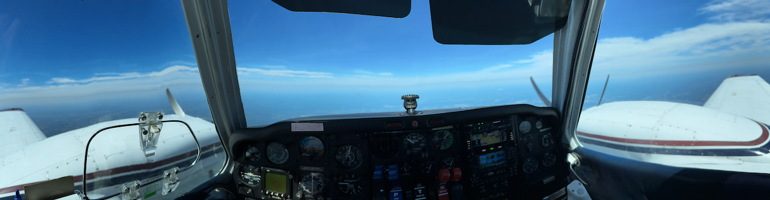
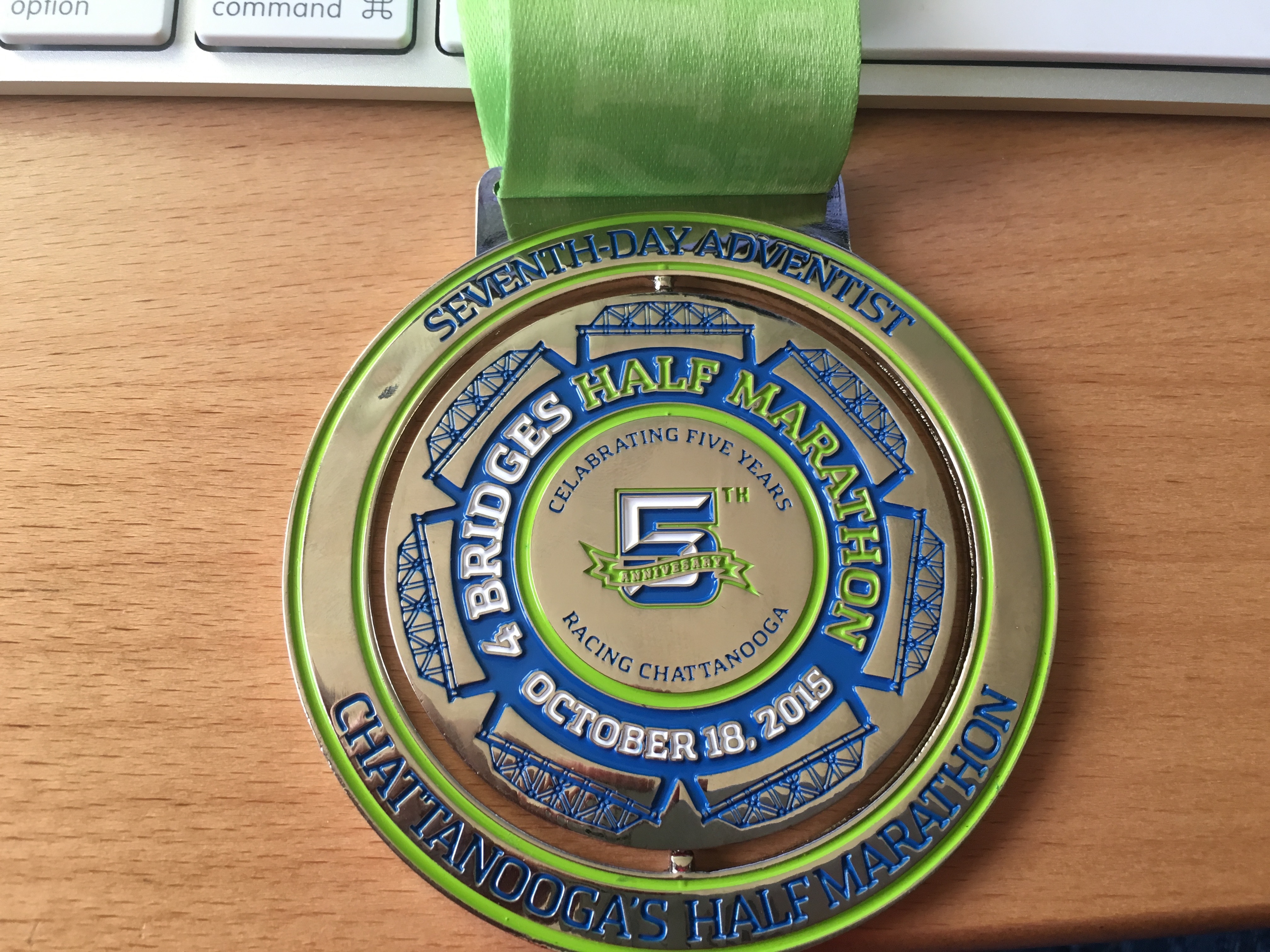
    • The next weekend I flew to Chattanooga for the Four Bridges Half Marathon. I had the boys that weekend, and Tom was working, so I ended up getting up at 0330 to fly myself to the Chattanooga airport, where the superb staff at Wilson Air loaned me a car. The race was a blast: the weather could not have been nicer, the course was lovely, there were plenty of water/potty stops on the course, and the runners and crowd were both enthusiastic. The only blemish on the day was that the volunteers who laid out the half-marathon course accidentally cut about 0.5 miles off it, so I ended up with not quite a half-marathon PR, running 12.5mi in 1:53:29. However, getting to fly to and from the race helped make up for it. As a bonus, the finishers’ medal had a unique misspelling, making it slightly more collectible than I’d expected.

IMG_0017

    • In early November, I flew to Atlanta to compete in the USAPL “Powerlifting for Pink” meet. My performance here was nothing to brag about; I missed two of my three squats and all three bench attempts, mostly due to poor focus. Turns out you really have to pay attention to the judges’ commands. However, I deadlifted well, I had fun with Dana, and I learned a ton that will help me in my future meets.

P4P-187

  • For my birthday, I’d planned a trip to run Rocketman but the logistics just weren’t going to work, so I ran the Huntsville Half Marathon instead. I didn’t do a lot of race preparation beforehand, and it showed; I ran it in 2:07:49, which was nearly 8 minutes faster than my previous half-marathon but about 0:30/mi off the pace in Chattanooga. I have no idea why. After the race, my legs were much more sore than they were after Chattanooga, too.

One of the lessons I am slowly starting to learn is that I’m not always going to set a PR every time I step up to the starting line or platform. There’s still a large gap between what I feel like I should be able to do and what I can actually do, but the gap is getting smaller, both as I adjust my expectations and as I become more capable.

As things stand right now, the Hobbs Island 10K will probably be my last race of the season; there are a few scattered triathlons before the end of the year, but I don’t think it will be feasible for me to run any of them. The good news is that I’ve already started picking my 2016 events and will be working with my coach to build a training plan accordingly. It’s going to be a busy winter!

Leave a comment

Filed under Fitness

Flying Friday: This ain’t Delta

Every pilot has different reasons for flying. For me, a big part of my love of flying is the ability to travel, relatively quickly, where and when I want. The values of “quickly,” “where,” and “when” are all subject to a variety of constraints, though. Some are self-imposed and some are limitations imposed by the FAA, the laws of physics and aerodynamics, or my desire to live to be a grumpy old man.

Let’s take one simple example: time. It would certainly be possible for me to fly from Alabama to southern California for a business trip, but I wouldn’t do it for a short trip— in my particular airplane, that would take me about 11 hours of flight time, which translates into something like 14 hours of total time when you factor in fuel stops… and that really means it would take two days, since flying for that length of time in a single day would make it difficult for me to maintain the focus and energy required for a safe journey. Likewise, I could easily fly from here to Birmingham for dinner, but when you factor in the time required to preflight and prepare the plane, conduct the flight, get to and from the restaurant, and return home, it would be quicker to drive over the short distance. For me personally, with the airplane I have now, the sweet spot is trips of about 150 miles up to about 1000 miles. Shorter or longer trips are possible, but when time is important, taking another means of transport is usually more sensible.

We can lump all the other constraints together into the general heading of “dispatch reliability.” That is, for a planned trip, how often are you actually able to complete it without bumping up against those constraints? It’s critical to keep in mind the difference between a commercial airline (which flies under Part 135 of the Federal Aviation Regulations) and my airplane, which flies under Part 91 of the FAR. There are 3 major factors that influence dispatch reliability in both of those worlds: weather, equipment, and regulation.

The ability to deal with weather, of course, is a huge part of dispatch reliability. I once was stuck away from home for 3 days because the weather was poor and I didn’t have an instrument rating, so I couldn’t leave when I wanted to. Sometimes the weather, or the forecast, is just too crummy to safely complete the planned flight. This happens more often in some places than others, of course; east of the Mississippi, we have lots more thunderstorms than in, say, California or Washington.

Equipment influences dispatch reliability in two different ways. First is redundancy. Unless it were truly urgent, I wouldn’t make an extended night flight in IFR over rough terrain in my airplane— not because it’s inherently unsafe but because, with only one engine and one vacuum system, there are several single points of failure that could make such a flight more exciting than I’d like. Waiting for daylight or better weather would be a smart play. On the other hand, commercial planes flying under Part 135 have doubly- or triply-redundant systems, ranging from engines to hydraulics to avionics. As you spend more money on an airplane, the number of redundant systems (and the reliability of the systems you have) tends to increase. The capability of your equipment also influences reliability. If you have onboard weather radar or in-cockpit radar data through XM Radio or ADS-B, for example, you may be able to complete flights that you wouldn’t without that data. More sophisticated aircraft that have jet engines and pressurized cabins can fly above many regions of bad weather; aircraft with icing protection can fly through moist clouds without picking up a killing load of ice. Most piston-engine singles (mine included) aren’t pressurized, don’t have anti-icing equipment, and don’t have onboard radar— meaning that there are conditions that are no problem for Delta or United but render general aviation flight impossible or unsafe. Both airliners and general aviation aircraft have lists of requirement equipment. Although the contents of the lists are very different, the concept is the same: if something on that list isn’t working, you can’t legally fly. (Keep that in mind the next time you’re on a commercial flight and the pilot tells you that some seemingly unimportant gadget isn’t working so they have to wait for a mechanic— if they’re waiting to fix it, it’s probably because it’s on that minimum list.)

Regulation is the third category. Without going into all the differences between different parts of the FARs, I can still say that there are some conditions that are legal for me but not an airline, or vice versa. For example, thanks to my instrument rating, it is literally legal for me to take off with such poor visibility that I can’t see the propeller while sitting in the pilot’s seat, while Part 135 flights have specific runway visual range (RVR) requirements that must be met before they can depart. On the other hand, a suitably equipped and crewed Part 135 flight can use Category III autoland to land in zero visibility, whereas I have to honor a higher minimum ceiling and visibility limits. There’s sometimes a huge difference between what’s legal and what’s safe, and the FARs that I fly under give a great deal of latitude to the pilot in command in most cases. That can be good or catastrophically bad, depending on your judgement.

In general, the rule I use is simple: if it is critical that I be somewhere, and I’m planning on flying, I’ll always have a backup. Last week, the boys and I were going down to the Voodoo Music Festival in New Orleans. We’d planned to fly, but when I preflighted the airplane, this is what I found: a broken alternator belt. 

WP 20151030 14 35 28 Pro

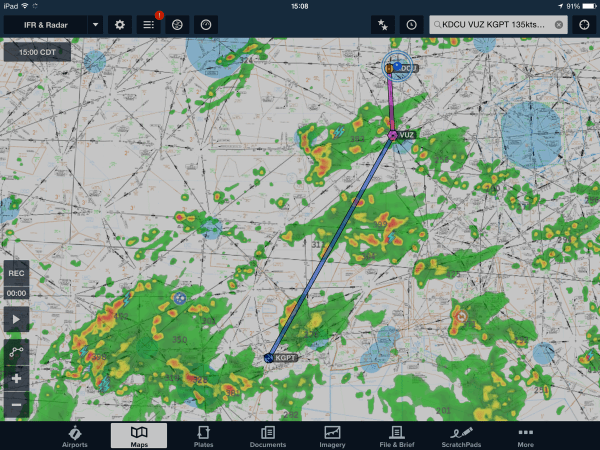
I didn’t have a spare, the shop didn’t have a spare, and even if we had, on my plane, you have to remove the propeller to replace the belt. We drove instead, but we still got to see the headline act because we’d built enough slack into the schedule. Likewise for weddings, funerals, or critical business meetings— if it’s really important, I’ll have a backup airline ticket in my pocket (or enough time to drive). If it’s not critical, I’ve learned to accept that sometimes the weather or the airplane may conspire against going. A couple of months ago, Dana and I had planned to fly down to Gulfport for the day to see Mom, Charlie, and Grandma. Here’s what the weather looked like:

20150816 200809000 iOS

Score that one in the “nope!” column. It would have been perfectly legal to pick my way around those storms, since I didn’t have the equipment to fly over them, but it would have been uncomfortable at best and criminally dangerous at worst. Driving would have taken too long, so we reluctantly cancelled; it wasn’t a critical trip.

Having a backup plan or the willingness to say “we’ll do this another time” is critical because it eliminates the pressure to attempt a flight when weather, equipment, or regulation might dictate otherwise. The hoary old saying “it’s better to be on the ground wishing you were flying than flying and wishing you were on the ground” applies in spades. Even when it’s difficult to tell your boss, your family, or your customer that you won’t be somewhere at the appointed time, it’s a hell of a lot easier than explaining yourself to the FAA, the NTSB, or St. Peter.

2 Comments

Filed under aviation, Travel

Fixed: Surface Book doesn’t recognize docking state

I got a shiny new Surface Book on Monday and started using it immediately… more specific notes on it later when I have more time. I ran into a problem today, though, and wanted to document what I found.

Symptom: the touchpad and keyboard don’t work. The clipboard switches to tablet mode (if you’ve enabled automatic switching). You can’t use the base unit’s USB ports. The taskbar “undock” icon shows that the base is undocked.

Cause: beats me.

Resolution: boot into the system BIOS by turning the machine off, then holding the power and volume-up keys for 15 seconds. When you get into the BIOS, just exit BIOS setup and the machine will reboot normally. There’s a thread here that outlines the exact procedure.

Overall, I love the machine: the form factor, build quality, screen resolution, performance, and trackpad are all superb. I expect this kind of temporary hiccup, so it hasn’t put me off at all.

2 Comments

Filed under General Tech Stuff

The next big thing: joining ENow as CTO

It is a cliché to talk about an opportunity that’s too good to refuse (not to be confused with an offer you can’t refuse), but sometimes it doeshappen.

I am very excited to announce that, effective 26 October 2015, I will be taking the position of chief technology officer (CTO) for ENow Software. In that role, I will be driving the development of their next generation of products for both on-premises and Office 365 monitoring. It’s a big step forward for my career, moving me simultaneously back towards the development world and further into the cloud. (It’s also a little surreal to see one’s job change announced in a press release.)

Before I get into the nuts and bolts of what I’ll be doing, a personal note: I want to thank Scott Edwards, Ben Curry, and all my coworkers at Summit 7 Systems. What a talented and skilled group of people! I accidentally learned much more than I expected about SharePoint from them, and both Ben and managing consultant Matt Whitehorn were instrumental in helping me identify soft skills I need to work on— always a challenge. I have huge respect for what the Summit 7 team has accomplished and recommend them in the highest possible terms to anyone who needs Office 365, Azure, AWS, or SharePoint design, strategy, or migration help.

So, the new job. In the CTO role, I’ll be reporting directly to Jay Gundotra, the CEO. I’ll be responsible for technical product strategy and implementation, the customer success team, technical presales, and internal IT. (I am still working on a transition plan to establish an ENow corporate aviation department, but don’t tell Jay.) That’s quite a broad scope, which means I can bring to bear everything I’ve learned throughout my career as a developer, consultant, and administrator. Driving beneficial change across these disparate fields is going to be an exhilarating challenge! Luckily I will have a really powerful team on my side, including Michael Van Horenbeeck (noted hooligan/tequila drinker, Microsoft Certified Master, and Exchange MVP) and Tony Redmond, a member of ENow’s advisory board.

ENow is already very successful in their chosen markets, but the cloud poses a brand-new set of technical and business challenges, both for them and their customers. The #1 question I hear from IT pros and business decision makers is simple: how will the move to the cloud affect me and my business? It’s interesting that I don’t remember many people asking that during the years-long transition from mainframe- and mini-based solutions to the x86 world; people just naturally assumed their skills would transfer. That hasn’t been the case with the cloud. Figuring out how to effectively monitor and manage cloud services when you don’t control the underlying platform is a tough problem. Instrument flight is probably a good metaphor here. On a clear day, you can see the ground, so flying is easy. There’s a visible horizon and landmarks. In the clouds, everything changes– if you’ve ever been in an airplane on a cloudy day, you know that you can see where the clouds are but not what’s inside them. Flying inside clouds is like being inside a ping-pong ball, with no visual cues you can use for orientation. You have to use your instruments to keep the plane pointed in the right direction and right side up. Moving workloads such as Exchange email or SharePoint to the cloud doesn’t lessen your need to monitor what’s happening, it just changes the way in which you’ll do it, and figuring out that change is a key task in my new role.

Of course, Microsoft is releasing new services and capabilities in Office 365 at a rapid clip, so another key challenge will be figuring out how to keep up with them and how best to bring ENow’s experience in simplifying the complexities of enterprise application monitoring to a world where Microsoft seems intent on giving everyone Fisher-Price-style monitoring and reporting tools.

Despite the new job, some things won’t change: I’m still living in Huntsville, I’m still not a Cowboys fan (sorry, Jay), and I’ll still be blogging here, although I expect to be writing some more strategy-oriented posts for ENow’s blog. Where I can, I plan to share details of what I’m working on, so stay tuned!

4 Comments

Filed under California, Friends & Family, UC&C

Office 365 Exposed ep 01 / Exchange Exposed ep 05

We’re baaaaack…

Last year, Tony and I started producing a podcast for Windows IT Pro called “Exchange Exposed.” It was moderately successful, but the demands of producing and delivering the podcast on a regular schedule didn’t mesh well with Penton’s plan for world domination, so Tony and I took back the rights to the podcast and are recording and distributing it ourselves. However, because of some peculiarities of the way the iTunes Store lists podcasts, we couldn’t just add new episodes to the existing podcast… but we didn’t find this out until the current episode was recorded and ready.

Going forward, we’re retitling the podcast to “Office 365 Exposed” to reflect the reality that Exchange and Exchange Online are part of the Office 365 family. Unlike some other Office 365-branded media that focuses exclusively on SharePoint, we’ll be covering the non-SharePoint part of the ecosystem with vigor and depth. There’s a lot to talk about!

In this episode, recorded at IT/Dev Connections in Las Vegas, we get some quality time with special guest Bhargav Shukla of KEMP Technologies to discuss the release of Exchange 2013 CU10, the impending release of Exchange 2016, and what the future of on-premises Exchange looks like. Give it a listen below. In a day or two, iTunes should pick up the feed and you’ll be able to subscribe, or you can point your RSS feed reader to the “Podcasts” category here.

Leave a comment

Filed under Podcasts, UC&C

Office 365 Pro Plus licensing change?

Microsoft has a really complex infrastructure for deploying new features into Office 365. This deployment process, internally known as “flighting,” involves rolling out code changes across a huge base of servers— by some estimates, more than 600,000 worldwide— spread across dozens of data centers all around the world. This poses an interesting challenge. Flighting has to be automated because of the scale necessary, but with an automated tool that works at high scale, you can make a quickly replicated mistake. Think of it like shooting yourself in the foot with a machine gun.

Recently one of my customers notified me that they had noticed a change in their tenant: each user with an E3 or E4 license was now showing a possible total of 10 product activations for Office 365 Pro Plus. The limit had previously always been 5, meaning each user may install Pro Plus on up to five PCs and Macs. The release of Office applications for Windows 10, iOS, and Android devices changed things slightly; you were allowed to install on 5 PCs/Macs plus 5 tablets or mobile devices. At various times I’ve been told that the limit was 10 (5 PC + 5 devices) and 15 (5 PC + 5 tablet + 5 phone), but in any event, the user interface in the Office 365 management tools has always reported per-user activation as N installed copies out of a maximum of 5.

Immediately upon hearing this, I checked my tenants. Sure enough, now my tenant users were showing a maximum of 10 installs.

I followed up with some local Microsoft folks and was told that they were told by Office 365 support that this was a mistake, whether in flighting or configuration I’m not sure. However, two-plus days later, tenants are still showing 10 activations. I took the below screenshot a few minutes before writing this post; it shows 4 activated Pro Plus installations, with 6 more available.

10 license

I’m going to reach out directly to the O365 team to ask whether this is: a) a temporary mistake that will be reversed b) a policy change that hasn’t been officially announced or c) a restatement of the 5 PC/Mac + 5 device policy that was already in place. I’ll report back what I find out. 

Leave a comment

Filed under Office 365, UC&C

Training Tuesday: Rocketman Olympic Triathlon (23 August)

This time, it was personal.

See, last year, I signed up for the bike leg of Rocketman and failed to complete it when my bike broke. Then this year, I lost my Olympic virginity at Renaissance Man with a disappointing time. I was highly motivated to finish this year’s Rocketman well… so I did.

Pre-race and setup

Rocketman is legendary for being well-organized, so I expected all the race logistics stuff to go smoothly, and it did. This was the first year on a new course, after many years of doing the race at Redstone Arsenal, but the race director did a great job of posting the course maps early, marking the course, and generally communicating what the changes would be. Matt and I went to Fleet Feet on Saturday, grabbed my race number and swag bag, and then headed home so I could pack.

WP_20150822_001

That looks like a lot of stuff, and it is. At the bottom, you can see my race number (attached to my Fitletic race belt), watch and heart rate monitor, and Garmin bike camera. My ancient iPhone is running the Wahoo Fitness app so I can watch my heart rate, cadence, and power on the bike; then there are two pairs of (large) shoes, my helmet and swim cap, and 3 water bottles. Not shown: all the stuff I normally take to eat and drink during the race. (Hint: it wasn’t shown for a good reason!)

I packed my bag, loaded the bike on the car, and went to bed. When I woke up, a scant 5 hours later, it wasn’t because my alarm went off. It was because the cat was burrowing under the covers because of the thunderstorm outside. Not a good sign.

wp_ss_20150823_0001

I was a little apprehensive about the weather when I went to bed, with good reason. The picture above shows the radar picture as I was loading the car; what it doesn’t show is that the line of storms was moving directly towards the race site. I loaded up and headed out to the race site in heavy rain, not a little wind, and occasional lightning– and it was getting worse the closer I got to Ditto Landing. Luckily, by the time I got there, it was only raining, but the damage had been done (at least to the parking area, which was thoroughly inundated and had turned into a swampy, muddy mess).

While driving, I had my usual shake (50g Karbolyn + a scoop of vanilla protein), at which point I realized that I didn’t pack all the nutrition stuff I meant to bring. Alas. I had mixed up a batch of Mercury and then frozen it in my run and bike bottles, but didn’t bring any gels, waffles, or (my current favorite) Uncrustables.

Setup

I picked up my timing chip and got my body marked, then learned that there was a 30-minute delay. This gave me enough time to brave the bathroom line and get everything set up in transition. Because it was overcast, I decided to leave my sunglasses in my transition bag, but stupidly put my eyeglasses in there too. They chased us out of transition and over to the swim start, where two long ramps (probably 25′ or so) were set up to get us into the water. This was a great alternative to picking our way down the rocks on the shore or jumping feet-first off the nearby dock (also about 20-25′ above the water), the other two choices. The race organizers thoughtfully put carpet down on the ramps to make them less slippery. Then… it was time to wait, and wait, and WAIT because I was in swim wave 6. Luckily there were plenty of familiar faces around, including friends from both last year’s Tri101 and this year’s Tri201. One of my favorite things about triathlons is the huge and welcoming tri community in Huntsville, so I always enjoy seeing my posse at local events.

Swim

The swim was just OK. I got down the slide with no trouble, then waited near the start line for a wave start. The water was warmer than I expected (and warmer than the air!), which was nice. I didn’t especially like having to tread water while waiting for the start, though, as I worried that it would tire me– I need to work on more efficient treading. The swim itself went pretty much just like the RenMan swim did; I maintained a steady pace, didn’t swim exactly a straight line, and finished with 1646 yards (on a 1500m course, that means I swam about an extra 6 yards– not too bad) in a little over 41 minutes. This was a bit disappointing since I had been breaking the 2:00/100y pace barrier in the pool. However, I finished the swim with plenty of energy, which is always a plus. I feel like I could do the half-Ironman swim distance at this same pace and still be capable of continuing the race.

rocketman-swim

Bike

It had stopped raining before the swim start, but I knew the roads would be wet so I had planned to be conservative on the bike. I got a good start out of T1 (despite having to go grab my eyeglasses out of my transition bag); I had a dose of Chocolate Outrage (that’s a Gu flavor, not a philosophy), saddled up, and rode out. At the halfway point, I was just under my PR time for the 40K distance, so I figured I would come in close to a PR time.. but either the ride was longer than I thought, my math skills are poor, or I inadvertently lessened my effort because I was still about 10 minutes over that time. I finished the bike in 1:38, which kinda sucks. I know I can do better than this. Speeding up my ride is going to be my primary focus going into my next race, I think.

T2 went quickly. I couldn’t find my second Gu, and I didn’t have anything else to eat, so I just swapped out my shoes, put on my 2014 Rocketman visor, and hit the run.

Run

The run was my big success for this race. I ran the 10K course in about 1:01, which is (it’s true) 5 min off my PR for a standalone 10K but almost a 9-minute improvement over my Ren Man time. The cool weather definitely helped; we had a bit of drizzle on the outbound leg, which was a nice addition. The course was flat and fast, although by about mile 4 my legs were pretty tired. On the last half-mile or so I went as fast as I could, so my finish line crossing was more of a shamble.

Post-race
The post-race setup was decent and pretty standard for races in Huntsville: free pizza, fruit, and a welcome tent set up by Fleet Feet for the Tri201 program participants. However, I have a major gripe: race entrants were promised two free Rocket Republic beers, and by the time I finished there was no more beer. After motivating myself with the thought of a tasty brew at the finish, this was a major disappointment. I did, however, get one of the coveted finisher glasses, plus a nice glass from the Tri201 coaches.

Summary
One of the things I most enjoyed about this race is that the announcer stayed on station and called out the name of every finisher. Hearing “Paul Robichaux…. from Madison, Alabama… YOU. ARE. A. ROCKETMAN!” was pretty thrilling. My gun time was 3:30:09, so nearly 10min better than Renaissance Man but still a good ways off from my goal time. Still, it’s only my second Olympic-distance race so I have a lot of potential for improvement.


https://connect.garmin.com/activity/embed/875236231

Onward!

2 Comments

Filed under Fitness, General Stuff

Fuel shenanigans

The saying goes that “you can never have too much fuel unless it’s on fire.” I have always been a believer in that truism, so I always fill the tanks before I go anywhere… except on a recent trip, which just confirmed the wisdom of whomever came up with the old chestnut.

I was flying DCU-IGX, which I flight planned as 394nm, just under 3:00 of flying time, and about 48 gallons of fuel. Sure enough, when I arrived, I’d drained one main tank, one tip tank, and about half of the other tip tank. The CGR-30p engine monitor, my analog gauges, and my eyeball inspection all agreed.

Fuel at IGX was $5.28/gallon. Fuel at my home airport is $4.80/gallon. “Hey,” I thought. “I have enough fuel to get home if I just fill the tip— that will give me 59gal on board, which still gives me a VFR reserve.” Visions of dollar signs dancing in my head, I filled out the fuel ticket and went into town to lift all the weights with Alex. When I returned, I verified the fill, sumped the tanks, and headed to the departure end of the runway with 59 gal on board.

Once airborne, the problems started. ATC wanted to vector me well north of where I wanted to go because of weather, and to keep me out of the RDU arrival corridor. They also gave me a higher altitude, so I burned more fuel in the climb than I’d expected. Once I got past the first waypoint, I had to divert around more weather… see where this is going? About 40 minutes into the flight it became clear that I didn’t have enough fuel to get home without a stop.

I’m not talking “had enough fuel if I ate into my reserve,” I’m talking “engine monitor shows negative fuel remaining on landing.” Noooope.

A little head scratching ensued, and I determined that I had plenty of fuel to make Winchester, where fuel is only $4.09/gallon. When I landed, I took on 71 gallons out of the 82-gallon usable capacity— within my 45-min reserve requirement, but just barely.

Lesson learned: by not filling that tank in Chapel Hill, I saved (25 gal * $0.48/gal)… a whopping $12. Then I cost myself another 30-40 minutes of diverting to Winchester, landing, fueling, and returning home. In this specific case, I was lucky because Winchester is open 24/7 and is easy to get into and out of, and their fuel is cheap. I probably netted a few dollars of savings filling up there as opposed to filling all 4 tanks in Decatur— but that unpleasant feeling of not having enough fuel aboard is one I don’t care to repeat.

Fill ‘er up!

2 Comments

Filed under aviation

Windows Hello and Microsoft Passport intro

I’ve been working on a white paper explaining how Windows Hello and Microsoft Passport work together in Windows 10– it’s a really neat combination. Over at my work blog, I have a short article outlining what Hello and Passport are and a little about how they work (plus a bonus demo video). If you’re curious, head over and check it out.

Leave a comment

Filed under General Tech Stuff, Security

Training Tuesday: I am a swimmer

Some titles are granted by an external authority. We, rightly, are suspicious of people who decide to call themselves “doctor” or “colonel” without having earned those titles.

Other titles are ones we bestow on ourselves. I can’t count the number of times I’ve heard accomplished triathletes demur the title of “athlete” or “triathlete”. The fact is simple: if you do triathlons, you are a triathlete, period. It doesn’t matter what your pace is. It doesn’t matter what distance races you compete in. Hell, it doesn’t even matter if you’re really competing or just entering the races because you enjoy them. If you do the work, you’ve earned the title.

I was thinking about this topic last night when I was busy swimming 1600+ yards in Lake Guntersville as part of my triathlon class. As I made my way back and forth along our marked swim course, It gradually dawned on me: I am a swimmer. Literally, I am a person who swims.

Am I a fast swimmer? No.

Do I have good swim technique? No.

Is there a lot of room for improvement in my performance? You bet your pool toys there is.

But do I get in the water and cover distance? Damn right I do.

Thanks to the madmen at CHP, I have the strength and endurance to swim a half-mile or more, in open water, without stopping. Last year I couldn’t swim one length of the pool without flailing. Six months ago, a 400yd swim would leave my upper body feeling wrung out and useless for the rest of the day. Now I actually find that swimming for an hour at my cruise pace is less tiring than running or biking for an hour at those cruise paces. (And yes, for you experienced swimmers out there, I know that means I need to go faster).

Sometimes I doubt myself. Many of my friends and competitors have years– or decades– of swimming experience. I’m in the water with people who swam competitively in high school and/or college, people who have worked as lifeguards, people who routinely swim miles in open water because they enjoy it. I may not be any of those things, but…

I am a swimmer.

3 Comments

Filed under Fitness

Renaissance Man Olympic triathlon (12 July 2015)

Executive summary: this was my first Olympic triathlon. It went better than I expected but not quite as well as I wanted.

Pre-race

This is the second year of Renaissance Man. Last year, my friend Laura (who was in Tri101 with me) did it as her first Olympic, and she spoke highly of how well the race was organized and how much fun it was. I hadn’t planned to do another Olympic before Rocketman, my goal race, but I decided to do this as a checkpoint to assess my fitness and race readiness. I wanted to try to complete it in under 3:30. The last several races I’ve run have been out of town, so one of the things I wanted to see was whether racing away from home has been slowing me down. Another thing I wanted to check out was whether my new race nutrition plan would make a noticeable difference. My coach has me eating a target number of calories (with specific targets for protein, fat, and carb intake) each day. The actual target amount varies according to that day’s planned activities.

The big question: exactly how hot would it be on race day? The other big question: how would I perform on a 1500-meter open-water swim in the scenic Tennessee River?

Setup

I should have taken pictures of all the crap I had set up before the race because it was pretty epic. Apart from all the normal contents of my triathlon bag (bike shoes and helmet, running shoes, race belt, towel, transition mat, sunscreen, and so on), I also had food strewn all over the kitchen counter. My coach’s recommendations were for ~ 50g carbs and ~30g protein an hour or so before the race, and I knew that I’d want plenty of Mercury (the hydration drink I use). I mixed all that stuff up on the counter the night before, strapped my bike on the back of the car, and packed my bag the night before.

Race day dawned and I was up and rolling just before 5am; the race venue is about an hour’s drive from my house and I wanted to have as much time as possible to get set up in transition and have a warmup swim. After a totally uneventful drive, I found the place, parked, got my race packet, and started setting up in transition… only to find that I didn’t have a race number for my bike. Yikes. Under USA Triathlon rules, that would result in a 2-minute time penalty if the refs caught me. I went back to the packet tent but they couldn’t make a replacement, so I decided to brazen it out, set up the rest of my stuff, and headed to the beach for a warmup swim. Not, however, before taking this panorama:

WP_20150712_06_21_18_Panorama

My warmup swim went well, the pre-race briefing didn’t contain any surprises, and the singer who performed the National Anthem was terrific. TIME TO RACE.

Swim
I’d been fairly nervous (for me, anyway) about the swim. I’d swum 1500+ yards in a single workout, but never without stopping, and never more than about 600 yards in open water. I really felt good about the swim after the easy 600 I did on Thursday– that was just supposed to be an easy cruise without stopping, and that’s just what it was. After a quick warmup, which was really just some splashing, I lined up to wait for the time trial. This race featured an

SafariScreenSnapz004

My target time was 45min, and I ended up swimming 1637y in 41:10. If I hadn’t done such a poor job of sighting, I would have been under 40min. If you look at the course plot on Strava you’ll see what I mean. Still a lot of work to do here but I am überproud of myself for swimming that distance without stopping— that’s a big milestone for me.

T1
Just a shade over 5 minutes, which is far too long. I’ve got to practice this more so I’m not so damn slow. In my defense, I had to go back and get my helmet sticker out of my bag, which was off to the side. I also put on my run belt so I’d have a visible race number–  I was paranoid about our local USAT ref, who is a real stickler. (My friend Tony got a 2-minute penalty for obstructing, so the struggle is real). I also took 200mg of caffeine here.

Bike

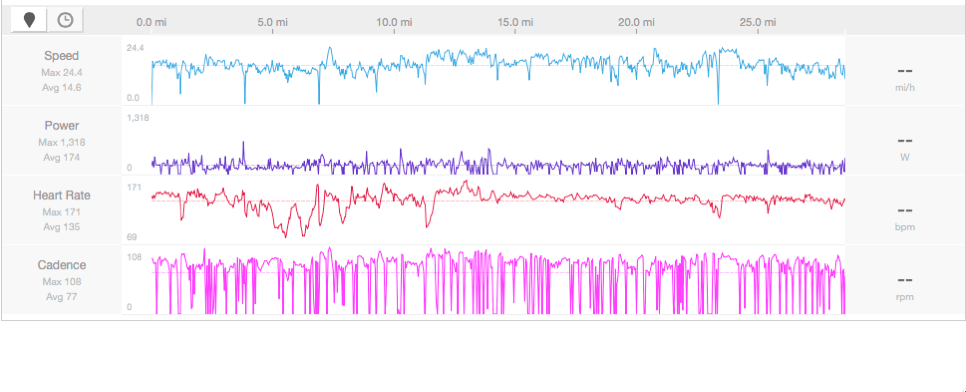
The ride was pretty decent. I rode about the first half of it in the small chain ring because I’m a dumbass; on one section of flat road, I was doing about 110rpm and couldn’t get above about 20.5mph, and then when I figured it out, boom. My average speed went up after that. (Takeaway: pay more attention). My sustained cadence still needs work but this was very close to a 40km PR for me— my previous PR was done on a group ride (so drafting) with two breaks en route. I actually passed a few people, which was a real treat for me. Had ~40oz of Mercury on the ride + 1 Gu. I probably should have had a third bottle; that’s on my shopping list, though it means I need a new bottle cage.

Paul-RenMan-bike


This was my first race with my new Stages power meter, about which more later. It wasn’t super useful to me, apart from being able to see my average and instantaneous power. I am not yet at the point where I can produce a consistent power output on demand, nor where I can figure out what power output I should be targeting. But I’ll get there.

T2

I got into T2 and out again in just over 3min, which is decent for me. During that time I scarfed down a Honey Stinger waffle, swallowed 4 SportsLegs with a swig of Mercury, swapped out my helmet for hat, and off I went. Next time I need to eat my waffle on the run.

Run

“Trudged” is a word I might use here. The run was miserable. It was my slowest-ever 10K, at a 13min/mi pace. Coming out of transition my legs were leaden. It didn’t help that the first half of the course had lots of rollers and zero shade. I never even saw the famous lions at the University of North Alabama. I guess I was too busy suffering. I had 2 x 8oz bottles of Mercury with me and the first one was gone inside the first mile. Luckily there were aid stations about every mile, although the first one was out of water when I got there! I was pounding water like it was free beer. My quads and calves were both equally bad; I think I need to work on my swim kick, among other things.

I’m really disappointed by this aspect of the race, frankly, because I know I can run a 10K faster than this.

Side note: the hottest I have ever been in my entire life was when I stopped to use a dark green port-a-potty in downtown Florence. Never in my life have I experienced such a temperature.

Race organization

Registration was simple, packet pickup was efficient, and the volunteer support was superb (especially the Borden Dental ladies at body marking and the Listerhill Credit Union staff who manned a drive-through aid station on Court Street, complete with music, food, and ice water). I was disappointed that by the time I got to the finish line, they weren’t still announcing finisher names and times, and that there was nothing other than half-bananas to eat post-race (though some pizza did eventually appear). Overall, you expect these kinds of glitches during a race’s first few years, so I’m sure next year they’ll have them sorted out.

The big takeaways

53 weeks ago, I had never run a triathlon (nor a half-marathon, nor any distance over five miles). On the one hand I am delighted by my progress– I ran an Olympic distance triathlon, something I never would have guessed I could or would do as recently as 54 weeks ago. On the other hand, the gap between how I want to perform and how I do perform is pretty clear. I’m setting some aggressive goals for my next race and will be working hard to hit them.

5 Comments

Filed under Fitness, General Stuff

Operational maturity and Exchange

Over at my work blog, I have a post that tackles an important issue: how do you reliably design and operate Exchange if you don’t happen to have a large team of Exchange rock stars on staff? (Short answer: hire me. Longer answer: read the post to find out). Bonus: the post contains a picture of Ross Smith IV Yoda.

Leave a comment

Filed under Office 365, UC&C

Training Tuesday: Pflugerville Sprint (6/21/15)

What’s better than racing a triathlon? Multiple choice:

  1. racing your first triathlon in a new place
  2. flying yourself to and from the race
  3. getting to see your mother, grandmother, uncle, cousin, and nephew en route
  4. turning a solid race performance
  5. seeing two of your oldest friends
  6. all of the above

The correct answer, of course, is “f”, and that’s exactly how this race went down.

Dana had told me that she had plans to go to Rock the South last weekend, so I found myself with an unexpectedly free weekend. I decided to see whether there were any races I could do– and sure enough, Trifind delivered the goods, pointing me to the Lake Pflugerville Sprint. It combined the potential to see a bunch of my Austin friends with an interesting-looking race so I signed up.

In the week leading up to race day, I had several schedule changes– first I was supposed to be in DC on the 18th, then I was supposed to be in Galveston, then I didn’t have to be anywhere. I decided that it would be a shame not to stop by Alexandria en route, so I left Friday afternoon after work, flew through a stiff headwind, and landed in Alexandria about 930pm, at which point I shot the required 3 landings needed to regain my night currency. After a delicious dinner of shish kebabs, I visited with Mom and my cousin Melissa (the same one who runs marathons!), then hit the rack. The next morning featured plenty more visiting; I left AEX for Austin Executive about 1130.

My flight to Austin was perfectly uneventful, although cloudy, so I was able to shoot the RNAV 13 approach when I got there. The staff at Henriksen Jet Center had a car for me, so I headed out for packet pickup, which was at Jack and Adam’s Bicycles. Frankly I was a little disappointed– given that Austin is such a bike mecca, I was expecting a bigger, fancier store with more stuff. Maybe the location on Lamar isn’t their biggest one? In any event, after packet pickup, I went to meet Erik, Chris, and Chris’ family at Takoba, where I had a truly excellent Mexican meal. (Having said that, I have yet to have a bad meal in Austin, so keep that in mind). Erik and I went around the corner to The Brixton for a beer, where we watched an epic thunderstorm ravage my bike while we chatted. Because I didn’t want to stay out too late, I headed over to Chris’ since he had generously offered me his guest bedroom. I got to meet all four of his dogs and hear about his recent adventures getting his EMT certification at Remote Medical International, which sounds like exactly my kind of place. I was sound asleep by 10pm.

Race morning dawned but I couldn’t tell; there was a heavy, low overcast. EDC was reporting a 700’ ceiling, and the radar didn’t look too favorable either. I retrieved my still-damp bike, loaded up my bag, and headed out to Pflugerville. After a quick stop at HEB, a local grocery store, I found the race site, parked, and got everything set up in transition, with plenty of time left over; the organizers delayed the race start for 15 minutes because of the weather.

Side note: I wish I had read this list of tips on how to deal with rainy races before the race!

The swim was 500 yards in Lake Pflugerville, a city reservoir. My goal was to swim at a steady pace that I could sustain without stopping, and I did. Unfortunately it was slower than I wanted. I had a good steady rhythm though. I was further slowed by the huge fields of hydrilla growing underwater along the return leg of the course. There is more weed in that lake than a Willie Nelson concert. I literally got tangled in the weeds on the return leg; they reached all the way up to the surface so it wasn’t just that my body position was poor. This was both disconcerting and aggravating. Apparently this is a known problem and the city cleans the weeds out every so often.

T1 was slow. I need to work on this. Part of the problem was that I spent some time trying to figure out why neither my HRM nor my on-bike iPhone mount were working. (HRM battery died, iPhone mount got water in it so the ANT+ key is apparently broken). As an experiment, I took 200mg of caffeine in T1, but didn’t eat anything else.

The bike leg felt really solid. The course had lots of little rollers, which were no problem. Not having cadence visible on the handlebars bugged me a lot for the first half but then I got used to it. We had a HUGE rainstorm from about miles 7-11 which slowed me down a bit, but overall I was pleased with my average speed. Despite my speed, though, I was getting passed left and right. Apparently Austin has a lot of really fast cyclists after all. Towards the end of the bike, I was having what felt like muscle cramps on the right side of my abdomen— not GI, but more like the feeling after you do a ton of planks. Not sure what brought that on, but it didn’t last; I am not sure whether it was temporary cramping brought on by electrolyte imbalance, bad posture, or just bad luck.

(For your entertainment, here’s a video of the bike leg. I shot it with a Garmin VIRB mounted on my aerobars, then ran it through Microsoft’s Hyperlapse Pro software to speed things up. For another time, a post on Garmin’s VIRB Edit software and how to make it work properly.)

In T2, I ate a Gu, drank a bit of Mercury, and emptied some of the water out of my bike shoes before taking off on the run The run was a packed gravel trail around the lake. I was really slow going out at first but settled in about halfway. For the first part of the run, I was running until I felt like I had to puke, then I’d walk, then when it passed I’d run more. I don’t know if it was the caffeine, the heat, or just bad luck; I’ve never really had that problem before. Luckily, it went away partway through, and I ended up with big-time negative splits: 11:22, 10:33, 8:51. The splits reassured me about my progress towards readiness to do an Olympic-distance race.

The race was very well organized and supported. Like many larger races, they had a professional announcer/DJ who played good music before the race and called out finishers’ names as they crossed the finish line— always a nice touch. I wasn’t hungry after the race, so I didn’t sample any of the post-race goodies. For swag, I got two hand towels, a bike bottle, and a small dog tag (plus my race shirt): not a great haul, but not the worst I’ve ever had. I can always use more triathlon-themed hand towels for the guest bathroom!

When I first saw my results I was pretty disappointed at my overall rank. However, after I plugged my results in to my tracking sheet, things looked a lot better. Austin has TONS of triathletes and yesterday, most of them were faster than I was, but I am headed in the right direction– I was faster on the bike than in New Orleans, my swim time was on par on a 20% longer distance, and my run splits were terrific. Onwards!

2 Comments

Filed under Fitness

Setting the record straight on Microsoft and subpoenas

This week I had the opportunity to present a session called “Cloud Best Practices” at the Alabama Digital Government Summit. I had a great time— it was fascinating to see how many different agencies in our state are putting advanced IT to work to save money and get more done for the taxpayer. However, there was one blemish on the experience that I wanted to polish away, so to speak.

Part of my talk concerned the fact that no matter where you live, your local government has lawful means to get your data: they can subpoena you, or your cloud provider, to get it. There’s nothing that you can do about it. It’s a feature, not a bug, of modern legal systems. I often talk about this in the context of people’s fears that the NSA, GCHQ, or whomever will snag their data, by lawful or unlawful means. Here’s the slide I put up:

NewImage

I don’t think these are controversial assertions. However, at this point in my talk, Stuart McKee (chief technical officer for state and local government at Microsoft) flatly asserted that Microsoft does not comply with government subpoenas for customer data; I believe he used the word “never”. He went on to say that Microsoft has a pattern of resisting subpoena requests and that this “has gotten [them] into some trouble.” He concluded by saying that Microsoft’s standard action is to tell governments that they must subpoena the data owner, not the service provider.

I believe these assertions to be largely untrue, and certainly misleading. (I’ll leave aside the insulting manner in which Stuart asserted that I was wrong— after all, I am certainly wrong sometimes and generally appreciate when people point it out.) I want to set the record straight to the extent that I can.

First, Microsoft absolutely does comply with lawful subpoenas for customer data. This page at Microsoft’s web site summarizes their responses to lawful legal demands for customer information (both information about customers and information belonging to customers) across a broad variety of jurisdictions, from Argentina to Venezuela. To assert otherwise is ludicrous.

Second, Microsoft has a pattern of complying with these lawful subpoenas, not refusing them. When Stuart said that Microsoft is “in trouble” for refusing a subpoena, I suspect that he’s referring to Microsoft vs United States, where the issue at hand is that Microsoft was served a search warrant for data stored in a Microsoft data center hosted in Ireland. The data are stored there because the customer is located outside the US. Microsoft moved to have the warrant vacated, and when that failed, asked the cognizant district court to vacate it. The district court upheld the original warrant; Microsoft refused to comply and was held in contempt. Now this particular case is working its way through the US federal court system.

Let me be clear: I applaud Microsoft for standing up and resisting the overreach in the original warrant— there doesn’t seem to be (at least not to my layman’s understanding) a right of the US government, at any level, to subpoena data belonging to a non-US person or organization if it’s stored outside the US, even if it’s held in a cloud service operated by a US person or organization. The brief Microsoft filed likens this to a German court ordering seizure of letters stored in a safe deposit box in a US branch of a German bank. Having said all that, claiming that this kind of resistance is routine is overblown. It isn’t. If Microsoft were refusing subpoenas left and right, the numbers I mentioned above would look very much different.

Third, Microsoft’s policy is indeed to try to redirect access requests whenever possible. The Office 365 privacy page has this to say:

We will not disclose Customer Data to a third party (including law enforcement, other government entity, or civil litigant; excluding our subcontractors) except as you direct or unless required by law. Should a third party contact Microsoft with a request for Customer Data, we will attempt to redirect the third party to request the data directly from you. As part of that process, we may provide your contact information to the third party. If compelled to disclose Customer Data to a third party, we will use commercially reasonable efforts to notify you in advance of a disclosure unless legally prohibited.

In other words, Microsoft will try to redirect subpoenas from themselves to the data owner, where they are allowed by law to do so, and if they can’t, they will notify you, if allowed by law to do so. This is the only one of Stuart’s claims that I think is inarguable.

Finally, Microsoft proactively cooperates with law enforcement. The Microsoft Digital Crimes Unit newsroom contains press releases touting Microsoft’s cooperation with law enforcement agencies around the world (here’s just one example). This cooperation and disclosure extends to Microsoft proactively notifying law enforcement agencies when their PhotoDNA service identifies child porn images in customer’s private OneDrive data. I support their right to do this (it’s covered very clearly in the terms of service for Microsoft cloud services), and I believe it’s the right thing to do— but to claim that Microsoft never discloses customer data to law enforcement agencies while they are voluntarily doing so is both untrue and misleading.

Everyone’s interests are best served when everyone understands the specifics of the legal interaction between local and national governments and cloud service providers in various jurisdictions. This is a really new area of law in many respects, so it’s understandable that some things may not be clear, or even defined yet, but I wanted to correct what I view as dangerously misleading misinformation in this specific instance.

The bottom line: no matter what cloud service you choose, be sure you understand the policies that your cloud provider uses to determine the conditions under which they’ll cough up your data.

2 Comments

Filed under Office 365, Security, UC&C

Fixing “Cannot find registrar pool” error for sipfed.online.lync.com

I was recently setting up hybrid Lync Skype for Business for a customer. This is more properly known as “split-domain” configuration because you share a single SIP namespace across both the on-premises and cloud portions of the infrastructure.

If you’re not familiar with the process, it goes like this:

  1. Set up AD FS or whatever other identity federation solution you like.
  2. Configure the service to allow federation.
  3. Configure the on-premises Lync/SfB servers to allow federation.
  4. Turn on federation.
  5. Enable your tenant for split-domain operations with Set-CsTenantFederationConfiguration.
  6. Start moving users.

Adam Jacobs’ summary is worth reading if you haven’t seen this before, but even without reading it, it seems straightforward enough, right? I found that when I got to step 6 I got a vexing error: “Cannot find Registrar pool. Verify that ‘sipfed.online.lync.com’ is a valid registrar pool.”
sipfederr

I was 100% sure that the registrar pool name was correct and that it existed, so why couldn’t the Move-CsUser cmdlet find it? I spent some fruitless time binging for a solution (note: this is not the same as “binging on beer” or “binging on carbs before my race”); the few hits I found all suggested ensuring that you’d connected to the service with Import-PSSession, which is, as suggestions go, right up there with “make sure it’s plugged in.”

After some experimentation, I finally figured out that step 3 above hadn’t been performed completely; when I ran Get-CsHostingProvider, the EnableSharedAddressSpace and HostsOcsUsers parameters were both set to “false”. I reset them (and the AutodiscoverUrl parameter, also required), and that solved the problem. It’s not clear to me why anyone at Microsoft thought “cannot find registrar pool” would be an appropriate error for this condition; there are distinct error messages for most other problems that might occur (such as trying to move users to the wrong pool) but not here.

Perhaps this breadcrumb will help some future admin who gets the error, or maybe Microsoft will fix it…

6 Comments

Filed under Office 365, UC&C