I’m excited to announce that I’m going to be volunteering as one of the coaches for Fleet Feet Huntsville’s Tri201 program. It’s designed to take people who are already at an intermediate level of fitness (including people who haven’t done a triathlon yet but have completed 10K or longer races and meet the de minimus swim and bike distance requirements) and prepare them to successfully complete the Rocketman Olympic triathlon in August. After completing Tri101 in 2014 and Tri201 last year, I’m really looking forward to share what I’ve learned in my short triathlon experience with a new group of athletes. If you live in metro Huntsville and are interested in triathlon, come check us out!
Category Archives: Fitness
Training Tuesday: just call me Sir Paul
A couple of weeks ago, I wrote about my plan to seek Knighthood. That’s how I spent Saturday, March 19th: on a bike, communicating with my fellow CHP athletes (including Rafe, who wrote his own Knighthood recap) via Skype and Facebook, and pedaling. A lot.
(Side note: if you don’t know what I’m even talking about, you might want to poke around the Sufferlandria web site, which explains the culture, customs, and traditions of that mysterious land.)
I set up my bike on the trainer in my living room, using a dog crate to hold my laptop (for communications), my iPad (for streaming video from the Sufferfest app), and snacks. It was cool outside, so I opened several windows and turned on the ceiling fan; one of my gripes about riding indoors is that you don’t get the cooling breeze from forward motion because there isn’t any.
The Sufferfest videos are organized into a few general categories: racing, endurance, climbing, and so on. They feature a mix of sustained riding at a predetermined pace, intervals at specific power levels, and race simulations (which include both). There are attacks, breakaways, climbs, and all sorts of goodies.
Here’s what happened, as best as I remember.
I got up, had a cup of coffee, checked all my equipment, and had a banana and a protein shake. The night before, I’d laid in a huge cache of supplies, including Oreos, beef jerky, M&Ms, and a bunch of other stuff I wouldn’t normally eat. I weighed in at 199.3 pounds, got dressed, and headed towards Sufferlandria.
(n.b. Cyclists take note: each of the video links below includes a description, a short trailer, and a ride profile showing the intervals and intensity levels.)
We started promptly at 0730 my time with The Rookie (55 minutes). This video’s theme is that you are the newest rider on the Giant/Shimano team, so you start riding as a domestique but actually get to lead a breakaway by the end through 3 10-minute race intervals. I rode this scaled to 75% of my FTP, so my threshold was 146W, and the app was smart enough to scale my performance targets accordingly. The ride went well– I felt good when I was done. Refreshed, you might say.
Next up was 48 minutes of The Wretched, the overview of which starts with “Perhaps one of the most difficult Sufferfests, The Wretched is the tale of a Sufferlandrian who has fallen from Local Hero to Zero.” The conceit here is that you’re simulating a stage of the Tour de France, so there are attacks galore. This one went well too; after finishing I had a few handsful of trail mix and a few Oreos, along with another shake (consisting of 1 scoop of Karbolyn and 1 scoop of Optimum Nutrition vanilla protein powder; I nicknamed this a “pain shake” after the famous Sufferlandrian beverage).
Video 3 was A Very Dark Place (51 minutes). I definitely felt this one. It featured 5 4-minute high-speed intervals, each with a different theme (solo breakaway, holding onto the race leader’s wheel, etc), which provided pleasant variety in the midst of the pain. I hadn’t done this or The Wretched before, so it was fun experiencing them for the first time while watching Rafe, Todd, and Torrey suffering on Skype.
Power Station, video 4, is 50 minutes of climbing– low cadence, high-power climbing that will burn your quads to a crisp. I’d ridden it before so I knew what to expect. It’s a tough workout, especially after the preceding three, but I am lucky in that I have really big quads and hamstrings relative to the rest of my legs (or my entire body for that matter). That makes me a crappy sprinter and a comical rider at 100+ rpm cadences, but I can handle hard low-cadence work.
I had some more snacks. In fact, you should assume that I snacked in between each video because that’s exactly what I did.
Video 5 was Angels, which I hadn’t ridden before: 3 8-minute climbs, which were not fun even a little tiny bit. I had just saddled up when Dana came over with the kids… and more snacks. They kept me company through both Angels and Nine Hammers, the following video. Both were tough but the company made the time pass much faster than I would have expected. Lilly drew me two signs, one for each video, and Dana made me what I must say was the best PB&J I have ever eaten.
Coach Alex prophetically said “this will be the worst part of the day” about video #7, Hell Hath No Fury… 75 minutes in which you race 2 20-minute race intervals against professional female cyclists. a 20-minute race interval is no joke; two of them back to back even less so. I was certainly feeling the burn by the end of this one. By this point, I was starting to have some persistent discomfort in the IT bands of both knees, as well as an occasional twinge in my left ankle. My legs were burning more or less constantly. I’d been taking Sportlegs, in which I am a firm believer, and they helped, but I found myself muttering Jens Voigt’s famous mantra: “shut up, legs.”
Video 8 was Do As You’re Told (47 minutes), which I think was the first Sufferfest video I ever rode. Familiarity didn’t make it any more pleasant; this video is all intervals / sprints, so it was punishing. I hung on, grimly, and used every second of the 10-minute break to refill my bottle, snack up, and stretch out my aching quads.
Video 9 was The Best Thing in the World (48 minutes). This is a flat-out lie, as it contains two 13:30 race simulations, which are not even close to the best thing in the world.
We closed with Blender (1 hour and 40 minutes). That’s right: 100 minutes of various intervals at the end of the quest. Many of the folks in the Knighthood-attempt Facebook group were horrified that we finished with this instead of doing it earlier, but that’s how Alex rolls. I was really dragging during some of these intervals; the recovery intervals weren’t nearly long enough to suit me. However, I managed to struggle through, finally dismounting the bike after successfully completing Blender, to loud cheers from the cat.
I staggered around the living room for a bit, then sat down. This was a bit of a mistake, because it was mighty hard to get up again. Luckily Dana and her kids brought me a pizza, which I gleefully consumed along with a Belgian beer I’d been saving for the occasion. After dinner, I filled out the Knighthood submission form, and earlier today I was rewarded with mail from the Minions containing this beauty:

I’m eagerly looking forward to the rest of the Knighthood swag I’ve earned, including some custom bike decals. More than that, I’m thankful to have had the opportunity to raise nearly $3,000 for charity along with my CHP posse, and to have completed the single most challenging athletic event I’ve ever attempted. Many thanks to all who donated or who supported us with moral support, snacks, drawings, or PB&J sandwiches.
On to my 70.3!
Filed under Fitness, General Stuff
Training Tuesday: get knighted or die tryin’
I have become a big fan of the cycling training videos from The Sufferfest. They provide high-intensity workouts with a nifty backstory: you are a citizen of the nation of Sufferlandria, a cycling-obsessed country with a completely unique culture. The videos present various entertaining scenarios, such as riding high-power intervals for an hour and forty minutes or trying out for the Giant-Shimano cycling team. The videos are well-produced, feature great music, and are damn challenging.
One feature of Sufferlandrian culture is their titled nobility: Knights of Sufferlandria earn that title by completing 10 of the videos, back to back with no more than a 10-minute break in between. This totals out to between 10 and 13 hours of riding, depending on which videos you choose. There are some other rules, explained at the link above, but the bottom line is that you have to Suffer, ideally while raising money for charity, in order to earn the coveted title. Only about 600 people worldwide have done so… so naturally, when Alex Viada suggested that we do a group Knighthood attempt at CHP, I was all over it.
On Saturday, March 19, I will undertake to earn my Knighthood (along with Alex, Kelly, my lifting buds Derek and Rafe, and about a dozen coaches and athletes). Our team is spread all over the US and UK, and we’ll all be riding at the same time. As a team, we chose two charities: Oxfam and Puppies Behind Bars. “Who?” you ask. Here’s what PBB does:
Puppies Behind Bars (PBB) trains prison inmates to raise service dogs for wounded war veterans and explosive detection canines for law enforcement. Puppies enter prison at the age of eight weeks and live with their inmate puppy-raisers for approximately 24 months. As the puppies mature into well-loved, well-behaved dogs, their raisers learn what it means to contribute to society rather than take from it. PBB programs bring the love and healing of dogs to hundreds of individuals every year. The dogs bring hope and pride to their raisers, and independence and security to those they serve.
I am excited by this opportunity and look forward to Suffering for a good cause. Hopefully we’ll be able to get a live stream put together, too. I invite you to consider donating– 100% of the proceeds are going 50/50 to our two target charities.
For more details on the event, and to donate, please visit this page.
Filed under Fitness, General Stuff
Training Tuesday: IoT insecurity, fitness division
There’s lots of hype about how the Internet of Things (IoT) will make our lives better, and much of it is true. For example, my house has two Internet-connected thermostats that I can use to see and change temperature settings— that way I can keep the house uncomfortably cool or warm when I’m not there and adjust the temperature remotely so it’s comfy when I get there. Fitness devices are definitely a well-established part of the IoT; companies such as BodyMedia and Garmin have been making devices that can connect, either on their own or through a PC or smartphone, to Internet services for a while. That market has been growing very rapidly over the last few years (some estimates put it as $3 billion in 2015), so some bright folks at Open Effect (funded in part by the Canadian government) decided to take a look at the security of IoT-connected fitness devices.
The results (full report here) are pretty horrifying:
- Many devices transmit their Bluetooth MAC IDs at all times that the device isn’t pried, and those IDs never change, so it’s easy to track someone through rudimentary Bluetooth beacon monitoring.
- The Jawbone and Withings fitness services don’t do a very good job of data validation; the researchers mention telling the Jawbone service that their test user walked 10,000,000,000 steps in one day, and the service happily accepted that. Worse still, they were able to inject fake data, generating records of “a person taking steps at a specific time when no such steps occurred.” Given that this data has been used in both criminal and civil trials in the US and Canada (see the extensive footnotes in section 1.4 of the report), this is pretty awful.
- Garmin and Withings don’t use HTTPS to protect data in transit. Given that I wear a Garmin watch and use a Withings scale daily, I have a problem with this. The researchers only studied the Garmin Connect app on iOS and Android, but if I had to bet, I’d guess that my Garmin watch (which has Wi-Fi) isn’t using HTTPS either.
Apart from calling Garmin to yell at them, I’m posting this mostly to point out yet another case where the rush to get things on the Internet may have unintended consequences. While my individual fitness data is not necessarily something I mind being visible, I don’t like that these manufacturers have been so sloppy. I can understand not wanting to implement HTTPS on a very low-power device but there’s no excuse not to implement it in a mobile app, for crying out loud.
Meanwhile, if I ever need to, now I know how to challenge any fitness-related data that may be introduced in court.
Filed under Fitness, General Tech Stuff, Security
Training Tuesday: “The Hybrid Athlete” (Viada) review
Fitness is a huge industry in part because it offers the promise of self-improvement. Look better! Be thinner! Run faster! There are low barriers to entry; anyone can hold themselves out as a fitness expert, and (much like weathermen or stock analysts) no one ever checks back to see if the promised results were actually delivered. One result of this combination is that there are a lot of people who uncritically accept some principles that turn out to be completely false. One example: “cardio kills your gains.” Another: “if I lift weights I’ll be too blocky and slow to run or cycle fast.”
Alex Viada has addressed this lack of knowledge rather neatly in The Hybrid Athlete. The book’s landing page defines a hybrid athlete as “a unique breed who can excel simultaneously in both strength and endurance activities.” Examples might include firefighters, members of military special operations forces, or even people like me who want to be unusually strong and have unusually good endurance. I bought the book sight unseen, although I had the benefit of being coached by Alex and the team at Complete Human Performance, and seeing his unique approach in action, for a few months before it came out. Sadly, I didn’t get around to finishing it until last night, but I’m glad I buckled down— I learned a ton. A few of the things I learned:
- what causes rigor mortis (page 34)
- the stomach isn’t an absorptive organ (page 170)
- swimming burns 10x as many calories per mile per pound compared to running (2.9 cal/mi/lb vs 0.29 cal/mi/lb, page 173)
- The average hard-training, non-steroid-taking man can gain between 1 and 1.5 lbs of lean body mass every 2 months— far below what I would have expected (p176)
- That thing you’re doing that you think is Tabata? It probably isn’t (page 66)
- Trappist ales are perhaps the finest recovery beer yet known to man. (page 232)
The book’s divided into 13 chapters. The first four are primary introductory material, covering hybrid training philosophy and the physiology of muscles and metabolic pathways. There are specific chapters for the critical components of strength and endurance training and chapters covering sport-specific training (along with an appendix listing sample hybrid programs for various combinations of sports, such as a powerlifter who wants to run marathons). To me, three of the chapters were particularly valuable, so I want to dig into those a little more.
First is chapter 7: “Cutting Out the Noise: Eliminating the Waste.” This might seem like an odd chapter title, but when you consider that consolidation of stressors is a fundamental part of hybrid training, it makes perfect sense. The question poses a simple question:
“Will performing this particular part of my workout routine improve my final performance more than any other potential component?”. If the answer is yes, include it then move on to the next. The answer will go from a firm “yes” to a more general “yeeeeeees” to, eventually, the dreaded “I think so”, or “the internet said so”. Any primary component of training should be both necessary and sufficient to improve sport performance in one particular component of a given sport. For a powerlifter, the squat, bench, and deadlift are all primary. For the triathlete, the tempo run or time trial. For the ultra runner, the long slow trail run. For the Weightlifter, the Snatch and C&J.
This is a really powerful concept once you understand and embrace it. Doing more miles on the bike, more time on the treadmill or road, or more laps in the pool will not necessarily lead to better sport performance. It sounds heretical, but Alex provides a really concrete example in the training template for powerlifting plus triathlon— the swim and bike distances are short relative to traditional triathlon training programs because swimming 5000-8000 meters are “very counterproductive to upper body power production.” Plus, they take a great deal of energy and focus, and it’s questionable whether swimming 8000m to prepare for a race distance of 3800m (in the Ironman-distance swim) is better preparation than spending the same amount of training time on other activities. Alex refers disparagingly sometimes to “junk miles,” referring to distance for distance’s sake, but intensity is a critical element too— for me, perhaps the most valuable single sentence in the book was found on page 66:
…many endurance athletes go entirely too hard on their “aerobic” or “low intensity” days, and end up gaining neither the discrete training benefits of higher intensity work nor recovery benefits of the lower intensity work.
He might as well have started that sentence like this: “HAY, PAUL, PAY ATTENTION BECAUSE THIS IS YOU:…”
Chapter 11, “Strength for the Endurance Athlete,” pulls no punches in calling out how awful most strength training routines in the fitness press are for triathletes. He points out, rightly, that no matter how much time you plank (to cite one example) it’s not going to help you stay aero on the bike as much as actual resistance training for your core muscles. This chapter (and its companion, “Conditioning for the Strength Athlete”) clearly lays out the specific adaptive benefits of strength training— improved ligament and tendon strength, better bone density, and improved sport-specific fitness.
Finally, Chapter 13, “Nutritional Support for Hybrid Training,” exploded a lot of false knowledge I (thought I) had about the process of feeding my body for the best possible performance. I haven’t worked all the way through the (simple) data gathering and associated math, but essentially I am eating roughly the right amount of calories but in the wrong proportion of macronutrients. This is easy to adjust and should give me better endurance and perhaps a little bit of weight loss.
Overall, this is a superb book. Alex’s writing style is clear and direct, with occasional flashes of his extremely dry wit. The degree of research he’s done, and knowledge he holds, is evident (and bolstered by the bibliography and recommended reading in appendix C). I strongly recommend this book for any triathlete or distance runner; I’d recommend it for powerlifters and Strongman competitors too, but all the ones I know are fellow CHP athletes and they know this stuff already. At $47, it’s cheaper than a jar of good protein powder or a new pair of bike shoes, and it will have much longer-lasting impact on your fitness, health, and performance.
Garmin Fenix 3 drops data from Stages power meter
I’ve been ignoring this problem for a while, hoping that it would be fixed in a firmware update, but it persists, and I finally got aggravated enough with it to write this post (and to engage Garmin support). The problem is simple: my Garmin Fenix 3 triathlon watch will not reliably record data from the Stages power meter I have on my bike.
A quick digression: there are two major standards for wireless exercise sensor connectivity, Bluetooth Low Energy (aka BLE and Bluetooth 4.0) and ANT+. Some devices support one or the other, and some devices support both. For example, my heart rate monitor (the excellent Scosche Rhythm+) simultaneously transmits both ANT+ and BLE signals, but my Wahoo speed/cadence sensor is ANT-only. When I ride, I usually use two devices: my old iPhone 4 on the handlebars, in a Wahoo case that has a built-in ANT+ adapter, plus my Fenix 3. The iPhone is too old to use BLE, and turning on BLE on the Fenix 3 dramatically drops its battery life, so I’m using ANT for all the sensor data. Having two devices means that sometimes I forget to start or stop one device or the other at various points, so I often have mismatched data between the two.
A picture will illustrate the problem most clearly. When I use the Fenix 3, I end up with ride data that looks like this:

As you can see, the power graph has a few spikes with lots of flats– and an average power of only 23W. (I’ll get to why the average is important in a minute). By contrast, here’s what the ride looked like when captured with the Strava app on my iPhone 4. Note that the power data much more closely tracks the speed, cadence, and HR data.
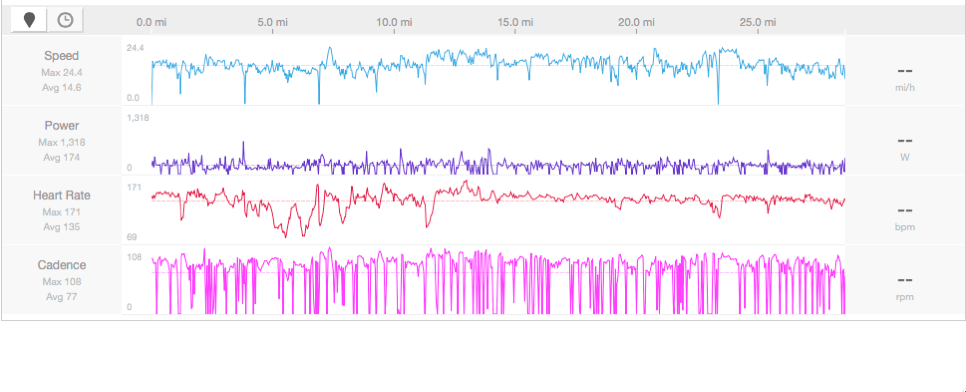
So why is this important? First of all, as a techie, it annoys me when two things that are supposed to work together won’t. More importantly, I actually use the power data from these rides in two ways. While I’m on the bike, I use it to gauge and adjust my level of effort. For example, yesterday’s ride was pretty windy, so I tried to hold a steady 190-210W while riding into the wind, keeping my level of effort constant and accepting whatever speed that gave me. After a ride, my coach and I use the power data to plan my recovery time and to identify areas where I need more practice (e.g. climbing hills). Having inaccurate or dirty data makes both of these uses impossible.
The Stages power meter support FAQ suggests moving the watch around, but I haven’t tried that yet. My troubleshooting efforts so far have been limited to changing the battery in the Stages and making sure the Stages and Fenix both have the latest firmware. I’ll see what Garmin support has to say. Hopefully they have a magic fix; I have a very early-model Fenix 3 so maybe they’ve made some improvements since launch. Until then, I’ll keep recording each ride twice and keeping the cleanest data.
Filed under FAIL, Fitness, General Tech Stuff
Training Tuesday: 2015 in review
All right, so it’s not Tuesday. I’m running behind because oft the holidays.
So far in 2015, if I trust Strava’s numbers, I’ve cycled 896 miles and run about 471 miles. That doesn’t count time on my bike trainer, and it’s probably missed a few activities here and there. I don’t know how many pounds of weights I’ve lifted, but I bet it’s a lot.
Competitions
This was a busy year for competitions. Maybe I should say “organized events,” since at my level I am not truly competitive in most events. Still, I had a great time racing with, and against, friends and strangers.
- Trail races: XTERRA Monte Sano, Tick Ridge Trek 10K
- Road races: UAH 8K, Rocket Run 10-Miler, Firecracker Chase 10.2 mile, Monte Sano 15K, Hobbs Island 10K
- Half marathons: Bridge Street, Four Bridges, Huntsville Half
- Duathlons: Heel & Crank, Lake Guntersville Duathlon
- Triathlons: New Orleans Sprint, Pflugerville Sprint, Huntsville Sprint, Rocketman, Renaissance Man
- Powerlifting: USPA Europa Orlando (where I took first place in my division of one!), USAPL Georgia Powerlifting for Pink
In 2016, I will complete my first half-Ironman: 1.2mi swim, 56mi bike, followed by a half marathon. IRONMAN North Carolina, here I come! Depending on how the offseason goes, I may give IRONMAN New Orleans a shot in April too; I’m still waffling on that. I’ll fill in my schedule with other events as they appear (for example, I already have lifting meets planned in January and February).
Performance
Thanks to the excellent coaching I received from Alex Viada and the crew at CHP, I am much stronger and faster than I was at this time last year. I cut nearly 30 seconds off my best time for the mile, a minute off my 5K, nearly 3 minutes off my best 10K time, and ran my first half marathon in 2:15– then shaved nearly 15 minutes off my best time before the end of the season. My bike endurance is greatly improved, although I’m still not where I want to be speed-wise. And my weightlifting… holy cow. I’ve put 70 pounds on to my maximum bench press, just under 150 pounds on my deadlift, and 80 on my squat. I am looking forward to more speed and power gains in 2016, that’s for sure. I have some specific time goals for Rocketman and Renaissance Man, and my goal is to join the 1000-lb combined lifting club before the end of 2016. (Notice I didn’t say anything about swimming? I will keep hacking away at it. Gradual improvement is still improvement.)
Nutrition
I worked with a nutrition coach for a few months but I did a really poor job adhering to his plan. This is something I need to work on in 2016— not necessarily for weight loss or body composition, but to make sure I’m fueling my body properly for what I’m asking it to do. Most of the nutrition challenges I’ve faced are self inflicted; they come about from failure to stock good things to eat as opposed to random crap, as well as failure to plan to eat so I don’t suddenly decide I’m starving and latch on to whatever’s within reach.
The mental game
If there’s one area where I feel like my 2015 performance was poor, it’s mental focus. I still haven’t learned how to consistently focus and perform. I have a few ideas about how to work on this, luckily enough. I tend to be extremely critical of my performance, and while a certain degree of this is healthy, too much of it is stifling.
I’m looking forward to another dynamic year— as long as I can stay healthy, I’ll see y’all out on the roads. But probably not in the water, because I’ll still be at the back of the pack.
Filed under Fitness
Training Tuesday: the season’s winding down
As I type this Tuesday night, I have only one more scheduled competition this calendar year. Since my last Training Tuesday post, I’ve been busy with a wide variety of things, some of which actually involve training. Rather than an exhaustive and boring list of all the stuff I’ve done, let me summarize: one road race, two half-marathons, and one powerlifting meet.
- The first race was the Monte Sano 15K, a road race at Monte Sano State Park. It was mildly hilly, but very cloudy, with maybe 200’ ceilings and lots of low fog. Cool and humid conditions made for a pretty fast course. I ran the 15K in 1:27:36, which was a good time for me on that distance, plus I got a very cool neon-yellow running shirt. Winning!
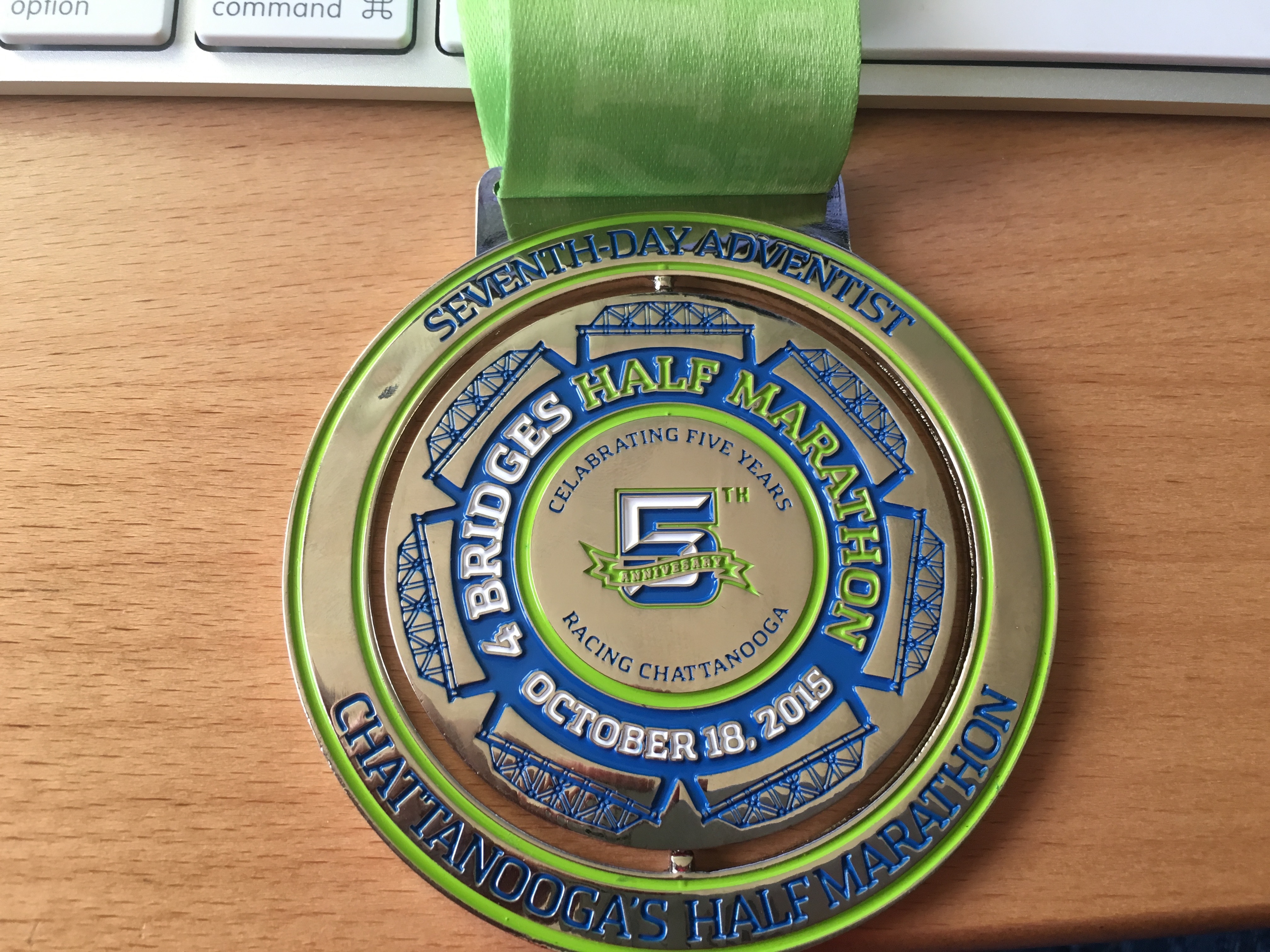
- The next weekend I flew to Chattanooga for the Four Bridges Half Marathon. I had the boys that weekend, and Tom was working, so I ended up getting up at 0330 to fly myself to the Chattanooga airport, where the superb staff at Wilson Air loaned me a car. The race was a blast: the weather could not have been nicer, the course was lovely, there were plenty of water/potty stops on the course, and the runners and crowd were both enthusiastic. The only blemish on the day was that the volunteers who laid out the half-marathon course accidentally cut about 0.5 miles off it, so I ended up with not quite a half-marathon PR, running 12.5mi in 1:53:29. However, getting to fly to and from the race helped make up for it. As a bonus, the finishers’ medal had a unique misspelling, making it slightly more collectible than I’d expected.
- In early November, I flew to Atlanta to compete in the USAPL “Powerlifting for Pink” meet. My performance here was nothing to brag about; I missed two of my three squats and all three bench attempts, mostly due to poor focus. Turns out you really have to pay attention to the judges’ commands. However, I deadlifted well, I had fun with Dana, and I learned a ton that will help me in my future meets.

- For my birthday, I’d planned a trip to run Rocketman but the logistics just weren’t going to work, so I ran the Huntsville Half Marathon instead. I didn’t do a lot of race preparation beforehand, and it showed; I ran it in 2:07:49, which was nearly 8 minutes faster than my previous half-marathon but about 0:30/mi off the pace in Chattanooga. I have no idea why. After the race, my legs were much more sore than they were after Chattanooga, too.
One of the lessons I am slowly starting to learn is that I’m not always going to set a PR every time I step up to the starting line or platform. There’s still a large gap between what I feel like I should be able to do and what I can actually do, but the gap is getting smaller, both as I adjust my expectations and as I become more capable.
As things stand right now, the Hobbs Island 10K will probably be my last race of the season; there are a few scattered triathlons before the end of the year, but I don’t think it will be feasible for me to run any of them. The good news is that I’ve already started picking my 2016 events and will be working with my coach to build a training plan accordingly. It’s going to be a busy winter!
Filed under Fitness
Training Tuesday: Rocketman Olympic Triathlon (23 August)
This time, it was personal.
See, last year, I signed up for the bike leg of Rocketman and failed to complete it when my bike broke. Then this year, I lost my Olympic virginity at Renaissance Man with a disappointing time. I was highly motivated to finish this year’s Rocketman well… so I did.
Pre-race and setup
Rocketman is legendary for being well-organized, so I expected all the race logistics stuff to go smoothly, and it did. This was the first year on a new course, after many years of doing the race at Redstone Arsenal, but the race director did a great job of posting the course maps early, marking the course, and generally communicating what the changes would be. Matt and I went to Fleet Feet on Saturday, grabbed my race number and swag bag, and then headed home so I could pack.
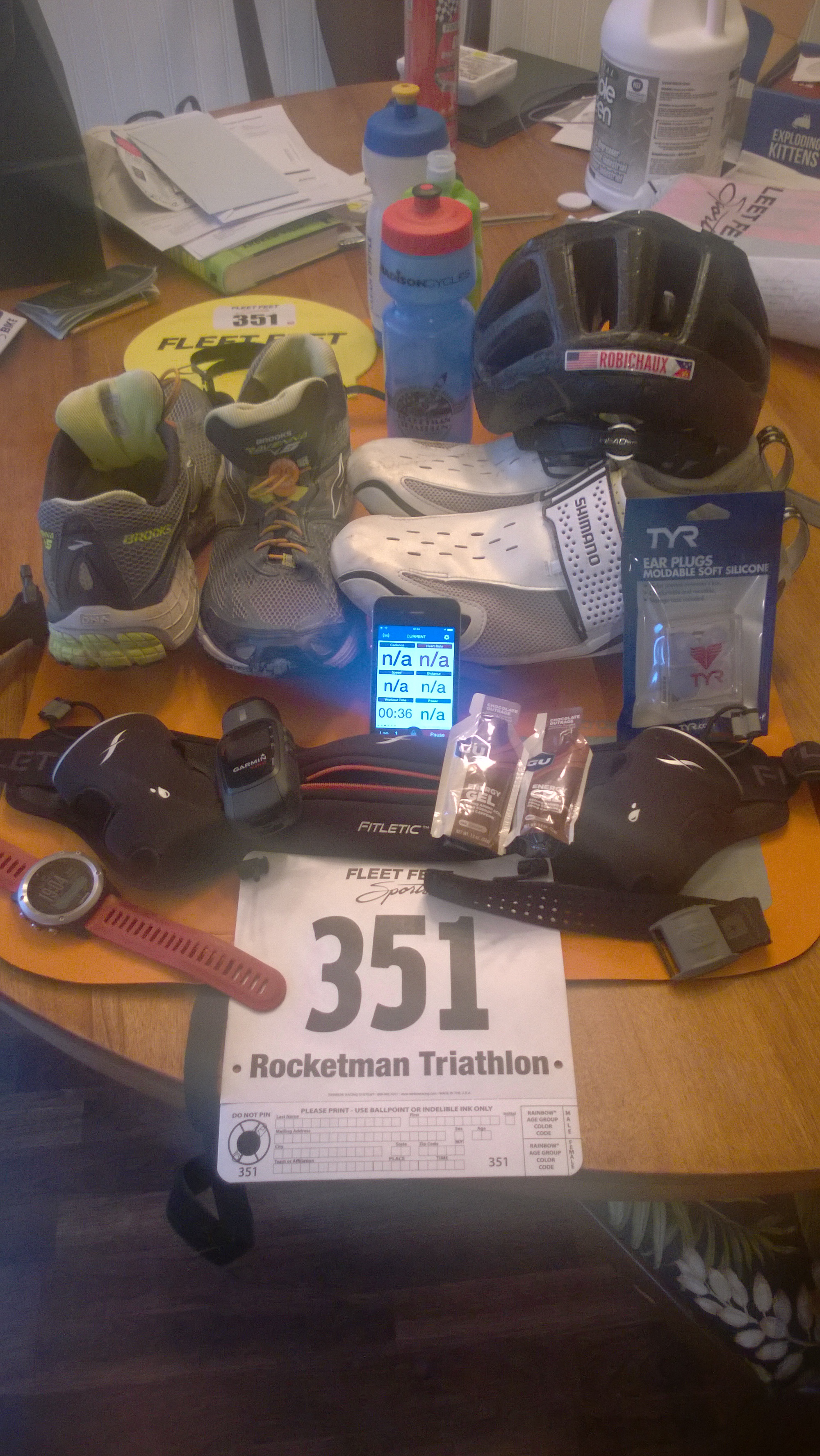
That looks like a lot of stuff, and it is. At the bottom, you can see my race number (attached to my Fitletic race belt), watch and heart rate monitor, and Garmin bike camera. My ancient iPhone is running the Wahoo Fitness app so I can watch my heart rate, cadence, and power on the bike; then there are two pairs of (large) shoes, my helmet and swim cap, and 3 water bottles. Not shown: all the stuff I normally take to eat and drink during the race. (Hint: it wasn’t shown for a good reason!)
I packed my bag, loaded the bike on the car, and went to bed. When I woke up, a scant 5 hours later, it wasn’t because my alarm went off. It was because the cat was burrowing under the covers because of the thunderstorm outside. Not a good sign.

I was a little apprehensive about the weather when I went to bed, with good reason. The picture above shows the radar picture as I was loading the car; what it doesn’t show is that the line of storms was moving directly towards the race site. I loaded up and headed out to the race site in heavy rain, not a little wind, and occasional lightning– and it was getting worse the closer I got to Ditto Landing. Luckily, by the time I got there, it was only raining, but the damage had been done (at least to the parking area, which was thoroughly inundated and had turned into a swampy, muddy mess).
While driving, I had my usual shake (50g Karbolyn + a scoop of vanilla protein), at which point I realized that I didn’t pack all the nutrition stuff I meant to bring. Alas. I had mixed up a batch of Mercury and then frozen it in my run and bike bottles, but didn’t bring any gels, waffles, or (my current favorite) Uncrustables.
Setup
I picked up my timing chip and got my body marked, then learned that there was a 30-minute delay. This gave me enough time to brave the bathroom line and get everything set up in transition. Because it was overcast, I decided to leave my sunglasses in my transition bag, but stupidly put my eyeglasses in there too. They chased us out of transition and over to the swim start, where two long ramps (probably 25′ or so) were set up to get us into the water. This was a great alternative to picking our way down the rocks on the shore or jumping feet-first off the nearby dock (also about 20-25′ above the water), the other two choices. The race organizers thoughtfully put carpet down on the ramps to make them less slippery. Then… it was time to wait, and wait, and WAIT because I was in swim wave 6. Luckily there were plenty of familiar faces around, including friends from both last year’s Tri101 and this year’s Tri201. One of my favorite things about triathlons is the huge and welcoming tri community in Huntsville, so I always enjoy seeing my posse at local events.
Swim
The swim was just OK. I got down the slide with no trouble, then waited near the start line for a wave start. The water was warmer than I expected (and warmer than the air!), which was nice. I didn’t especially like having to tread water while waiting for the start, though, as I worried that it would tire me– I need to work on more efficient treading. The swim itself went pretty much just like the RenMan swim did; I maintained a steady pace, didn’t swim exactly a straight line, and finished with 1646 yards (on a 1500m course, that means I swam about an extra 6 yards– not too bad) in a little over 41 minutes. This was a bit disappointing since I had been breaking the 2:00/100y pace barrier in the pool. However, I finished the swim with plenty of energy, which is always a plus. I feel like I could do the half-Ironman swim distance at this same pace and still be capable of continuing the race.

Bike
It had stopped raining before the swim start, but I knew the roads would be wet so I had planned to be conservative on the bike. I got a good start out of T1 (despite having to go grab my eyeglasses out of my transition bag); I had a dose of Chocolate Outrage (that’s a Gu flavor, not a philosophy), saddled up, and rode out. At the halfway point, I was just under my PR time for the 40K distance, so I figured I would come in close to a PR time.. but either the ride was longer than I thought, my math skills are poor, or I inadvertently lessened my effort because I was still about 10 minutes over that time. I finished the bike in 1:38, which kinda sucks. I know I can do better than this. Speeding up my ride is going to be my primary focus going into my next race, I think.
T2 went quickly. I couldn’t find my second Gu, and I didn’t have anything else to eat, so I just swapped out my shoes, put on my 2014 Rocketman visor, and hit the run.
Run
The run was my big success for this race. I ran the 10K course in about 1:01, which is (it’s true) 5 min off my PR for a standalone 10K but almost a 9-minute improvement over my Ren Man time. The cool weather definitely helped; we had a bit of drizzle on the outbound leg, which was a nice addition. The course was flat and fast, although by about mile 4 my legs were pretty tired. On the last half-mile or so I went as fast as I could, so my finish line crossing was more of a shamble.
Post-race
The post-race setup was decent and pretty standard for races in Huntsville: free pizza, fruit, and a welcome tent set up by Fleet Feet for the Tri201 program participants. However, I have a major gripe: race entrants were promised two free Rocket Republic beers, and by the time I finished there was no more beer. After motivating myself with the thought of a tasty brew at the finish, this was a major disappointment. I did, however, get one of the coveted finisher glasses, plus a nice glass from the Tri201 coaches.
Summary
One of the things I most enjoyed about this race is that the announcer stayed on station and called out the name of every finisher. Hearing “Paul Robichaux…. from Madison, Alabama… YOU. ARE. A. ROCKETMAN!” was pretty thrilling. My gun time was 3:30:09, so nearly 10min better than Renaissance Man but still a good ways off from my goal time. Still, it’s only my second Olympic-distance race so I have a lot of potential for improvement.
https://connect.garmin.com/activity/embed/875236231
Onward!
Filed under Fitness, General Stuff
Training Tuesday: I am a swimmer
Some titles are granted by an external authority. We, rightly, are suspicious of people who decide to call themselves “doctor” or “colonel” without having earned those titles.
Other titles are ones we bestow on ourselves. I can’t count the number of times I’ve heard accomplished triathletes demur the title of “athlete” or “triathlete”. The fact is simple: if you do triathlons, you are a triathlete, period. It doesn’t matter what your pace is. It doesn’t matter what distance races you compete in. Hell, it doesn’t even matter if you’re really competing or just entering the races because you enjoy them. If you do the work, you’ve earned the title.
I was thinking about this topic last night when I was busy swimming 1600+ yards in Lake Guntersville as part of my triathlon class. As I made my way back and forth along our marked swim course, It gradually dawned on me: I am a swimmer. Literally, I am a person who swims.
Am I a fast swimmer? No.
Do I have good swim technique? No.
Is there a lot of room for improvement in my performance? You bet your pool toys there is.
But do I get in the water and cover distance? Damn right I do.
Thanks to the madmen at CHP, I have the strength and endurance to swim a half-mile or more, in open water, without stopping. Last year I couldn’t swim one length of the pool without flailing. Six months ago, a 400yd swim would leave my upper body feeling wrung out and useless for the rest of the day. Now I actually find that swimming for an hour at my cruise pace is less tiring than running or biking for an hour at those cruise paces. (And yes, for you experienced swimmers out there, I know that means I need to go faster).
Sometimes I doubt myself. Many of my friends and competitors have years– or decades– of swimming experience. I’m in the water with people who swam competitively in high school and/or college, people who have worked as lifeguards, people who routinely swim miles in open water because they enjoy it. I may not be any of those things, but…
I am a swimmer.
Filed under Fitness
Renaissance Man Olympic triathlon (12 July 2015)
Executive summary: this was my first Olympic triathlon. It went better than I expected but not quite as well as I wanted.
Pre-race
This is the second year of Renaissance Man. Last year, my friend Laura (who was in Tri101 with me) did it as her first Olympic, and she spoke highly of how well the race was organized and how much fun it was. I hadn’t planned to do another Olympic before Rocketman, my goal race, but I decided to do this as a checkpoint to assess my fitness and race readiness. I wanted to try to complete it in under 3:30. The last several races I’ve run have been out of town, so one of the things I wanted to see was whether racing away from home has been slowing me down. Another thing I wanted to check out was whether my new race nutrition plan would make a noticeable difference. My coach has me eating a target number of calories (with specific targets for protein, fat, and carb intake) each day. The actual target amount varies according to that day’s planned activities.
The big question: exactly how hot would it be on race day? The other big question: how would I perform on a 1500-meter open-water swim in the scenic Tennessee River?
Setup
I should have taken pictures of all the crap I had set up before the race because it was pretty epic. Apart from all the normal contents of my triathlon bag (bike shoes and helmet, running shoes, race belt, towel, transition mat, sunscreen, and so on), I also had food strewn all over the kitchen counter. My coach’s recommendations were for ~ 50g carbs and ~30g protein an hour or so before the race, and I knew that I’d want plenty of Mercury (the hydration drink I use). I mixed all that stuff up on the counter the night before, strapped my bike on the back of the car, and packed my bag the night before.
Race day dawned and I was up and rolling just before 5am; the race venue is about an hour’s drive from my house and I wanted to have as much time as possible to get set up in transition and have a warmup swim. After a totally uneventful drive, I found the place, parked, got my race packet, and started setting up in transition… only to find that I didn’t have a race number for my bike. Yikes. Under USA Triathlon rules, that would result in a 2-minute time penalty if the refs caught me. I went back to the packet tent but they couldn’t make a replacement, so I decided to brazen it out, set up the rest of my stuff, and headed to the beach for a warmup swim. Not, however, before taking this panorama:

My warmup swim went well, the pre-race briefing didn’t contain any surprises, and the singer who performed the National Anthem was terrific. TIME TO RACE.
Swim
I’d been fairly nervous (for me, anyway) about the swim. I’d swum 1500+ yards in a single workout, but never without stopping, and never more than about 600 yards in open water. I really felt good about the swim after the easy 600 I did on Thursday– that was just supposed to be an easy cruise without stopping, and that’s just what it was. After a quick warmup, which was really just some splashing, I lined up to wait for the time trial. This race featured an

My target time was 45min, and I ended up swimming 1637y in 41:10. If I hadn’t done such a poor job of sighting, I would have been under 40min. If you look at the course plot on Strava you’ll see what I mean. Still a lot of work to do here but I am überproud of myself for swimming that distance without stopping— that’s a big milestone for me.
T1
Just a shade over 5 minutes, which is far too long. I’ve got to practice this more so I’m not so damn slow. In my defense, I had to go back and get my helmet sticker out of my bag, which was off to the side. I also put on my run belt so I’d have a visible race number– I was paranoid about our local USAT ref, who is a real stickler. (My friend Tony got a 2-minute penalty for obstructing, so the struggle is real). I also took 200mg of caffeine here.
Bike
The ride was pretty decent. I rode about the first half of it in the small chain ring because I’m a dumbass; on one section of flat road, I was doing about 110rpm and couldn’t get above about 20.5mph, and then when I figured it out, boom. My average speed went up after that. (Takeaway: pay more attention). My sustained cadence still needs work but this was very close to a 40km PR for me— my previous PR was done on a group ride (so drafting) with two breaks en route. I actually passed a few people, which was a real treat for me. Had ~40oz of Mercury on the ride + 1 Gu. I probably should have had a third bottle; that’s on my shopping list, though it means I need a new bottle cage.
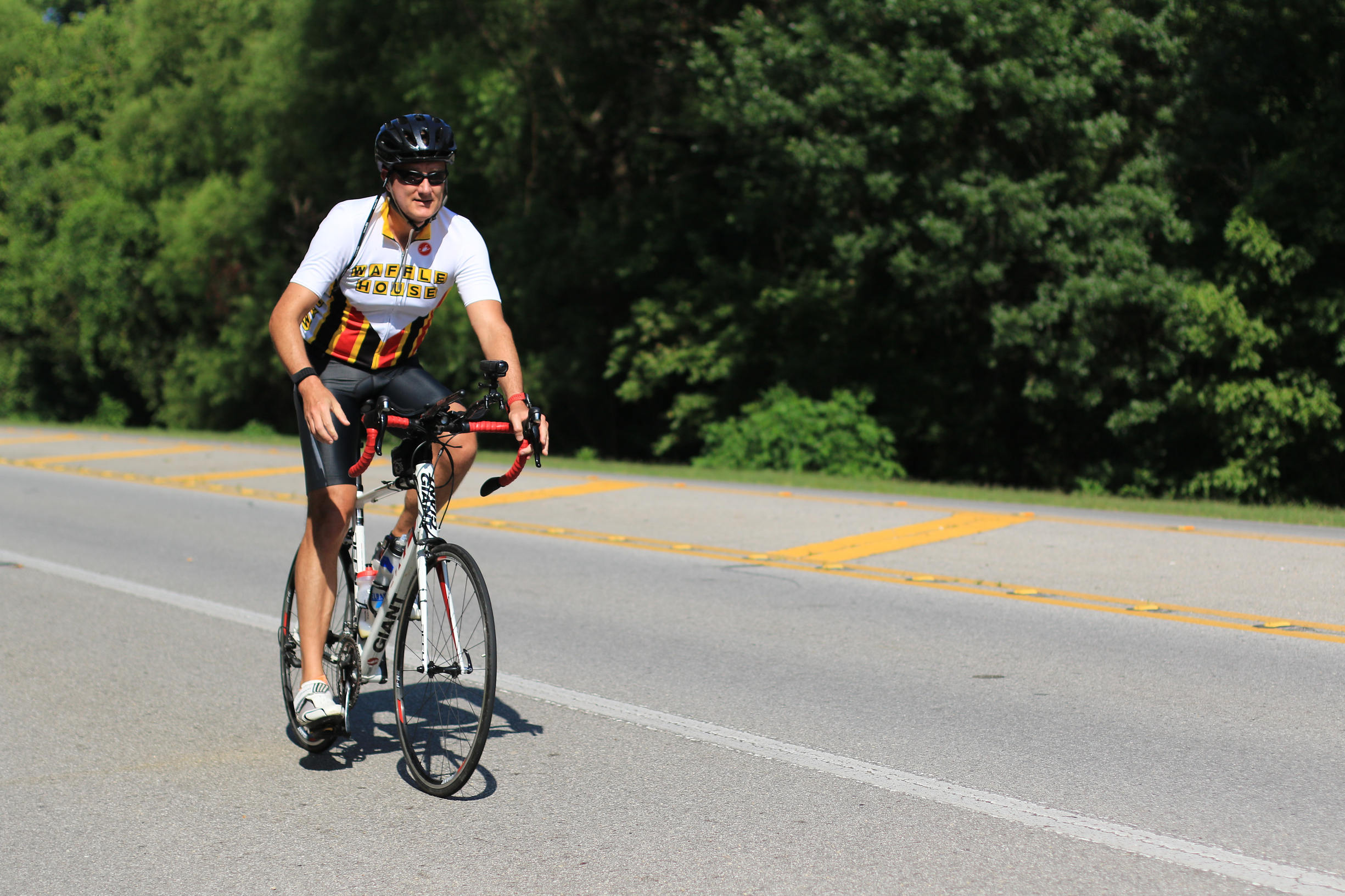
This was my first race with my new Stages power meter, about which more later. It wasn’t super useful to me, apart from being able to see my average and instantaneous power. I am not yet at the point where I can produce a consistent power output on demand, nor where I can figure out what power output I should be targeting. But I’ll get there.
T2
I got into T2 and out again in just over 3min, which is decent for me. During that time I scarfed down a Honey Stinger waffle, swallowed 4 SportsLegs with a swig of Mercury, swapped out my helmet for hat, and off I went. Next time I need to eat my waffle on the run.
Run
“Trudged” is a word I might use here. The run was miserable. It was my slowest-ever 10K, at a 13min/mi pace. Coming out of transition my legs were leaden. It didn’t help that the first half of the course had lots of rollers and zero shade. I never even saw the famous lions at the University of North Alabama. I guess I was too busy suffering. I had 2 x 8oz bottles of Mercury with me and the first one was gone inside the first mile. Luckily there were aid stations about every mile, although the first one was out of water when I got there! I was pounding water like it was free beer. My quads and calves were both equally bad; I think I need to work on my swim kick, among other things.
I’m really disappointed by this aspect of the race, frankly, because I know I can run a 10K faster than this.
Side note: the hottest I have ever been in my entire life was when I stopped to use a dark green port-a-potty in downtown Florence. Never in my life have I experienced such a temperature.
Race organization
Registration was simple, packet pickup was efficient, and the volunteer support was superb (especially the Borden Dental ladies at body marking and the Listerhill Credit Union staff who manned a drive-through aid station on Court Street, complete with music, food, and ice water). I was disappointed that by the time I got to the finish line, they weren’t still announcing finisher names and times, and that there was nothing other than half-bananas to eat post-race (though some pizza did eventually appear). Overall, you expect these kinds of glitches during a race’s first few years, so I’m sure next year they’ll have them sorted out.
The big takeaways
53 weeks ago, I had never run a triathlon (nor a half-marathon, nor any distance over five miles). On the one hand I am delighted by my progress– I ran an Olympic distance triathlon, something I never would have guessed I could or would do as recently as 54 weeks ago. On the other hand, the gap between how I want to perform and how I do perform is pretty clear. I’m setting some aggressive goals for my next race and will be working hard to hit them.
Filed under Fitness, General Stuff
Training Tuesday: Pflugerville Sprint (6/21/15)
What’s better than racing a triathlon? Multiple choice:
- racing your first triathlon in a new place
- flying yourself to and from the race
- getting to see your mother, grandmother, uncle, cousin, and nephew en route
- turning a solid race performance
- seeing two of your oldest friends
- all of the above
The correct answer, of course, is “f”, and that’s exactly how this race went down.
Dana had told me that she had plans to go to Rock the South last weekend, so I found myself with an unexpectedly free weekend. I decided to see whether there were any races I could do– and sure enough, Trifind delivered the goods, pointing me to the Lake Pflugerville Sprint. It combined the potential to see a bunch of my Austin friends with an interesting-looking race so I signed up.
In the week leading up to race day, I had several schedule changes– first I was supposed to be in DC on the 18th, then I was supposed to be in Galveston, then I didn’t have to be anywhere. I decided that it would be a shame not to stop by Alexandria en route, so I left Friday afternoon after work, flew through a stiff headwind, and landed in Alexandria about 930pm, at which point I shot the required 3 landings needed to regain my night currency. After a delicious dinner of shish kebabs, I visited with Mom and my cousin Melissa (the same one who runs marathons!), then hit the rack. The next morning featured plenty more visiting; I left AEX for Austin Executive about 1130.
My flight to Austin was perfectly uneventful, although cloudy, so I was able to shoot the RNAV 13 approach when I got there. The staff at Henriksen Jet Center had a car for me, so I headed out for packet pickup, which was at Jack and Adam’s Bicycles. Frankly I was a little disappointed– given that Austin is such a bike mecca, I was expecting a bigger, fancier store with more stuff. Maybe the location on Lamar isn’t their biggest one? In any event, after packet pickup, I went to meet Erik, Chris, and Chris’ family at Takoba, where I had a truly excellent Mexican meal. (Having said that, I have yet to have a bad meal in Austin, so keep that in mind). Erik and I went around the corner to The Brixton for a beer, where we watched an epic thunderstorm ravage my bike while we chatted. Because I didn’t want to stay out too late, I headed over to Chris’ since he had generously offered me his guest bedroom. I got to meet all four of his dogs and hear about his recent adventures getting his EMT certification at Remote Medical International, which sounds like exactly my kind of place. I was sound asleep by 10pm.
Race morning dawned but I couldn’t tell; there was a heavy, low overcast. EDC was reporting a 700’ ceiling, and the radar didn’t look too favorable either. I retrieved my still-damp bike, loaded up my bag, and headed out to Pflugerville. After a quick stop at HEB, a local grocery store, I found the race site, parked, and got everything set up in transition, with plenty of time left over; the organizers delayed the race start for 15 minutes because of the weather.
Side note: I wish I had read this list of tips on how to deal with rainy races before the race!
The swim was 500 yards in Lake Pflugerville, a city reservoir. My goal was to swim at a steady pace that I could sustain without stopping, and I did. Unfortunately it was slower than I wanted. I had a good steady rhythm though. I was further slowed by the huge fields of hydrilla growing underwater along the return leg of the course. There is more weed in that lake than a Willie Nelson concert. I literally got tangled in the weeds on the return leg; they reached all the way up to the surface so it wasn’t just that my body position was poor. This was both disconcerting and aggravating. Apparently this is a known problem and the city cleans the weeds out every so often.
T1 was slow. I need to work on this. Part of the problem was that I spent some time trying to figure out why neither my HRM nor my on-bike iPhone mount were working. (HRM battery died, iPhone mount got water in it so the ANT+ key is apparently broken). As an experiment, I took 200mg of caffeine in T1, but didn’t eat anything else.
The bike leg felt really solid. The course had lots of little rollers, which were no problem. Not having cadence visible on the handlebars bugged me a lot for the first half but then I got used to it. We had a HUGE rainstorm from about miles 7-11 which slowed me down a bit, but overall I was pleased with my average speed. Despite my speed, though, I was getting passed left and right. Apparently Austin has a lot of really fast cyclists after all. Towards the end of the bike, I was having what felt like muscle cramps on the right side of my abdomen— not GI, but more like the feeling after you do a ton of planks. Not sure what brought that on, but it didn’t last; I am not sure whether it was temporary cramping brought on by electrolyte imbalance, bad posture, or just bad luck.
(For your entertainment, here’s a video of the bike leg. I shot it with a Garmin VIRB mounted on my aerobars, then ran it through Microsoft’s Hyperlapse Pro software to speed things up. For another time, a post on Garmin’s VIRB Edit software and how to make it work properly.)
In T2, I ate a Gu, drank a bit of Mercury, and emptied some of the water out of my bike shoes before taking off on the run The run was a packed gravel trail around the lake. I was really slow going out at first but settled in about halfway. For the first part of the run, I was running until I felt like I had to puke, then I’d walk, then when it passed I’d run more. I don’t know if it was the caffeine, the heat, or just bad luck; I’ve never really had that problem before. Luckily, it went away partway through, and I ended up with big-time negative splits: 11:22, 10:33, 8:51. The splits reassured me about my progress towards readiness to do an Olympic-distance race.
The race was very well organized and supported. Like many larger races, they had a professional announcer/DJ who played good music before the race and called out finishers’ names as they crossed the finish line— always a nice touch. I wasn’t hungry after the race, so I didn’t sample any of the post-race goodies. For swag, I got two hand towels, a bike bottle, and a small dog tag (plus my race shirt): not a great haul, but not the worst I’ve ever had. I can always use more triathlon-themed hand towels for the guest bathroom!
When I first saw my results I was pretty disappointed at my overall rank. However, after I plugged my results in to my tracking sheet, things looked a lot better. Austin has TONS of triathletes and yesterday, most of them were faster than I was, but I am headed in the right direction– I was faster on the bike than in New Orleans, my swim time was on par on a 20% longer distance, and my run splits were terrific. Onwards!
Filed under Fitness
Europa Orlando powerlifting meet
“Try a powerlifting meet,” they said. “It’ll be fun,” they said.
That’s pretty much what happened and you know what? They were right. I did, and it was.
After working with CHP for a while, I started noticing my fellow athletes doing these things called powerlifting meets. The basic meet is simple: contestants get three attempts for each of three lifts: the squat, the bench press, and the deadlift. Meets are usually organized according to weight class and age, and there are various federations with different rules on which age groups and weight classes are used, what kinds of equipment you can use, and so on. Everyone who competed seemed to enjoy it, and I was told multiple times about how much I could learn from going to a meet and just watching, even if I didn’t compete.
I thus made a mental note to find a meet that I could go to. I found that there were several powerlifting books on Amazon’s Kindle Unlimited service. I read through “From Gym Lifter to Competitive Powerlifter” and found it super educational, but I still wasn’t quite ready to make the leap. As it turned out, Matt had a choir trip lined up at Disney World, so when I learned that one of my fellow CHP athletes was doing his first meet in Orlando the weekend of Matt’s trip, I took the plunge and signed up for the Europa Orlando meet, organized under US Powerlifting Association (USPA) rules. The plan was that Tom and I would fly down Friday, I’d compete Saturday, we’d pick up Matt on Saturday night, and then hit Legoland before coming home.
With the planning done, I settled in to lifting, a lot, and worrying, more than I normally would have. My goals were simple: I wanted to complete the meet well.
As the meet approached, I started getting nervous about three things. First was my technique: each lift has specific performance criteria you have to meet. For example, on the squat, when you’re all the way down, your hip crease must be below the level of your knee (this is known as “breaking parallel” on the squat). Each lift is overseen by three referees or judges, each of whom can signal that the lift was good or bad by switching on a white or red light. You need two or three white lights for a lift to count. I was worried that my squats weren’t low enough. There are also specific verbal commands you must follow in sequence; I’d heard of people getting red-lighted for returning the bar to the rack before the command, for instance. I didn’t want to screw up, but I realized it was a distinct possibility.
Second, I had to get used to the gear. In general, most federations separate lifters into three groups: raw lifters use nothing more than knee sleeves and a weight belt; single-ply lifters can use special shirts and shorts that are, basically, Spanx; and multi-ply lifters can use special thick suits for the bench and deadlift. (These latter two groups are known as “geared lifters”.) I had knee sleeves, but needed to get a weight belt (which was a shopping adventure all its own; topic for another time) and get used to it. (For gear fiends: I ended up with an EliteFS 13mm single-prong belt, which I am gradually getting used to.)
Third was weight: both the amount I was going to be lifting and the amount I actually weighed. I could say “oh, I’m strong for a triathlete,” or maybe “but I’m fast for a powerlifter”; the fact is that I am still pretty new to both so I was intimidated by being around a bunch of seasoned competitors who would be lifting a lot more than me, and I realized about two weeks out that I was not going to make the 198lb weight class without extraordinary measures. I decided that rather than try to drop weight I’d just move up a weight class– which turned out to be a really good decision.
Soon enough, it was time to pack up and go. Was the hay in the barn? I’d soon find out. The Monday before the meet, Alex had me test a few weights for openers, so I had a decent idea of what I wanted to try. On the advice of fellow CHPers, I packed a gear bag with my stuff, snacks (protein bars, Fig Newtons, turkey pepperoni), a spare roll of toilet paper, and a few other odds and ends. Tom and I had a great flight down, with good weather and a smooth ride, and landed at Gilbert’s Winter Haven airport (HOVA, the FBO there, took terrific care of us throughout our stay– I recommend them highly.) We had planned to meet Rafe and Derek, two fellow CHP athletes, at the convention center but we arrived later than expected and they had other commitments, so Tom and I had a delicious dinner at the hotel and hit the bed.
Normally, weigh-in for meets is done the day before. Because I didn’t arrive until after weigh-in closed, I had a 7am weigh-in time Saturday morning. I showed up on time and waited. And waited. And waited. The meet director showed up about 830, weighed me in at 205.6, and asked me for my initial attempts. This requires a little explanation: no matter what federation, age, or weight class you’re in, the basic structure of the meets are the same: lifters are separated into groups called flights, with the lightest weight being lifted first. The first lifter attempts a lift with whatever weight they want. Then the second lifter attempts his lift, and so on until everyone’s done. Your total score is the total number of weight moved for the best attempt in each lift. In addition, something called a Wilks score is calculated to measure how strong you are in proportion to your bodyweight.
To sequence lifters into flights, the organizers need to know what weight you’re going to try to lift for your first attempt. You can go up any amount on each subsequent attempt, but you only get three tries so there’s quite a bit of strategy involved in choosing good attempts. David Dellanave’s strategy guide was very helpful. I texted Alex my attempts and wrote them down: 115kg to open in the squat, 75kg for the bench, and 147.5kg for the deadlift. I was lifter 4 in flight 1, reflecting my relatively light opening weights. On a positive note, this guaranteed me an early start so I could get a lift in and then adjust as needed after watching the other competitors. In the flighting system, all the lifters in a flight do all 3 attempts before the next flight starts.
Rafe and Derek met me back in the weightlifting corner. If you’ve ever been to the Orange County Convention Center in Orlando, you know that it’s a perfect specimen of the large, ugly, dehumanized conference center species. The Europa expo floor was up front, with lots of bright colors and noise, but the powerlifters were tucked into a back corner, with bare concrete floors and loud music richocheting from the adjacent kids’ play zone and Zumba demonstration stage. Anyway, they were both very encouraging and we had a great time chatting while Rafe and I got oriented and got our gear together.
The meet officially began with a quick rules briefing, covering everything from the flight sequencing to what kind of underwear is legal under the required lifting singlet: “tighty whities or commando,” the meet director said, and he meant it, because sufficiently compressive shorts might provide a performance advantage. After the briefing, the MC began calling lifters to the platform for their lifts.
My squat opener went really well, despite a brief frisson of worry when Derek corrected my math mistake and told me that 115kg was not, in fact, about 230lbs– it’s 253lbs. I nailed it anyway. My second attempt went equally well: nice and smooth, with good depth. One judge red-lighted me for depth, though. I should have paid a little more attention because on my third attempt at 140kg, I got the dreaded two reds– one of the judges pointed out that my depth wasn’t sufficient. Derek, Rafe, my coaches, and I all agree upon video review that I broke parallel, but that’s no matter. The judges were tough but consistent, so I didn’t feel like there was any basis for complaint. 140kg was a new PR for me, so I was happy to get it even if it wasn’t a good lift towards my final score. Key learning: if you really bury your squat deep, so that there’s no question about whether you broke parallel, you have nothing to worry about.
Once my third lift was done, I watched the other flights squat. Rafe nailed his lifts, and then the heavyweights started theirs. Interestingly, we had a mix of ages– I think the youngest lifter in the meet was 15 and the oldest was 57. There wasn’t any real correspondence between age and lifting weight, either; some of the older guys (including the overall “best lifter” winner) were as old, or older, than me. It’s pretty amazing how much some of those guys could squat– I don’t remember what the heaviest weight I saw was, but there were 2-3x bodyweight squats being dropped like it was routine.
After all three flights finished squatting, the organizers needed time to shift the equipment around. One very nice thing about lifting in a meet is that other people rack, spot, and set the weights for you– a nice contrast to the traditional gym environment where you do it all yourself. While they were doing that, Tom and I went to walk around the expo floor a bit, then it was back for the bench, one of my weaker lifts. I have big legs and a strong back, but my arms and chest are small relative to the rest of me, so I wasn’t expecting huge numbers here.
I hit my first two attempts easily at 75kg and 80kg– a new PR. Derek pointed out a couple of technical adjustments to the lift during my warmups that really helped– I need to focus on squeezing my shoulder blades together, and on the press movement it’s actually more efficient to press slightly down towards the waist than straight up. I decided to try 85kg for my third attempt and just couldn’t quite lock it out, getting three reds for a failed attempt. Still, I didn’t feel bad about it given that I’d already hit a PR. I can definitely see that my 2015 goal of being able to bench my bodyweight is in striking distance.
Tom and I made another loop around the expo and took a quick food break. Convention center food being what it is, I decided to stick with the snacks I’d brought. Then it was time to go back for the deadlift. If the squat is the lift I think is my worst, and the bench is the lift that is actually my weakest, the deadlift is my favorite. I’d deadlift heavy every day if I could. I opened with 147.5kg, easily hit 157.5kg for my second, and decided on 165kg for my third– in retrospect, I wish I’d gone a bit heavier because I felt like I could have hit it easily. Once I was done, I was able to take off some of my gear and relax to enjoy the show as the rest of the lifters did their thing. By the time the biggest guys in the third flight were lifting, Rafe, Tom, and I were in the spectator area cheering and howling as we watched the big pulls– several over 700lbs. It was really impressive to watch.
I stuck around for the awards ceremony because I figured Rafe might have won in his division. Turns out, he did.. and so did I.

In fairness, this was because I was the only person in the 220lb 45-49 division, not because I lifted a massive amount of weight. On the other hand, I did lift a hell of a lot: 370kg, or 818lbs.

That’s a good 50lbs better than my previous 3-lift total, good enough for a Wilks score of 238– just a hair below “intermediate” ranking and good enough to move me pretty close to class IV according to the USPA’s guidelines (at least at 198lbs, where I will be within a couple of weeks). This would have been an unthinkable amount of weight for me a year ago, so I am really thankful to Alex and the CHP coaches, the community at Fitocracy, and especially to Rafe and Derek for their on-site support, so to speak.
Takeaways:
- I had a blast.
- There is a surprising amount of technique in these lifts, but unlike football or baseball, the technique is mostly invisible. For example, knowing that part of a good bench is squeezing your shoulder blades together is impossible to spot
- In triathlon, the gap between the winners and me is often so great that I find it discouraging– the magnitude of improvement required to be on the podium is sometimes so large that it seems out of reach. That wasn’t the case here; the huge amount of weight that the top lifters were moving was motivating and inspiring, not discouraging at all. I may never be able to deadlift 700 pounds, but seeing it done at the meet makes me want to deadlift however much more I can.
- Tom is super excited about going to the gym and starting to lift. I am excited for him and can’t wait to help him get started.
- When’s the next meet?
Filed under Fitness, General Stuff
Training Tuesday: Lake Guntersville Duathlon (4/25/15)
Continuing my series of catch-up race reports…
Summary: 4th in my AG—missed the podium by 0:51. Damnit!
I hadn’t planned to run this, but thought it might be fun to do as a light workout. Alex encouraged me to race it, and Dana decided to sign up for it too, so I signed up the week before. The day before the race, the local (and national media… I’m looking at you, Weather Channel) bombarded the area with dire warnings of high winds, strong thunderstorms, and maybe even a tornado or two late Friday night into Saturday morning. The race organizers decided to delay the start by an hour, and in the end none of the bad weather showed up here overnight– just some rain.
Race day dawned and we loaded up the bikes to head out. It was cloudy and in the low 60s as we drove down to Guntersville, but the forecast called for steadily clearing skies and a high around 80, so I wasn’t too worried about the rain.
This particular duathlon is pretty small; there were about 70 participants, including a few relay teams, and the crowd was full of familiar faces from the local tri and running community. That always makes for a fun race. The course was an 5K out-and-back loop along the lake shore, a 16.2mi bike ride around part of the lake perimeter, and another 5K on a slightly different lakeshore loop. The course organizers didn’t post a course map beforehand, which always annoys me a little, but from talking to others who had run the race before I was comfortable that there wouldn’t be too many surprises.
After the half-marathon, I’d been having persistent and unpleasant calf pain, in slightly different locations on each side. That was really hampering my runs– even when Alex had me doing slow Z2 recovery-style runs, I was really uncomfortable and felt super slow. I was worried about how my legs would hold up, but as it turns out I needn’t have worried too much. The first run went very well. I held an 8:45 pace. If it had been a true 5K distance it would have been a PR; as it was only 3.02mi, so not quite long enough for a PR. I had a little tenderness in my right Achilles on the first half-mile or so, but after that zero calf pain throughout the race. I’m not sure why, as I didn’t do anything different other than a bit of extra stretching and taking SportsLegs an hour before race time.
Transition went fast– less than 2min, which is lightning-quick for me. I tried really hard to keep a steady cadence for longer stretches () but was only partly successful. One thing I found was that on any kind of downhill I had to slow my cadence even in top gear to keep from bouncing. For some reason on the road it’s realllly hard for me to hold a steady 80. Part of this is that on the trainer, I can look at the TR display, see my cadence, and adjust accordingly. I handlebar-mounted my old iPhone and ran Strava on it but it didn’t see my cadence sensor—have some hardware adjustments to make. Nonetheless, my average speed and total time were both better than the bike leg at Heel & Crank 2 weeks ago.
On the second run, I paid the price, with a dragging 10:20/mi pace. In retrospect, I am angry at myself for not pushing harder given how narrow the margin to the podium was, but at the time I just felt gassed. Lesson learned.
Post-race, the organizers had a great spread of local BBQ, local beer from Rocket Republic, and homemade snacks. Dana and I had a very pleasant al fresco parking lot lunch while chatting with friends while we waited for race results– and she took 3rd in her age group! That put an excellent cap on an excellent race experience.
One thing I noticed right after the race (and ever since, ouch): I have a large pain in the butt because my saddle impinges on the top of my right hamstring such that I have a sore butt in that one spot after any more than 5-7 mi. I am going to head in to Bicycle Cove and get a new saddle and refit this week. Thankfully I don’t have any real leg soreness except for that one spot (and some residual burn in my quads)– a good thing considering that my first powerlifting meet is coming up in less than a week.
Onwards…
Training Tuesday: Bridge Street Half Marathon (4/12/15)
So about that 35.1 challenge…
I spent the rest of Saturday relaxing and resting my sore legs after Heel & Crank. I also was battling a bad case of bubbleguts– cramps and gas sufficient to clear out the room. At first I thought it was because of a new endurance supplement I’d used during the race; it’s made with waxy maize and I thought maybe that was the problem (and maybe it was, but I now think it had much more to do with what I ate post-race, as I’ve had similar symptoms after drinking post-race beer elsewhere). I took some Advil and SportsLegs, washed them down with diet Coke, and made sure I had all my race stuff ready. Of course, that’s much easier for a running-only race– I needed my headphones, race belt, shirt, shorts, shoes, socks, and runderwear… oh, and BodyGlide, the endurance athlete’s best friend. If you’re not familiar with BodyGlide, think of it like WD-40 for your body– put some on the neck of your wetsuit, the seams of your bike shorts, or any place else you want to reduce friction during repetitive motion.
Anyway, I gathered up all my stuff and Dana drove us to Bridge Street– she graciously decided to volunteer at the food tent. I got there just as my training group was assembling for a group photo, so I spent a very pleasant few minutes chatting with my running pals and trying to ignore my normal pre-race jitters. Today’s jitters were more intense than usual; my most recent long run was only 10 miles, and it was nearly a month before, so I was concerned that I would have problems hitting the distance.
Most runners set goal times for big races. At first, I did the same for this race; I wanted to set an aggressive goal, but I decided it would be better for me just to enjoy the race, since it was my first, and work on goals later. Accordingly, I decided to run with the 2:15 pace group. If you’re not familiar with distance running, you might not know that at most races there are volunteer runners who hold a steady pace throughout the race, often carrying signs. Running a marathon or half at a given speed thus becomes a matter of finding your pace group and sticking with them.
The weather was perfect: clear and cool, with a few clouds. Bridge Street is known for being a flat, fast course. Because it winds around Research Park, the scenery isn’t much to behold unless you like big office parks.However, I had a blast on the race– I sustained the pace I wanted, my legs were a little sore but not terribly so, and I was able to enjoy brief chats with a number of my running friends as the course went on.
Having said that: two+ hours is a long time to run. I don’t think I have much ambition to do a marathon.
The course finish took us up Explorer along the route where I normally finish my Thursday Panera runs, which was fun and familiar. We ran past the entryway of the Westin, along the eastern boundary of the mall area, and then took a convoluted path to finish on the titular bridge– but whoever laid out the race course had a pace sign well before the bridge, along with a balloon arch, so I started my kick a little too early and then was surprised by how far away the finish line actually was. I’ll remember that for next time.
Thanks to the excellent steady pacing of Dennis, Carrie, and Tom, I finished in 2:15:09. I got my medal, stuck around to chat with Alex and other friends as they finished, then raided the food tent to relieve Dana of some of her goodies. Along the way, I also had a chance to take a picture with Deena Kastor, three-time Olympian and record holder in both the marathon and half-marathon. (That sets my personal pace to meeting one Olympic medalist every 29 years, so check back with me in 2044.)
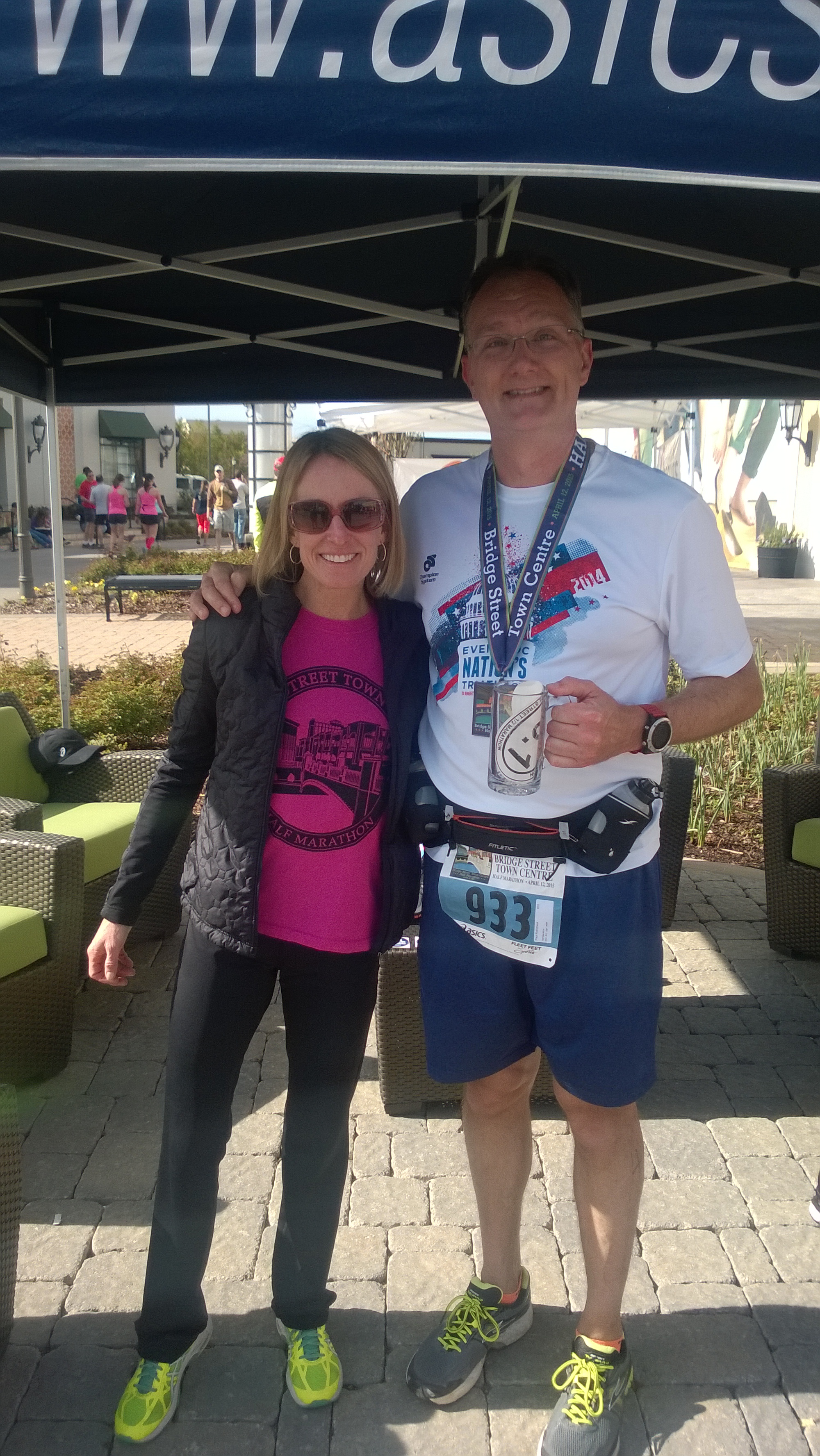 After the race wound down, I had a light lunch…. ahhh, who am I kidding? I ate approximately 25 lbs of food.
And, of course, once I got home, it was time to enjoy the fruits of my labor: the coveted 35.1 challenge mug, filled with one of my favorite beers. And some Advil.
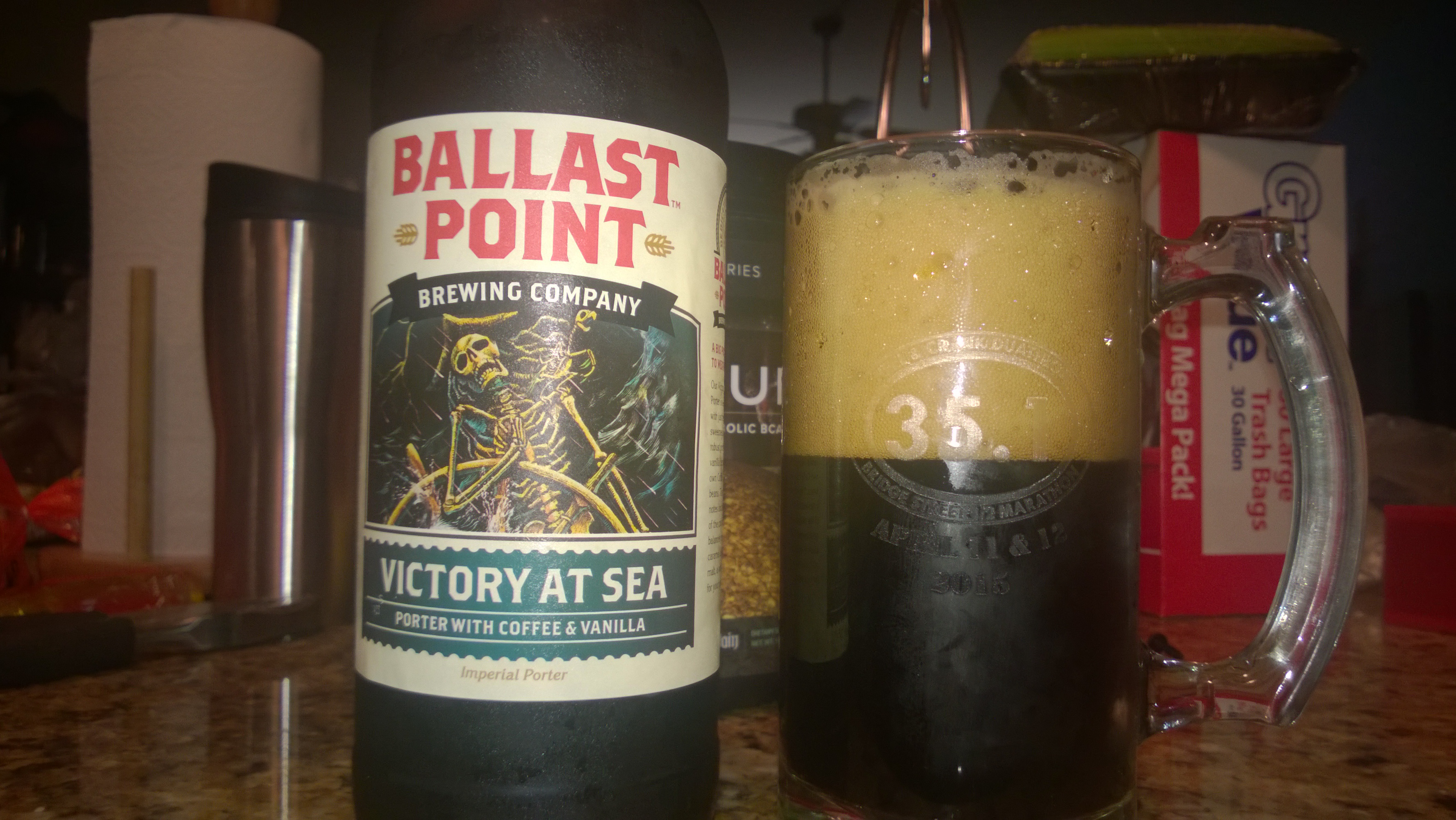 All in all, it was a great experience, although I don’t plan on running any more races of this distance during triathlon season. In the fall, maybe, after the season’s closed out, I’ll consider it, but for now it’s back to the 5K / 10K distances I’m more accustomed to.
Filed under Fitness


 Paul's Down-Home Page
