I’m going to start this post with an apology: I should have taken about a million pictures, and now I’m sorry I didn’t. Now, on to the good stuff.
RAM Aircraft is really well known in the airplane engine aftermarket. They make engine parts (under what the FAA calls “PMA,” or “parts manufacturing approval“), including entire crankcases, and they have a very well-earned reputation for high-quality engine builds and overhauls. They sell a variety of upgrades for different aircraft, sadly not including my model of Baron, and they’ve been in the business since 1976, which is pretty rare in the aviation market.
They’re also a service center, and one of the things they do is what they call a “service check.” Think of the service check like the 14-point service that your local oil-change place does when you bring your car in; RAM’s service check includes an oil and filter change (including cutting the filter open to look for contamination or metal residue caused by unusual engine wear), but it goes well beyond that. They remove and clean the spark plugs, check the engine cylinder compressions, remove and clean the fuel injectors, adjust the fuel metering system to factory specs, test the intake and exhaust system for leaks, and wash the engine. If you bring in a twin-engine plane, they do all that twice… and, of course, they can fix any problems they find.
RAM were generous enough to donate a couple of gift certificates for service checks to the American Bonanza Society. I saw one for sale on BeechTalk and that sparked an idea: RAM is in Waco, Waco is near Dallas, I needed to be in Dallas for work, and I needed an oil change. What a happy chain of circumstances! I called RAM to schedule a service visit for when I needed to be in Dallas, bought the certificate and planned my trip: I’d fly the plane to Waco on Monday, drive back to Dallas for my meetings, and then pick the plane up on Thursday.
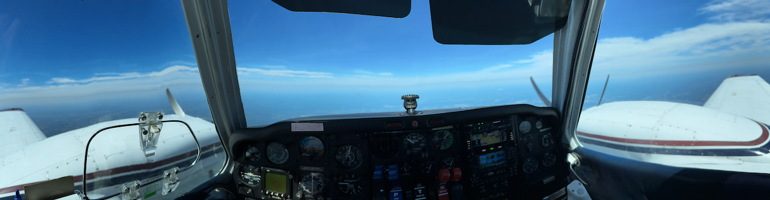
My flight to Waco was perfectly uneventful but hotter than blazes– it was 104º when I landed, and even at 3000′ it was still above 90º. In my particular airplane, temperatures above 90º on the ground call for a few differences in takeoff procedure, and climb performance (especially on one engine!) is significantly reduced, so I had to bear both of those in mind.
I landed and taxied over to the RAM ramp, and after a short wait John Sartor, RAM’s customer service manager, came out to meet me.
My personal opinion: you will never meet a more friendly or pleasant person in the aviation industry than John. He immediately made me feel like an honored customer even though he’d just met me 5 minutes before. After a short verification of what work RAM was going to do, we went out for me to show him my plane only to find that it had already been towed into the RAM hangar. That was a foretaste of how efficient their operation is! After verifying that he had the keys and access to the plane, he drove me to the Texas Aero FBO so I could pick up my rental car and I was off to Dallas.
The next morning, John called about 815a. I first though “oh no, something’s wrong”… but no, he was calling to tell me they’d already drained the oil and wanted to verify what oil I wanted to use. Efficiency again!
A later call brought the slightly unwelcome news that some of my spark plugs were worn to the point where the RAM QA department wouldn’t sign them off as airworthy. Aviation spark plugs are very similar in design to the ones in your car, lawn mower, boat, etc., but because piston aviation engines use leaded fuel, the plugs can foul faster, and over time the electrodes can wear. The electrodes on a few plugs were worn past their limits. A less conservative shop would have put the plugs back in and said “hey, you should change these,” but the good news is that RAM had the plugs in stock and changing them had zero labor cost.
Thursday morning John texted me to say the plane was ready, so after work I drove back to Waco (stopping at In-n-Out on the way, since I’d missed lunch). When I got there, he was kind enough to give me a 90-minute tour of their entire facility. The tour started in the lobby, where they have cutaway models of three engines with all the rotating parts intact. Turn the prop, and you can see the crankshaft turn, the movement of cylinders, camshafts, and valves, plus movement of the oil pump, turbocharger, alternator, and other accessories. The machinework on the models is amazing, and it was really fascinating to see the parts of the engine I don’t normally see.
We then made the rounds: the order and processing department, accounting (where I paid my bill, yikes), and the various assembly, test, and disassembly areas. The most junior RAM engine builder I met had been there 9 years. The most senior had been there 34 years! The shop spaces were meticulously organized and clean; the parts and tools were clearly labeled to keep the right things in the right places, and overall the impression I got was of a smooth-flowing workplace where people are expected to take time to do the work properly and to spec.
Each rebuild starts as a cart full of parts, so when the builder starts work, all of the components required for that particular engine are already together. There are a number of interesting touches to the build process, including custom-made carts that let them roll the engine from the build area into the (small, scary) elevator to take it down to the test cells. Those were cool too– in the cells, they do the engine break-ins for you, using a water dynamometer instead of a propeller or “club”. When the engine arrives it’s ready to be installed and flown, with no further break-in required. Considering that properly breaking in a new engine is a tricky process, this is a valuable addition. At the end of the process, there’s a hallway full of beautifully painted, perfectly clean, freshly rebuilt engines ready to go back into service.
I hated to leave, because I could’ve poked around all day asking questions and generally being a nuisance, but it was already after 5pm and I didn’t want to be that guy. I shook John’s hand, preflighted the plane (which had been fueled by Texas Aero while I was on tour), and blasted off for home. As one does, I kept a hawk eye on the engine parameters but they were refreshingly normal, and I landed about a half-hour after a beautiful sunset and went home happily.
Summary: if RAM rebuilt the kind of engines my plane has, I’d use them; if they support your engine type, you should take a very close look at them for repair / rebuild services. They do good work and they’re good people.


 Paul's Down-Home Page
Very good article! Glad you add an awesome visit, and flight home was enjoying. Thank you