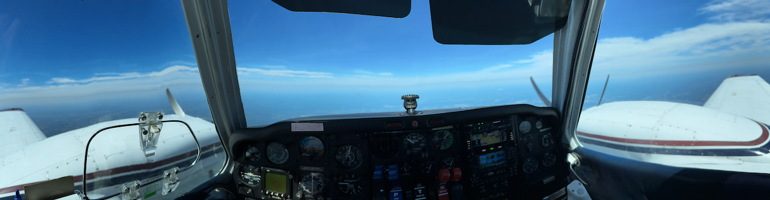
It’s official: I’m pulling both engines on N421BJ. This is not unexpected, but it means I won’t be flying for a while. The timing isn’t great but the great aviation circle of life meant I didn’t really have a lot of choice. The engines I have now were built in 2004 and have accumulated about 2650 flying hours… which is a lot.
Here’s what’s going on.
Crack(s) is whack
During my routine annual inspection, Curtis and the gang at Baker Aviation reported lower compression on a few cylinders than I’d like to see, along with some uneven wear on some valves on the right engine. These things are curable… but do you know what’s not curable? The cracks in the top of the left engine crankcase.
Continental’s Service Bulletin M90-17 lays out the rules: depending on the location and size of the crack, you can either adapt “watchful waiting,” weld the crack, or replace the crankcase. My cracks were in a non-critical area, but one of them was leaking oil (as opposed to seeping it), which basically means the case was done.
Because of the way these engines are built, you can’t do the welding without removing and disassembling the engine, and by the time you get to that point, you may as well rebuild it.
The thing about aircraft engines
I’ve written before about the basics of how aircraft piston engines work (part 1, part 2), and things haven’t changed much since then. Aircraft engines are still complex and expensive for what they do, and there’s no realistic alternative given the way that certification works.
Now, the manufacturer’s “time between overhaul” (TBO) of 1700 hours for these particular engines is a suggestion, not a requirement, if you’re flying under Part 91. My engines have performed flawlessly, a testament to Bill Cunningham at Powermaster. If you closely monitor the engine’s health and condition, you can safely fly well beyond TBO… but not with cracks.
The right engine is also past TBO but running fine, with no cracks found on its case. So the immediate question was: do I fix just the left engine and keep flying, or take the opportunity to address both engines at once?
One lump or two?
It made no sense to even consider just repairing or replacing the case given that the guts of the engine were so old. That left me with the decision of whether to only do the left engine or to bite the bullet and do both at the same time. There are various pros and cons to swapping both engines at the same time.
Doing one engine means lower up-front costs, but it also means that, at any time, the other engine could fail in some expensive and/or dangerous way. That means potentially twice the downtime, with no savings. Doing one engine also means I can’t upgrade the engines.
Doing both engines is more convenient but more expensive. It’s the same amount of initial downtime, but there’s an added risk.
See, in both cases, we have to contend with the fact that aircraft engines exhibit a classic “bathtub curve” failure pattern: the failure rates are highest in the first 100-200 hours, then taper down before increasing again as the engine ages out. Putting in two engines increases the risk of having two failures– not necessarily at the same time, but still within that initial “infant mortality” window. Part of the advantage of a twin, of course, is that having both engines fail at the same time is rare, and I decided the small additional risk within that initial window was outweighed by the increased performance of upgrades.
The Cygnet upgrade
Here’s the twist that changed the whole project. My Baron came with a Cygnet Aerospace IO-470-MOD STC — a supplemental type certificate that allows you to install IO-520 cylinders on an IO-470 crankcase. It’s a well-proven conversion that’s been flying since the 1990s, popular with Baron owners who want more power without a full engine swap. The added displacement adds about 25 horsepower per side, which is nice, but the bigger improvement is in single-engine climb performance and single-engine service ceiling. Since I live in the hot, humid southeastern US, OEI performance on a hot day is pretty important to me.
I’d had the STC sitting in the logs but didn’t originally plan to use it during this overhaul. I wanted to, but if I was only going to replace one it wouldn’t work. After speaking to Chris Szarek at Cygnet, I did some more research and found that the cost premium for the Cygnet conversion runs about 25% total. That’s not nothing. But given that I expect these engines to last the rest of my flying career, and that I wouldn’t feasibly be able to go back and add the upgrade later.
I was waffling, still, until I learned that the left engine case was cracked and would almost certainly need replacement. To install the bigger cylinders, the case must be machined to accept them. The IO-470-L and the IO-520-E have identical internals; the 520-E case is bored for the bigger cylinders, but it’s dimensionally identical otherwise. So the easier route was to get two IO-520-E cases and use those, which also necessitates the 520’s bigger oil pump.
Given that, either way, I’d be buying at leats one new case, the Cygnet conversion looked a lot better, so that’s what I decided to plan on.
Shopping for an overhaul shop
I solicited quotes from five shops and quickly learned that comparing engine overhaul quotes is like comparing cell phone plans — everyone bundles things differently, and the headline number never tells the whole story.
The shops I looked at:
AirPower is the only place you can buy a factory engine, whether rebuilt or new. Straightforward, but at a premium — their factory rebuilt price was roughly 15% more than the most competitive overhaul quote, and factory new was about 30% more. They run a 14-20 week lead time, and you can pay an eye-watering $7500/engine to skip to the front of the line. Not surprisingly this was the highest-total-cost option.
Certified Engines Unlimited (CEU) in Opa-Locka, Florida. Competitive pricing, fast turnaround, and my local A&P at Revolution Flight recommended them based on past experience. The downside: their warranty uses a “phantom usage” calculation that assumes you’re flying 30 hours a month whether you actually are or not. At my flying rate, the warranty calendar would expire well before I hit the hour limit.
Pinnacle Aircraft Engines in Silverhill, Alabama. Solid reputation, the best warranty of the bunch (three years to TBO, transferable, no phantom usage), and new Superior cylinders standard. The catch: Alabama sales tax adds about 9% to the bill, which is a significant hit that erases most of their competitive pricing.
Poplar Grove Airmotive in Poplar Grove, Illinois. This is where things got interesting. Steve Thomas and his team have a strong reputation in the Continental piston community, and critically, Chris from Cygnet referred me to a happy customer. Illinois exempts aircraft engine overhauls from sales tax, which is a meaningful advantage. Their warranty — two years or 500 hours, no phantom usage — is solid.
A couple of other options fell through early. To my regret, Powermaster (my first choice) couldn’t take on the work because of their backlog, and Western Skyways couldn’t either.
Financing
A dual-engine overhaul with the Cygnet conversion is a six-figure project. I’m financing through Dorr Aviation, who specialize in aircraft loans. The structure is a refinance of the existing airframe loan plus the overhaul cost, with the post-upgrade aircraft value supporting the loan-to-value ratio. I got quotes from both Airfleet and Dorr, and Dorr had better rates, a better term, and a better LTV ratio for the loan. I’ve used Airfleet in the past and been happy with them, but I chose Dorr when I bought this plane the first time and again for the refi.
What’s Next
The plan’s in motion: financing and insurance paperwork are done (I need better insurance because the re-engined airplane is worth roughly 2.5x what it was with the geezer engines), Steve has sent shipping crates down to Florida for the old engines, and Curtis’ team at Baker Aviation will start pulling the old engines next week. Meanwhile the new IO-520E cases are headed for rework to move the oil filler necks.
I’ll document the process as it goes — I’ll have plenty of time since I won’t be flying the plane for 4-6 months. Send thoughts and prayers.


 Paul's Down-Home Page