Do you like touring vineyards? Then this stage of the hike will be perfect for you. I think we saw every vineyard in this part of Slovenia, plus a goodly number of churches. (It seems like every single ridge in Slovenia has a church on top of it, which is certainly scenic!) This route had some decent hills, with a mix of shade and full sun; combined, I’d have to say the en route segments felt like a bit more of a slog but the views and breaks were well worth it.
After a delicious breakfast buffet at the Koren Apartments, we set out through the town of Vipava, walking past a grocery store, a small car dealer, and some other trappings of industral civilization that had mostly been absent on our other routes. It wasn’t long before we were off the road and crossing a meadow which led to… a vineyard.
representative vineyard shot– I honestly disremember if this was the first one we saw that day or not
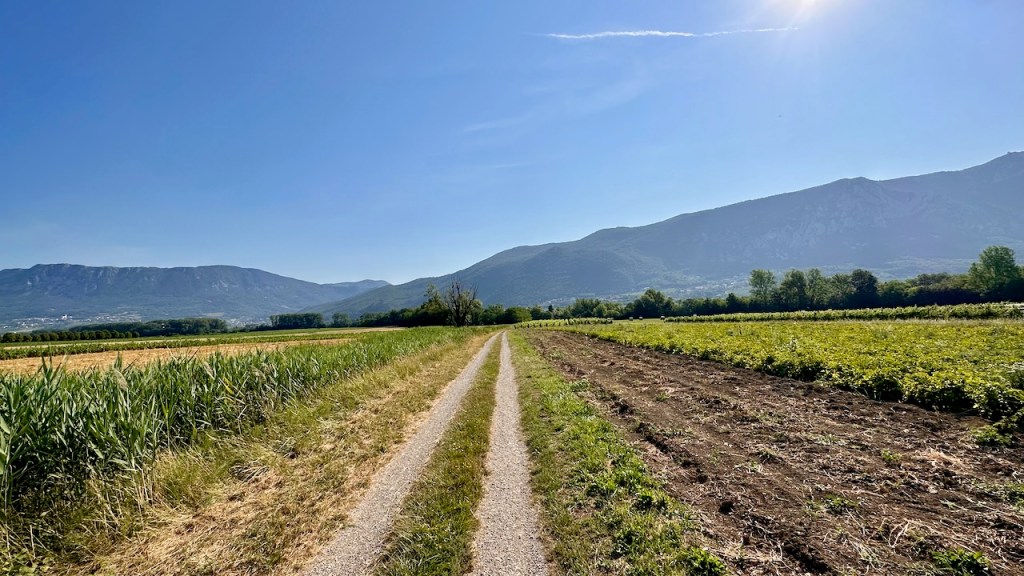
nice sample of the day’s terrain
vineyards love hills
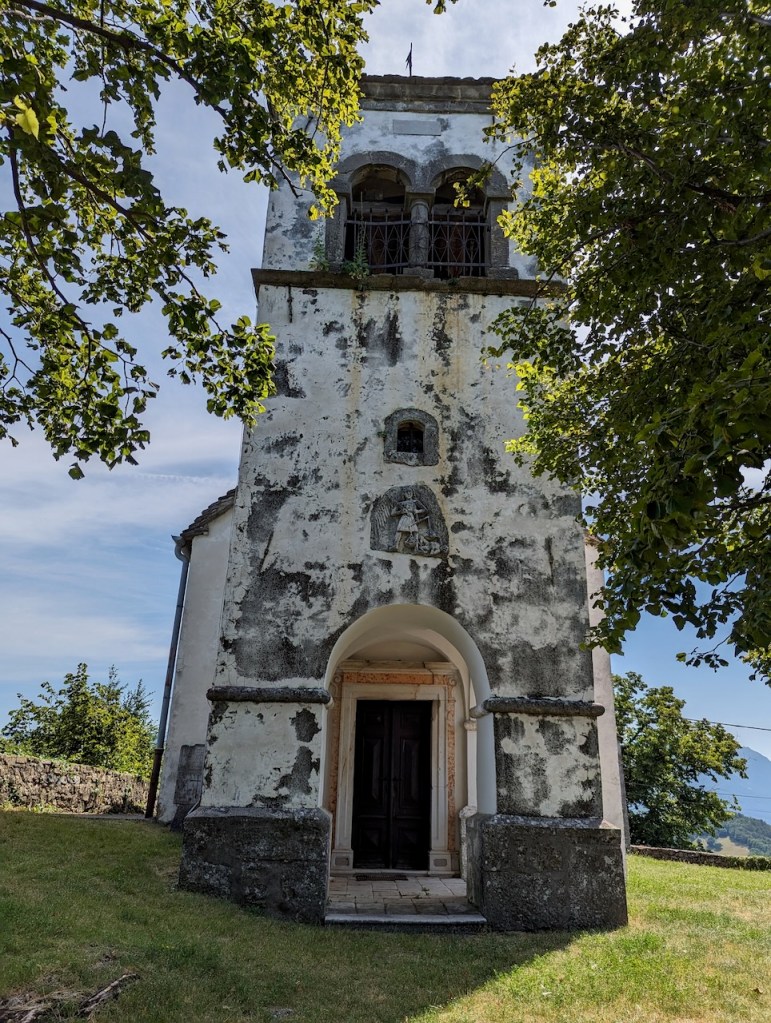
We climbed through the small village of Lože, then walked into the slightly larger and fancier village of Goče. Our directions encouraged us to wander through the village (“it’s impossible to get lost!” it promised), so we did, walking up the hill to the 17th-century cemetery (which features a lovely garden, a welcome water faucet for refilling, and a set of kid-size soccer fields across the narrow street), then back down to Saint Andrew’s church in the village. Like most of the churches we saw on this trip, it was closed and we weren’t able to go in.
St Andrew’s of Goče
After Goče, it was over (and up!) to Erzelj. Along the way, we made another detour, with accompanying climb, to the Church of St Maria of the Snow, which featured some terrific views back over the valley (and its vineyards) over towards Goče. The church is about a kilometer off the road, so the out-and-back added a little distance but it was well worth it.
We briefly stopped in Erzelj, which had some kind of government building, with a small playground next to it, and a smattering of houses. Like the vast majority of the other villages, we saw no signs of life– no people, no cars, no roaming pets, nada. We did find a faucet to refill our water bottles, so we relaxed in the shade of the playground trees, had a small snack, and then set out for the next leg to Tabor, where we got some great views from the old village church.
After that stop, we just walked a bunch more, passing through a few small sub-villages. We passed through Kodreti, which is where our stop for the night was: Hiša posebne sorta, which is Slovene for “a special sort of house.” The hostess warmly welcomed us and showed us to our room, where I promptly cranked up the AC and sat for a few minutes to cool off before a quick shower, a cold beer on their shaded terrace, and an excellent 3-course dinner of soup, pork stuffed with plums and cheese, and some kind of magical dessert.
It’s true that hunger is the best sauce, but it’s also true that every dinner we had on this trip was a highlight. Then to bed to rest up for the next day’s hike.
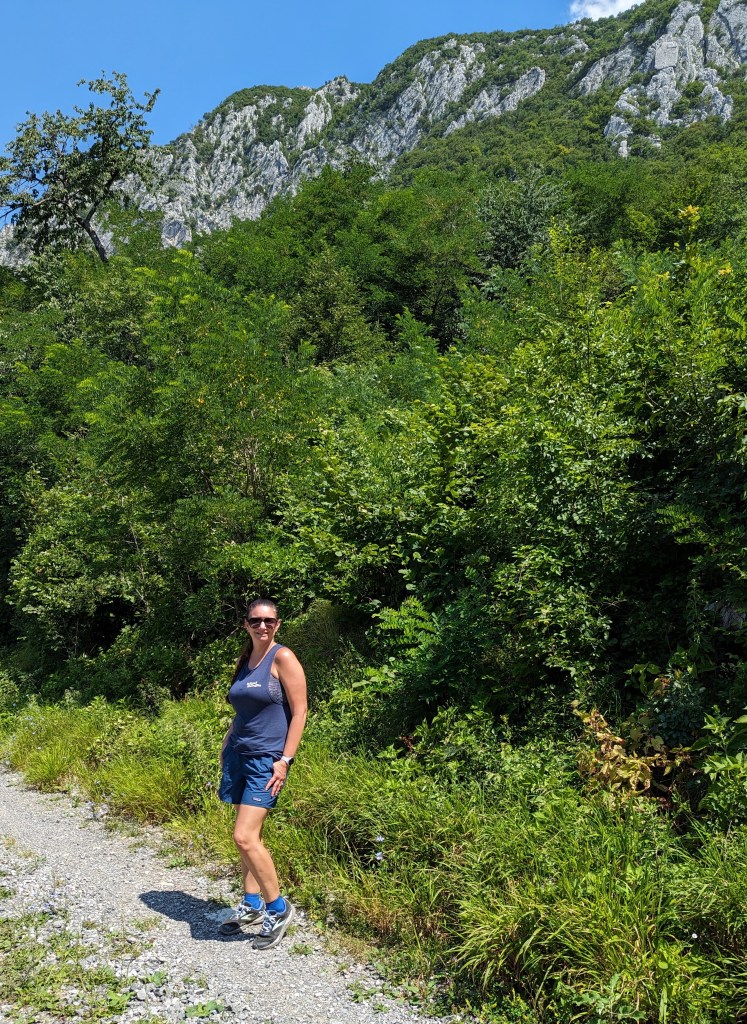
The big attraction of this day’s hike was the ability to climb up the ridge on Mount Nanos, which is actually a big limestone plateau and not a proper mountain. On one side it’s a huge mostly sheer set of cliffs, sort of like parts of Yellowstone, but those don’t photograph all that well with a cellphone camera. Here’s a small sample– note the exposed rock up at the top.
We didn’t climb all the way to the top, I regret to say
The hike started at a small church but, after a short walk to the trailhead, we were quickly headed uphill. We saw lots of people hiking down the trail, which explained the full parking lot at the trailhead. This made sense once we realized that it was still early and most of the hikers we saw had clearly gone out for a quick hike before it got too hot.
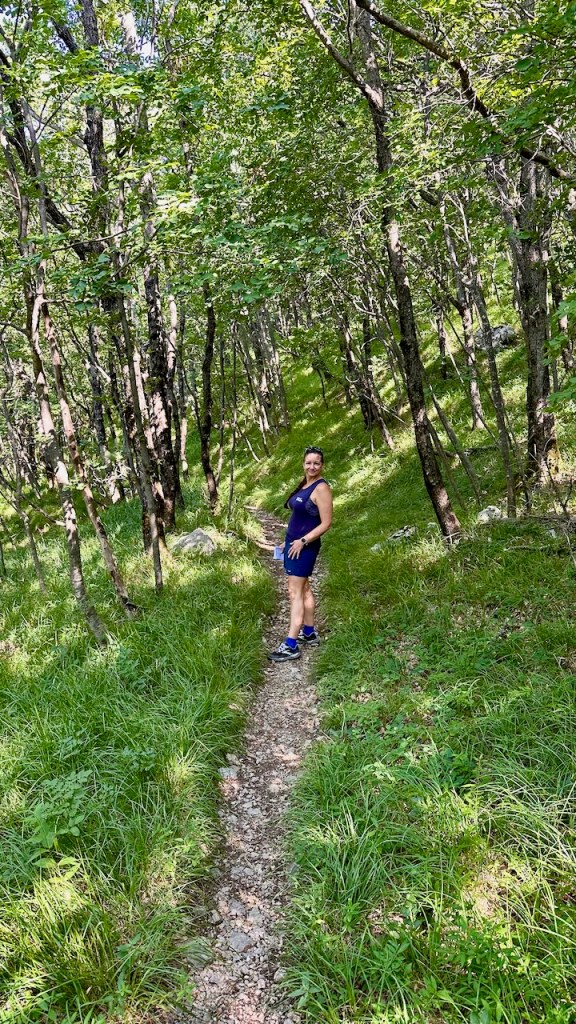
the initial trail was nicely wooded
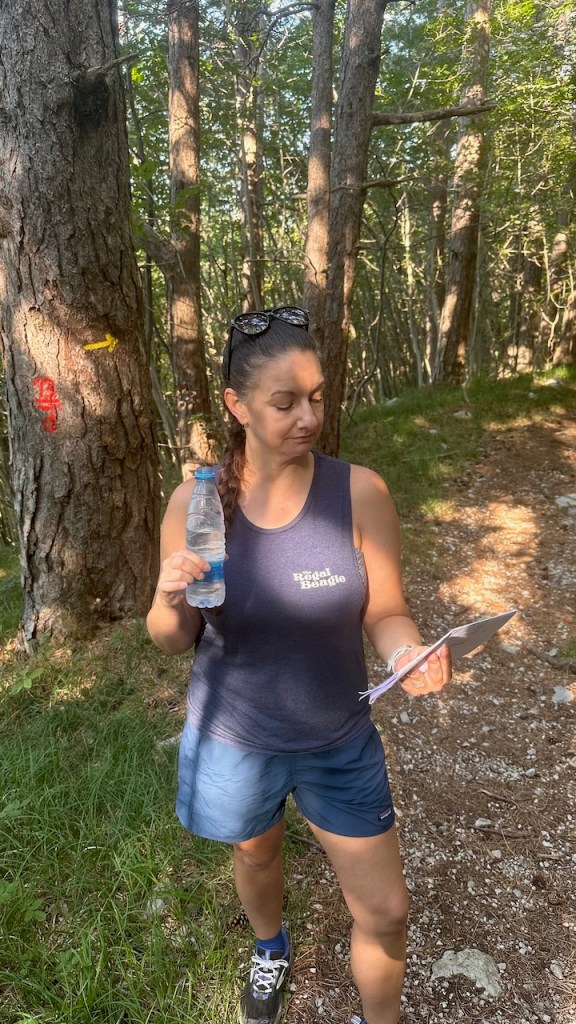
The route instructions called for us to climb up to one of the designated waypoints, then decide if we wanted the main route or the one that went up on the ridge for better views. The trail was marked both with yellow arrows and small red-and-white marks that look like the Target logo, which were super helpful, and the turn-by-turn directions were also very detailed.
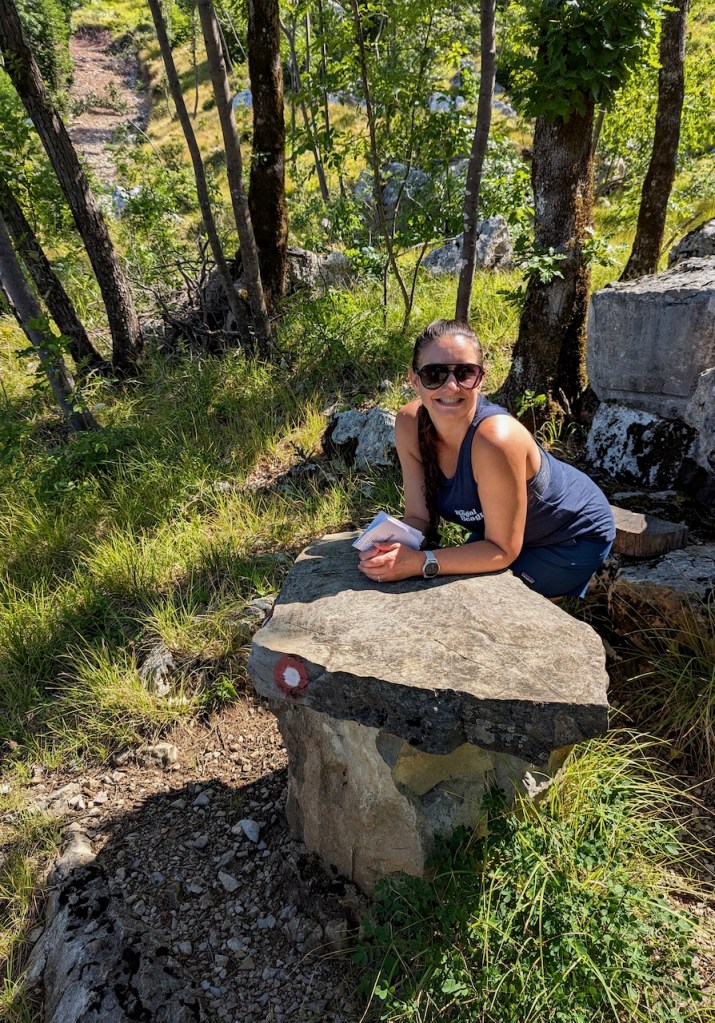
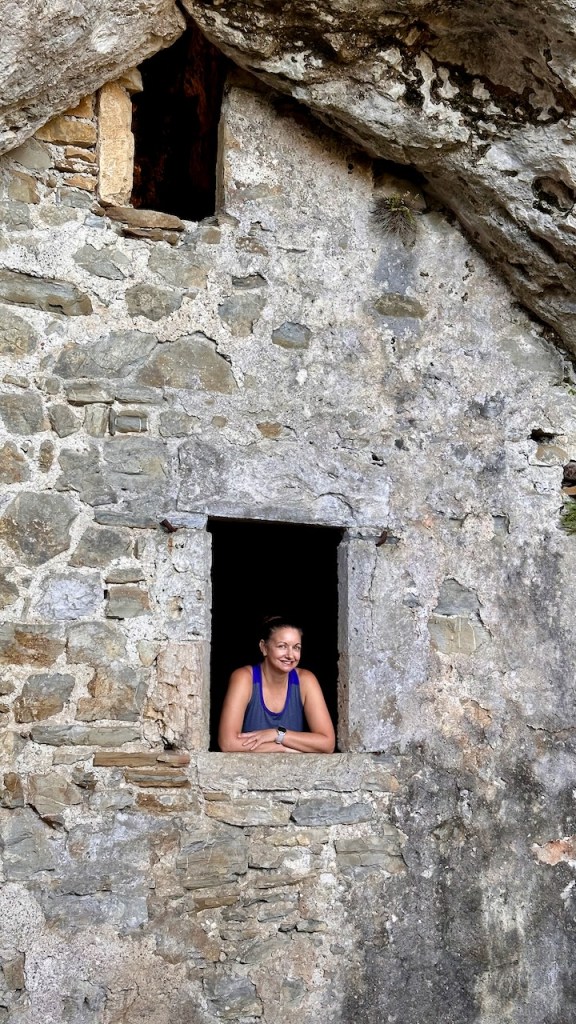
gorgeous smile, but also, did you see that little red-and-white trail marker?!
I was using the GPS map on my phone for route guidance, and Erica was cross-checking with the printed directions. This system worked pretty well for us, except in this one specific case. See, the directions basically said “for the main route, do X, Y, Z” for, oh, maybe 8 pages. At the end of that section, it then said “and if you want to climb the ridge, instead of Y, do P, D, and Q.” So we missed the turn onto the ridge route at first, and didn’t realize it until we were well along the main route.
Erica kept the printed directions handy
We didn’t notice because of two reasons. First was that we were hearing voices… really. Somewhere in the valley below is a motorsports track, and we could hear roaring engines and the track announcer. There was too much foliage alongside the trail for us to directly see the track but we could definitely hear it. The other is that the trail we were on was marked; I just didn’t notice the aforementioned split in the before/after directions until we were quite some distance in.
Luckily, the AllTrails map showed all of the trails in the area, not just the ones we were on. We found a side trail that angled off about 45º to our track and that joined the marked route for the ridge. This trail didn’t have as many of the trail markers as I would have liked, so we made a couple of wrong turns. Sadly, each of those wrong turns involved a steep climb, followed by puzzlement, swearing, and backtracking. Eventually we found the correct path, which linked up with the ridge route, and we got some of the promised amazing views.
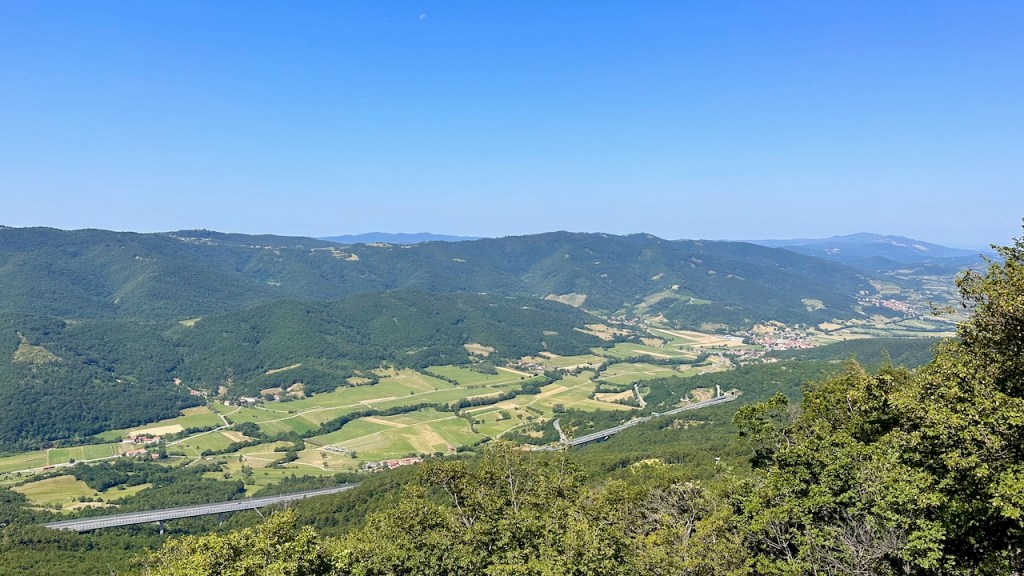
off to the right is our destination, the village of Vipava
The path eventually ran alongside a small road, with lots of switchbacks; in one of those switchbacks we found a shaded bench to sit on for lunch. There I had one of the best lunches I can remember: there was a small water trough with fresh, and extremely cold, water, an amazing view shared with my lovely wife, and a delicious lunch consisting of farm-fresh fruit and sandwiches, on homemade bread, of local cheese, uncured ham, and… wait for it… donkey salami.
Yes, you read that right.
It was very tasty. Sorry, Eeyore.
Anyway, after an amazing lunch, it was back onto the trail. We moved into a more forested area, with the highlight being a stop at the Church of St. Niklaus, which dates back at least to 1608. We couldn’t go in, but I did manage to ring the church bells. At first I tried using a tree branch, but after a little research, I found the bamboo rod, with a convenient hook on the end, that was meant for bell-ringing, so I gave it a try. (annoyingly, I can’t make WordPress uncrop the video, the dirty rats. Watch it full-screen if you actually want to see the bells.)
Ring out, wild bells. Or something.
That probably isn’t allowed, so we fled the area fairly quickly, only to find out that we were in an old artillery range that used to be used by the Yugoslavian army back in the day. We didn’t think it was in time of shooting, so we pressed on.
This part of the trail was neat because to our right we had the sheer faces of Nanos, and between that and the trail were large fields of scree and gravel. Clearly rock had fallen down off the face and been weathered into smaller and smaller pieces before it ended up underfoot. You could see spots on the face where a large rock had broken off and fallen, then the fallen rock itself… sort of like those maps of Pangaea that show the primordial continent evolving into today’s arrangement. The path was mostly trending downhill, and soon enough we came out of the forest and found a lovely oasis in the form of Kamp Tura. This is, essentially, a Slovene KOA, with spots for tents or campers, a shower house and bathrooms, sports courts, and a nice little cafe where I drank two brain-freezingly cold Coke Zeros while we chatted with Bojena, one of the owners.
Pro tip: on the entire trip we found approximately zero public restrooms. That turned out not to be a problem because it was so hot that we didn’t need any pee breaks en route, but you should plan accordingly if you do this route in less-sweaty conditions.
After Kamp Tura, it was an easy downhill leg through some vineyards and past what looked like a Soviet-era industrial complex (but which turned out to be a winery!) before we got into Vipava itself. Vipava’s a real town, with a few restaurants and bars on the town square. On Foot had booked us into a very nice little tourist apartment; after checking in, cranking up the AC, and doing a little sink laundry, we headed out to try to find a wine tasting. The only problem is, the nearest winery was a couple of miles away uphill– and there are no taxis in or around Vipava. So that was right out. Luckily, the family that operates the apartments also runs a small winery, Wipach, and there’s a small wine shop on the ground floor. We had an amazing tasting hosted by one of the winery owners, a charming schoolteacher who runs the winery with her husband. She’s the grand-daughter of one of the winery’s two founders and her husband is the grandson of the other founder… so it’s absolutely a family concern.
After the tasting, we got cleaned up for dinner. Our apartment hostess had asked if we liked pizza; when we said “yes,” that’s what we were expecting. Instead…
what kind of soup is that? wrong answers only.
…she booked us a table at Gostilna Podfarovz, where we had an amazing dinner consisting of, well, I’m not really sure. The photo above is our soup: cucumber and zucchini cold soup with kefir on top, and some kind of little puffy thing with raspberry balls on it. There was a course of trout tartare and beef tartare; there was lamb; there were various other odd combinations of ingredients that I would never have ordered but which I was happy to eat. In fact, they fed us so much that we had to decline dessert. All throughout dinner we saw people walking by with ice cream, and we kept joking about how good ice cream would be before bed… except we just didn’t have room.
Full of lamb-trout-mystery-food, we went back to the apartment to make an early-ish night of it; the next day’s segment was going to be hilly and hot without a lot of shade so we wanted an early start.
Not surprisingly at all, we both woke up before the alarm– neither of us wanted to be late to meet our driver. Our B&B had the convenient feature of allowing you to pre-order breakfast, so promptly at 0730 we went out to the terrace and had an amazing breakfast of fresh-baked bread, local meats and cheeses, local honey, and locally-farmed eggs. This set the pattern for our hiking, where I can only think of one store-bought or processed item (a pot of fruit yogurt) that we were even offered. Plus, the coffee was delicious.
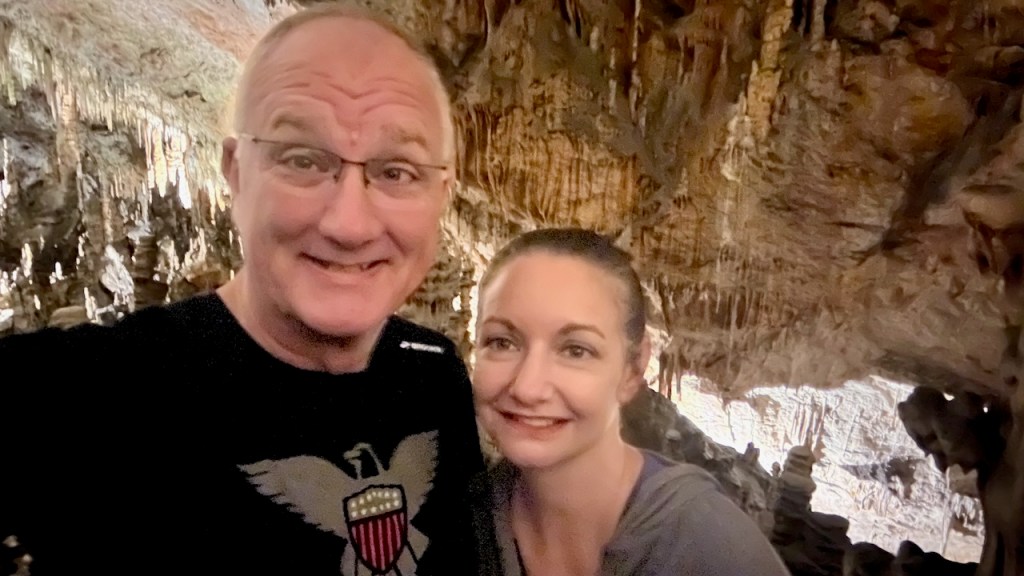
For this hiking route, On Foot had arranged a driver to take us to Landol, the first waypoint on our hike. We’d prearranged with the driver to divert and stop at the famous cave system at Postojna. To tour the caves, you ride an underground railway for 10 minutes or so, then take a walking tour through the cave system itself. I do love a good cave, and this one was fantastic– the cave system itself goes on for kilometers, as a result of the limestone terrain that’s easily infiltrated and undercut by water. As with our other cave visits, cellphone pictures don’t really do justice to the sights, so I didn’t take a lot of pictures.
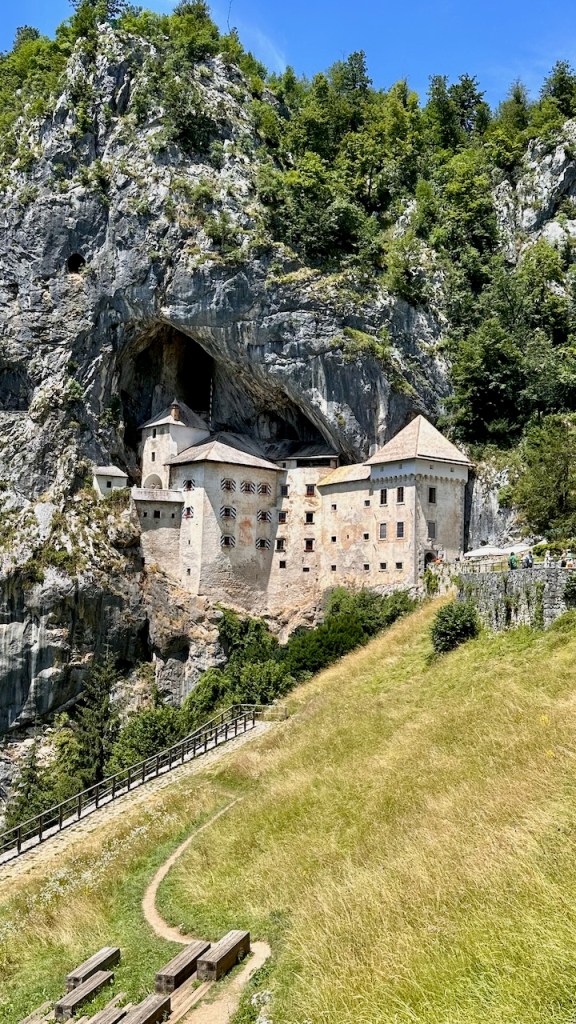
From our dropoff point in Landol, our first waypoint was the castle at Predjama, which was good because we both wanted to see it. Predjama is about 10km from Postojna and maybe 4km from Landol, so the first leg was pretty easy. Predjama literally means “in front of the cave,” and when you look at the pictures you can see why. The castle itself is built into the side of a cliff and extends into a pre-existing cave system.
Predjama is uniquely sited in the side of a cliff
The castle definitely has a tourist-y vibe; there’s an available audio tour, lots of placards, and some samples of armor, weaponry, etc. The presented history emphasizes the role of Erasmus, the robber-baron-knight of the area, which was a nifty story I didn’t previously know.
Rapunzel, Rapunzel, let down your hair… oops, wrong castle
After the castle visit, we had lunch at one of the restaurants– I had a giant schnitzel and a half-liter of Union beer, just to make sure I was getting enough salt, fat, and alcohol on board before the real hike started. Then… we started walking.
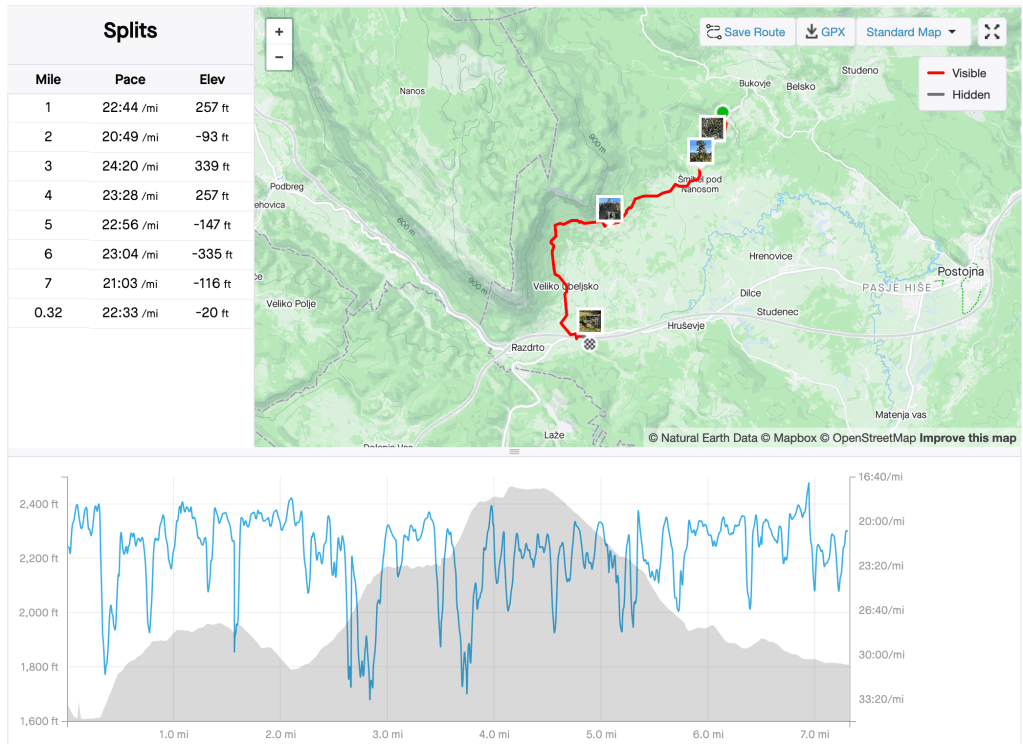
The hike itself was just under 7.5 miles, all over mixed terrain: some meadows, some wooded trails, some climbs, a few descents, a little gravel. The below route map from Strava should give you some idea; this was a relatively flat course that didn’t have a lot in the way of stunning views, but it did have some lovely scenery.
a quiet forested trail is good for the soul
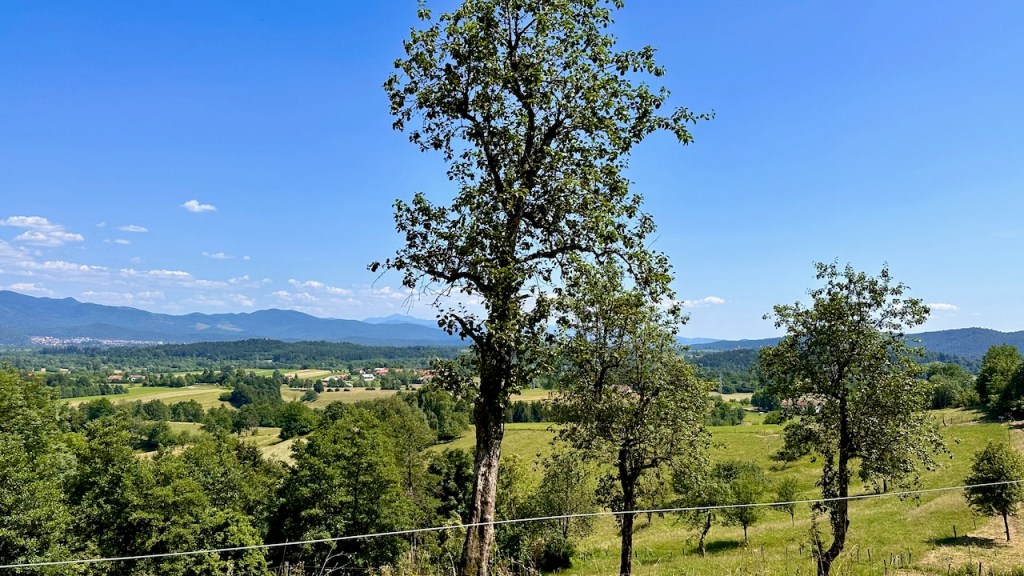
It was a lovely day to be out in the countryside
One thing the On Foot guide had prepared us to expect was the presence of monuments in each village. When you think “village” you may be assuming something larger than the typical Slovenian village– the entire country has only about 2 million people, half of whom live in Ljubljana and other cities. A village there might be no more than half-a-dozen houses clustered near each other, but I think every one we went to had at least one shrine, plus a monument to partisans killed resisting the Nazis in World War II.
Another welcome feature of the villages: they usually had someplace to refill our water bottles. Erica had gotten us a pair of collapsible LifeStraw bottles for our Belize trip, and they were perfect for this trip. We didn’t need the filtering, since Slovenian tap water is as safe to drink as in America, but being able to collapse them was handy. Our day pack weighed maybe 15 lb and contained the two LifeStraw bottles, an extra 1.5L of bottled water, our lunches, snacks, a small first aid kit, rain jackets, maps, and a few other odds and ends.
On the drive to Postojna, our guide said that Slovenia is famous for having more tractors than cars. I can’t assess whether that’s true but we did see rather a lot of tractors, including this beauty. We saw plenty of them, both parked in barns but also working in the fields.
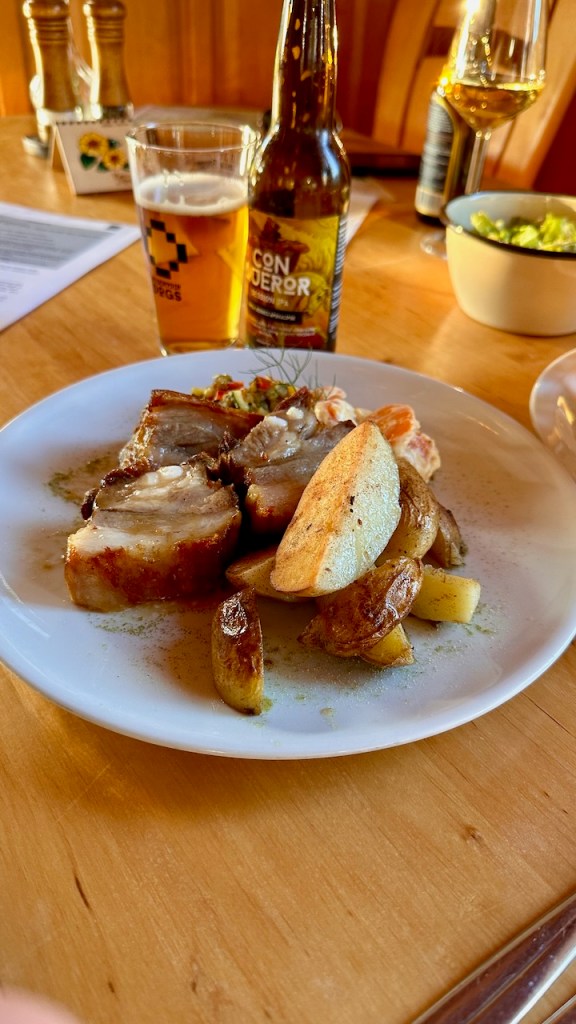
After a pleasant, but hot, hike, we made it to Hudičevic, which means “the hidden devil.” There’s a local legend about a mean old washerwoman who was taken ill. As she lay on her deathbed, the local priest dressed up as the devil to try to frighten her into accepting last rites. Thinking he was the actual devil, she shot him. (coolStoryBro.jpg) Hudičevic is a tourist farm operated by the son and daughter-in-law of the original founders, the Simčič family, who opened in 1970 as an inn to feed the workers who were building the nearby motorway. The couple’s 10 kids all live and work at the farm, which was pretty neat. Our room was small and nicely furnished; although it didn’t have air conditioning, as the evening cooled it was quite nice. Dinner, and the next day’s breakfast and lunch, were all locally produced. Although the menu offered both donkey salami and horse salami, we decided to stick with more traditional fare. I had pork loin stuffed with cheese and plums, along with a thick vegetable soup and a delicious berry dessert with fresh homemade ice cream. Erica had lamb.
We both slept very well and enjoyed a fantastic breakfast buffet; whichever kid was working in the kitchen also packed us each a sack lunch, then Klara drove us into the village for the day’s route.
that wasn’t the mountain we climbed but it’s a decent stand-in
There’s no great way to get from Venice to Ljubljana by air or train, so I decided to book us on Flixbus. The bus left from the Venice central station, which wasn’t far from our hotel. We took a taxi after the first two city buses we wanted didn’t show up. When we got to the station, it was like being in an anthill– tons of people, all milling around in unpredictable patterns. I was getting a little panicky because the bus wasn’t anywhere to be found at the specified location, but we eventually found a queue of other people who were waiting for the same bus, and it showed up about 15 minutes later.
Pro tip: Italian train/bus stations have pay toilets. Take a couple of €1 coins, just in case.
For about €40, we had a clean, safe, quiet, and comfortable 3-hour bus ride. Both of us were surprised at how quiet the atmosphere on the bus was– much quieter than a typical commercial airline flight. Flixbus bought Greyhound in the US, which I didn’t know, so maybe “riding the dog” will come back. It’s hard to beat the price. When we arrived in Ljubljana, we quickly found our way to Pension Slamič, our lodging for the night. It was much nicer than I had expected– a modern, clean, quiet hotel only a few blocks’ walk from Old Town. After checkin, we headed out to see some sights and immediately fell in love with how walkable that area of Ljubljana is. Big, wide sidewalks, with bike paths and plenty of trees, make it easy to get around comfortably. We found a post office and bought some postcard stamps, then found a Spar and bought a few extra bottles of water for the hike. Because we’d missed lunch thanks to being on the bus, our first important stop was dinner at Patrón for tacos. This might seem like a weird choice but having tacos in foreign lands is kind of our thing, and I’m really glad we did it here. The fish taco I had was one of the best I’ve ever enjoyed anywhere, and the carnitas taco was as good as anything I’ve cooked myself. We enjoyed sitting out on the street and people watching for a while, then set out to go hit our major objectives.
wish I’d noticed how blurry this was before I ate the tacos
Ljubljana has (at least) two well-known bridges: the Dragon Bridge and the Triple Bridge. You can probably guess how they got their names…
here there be dragons
The old city itself isn’t that large, so we made a circuit across the bridges and then climbed the hill to the castle, which is a really interesting tourist-ized version of its former self. There are several exhibits and museums in it, including a really interesting section dedicated to Slovenian history, a topic as complex as you’d expect from a central European country that’s been passed around from empire to empire over the centuries. There’s a nice mix of original and restored structures and artifacts, and you can climb the clock tower to look out over the city.
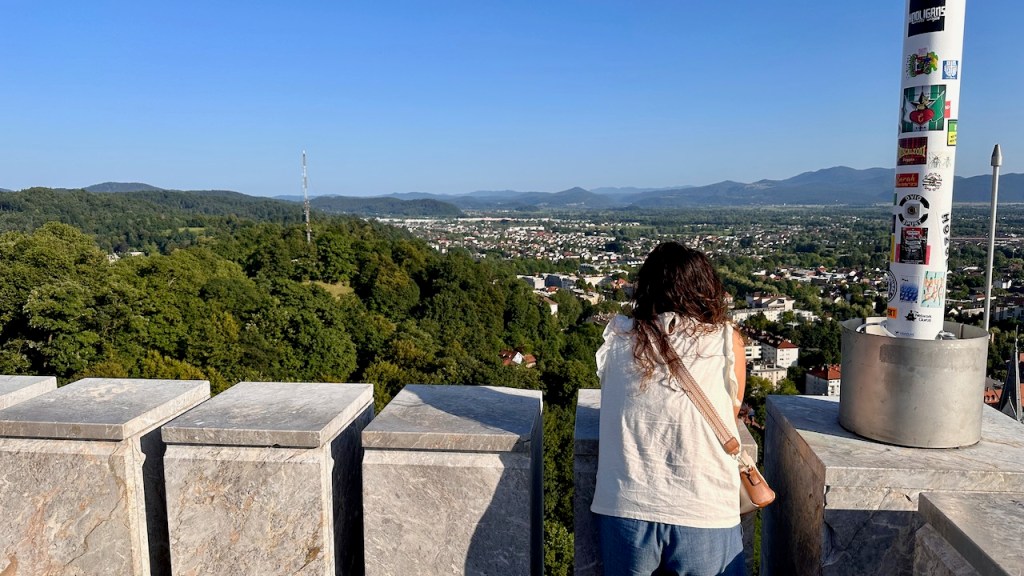
the castle overlooks Ljubljana and the surrounding area
After our castle visit, we only had one more planned stop: the rooftop bar at the Nebotčnik. This was lively, even at 6pm, and we had to wait a few minutes for a table, but the views were worth it. I had some kind of cocktail which appeared to be a glass of Windex, and we split two delicious pieces of cake.
After our rooftop visit, we headed back to Slamič to make sure our day pack was ready for the following day’s hike, then hit the bed early.
Erica and I do love a good adventure. After doing the Bermuda Challenge and Ragnar New England, we decided maybe it would be fun to have an active vacation that wasn’t focused on running. “How about a multi-day hike?” she asked me one day. “Suuuuure,” I said, envisioning a week-plus of sleeping in a tent (something I got my fill of in the Marine Corps). She did some research and came back with a terrific suggestion: On Foot Holidays, a UK company that arranges cross-country hikes with lodging at each point. In particular, she suggested we look at their route in Slovenia, which covered six nights starting in Ljubljana and ending in Trieste. This was especially attractive since neither of us had been to either Italy or Slovenia before. Each day was a separate point-to-point hike, with lodging arranged, and On Foot would handle moving our luggage for us.
We signed up and started digging into the logistics of traveling from Huntsville to Ljubljana. Let’s just say that the process wasn’t entirely straightforward. Erica had built up a great stash of Chase Ultimate Rewards points and wanted to use them, so she started hunting for flights. We ended up with great points deals to go from Miami to Venice on Air France, and from Venice direct to Newark on United. I booked Delta mileage tickets from Huntsville to Miami and from JFK back home, and then the real fun started. First Air France cancelled the Miami-Paris leg and moved it a couple of days, so I got to call AF and get that all straightened out. That change necessitated changing our Delta flights too, but when the dust settled, we had a fairly simple Huntsville-Atlanta-Paris-Venice routing.
On Foot provided us a thick packet of maps and guidance well in advance of the trip. Each day of the hike had its own topographic map and printed set of very detailed turn-by-turn directions, along with a summary itinerary telling us where we’d be staying and what to see/do in each location and a detailed packing list. They also gave us a single GPX file that had all of the GPS routes in it (more on that in a future post!) The On Foot team communicated frequently and clearly throughout the pre-game process, including assigning us a local contact that we could use if we got lost, stuck, or puzzled. That left us free to concentrate on planning the Venice and Trieste stays, since we could trust that On Foot had arranged lodging and food. As usual, Erica did an amazing job of identifying things we might want to do and organizing and arranging them. We had nearly two days in Venice on arrival, followed by a day in Trieste and two more days in Venice after the hike, and that led to a jam-packed schedule of things to do, see, and eat.
Our travel started out as completely unexceptional. The friendly Delta ticket agent figured out that he could check our bags straight to Venice even though we had separate Delta and Air France tickets; once that was done, we flew to Atlanta, had a snack at the Sky Club, changed planes, and settled in for the long-haul flight to Paris. The flight featured a toddler in the row in front of us who cried, whined, and, at one point, spit a mouthful of cracker over the two of us. It was just exactly as much fun as you’d expect, but we got to Paris undaunted, changed planes again, and then arrived in Venice.
Delta had a large, and rather patriotic, display in the Atlanta Sky Club
Of course, when we got to Venice, only one of us got a suitcase. We’d checked two bags. Mine went from Huntsville to Atlanta to Venice, all on Delta flights. Erica’s went from Huntsville to Atlanta to Paris to Venice, also all on Delta flights. Notice that we didn’t take those flights. Why did our bags take different flights from us? Why were they different from each other? Heaven knows. We filled out the you-lost-my-bag form, stood in an interminable line, and learned that Erica’s bag would arrive that evening but after the cutoff for bag delivery, meaning that if she wanted it that night, we’d have to go back to the airport to get it. Resigned to that fate, we grabbed a cab to our hotel to get ready for visiting Venice proper…















 Paul's Down-Home Page