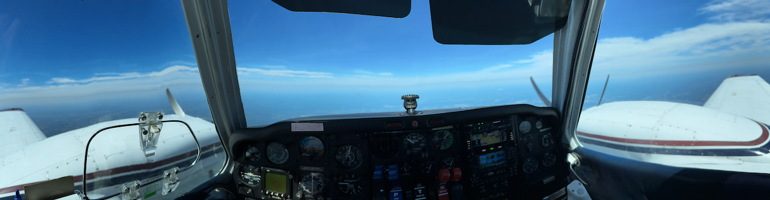
My friend Bob Thompson had an interesting post last week that set me to thinking. He complained about the relative difficulty and clunkiness of CD burning under Linux, compared to Windows. Predictably, he got feedback from a Linux person, taking issue with his comments. Bob went on to say:
Mr. Dobbins is very smart, very skilled, and very experienced with Linux. He is, in fact, an expert. He’s also a good guy, always willing to help, and a true proponent of Linux. But, drawing an analogy, Roland has a rotary-wing pilot’s license, and I have only a normal driver’s license. I’m driving around in an old junker, and am interested in upgrading to a better car. Roland, meanwhile, is singing the praises of helicopters.
I don’t doubt that the view from a helicopter is better, or that it can get me where I want to go faster and easier. But I don’t want to invest the time and effort necessary to get a rotary-wing pilot’s license. I just want to continue using my regular old driver’s license, but in a better car. I want to be able to sit down in the new car, and have all the controls and instruments in more or less the same locations that I’m used to. I want to be able to turn the key, put the new car in gear, and drive off. I don’t want to have to build the engine from parts, or to assemble the new car before I use it.
This is a great analogy (of course, Bob’s a professional writer— I expect no less.) However, he didn’t take it to its logical conclusion: cars are general-purpose vehicles that can use a widely deployed infrastructure of gas stations, roads, repair shops, and auto parts stores. Helicopters require more infrastructure; the infrastructure is simultaneously much more complex and much less widely distributed. While it’s certainly true that helicopters can do things that cars cannot, it’s also true that the cost of doing these things (in both equipment and time) is high. The science-fiction writers of the 1940s and 1950s confidently predicted that we’d all have personal helicopters to get around in, but most of us don’t. Why not? Entry barriers: cost, time, and infrastructure.
On the desktop, the parallel is pretty clear. The Linux-copter suffers from the same three barriers. “Cost” might seem like an odd barrier, since Linux doesn’t cost anything. However, there is a cost associated with using it, one that Mac users will immediately recognize: the cost of not being able to do stuff. Want to run your small business’ accounting on Linux? Too bad. Want to manage your dental office? Sorry. Games for the kids? Forget it.
The “time” barrier is more subtle, but just as real. The question I like to ask about OSes that seek to supplant Windows on the desktop is “can my mom use it?” She’s a smart lady, but she doesn’t have any interest in being a helicopter pilot; she just wants to use her computer for email, digital photos, and the like. She can do that easily with Windows or Mac OS X without investing a great deal of time to learn how. a) she doesn’t have time to learn how to make Linux do what she wants and b) if she did, she would spend it doing something she actually enjoys. In fact, I don’t have time to maintain a desktop Linux machine for her, and I’m a (student) helicopter pilot!
The Linux-copter can do things that an ordinary Windows-mobile can’t: it can operate without payment to Microsoft, it can be made to run on all sorts of bizarre hardware, it can be limitlessly reconfigured. However, getting it to do so is an adventure, sort of like building your own kit helicopter), and that doesn’t seem likely to change dramatically in the next two to three years.


 Paul's Down-Home Page